Volume 2006, Article ID 64159, Pages1–9 DOI 10.1155/WCN/2006/64159
Relay Techniques for MIMO Wireless Networks with
Multiple Source and Destination Pairs
Tetsushi Abe,1Hui Shi,2Takahiro Asai,2and Hitoshi Yoshino2
1DoCoMo Communications Laboratories Europe GmbH, 312 Landsbergerstreet, Munich 80687, Germany 2NTT DoCoMo, Inc., Japan
Received 1 November 2005; Revised 17 May 2006; Accepted 16 August 2006
A multiple-input multiple-output (MIMO) relay network comprises source, relay, and destination nodes, each of which is equipped with multiple antennas. In a previous work, we proposed a MIMO relay scheme for a relay network with a single source and destination pair in which each of the multiple relay nodes performs QR decompositions of the backward and forward channel matrices in conjunction with phase control (QR-P-QR). In this paper, we extend this scheme to a MIMO relay network employing multiple source and destination pairs. Towards this goal, we use agroup nullingapproach to decompose a multiple S-D MIMO relay channel into parallel independent S-D MIMO relay channels, and then apply the QR-P-QR scheme to each of the decom-posed MIMO relay links. We analytically show the logarithmic capacity scaling of the prodecom-posed relay scheme. Numerical examples confirm that the proposed relay scheme offers higher capacity than existing relay schemes.
Copyright © 2006 Tetsushi Abe et al. This is an open access article distributed under the Creative Commons Attribution License, which permits unrestricted use, distribution, and reproduction in any medium, provided the original work is properly cited.
1. INTRODUCTION
A wireless network comprises a number of nodes connected by wireless channels. Using internode transmission (relay-ing) is an important technique to widen network coverage. Network information theory has shown that the use of multi-ple relay nodes in source and destination (S-D) communica-tions increases the capacity of the S-D system logarithmically with the number of relay nodes [1].
The use of multiple antennas at each node provides ad-ditional degrees of freedom to improve further the capac-ity per S-D pair in the relay network. A significant capaccapac-ity improvement achieved with multiple-input multiple-output (MIMO) transmission was revealed in [2–5] for a point-to-point wireless link, and in [6–9] for multiple-access and broadcast channels. The capacity bounds of the MIMO re-lay network have recently been derived in [10,11] where the capacity of the MIMO relay network was analyzed in terms of distributed array gain, which offers logarithmic capacity scaling,spatial multiplexing gain, and receive array gain. In [12], we proposed a MIMO relay scheme for a relay network comprising a single S-D pair and multiple relay nodes. The relay technique in [12], called QR-P-QR, performs the QR decomposition (QRD) in the backward and forward chan-nels in conjunction with employing phase control at each relay node, and successive interference cancellation (SIC) at
the destination node to detect multiple data streams. This architecture achieves bothdistributed array gainandreceive array gain while maintaining the maximum spatial multi-plexing gain, which leads to higher capacity than the exist-ing zero-forcexist-ing (ZF) and amplify and forward (AF) relayexist-ing techniques [11].
Source
1st time slot 2nd time slot
Figure1: MIMO relay network with multiple source and destination pairs.
technique achieves higher capacity than other existing relay schemes.
The rest of this paper is organized as follows.Section 2 shows a system model and the upper bound for the capacity of the MIMO relay network. We describe the proposed and existing relay schemes inSection 3. Numerical examples are given inSection 4. Finally,Section 5concludes this paper.
Notation
E{•}and tr{•}denote the expectation and trace operation, respectively.astands for the norm of vectora, and super-scriptsT,H, and ∗represent the transpose, the conjugate transpose, and the conjugate operation, respectively. (A)iand
(A)i,jdenote the ith row and (i,j)th entry of matrixA,
re-spectively.Iiis thei×iidentity matrix.
2. MIMO RELAY NETWORK
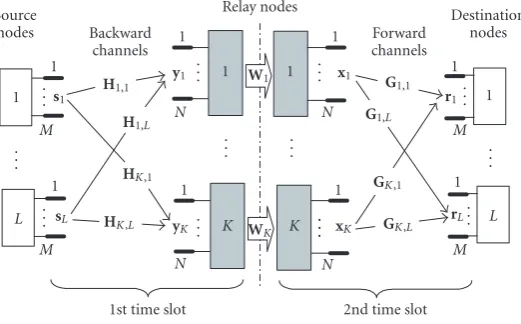
The MIMO relay network used in this paper is illustrated in Figure 1. This paper assumes a one-hop relay network com-prisingLsource and destination nodes, each of which hasM antennas, andKrelay nodes, each of which hasNantennas. In addition, we assume that the relay nodes do not transmit and receive simultaneously. In other words, two time slots are required to send a message from the source to the destination as shown inFigure 1.
First,M×1 vectorsl(l = 1,. . .,L), destined for thelth
destination node, is sent to all relay nodes from thelth source node without using any channel state information (CSI). The N×1 vector received at thekth relay node is expressed as
yk=
L
l=1Hk,lsl+nk, whereHk,l(k=1,. . .,K) is theN×M
MIMO channel matrix between thelth source node and the kth relay node (backward channel), andnkrefers to theN×1
noise vector at thekth relay node with zero mean and covari-ance matrix E{nknHk} = σr2IN. We constrain the
transmit-ted signal power at the source node to E{slsHl } =(P/M)IM,
wherePis the total transmit power. A relay operation is per-formed at thekth relay node by usingN×N relay matrix
Wkto obtainN×1 transmitted signal vectorxk =EkWkyk,
where Ek is a power coefficient resulting from total power
constraint E{xkHxk} =P. This can be expressed as
receive vector given by
rl= K
k=1
Gk,lxk+zl (2)
is obtained at thelth destination node, whereGk,landzlare
theM×Nchannel matrix between thekth relay node and the lth destination node (forward channel), and theM×1 noise vector added at thelth destination node with zero mean and covariance matrix E{zlzHl } =σd2IM, respectively.
Using the cut-set theorem [13], the upper bound for the capacity of the MIMO relay network is derived in [10] as
Cupper=E{Hk}
3. MIMO RELAY TECHNIQUES
In this paper, we assume that each relay node knows the CSI of its own backward and forward channels. However, we do not allow source nodes, relay nodes, and destination nodes to exchange their CSI with other nodes.
3.1. ZF relaying scheme [11]
The ZF relaying scheme computes backward and forward ZF matricesH+k andG+k that satisfyH+kHk = ILM andGkG+k =
ILMwithLM×NmatrixGk =[GTk,1,. . .,GTk,L]T. Relay
Note here that the ZF scheme requires that N ≥ LM. In this case, the effective signal-to-noise ratio (SNR) for themth data stream,λZF
l,m(m=1,. . .,M), at thelth destination node
From (4), we find that due to the transmit and receive ZF op-erations the signals fromKrelay nodes are coherently com-bined at the destination node, which leads todistributed ar-ray gain[11].
3.2. GN/QR-P-QR relaying scheme
The first step of the GN/QR-P-QR scheme is to compute a pre-group nullingfilter at a relay node to suppress the signal component from all source nodes except from thelth source node. To accomplish this, we defineN×M(L−1) matrix
H(l)k ≡[Hk,1,. . .,Hk,l−1,Hk,l+1,. . .,Hk,L]. Note that the
chan-nel matrix between thelth source andkth relay node,Hk,l,
is removed. Next, we perform the singular value decomposi-tion (SVD) ofH(l)k as
From (6), we see that U(l)k,Lremoves the signal contribution from all source nodes except that from thelth source node due to the projection of the received signal vector onto the null space of nondesired source nodes. A null space-based method was also employed in [14] for the precoding in a MIMO down link transmission.
The second step of the GN/QR-P-QR scheme is the trans-formation ofyk,lusingN−M(L−1)×N−M(L−1) matrix Φk,lto obtain vectoryk,l=Φk,lU(l)Hk,L yk. The computation of Φk,lwill be described later in this section.
The third step is to compute the post-group nulling fil-ter to suppress the transmitted signal to all destination nodes except that to thelth destination node. Toward this goal, we
defineN×M(L−1) matrixG(l)k ≡ [GHk,1,. . .,GHk,l−1,GHk,l+1, group nullingscheme also requires thatN ≥LMin order to obtain null space matricesU(l)k,LandA(l)k,L.
The above three-step procedure is performed for allL source and destination pairs (l = 1,. . .,L) at thekth relay node. Finally, theN×1 signal vector transmitted from the kth relay node isxk=Ek
L
l=1yk,l=Ek
L
l=1A(l)k,LΦk,lU(l)Hk,L yk.
In this case, the relaying matrix is written as Wk =
L
l=1A(l)k,LΦk,lU(l)Hk,L , and the received signal vector at the lth
destination is written from (2) as
rl=
Equation (8) shows that at thelth destination node, the sig-nal contribution from all source nodes is removed except that from thelth source node. Namely, we can establish an inde-pendent MIMO relay link between thelth source and desti-nation nodes that is characterized byM×MMIMO channel matrixEkGk,lA(l)k,LΦk,lU(l)Hk,L Hk,l.
To compute the intermediate filter Φk,l, we use the
QR-P-QR scheme [12]. The QR-P-QR relaying scheme first performs the QRD of N −M(L − 1)× M matri-cesU(l)Hk,L Hk,l and (Gk,lA(l)k,L)H as U(l)Hk,L Hk,l = Q1k,lR1k,l and
(Gk,lA(l)k,L)H = Q2k,lR2k,l, whereN−M(L−1)×M
matri-cesQ1k,l andQ2k,lhave orthonormal columns, andM×M
matrices R1k,l and R2k,l are upper triangular matrices. By using these results, the intermediate filter is computed as
Φk,l = Q2k,lDk,l
QH1k,l, where the M ×M matrix, Dk,l,
is a diagonal matrix whose mth diagonal entry isdk,l,m =
(RH
2k,lΠR1k,l)m,M−m+1/(R2k,lH ΠR1k,l)m,M−m+1andΠis anM×
M exchange matrix (see [12] for details). We can see that
Φk,lconsists of two orthogonal matrices,Q1k,landQ2k,l,
ob-tained by the QRD in the backward and forward channels with phase control matrix Dk,lin between (for this reason
computedΦk,l, (8) is rewritten as
triangular form with positive scalars in diagonal entries. The triangular structure provides thereceive array gainby using the SIC at the destination node to detect each data stream. The positive diagonal entries achieved by the phase control matrix enable the diagonal elements transmitted fromK re-lay nodes to be coherently combined at the destination node, which obtains thedistributed array gain.
Thelth destination node simply performs SIC by using the CSI of compound triangular channelKk=1EkRH2k,lDk,lR1k,l
to detect each of the multiple streams. The effective signal-to-interference-plus-noise ratio (SINR) for themth data stream at thelth destination node can be expressed as
λQRl,m=
Consequently, the ergodic capacity of the relay network with totalLS-D pairs is
CQR=E{Hk,Gk}
3.3. Achievable gains in the relay schemes
To evaluate the achievable gains of the GN/QR-P-QR relay technique, we investigate its asymptotic capacity whenK ap-proaches infinity. From (10) and (11), whenK approaches infinity, the capacity becomes
CQR=1 From (12), we see that the capacity of the GN/QR-P-QR
scheme scales with (LM/2) log2(K) asymptotically inK. The term log 2(K) indicates that the distributed array gain of
the GN/QR-P-QR scheme isK. In addition, the prelog term LM/2 implies that themultiplexing gainisLM/2, where 1/2 represents the loss when using two time slots in each trans-mission. Furthermore, it was shown in [11] that the up-per bound of the capacity in (3) and the capacity of the ZF scheme asymptotically scale with (LM/2) log2(K). Thus, we see that the GN/QR-P-QR scheme as well as the ZF scheme exhibit the optimum capacity scaling for a largeKvalue.
The difference between the GN/QR-P-QR scheme and the ZF scheme is the available degrees of freedom remaining after interference suppression among multiple S-D pairs. The ZF scheme performs complete stream-wise nulling in both the backward and forward channels. At each channel the ZF scheme separatesLM streams, which requiresLM−1 de-grees of freedom. Thus, the dede-grees of freedom that remain after the ZF relaying areN−(LM−1). On the other hand, since the proposed scheme performs group-wise nulling, it preserves a higher degree of freedom than the ZF scheme. To be more specific, we define theN−M(L−1)×M decom-posed forward MIMO channel for thelth S-D pair from (6) asH'k,l≡U(l)Hk,L Hk,l. Assuming (Hk,l)i,jare i.i.d. complex
ran-dom variables with zero mean and unit variance, (H'k,l)i,jhas
the following statistical property:
EH'k,l
are mutually orthogonal. Equation (13) is then proven.
We can see from (6) and (13) that thegroup nulling trans-formsN×Mi.i.d. matrixHk,lto anN−M(L−1)×Mi.i.d.
matrixH'k,l. This shows that due to thegroup nulling,M(L−
1) degrees of freedom are lost for thelth S-D pair, butH'k,l
still holdsN−M(L−1) degrees of freedom. Furthermore, it is straightforward that the same discussion holds for the back-ward decomposed channel Gk,lA(l)k,L. Thus, after the group nullingoperations, the proposed scheme holdsN−M(L−1) degrees of freedom, which are higher than that of ZF by M−1. This additional degree of freedom is converted as the receive array gainthrough the channel triangulation in (9) using the QR-P-QR technique and the following SIC at the destination node.
3.4. Other simple schemes
For GN-based relaying, we could simply employ an AF relay scheme instead of the QR-P-QR scheme, which gives the in-termediate filterΦk,l =IN−M(L−1). In this case, however, we
node. In addition, [10,15] describe another simple matched filter (MF) relaying scheme in which each relay node per-forms receive and transmit MF operations. For the MF relay-ing, the relay matrix is expressed asWk=GHkHHk. Unlike the
ZF and the proposed schemes, this scheme does not require thatN ≥ LM, and the capacity still scales logarithmically with the number of relay nodes [10].
4. NUMERICAL RESULTS
The ergodic capacities of the relaying schemes presented in the previous section were evaluated. We obtained the capac-ity plots of the upper bound, ZF, GN/QR-P-QR, GN/AF, and MF. In addition, we evaluated as a reference the capacity of QR-P-QR when all relay and destination nodes fully coop-erate. To be more specific, we calculated the capacity of the QR-P-QR scheme in a network comprising a source node with LM transmit antennas, a relay node with KN anten-nas, and a destination node withLMantennas. In this case, the power constraints at the source and relay areLPandKP, respectively. We assumed a flat fading channel in which each component ofHk andGk is an i.i.d. complex random
vari-able with zero mean and unit variance. We setσ2
r =σd2and
identical transmit powerPfor all source and relay nodes. We did not take into account path loss.
4.1. Capacity versus the number of relay nodes
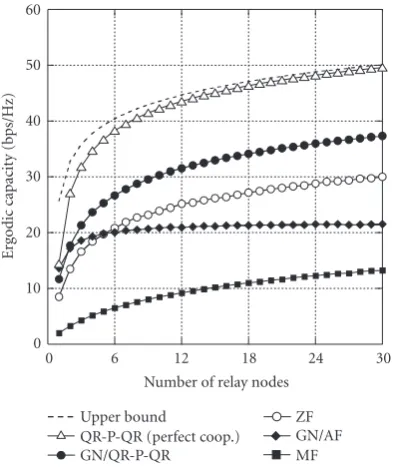
Figure 2shows the capacity versus the number of relay nodes KforL=2,M=4, andN=8. The total transmit power-to-noise ratio (PNR = P/σ2
r) was set to 20 dB. The graph
shows that the capacity of the GN/AF scheme is saturated whenK becomes large. This is because although the sepa-ration of multiple S-D pairs is accomplished by the group nulling, the signals relayed from multiple relay nodes are ran-domly combined at each destination node due to the simple AF relay operation, and thus thedistributed array gainis not obtained. On the other hand, we can see that the GN/QR-P-QR scheme, ZF scheme, and MF scheme exhibit logarithmic capacity scaling as does the upper bound of the capacity. This is due to the fact that signal components from multiple re-lay nodes are coherently combined at the destination node. Furthermore, the GN/QR-P-QR scheme offers higher capac-ity than the ZF scheme due to the higher degree of freedom converted to thereceive array gainat the destination node as described inSection 3.3. The capacity of the MF scheme is lower than that of the others due to its inability to suppress actively the interference among S-D pairs. The capacity gap between GN/QR-P-QR and the upper bound is due to the imperfect cooperation among nodes. As mentioned in [10], the capacity upper bound in (3) can be achieved if all the relay nodes perform joint decoding and encoding. To exam-ine this, we obtaexam-ined the capacity of QR-P-QR when all the relay nodes and all destination nodes cooperate. Note that in this case, there is no need for GN. We can see that the capacity of the QR-P-QR scheme with perfect node coop-eration approaches the upper bound. Furthermore, whenK becomes larger the gap between the two becomes narrower.
60
50
40
30
20
10
0
Ergodic
capacit
y
(bps/Hz)
0 6 12 18 24 30
Number of relay nodes Upper bound
QR-P-QR (perfect coop.) GN/QR-P-QR
ZF GN/AF MF
Figure2: Capacity versus the number of relay nodes (L=2,M=4,
N=8).
This can be briefly explained as follows. The capacity up-per bound in (3) only depends on the backward channel. On the other hand, the capacity expressions of QR-P-QR in (10) with (11) show that the noise power at destination nodeσd2
becomes less significant whenKbecomes large. Thus, the ca-pacity depends more on the backward channel and thus ap-proaches closer to the upper bound. Therefore, if we allow relay nodes to perform the joint relay operation, we could approach closer to the bound. However, this requires all re-lay nodes and all the destination nodes to exchange their CSI. In addition, the joint relay operation requires the QRD of KN×LMmatrix, which might be practically demanding in terms of complexity.Figure 3shows capacity plots forL=2, M =2, andN =4. A similar tendency is observed, but the gap between GN/QR-P-QR and ZF is decreased. This is be-cause the number of antennas at each node is reduced by half, and thus thereceive array gainobtained in the GN/QR-P-QR scheme is decreased.Figure 4shows capacity plots forL=4, M=2, andN=8. In this case, the total number of antennas in the network is the same as in the case inFigure 2, but the capacity obtained by each relay scheme is higher than that inFigure 2except for MF. This is because the total transmit power in the network is increased due to the increased num-ber of the S-D pairs.
4.2. Capacity versus PNR
35 30
25 20
15 10 5 0
Ergodic
capacit
y
(bps/Hz)
0 6 12 18 24 30
Number of relay nodes Upper bound
QR-P-QR (perfect coop.) GN/QR-P-QR
ZF GN/AF MF
Figure3: Capacity versus the number of relay nodes (L=2,M=2,
N=4).
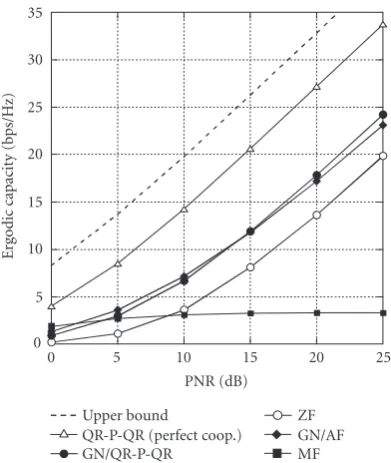
MF scheme is better than the other schemes in a low PNR region due to the SNR gain of the matched filtering. How-ever, the capacity saturates in a high PNR region due to the interference among S-D pairs.
4.3. Effectiveness of spatially multiplexing multiple S-D pairs
Figure 7 shows the capacity curves of the GN/QR-P-QR scheme forL=2,M=4, andN=8 withK=2 and 8. Here, we measured the capacity for two cases: time-division multi-plexing (TDM) and spatial-division multimulti-plexing (SDM) for the two S-D pairs. Note that in the former case, only one S-D pair is active at any instant, and thusgroup nulling is not needed.Figure 7shows that in a low PNR region, TDM provides higher capacity, but in higher PNR regions, SDM offers significantly higher capacity, which matches results of conventional studies on the trade-offbetween spatial mul-tiplexing and beam-forming. Furthermore, the figure shows that whenKincreases, the crosspoint of SDM and TDM is shifted to lower PNR regions. This is because the effective SNR at the destination node increases asKincreases. Thus, it is clear that it is more advantageous to multiplex spatially multiple S-D pairs in a situation, where the PNR is relatively high or the number of relay nodes is relatively large.
4.4. Capacity versus the number of antennas at the relay node
Figure 8shows the capacity of the GN/QR-P-QR and the ZF schemes with variousNforL=2 andM =4.Kis set to 2 and 8. We can see that when the number of antennas per relay node,N, increases, the capacity gap between the
GN/QR-P-60
50
40
30
20
10
0
Ergodic
capacit
y
(bps/Hz)
0 6 12 18 24 30
Number of relay nodes Upper bound
QR-P-QR (perfect coop.) GN/QR-P-QR
ZF GN/AF MF
Figure4: Capacity versus the number of relay nodes (L=4,M=2,
N=8).
35 30 25 20
15 10 5 0
Ergodic
capacit
y
(bps/Hz)
0 5 10 15 20 25
PNR (dB) Upper bound
QR-P-QR (perfect coop.) GN/QR-P-QR
ZF GN/AF MF
Figure5: Capacity versus PNR (L=2,M=4,N=8,K=2).
QR and the ZF schemes becomes smaller. This is because as Nbecomes larger, both the GN and the ZF operations retain enough degrees of freedom after the interference suppression as shown inSection 3.3.
4.5. Complexity
35 30
25 20
15 10
5 0
Ergodic
capacit
y
(bps/Hz)
0 5 10 15 20 25
PNR (dB) Upper bound
QR-P-QR (perfect coop.) GN/QR-P-QR
ZF GN/AF MF
Figure6: Capacity versus PNR (L=2,M=4,N=8,K=8).
35 30 25 20 15 10 5 0
Ergodic
capacit
y
(bps/Hz)
0 5 10 15 20 25
PNR (dB) TDM
K=8
K=2
SDM
K=8
K=2
Figure7: Capacity of GN/QR-P-QR: SDM versus TDM (L = 2,
M=4,N=8).
number of required complex multiplications at each relay node. We approximated the complexity by computing only matrix inversion, multiplication, SVD, and QRD parts and evaluated only terms with the highest order (cubic) in terms of matrix size. First, we observe that the complexity of the MF scheme is much lower than that of others due to its simple operations. The ZF scheme needs only one matrix inversion for both the backward and forward channel matrices (Hkand
GTk), but the matrix sizeN×LMis the largest. The GN/AF scheme requires SVD for every S-D pair of both equivalent
45 40 35 30
25 20 15 10
Ergodic
capacit
y
(bps/Hz)
8 10 12 14 16
Number of antennas at relay nodes GN/QR-P-QR
K=2
K=8
ZF
K=2
K=8
Figure8: Capacity of GN/QR-P-QR versus ZF for variousN(L=
2,M=4).
backward and forward channel matrices (H(l)k andG(l)k ), but the matrix size N ×M(L−1) is smaller than that in ZF. The GN/QR-P-QR scheme further requires QRD for every S-D pair of both equivalent backward and forward channels
U(l)Hk,L Hk,land (Gk,lAk,L(l))H, and their matrix size,N−M(L−
1)×M, is smaller than that in ZF. Thus, when the number of S-D pairs is small, such as when (L,M,N)=(2, 2, 4) and (2, 4, 8), the GN-based relay schemes offer lower complexity than the ZF due to the matrix size reduction. On the other hand, when the number of S-D pairs becomes larger, such as when (L,M,N) = (4, 2, 8), the ZF scheme offers lower complexity due to fewer matrix operations. Therefore, when the number of S-D pairs is small, the GN/QR-P-QR scheme achieves higher capacity with lower complexity than the ZF scheme.
5. CONCLUDING REMARKS
Table1: Computational complexity per relay node (number of complex multiplications), (A=M(L−1),B=N−M(L−1)).
Complexity (L,M,N)=(2, 2, 4) (L,M,N)=(2, 4, 8) (L,M,N)=(4, 2, 8)
MF N(ML)2 64 512 512
ZF 3N2(ML) + 2(ML)3+N3×2 +N3 832 6656 6656
GN/AF 3N2A+N3×L×2 +N2A×L 704 5632 14048
GN/QR-P-QR
3N2A+N3×L×2
816 6528 14848
+3B2M−3/2BM2+M3×L×2 +2MB2+N2B×L
however, that the requirement for the number of antennas, N ≥LN, in the proposed scheme as well as in the ZF relay scheme could still be a limiting factor in some application scenarios. In addition, since the relay techniques described in this paper assume perfect CSI knowledge for both the back-ward and forback-ward MIMO channels at each relay terminal, investigation of their capacity with imperfect CSI is an im-portant future research topic.
ACKNOWLEDGMENT
The authors thank Mr. Katsutoshi Kusume for his helpful discussion regarding the complexity issues.
REFERENCES
[1] M. Gastpar and M. Vetterli, “On the capacity of wireless net-works: the relay case,” inProceedings of the 21st Annual Joint Conference of the IEEE Computer and Communications Soci-eties (INFOCOM ’02), vol. 3, pp. 1577–1586, New York, NY, USA, June 2002.
[2] I. E. Telatar, “Capacity of multi-antenna Gaussian channels,”
European Transactions on Telecommunications, vol. 10, no. 6, pp. 585–595, 1999.
[3] G. J. Foschini and M. J. Gans, “On limits of wireless com-munications in a fading environment when using multiple antennas,”Wireless Personal Communications, vol. 6, no. 3, pp. 311–335, 1998.
[4] G. G. Raleigh and J. M. Cioffi, “Spatio-temporal coding for wireless communication,”IEEE Transactions on Communica-tions, vol. 46, no. 3, pp. 357–366, 1998.
[5] J. H. Winters, “On the capacity of radio communication sys-tems with diversity in a Rayleigh fading environment,”IEEE Journal on Selected Areas in Communications, vol. 5, no. 5, pp. 871–878, 1987.
[6] A. Goldsmith, S. A. Jafar, N. Jindal, and S. Vishwanath, “Ca-pacity limits of MIMO channels,”IEEE Journal on Selected Ar-eas in Communications, vol. 21, no. 5, pp. 684–702, 2003. [7] G. Caire and S. Shamai, “On the achievable throughput of a
multiantenna Gaussian broadcast channel,”IEEE Transactions on Information Theory, vol. 49, no. 7, pp. 1691–1706, 2003. [8] S. Vishwanath, N. Jindal, and A. Goldsmith, “Duality,
achievable rates, and sum-rate capacity of Gaussian MIMO
broadcast channels,”IEEE Transactions on Information Theory, vol. 49, no. 10, pp. 2658–2668, 2003.
[9] W. Yu and J. M. Cioffi, “Sum capacity of Gaussian vector broadcast channels,”IEEE Transactions on Information Theory, vol. 50, no. 9, pp. 1875–1892, 2004.
[10] H. B¨olcskei, R. U. Nabar, ¨O. Oyman, and A. J. Paulraj, “Ca-pacity scaling laws in MIMO relay networks,”IEEE Transac-tions on Wireless CommunicaTransac-tions, vol. 5, no. 6, pp. 1433–1444, 2006.
[11] R. U. Nabar, ¨O. Oyman, H. B¨olcskei, and A. J. Paulraj, “Capac-ity scaling laws in MIMO wireless networks,” inProceedings of Allerton Conference on Communication, Control, and Comput-ing, pp. 378–389, Monticello, Ill, USA, October 2003. [12] H. Shi, T. Abe, T. Asai, and H. Yoshino, “A relaying scheme
us-ing QR decomposition with phase control for MIMO wireless networks,” inProceedings of IEEE International Conference on Communications (ICC ’05), vol. 4, pp. 2705–2711, Seoul, Ko-rea, May 2005.
[13] T. M. Cover and J. A. Thomas,Elements of Information Theory, John Wiley & Sons, New York, NY, USA, 1991.
[14] L.-U. Choi and R. D. Murch, “A transmit preprocessing tech-nique for multiuser MIMO systems using a decomposition ap-proach,”IEEE Transactions on Wireless Communications, vol. 3, no. 1, pp. 20–24, 2004.
[15] H. B¨olcskei and R. U. Nabar, “Realizing MIMO gains without user cooperation in large single-antenna wireless networks,” in
Proceedings of IEEE International Symposium on Information Theory, p. 18, Chicago, Ill, USA, June-July 2004.
Tetsushi Abereceived his B.S. degree and M.S. degree in electrical and electronic en-gineering from Tokyo Institute of Technol-ogy, Tokyo, Japan, in 1998 and 2000, re-spectively. During 1998-1999, he studied in the Department of Electrical and Com-puter Engineering in University of Wiscon-sin, Madison, USA, under the scholarship exchange student program offered by the Japanese Ministry of Education. He joined
Hui Shi received his B.S. degree in me-chanic engineering from Dalian University of Technology, Dalian, China, in 1998 and M.S. degree in electrical and electronic en-gineering from Nagoya University, Nagoya, Japan, in 2002. Since 2002, he has been with the Research Laboratories at NTT Do-CoMo, Inc. His research interests cover the wireless network systems, relay net-works, multiple-input and multiple-output
(MIMO) transmission, and information theory issues. He is a Member of IEEE and IEICE.
Takahiro Asaireceived the B.E. and M.E. degrees from Kyoto University, Kyoto, Japan, in 1995 and 1997, respectively. In 1997, he joined NTT Mobile Communica-tions Network, Inc. (now NTT DoCoMo, Inc.). Since joining NTT Mobile Communi-cations Network, Inc., he has been engaged in the research of signal processing for mo-bile radio communication. He is a Member of IEEE.
Hitoshi Yoshinoreceived the B.S. and M.S. degrees in electrical engineering from the Science University of Tokyo, Tokyo, Japan, in 1986 and 1988, respectively, and the Dr.Eng. degree in communications and in-tegrated systems from the Tokyo Institute of Technology, Tokyo, Japan, in 2003. From 1988 to 1992, he was with Radio Communi-cation Systems Laboratories, Nippon Tele-graph and Telephone Corporation (NTT),