Software-Defined Radio—Basics and Evolution
to Cognitive Radio
Friedrich K. Jondral
Universit¨at Karlsruhe (TH), Institut f¨ur Nachrichtentechnik, D-76128 Karlsruhe, Germany Email:[email protected]
Received 24 February 2005; Revised 4 April 2005
We provide a brief overview over the development of defined or reconfigurable radio systems. The need for software-defined radios is underlined and the most important notions used for such reconfigurable transceivers are thoroughly software-defined. The role of standards in radio development is emphasized and the usage of transmission mode parameters in the construction of software-defined radios is described. The software communications architecture is introduced as an example for a framework that allows an object-oriented development of software-defined radios. Cognitive radios are introduced as the next step in radio systems’ evolution. The need for cognitive radios is exemplified by a comparison of present and advanced spectrum management strategies.
Keywords and phrases:software-defined radio, reconfigurable transceiver, mobile communication standards, cognitive radio, advanced spectrum management.
1. INTRODUCTION
Reconfigurability in radio development is not such a new technique as one might think. Already during the 1980s re-configurable receivers were developed for radio intelligence in the short wave range. These receivers included interesting features like automatic recognition of the modulation mode of a received signal or bit stream analysis. Reconfigurability became familiar to many radio developers with the publica-tion of the special issue on software radios of the IEEE Com-munication Magazine in April 1995.
We refer to a transceiver as asoftware radio (SR) if its communication functions are realized as programs running on a suitable processor. Based on the same hardware, diff er-ent transmitter/receiver algorithms, which usually describe transmission standards, are implemented in software. An SR transceiver comprises all the layers of a communication sys-tem. The discussion in this paper, however, mainly concerns the physical layer (PHY).
The baseband signal processing of adigital radio(DR) is invariably implemented on a digital processor. An ideal SR directly samples the antenna output. Asoftware-defined ra-dio(SDR) is a practical version of an SR: the received signals are sampled after a suitable band selection filter. One remark
This is an open access article distributed under the Creative Commons Attribution License, which permits unrestricted use, distribution, and reproduction in any medium, provided the original work is properly cited.
concerning the relation between SRs and SDRs is necessary at this point: it is often argued that an SDR is a presently realiz-able version of an SR since state-of-the-art analog-to-digital (A/D) converters that can be employed in SRs are not avail-able today. This argument, although it is correct, may lead to the completely wrong conclusion that an SR which directly digitizes the antenna output should be a major goal of future developments. Fact is that the digitization of an unnecessary huge bandwidth filled with many different signals of which only a small part is determined for reception is neither tech-nologically nor commercially desirable.1However, there is no
reason for a receiver to extremely oversample the desired sig-nals while respecting extraordinary dynamic range require-ments for the undesired in-band signals at the same time. Furthermore, the largest portion of the generated digital in-formation, which stems from all undesired in-band signals, is filtered out in the first digital signal processing step.
Acognitive radio(CR) is an SDR that additionally senses its environment, tracks changes, and reacts upon its findings. A CR is an autonomous unit in a communications environ-ment that frequently exchanges information with the net-works it is able to access as well as with other CRs. From our point of view, a CR is a refined SDR while this again repre-sents a refined DR.
Re
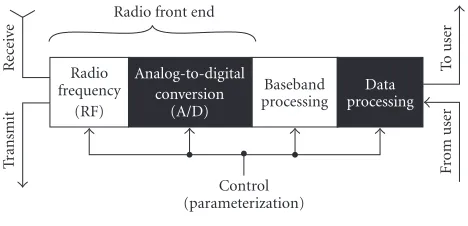
Figure1: SDR transceiver.
According to its operational area an SDR can be
(i) amultiband systemwhich is supporting more than one frequency band used by a wireless standard (e.g., GSM 900, GSM 1800, GSM 1900),
(ii) amultistandard systemthat is supporting more than one standard. Multistandard systems can work within one standard family (e.g., UTRA-FDD, UTRA-TDD for UMTS) or across different networks (e.g., DECT, GSM, UMTS, WLAN),
(iii) amultiservice systemwhich provides different services (e.g., telephony, data, video streaming),
(iv) amultichannel systemthat supports two or more in-dependent transmission and reception channels at the same time.
Our present discussion is onmultimode systemswhich are combinations of multiband and multistandard systems.
The SDR approach allows different levels of reconfigura-tion within a transceiver.
(i) Commissioning: the configuration of the system is done once at the time of product shipping, when the costumer has asked for a dedicated mode (standard or band). This is not a true reconfiguration.
(ii) Reconfiguration with downtime: reconfiguration is only done a few times during product lifetime, for example, when the network infrastructure changes. The recon-figuration will take some time, where the transceiver is switched off. This may include the exchange of com-ponents.
(iii) Reconfiguration on a per call basis: reconfiguration is a highly dynamic process that works on a per call de-cision. That means no downtime is acceptable. Only parts of the whole system (e.g., front-end, digital base-band processing) can be rebooted.
(iv) Reconfiguration per timeslot: reconfiguration can even be done during a call.
Figure 1 shows an SDR transceiver that differs from a conventional transceiver only by the fact that it can be recon-figured via a control bus supplying the processing units with the parameters which describe the desired standard. Such a configuration, called a parameter-controlled (PaC) SDR, guarantees that the transmission can be changed instanta-neously if necessary (e.g., for interstandard handover).
The rest of this paper is organized as follows. InSection 2 we take a look at the most important wireless transmis-sion standards currently used in Europe and specify their main parameters.Section 3provides an overview of design approaches for mobile SDR terminals, especially over PaC-SDRs. In Section 4the software communications architec-ture (SCA), as it is used in the US Joint Tactical Radio System (JTRS), is introduced. The notion of cognitive radio (CR) is discussed in Section 5and the need for a modified spec-trum management in at least some major portions of the electromagnetic spectrum is underlined inSection 6. Finally, inSection 7we propose the development of technology cen-tric CRs as a first step towards terminals that may sense their environment and react upon their findings. Conclusions are drawn inSection 8.
2. MOBILE COMMUNICATION STANDARDS
Standards are used to publicly establish transmission meth-ods that serve specific applications employable for mass mar-kets. The presently most important mobile communication standards used in Europe are briefly described in the follow-ing paragraphs.
Personal area networks
Bluetooth is a short distance network connecting portable devices, for example, it enables links between computers, mobile phones or connectivity to the internet.
Cordless phone
DECT (digital enhanced cordless telecommunications) pro-vides a cordless connection of handsets to the fixed telephone system for in-house applications. Its channel access mode is FDMA/TDMA and it uses TDD. The modulation mode of DECT is Gaussian minimum shift keying (GMSK) with a bandwidth (B) time (T) product of BT=0.5. The transmis-sion is protected only by a cyclic redundancy check (CRC).
Wireless local area networks
Today, IEEE 802.11b installations are the most widely used in Europe. Also, IEEE 802.11a systems are in operation. If IEEE.11a is to be implemented into an SDR, it should be recognized that its modulation mode is OFDM. It should be pointed out here that there are major efforts towards the development of joint UMTS/WLAN systems which use the SDR approach.
Cellular systems
800 900 1000 1100 1200 1300 1400 1500 1600
890 915 935 960
1600 1700 1800 1900 2000 2100 2200 2300 2400 2500
1710 1785 1805 1880 1920 1980 2010 2025 2110 2170
2483
.
5
5100 5200 5300 5400 5500 5600 5700 5800 5900
5150 5350 5470 5725
GSM DECT UTRA-TDD UTRA-FDD
MSS ISM WLAN
f(MHz) · · ·
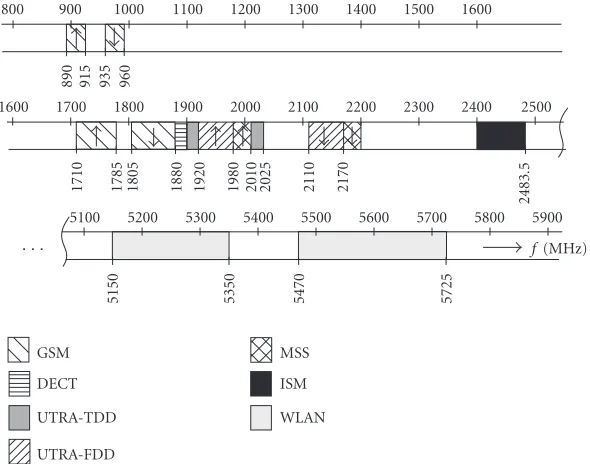
Figure2: Mobile spectrum in Europe.
as well as in the 1800 MHz (GSM 1800) bands. The North American equivalent of GSM is IS-136. Also, GSM 1900 as well as IS-95, a second-generation CDMA system, are widely used in the US. UMTS (universal mobile telecommunication system) is the European version of the third-generation fam-ily of standards within IMT-2000. One of the differences with respect to second-generation systems is that third-generation systems are mainly developed for data (multimedia) trans-mission. UMTS applies two air interfaces: UTRA-FDD and UTRA-TDD according to the duplex modes used. The chan-nel access mode is CDMA. CRC, convolutional codes, as well as turbo codes [1] are employed for error protection. The basic data modulation is QPSK. Furthermore, it should be mentioned that one mobile user within an UTRA-FDD cell can occupy up to seven channels (one control and six trans-port channels) simultaneously.
Figure 2gives an overview over the present spectrum al-location for mobile communications in Europe. Besides the spectra of the standards mentioned above, also the spectra allocated to mobile satellite system (MSS) as well as to indus-trial, scientific, and medical (ISM) applications are specified. The arrows within some of the bands indicate whether uplink (mobile to base station) or downlink (base station to mobile) traffic is supported.
In connection with mobile communications, some addi-tional groups of standards have to be discussed.
Professional mobile radio
PMR standards are developed for police, firefighters, and other administrative applications. The main difference to cel-lular systems is that they allow direct handheld to hand-held communication. The main PMR systems in Europe are TETRA (recommended by ETSI) and TETRAPOL.
Location and navigation
One important feature of mobile terminals is their ability to determine their own location as well as to track location in-formation. Today many location-dependent services rely on the global positioning system (GPS). Currently the European satellite location and navigation system Galileo is under de-velopment.
Digital broadcast
There is a possibility that digital broadcast systems may be used as downstreaming media within future mobile commu-nication infrastructures. The main developments in Europe in this area are digital audio broadcast (DAB) and digital video broadcast (DVB).
To have a sound basis for the description of a PaC-SDR that can be switched between different standards, the most important parameters of selected air interfaces are summa-rized inTable 1.
3. MOBILE SDR TERMINALS
The general structure of a PaC-SDR terminal was already given inFigure 1. Now we are going to look into the PaC-SDR transceiver structure in a more detailed way. The main pro-cessing modules of an SDR terminal are the radio front-end, the baseband processing, and the data processing. Since a lot of information about baseband processing can be found in the literature [2,3] and since data processing is out of the scope of this paper, we are going to focus on the front-end here.
Table1: Parameters of selected air interfaces.
Bluetooth DECT GSM UTRA-FDD
Frequency range 2.4 GHz (ISM band) 1900 MHz 900, 1800, 1900 MHz 2 GHz
Channel bandwidth 1 MHz 1728 kHz 200 kHz 5 MHz
Access mode TDMA FDMA/TDMA FDMA/TDMA Direct sequence (DS)
CDMA
Duplex mode TDD TDD FDD FDD
Users per carrier frequency 8 maximum 12 8 —
Modulation
FH sync. to master station,
GMSK GMSK QPSK
GFSK with modulation index between 0.28 and 0.35
Error correction code — No (CRC) CRC, convolutional CRC, convolutional, turbo
Bit (chip) rate 1 Mbps 1152 kbps 270.833 kbps 3.840 Mchip/s
Number of bits (chips)/burst
(slot) 625 480 (DECT P32) 156.25 2560
Frame duration — 10 ms 4.615 ms 10 ms
Number of bursts
(slots)/frame — 24 8 15
Burst (slot) duration 0.625 ms 0.417 ms 0.577 ms 0.667 ms
Maximum cell radius 5–10 m (1 mW Tx power) 300 m 36 km (10 km) Few km
Spreading sequences — — — User specific OVSF codes,
call specific scrambling
Spreading factor — — — 2k(k=2, 3,. . ., 8), 512
for downlink only Bit (chip) pulse shaping
Gauss (BT=0.5) Gauss (BT=0.5) Gauss (BT=0.3) Root-raised cosine,
filter roll-offfactor 0.22
Net data rate 1 Mbps 26 kbps 13 kbps 8 kbps to 2 Mbps
Evolutionary concepts UWB — GPRS, HSCSD, EDGE HSDPA
Comparable systems — PHS, PACS, WACS IS-136, PDC UMTS-TDD. Cdma2000
TETRA IEEE 802.11a GPS DVB-T
Frequency range 400 MHz 5.5 GHz 1200, 1500 MHz VHF, UHF
Channel bandwidth 25 kHz 20 MHz — 7 (VHF) or 8 MHz (UHF)
Access mode TDMA FDMA/TDMA Direct sequence spreadspectrum FDMA
Duplex mode FDD/TDD Half duplex — —
Users/carrier
4 — — —
frequency
Modulation Π/4-DQPSK
OFDM with subcarrier
BPSK, QPSK
OFDM with subcarrier
modulation modulation
BPSK/QPSK/16QAM/64QAM QPSK/16QAM/64QAM
Error correction code CRC, Reed-Muller, RCPC Convolutional — Reed-Solomon, convolutional Bit (chip) rate 36 kbps 6/9/12/18/24/36/48/54 Mbps 50 bps 9.143 Msamples/s for an
8 MHz channel Number of bits (chips)
510 (255 symbols) 52 modulated symbols per — 2k mode: 2048 + guard int.
per burst (slot) OFDM symbol 8k mode: 8192 + guard int.
Frame duration 56.67 ms Packets of several 100µs 15 s (7500 bit) 68 OFDM symbols Number of bursts
4 Variable 5 subframes 68
(slots) per frame
Burst (slot) duration 14.167 ms 1 OFDM symbol of 3.3µs + 30 s 2k mode: 224µs + guard time 0.8µs guard time 8k mode: 896µs + guard time
Maximum cell radius — Some 10 m — —
Spreading sequences — — Gold or PRN code —
Spreading factor — — 1023 or 10 230 —
Bit (chip) pulse Root-raised cosine, — — Rectangular, other filtering
shaping filter roll-offfactor 0.35 possible
Net data rate Up to 28.8 kbps Up to 25 Mbps — 49.8–131.67 Mbps
Evolutionary concepts — IEEE 802.11n Galileo —
RF
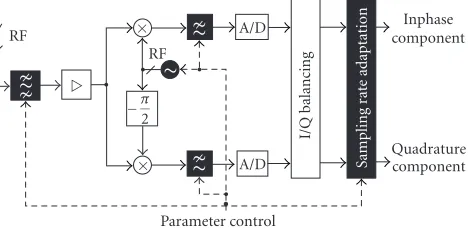
Figure3: SDR/CR receiver front-end.
Figure 3shows how it works: coming from the antenna, the RF signal is first bandpass filtered and then amplified. Fol-lowing a two-way signal splitter, the next step is an analog mixing with the locally generated RF frequency in the in-phase (I) path and with the same frequency in-phase shifted by
−π/2 in the quadrature (Q) path. Afterwards, the I and Q components of the signal are lowpass filtered and A/D con-verted. The sampling rate of the A/D converters should be fixed for all signals and has to be chosen in such a way that the conditions of Shannon’s sampling theorem are fulfilled for the broadest signal to be processed. Before the sampling rate can be adapted to the signal’s standard, the impairments of the two-branch signal processing that come from the analog mixers and filters as well as from the A/D converters them-selves have to be corrected [4].
The reason for the Sampling rate adaptation is that the signal processor should work at the minimum possible rate. For a given standard, this minimum sampling rate depends on fc=1/Tc, the symbol or chip rate, respectively. Usually a sampling rate of fs=4fcis sufficient for the subsequent
sig-nal processing where, after the precise synchronization, the sampling rate may be reduced once more by a factor of 4. If the fraction of the sampling rates at the adaptor’s output and input is rational (or may be sufficiently close approxi-mated by a rational number), the sampling rate adaptation can be implemented by an increasing of the sampling rate followed by an interpolation lowpass filter and a decreasing of the sampling rate. If the interpolation lowpass is imple-mented by an FIR filter, the impulse response usually be-comes quite long. The solution is to take the up and down sampling into account within the filter process. Since the up-sampled signal is usually generated by the insertion of zeros, the processing of these zeros can be omitted within the fil-ter. This leads to the polyphase structure ofFigure 4. Because different input/output ratios have to be realized for diff er-ent standards, the number of filter coefficients that must be stored may become large. If necessary, a direct computation of the filter coefficients can be more efficient than their ad-vance storage [5]. After the sampling rate adaptation, the sig-nal is processed within the complex baseband unit (demod-ulation and decoding). The SDR data processing within the higher protocol layers [6] is not considered in the present pa-per.
Figure4: Polyphase filter for sampling rate adaptation.
The SDR transmitter branch consists of the procedures inverse to that of the receiver branch. That is, the signal to be transmitted is generated as a complex baseband signal, from which, for example, the real part is taken to be shifted to the (transmission) RF.
For SDRs, reconfigurability means that the radio is able to process signals of different standards or even signals that are not standardized but exist in specific applications. One method to implement reconfigurability is parameterization of standards. We look at acommunication standardas a set of documents that comprehensively describe all functions of a radio system in such a way that a manufacturer can de-velop terminals or infrastructure equipment on this basis. Standardization is one necessary condition to make a com-munication system successful on the market, as exemplified by GSM. Standardization pertains to all kinds of communi-cation systems, that is, especially to personal, local, cellular, or global wireless networks. Of course, a standard has to con-tain precise descriptions of all the functions of the system. Especially for a mobile system, both the air interface and the protocol stack have to be specified.Parameterizationmeans that every standard is looked upon as one member of a family of standards [7]. The signal processing structure of the fam-ily is then developed in such a way that this structure may be switched by parameters to realize the different standards.
When developing an SDR, one has to pay attention to the fact that there are substantial differences between the second-generation FDMA/TDMA standards (GSM or IS-136), the third-generation CDMA standards (UMTS or cdma2000), and the OFDM-modulated WLAN standards (IEEE 802.11a or HiperLAN/2) (cf. Table 1). Within UMTS, spreading at the transmitter and despreading at the receiver have to be realized. IFFT and FFT operations are necessary for WLAN transceivers. Aside from such fundamental differences, sim-ilarities among communication standards are predominant. For example, when looking at the signal processing chains, we remark that the error correction codes of all the second-generation standards are very similar: a combination of a block code for the most important bits and a convolutional code for the larger part of the voice bits is applied. Channel coding for data transmission is done by a powerful convolu-tional code. UTRA, as a third-generation air interface, offers net data rates of up to 2 Mbps and guarantees BERs, of up to 10−6for specific applications. To reach these BERs turbo
4. THE SOFTWARE COMMUNICATIONS ARCHITECTURE
The Joint Tactical Radio System (JTRS) represents the fu-ture (mobile) communications infrastrucfu-ture of the US joint forces. Introducing JTRS stands for an essential step towards the unification of radio communication systems, the trans-parency of services, and the exchangeability of components. The development of the JTRS is accompanied and supervised by the US forces’Joint Program Office(JPO).
Development, production, and delivery continue to be the tasks of competing industrial communications software and hardware suppliers. An important new aspect added by the JTRS set-up is that the suppliers are guided to aim for a most perfect interchangeability of components due to the supervision function of the JPO. The tool used by the JPO is thesoftware communications architecture(SCA) [8], an open framework that prescribes the developing engineers how the hardware or software blocks have to act together within the JTRS. The communication devices emerging from this phi-losophy are clearly SDRs.
A major group of suppliers and developers of communi-cation software and hardware founded the SDR Forum [9] to promote their interests. The importance of the SDR Forum, however, reaches well beyond the application of SDRs in the JTRS. This is underlined by the SDR Forum membership of European and Asian industrial and research institutions that usually are mainly interested in the evolution of commercial mobile communication networks.
The SCA describes howwaveformsare to be implemented onto appropriate hardware devices. A waveform is defined by the determination of the lower three layers (network, data link, physical) of the ISO/OSI model. Therefore, wave-form is a synonym of standard or air interface. Based on the waveform definition, a transmission method is com-pletely determined. The definition of a waveform, there-fore, lays down the modulation, coding, access, and duplex modes as well as the protocol structure of the transmission method.
The SCA defines the software structure of an SDR that may be usable within the JTRS. The underlying hardware as well as the software is described in object-oriented terms. Moreover, the structures of application program interfaces (APIs) and of the security environment are described. Each component has to be documented in a generally accessible form.
The JTRS operating environment (OE) defined in the SCA consists of three main components:
(i) a real-time operating system, (ii) a real-time request broker, (iii) the SCA core framework.
When developing an SCA compliant radio device the supplier gets the operating system and the CORBA middle-ware from the commercial market. The core framework as well as the waveform is developed by him or he also gets it from the market or (in future) it may be contributed by the JPO.
The SCA is the description of an open architecture with distributed components. It strictly separates applications (waveforms) from the processing platform (hardware, oper-ating system, object request broker, core framework). It seg-ments the application functions and defines common inter-faces for the management and the employment of software components. It defines common services and makes use of APIs to support the portability of hardware and software components and of applications.
The connections between the applications and the core framework within the SCA are given by the APIs. Standard-ized APIs are essential in assuring the portability of applica-tions as well as for the exchangeability of devices. APIs guar-antee that application and service programs may commu-nicate with one another, independent of the operating sys-tem and the programming language used. APIs are waveform specific since uniform APIs for all waveforms would be inef-ficient for implementations with bounded resources. There-fore, the goal is to have a standard set of APIs for each wave-form. The single APIs are essentially given by the layers of the ISO/OSI model.
(i) APHY APIsupports initialization and configuration of the system in non-real-time. In real-time it takes care of the transformation of symbols (or bits) to RF in the trans-mitter branch. In the receiver branch it transforms RF signals to symbols (bits).
(ii) AMAC API supports all the MAC functions of the ISO/OSI layer model (e.g., timeslot control in TDMA or FEC control).
(iii) An LLC API makes available an interface for the waveform’s link layer performance (according to the ISO/OSI layer model: data link services) on component level.
(iv) Anetwork API makes available an interface for the waveform’s network performance on component level.
(v) Asecurity APIserves for the integration of data secu-rity procedures (INFOSEC, TRANSEC).
(vi) Aninput/output APIsupports the input and output of audio, video, or other data.
The security relevant SCA aspects are written down in the
SCA security supplement[8]. The SCA security functions and algorithms are of course defined with respect to the military security requirements of JTRS.
5. USER CENTRIC AND TECHNOLOGY CENTRIC COGNITIVE RADIO PROPERTIES
not. Of course, these visions as well as therecognition cycle for CRsin [11] are strongly intended to stimulate new research and development. For a more pragmatic point of view, how-ever, we approach CR in a different way.
The properties of CRs may be divided into two groups:
(i) user centric properties that comprise support func-tions like finding the address of an appropriate restau-rant or a movie theater, recommendation of a travel route, or supervision of appointments,
(ii) technology centric properties like spectrum monitor-ing, localization, and trackmonitor-ing, awareness of processing capabilities for the partitioning or the scheduling of processes, information gathering, and knowledge pro-cessing.
From our point of view, many of the user centric proper-ties can be implemented by using queries to data bases. This type of intelligence can be kept in the networks and activated by calls. In transceiver development, much more difficult de-sign choices need to be made to realize the wanted technol-ogy centric properties of a CR. Therefore, we concentrate on the latter in the following sections.
6. THE NEED FOR ADVANCED SPECTRUM MANAGEMENT
Today, spectrum isregulatedby governmental agencies. Spec-trum is assigned to users or licensed to them on a long-term basis normally for huge regions like countries. Doing this, resources are wasted, because large-frequency regions are used very sporadically. The vision is to assign appropriate resources to end users only as long as they are needed for a geographically bounded region, that is, a personal, local, re-gional, or global cell. The spectrum access is then organized by the network, that is, by the users. First examples for self-regulation in mobile radio communications are to be found in the ISM (2400–2483.5 MHz) and in the WLAN (5150– 5350 MHz and 5470–5725 MHz) bands.
Future advanced spectrum management will comprise [12] the following.
(i) Spectrum reallocation: the reallocation of bandwidth from government or other long-standing users to new services such as mobile communications, broadband internet access, and video distribution.
(ii) Spectrum leases: the relaxation of the technical and commercial limitations on existing licensees to use their spectrum for new or hybrid (e.g., satellite and terrestrial) services and granting most mobile radio li-censees the right to lease their spectrum to third par-ties.
(iii) Spectrum sharing: the allocation of an unprecedented amount of spectrum that could be used for unlicensed or shared services.
If we look upon the users’ behavior in an FDMA/TDMA system over the time/frequency plane (cf. Figure 5), we may find out that a considerable part of the area remains
f0
fu
Fre
q
u
en
cy
0 Time
Figure 5: FDMA/TDMA signals over the time/frequency plane, spectrum pool.
unused [12, 13]. This unused area marks the pool from which frequencies can be allocated to secondary users (SUs), for example, in a hotspot. In the following we denote the FDMA/TDMA users as primary users (PUs). In order to make the implementation of the SUs’ system into the PUs’ system feasible, two main assumptions should be fulfilled:
(i) the PUs’ system is not disturbed by the SUs’ system, (ii) the PUs’ system remains unchanged (i.e., all signal
processing that has to be done to avoid disturbances of the PUs communications must be implemented in the SUs’ system).
Now we assume that the transmission method within the SUs’ system is OFDM.Figure 6gives a brief overview over an OFDM transmitter: the sequential data stream is converted to a parallel stream, the vectors of which are interpreted as signals in the frequency domain. By applying an inverse fast Fourier transform (IFFT), these data are transformed into the time domain and sent over the air on a set of orthogonal carriers with separation∆f on the frequency axis. If some carriers should not be used, it is necessary to transmit zeros on these carriers. This is the strategy to protect the PUs’ sys-tem from disturbances originating from the SUs’ syssys-tem. In order to make the SUs’ system work, the following problems have to be solved.
(i) The reliable detection of upcoming PUs’ signals within an extremely short time interval. (This means that the detection has to be performed with a very high detection probability ensuring a moderate false alarm probability.)
(ii) The consideration of hidden stations.
(iii) The signaling of the present transmission situation in the PUs’ system to all stations of the SUs’ system such that these do not use the frequencies occupied by the PUs.
Bit
Figure6: OFDM. (a) Transmitter. (b) Spectrum.
The central point in our present discussion is that the SUs system’s transceivers have in some sense to act like CRs. They have to sense their spectral neighborhood for PUs’ signals and to react upon their findings.
7. TECHNOLOGY CENTRIC COGNITIVE RADIO
In a more advanced spectrum sharing system, CRs have to apply more advanced algorithms. If a portion of the spec-trum may be accessed by any access mode, the following procedure becomes imaginable: starting from the transmis-sion demand of its user, the CR decides about the data rate, the transmission mode, and therefore about the bandwidth of the transmission. Afterwards it has to find an appropri-ate resource for its transmission. This presumes that the CR knows where it is location), what it is able to do (self-awareness), and where the reachable base stations are. To get more information about possible interferences it should, for example, be able to detect signals active in adjacent frequency bands and to recognize their transmission standards [14].
Summing up, a CR should have implemented the follow-ing technologies (possibly among others):
(i)location sensors(e.g., GPS or Galileo);
(ii) equipment tomonitor its spectral environmentin an intelligent2way;
2Intelligent means that searching for usable frequency bands is not done by just scanning the whole spectrum.
Control SDR core
Spectrum
monitoring Localization
Information and knowledge processing
Figure7: Technology centric cognitive radio.
(iii) in order totrack the location’s or the spectral environ-ment’s developments, learning and reasoning algorithms have to be implemented;
(iv) when complying with a communications etiquette, it has tolisten before talkas well as to prevent the disturbance ofhidden stations;
(v) in order to be fair it has to compromise its own de-mands with the dede-mands of other users, most probably in making decisions in a competitive environment using the re-sults ofgame theory[15];
(vi) it has to keep its owner informed via a highly sophis-ticated man-machine interface.
A first block diagram of a technology centric CR is given inFigure 7. One of the most important decisions that have to be made in an open access environment is whether a control channel is to be implemented or not. The most challenging development is that of the information and knowledge pro-cessing.
8. CONCLUSIONS
ACKNOWLEDGMENT
The author gratefully acknowledges the influence that the 6th European Framework’s Integrated ProjectEnd-to-End Recon-figurability(E2R) as well as the Software-Defined Radio
Fo-rum have on his present work.
REFERENCES
[1] C. Heegard and S. B. Wicker,Turbo Coding, Kluwer Academic,
Boston, Mass, USA, 1999.
[2] F. K. Jondral, “Parametrization—a technique for SDR
imple-mentation,” inSoftware Defined Radio—Enabling
Technolo-gies, W. Tuttlebee, Ed., pp. 232–256, John Wiley & Sons,
Lon-don, UK, 2002.
[3] A. Wiesler and F. K. Jondral, “A software radio for second-and
third-generation mobile systems,”IEEE Trans. Veh. Technol.,
vol. 51, no. 4, pp. 738–748, 2002.
[4] P. Rykaczewski, D. Pienkowski, R. Circa, and B. Steinke, “Sig-nal path optimization in software defined radio systems,”
IEEE Trans. Microwave Theory Tech., vol. 53, no. 3, pp. 1056– 1064, 2005.
[5] T. Hentschel and G. Fettweis, “Sample rate conversion for
software radio,”IEEE Commun. Mag., vol. 38, no. 8, pp. 142–
150, 2000.
[6] M. Sieber, “Design of a generic protocol stack for an adaptive
terminal,” inProc. 1st Karlsruhe Workshop on Software Radios,
pp. 31–34, Institut f¨ur Nachrichtentechnik, Universit¨at Karl-sruhe (TH), KarlKarl-sruhe, Germany, March 2000.
[7] F. K. Jondral, R. Machauer, and A. Wiesler,Software Radio—
Adaptivit¨at durch Parametrisierung, J. Schlembach Fachverlag, Weil der Stadt, Germany, 2002.
[8] “Software communications architecture specification,
jtrs-5000sca v3.0,” Joint Tactical Radio System (JTRS)
Joint Program Office, August 2004, available online on
http://jtrs.army.mil.
[9] “Software Defined Radio Forum,” available online on http://www.sdrforum.org.
[10] J. Mitola III and G. Q. Maguire, “Cognitive radio: making
software radios more personal,”IEEE Pers. Commun., vol. 6,
no. 4, pp. 13–18, 1999.
[11] J. Mitola III, “Cognitive radio: an integrated agent architec-ture for software defined radio,” Ph.D. dissertation, Computer Communication System Laboratory, Department of Telein-formatics, Royal Institute of Technology (KTH), Stockholm, Sweden, May 2000.
[12] G. Staple and K. Werbach, “The end of spectrum scarcity,”
IEEE Spectr., vol. 41, no. 3, pp. 48–52, 2004.
[13] T. A. Weiss and F. K. Jondral, “Spectrum pooling: an
inno-vative strategy for the enhancement of spectrum efficiency,”
IEEE Commun. Mag., vol. 42, no. 3, pp. 8–14, 2004.
[14] M. ¨Oner and F. K. Jondral, “Air interface recognition for a
software radio system exploiting cyclostationarity,” in Proc.
15th IEEE International Symposium on Personal, Indoor and Mobile Radio Communications (PIMRC ’04), vol. 3, pp. 1947– 1951, Barcelona, Spain, September 2004.
[15] J. Neel, J. Reed, and R. Gilles, “The role of game theory in
the analysis of software radio networks,” inProc. Software
De-fined Radio Forum Technical Conference and Product Exhibi-tion (SDR ’02), vol. 2, pp. NP–3–02, San Diego, Calif, USA, November 2002.
[16] J. Mitola III,Software Radio Architecture: Object-Oriented
Ap-proaches to Wireless Systems Engineering, John Wiley & Sons, New York, NY, USA, 2000.
[17] J. Mitola III and Z. Zvonar, Eds.,Software Radio Technologies:
Selected Readings, John Wiley & Sons, New York, NY, USA, 2000.
[18] J. Mitola III and W. Tuttlebee, Eds.,Software Defined Radio:
Origins, Drivers and International Perspectives, John Wiley & Sons, Chichester, UK, 2002.
[19] W. Tuttlebee, Ed.,Software Defined Radio: Enabling
Technolo-gies, John Wiley & Sons, Chichester, UK, 2002.
[20] M. Dillinger, K. Madani, and N. Alonistioti, Eds.,Software
De-fined Radio: Architectures, Systems and Functions, John Wiley & Sons, Chichester, UK, 2003.
[21] J. Reed,Software Radio—a Modern Approach to Radio
Engi-neering, Prentice-Hall, Upper Saddle River, NJ, USA, 2002.
[22] H. Harada and R. Prasad,Simulation and Software Radio for
Mobile Communications, Artech House, Boston, Mass, USA, 2002.
[23] S. Haykin, “Cognitive radio: brain-empowered wireless
com-munications,”IEEE J. Select. Areas Commun., vol. 23, no. 2,
pp. 201–220, 2005.
Friedrich K. Jondral received a Diploma and a Doctoral degree in mathematics from the Technische Universit¨at Braunschweig, Germany, in 1975 and 1979, respectively. During the winter semester 1977/78, he was a Visiting Researcher in the Department of Mathematics, Nagoya University, Japan. From 1979 to 1992, Dr. Jondral was an em-ployee of AEG-Telefunken (now European Aeronautic Defence and Space Company