On Erasure Coding for Distributed Storage
and Streaming Communications
Thesis by
Derek Leong
In Partial Fulfillment of the Requirements for the Degree of
Doctor of Philosophy
California Institute of Technology Pasadena, California, USA
2013
c
Acknowledgments
I would like to express my gratitude to my research adviser Tracey Ho for her guidance and infinite wisdom, generosity, and patience, and also for her constant encouragement and prodding to tighten this bound and generalize that theorem. I would also like to extend my appreciation to my research mentor and collaborator Alex Dimakis for sharing his intuitions and insights on various problems, and for his candid tips on preventing paper rejections and audience narcolepsy. My thanks also go to my other thesis committee members Michelle Effros, Steven Low, Babak Hassibi, and Jehoshua (Shuki) Bruck for their feedback and comments on improving my work. I would also like to thank my research collaborators Edmund Yeh, Asma Qureshi, Michael Burd, Kyle Dumont, and Rebecca Cathey for the many enriching discussions.
The work in this thesis was funded in part by the Agency for Science, Technology and Research (A*STAR), Singapore; the Lee Center for Advanced Networking, California Institute of Technol-ogy; Subcontract 069153 issued by BAE Systems National Security Solutions, Inc. and supported by the Defense Advanced Research Projects Agency (DARPA) and the Space and Naval Warfare System Center (SPAWARSYSCEN), San Diego, under contract N66001-08-C-2013; and the Air Force Office of Scientific Research (AFOSR) under grant FA9550-10-1-0166.
My Caltech graduate student experience has been an exciting and fulfilling one thanks in large part to the company of my research group mates and office mates Theodoros Dikaliotis, Svitlana Vyetrenko, Alex Gittens, Christopher Chang, Tao Cui, Mayank Bakshi, Ming Fai Wong, Jinghao Huang, and Hongyi Yao.
Abstract
The work presented in this thesis revolves around erasure correction coding, as applied to dis-tributed data storage and real-time streaming communications.
First, we examine the problem of allocating a given storage budget over a set of nodes for max-imum reliability. The objective is to find an allocation of the budget that maximizes the probability of successful recovery by a data collector accessing a random subset of the nodes. This optimization problem is challenging in general because of its combinatorial nature, despite its simple formula-tion. We study several variations of the problem, assuming different allocation models and access models, and determine the optimal allocation and the optimalsymmetric allocation (in which all nonempty nodes store the same amount of data) for a variety of cases. Although the optimal al-location can have nonintuitive structure and can be difficult to find in general, our results suggest that, as a simple heuristic, reliable storage can be achieved by spreading the budget maximally over all nodes when the budget is large, and spreading it minimally over a few nodes when it is small. Coding would therefore be beneficial in the former case, while uncoded replication would suffice in the latter case.
Third, we consider a real-time streaming system where messages created at regular time inter-vals at a source are encoded for transmission to a receiver over a packet erasure link; the receiver must subsequently decode each message within a given delay from its creation time. For erasure models containing a limited number of erasures per coding window, per sliding window, and con-taining erasure bursts whose maximum length is sufficiently short or long, we show that a time-invariant intrasession code asymptotically achieves the maximum message size among all codes that allow decoding under all admissible erasure patterns. For the bursty erasure model, we also show that diagonally interleaved codes derived from specific systematic block codes are asymptot-ically optimal over all codes in certain cases. We also study an i.i.d. erasure model in which each transmitted packet is erased independently with the same probability; the objective is to maximize the decoding probability for a given message size. We derive an upper bound on the decoding prob-ability for any time-invariant code, and show that the gap between this bound and the performance of a family of time-invariant intrasession codes is small when the message size and packet erasure probability are small. In a simulation study, these codes performed well against a family of random time-invariant convolutional codes under a number of scenarios.
Contents
Acknowledgments iv
Abstract v
1 Introduction 1
2 Distributed Storage Allocations 5
2.1 Introduction . . . 5
2.1.1 Independent Probabilistic Access to Each Node . . . 7
2.1.2 Access to a Random Fixed-Size Subset of Nodes . . . 9
2.1.3 Probabilistic Symmetric Allocations . . . 11
2.1.4 Other Related Work . . . 11
2.2 Independent Probabilistic Access to Each Node . . . 12
2.2.1 Asymptotic Optimality of Maximal Spreading . . . 15
2.2.2 Optimality of Minimal Spreading (Uncoded Replication) . . . 16
2.2.3 Optimal Symmetric Allocation . . . 17
2.3 Access to a Random Fixed-Size Subset of Nodes . . . 22
2.3.1 Regime of High Recovery Probability . . . 24
2.3.2 Upper Bounds for the Optimal Recovery Probability . . . 26
2.4 Probabilistic Symmetric Allocations . . . 28
2.4.1 Optimality of Maximal Spreading . . . 30
2.5 Conclusion and Future Work . . . 31
2.6 Proofs of Theorems . . . 32
3 Distributed Storage Allocations for Optimal Delay 65
3.1 Introduction . . . 65
3.1.1 Our Contribution . . . 67
3.1.2 Other Related Work . . . 68
3.2 Theoretical Analysis . . . 68
3.2.1 Maximization of Recovery Probability . . . 69
3.2.2 Minimization of Expected Recovery Delay . . . 70
3.3 Simulation Study . . . 74
3.3.1 Protocol Description . . . 74
3.3.2 Network Model and Simulation Setup . . . 77
3.3.3 Simulation Results . . . 77
3.3.4 Evaluation on Mobility Traces . . . 79
3.4 Conclusion and Future Work . . . 80
3.5 Proofs of Theorems . . . 80
4 Coding for Real-Time Streaming under Packet Erasures 87 4.1 Introduction . . . 87
4.2 Problem Definition . . . 89
4.3 Code Constructions . . . 91
4.3.1 Symmetric Intrasession Codes . . . 91
4.3.1.1 Active Messages at Each Time Step . . . 93
4.3.1.2 Block Sizes for Each Message . . . 95
4.3.1.3 Achievability . . . 95
4.3.1.4 Partitioning of Coding Windows . . . 96
4.3.2 Diagonally Interleaved Codes . . . 97
4.4 Window-Based Erasure Model . . . 99
4.4.1 Coding Window Erasure Model . . . 100
4.4.2 Sliding Window Erasure Model . . . 101
4.5 Bursty Erasure Model . . . 103
4.5.2 Optimality of Diagonally Interleaved Codes . . . 104
4.6 IID Erasure Model . . . 110
4.6.1 Performance of Symmetric Intrasession Codes . . . 112
4.6.1.1 Decoding Probability . . . 113
4.6.1.2 Burstiness of Undecodable Messages . . . 115
4.6.1.3 Trade-off between Performance Metrics . . . 116
4.6.2 Simulation Study: Symmetric Intrasession Codes vs. Random Time-Invariant Convolutional Codes . . . 117
4.6.2.1 Simulation Setup . . . 117
4.6.2.2 Simulation Results and Discussion . . . 119
4.7 Conclusion and Future Work . . . 123
4.8 Proofs of Theorems . . . 125
4.9 Acknowledgment . . . 160
5 Routing-Caching for Named Data Networking 161 5.1 Introduction . . . 161
5.2 Network Model . . . 162
5.2.1 Creation of Requests . . . 163
5.2.2 Handling of Interest Packets (IPs) and Routing . . . 164
5.2.3 Handling of Data Packets (DPs) and Caching . . . 164
5.2.4 Performance Metrics . . . 165
5.3 Virtual Backpressure Routing-Caching Policy . . . 166
5.3.1 Creation of Virtual Interest Packets (VIPs) . . . 167
5.3.2 Handling of Virtual Interest Packets (VIPs) . . . 168
5.3.3 Routing Policy for the Actual Plane . . . 169
5.3.4 Caching Policy for the Actual Plane . . . 169
5.4 Simulation . . . 171
5.4.1 Simulation Setup . . . 172
5.4.2 Simulation Results and Discussion . . . 172
5.6 Acknowledgment . . . 174
6 Summary and Future Work 175
6.1 Summary . . . 175 6.2 Future Work . . . 176
List of Figures
2.1 Information flows in a distributed storage system . . . 6
2.2 Plot of access probabilitypagainst budgetT describing the optimality of minimal spreading . . . 17
2.3 Plot of recovery failure probability1−PSagainst budgetT for symmetric allocations 18 2.4 Plot of access probabilitypagainst budgetT describing the optimal symmetric al-location . . . 21
2.5 Plot of the optimal recovery probabilitymaxPSagainst budgetT . . . 23
2.6 Plot of the desired recovery probabilityPSagainst the number of nodes accessedr describing the optimality of allocation(1r, . . . ,1r) . . . 26
2.7 Plot of recovery probability PS against budget-per-node Tn for probabilistic sym-metric allocations . . . 29
2.8 Plot of recovery probabilityPSagainst the number of nodes accessedrdescribing the optimal probabilistic symmetric allocation . . . 31
2.9 Example for the construction in the proof of Theorem 2.15 . . . 50
2.10 Example for the construction in the proof of Theorem 2.16 . . . 53
3.1 Information flows in a network of mobile storage nodes . . . 66
3.2 Plot of expected recovery delayE[D]against budgetT for symmetric allocations . 72 3.3 Simulation results for the random waypoint mobility model . . . 75
3.4 Simulation results for the mobility traces . . . 76
4.1 Real-time streaming system . . . 88
4.2 Packet space allocation in the symmetric intrasession code . . . 93
4.4 Construction of the diagonally interleaved code . . . 98
4.5 Systematic block code specified in Theorem 4.9 . . . 105
4.6 Systematic block code specified in Theorem 4.10 . . . 105
4.7 Systematic block code specified in Theorem 4.12 . . . 106
4.8 Plots describing the performance of symmetric intrasession codes . . . 114
4.9 Simulation results for the low-erasure scenario . . . 120
4.10 Simulation results for the medium-erasure scenario . . . 121
4.11 Simulation results for the high-erasure scenario . . . 122
5.1 Network used in the simulation . . . 171
List of Tables
Chapter 1
Introduction
The work presented in this thesis revolves around erasure correction coding, as applied to dis-tributed data storage and real-time streaming communications. In this chapter, we briefly discuss key motivations, related previous work, and our main contributions.
Distributed storage systems are widely used today as a means of keeping data safe and easily ac-cessible. They can be as small as a RAID system [1] sitting on a desk, or as large as the Amazon S3 storage service [2] spanning across multiple data centers around the world. A distributedstorage system introduces many new coding challenges that are not addressed in the single node case; chief among them are the cost and reliability of data recovery (or reconstruction) and node repairs in the event of device failures.
the problem, assuming different allocation models and access models, and determine the optimal allocation and the optimalsymmetricallocation (in which all nonempty nodes store the same amount of data) for a variety of cases. Although the optimal allocation can have nonintuitive structure and can be difficult to find in general, our results suggest that, as a simple heuristic, reliable storage can be achieved by spreading the budget maximally over all nodes when the budget is large, and spreading it minimally over a few nodes when it is small. Coding would therefore be beneficial in the former case, while uncoded replication would suffice in the latter case. Although these results are framed in the context of distributed data storage, the fundamental nature of the problem lends them to many other applications, such as multipath routing over delay-tolerant networks [9–11], peer-to-peer networking [12], and streaming communications.
In Chapter 3, we study how distributed storage allocations affect the recovery delay in a mo-bile setting. Specifically, two recovery delay optimization problems are considered for a network of mobile storage nodes: the maximization of the probability of successful recovery by a given deadline, and the minimization of the expected recovery delay. We show that the first problem is closely related to the allocation problem of Chapter 2, and solve the second problem completely for the case of symmetric allocations. It turns out that the optimal allocations for the two problems can be quite different. We present a simple data dissemination and storage protocol that generalizes the Spray-and-Wait protocol [13] by using variable-size coded packets to create different symmetric allocations. In a simulation study, we evaluated the performance of the proposed protocol for delay-tolerant networks using a random waypoint mobility model and real-world mobility traces from vehicles, and observed that the choice of allocation can have a significant impact on the recovery delay under a variety of scenarios.
The ability to stream data reliably in real-time over packet erasure networks such as the Internet is essential for applications ranging from personal video conferencing to large-scale environmental monitoring or surveillance. In contrast to ordinary communications, real-time streamingimposes stringent constraints on what an encoder can access, and how long a decoder can wait.
cre-ation time. Unlike previous work that aim to minimize the expected message decoding delay [14], or achieve a decoding failure probability that decays exponentially with delay [15–17], our real-time streaming model features hard message decoding deadlines. For erasure models containing a limited number of erasures per coding window, per sliding window, and containing erasure bursts whose maximum length is sufficiently short or long, we show that a time-invariant intrasession code asymptotically achieves the maximum message size among all codes that allow decoding under all admissible erasure patterns. This is interesting because intrasession coding is attractive due to its relative simplicity (it allows coding within the same message but not across different messages), but it is not known in general when intrasession coding is sufficient or when intersession coding is necessary. For the bursty erasure model, we also show that diagonally interleaved codes derived from specific systematic block codes are asymptotically optimal over all codes in certain cases. We also study an i.i.d. erasure model in which each transmitted packet is erased independently with the same probability; the objective is to maximize the decoding probability for a given message size. We derive an upper bound on the decoding probability for any time-invariant code, and show that the gap between this bound and the performance of a family of time-invariant intrasession codes is small when the message size and packet erasure probability are small. In a simulation study, these codes performed well against a family of random time-invariant convolutional codes, which are related to the codes in [14, 17], under a number of scenarios.
In Chapter 5, we consider the joint problems of routing and caching for named data networking. Named data networking (NDN), or content-centric networking (CCN), is a proposed network ar-chitecture for the Internet that replaces the traditional client-server model of communications with one based on the identity of data or content [18]. Requests for a data object in an NDN can be fulfilled not only by the origin server but also by any node with a copy of the object in its cache. Assuming the prevalence of caches, the usual approaches to routing and caching may no longer be effective for such a network. We propose a policy based on the backpressure algorithm [19, 20] that employs virtual interest packets to make routing and caching decisions. In a packet-level simula-tion, the proposed policy outperformed a basic protocol that combines shortest-path routing with least-recently-used (LRU) cache replacement [21].
Chapter 2
Distributed Storage Allocations
2.1
Introduction
Consider a distributed storage system comprisingnstorage nodes. A source has a single data object of normalized unit size that is to be coded and stored in a distributed manner over these nodes, subject to a given total storage budgetT. Letxibe the amount of coded data stored in node i∈ {1, . . . , n}. Any amount of data may be stored in each node, as long as the total amount of storage used over all nodes is at most the given budgetT, i.e.,
n ∑
i=1
xi≤T.
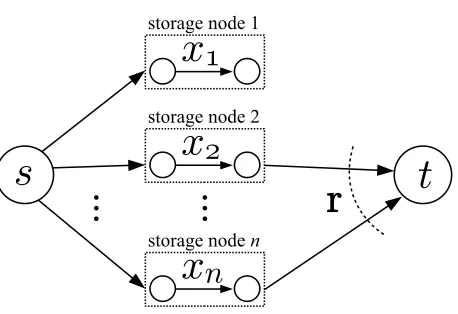
This is a realistic constraint if there is limited transmission bandwidth or storage space, or if it is too costly to mirror the data object in its entirety in every node. At some time after the creation of this coded storage, a data collector attempts to recover the original data object by accessing only the data stored in arandomsubsetrof the nodes, where the probability distribution ofr⊆ {1, . . . , n} is specified by an assumed access model or failure model (nodes or links may fail probabilistically, for example). Figure 2.1 depicts such a distributed storage system.
The reliabilityof this system, which we define to be the probability of successful recovery (or recovery probability in short), depends on both the storage allocation and the coding scheme. For maximum reliability, we would therefore need to find
Figure 2.1. Information flows in a distributed storage system. The source s has a single data object of normalized unit size that is to be coded and stored overnstorage nodes. Subsequently, a data collector t attempts to recover the original data object by accessing only the data stored in a random subsetrof the nodes.
1) an optimal allocation of the given budget T over the nodes, specified by the values of x1, . . . , xn; and
2) an optimal coding scheme
that jointly maximize the probability of successful recovery. It turns out that these two problems can be decoupled by using a good coding scheme, specifically one that enables successful recovery whenever the total amount of data accessed by the data collector is at least the size of the original data object. This can be seen by considering the information flows for a network in which the source is multicasting the data object to a set of potential data collectors [26, 27]: successful recovery can be achieved by a data collector if and only if its corresponding max-flow or min-cut from the source is at least the size of the original data object. Random linear coding over a sufficiently large field would allow successful recovery with high probability when this condition is satisfied [28, 29]. Alternatively, a suitable maximum distance separable (MDS) code for the given budget and data object size would allow successful recovery with certainty when this condition is satisfied.
Therefore, assuming the use of an appropriate code, the probability of successful recovery for an allocation(x1, . . . , xn)can be written as
P[successful recovery] =P
[ ∑
i∈r
xi ≥1 ]
.
given budget constraint.
Although we have assumed coded storage at the outset, coding may ultimately be unnecessary for certain allocations. For example, if the budget is spread minimally such that each nonempty node stores the data object in its entirety (i.e.,xi ≥1for alli∈S, andxi = 0for alli /∈S, where Sis some subset of{1, . . . , n}), then uncoded replication would suffice since the data object can be recovered by accessing anyonenonempty node; the data collector would not need to combine data accessed from different nodes in order to recover the data object. Thus, by solving for the optimal allocation, we will also be able to determine whether coding is beneficial for reliable storage.
We note that even though no explicit upper bound is imposed on the amount of data that can be stored in each node, it is never necessary to setxi >1becausexi = 1already allows the data object to be stored in its entirety in that node. The absence of a tighter per-node storage constraint xi ≤ci <1is reasonable for storage systems that handle a large number of data objects: we would expect the storage capacity of each node to be much larger than the size of a single data object, making it possible for a node to accommodate some of the data objects in their entirety. As such, it would be appropriate to apply a storage constraint for each data object via the budgetT, without a separatea prioriconstraint forxi. Furthermore, the simplifying assumption ofxi being a continu-ous variable is a reasonable one for large data objects: a large data object size would facilitate the creation of coded data packets with sizes (closely) matching that of a desired allocation. Inciden-tally, the overhead associated with random linear coding or an MDS code, which is ignored in our model, becomes proportionately negligible when the amount of coded data is large.
In spite of the simple formulation, this optimization problem poses significant challenges be-cause of its combinatorial nature and the large space of feasible allocations. Different variations of this problem can be formulated by assuming different allocation models and access models; in this chapter, we will examine three such variations that are motivated by practical storage problems in content delivery networks, delay tolerant networks, and wireless sensor networks.
2.1.1 Independent Probabilistic Access to Each Node
reliability of data storage in a system comprisingnstorage devices where each device fails inde-pendently with probability1−p. It is not hard to show that determining the recovery probability of agivenallocation is computationally difficult (specifically, #P-hard). The intuitive approach of spreading the budget maximally over all nodes, i.e., settingxi = Tn for alli, turns out to be not nec-essarily optimal; in fact, the optimal allocation may not even be symmetric (we say that an allocation issymmetricwhen all nonzeroxiare equal). The following counterexample from [8] demonstrates that symmetric allocations can be suboptimal: for(n, p, T) =(5,23,73), the nonsymmetric
alloca-tion ( 2 3, 2 3, 1 3, 1 3, 1 3 ) ,
which achieves a recovery probability of0.90535, performs strictly better than any symmetric al-location; the maximum recovery probability among symmetric allocations is 0.88889, which is
achieved by both (
7 6,
7 6,0,0,0
) and ( 7 12, 7 12, 7 12, 7 12,0
) .
Evidently, the simple strategy of “spreading eggs evenly over more baskets” may not always im-prove the reliability of an allocation.
Our Contribution:We show that the intuitive symmetric allocation that spreads the budget max-imally over all nodes is indeedasymptoticallyoptimal in a regime of interest. Specifically, we derive an upper bound for the suboptimality of this allocation, and show that the performance gap vanishes asymptotically as the total number of storage nodes ngrows, when p > T1. This is a regime of interest because a high recovery probability is possible whenp > T1 ⇐⇒pT >1: The expected total amount of data accessed by the data collector is given by
E [ n
∑
i=1
xiYi ]
=
n ∑
i=1
xiE[Yi] =p n ∑
i=1
xi ≤pT, (2.1)
whereYi’s are independent Bernoulli(p)random variables. Therefore, the data collector would be able to access a sufficient amount of datain expectationfor successful recovery ifpT >1.
for a wide range of parameter values ofpandT.
Related Work:This problem was introduced to us through a discussion at UC Berkeley [8]. We have since learned that variations of the problem have also been studied in several different fields.
In reliability engineering, the weighted-k-out-of-nsystem [30] comprisesncomponents, each having a positive integer weight wi and surviving independently with probability pi; the system is in a good state if and only if the total weight of its surviving components is at least a specified thresholdk. Related work on this system and its extensions has focused on the efficient computation of the reliability of a given weight allocation (e.g., [31]).
In peer-to-peer networking, the allocation problem deals with the recovery of a data object from peers that are available only probabilistically. Linet al.[12] compared the performance of uncoded replication vs. coded storage, restricted to symmetric allocations, for the case where the budget is an integer.
In wireless communications, the allocation problem is studied in the context of multipath rout-ing, in which coded data is transmitted along different paths in an unreliable network, exploiting path diversity to improve the reliability of end-to-end communications. Tsirigos and Haas [9, 10] examined the performance of symmetric allocations and noted the existence of a phase transition in the optimal symmetric allocation; approximation methods were also proposed by the authors to tackle the optimization problem, especially for the case where path failures occur with nonuniform probabilities and may be correlated. Jainet al. [11] evaluated the performance of symmetric allo-cations experimentally in a delay tolerant network setting, and presented an alternative formulation using Gaussian distributions to model partial access to nodes.
Our work generalizes these previous efforts by considering nonsymmetric allocations and non-integer budgets. We also correct some inaccurate claims about the optimal symmetric allocation in [11] and its associated technical report.
2.1.2 Access to a Random Fixed-Size Subset of Nodes
contact up tornodes randomly. We can treat this access model as an approximation to the preceding independent probabilistic access model by pickingr≈np. Finding the optimal allocation in this case is still challenging. As in the first problem formulation, it is not hard to show that determining the recovery probability of agivenallocation is computationally difficult (specifically, #P-complete). The problem appears nontrivial even if we restrict the optimization to only symmetric alloca-tions. Numerically, we observe that givennandr, either a minimal or a maximal spreading of the budget is optimal among symmetric allocations for most, if not all, choices ofT. One example of an exception is(n, r, T) =(14,5,83)for which it is optimal to have8nonempty nodes in the symmet-ric allocation, instead of the extremes2or13; another example is(n, r, T) =(16,4,72)for which it is optimal to have7nonempty nodes in the symmetric allocation, instead of the extremes3or14. Furthermore, the number of nonempty nodes in the optimal symmetric allocation is not necessarily a nondecreasing function of the budgetT; for instance, given(n, r) = (20,4), it is optimal to have
(4,18,14,19,20)nonempty nodes in the symmetric allocation for T = (4.25,4.5,4.67,4.75,5), respectively.
Our Contribution:We show that the allocation(1r, . . . ,1r)is optimal in thehigh recovery prob-ability regime. Specifically, we demonstrate that this allocation, which has a recovery probability of exactly1, minimizes the budgetT necessary for achieving any recovery probability exceeding a specified threshold1−ϵ. Althoughϵdepends onnandr in a complicated way, we can conclude that for anyr, this allocation is optimal if the recovery probability is to exceed1−1n.
We also make the following conjecture about the optimal allocation, based on our numerical observations:
Conjecture 2.1. Asymmetricoptimal allocation always exists for anyn,r, andT.
2.1.3 Probabilistic Symmetric Allocations
In the third problem formulation, we assume aprobabilisticallocation model in which the source selects a random allocation from a distribution of allocations, with the constraint that theexpected total amount of storage used in an allocation is at most the given budgetT. We specifically consider the case where each of thennodes is selected by the source independently with constant probability
min(ℓTn,1)to store a constant1ℓ amount of data, thus creating a probabilisticsymmetricallocation of the budget. The data collector subsequently accesses anr-subset of thennodes selected uniformly at random from the collection of all(nr) possibler-subsets, whereris a given constant. The goal is to find an optimal allocation, specified by the value of parameterℓ, that maximizes the recovery probability. This model was conceived as a simplification of the preceding fixed-size subset access model which assumes a deterministic allocation of the budget.
Our Contribution:We show that the choice ofℓ=r, which corresponds to a maximal spreading of the budget, is optimal when the given budget T is sufficiently large, or equivalently, when a sufficiently high recovery probability (specifically, 34 or higher) is achievable. We believe this is a reasonable operating regime for applications that require good reliability.
2.1.4 Other Related Work
Apart from the work done on the preceding problems, a variety of storage allocation problems have also been studied in a nonprobabilistic setting. For instance, the objective adopted in [35] and [36] is to minimize the total storage budget required to satisfy a given set of deterministic recovery requirements in a network. Incidentally, the use of network coding makes it easier to deal with the total cost of content delivery, which covers the initial dissemination, storage, and eventual fetching of data objects; this cost-minimization problem is considered in [27] and [37], subject to various deterministic constraints involving, for example, load balancing or fetching distance.
We note that in most of the literature involving reliable distributed storage, either the data object is assumed to be replicated in its entirety (e.g., [13]), or, if coding is used, every node is assumed to store the same amount of coded data (e.g., [3–7]). Allocations of a storage budget with nodes possibly storing different amounts of data are not usually considered.
Table 2.1. Notation.
Symbol Definition
n total number of storage nodes,n≥2
xi amount of data stored in storage nodei,xi≥0, wherei∈ {1, . . . , n}
T total storage budget,1≤T ≤n
r subset of nodes accessed,r⊆ {1, . . . , n} p access probability (Section 2.2),0< p <1
r number of nodes accessed (Section 2.3),1≤r≤n 1
ℓ amount of data stored in each nonempty node (Section 2.4),ℓ >0 B(n, p) binomial random variable withntrials and success probabilityp
1[G] indicator function;1[G] = 1if statementGis true, and0otherwise
Z+
0 the set of nonnegative integers, i.e.,Z+∪ {0}
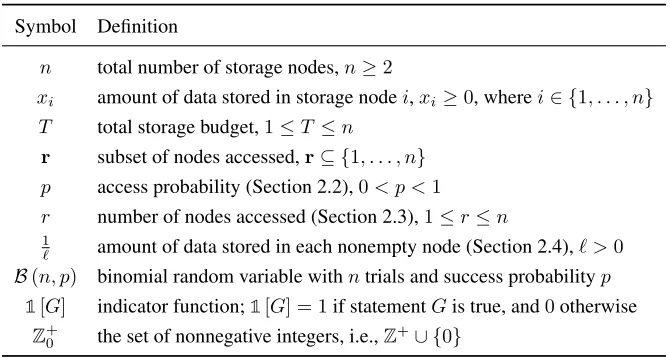
Proofs of theorems are deferred to Section 2.6. Table 2.1 summarizes the notation used throughout this chapter.
2.2
Independent Probabilistic Access to Each Node
In the first variation of the storage allocation problem, we consider a data collector that accesses each of the nnodes independently with probability p; successful recovery occurs if and only if the total amount of data stored in the accessed nodes is at least 1. We seek an optimal allocation
(x1, . . . , xn) of the budget T that maximizes the probability of successful recovery, for a given choice ofn,p, andT. This optimization problem can be expressed as follows:
Π1(n, p, T) :
maximize x1,...,xn
∑
r⊆{1,...,n}
p|r|(1−p)n−|r|·1 [
∑
i∈r
xi ≥1 ]
(2.2)
subject to n ∑
i=1
xi ≤ T (2.3)
The objective function (2.2) is just the recovery probability, expressed as the sum of the probabilities corresponding to the subsetsrthat allow successful recovery. An equivalent expression for (2.2) is
P [ n
∑
i=1
xiYi ≥1 ]
,
whereYi’s are independent Bernoulli(p) random variables. Inequality (2.3) expresses the budget constraint, and inequality (2.4) ensures that a nonnegative amount of data is stored in each node. For the trivial budgetT = 1, the allocation(1,0, . . . ,0)is optimal; forT =n, the allocation(1, . . . ,1)
is optimal. Incidentally, computing the recovery probability of a given allocation turns out to be #P-hard:
Proposition 2.2. Computing the recovery probability
∑
r⊆{1,...,n}
p|r|(1−p)n−|r|·1 [
∑
i∈r
xi ≥1 ]
for a given allocation(x1, . . . , xn)and choice ofpis #P-hard.
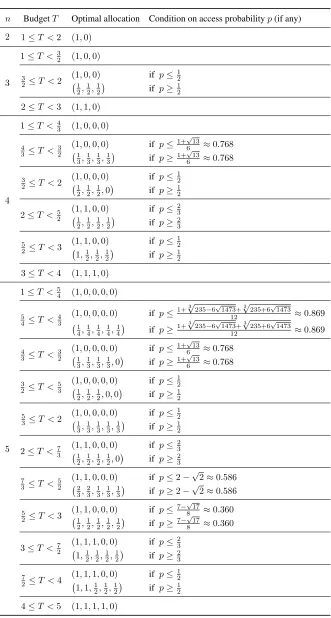
Table 2.2 lists the optimal allocations for n = 2,3,4,5, covering all parameter values of p∈(0,1)andT ∈[1, n). These solutions are obtained by minimizingT for each possible value of the objective function (2.2). We observe that
1) for any T, the symmetric allocation (1, . . . ,1,0, . . . ,0), which corresponds to a minimal spreading of the budget (uncoded replication), appears to be optimal whenp is sufficiently small; and
2) the optimalsymmetricallocation appears to perform well despite being suboptimal in some cases, e.g., when(n, T) =(4,52)andp > 12.
Table 2.2. Optimal allocations for number of nodesn= 2,3,4,5. n BudgetT Optimal allocation Condition on access probabilityp(if any)
2 1≤T <2 (1,0)
3
1≤T < 32 (1,0,0)
3
2 ≤T <2
(1,0,0) if p≤12
(1 2, 1 2, 1 2 )
if p≥1 2
2≤T <3 (1,1,0)
4
1≤T < 4
3 (1,0,0,0)
4 3 ≤T <
3 2
(1,0,0,0) if p≤1+
√
13
6 ≈0.768
(1 3, 1 3, 1 3, 1 3 )
if p≥1+
√
13
6 ≈0.768
3
2 ≤T <2
(1,0,0,0) if p≤1 2 (1 2, 1 2, 1 2,0
)
if p≥12
2≤T < 5 2
(1,1,0,0) if p≤23
(1 2, 1 2, 1 2, 1 2 )
if p≥2 3
5
2 ≤T <3
(1,1,0,0) if p≤1 2
(
1,12,12,12) if p≥12
3≤T <4 (1,1,1,0)
5
1≤T < 54 (1,0,0,0,0)
5 4 ≤T <
4 3
(1,0,0,0,0) if p≤1+ 3
√
235−6√1473+√3235+6√1473
12 ≈0.869
(1 4, 1 4, 1 4, 1 4, 1 4 )
if p≥1+ 3
√
235−6√1473+√3235+6√1473
12 ≈0.869
4 3 ≤T <
3 2
(1,0,0,0,0) if p≤1+
√
13
6 ≈0.768
(1 3, 1 3, 1 3, 1 3,0
)
if p≥1+
√
13
6 ≈0.768
3 2 ≤T <
5 3
(1,0,0,0,0) if p≤1 2 (1 2, 1 2, 1 2,0,0
)
if p≥12
5
3 ≤T <2
(1,0,0,0,0) if p≤12
(1 3, 1 3, 1 3, 1 3, 1 3 )
if p≥1 2
2≤T < 73 (1,1,0,0,0) if p≤ 2 3 (1 2, 1 2, 1 2, 1 2,0
)
if p≥23
7 3 ≤T <
5 2
(1,1,0,0,0) if p≤2−√2≈0.586
(2 3, 2 3, 1 3, 1 3, 1 3 )
if p≥2−√2≈0.586
5
2 ≤T <3
(1,1,0,0,0) if p≤7−
√
17
8 ≈0.360
(1 2, 1 2, 1 2, 1 2, 1 2 )
if p≥7−√17
8 ≈0.360
3≤T < 72 (1,1,1,0,0) if p≤ 2 3
(
1,12,12,21,12) if p≥23 7
2 ≤T <4
(1,1,1,0,0) if p≤12
(
1,1,1 2, 1 2, 1 2 )
if p≥1 2
ofT and contains exactlym∈ {1,2, . . . , n}nonempty nodes:
¯
x(n, T, m),
( T m, . . . ,
T m
| {z }
mentries
, 0, . . . ,0
| {z }
(n−m)entries )
.
Since successful recovery for the symmetric allocation x(¯ n, T, m) occurs if and only if at least ⌈
1/ (mT)⌉ = ⌈mT⌉ out of them nonempty nodes are accessed, the corresponding probability of successful recovery can be written as
PS(p, T, m),P [
B(m, p)≥
⌈m T
⌉] .
2.2.1 Asymptotic Optimality of Maximal Spreading
The recovery probability of the symmetric allocation x¯(n, T, m=n), which corresponds to a maximal spreading of the budget over all nodes, is given by
PS(p, T, m=n) =P [
B(n, p)≥
⌈n T
⌉]
. (2.5)
To establish the optimality of this allocation, we compare (2.5) to an upper bound for the recovery probability of an optimal allocation. Such a bound can be derived by conditioning on the number of accessed nodes:
Lemma 2.3. The probability of successful recovery for an optimal allocation is at most n
∑
r=0
⌊
min
( rT
n ,1 ) (
n r
)⌋
pr(1−p)n−r. (2.6)
The suboptimality ofx¯(n, T, m=n)is therefore bounded by the difference between (2.5) and (2.6), as given by the following theorem; whenp > T1, this allocation becomes asymptotically opti-mal since its suboptiopti-mality gap vanishes asngoes to infinity:
Theorem 2.4. The gap between the probabilities of successful recovery for an optimal allocation
budget over all nodes, is at most
p T P [
B(n−1, p)≤
⌈n T ⌉
−2
] .
IfpandT are fixed such thatp > T1, then this gap approaches zero asngoes to infinity.
We note that the regimep > T1 is particularly interesting because it corresponds to the regime of high recovery probability; the recovery probability would be bounded away from1ifp < T1 ⇐⇒ pT <1instead. This follows from the application of Markov’s inequality to the random variable W denoting the total amount of data accessed by the data collector, which produces
P[W ≥1]≤E[W].
SinceP[W ≥1]is just the probability of successful recovery, andE[W]≤pT according to (2.1), we have
P[successful recovery]≤pT.
2.2.2 Optimality of Minimal Spreading (Uncoded Replication)
The recovery probability of the symmetric allocationx¯(n, T, m=⌊T⌋), which corresponds to a minimal spreading of the budget, is given by
PS(p, T, m=⌊T⌋) =P[B(⌊T⌋, p)≥1] = 1−(1−p)⌊T⌋. (2.7)
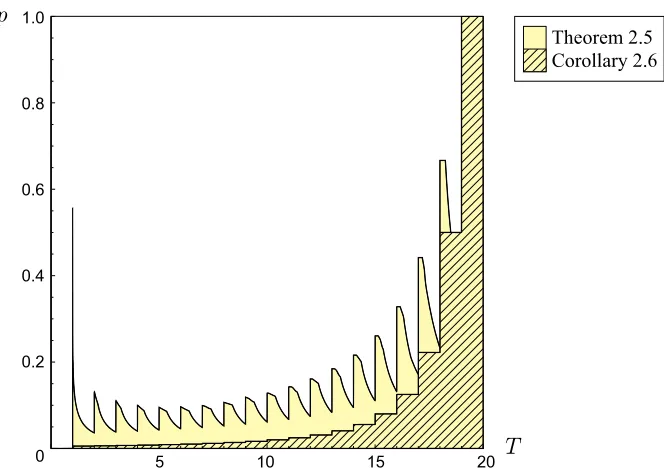
Figure 2.2. Plot of access probabilitypagainst budgetT, showing regions of(T, p)over which the sufficient conditions of the theorems are satisfied, forn= 20. Minimal spreading (uncoded replication) is optimal among all allocations in the colored regions.
Theorem 2.5. If1< T < nand
1−(1−p)⌊T⌋−n+ (n−ℓ)
( p 1−p
)
+
⌈n−ℓ T∑−ℓ⌉−1
r=2
(
1−T−ℓ n−ℓ ·r
) ( n−ℓ
r ) (
p 1−p
)r
≥0
(2.8)
for allℓ∈ {0,1, . . . ,⌊T⌋ −1}, thenx¯(n, T, m=⌊T⌋), which corresponds to a minimal spreading of the budget (uncoded replication), is an optimal allocation.
The following corollary shows that this allocation is indeed optimal for sufficiently smallp:
Corollary 2.6. If1< T < nandp≤ 2
(n−⌊T⌋)2, thenx¯(n, T, m=⌊T⌋)is an optimal allocation.
Figure 2.2 illustrates these results in the form of a region plot for an instance ofn.
2.2.3 Optimal Symmetric Allocation
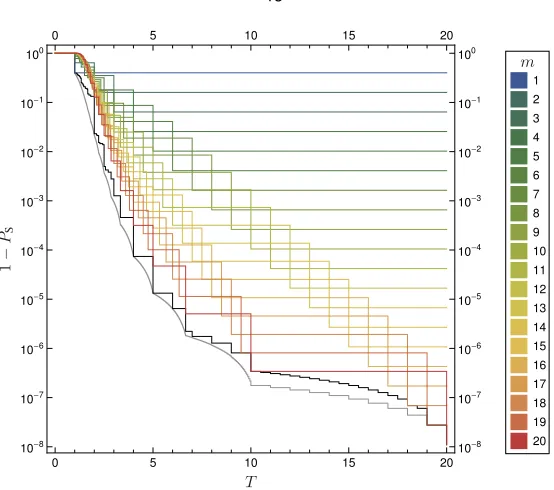
Figure 2.3. Plot of recovery failure probability 1−PS against budget T for each symmetric allocation
¯
x(n, T, m), for(n, p) =(20,35). Parametermdenotes the number of nonempty nodes in the symmetric allocation. The gray and black curves describe lower bounds for the recovery failure probability of an opti-mal allocation, as given by Lemma 2.3 and (2.23), respectively.
symmetric allocation can change drastically as the budgetT varies.
Fortunately, we can eliminate many candidates for the optimal value of mby making the fol-lowing observation: Recall that the recovery probability of the symmetric allocationx(¯ n, T, m)is given byPS(p, T, m),P
[
B(m, p)≥⌈mT⌉]. For fixedn,p, andT, we have
⌈m T
⌉
=k whenm∈((k−1)T, kT],
fork= 1,2, . . . ,⌊nT⌋, and finally,
⌈m T
⌉
=
⌊n T ⌋
+ 1 whenm∈ (⌊n
T ⌋
T, n ]
.
PS(p, T, m)over allmfrom among ⌈n T ⌉ candidates: {
⌊T⌋,⌊2T⌋, . . . , ⌊⌊n T ⌋ T ⌋ , n } . (2.9)
Form=⌊kT⌋, wherek∈Z+, the corresponding probability of successful recovery is given by
PS(p, T, m=⌊kT⌋) =P[B(⌊kT⌋, p)≥k].
The difference between the probabilities of successful recovery for consecutive values ofk ∈Z+ can be written as
∆(p, T, k),PS(p, T, m=⌊(k+ 1)T⌋)−PS(p, T, m=⌊kT⌋)
=P[B(⌊(k+ 1)T⌋, p)≥k+ 1]−P[B(⌊kT⌋, p)≥k]
=
min(α∑k,T−1,k)
i=1
P[B(⌊kT⌋, p) =k−i]·P[B(αk,T, p)≥i+ 1]
−P[B(⌊kT⌋, p) =k]·P[B(αk,T, p) = 0],
whereαk,T ,⌊(k+ 1)T⌋ − ⌊kT⌋. The above expression is obtained by comparing the branches of the probability tree for⌊kT⌋vs.⌊(k+ 1)T⌋independent Bernoulli(p)trials: the first term describes unsuccessful events (“B(⌊kT⌋, p)< k”) becoming successful (“B(⌊(k+ 1)T⌋, p)≥k+ 1”) after the additionalαk,T trials, while the second term describes successful events (“B(⌊kT⌋, p)≥k”) becoming unsuccessful (“B(⌊(k+ 1)T⌋, p)< k+ 1”) after the additionalαk,T trials. After further simplification, we arrive at
∆(p, T, k) =pk(1−p)⌊(k+1)T⌋−k·
min(αk,T−1,k ) ∑
i=1
α∑k,T
j=i+1
(
⌊kT⌋ k−i
)( αk,T
j ) (
p 1−p
)−i+j
−
(
⌊kT⌋ k
)
. (2.10)
The following theorem essentially provides a sufficient condition onpandTfor∆(p, T, k)≥0
nodes (they are identical when nT ∈Z+, i.e.,T =n,n2,n3, . . .):
Theorem 2.7. If
(1−p)⌊T⌋+ 2⌊T⌋p(1−p)⌊T⌋−1−1≤0, (2.11)
then eitherx¯(n, T, m=⌊⌊nT⌋T⌋)orx¯(n, T, m=n), which correspond to a maximal spreading of the budget, is an optimal symmetric allocation.
The following corollary restates Theorem 2.7 in a slightly weaker but more convenient form:
Corollary 2.8. Ifp≥ 3⌊4T⌋, then either¯x(n, T, m=⌊⌊Tn⌋T⌋)orx¯(n, T, m=n)is an optimal sym-metric allocation.
The following lemma mirrors Theorem 2.7 by providing a sufficient condition on pandT for
∆(p, T, k)≤0for anyk∈Z+, thereby eliminating all but the smallest candidate value form∗ in (2.9), i.e.,m=⌊T⌋, which corresponds to a minimal spreading of the budget (uncoded replication):
Lemma 2.9. IfT >1, and either
T = 1 p ∈Z
+ (2.12)
or
T < 1
p and p(1−p)
⌈T⌉−1 ≤ 1
T (
1− 1 T
)⌈T⌉−1
, (2.13)
thenx¯(n, T, m=⌊T⌋)is an optimal symmetric allocation.
The following lemma restates Lemma 2.9 in a slightly weaker but more convenient form:
Lemma 2.10. Ifp≤ ⌈T2⌉− T1, thenx¯(n, T, m=⌊T⌋)is an optimal symmetric allocation.
The following theorem expands the region covered by Lemma 2.10 by showing that
¯
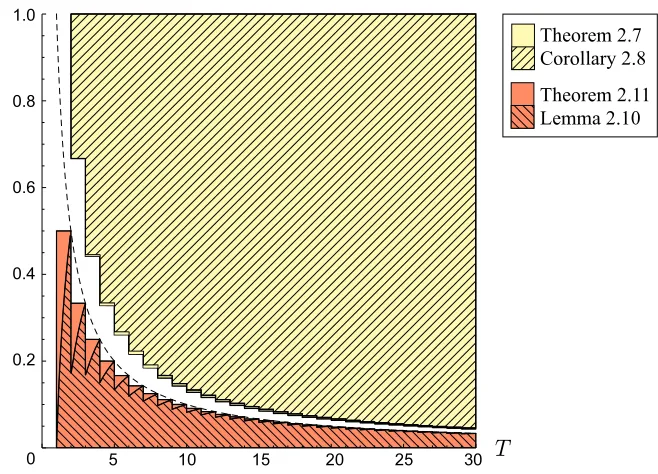
x(n, T, m=⌊T⌋)remains optimal between the “peaks” in Figure 2.4:
Theorem 2.11. If p≤ ⌈T1⌉, thenx¯(n, T, m=⌊T⌋), which corresponds to a minimal spreading of the budget (uncoded replication), is an optimal symmetric allocation.
Figure 2.4. Plot of access probabilitypagainst budgetT, showing regions of(T, p)over which the sufficient conditions of the theorems are satisfied. The black dashed curve marks the points satisfyingp=T1. Maximal spreading is optimal among symmetric allocations in the colored regions above the curve, while minimal spreading (uncoded replication) is optimal among symmetric allocations in the colored regions below the curve.
ofpandT except for the gap aroundp= T1, which diminishes with increasingT. Both minimal and maximal spreading of the budget may be suboptimal among symmetric allocations in this gap on either side of the curvep= T1: for example, when (n, p, T) =(10,259,52), for whichp < T1, the optimal symmetric allocation is x¯(n, T, m=⌊2T⌋); when (n, p, T) =(10,35,125 ), for which p > T1, the optimal symmetric allocation isx¯(n, T, m=⌊3T⌋). In general, for any budgetT ≥2, the optimal symmetric allocation changes from minimal spreading to maximal spreading eventually, as the access probabilitypincreases. This transition, which is not necessarily sharp, appears to occur at aroundp= T1. Interestingly, whenp= T1 exactly, we observe numerically thatx¯(n, T, m=⌊T⌋)
is the optimal symmetric allocation formostvalues ofT; the optimal symmetric allocation changes continually over the intervals
1.5≤T <2 and 2.5≤T ≤2.8911,
2.3
Access to a Random Fixed-Size Subset of Nodes
In the second variation of the storage allocation problem, we consider a data collector that accesses anr-subset of the nnodes selected uniformly at random from the collection of all (nr) possibler-subsets, wherer is a given constant; successful recovery occurs if and only if the total amount of data stored in the accessed nodes is at least1. We seek an optimal allocation(x1, . . . , xn) of the budgetT that maximizes the probability of successful recovery, for a given choice ofn,r, andT. This optimization problem can be expressed as follows:
Π2(n, r, T) :
maximize x1,...,xn,PS
PS (2.14)
subject to ∑
r⊆{1,...,n}:
|r|=r
1
(n r
) ·1 [
∑
i∈r
xi ≥1 ]
≥PS (2.15)
n ∑
i=1
xi ≤ T (2.16)
xi ≥ 0 ∀ i∈ {1, . . . , n}. (2.17)
The left-hand side of inequality (2.15) is just the recovery probability, expressed as the sum of the probabilities corresponding to the r-subsets r that allow successful recovery. The objective function (2.14) is therefore equal to the recovery probability sincePS is maximized when (2.15) holds with equality. Inequality (2.16) expresses the budget constraint, and inequality (2.17) ensures that a nonnegative amount of data is stored in each node. For the trivial budgetT = 1, the allocation
(1,0, . . . ,0) is optimal; for T ≥ nr, the allocation (1r, . . . ,1r), which has the maximal recovery probability of1, is optimal. Incidentally, computing the recovery probability of agivenallocation turns out to be #P-complete:
Proposition 2.12. Computing the recovery probability
∑
r⊆{1,...,n}:
|r|=r
1
(n r
) ·1 [
∑
i∈r
(a)(n, r) = (6,2)
[image:36.612.170.482.68.414.2](b)(n, r) = (5,3)
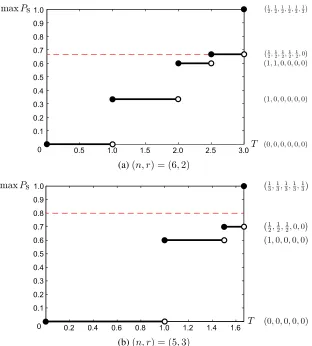
Figure 2.5. Plot of the optimal recovery probabilitymaxPS against budgetT, for (a) (n, r) = (6,2)and
(b) (n, r) = (5,3). The optimal allocation corresponding to each value of maxPS is given on the
right-hand side of the plot. In (a), the red dashed line marks the threshold onPSderived in Theorem 2.15; the
allocation(1r, . . . ,1r)is optimal forΠ′2(n, r, PS)if and only if the desired recovery probabilityPSexceeds
this threshold. In (b), the red dashed line marks the threshold onPSderived in Theorem 2.16; the allocation
(1 r, . . . ,
1
r )
is optimal forΠ′2(n, r, PS)ifPSexceeds this threshold. for a given allocation(x1, . . . , xn)and choice ofris #P-complete.
An alternate way of formulating this problem is to minimize the budgetT required to achieve a desired recovery probabilityPS:
Π′2(n, r, PS) :
minimize x1,...,xn,T
T
subject to the three constraints (2.15)–(2.17) ofΠ2(n, r, T).
two instances of(n, r). These plots are obtained by solvingΠ′2(n, r, PS)for each possible value of
PS. We observe that when the budgetT drops belownr, the optimal recovery probabilitymaxPSis reduced by a significant margin below1. In other words, if the desired recovery probabilityPSin
Π′2(n, r, PS)is sufficiently high, then the optimal allocation is (1
r, . . . ,
1
r )
, which requires a budget of T = nr. In Section 2.3.1, we examine the optimality of this allocation for the high recovery probability regime.
2.3.1 Regime of High Recovery Probability
Consider the optimization problem Π′2(n, r, PS). We will demonstrate that the allocation (1
r, . . . ,
1
r )
is optimal when the desired recovery probabilityPSexceeds a specified threshold ex-pressed in terms ofnandr. Our results follow from the observation that successful recovery for certain combinations of r-subsets of nodes can impose a lower bound on the required budgetT. For example, given(n, r) = (4,2), if successful recovery is to occur for{1,2}and{3,4}, possibly among otherr-subsets of nodes, then we have
∑
i∈{1,2}
xi ≥1 and
∑
i∈{3,4}
xi ≥1,
which would imply that the minimum budgetT must be at least2, since
T ≥
4
∑
i=1
xi = ∑
i∈{1,2}
xi+ ∑
i∈{3,4}
xi≥2.
This observation is generalized by the following lemma:
Lemma 2.13. Consider a setS ⊆ {1, . . . , n}, andcsubsets ofSgiven byrj ⊆S,j = 1, . . . , c. If ∑
i∈rj
xi ≥1 ∀ j∈ {1, . . . , c}, (2.18)
and each element inSappears exactlyb >0times among thecsubsets, i.e., c
∑
j=1
then
∑
i∈S xi≥
c b.
We begin with the special case of probability-1recovery, i.e.,PS= 1. The resulting optimiza-tion problem is just a linear program with all(nr)possibler-subset constraints.
Lemma 2.14. IfPS= 1, then
(1 r, . . . ,
1
r )
is an optimal allocation.
When the desired recovery probabilityPSis less than1, we can afford to dropsomeof ther-subset constraints from this linear program (recall that the recovery probability of an allocation is just the fraction of these (nr) constraints that are satisfied). Our task is to determine how many such constraints can be dropped before the lower bound forT obtained with the help of Lemma 2.13 falls below nr, in which case the allocation(1r, . . . ,1r) may no longer be optimal. We do this by constructing collections ofr-subset constraints that yield the required lower bound of nr forT, and counting how manyr-subset constraints need to be removed from the linear program before no such collection remains. Our answer depends on the divisibility ofnbyr.
Whennis a multiple ofr, we are able to state a necessary and sufficient condition onPSfor the allocation to be optimal:
Theorem 2.15. Ifnis a multiple ofr, then(1r, . . . ,1r)is an optimal allocation if and only if
PS>1− r n.
When n isnot a multiple ofr, we are only able to state a sufficient condition on PS for the allocation to be optimal:
Theorem 2.16. Ifnis not a multiple ofr, then(1r, . . . ,1r)is an optimal allocation if
PS >1−
gcd(r, r′) αgcd(r, r′) +r′,
whereαandr′are uniquely defined integers satisfying
n=α r+r′, α∈Z+0, r′ ∈ {r+ 1, . . . ,2r−1}.
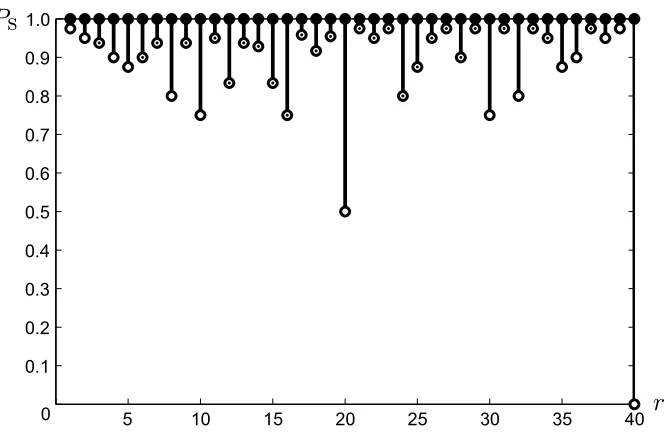
Figure 2.6. Plot of the desired recovery probabilityPS against the number of nodes accessedr, showing
intervals ofPSover which the allocation
(1 r, . . . ,
1
r )
is optimal forΠ′2(n, r, PS), forn= 40. A dotted
cir-cle marker denotes an endpoint that may not be tight, i.e., we have not demonstrated that the allocation is suboptimal everywhere outside the interval.
Corollary 2.17. Ifnis a multiple of(n−r), then(1r, . . . ,1r)is an optimal allocation if and only if
PS> r n.
Note that Corollary 2.17 allows us to solveΠ2(n, r, T)completelywhennis a multiple of(n−r):
for any T ∈[1,nr), the allocation (1,0, . . . ,0) is optimal since it has a recovery probability of
(n−1
r−1)
(n r)
= nr, i.e., exactly the threshold in Corollary 2.17; higher recovery probabilities are not achiev-able unlessT ≥ nr.
Figure 2.6 illustrates these results for an instance ofn.
2.3.2 Upper Bounds for the Optimal Recovery Probability
Consider the optimization problemΠ2(n, r, T). For a given allocation(x1, . . . , xn), letS be the collection of successful subsets, i.e.,
S ,
{
r⊆ {1, . . . , n}:|r|=r,∑ i∈r
xi≥1 }
and letS be the number of successful subsets, i.e.,S =|S|. The following lemma provides sev-eral upper bounds onS, which can be used to bound the optimal recovery probability in both the fixed-size subset access model of Section 2.3 and the independent probabilistic access model of Section 2.2:
Lemma 2.18. For any feasible allocation(x1, . . . , xn), i.e., such that ∑n
i=1xi ≤T andxi≥0for
alli∈ {1, . . . , n}, the number of successful subsetsShas the following upper bounds:
S≤ (
n r )
− gcd(r, r′)
αgcd(r, r′) +r′ (
n r )
ifT < n
r, (2.20)
S≤ ⌊T⌋r n
( n r )
ifT < ⌊n
r ⌋
, (2.21)
S≤ ⌊βT⌋ β r n ( n r ) , (2.22)
where α and r′ are uniquely defined integers satisfying n=α r+r′, α∈Z+0, and
r′ ∈ {r, . . . ,2r−1}, andβ, lcm(nn,r).
Upper bound (2.20) is a corollary of Theorems 2.15 and 2.16. To obtain upper bounds (2.21) and (2.22), we apply permutation counting arguments similar to Katona’s proof of the Erd˝os-Ko-Rado theorem [38, 39]. Picking the tightest of these bounds, and applying the fact thatSis an integer that is at most(nr), produces the following upper bound forS:
SUB(n, r, T),
0 ifT <1,
⌊
min
(
1−1[T < nr]·αgcd(gcd(r,rr,r′)+′)r′,
1−1[T <⌊nr⌋]·(1− ⌊T⌋nr),⌊βTβ⌋nr)(nr)⌋ otherwise.
By combining this bound with the proof technique of Theorem 2.5, we can in turn derive an im-proved upper bound for the optimal recovery probability in the independent probabilistic access model of Section 2.2 (cf. Lemma 2.3):
PSUB(n, p, T), max
ℓ∈{0,1,...,⌊T⌋} (i)
z }| {
1−(1−p)ℓ+
(ii)
z }| {
(1−p)ℓ
n−ℓ ∑
r=2
SUB(n−ℓ, r, T −ℓ)pr(1−p)n−ℓ−r.
Parameterℓdenotes the number of individual nodes that store at least a unit amount of data. At least ℓamount of data is stored in thesecompletenodes, leaving the remaining budget of at mostT−ℓto be allocated over the remainingn−ℓincompletenodes. Term (i) gives the probability of successful recovery from accessing at least one complete node, while term (ii) gives an upper bound on the probability of successful recovery from accessing exactlyr ∈ {2, . . . , n−ℓ}incomplete nodes. A plot of this bound is shown in Figure 2.3.
2.4
Probabilistic Symmetric Allocations
In the third variation of the storage allocation problem, we consider the case where each of the nnodes is selected by the source independently with probabilitymin(ℓTn,1)to store 1ℓ amount of data, so that the expected total amount of storage used in the resultingsymmetric allocation is at mostn·ℓTn ·1ℓ =T, the given budget. The data collector subsequently accesses anr-subset of the nnodes selected uniformly at random from the collection of all(nr)possibler-subsets, whereris a given constant; successful recovery occurs if and only if the total amount of data stored in the accessed nodes is at least1. We seek an optimal probabilistic symmetric allocation of the budgetT, specified by the value of parameterℓ, that maximizes the probability of successful recovery, for a given choice ofn,r, andT. Since successful recovery for a particular choice ofℓoccurs if and only if at least⌈1/ (1ℓ)⌉=⌈ℓ⌉out of theraccessed nodes are nonempty, the corresponding probability of successful recovery can be written as
PS(n, r, T, ℓ),P [
B
( r,min
( ℓT
n ,1 ))
≥ ⌈ℓ⌉ ]
.
This optimization problem can therefore be expressed as follows:
Π3(n, r, T) :
maximize
ℓ P
[
B
( r,min
( ℓT
n ,1 ))
≥ ⌈ℓ⌉ ]
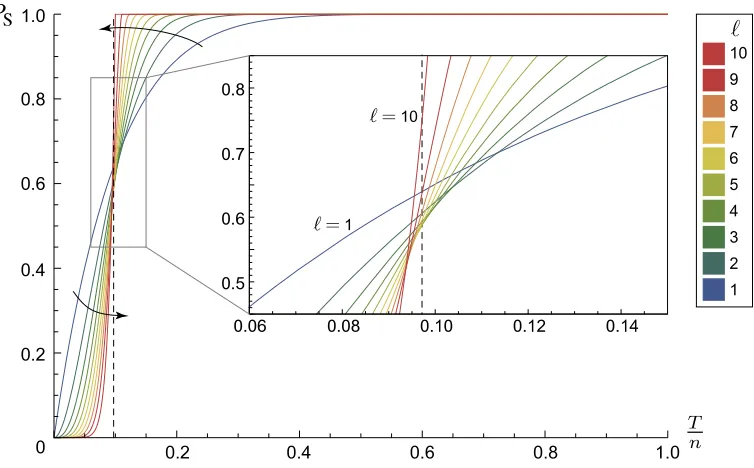
Figure 2.7. Plot of recovery probability PS against budget-per-node Tn for each choice of parameter
ℓ∈ {1,2, . . . , r}, forr= 10. Parameterℓcontrols how much the budget is spread in the probabilistic sym-metric allocation; specifically, each of thennodes is selected by the source independently with probability
min(ℓTn,1)to store 1ℓ amount of data. Arrows indicate the direction of increasingℓ. The black dashed line marks the threshold on Tn derived in Theorem 2.20; maximal spreading (ℓ=r) is optimal for any Tn greater than or equal to this threshold.
For budgetT ≥ nr, the choice ofℓ=r, which yields a recovery probability ofP[B(r,1)≥r] = 1, is optimal.
Observe that the recovery probabilityPS(n, r, T, ℓ)is zero whenℓ > r. Furthermore, for fixed
n,r, andT, the recovery probability is nondecreasing in ℓwithin each of the unit intervals(0,1],
(1,2],(2,3],. . ., since asℓincreases within each interval,⌈ℓ⌉remains constant whilemin(ℓTn,1)
either increases or remains constant at1. Thus, givenn,r, andT, we can find an optimalℓ∗ from amongrcandidates:
{
1,2, . . . , r}. (2.24)
budget, becomes optimal. This observation echoes our findings on the allocation and access models of the preceding sections, namely that minimal spreading (ℓ= 1) is optimal for sufficiently small budgets, while maximal spreading (ℓ=r) is optimal for sufficiently large budgets. However, we note two important distinctions in contrast to the previous models. First, the recovery probability for a probabilistic symmetric allocation in this model is a continuous nondecreasing function of the given budget; there are no “jumps” from one discrete value to the next. Second, our empirical computations suggest that the phase transition from the optimality of minimal spreading to that of maximal spreading in this model issharp; the other intermediate values ofℓ∈ {2, . . . , r−1}never perform better than bothℓ= 1andℓ=rsimultaneously.
In Section 2.4.1, we shall demonstrate that the choice ofℓ=r, which corresponds to a max-imal spreading of the budget, is indeed optmax-imal when the given budget T is sufficiently large, or equivalently, when a sufficiently high recovery probability is achievable.
2.4.1 Optimality of Maximal Spreading
Assume that r≥2. As noted earlier, the choice ofℓ=r, which corresponds to a maximal spreading of the budget, is optimal for anyT ≥ nr because it yields the maximal recovery probability of1. The following lemma provides an upper bound for the recovery probabilities corresponding to theothercandidate values forℓ∗ in (2.24) at the critical budgetT = nr:
Lemma 2.19. The probability of successful recoveryPS(n, r, T, ℓ) atT = nr is at most 34 for any ℓ∈ {1,2, . . . , r−1}.
Such an upper bound allows us to derive a sufficient condition for the optimality ofℓ=r, by making use of the fact that the recovery probabilityPS(n, r, T, ℓ)is a nondecreasing function of the budget
T. The following theorem shows that the choice ofℓ=ris optimal when the budgetT is at least a specified threshold expressed in terms ofnandr:
Theorem 2.20. If
T ≥ n r
(
3 4
)1
r ,
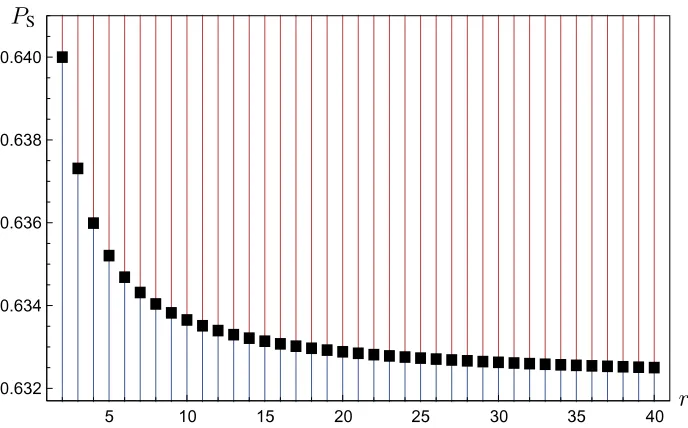
Figure 2.8. Plot of recovery probabilityPSagainst the number of nodes accessedr, indicating the value of PSat which the optimal choice of parameterℓchanges from1tor, for each given value ofr. Specifically, if
it is possible to achieve a recovery probabilityPSabove the square marker, then maximal spreading (ℓ=r)
is optimal; otherwise, minimal spreading or uncoded replication (ℓ= 1) is optimal. Observe that the critical value ofPSforr= 10(which is approximately0.633652) corresponds to the intersection point of the curves
forℓ= 1andℓ= 10in Figure 2.7.
it demonstrates the optimality ofℓ=rin the high recovery probability regime:
Corollary 2.21. If a probability of successful recovery of at least 34 is achievable for the givenn,r,