Comparative Study of AI-2%SI Alloys With the
Addition of Yttrium Oxide (Y
2
0
3
) For Different Process
Parameters Using Friction Stir Welding Techniques
1
Dr. YuvarajaNaik,
Assistant Professor, School of Mechanical, Presidency University, Bangalore-064, Karnataka, India
2
Arjun S,
Assistant Professor, Department of Mechanical Engineering,SaiVidyaInstitute of Technology, Bangalore-064, Karnataka, India.
3
Manjunath B.R,
Assistant Professor,Department of Mechanical Engineering, KSIT, Bangalore, Karnataka,India.
ABSTRACT
In the joining process Friction stir welding is one of the processes, where the tool is plunged between the alloys diffuses to plastic state it and makes a bond between the two alloys. It is used for applications where the base material characteristics need to remain constant after welding. Friction stir welding techniques, currently used in a wide range of applications such as aerospace, shipbuilding, railway industries and many more. Present study includes preparation of Al-2%Si alloys using stir casting techniques and machined into plates of standarddimensions (120 x 60 x 6) mm. Friction stir welding process is carried out of Al-2%Si alloy and with the addition of yttrium oxide (Y2O3) using different process parameter like tool rotational speed,rpm and feed rate mm/min. Also, the microstructure formation, tensile strength and hardness values for the weld joints are discussed and compared, for hypo eutectic alloys (Al-2%Si) of the alloy.
Key words: FSW, hypo eutectic alloys, Feed, Tool rotational speed etc.,
1. INTRODUCTION
Friction Stir Welding (FSW) was invented in 1991 by The Welding Institute [1], United Kingdom. After that, many numerical/analytical and experimental methods, and finite element methods have been developed. Aluminium alloys are used as an engineering materials, in extensive ranges of applications due to its light weight and itsstrength. Commercial by available aluminum has a tensile strength around 90 MPa. In this present study by using stir casting techniques the mixture of Al-2%Si alloy is prepared [2-3] and increase in the silicon content leads to higher hardness and impact strength along with weight. The hardness and impact strength with an increase in weight percentage of silicon increased and proposed for work for the various engineering applications.Four compositions of Al-Si alloys were studied noticed that enhancement in the wear characteristics for the addition of 5%SiC with in the alloys. For different process parameters further increase in the Si content leads to enhancement in the microstructure and joining process [4-5].For variable speeds from 400 to 800 rpm and defects are reduced and for higher rates tunnel and voids are noticed [6],performed a friction stir processing (FSP) on aluminum alloy 356 plates to improve the mechanical properties and alteration of microstructure [7].By introducing tracer material by varying process parameter rotating speed and welding speed to investigate the material radiographic and metallographic properties[8].friction stir welding of Al-30Si alloy is carried out and investigated the corrosion property for single pass and it will get reduced for[9] multiple passes. The current investigation includes that Friction stir welding of Al-2%Si alloy is carried out for three process parameter tool rotational speed 600 rpm,900rpm and 1200rpm and feed rate 50mm/min,100mm/min &150mm/min, with tapered tool is 6mm to 4mm is used and same is comparing the same with the addition of yttrium oxide .This paper gives Comparative study between with and without addition of yttrium oxide and mechanical characterization like appearance study, plunging depth, microstructure , hardness and tensile strength.
Table:1 Chemical Composition of Al-Si alloy
Al alloys
Wt% Composition
Si Mg Fe Zn Mn Cu Al
2. EXPERIMENTAL WORK
[image:2.595.201.427.191.310.2]The material used in the current research consists of Al-alloys, It consists 2%Si rest pure aluminum balance is shown in Table 1. The Al matrix was reinforced with Si particle with varying percentage further composite were cast using Muffle stir casting process as it ensure uniform distribution of the reinforcement and further casted plates are prepared of the required dimensions (120 x 60 x 6) mm.
Fig 1 5-Axis Friction Stir Welding Machine (Courtesy IISC Bangalore)
[image:2.595.229.431.470.580.2]Fig.1 Friction stir welding is carried out using 5-Axis Friction Stir welding Machine having rigid stiffness, with accurate measuring loading frame of 5 axis movements used for the process, (X- Horizontal-Transverse, Z-Vertical and RL –Rotation left, RR –Rotation right) There is independently controlled servo-actuators having an advanced features of controller for movement of each axis. These systems are generally used for welding aluminum sheets and other alloys. Vertical load capacity is 50 kN with maximum rotational speed 3000 rpm , 500 mm stroke length in X and Y axis, Wide range of options, straight, 3D ,contour, profile welding, etc., Testing & calibration, Tilt angle 2 deg . Different process parameters like tool rotational speed and feed rate are mentioned below table 2. To perform welding process High Density Tool is used of taper 6 mm to 4mm with 5.2 mm depth. Surface roughness tester is used to measure the surface roughness number. It has a probe moving on the weld surface for certain distance, and three trials roughness measurement are recorded and shown in fig 2.
Fig 2. Measurement of surface roughness of Friction welded joint with the SJ-210
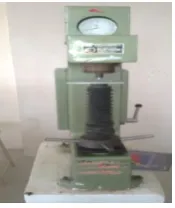
[image:2.595.282.370.629.733.2]The Brinnel hardness Testing machine is shown for measuring weld hardness in Fig 3. The Venus make having loading capacity up to 250kgf. A 10mm diameter steel ball indenter is used to measure the weld surface.
Table 2 Tool rotational speed in Rpm and Feed rate in mm/min
Alloys Tool Rotational Speed
in, Rpm Force in KN
Feed rate
(mm/min)
Al-2Si
600 30 50
900 25 100
1200 20 150
3. RESULTS AND DISCUSSIONS
3.1Surface Appearance Test
The increases in the silicon content of the alloy strongly affect the metal flow and in turn the desired mechanical properties. For the FSW process of Al-2Si alloy, the metal undergoes a severe plastic deformation at the nugget zone.
[image:3.595.67.515.342.544.2]Al-2%Si Al-2%Si with yttrium oxide , (Y2O3)
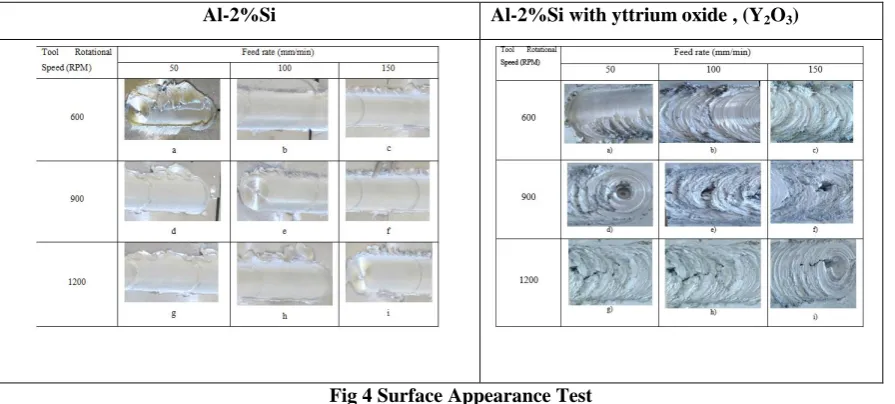
Fig 4 Surface Appearance Test
Surface appearance test is shown in fig 4, Al-2%Si alloy shows severe plastic deformation because of its softness and due to lower speed and feed rate high contact time taken place between tool shoulders and the work piece and accumulation of lump of aluminum on the Retracting side of the weld joint. Further increase in the tool rotational speed and feed rate there is discontinues chips are occurs at the walls of the weld joint. Addition of yttrium oxide increases the mixing of the alloy and proper mixing of the alloy taken place and makes harder the weld surface.
Table 3 Characteristics of yttrium oxide (Y2O3)
Molar mass 225.81 g/mol
Melting point: 2,425 °C
Boiling point: 4,300 °C
Appearance: White solid
[image:3.595.138.459.657.755.2]3.2 Plunging Depth
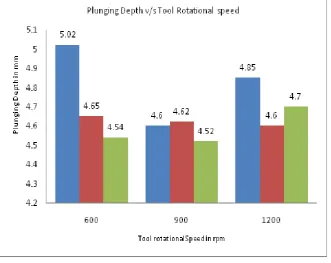
[image:4.595.134.466.210.473.2]From the earlier explanation, there is a severe deformation happening during the joining of Al-2Si alloys. The tool easily plunges the alloy, overcoming friction and thrust force. Here, the plunging depth of 5.02mm is noted for the tool rotational speed of 600rpm and feed rate 50mm/min and further increase in rotational speed due to less contact between the tool shoulder and surface of the plate 4.6 mm to 4.85 mm plunging depth is recorded. In addition of the yttrium oxide plunging is very difficult and due to improper stirring very mere plunging depth is observed.
Fig 5 Plunging Depth v/s Spindle speed, Rpm and Feed rate in mm/min
3.3 Surface Roughness
Fig 6 Surface Roughness v/s Spindle speed and Feed Rate
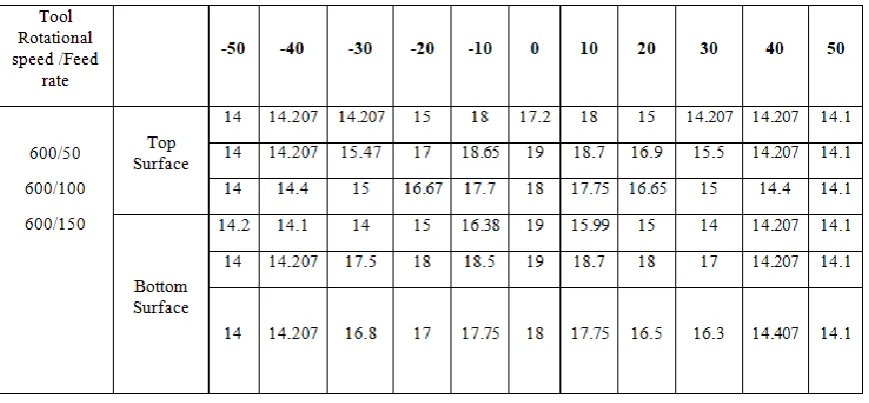
From Fig 4 addition of yttrium oxide makes more harder surface it leads to high surface number compare to Al-2%Si alloys higher the surface roughness number may leads to poor weld joint.
3.4 Brinnel hardness test
In Hypo eutectic alloys, during the lower process parameters, the alloy undergoes severe deformation during the process. The tool reaches near to the bottom surface of the alloy during the plunging action of the tool. The proper grinding of the alloys takes place below the tool pin and the increase in the hardness value nearly 4.6% is recorded in the nugget zone.
[image:5.595.85.520.539.740.2][image:6.595.169.429.210.443.2]
In Table 5 There was a significant improvement in the hardness value, when compared with the specimen processed without the addition of Yttrium powder. The hardness value was found to be in the range 65 to 87BHN, which was a considerable improvement in its value by the addition of yttrium powder. Here, the dynamic movement of the diffused layer will impede the free dislocation movement and thus enhances the heat flow and improve the hardness in the weld region.
Table 5 Brinnel Hardness value Al-2Si with addition of yttrium oxide (Y2O3) at nugget zone
Sl.no Tool speed/Feed rate, rpm & mm/min BHN
1 600/50 64.97
2 600/100 64.97
3 600/150 75
4 900/50 71.3
5 900/100 75
6 900/150 64.97
7 1200/50 64.97
8 1200/100 87
9 1200/150 75
3.5 Tensile Strength
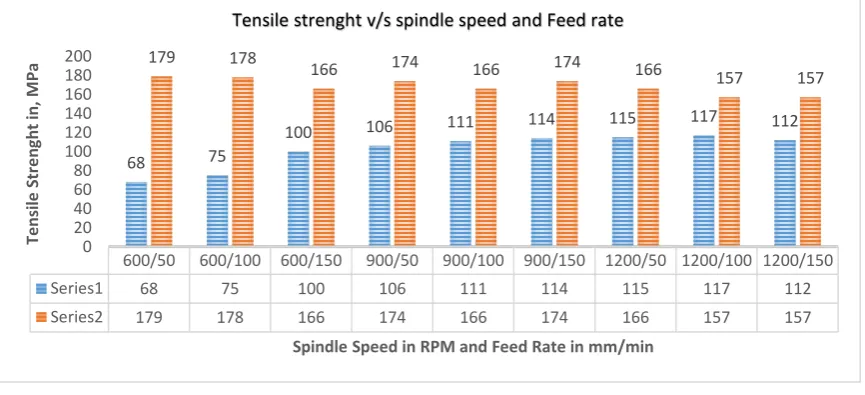
From the earlier Appearance test, surface roughness test and plunging depth study Al-2%si alloys shows more tensile strength of 114 MPa to 117MPa because higher tool rotational speed with lower feed rate uniform mixing of the alloy will be taken place and achieved more tensile test that mentioned below but in addition of yttrium oxide if we take Comparision with the hardness value it shows 65% enhancement in the tensile strength for variable process parameters mentioned in fig 7, so detailed study is necessary.
Fig 7 Tensile strength v/s Spindle speed in RPM & Feed Rate for both Al-2%Si alloy and with the addition of yttrium oxide (Y2O3)
600/50 600/100 600/150 900/50 900/100 900/150 1200/50 1200/100 1200/150
Series1 68 75 100 106 111 114 115 117 112
Series2 179 178 166 174 166 174 166 157 157
68 75
100 106 111 114 115 117 112
179 178
166 174 166 174 166 157 157
0 20 40 60 80 100 120 140 160 180 200 Tensi le S tr e n gh t in , M Pa
[image:6.595.74.507.522.719.2]3.6 Microstructure
3.6.1 Al-2%Si alloy
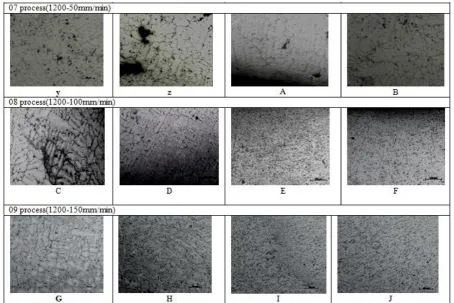
Fig 8 (a-J) Microstructure for Al-2Si alloys at different locations
Overall, at a lower tool rotational (600 rpm), there is a severe plastic deformation in the alloy forming fine structures in the advancing and retarding side of the weld portion. The dendrite type structures are noticed on the top surface of the weld due to improper spreading of the alloy on the weld surface. A mere increase in hardness value are found out for increase in tool feed rate, say 150mm/min, there is no much deformation of the alloy, since the plunging tool did not penetrate properly. The reduction in the breakage of silicon particle and less deformation are occurred finally. The increase in the tool rotation makes deformation on the advancing side and moves around the tool circumference. There is difficulty in penetrating diffused alloy on the retracting side and hence accumulates heat in this region. This creates dendrites structure on the retarding side of the zone. Small dendrites are also seen in the top weld zone, which may be due to the accumulation of heat, but reduces, with the increase in the tool rotational speed.
3.6.2 Al-2%Si alloy with addition of yttrium oxide (Y2O3)
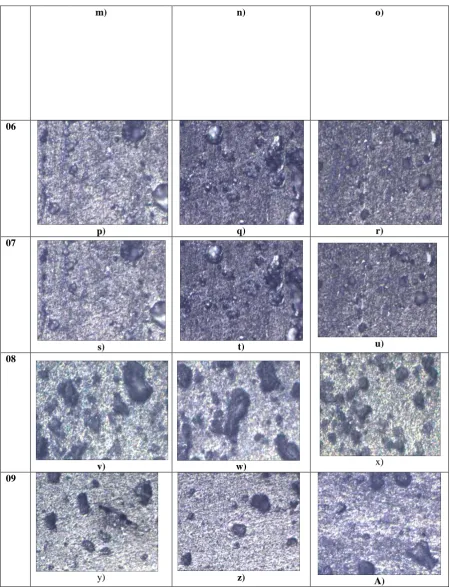
The microstructure formations in the weld joint are shown in figure 9(a-A). During the lower process parameters (600rpm; 50mm/min), a severe deformation of the alloy was found in the earlier process. This severe deformation was reduced by the addition of yttrium. The ability of the diffused alloy in circulating the tool circumference was improved and the lump formation was reduced. The dislocation line which was noticed in the earlier process is reduced here.
[image:9.595.71.526.144.447.2]AS NZ RS
01
a) b) c)
02
d) e) f)
03
g) h) i)
04
j) k) l)
Fig 9 Al-2%Si with addition of the yttrium oxide (Y2O3)
m) n) o)
06
p) q) r)
07
s) t) u)
08
v) w) x)
09
4. CONCLUSIONS
Friction stir welded joints of Al-2%Si alloy and with addition of yttrium oxide (Y2O3) were fabricated and Mechanical characterization like tensile strength, hardness test and microstructure were studied and following conclusions are mentioned below.
[1]. FSW is carried out for three different process parameter like tool rotational speed and feed rate. Al-2%Si alloys shows better appearance, plunging depth and surface roughness value compared with the addition of the yttrium oxide(Y2O3).
[2]. Compared to Al-2%Si alloys shows better hardness value and Tensile strength shows in addition of yttrium oxide(Y2O3) needed further investigations.
[3]. For lesser feed and speed, Al-2%Si shows uniform mixing at the nugget zone and it shows fine particles with sound weld joint but in addition of yttrium oxide most porous particles are observed need to be investigated further.
ACKNOWLEDGMENT
The authors gratefully acknowledge the support by the CMTI and Mechanical Engineering Department IISc Bangalore to carry out this research.
REFERENCES
[1]. W.M. Thomas, G.B. Patent Application No. 9125978.8 (1991)
[2]. Dinesh Pargunde, "Fabrication of Metal Matrix Composite by Stircasting Method," International Journal of Advanced Engineering Research Studies, vol. II/IV, pp. 4951, July-Sep 2013
[3]. K Hemalatha and K Venkatachalapathy,NAlagaurthy, "Processing and Synthesis of Metal Matrix Al6063/AL2O3 Metal Matrix Composite by Stircasting Process," Journal of Engineering Research and Applications, vol. 3, no. 6, pp. 1390-1394, Nov-Dec 2013
[4]. KamalpreetRamakishoreAnant and O.P Pandey, "TribologicalBehaviour of SiC particle Reinforced Al-Si Alloy," Springer, pp. 41-58, 25th June 2011
[5]. J M Garci a-Infanta, A P Zhilyaev, and F Carreno, "Strain Path Microstructure Evaluation during Severe Deformation Processing of an as-cast Hypoeutectic Al-Si Alloy," Journal of MAterial Science, pp. 4613-4620, 2010.
[6]. Z.Y Mao Z. Zhang. B.L Xia, "Effect of welding parameters on microstructure and mechanical properties of friction stir welded 2219 Al-T6 joints"," Journal of Material Science, pp. 4075-4086, january 2012.
[7]. Z Y Ma,S.R Sharma And R.S Mishra, "Microstrctural Modification of As-Cast Al-SiMg alloy by Friction stir processing," Metallurgical and Materials Transactions A, vol. 37A, p. 3323, November 2006
[8]. M Ramulu Paul D Edwards, "Maaterial Flow during friction stir welding of Ti-6Al4V," Journal of Material Processing Technolgy, pp. 107-115, December 2014