51
Efficiency Improvement of SI/CI Engine by Using
Blend of Oxy-Hydrogen Gas with Fuel
Prashant N. Pakale
1, Nrendra.B.Pawar
2, H.G.Patil
3, S.U.Patel
4Mechanical Engineering Department, DNP COE Shahada, Maharashtra, India.1, 3, 4, Mechanical Engineering Department, S.G.D.C.O.E Jalgaon, Maharashtra, India.2
PG Student 1, 2, Assoc.Prof.3, H.O.D 4
Email: [email protected],[email protected],[email protected], [email protected] 4
Abstract- This Today the whole world is facing two major problems one is increasing pollution and rapid use of fossil fuels. So there is a need to control pollution and reduce fuel consumption. Incomplete combustion of fuel causes pollution and reduction in fuel utilization. We are looking for such source of energy which helps for complete combustion of fuel and increases fuel utilization which ultimately reduces the pollution. In order to overcome the drawbacks of the regular petroleum fuel, it is the need of time to completely or partially replace the petroleum fuel. But alternative options to petroleum fuel are having disadvantages. An electric or compressed air driven cars cannot be used where high torque is required or using hydrogen as fuel requires very costly storage equipment’s. In this research work an attempt has been made to reduce the drawbacks of petroleum fuels. Electrolysis of water can give us hydrogen in form of oxy-hydrogen gas which can be used as an alternative fuel for any internal combustion engine. This paper discusses various methods designed for the production of oxy-hydrogen gas. Later blend of ‘oxy-hydrogen gas’ and petrol or diesel is used instead of only petrol/diesel to study the influence of the ‘oxy-hydrogen gas’ on the performance of the internal combustion engine. All together it has been observed that the blend of ‘oxy-hydrogen gas’ and petrol instead of only conventional fuel improves the performance of the engine.
Index Terms- Brake thermal efficiency of Engines, Electrolysis of Water, Oxy-Hydrogen Gas, SI/CI Engine.
1. INTRODUCTION
Oxy-hydrogen gas is a mixture of ‘hydrogen’ and ‘oxygen’ bonded together. Oxy-hydrogen gas is produced by electrolysis of water using caustic soda or KOH as the catalyst. Due to using ‘oxy-hydrogen gas’ in I.C. Engines during combustion process decreases the ‘brake specific fuel Consumption’ and also increases the ‘brake thermal efficiency. In this process water is by-product of the combustion process which also decreases the temperature of the combustion process. It is safe to use ‘oxy-hydrogen gas’ as it is not stored but is produced and used when required. Together with ‘brake thermal efficiency’ of engine shows improvement in the ‘brake thermal efficiency’ with the blend of fuel. All together it has been observed that the blend of ‘oxy-hydrogen gas’ and petrol instead of only conventional fuel improves the performance of the engine.
In order to overcome the drawbacks of the regular petroleum fuel, it is the need of time to completely or partially replace the petroleum fuel. But alternative options to petroleum fuel are having disadvantages. An electric or compressed air driven cars cannot be used where high torque is required or using hydrogen as fuel requires very costly storage equipment’s. In
this paper, an attempt has been made to reduce the drawbacks of petroleum fuels.
The need of thesis for following reason
[1] To Increases Mileage
[2] To Increases the power & Performance of Vehicle
[3] To Reduces Engine Noise & Vibration
[4] To Increases Life span of Engine
[5] To Increases Burning Efficiency
[6] To Reduces Pollution
[7] To Reduce the engine temperature
This paper aim is that it will useful for bike to increases it’s mileage without any major changes in design.
2. METHODOLOGY
52 Different methods used to control the emissions
MPFI, EGR, PCV, evaporative emission control, oxygen sensors etc. which minimize the rate of emission through I.C. engine and gives proper combustion of fuel in engine.
[1] Magnetic Fuel Conditioner:
It has disadvantage that, if the strength of the magnet is increased it will overflow the whole tank of vehicle if the cock is kept in on position.
[2] By Oxy-Hydrogen Gas:
Electrolysis of water can give us hydrogen in form of oxy-hydrogen gas which can be used as an alternative fuel for any internal combustion engine.
2.2 Properties of Hydrogen as alternative fuel
[image:2.595.67.289.488.776.2]Hydrogen has been considered as a fuel for I.C. Engines for more than 100 years. In 1820, Cecil was first man who recommended the use of hydrogen as fuel for engines and Roudolf Erren makes more than 1000 vehicles which run on hydrogen and fuel blends. Hydrogen has several unique properties, some quite different from conventional liquid fuels, which are summarized in Table. 1
Table 1-Combustion properties of hydrogen and gasoline
The properties that contribute to its use as a combustible fuel are:
i. Wide Range of Flammability :-
Hydrogen has a wide flammability range in comparison with all other fuels. By Combustion of any fuel with an excess of air is a desirable because of it will completely burn and produces less pollutants. Wide range of fuel-air mixtures will be suitable for combustion in I.C. Engines. One of the main advantages of hydrogen is that, it needs less amount of fuel i.e. less than the theoretical, stoichiometric or chemically ideal with given amount of air for burning. Hence it is fairly easy to get an engine to start on hydrogen. Additionally, the final combustion temperature is generally lower; Fuel economy is greater, reducing the amount of pollutants, such as nitrogen oxides, emitted in the exhaust while running on lean mixture. But there is some limit to use lean mixture as it reduces power output due to a reduction in the volumetric heating value of the air/fuel mixture.
ii. Low Ignition Energy :-
Hydrogen has very low ignition energy. The amount of energy needed to ignite hydrogen is about one order of magnitude less than that required for gasoline. This enables hydrogen engines to ignite lean mixtures and ensures prompt ignition. Unfortunately, the low ignition energy means that hot gases and hot spots on the cylinder can serve as sources of ignition, creating problems of premature ignition and flashback. Preventing this is one of the challenges associated with running an engine on hydrogen. The wide flammability range of hydrogen means that almost any mixture can be ignited by a hot spot.
iii. Small Quenching Distance :-
Hydrogen has a small quenching distance, smaller than gasoline. So, hydrogen flames travel closer to the cylinder wall than other fuels before they extinguish. Thus, it is more difficult to quench a hydrogen flame than a gasoline flame. The smaller quenching distance can also increase the tendency for backfire since the flame from a hydrogen-air mixture more readily passes a nearly closed intake valve, than a hydrocarbon-air flame.
iv. High Auto ignition Temperature :-
Hydrogen has a relatively high auto ignition temperature. This has important advantage when a hydrogen-air mixture is compressed. Generally auto ignition temperature is an important factor in determining what compression ratio used for engine, since the temperature rise during compression is related to the compression ratio. The temperature rise is shown by the equation:
Property Hydro
gen
Gasoline (Petrol)
Molecular weight 2.02 91.4 Stoichiometric
composition in air, vol.% 29.53 1.76 Minimum energy of
Ignition in air, mJ. .02 0.24 Auto-ignition
temperature, K. 858 501-744 Flame temperature, K 2318 2470 Burning velocity at NTP
in air, cm s-1
265-325 37-43 Diffusivity in air, cm2 s-1 0.63 0.08 Limits of flammability
(equivalence ratio) 0.1-7.1 0.7-3.8 Density at 1 atm. &
300K, kg m-3 0.082 5.11 Lower Heating value, MJ
kg-1 119.7 44.79
Lower Heating value, MJ
m-3 10.22 216.38
Ratio of specific heat at
53 Where:
V1/V2 = the compression ratio γ = ratio of specific heats
T1 = absolute initial temperature T2 = absolute final temperature
The temperature may not exceed hydrogen’s auto ignition temperature without causing premature ignition. Thus, the absolute final temperature limits the compression ratio. The high auto ignition temperature of hydrogen allows larger compression ratios to be used in a hydrogen engine than in a hydrocarbon engine. This higher compression ratio is important because it is related to the thermal efficiency of the system and hydrogen is difficult to ignite in a compression ignition or diesel configuration, because the temperatures needed for those types of ignition are relatively high.
v. High Flame Speed :-
Hydrogen has high flame speed at stoichiometric ratios. Under these conditions, the hydrogen flame speed is nearly more than that of gasoline. This means that hydrogen engines can more closely to ideal engine cycle. At leaner mixtures, however, the flame velocity decreases.
vi. High Diffusivity :-
Hydrogen has very high diffusivity. This ability to disperse in air is considerably greater than gasoline and is advantageous for two main reasons. Firstly, it allows the formation of a uniform mixture of fuel and air. Secondly, if a hydrogen leak develops, the hydrogen disperses fastly. Thus, unsafe conditions can either be avoided or minimized. \
vii. Low Density :-
Hydrogen is the lightest element and and having very low specific volume and an extremely low density, both as a gas and as a liquid. So, efficiency will falls down when hydrogen is added to the intake of an engine. Low energy density property could be a major advantage that it disperses in the atmosphere much more rapidly. Hydrogen has density of 0.08376 kg m3. This results in two problems when used in an internal combustion engine. Firstly, a very large volume is necessary to store enough hydrogen to give a vehicle an adequate driving range. Secondly, the energy density of a hydrogen-air mixture, and hence the power output, is reduced.
viii. Stoichiometric Air/Fuel Ratio calculation for
Hydrogen :-
The theoretical or stoichiometric combustion of hydrogen and oxygen is given as:
2 H2 + O2 = 2 H2O Moles of H2 for complete combustion = 2 moles Moles of O2 for complete combustion = 1 mole
Because air is used as the oxidizer instead oxygen, the nitrogen in the air needs to be included in the calculation:
Moles of N2 in air = Moles of O2 x (79% N2 in air / 21% O2 in air) = 1 mole of O2 x (79% N2 in air / 21% O2 in air) = 3.762 moles N2
Number of moles of air = Moles of O2 + moles of N2 = 1 + 3.762
= 4.762 moles of air
Weight of O2 = 1 mole of O2 x 32 g/mole = 32 g
Weight of N2 = 3.762 moles of N2 x 28 g/mole = 105.33 g Weight of air = weight of O2 + weight of N (1) = 32g + 105.33 g
= 137.33 g Weight of H2 = 2 moles of H2 x 2 g/mole = 4 g
Stoichiometric air/fuel (A/F) ratio for hydrogen and air is:
A/F based on mass: = mass of air/mass of fuel = 137.33 g / 4 g
= 34.33:1
A/F based on volume = volume (moles) of air/volume (moles) of fuel = 4.762 / 2
= 2.4:1
The percent of the combustion chamber occupied by hydrogen for a stoichiometric mixture:
% H2 = volume (moles) of H2/total volume (2) = volume H2 / (volume air + volume of H2) = 2 / (4.762 + 2)
= 29.6%
As above calculations show, the stoichiometric or chemically correct A/F ratio for the complete combustion of hydrogen in air is about 34:1 by mass. This means that for complete combustion, 34 Kg. of air are required for every Kg. of hydrogen. This is much higher than the 14.7:1 A/F ratio required for gasoline.
Since hydrogen is a gaseous fuel used for efficient combustion than a liquid fuel. Consequently less of the combustion chamber can be occupied by air. At stoichiometric conditions, hydrogen displaces about 30% of the combustion chamber, compared to about 1 to 2% for gasoline.
54 As we see the properties of the fuel, come to know
that hydrogen fuel is extremely desirable. The ignition energy required to ignite an air-fuel mixture depends very much on the air-fuel or equivalence ratio. Hydrogen has an extremely low ignition energy compared to gasoline. The low minimum ignition energy enables the conventional ignition system to be effective with a very low energy spark whereas at the same time it makes the system susceptible to surface ignition. Surface ignition is a highly undesirable combustion phenomenon because it precipitates flashback, pre-ignition and rapid rates of pressure rise Based on the lower flammability limit, hydrogen seems to be superior to gasoline, but a small leakage from a hydrogen operated system brings in the problem of safety. As far as the quenching distance is concerned, hydrogen combustion which can be initiated with a low energy spark becomes difficult to quench. Because of the smaller quenching distance of hydrogen, a flame in a hydrogen-air mixture escapes more readily past an even nearly closed intake valve than a hydrocarbon-air mixture. Pre-ignition is supposed to be a common occurrence in hydrogen engines since the low ignition energy of the fuel. In principle, pre-ignition during compression stroke is less likely to occur in hydrogen engines because the conditions those are responsible for it to occur, practically lead to pre-ignition during intake stroke. Pre-ignition often results in excessive combustion temperatures, rough running and decreased thermal efficiency. Detonation takes place as a result of increased combustion temperature. Knocking occurs due to high rate of flame propagation. Some researchers have found that the knocking sound in a hydrogen engine is quite similar to the sound heard when detonation occurs.
+The minimum ignition energy required for ignition (0.02 mJ) of a hydrogen-air mixture has often been responsible for the fresh charge being ignited by the hot spots in the combustion chamber and thereby causing a flame that propagates through the induction system giving rise to backfire. The simplest method to avoid backfire is to ensure the absence of combustible mixture in the intake manifold. A reduction of temperature level could also prove very effective. On the other hand, conditions leading to pre-ignition could be disposed of by preparing a late hydrogen-air mixture.
These can be achieved by various methods such as: (i) Use of leaner mixtures,
(ii) Exhaust gas recirculation,
(iii) Intake air cooling (by liquid hydrogen or by water) and
(iv) Reduction of valve overlap.
Several investigators have adopted various means to combat the effect of these phenomena in a hydrogen operated engine. The mode of mixture preparation has
been found to be quite important in determining the overall operational characteristics of a hydrogen engine.
2.4 METHODS OF OXY HYDROGEN GAS GENERATION:
There are two general methods which are used in work for the generation of oxy-hydrogen gas.
1) By producing Resonance inside the water molecule.
2) By the use of basic principal of Faraday’s Law.
1) First method: By producing Resonance inside
the water molecule:
In this method, the resonance is produced inside water molecules between the electrodes by DC pulses (typically square wave output). This alteration at natural frequency of water causes enormous electrical force to break the bond between the hydrogen and the oxygen and they freed as gas molecules which are magnetically coupled to each other.
The limitation of this method: 1) Bulky structure.
2) Complex in design.
3) Large space require for installation.
As above method is disadvantages hence we use the second method for generation of Oxy-Hydrogen gas i.e. by the use of basic principal of Faraday’s Law,
3. SYSTEM LAYOUT DEVELOPMENT
Figure-1 Block diagram of oxy-hydrogen unit mounted on engine
55 By the use of basic principle of Faraday’s Law:
An electrical power source is connected to two electrodes, or two plates typically made from some inert metal such as platinum or stainless steel which is placed in the water.
In a properly designed cell, hydrogen will appear at the cathode (the negatively charged electrode, where electrons enter the water) and oxygen will appear at the anode (the positively charged electrode). Assuming ideal faradic efficiency, the amount of hydrogen generated is twice the number of moles of oxygen and both are directly proportional to the total electrical charge conducted by the solution. Following are the reactions that normally take place at cathode and anode:
Cathode (reduction): 2 H2O + 2e− → H2 + 2 OH- Anode (oxidation): 4 OH- → O2 + 2 H2O + 4 e- Overall reaction: 2 H2O → 2 H2 (g) + O2 (g)
3.2 COMPONENTS:
In our experimental set up following are the main components which plays important role in it
1) Battery (12volt).
2) Plastic container.
3) Two electrodes: Stainless steel or Platinum.
4) Electrolyser (Distilled water and potassium hydroxide).
5) Rubber tube.
6) Elbow.
7) Controller circuit
3.3 DESCRIPTION OF COMPONENTS
1) Battery:
The battery available in TVS Scooty pep of 12 volt is used.
Fig-2 battery
2) Plastic container:
The plastic container used as safety device, reduces cost and even if back fire occurs, the plastic bottle will tear off quickly and avoid strong blast.
Fig-3 Plastic container
3) Electrodes:
Two electrodes or two plates typically made from some inert metal such as platinum or stainless steel which is placed in the electrolyte. Electrodes are made up of 216 stainless steel plate with width is equal to 100 mm, length is equal to 160 mm and thickness is 1 mm.
Fig-4 Electrodes
4) Electrolyser:
The plastic container is filled with the electrolytic solution which consists of distilled water and potassium hydroxide or mineral water. Distilled water will keep the electrodes clean during the process of Gas generation and KOH is added to make the distilled water conductive.
56 Fig-5 Rubber tube
6) Elbow
Fig-6 Elbow
7) Controller circuit
Fig-7 Controller unit
8) Kit assembly
Fig-8 Kit assembly
Our test result is carried out on TVS Scooty pep.
Fig-9 Scooty pep
3.4 Component assembly
1) Make a 4 mm hole on the Rubber Hose which connects Air Filer and Carburetor. Fix the Elbow connected to the Blue Tube into the hole and glue it with “Araldite”. Let it cure for 2 Hrs. in the same position and make sure that it is glued tight.
2) This Cell uses a good quality Drinking Water or Bottled water or distilled water and potassium hydroxide.
3) Take all necessary precautions to check and prevent leakage of gas. It is highly inflammable.
Fig-10 Mechanical connection.
3.5 Where to Install Cell and Controller:
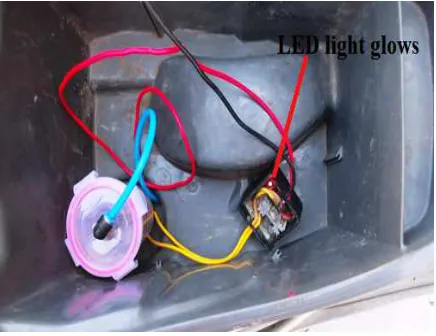
1) After connecting the Controller Circuit and testing it for correct operation, mount the Controller Circuit box on a suitable place inside the tool box empty space.
2) The Cell can be mounted near the Carburetor using a Cable Tie.
3) Make sure that Cell is fixed firmly so that it does not move while on the bumpy road.
4) Make sure that when the vehicle Ignition is Switched ON, the controller LED glows RED and when the vehicle Ignition is Switched OFF, the controller LED is OFF.
57 After installing the kit and electrical connections, we
have to set the Carburettor correctly to achieve better mileage.
1) Start the vehicle and run it idle for 5 minutes.
2) Release the Air Control Valve to allow for maximum air intake and maximum RPM of about 300 RPM. Run the vehicle for 3 minutes to ensure that the engine doesn’t stop abruptly
3) Now adjust the Fuel Control Valve so that the fuel supply is decreased to minimal such a way that the engine does not stop for few minutes. Adjust the Air control valve such a way that the engine runs at constant RPM and smoothly in idle condition. Finer setting of fuel supply will result in increased mileage of the vehicle.
3.6 Mechanical connection:
Fig-11 Mechanical connection setup
4. Experimental Analysis
58 Table 3 Experimental Analysis
The hydrogen generation rate is 0.025 lit./min (1.5 lit./hr.) with the present electrolysis system.(REBEL'S ROOST method)
Fig.-12 REBEL'S ROOST method
5. ADVANTAGE AND APPLICATION
5.1 Advantages:-
1) Increases Mileage
2) Increases the power & Performance of Vehicle
3) Increases Life span of Engine 4) Increases Burning Efficiency 5) Reduces Pollution
6) Reduce the engine temperature 7) Increase pick up
5.2 Disadvantages:-
[1]Oxy hydrogen gas is very low in density.
[2]This results in a storage problem when used in an internal combustion engine.
5.3 Application:- 1) S.I. Engine 2) C.I. Engine
6. CONCLUSIONS
An attempt has been made in this paper, by using blend of Oxy-Hydrogen gas with fuel will help to maximize brake thermal efficiency and thereby increase the performance of SI/CI Engine with using small changes with set up. Also in future scope by the use of micro-controllers and efficient electrolysis system regular vehicles can be made to operate partially on hydrogen at different speeds. The programming in micro-controller itself decides the hydrogen injection duration by sensing the speed of the vehicle.
REFERENCES
[1] Yadav Milind S.1, Sawant S. M.2, Anavkar Jayesh A.1 and Chavan Hemant V1. “Investigations on generation methods for oxy-hydrogen gas, its blending with conventional fuels and effect on the performance of internal combustion engine” [2] Finolex Academy of Management and
Technology, Ratnagiri, Maharashtra, India. [3] Rajarambapu Institute of Technology,
Sakharale, Maharashtra, India. Journal of Mechanical Engineering Research Vol. 3(9), pp. 325-332, 21 September, 2011
[4] G. G. Lucas and W. L. Richards, The hydrogen/petrol engine-the means to give good part-load thermal efficiency. Presentation at the Society of Automotive Engineers, Int. Congress and Exposition Detroit, Michigan (1982).
Aspect S r N o
Petrol Filled (ml)
Start Km
End Km
Mileage Km/Ltr .
Without kit
1 200ml 12831.1 12841.8 53.5 km/Ltr
2 120ml 12841.9 12848.0 50.81k m/Ltr
With kit [water]
3 200ml 12916.4 12928.5 60.5 km/Ltr
4 120ml 12928.5 12936.7 68.33k m/Ltr
With kit[distil led water + KOH]
5 120ml 13097.7 13105.2 64.4 km/Ltr
[image:8.595.74.282.592.716.2]59 [5] H. May and D. Gwinner, Possibilities of
improving exhaust emissions and energy consumption in mixed hydrogen gasoline operation. Int. J. Hydrogen Energy 8, 121-129(1983).
[6] Liu Zhizhang, et al., Experimental investigations of hydrogen-gasoline mixed fuel for gasoline engines. Paper Presented at Beijing Int. Symp. for Hydrogen Energy (1985).
[7] F. W. Hoehn, R. L. Baisley and M. W. Dowdy, Advances in Ultralean Combustion Technology Using Hydrogen- Enriched Gasoline. IECEC (1975).
[8] T. Hongwei, The use of mixed fuel of hydrogen and gasoline in motor vehicles, international Syrup. Hydrogen Energy, Beijing (1985).
[9] Fred B. Parks, A Single Engine Study of Hydrogen-Rich Fuels, SAE 760099 (1976). [10]J. S. Mac-Donald, Evaluation of
Hydrogen-Supplemented Fuel Concept with an Experimental Multi-cylinder Engine. SAE 760101 (1976).
[11]College of Desert, “Module:3 Hydrogen use in Internal Combustion Engine ”, Hydrogen Engines & Related Technologies, Rev.0, December 2001, CA 92260, USA
[12]Al Phillips, M.Sc., P.Ag. Allister Hickson, Ph.D., “Hydrogen Hybrid Internal Combustion Engine Bus Winnipeg Rider ship Survey.” CFA, University of Manitoba Transport Institute, March 2005, USA. [13]Rohit Gulati, L.M. Das, P.K. Gupta, Centre
for Energy Studies, Indian Institute of Technology, New Delhi. “A comparative evaluation of the performance characteristics of a spark ignition engine using hydrogen and compressed natural gas as alternative fuels International Journal of Hydrogen Energy, vol.25, pp. 783-793, 2000
[14]L. M. DAS, Indian Institute of Technology, Delhi, “Fuel induction techniques for Hydrogen operated engine.”, Int. J. Hydrogen Energy, Vol. 15, No. 11, pp. 833-842, 1990
[15]H. B. MATHUR and L. M. DAS, Indian Institute of Technology, New Delhi, “Performance characteristics of a Hydrogen fuelled S.I. Engine using Timed Manifold Injection.” Int. J. Hydrogen Energy, Vol. 16, No. 2, pp. 115-127, 1991
[16]P.K. Gupta, L.M. Das, Rohit Gulati, Centre for Energy Studies, Indian Institute of Technology, Delhi, “Performance evaluation of a hydrogen-fuelled spark ignition engine using electronically controlled solenoid actuated injection system.” International