Lexical Paraphrasing for Document Retrieval and Node Identification
Ingrid Zukerman School of Computer Science
and Software Engineering Monash University Clayton, VICTORIA 3800
AUSTRALIA
Sarah George School of Computer Science
and Software Engineering Monash University Clayton, VICTORIA 3800
AUSTRALIA [email protected]
Yingying Wen School of Computer Science
and Software Engineering Monash University Clayton, VICTORIA 3800
AUSTRALIA [email protected]
Abstract
We investigate lexical paraphrasing in the context of two distinct applications: doc-ument retrieval and node identification. Document retrieval – the first step in ques-tion answering – retrieves documents that contain answers to user queries. Node identification – performed in the con-text of a Bayesian argumentation system – matches users’ Natural Language sen-tences to nodes in a Bayesian network. Lexical paraphrases are generated using syntactic, semantic and corpus-based in-formation. Our evaluation shows that lex-ical paraphrasing improves retrieval per-formance for both applications.
1 Introduction
One of the difficulties users face when accessing a knowledge repository is that of expressing them-selves in a way that will produce the desired out-come, e.g., retrieve relevant documents or make their dialogue contributions understood. The use of appropriate terminology is one aspect of this prob-lem: if a user’s vocabulary differs from that within the resource being accessed, the system may be un-able to satisfy the user’s requirements. In this pa-per, we investigate the application of lexical para-phrasing to two different information access appli-cations: document retrieval and node identification. Document retrieval is performed in the context of the TREC Question Answering task, where the system retrieves documents that contain answers to users’
queries. Node identification is performed in the context of a Natural Language (NL) interface to a Bayesian argumentation system (Zukerman and George, 2002). Here the system finds the nodes from a Bayesian network (BN) (Pearl, 1988) that best match a user’s NL sentences.
Lexical paraphrases replace content words in a user’s input with their synonyms. We use the follow-ing information sources to perform this task: syn-tactic – obtained from Brill’s part-of-speech tag-ger (Brill, 1992); semantic – obtained from Word-Net (Miller et al., 1990) and the Webster-1913 on-line dictionary; and statistical – obtained from our document collection. The statistical information is used to moderate the alternatives obtained from the semantic resources, by preferring query paraphrases that contain frequent word combinations.
Our evaluation assessed the effect of lexical para-phrasing on our two applications. Its impact on document retrieval was evaluated using subsets of queries from the TREC8, TREC9 and TREC10 col-lections, and its effect on node identification was evaluated using paraphrases generated by people for some nodes in our BN (Section 6.2).
In the next section we discuss related research. Section 3 describes our two applications. In Sec-tion 4, we consider the paraphrasing process, and in Section 5 the information retrieval procedures. Sec-tion 6 presents the results of our evaluaSec-tion, followed by concluding remarks.
2 Related Research
query expansion. Query expansion in turn is of-ten preceded by Word sense disambiguation (WSD) in order to avoid retrieving irrelevant information. Mihalcea and Moldovan (1999) and Lytinen et
al. (2000) used WordNet (Miller et al., 1990) to
ob-tain the sense of a word. In contrast, Sch¨utze and Pedersen (1995) and Lin (1998) used a corpus-based approach where they automatically constructed a thesaurus on the basis of contextual information. The results obtained by Sch¨utze and Pedersen and by Lytinen et al. are encouraging. However, experi-mental results reported in (Gonzalo et al., 1998) in-dicate that the improvement in IR performance due to WSD is restricted to short queries, and that IR per-formance is very sensitive to disambiguation errors. Harabagiu et al. (2001) offered a different form of query expansion, where they used WordNet to pro-pose synonyms for the words in a query, and applied heuristics to select which words to paraphrase.
Our approach to the vocabulary mis-match prob-lem differs from WSD in that instead of return-ing the sense of the words in a sentence, we pro-pose alternative lexical paraphrases. Like Langk-ilde and Knight (1998), when generating candidate paraphrases, we use WordNet to propose synonyms for the words in a sentence. However, they chose among these synonyms using the word-sense rank-ings offered by WordNet, while we make our selec-tion using word-pair frequencies obtained from our corpus, and word-similarity information obtained from a thesaurus that is automatically constructed from the Webster Dictionary. It is worth noting that the retrieval performance obtained with para-phrases generated using our dictionary-based the-saurus compares favorably with that obtained using Lin’s context-based thesaurus.
3 Applications
Our two applications are: document retrieval (DocRet) and node identification (NodeID).
The document retrieval application consists of re-trieving documents that are likely to contain the an-swer to a user’s query. This is the first step in our Question Answering project, whose aim is to use these documents to generate answers to queries.
The node identification application is the back-bone of the NL interface to our Bayesian
Interac-tive Argumentation System (BIAS) (Zukerman and
George, 2002). Here the system matches NL sen-tences that make up a user’s argument to nodes in a BN that represents the system’s domain knowledge. The eventual goal is to understand the user’s argu-ment (in terms of the system’s domain knowledge) and generate responses.
There are significant differences between these applications and their underlying domains:
Our DocRet repository consists of 131,896 arti-cles from the LA Times portion of the NIST TREC collection (the other TREC repositories were omit-ted owing to disk space limitations). Full-text in-dexing was performed for these documents using lemmas (uninflected versions of words), rather than stems or complete words. OurNodeIDrepository is an 85-node BN which represents domain knowledge for a murder mystery. Most nodes are associated with one “canonical” sentence, and 8 nodes are as-sociated with two or three sentences. Sample canon-ical sentences for the nodes in our domain are “Mr Green murdered Mr Body” and “The blue paint on the mailbox is one week old”. The sentences in this domain were also lemmatized, but no indexing was performed owing to the small size of the BN.
The queries in theDocRetapplication have an av-erage length of 7.22 words, and the articles in the LA Times repository have 242 words on average. In contrast, in the NodeIDapplication, the user’s sen-tences and the sensen-tences associated with the nodes in the BN are of similar length (8.45 words on av-erage for the user sentences, compared to 7.7 words for the BN sentences).
TheDocRettask is one of containment, i.e., to re-trieve documents that include the words in a query, while theNodeIDtask is one of equivalence, i.e., to retrieve the node that best matches the user’s sen-tence. Further, forDocRetthere may be several arti-cles that answer a user’s query, while forNodeIDat most one node matches a user’s sentence.1
4 Lexical Paraphrasing
In this section, we discuss the resources used by our paraphrasing mechanism and describe the para-phrasing process.
1
4.1 Resources
Our system uses syntactic, semantic and statistical information for paraphrase generation.
Syntactic information for each sentence was
ob-tained from Brill’s part-of-speech (PoS) tagger (Brill, 1992).
Semantic information was obtained from two
sources: WordNet – a knowledge-intensive, hand-built on-line repository; and Webster – an on-line version of the Webster-1913 dictionary (http://www.dict.org). WordNet was used to generate lemmas for the corpus and the sentences, and to generate different types of synonyms for the words in the sentences. Webster was used to auto-matically build a thesaurus that includes similarity scores between lemmas, and to automatically con-struct a list of nominals corresponding to the verbs in the dictionary, and a list of verbs corresponding to the nouns in the dictionary. The thesaurus was used to assign similarity scores to the synonyms re-turned by WordNet. The nominalization and verbal-ization lists were used to generate additional syn-onyms. This was done by activating WordNet for the nouns corresponding to the verbs in the sentences and for the verbs corresponding to the nouns in the sentences.2 The idea was that nominalizations and verbalizations will help paraphrase queries such as “who killed Lincoln?” into “who is the murderer of Lincoln?” (Harabagiu et al., 2001).
The thesaurus, nominal list and verb list were ob-tained by building a vector from the content lemmas in the definition of each word in the dictionary, and applying the cosine similarity measure to calculate a score for the similarity between the vector corre-sponding to each word and the vectors correspond-ing to the other words in the dictionary. The dic-tionary words that had the highest similarity score against the original word were retained. To build the thesaurus, only words with the same PoS as the original word were considered. To build the nomi-nalization list, only nouns were considered for each verb in the dictionary, and to build the verbalization list, only verbs were considered for each noun. Fur-ther, for these lists, the retained noun (or verb) had to have the same stem as the original verb (or noun).
2
It was necessary to build nominalization and verbalization lists because WordNet does not include this information.
Statistical information was obtained from the LA
Times portion of the NIST Text Research Collection (http://trec.nist.gov). The statistical informa-tion was used to estimate the probability of the para-phrases generated for a sentence (Section 5.1). The statistical information was stored in a lemma dictio-nary (202,485 lemmas) and a lemma-pair dictiodictio-nary (37,341,156 lemma pairs). Lemma pairs which ap-pear only once constitute 64% of the pairs, and were omitted owing to disk space limitations.
4.2 Procedure
The following procedure was applied to paraphrase a sentence:
1. Tokenize, tag and lemmatize the sentence.
2. Generate replacement lemmas for each content lemma in the sentence.
3. Propose paraphrases for the sentence using dif-ferent combinations of replacement lemmas, esti-mate the probability of each paraphrase, and rank the paraphrases according to their probabilities. Retain the lemmatized sentence plus the top paraphrases.
Documents or nodes are then retrieved for the sen-tence and its paraphrases, the probability of each re-trieved item is calculated, and the top items are
retained (Section 5).
4.2.1 Tagging and lemmatizing sentences
We used Brill’s tagger (Brill, 1992) to obtain the PoS of a word. This PoS is used to constrain the number of synonyms generated for a word. Brill’s tagger incorrectly tagged 16% of the queries in the DocRetapplication, which had a marginal detrimen-tal effect on retrieval performance (Zukerman and Raskutti, 2002). After tagging, each sentence was lemmatized using WordNet.
4.2.2 Proposing replacements for each lemma
We used WordNet and the nominalization and verbalization lists built from Webster to propose re-placements for the content lemmas in a sentence. These resources were used as follows:
2. We then used WordNet to propose different types of synonyms for the lemmas produced in the first step. These types of synonyms were: syn-onyms, attributes, pertainyms and seeal-sos(Miller et al., 1990). For example, according to WordNet, asynonymfor “high” is “steep”, an attributeis “height”, and aseealsois “tall”; a pertainymfor “chinese” is “China”. hypernyms and hyponymswere optionally included depend-ing on the approach used to represent the similar-ity between two lemmas (Section 4.2.4).
4.2.3 Paraphrasing sentences
Sentence paraphrases were generated by an iter-ative process which considers each content lemma in a sentence in turn, and proposes a replacement lemma from those collected from our information sources (Section 4.2.2). Sentences which did not have sufficient context were not paraphrased. These are sentences where all the words except one are closed-class words or stop words (frequently occur-ring words that are ignored when used as search terms).
4.2.4 Probability of a paraphrase
The probability that a paraphrase is an appropri-ate rendition of a sentence depends on two factors: (1) how similar is the paraphrase to the sentence, and (2) how common are the lemma combinations in the paraphrase. This may be expressed as follows:
Pr ParaSent
Pr SentPara Pr Para
Pr Sent
(1)
where Para is the th paraphrase of a sentence.
Since the probability of the denominator is constant for a given sentence, we obtain:
Pr ParaSent Pr SentPara Pr Para (2)
where
Pr SentPara (3)
Pr Slem Slemlem lem
Pr Para Pr lem lem (4)
where ! is the number of content words in a
sen-tence, Pr Slem"# is the probability of using Slem" –
the$ th lemma in the sentence, and Pr lem" is the
probability of using lem" – the$ th lemma in theth
paraphrase of the sentence.
To calculate Pr SentPara in Eqn. 3 we assume
(1) Pr Slem%&lem lem' is independent of
Pr Slem"(lem lem for )$* +,!
and).-/$ , and
(2) given lem% , Slem% is independent of the
other lemmas in the sentence paraphrase, i.e., Pr Slem%0lem lem21 Pr Slem%&lem
%# .
These assumptions yield
Pr SentPara1
3
"546
Pr Slem"7lem" (5)
Eqn. 4 may be rewritten using Bayes rule:
Pr Para1
3
"546
Pr lem"7ctxt" (6)
where ctxt" is the context for lemma$ in the th
paraphrase.
Substituting Eqn. 5 and Eqn. 6 into Eqn. 2 yields
Pr Para
Sent (7)
3
"546
8
Pr Slem"lem"9 Pr lem"(ctxt":
Pr Slem" lem" may be interpreted as the
prob-ability of using Slem" instead of lem" . Intuitively,
this probability depends on the similarity between the lemmas. We considered two approaches for rep-resenting this probability:
Baseline similarity:
Pr Slem"lem";+ if Slem" is a WordNet
syn-onym of lem" , and 0 otherwise (where
“syn-onym” encompasses different types of WordNet similarities).
Webster cosine similarity:
Pr Slem" lem" < SimScore lem" Slem" if
Slem" is a synonym of lem" according to the
Webster thesaurus, and 0 otherwise (where Sim-Score is obtained by applying the cosine similar-ity measure, Section 4.1). This approach yields a reduced number of synonyms, which are at the intersection between the lemmas in the Webster thesaurus and those returned by WordNet. This enables us to additionally consider hypernyms andhyponymsreturned by WordNet.3
3
Pr lem"(ctxt" may be represented by
Pr lem"(lem lem" . We consider the
baseline measure Pr lem"7lemlem" 9 + ,
and also the following approximation:
Pr lem"(lem lem"
"
3
%
46
Pr lem%(lem"
(8) where Pr lem%( lem" is obtained directly from
the lemma-pair dictionary (Section 4.1). This ap-proximation, although ad hoc, works well in prac-tice, yielding a better performance than bi-gram ap-proximations (Zukerman and Raskutti, 2002).
5 Retrieval Procedures
In this section, we describe the retrieval techniques used for our two applications, and present proba-bilistic formulations that incorporate sentence para-phrasing into our retrieval procedures.
5.1 Document retrieval
The retrieval procedure for the DocRetapplication relies on the vector-space model, which calculates the score of candidate documents given a list of terms in a query (Salton and McGill, 1983). Nor-mally, this score is based on the TF.IDF measure (Term Frequency . Inverse Document Frequency). If we replace a query with its paraphrase, this score is represented by the following formula:
Score DocPara
" 46
tfidf Doc,lem" (9)
where! is the number of lemmas in the paraphrase.
By normalizing the scores of the documents, we obtain the probability that a document contains the answer to the paraphrase:
Pr DocPara
"546
tfidf Doc,lem"
(10)
We assume that given a paraphrase of a query, a document retrieved on the basis of the paraphrase is conditionally independent of the original query. This yields the following formula:
Pr DocQuery
4
Pr DocPara Pr Para Query
(11) where is the number of paraphrases. We also adopt the convention that the 0-th paraphrase is the origi-nal lemmatized query.
By substituting Eqn. 10 and Eqn. 7 for the first and second factors in Eqn. 11 we can calculate the probability of each document given a query.
5.2 Node identification
In order to find the node in the BN that best matches a user’s sentence, we calculate for each node a score that reflects its similarity to the user’s sentence. This score is composed of two elements: SP-score and NP-score. SP-score is obtained by paraphras-ing the user’s sentence, and calculatparaphras-ing a similar-ity score between each paraphrase and the canonical sentence(s) for the node in question. NP-score is ob-tained by paraphrasing the canonical sentence(s) for the node, and calculating a similarity score between each paraphrase and the user’s sentence. These el-ements are represented by the following formulas:
SP-score NodeSent (12)
func45
SimScore Para Sent Node
Pr ParaSentSent
NP-score NodeSent (13)
func45
SimScore Sent Para Node
Pr ParaNodeNode
where SimScore is calculated using the cosine sim-ilarity measure (which was also used to build the Webster thesaurus and the nominal and verb lists, Section 4.1); Pr Paraitemitem is estimated
us-ing Eqn. 7; is the number of paraphrases gen-erated for sentences and nodes; and func is either maximum or average. When func=maximum, the
SP-score of a node is the score of the paraphrase
of the user’s sentence that best matches the node’s canonical sentence, and the NP-score is the score of the paraphrase of the node which best matches the user’s sentence. When func=average, the SP-score of a node is the weighted average of the scores of the paraphrases of the user’s sentence, and the
NP-score is the weighted average of the NP-scores of the
paraphrases of the node.
The probability that a node is intended by a user’s sentence is the normalized value of
Pr NodeSent (14)
func
where func=maximum retains the best of SP-score and NP-score, and func=average simply averages these scores.
We also conducted experiments using SP-score or
NP-score alone, but the best results were obtained by
combining these scores. In the future, we intend to experiment with a measure that compares the para-phrases of users’ sentences against the parapara-phrases of nodes, instead of using SP- and NP-scores.
6 Evaluation
In this section we describe our evaluation metric and data sets. We then discuss our experiments, and an-alyze our results.
6.1 Evaluation metric
We use the number of matches measure to evalu-ate retrieval performance. In the DocRet applica-tion, this measure returns the number of queries for which the system retrieved at least one document that contains the answer to a query. In theNodeID application, this measure returns the number of sen-tences for which the intended node was among the returned nodes. The following example illustrates why this measure was chosen instead of the stan-dard precision measure. Consider a situation in the DocRetapplication where 10 correct documents are retrieved for each of 2 queries and 0 correct doc-uments for each of 3 queries, compared to a situ-ation where 2 correct documents are retrieved for each of 5 queries. Average precision would yield a better score for the first situation, failing to address the question of interest for this application, namely how many queries have a chance of being answered, which is 2 in the first case and 5 in the second case.
6.2 Data
The data for the DocRet application consisted of 125 queries from the TREC8 collection, 404 queries from TREC9, and 231 queries from TREC10. These are queries whose answers reside in the LA Times portion of the TREC corpus.
[image:6.612.310.546.40.109.2]The data for the NodeID application was gener-ated by asking high-school and university students to modify the canonical sentences corresponding to 7 of the nodes in our BN. No constraints were placed on the allowed modifications, i.e., students were ad-vised that they could make any changes to the sen-tences, provided their meaning was preserved. We
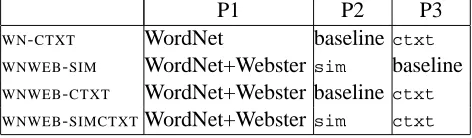
Table 1: Configurations of paraphrasing parameters
P1 P2 P3
WN-CTXT WordNet baseline ctxt
WNWEB-SIM WordNet+Webster sim baseline
WNWEB-CTXT WordNet+Webster baseline ctxt
WNWEB-SIMCTXTWordNet+Webster sim ctxt
received a total of 258 modified sentences from 21 students (an average of 37 sentences per node).
6.3 Experiments
Our evaluation determines the effect of paraphras-ing on retrieval performance, as well as the number of paraphrases that yields the best performance. For both applications, we submitted to the retrieval en-gine increasing sets of paraphrases as follows: first the lemmatized query or sentence alone (Set 0), next we added to the query or sentence up to 2 para-phrases (Set 2), then up to 5 parapara-phrases (Set 5), up to 12 paraphrases (Set 12), and up to a maximum of 19 paraphrases (Set 19).4
For the DocRet application, the number of re-trieved documents was kept constant at 200, as sug-gested in (Moldovan et al., 2002). Since for the NodeIDapplication there is only one correct node, it is critical to return this node most of the time. Hence, we considered 1 or 3 retrieved nodes.
We experimented with different combinations of the operating parameters of the paraphrasing pro-cess as follows: (P1) WordNet alone or Word-Net+Webster; (P2) Pr Slem" lem" – baseline
measure or Webster similarity score (sim); and (P3) Pr lem"7ctxt" – baseline measure or the
ap-proximation in Eqn. 8 (ctxt). The combination of these parameters yielded the four configurations in Table 1 (the remaining options are not viable).
In addition, we considered the following options for the retrieval process: (R1) Weighting – uniform or weighted; and (R2) func – maximum or average (only for theNodeIDapplication, Section 5.2).5 The uniform policy in R1 assigns the same weight (=1)
4
These numbers represent the maximum number of para-phrases – fewer parapara-phrases were generated if there weren’t enough synonyms. Also, previous experiments show that Sets 0, 2, 5, 12 and 19 are significant in terms of retrieval per-formance, and that there seems to be no advantage in generating more than 19 paraphrases.
5
func=maximum is not suitable for theDocRetapplication,
160 170 180 190 200 210 220 230
0 2 4 6 8 10 12 14 16 18
No. of sentences matched
No. of paraphrases WNWEB-SIMCTXT/UNI/MAX WNWEB-CTXT/UNI/MAX WNWEB-SIM/UNI/MAX WNWEB-CTXT/WGT/AVG
160 170 180 190 200 210 220 230
0 2 4 6 8 10 12 14 16 18
No. of sentences matched
No. of paraphrases WNWEB-SIMCTXT/UNI/MAX WNWEB-CTXT/UNI/MAX WNWEB-SIM/UNI/MAX WNWEB-CTXT/WGT/AVG
[image:7.612.77.547.26.208.2](a) 1 retrieved node (b) 3 retrieved nodes
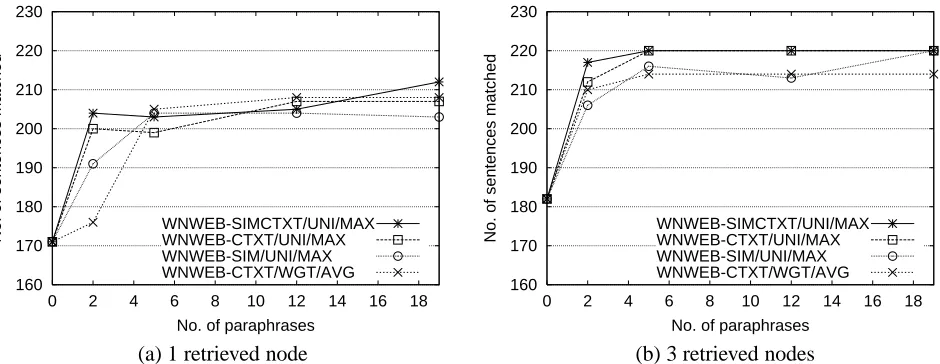
Figure 1: Effect of number of paraphrases on performance for theNodeIDapplication (258 sentences)
to the paraphrases during retrieval, instead of using the weights obtained from the paraphrasing process (weighted policy). The rationale for the uniform pol-icy is that while a sorting criterion is required to rank the paraphrases, once a ranking is obtained, the top-K paraphrases may be equally useful.
The policies in R1 yielded four additional con-figurations, one for each entry in Table 1. These configurations were used to generate and rank the paraphrases, but the top-K paraphrases were weighed uniformly during retrieval (we distin-guish the weighted policy from the uniform pol-icy by appending the suffix WGT to the weighed
options and the suffix UNI to the uniform
op-tions). Finally, the policies in R2 yielded another eight configurations for theNodeIDapplication only (each of the above options with func=maximum or
func=average). These configurations are denoted by
appending the suffixMAXor AVGto the above
desig-nations, e.g.,WNWEB-SIMCTXT/UNI/AVG.
6.4 Results
Paraphrasing improved retrieval performance under the vast majority of the paraphrasing and retrieval options for both applications. Performance gen-erally improved as the number of paraphrases in-creased, with the largest improvement being ob-tained for 2-5 paraphrases. However, it is worth not-ing that when retrieval was performed usnot-ing the uni-form R1 policy and func=average, the peruni-formance was sometimes unstable. That is, the number of matched sentences or answerable queries sometimes
245 250 255 260 265 270 275
0 2 4 6 8 10 12 14 16 18
No. of answerable queries
[image:7.612.317.545.244.411.2]No. of paraphrases WNWEB-SIMCTXT/UNI/AVG WNWEB-CTXT/UNI/AVG WNWEB-SIM/UNI/AVG WN-CTXT/WGT/AVG
Figure 2: Effect of number of paraphrases on per-formance for theDocRetapplication (TREC9, 404 queries, 200 retrieved documents)
fluctuated as the number of paraphrases increased. This may be explained by the observation that low probability paraphrases (i.e., paraphrases with a low Webster similarity score to the original sentence, or with a low context-probability) have the same con-tribution to the score of a node or a retrieved docu-ment as high-probability paraphrases.
shown in Figure 2 (paraphrasing also improves per-formance for TREC8 and TREC10, but the im-provements are more modest than for TREC9). As can be seen from these Figures, paraphrasing has a greater impact on theNodeIDapplication than on the DocRetapplication. Specifically, the best configu-ration forNodeID(WNWEB-SIMCTXT/UNI/MAXwith 19
paraphrases) improved the number of matched sen-tences from 65.9% to 82.2% for 1 retrieved node, and from 70.5% to 85.3% for 3 retrieved nodes. In contrast, the best configuration forDocRet(WNWEB
-CTXT/UNI/AVG with 19 paraphrases) improved the
number of answerable queries from 62.1% to 66.8%. Finally, note that the top-4 configurations for our two applications differ (but with respect to one as-pect only). This indicates that while paraphrasing generally improves retrieval performance, the char-acteristics of the application determine both the im-pact of paraphrasing and the paraphrasing and re-trieval configuration that works best.
7 Conclusion
We have investigated the effect of lexical paraphras-ing on two applications: document retrieval and node identification. Paraphrasing was performed us-ing syntactic, semantic and statistical information. Our results show that paraphrasing improves re-trieval performance. However, the improvement is sensitive to the application at hand and to the para-phrasing and retrieval operating parameters.
Acknowledgments
This research was supported in part by grants A49927212 and DP0209565 from the Australian Research Council.
References
Eric Brill. 1992. A simple rule-based part of speech tag-ger. In ANLP-92 – Proceedings of the Third
Confer-ence on Applied Natural Language Processing, pages
152–155, Trento, Italy.
Julio Gonzalo, Felisa Verdejo, Irina Chugur, and Juan Cigarran. 1998. Indexing with WordNet synsets can improve text retrieval. In Proceedings of the
COLING-ACL’98 Workshop on Usage of WordNet in Natural Language Processing Systems, pages 38–44,
Mon-treal, Canada.
Sanda Harabagiu, Dan Moldovan, Marius Pasca, Rada Mihalcea, Mihai Surdeanu, Razvan Bunescu, Roxana Girju, Vasile Rus, and Paul Morarescu. 2001. The role of lexico-semantic feedback in open domain textual
question-answering. In ACL01 – Proceedings of the
39th Annual Meeting of the Association for Computa-tional Linguistics, pages 274–281, Toulouse, France.
Irene Langkilde and Kevin Knight. 1998. Generation that exploits corpus-based statistical knowledge. In
COLING-ACL’98 – Proceedings of the International Conference on Computational Linguistics and the An-nual Meeting of the Association for Computational Linguistics, pages 704–710, Montreal, Canada.
Dekang Lin. 1998. Automatic retrieval and clustering of similar words. In COLING-ACL’98 – Proceedings of
the International Conference on Computational Lin-guistics and the Annual Meeting of the Association for Computational Linguistics, pages 768–774, Montreal,
Canada.
Steven Lytinen, Noriko Tomuro, and Tom Repede. 2000. The use of WordNet sense tagging in FAQfinder. In
Proceedings of the AAAI00 Workshop on AI and Web Search, Austin, Texas.
Rada Mihalcea and Dan Moldovan. 1999. A method for word sense disambiguation of unrestricted text. In
ACL99 – Proceedings of the 37th Annual Meeting of the Association for Computational Linguistics,
Balti-more, Maryland.
George Miller, Richard Beckwith, Christiane Fellbaum, Derek Gross, and Katherine Miller. 1990. Introduc-tion to WordNet: An on-line lexical database. Journal
of Lexicography, 3(4):235–244.
Dan Moldovan, Marius Pasca, Sanda Harabagiu, and Mi-hai Surdeanu. 2002. Performance issues and error analysis in an open domain question answering
sys-tem. In ACL02 – Proceedings of the 40th Annual
Meeting of the Association for Computational Linguis-tics, pages 33–40, Philadelphia, Pennsylvania.
Judea Pearl. 1988. Probabilistic Reasoning in Intelligent
Systems. Morgan Kaufmann Publishers, San Mateo,
California.
G. Salton and M.J. McGill. 1983. An Introduction to
Modern Information Retrieval. McGraw Hill.
Hinrich Sch¨utze and Jan O. Pedersen. 1995. Informa-tion retrieval based on word senses. In Proceedings of
the Fourth Annual Symposium on Document Analysis and Information Retrieval, pages 161–175, Las Vegas,
Nevada.
Ingrid Zukerman and Sarah George. 2002. Towards
a noise-tolerant, representation-independent mecha-nism for argument interpretation. In COLING 2002
– Proceedings of the 19th International Conference on Computational Linguistics, pages 1170–1176, Taipei,
Taiwan.
Ingrid Zukerman and Bhavani Raskutti. 2002. Lexical query paraphrasing for document retrieval. In
COL-ING’02 – Proceedings of the 19th International Con-ference on Computational Linguistics, pages 1177–