A Language Independent Method for
Generating Large Scale Polarity Lexicons
Giuseppe Castellucci, Danilo Croce, Roberto Basili
Dept. of Electronic Engineering, Dept. of Enterprise Engineering, Dept. of Enterprise Engineering University of Roma, Tor Vergata, Via del Politecnico 1, 00133 Roma, Italy
[email protected], [email protected], [email protected]
Abstract
Sentiment Analysis systems aims at detecting opinions and sentiments that are expressed in texts. Many approaches in literature are based on resources that model thepriorpolarity of words or multi-word expressions, i.e. a polarity lexicon. Such resources are defined by teams of annotators, i.e. a manual annotation is provided to associate emotional or sentiment facets to the lexicon entries. The development of such lexicons is an expensive and language dependent process, making their coverage of linguistic sentiment phenomena limited. Moreover, once a lexicon is defined it can hardly be adopted in a different language or even a different domain. In this paper, we present several Distributional Polarity Lexicons (DPLs), i.e. large-scale polarity lexicons acquired with an unsupervised methodology based on Distributional Models of Lexical Semantics. Given a set of heuristically annotated sentences from Twitter, we transfer the sentiment information from sentences to words. The approach is mostly unsupervised, and experimental evaluations on Sentiment Analysis tasks in two languages show the benefits of the generated resources. The generated DPLs are publicly available in English and Italian. Keywords:Polarity Lexicon Generation, Sentiment Analysis, Distributional Models
1.
Introduction
Sentiment Analysis (SA) and Opinion Mining systems (Pang and Lee, 2008) aim at tracking the opinions ex-pressed in texts with respect to specific topics, e.g. prod-ucts or people. In particular, SA deals with the problem of deciding whether a portion of a text, e.g. a sentence or a phrase, is expressing a trend towards specific feelings, e.g. positivity or negativity. Polarity lexicons are list of words each associated to one or more values, indicating their trend towards specific feelings, e.g. a single value in[−1,+1] can be used to indicatenegativity(−1), neu-trality(0) or positivity (+1). Such lexicons have been de-fined to support the development of automatic systems for detecting subjective phrases or sentences and recognizing their polarity (Mohammad and Turney, 2010). For exam-ple, in these lexicons, “good” can be associated to a prior positive sentiment in contrast to “sad”, considered negative in every domain. The occurrence of such words in a sen-tence can be adopted as an indicator of the polarity trends that are expressed in the sentence. These lexicons are often hand-compiled; however, from a linguistic point of view, a-priori membership of words to polarity classes can be considered too restrictive, as sentiment expressions are of-ten topic dependent: the occurrences of the word mouse, for example, are mostly neutral in the consumer electron-ics domain, while it can be negatively biased in a restaurant domain. Representing topic specific polarity phenomena would require manual revisions of the lexicon entries, thus resulting in a costly operation. Moreover, these resources mainly exist for the English language, while they scarce for the others. Again, the manual annotation of a polarity lex-icon for a new language can be an expensive process that cannot be afforded in many cases.
In this paper, we describe large-scale polarity lexicons re-sources that have been released to the research community. They have been acquired with a methodology we recently proposed (Castellucci et al., 2015). It consists of an
un-supervised methodology to derive large-scale polarity lexi-cons, which exploits the extra-linguistic information within Social Media data, e.g. the presence of emoticons in mes-sages. The approach relies on Distributional Models of Lexical Semantics (Sahlgren, 2006; Mikolov et al., 2013b), where the equivalence in sentences and words representa-tions available in some distributional models (e.g. the dual LSA space for words and texts introduced in (Landauer and Dumais, 1997)) is exploited to transfer sentiment informa-tion from sentences to words. In fact, as sentences can be clearly related to polarity, a classifier can always be trained in such spaces and used to transfer sentiment information from sentences to words. Specifically, we train a polarity classifier by observing sentences expressing some polarity and we adopt it to classify words in order to populate a po-larity lexicon. Annotated messages are derived from Twit-ter1 and their polarity is determined by simple heuristics. It means that words in specific domains can be related to sentiment classes by looking at their semantic closeness to emotionally biased sentences. The approach for deriving a new lexicon is highly applicable, language and domain independent, as the distributional model can be acquired without any supervision, and the provided heuristics do not have any bias with respect to languages or domains. Thus, polarity lexicons can be generated in multiple languages, without the need of expensive manual supervision. We generated large-scale polarity lexicons for English and Italian and we released them to the research community2. Their contribution is measured against different SA tasks in the two languages. In particular, our evaluation is based on Twitter Sentiment Analysis, as recently it has been the fo-cus of highly participated challenges, as the recent SemEval (Nakov et al., 2013; Rosenthal et al., 2014) and Evalita (Basile et al., 2014) tasks demonstrate.
1
http://www.twitter.com
2
http://sag.art.uniroma2.it/demo-software/
In the rest of the paper, related works are discussed in Sec-tion 2., while SecSec-tion 3. presents the methodology proposed to generate the lexicons. In Section 4. a detailed description of the generated lexicons is provided. The beneficial impact of these resources in polarity detection tasks is discussed in Section 5.. Finally, in Section 6., conclusions and future works are presented.
2.
Related Works
Polarity lexicon generation has been tackled in many re-searches and three main approaches can be pointed out for producing a polarity lexicon.
Manually annotated lexicons. Earlier works in lexicon generation are based on manual annotations of terms with respect to emotional or sentiment categories. For example, in (Stone et al., 1966) sentiment labels are manually as-sociated to 3600 English terms. In (Hu and Liu, 2004) a list of positive and negative words are manually extracted from customer reviews. The MPQA Subjectivity Lexicon (Wilson et al., 2005) contains words, each with its prior po-larity (positive or negative) and a discrete strength (strong or weak) value. The NRC Emotion Lexicon (Mohammad and Turney, 2010) is composed by frequent English nouns, verbs, adjectives, and adverbs annotated through Amazon Mechanical Turk system with respect to eight emotions (e.g. joy, sadness, trust) and sentiment.
Lexicons acquired over graphs. Graph based approaches exploit an underlying semantic structure that can be built upon words. In (Esuli and Sebastiani, 2006) the WordNet (Miller, 1995) synset glosses are exploited to derive three scores describing the positivity, negativity and neutrality of the synsets. The work in (Rao and Ravichandran, 2009) generates a lexicon as graph label propagation problem. Each node in the graph represents a word. Each weighted edge encodes a relation between words derived from Word-Net (Miller, 1995). The graph is constructed starting from a set of manually defined seeds. The polarity for the other words is determined by exploiting graph-based methods. Corpus-based lexicons. Statistics based approaches are more general, as they mainly exploit corpus processing techniques. (Turney and Littman, 2003) proposed a mini-mally supervised approach to associate a polarity tendency to a word by determining if it co-occurs more with posi-tive words than negaposi-tive ones. More recently, (Zhang and Singh, 2014) proposed a semi-supervised framework for generating a domain-specific sentiment lexicon. Their sys-tem is initialized with a small set of labeled reviews, from which segments whose polarity is known are extracted. It exploits the relationships between consecutive segments to automatically generate a domain-specific sentiment lexi-con. In (Kiritchenko et al., 2014) a minimally-supervised approach based on Social Media data is proposed by ex-ploiting hashtags or emoticons related to positivity and neg-ativity, e.g.,#happy,#sad,:) or:(. They compute a score, reflecting the polarity of each word, through a Point wise Mutual Information based measure between a word and an emotion. In (Saif et al., 2014) word contexts are adopted to generate sentiment orientation for words. In particular, the sentiment of context words, available in an already built lexicon, is shown to contribute in deriving the
sentiment orientation of a target word. As a result, the so-calledSentiCircleis derived for each target word by con-sidering the contexts in which they appear. The approach here presented can be seen as more general, as it does not rely on any existing lexicon, but it could be used to build a
SentiCircle.
3.
Polarity Lexicons Generation
In this Section, the approach defined in (Castellucci et al., 2015) for the Automatic Generation of Polarity Lexicons is described. The generation process relies on an embed-dedrepresentation of lexical items, that is derived by ap-proaches in the family of the Distributional Model (DM) of Lexical Semantics; in these models, semantics relation-ships between words and sentences can be exploited at the same time. In particular, the approach is based on the pos-sibility to acquire comparable representations (e.g. vectors) for sentences and words. In this perspective, common alge-braic operations are then adopted to establish relationships between lexical items and polarity biased sentences.3.1.
Word Embedding for Lexical Semantics
Word embedding are adopted to represent lexical items in compact vector representations. These vectors embed, within the dimensions of the space, information about the semantic relationships of words; this information is ac-quired by looking at the words usage in large corpora. Word embedding fall in the family of the Distributional Mod-els (DMs) of Lexical Semantics: the foundation for these models is theDistributional Hypothesis(Harris, 1964), i.e. words that are used and occur in the same contexts tend to have similar meanings. Although different DMs have been defined, they are similar in nature as they all derive vector representations for words, i.e. a word space, from more or less complex corpus processing stages.
The semantic relationships of interest are derived in terms of algebraic operations in the word space, such as the cosine similarity. Different relationships can be modeled depend-ing on the way the word space has been acquired. For ex-ample,topicalsimilarities between words can be captured when vectors are built considering the occurrence of a word in documents; paradigmatic similarities can be, instead, captured when vectors are built considering the occurrence of a word in the context of another word (Sahlgren, 2006). In such models, words like runandwalkare close in the word space, whilerunandreadare projected in different sub-spaces. These representations can be derived mainly in two ways3:countingthe co-occurrences between words, e.g. (Landauer and Dumais, 1997; Sahlgren, 2006), and then, optionally, applying dimensionality reduction tech-niques, such as Singular Value Decomposition (Golub and Kahan, 1965) in Latent Semantic Analysis (Landauer and Dumais, 1997). Another popular method for the acquisi-tion of word spaces relies on a supervised setting, where thepredictionof context-based task is exploited (examples are (Bengio et al., 2003; Mikolov et al., 2013a)). These are intended to capture moresyntagmaticaspects during the word space construction.
3For an in-depth comparison between the two methods, refer
Despite the specific algorithm used for the space acqui-sition4, all these approaches allow to derive a projection functionΦ(·)of words into a geometrical space, i.e. the
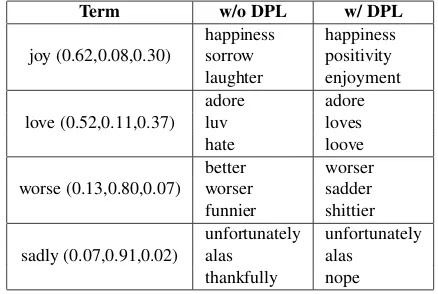
d-dimensional vector representation for a wordwk ∈Wis obtained through wk~ = Φ(wk). Geometrical regularities are exploited to determine the prior sentiment for words, i.e. the main assumption is that words carrying sentiment lie in specific sub-spaces. In the following, we discuss how polarity transfer can be applied from sentences (whose po-larity is known) to single words by exploiting those sub-spaces. Polarized words often share the same contexts: as a consequence, a DM tends to derive similar representations for words characterized by opposite polarity, e.g. joyand
sorrow(see the first and second columns in Table 6). The final aim is thus to leverage on DMs, because of their abil-ity to represent the semantic relationships between words, but considering also their sentiment in order to obtain a new representation that will account for sentiment-related phe-nomena.
3.2.
Lexicon Generation through Classification
The semantic similarity (closeness) established by tradi-tional DMs does not correspond well with emotradi-tional simi-larity. For example, in the Table 6 we selected words that are polarity carrier in English. In the second column we selected the three most similar words to each of them ac-cording to the cosine similarity measure computed between vectors derived from the DM. As it can be noticed, each word is similar to another word whose polarity can be de-fined as oppositeto the one of the target word. Instead, sentiment or emotional differences between words should be captured into representations that are able to coherently express the underlying sentiment. In this perspective, a dis-criminant function can be derived by machine learning over these representations. Let us consider a space Rd where some geometrical representation of a set of annotated ex-amples can be derived. In general, a linear classifier can be seen as a separating hyper planeθ ∈Rdthat is used to classify a new example represented in the same space. Each
θicorresponds to a specific dimension, or featureithat has been extracted from the annotated examples. After a learn-ing stage, the magnitude of eachθireflects the importance
of the feature i with respect to a target phenomenon. In this sense, when applied on distributional vectors of word semantics, linear classifiers are expected to learn such re-gions that are useful to properly discriminate examples with respect to the target classes. If these classes reflect the sen-timent expressed by words, a classifier should find those sub-spaces better correlating examples with the sentiment. In this way, any set of wordswiin the vocabularyW asso-ciated with their prior polarity could be used to train a sen-timent classifier. In fact, given a set of seed words whose prior polarity is known, their projection in the Word Space model wk~ seed = Φ(wkseed)is sufficient to train the linear classifier. This would find what dimensions inRd are re-lated to the different polarities. Classification thus corre-sponds to transferring the knowledge about sentiment im-plicit in the seed words to the other remaining words.
4
In this paper we will acquire word spaces with theprediction based technique.
The definition and annotation of seed words, however, could be expensive and hardly portable across natural lan-guages. Moreover, lexical items do change emotional fla-vor across domains and the knowledge embodied by the seed lexicons may not generalize when different domains are faced. We suggest to avoid the selection of lexical seeds and emphasize the role of distributional models: a common representation of sentences and words is here capitalized to automatize the development of portable sentiment lexi-cons. In (Castellucci et al., 2015) we propose to make use of sentences as the training material of the classifier, as they embody sentiment more explicitly: for example, sentences including strong sentiment markers can be cheaply gath-ered, thus providing a large scale seed resource. As these sentences and words (i.e. candidate entries for the polarity lexicon) lie into the same space (i.e. sentences and seman-tically related words belong to the same sub-spaces), we train a classifier over sentences and apply it to produce a very large lexicon. Sub-spaces strongly related to a senti-ment class are captured from the analysis of the sentences, and they are used to project the sentiment over the lexicon. In details, we have wordswkin the vocabularyWand their vector representationwk~ ∈Rdobtained by projecting them in a Word Space, i.e.wk~ = Φ(wk). We also have a training setT, including sentences associated to a polarity class. In order to project an entire sentence in the same space, we ap-ply a simple but effective linear combination operator. For each sentencet ∈ T, we derive the vector representation
~t ∈ Rd by summing all the word vectors composing the
sentence, i.e. ~t =P
wi∈tΦ(wi). It is one of the simpler,
but still expressive, method that is used to derive a repre-sentation that accounts for the underlying meaning of a sen-tence, as discussed in (Landauer and Dumais, 1997). Hav-ing projected an entire sentence in the space, we can find all the dimensions of the space that are related to a sentiment class. Sentence representations are adopted to train a linear discriminant function f expected to capture the sentiment related sub-spaces by properly weighting each dimensioni
of the original space. The lexicon is generated by apply-ingf to the entireW. As we deal with multiple sentiment classes, f can be seen asm distinct binary classification functions(f1, . . . , fm), one for each sentiment class. Each
wordw∈Wis classified with all thefi, thus receivingm
distinct scoresfi(w)reflecting the classifier confidence in
the membership ofwto classi. The final normalized polar-ity scoreoi(w)is obtained fromfi(w)through a softmax function5: eachwcan be represented both with its distri-butional representation, i.e. w~ = Φ(w), and its sentiment representation, i.e.~o(w).
Generating a Dataset through EmoticonsAn annotated dataset of sentencesTis needed to acquire a linear classi-fier that emphasizes specific sub-spaces. Although differ-ent datasets of such kind exist, our aim is to use a general methodology that can enable the use of this technique in different domains or languages. We are going to use heuris-tic rules to select sentences by exploring Twitter messages through the emoticons, i.e. a Distant Supervision approach (Go et al., 2009). In order to derive messages belonging to
5o
the positive or negative classes, we select Twitter messages whose last token is a smile either positive, e.g.:)or:Dor negative, e.g. :(or:-(. Neutral messages are filtered by looking at those messages that end with a url, as in many cases these are written by newspaper accounts and they use mainly non-polar words to announce an article. In order to have a more accurate dataset, we filter out those messages that contain elements of other classes, i.e. if a message ends with a positive smile and it contains either a negative smile or a url it will be discarded.
4.
Distributional Polarity Lexicons for
English and Italian
The methodology presented in the Section 3., has been ap-plied to derive polarity lexicons in two languages, i.e. En-glish and Italian. For each language, we release two con-figurations of the lexicon: the first version is composed by words that are lemmatized and pos-tagged. We will call these pre-processed lexiconsDPLp-ENandDPLp-IT, re-spectively for English and Italian. A second version con-tains words that have been not pre-processed. We will refer to this lexicon asDPL-ENandDPL-IT, respectively for English and Italian.
All the lexicons are derived from the analysis of corpora of Twitter messages6 that have been gathered through the Twitter API. We gathered about30million of messages in English and 10million in Italian. In order to acquire the lemmatized and pos-tagged versions of the lexicons, each corpus has been pre-processed with a multi-lingual parser, i.e. the Chaos system (Basili and Zanzotto, 2002), that has been adapted to manage Twitter specific phenomena, e.g. hashtags or user mentions. The corpora have been also filtered out with the heuristics based on the presence of emoticons and links described in the previous section. From each corpus, we derived 10,000 messages for each
sentimentclass, i.e.positive,negativeandneutralthat have been adopted to train the linear classifierf.
Word spaces are derived according to a specific Distri-butional Model, that is the Skip-gram model defined in (Mikolov et al., 2013a) with theword2vectool7. In par-ticular, we derived250-dimensional word vectors, by an-alyzing these corpora made of tweets. For each language, we derived two word spaces from each corpus, i.e. one with words with their original surface and one with the lemma-tized and pos-tagged words.
Lexicons are generated by applying the methodology de-scribed in the Section 3.: for each space, a linear classi-fierf is first acquired through a linear Support Vector Ma-chine8applied on vectors representing the set of tweets se-lected via heuristics; then, each word represented in the same word space is classified throughf to derive its po-larity scores.
In Table 1, statistics related to the English and Italian lex-icons independent from pos-tags and lemmatizations are
6
We normalized each message to reduce noise: in particular, elongated words , e.g.coool, are normalized to their original form, e.g.cool.
7
https://code.google.com/archive/p/word2vec/
8
We adopted the linear SVM formulation available in KeLP (Filice et al., 2015)
Language Words Positive Negative Neutral DPL-EN 191,389 57,726 43,172 90,491
[image:4.595.314.532.69.104.2]DPL-IT 143,764 34,790 36,188 72,786
Table 1: Statistics for the English and Italian lexicons when no pre-processing stages are applied.
shown (DPL-EN andDPL-IT). The English word space is composed by 191,389 words, each of which has been classified by thef classifier to produce the corresponding lexicon. In Italian, the word space, and consequently the polarity lexicon, is composed by143,764words. In this Ta-ble, statistics about the distribution with respect to the three polarity classes positive,negative andneutralare shown. We decided a word belongs to a specific polarity class with the argmax operator, i.e. pol(w) = arg maxcdpl c(w), wherec∈ {positive, negative, neutral}, anddpl c(w)is the score of the wordwwith respect toc.
Part-of-speech Positive Negative Neutral
Verb 2,296 3,273 3,902
Noun 7,650 9,293 40,386
Adjectives 3,597 5,179 7,708
Adverbs 492 664 660
[image:4.595.325.520.299.370.2]Hashtags 1,956 1,530 17,531
Table 2: Statistics for the English polarity lexicon (DPLp-EN) when the pre-processing stage is applied to de-rive lemmas and part-of-speech of each word.
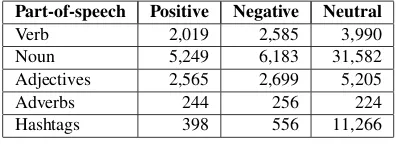
The statistics of theDPLp-ENandDPLp-ITlexicons are instead shown in the Tables 2 and 3. The word spaces size was188,635and99,410, respectively for English and Italian. We filtered out some words, maintaining only the
verbs,nouns,adjectives,adverbsandhashtags. Thus, the final lexicon sizes are106,117and75,021, respectively for English and Italian. The number of items in each class is reported in the Tables. Again, we decided the class mem-bership of a word with thearg maxoperator over the DPL scores.
Part-of-speech Positive Negative Neutral
Verb 2,019 2,585 3,990
Noun 5,249 6,183 31,582
Adjectives 2,565 2,699 5,205
Adverbs 244 256 224
Hashtags 398 556 11,266
Table 3: Statistics for the Italian polarity lexicon (DPLp-IT) when the pre-processing stage is applied to de-rive lemmas and part-of-speech of each word.
[image:4.595.323.521.555.627.2]ad-Term Positive Negative Neutral good::j 0.74 0.11 0.15
:) 0.86 0.04 0.10
[image:5.595.61.281.68.245.2]bad::j 0.12 0.80 0.08 pain::n 0.13 0.76 0.11 #apple::h 0.14 0.16 0.70 #ibm::h 0.07 0.04 0.89 #microsoft::h 0.09 0.09 0.82 #google::h 0.14 0.17 0.69 #dell::h 0.13 0.20 0.67 #barackobama::h 0.19 0.07 0.74 #mccain::h 0.22 0.16 0.62 article::n 0.16 0.09 0.75 government::n 0.09 0.09 0.82 friend::n 0.37 0.31 0.32 surprise::n 0.40 0.31 0.29
Table 4: Example of polarity lexicon terms and relative sen-timent scores (English language) inDPLp-EN.
jectivegood(in the first row) has a bias towards positivity, as demonstrated by thePositivescore of0.74(in the second column), while it is less biased towards theNegativeclass, whose score is0.11. Similar trends can be pointed out for other words, such as the nounpain(fourth row in the table), which is more biased towards negativity, as demonstrated by the Negativescore of0.76. These polarity scores are reasonable if compared to a human assignment of the po-larity to the same words. For example, let us consider the Subjectivity Lexicon (Wilson et al., 2005), where a word is manually associated to a polarity category (positive, nega-tive, neutral) with a strength value (weak or strong). The polarity values in this lexicon forgoodandpainareweak positive andstrong negative, respectively. The DPLp-EN polarity assignment for these two words is comparable to the ones in the Subjectivity lexicon.
Similar outcomes can be found in the Italian language lexi-con, i.e.DPLp-IT. In Table 5 we report the polarity scores that can be found in the lexicon, for the translation in Ital-ian of the words of Table 4. Again, the scores associated to each word are reasonable. For example, let us consider the adjectivecattivoin the third row of the Table: it is clearly a word evoking negativity in the Italian language. The Distri-butional Polarity Lexicon approach is able to derive a Neg-ativescore of0.63(second column). Moreover, the English and Italian lexicons, i.e. DPLp-ENandDPLp-IT, assign similar scores to words that are the translation of each other. As an example, let us consider the adjectivegoodin English and its translation in Italian (that isbuono) in the first rows from the two Tables 4 and 5. The two lexicons assign to these words similar scores for all the three classes we are considering (0.74,0.11,0.15and0.77,0.12,0.11). More-over, notice that companies related hashtags are all mainly neutral in both languages. The same phenomenon occurs with hashtags about politicians, as#obamaor#mccain. One of the aims of the Distributional Polarity Lexicon ap-proach is to derive a new representation that is able of tak-ing into account polarity phenomena of the lexical items. The specific scores assigned within the polarity lexicon, as the ones reported in Table 4 or 5, can be adopted as a new vector representing the sentiment of each word. This new
Term Positive Negative Neutral
buono::j 0.77 0.12 0.11
:) 0.73 0.08 0.19
[image:5.595.313.533.69.244.2]cattivo::j 0.23 0.63 0.14 sofferenza::n 0.17 0.48 0.35 #apple::h 0.17 0.12 0.71 #ibm::h 0.15 0.13 0.72 #microsoft::h 0.14 0.12 0.74 #google::h 0.20 0.07 0.73 #dell::h 0.24 0.09 0.67 #barackobama::h 0.09 0.07 0.84 #mccain::h 0.13 0.02 0.85 articolo::n 0.19 0.05 0.76 governo::n 0.12 0.12 0.76 amico::n 0.44 0.24 0.32 sorpresa::n 0.40 0.22 0.38
Table 5: Example of polarity lexicon terms and relative sen-timent scores (Italian language) inDPLp-IT.
representation can be used to enrich a pure semantically oriented representation of words (from the original DMs) in order to inject sentiment related information in the em-bedding. In other words, we can combine the original word space vectors and the DPL vectors in a way such that the resulting representation can still represent the semantics of the words being at the same time more suitable for senti-ment analysis related tasks. In particular, for each word in the vocabulary, we derived such representation by jux-taposing9the original250-dimensional word space vector, which is derived throughword2vec, and a DPL vector: the result of this operation is a new253-dimensional repre-sentation.
Term w/o DPL w/ DPL
joy (0.62,0.08,0.30)
happiness happiness sorrow positivity laughter enjoyment
love (0.52,0.11,0.37)
adore adore
luv loves
hate loove
worse (0.13,0.80,0.07)
better worser worser sadder funnier shittier
sadly (0.07,0.91,0.02)
unfortunately unfortunately
alas alas
thankfully nope
Table 6: Similar words in the embedding without (2ndcolumn) and with (3rdcolumn) DPL, whose scores
(positivity, negativity, neutrality) are reported in parenthesis in the first column.
In Table 6 we computed the most similar words for some polarity-carrier word in English, or target word (first col-umn in the Table). Given a vector representation of the target word, the K most similar items are the K near-est neighbors according to the cosine similarity measure. The second column refers to the most similar words of
9Each vector is normalized (i.e. converted to a unit vector)
[image:5.595.312.531.466.613.2]a target word when the corresponding vector representa-tion is not enriched with the DPL, i.e. each word is rep-resented through the original Skip-gram 250-dimensional vector. The third column of the Table instead reports the most similar words when the word space vector is enriched with theDPL-EN, i.e. when it is represented with the253 -dimensional vector that is derived after the operation of juxtaposition. Notice how the DPL enrichment makes op-posite polarity words less similar in the vector space. For example, let us consider the target wordjoy, whose DPL scores are (0.62,0.08,0.30), i.e. it is biased towards posi-tivity. Notice, in the second column, that the originalK -nearest neighbors contain the wordsorrow, which can be considered a negative, and thus opposite, word. Thus, the original word space is not able to properly differentiate be-tween these two words from a sentiment perspective. No-tice, instead, that the enriched representation is more con-sistent with the underlying sentiment. In fact, the new253 -dimensional vector captures pure semantics phenomena, as theK-nearest neighbors are still related to the target, but it makes opposite polar words less similar in the space (see the third column in the Table). For example,sorrowis no more in the3-nearest neighbors ofjoy, while its new3most similar words arehappiness, positivityandenjoyment. It means that this new representation could be more suitable for representing words in Sentiment Analysis tasks.
5.
Experimental Evaluation
In this Section, an indirect evaluation of the polarity lexi-cons is provided. In particular, all the released lexilexi-cons are used in Sentiment Analysis tasks in Twitter with respect to English and Italian. In each task, the recognition of senti-ment classes underlying a tweet is modeled as a classifica-tion problem. As for the generaclassifica-tion of Distribuclassifica-tional Polar-ity Lexicons, the SVM learning algorithm implemented in KeLP (Filice et al., 2015) is adopted to acquire the classifi-cation functions.
5.1.
Sentiment Analysis in Twitter in English
TheDPL-ENandDPLp-ENlexicons are evaluated against two tasks, the Semeval2013and the Semeval2014 Senti-ment Analysis in Twitter tasks.
The evaluations are addressed with two basic feature repre-sentations in a SVM learning framework: a boolean Bag-of-Word (BoW) and a word space (WS) derived representa-tion. The former captures pure lexical information, whereas each binary dimension expresses the presence (or absence) of a particular word in a sentence. The latter is based on a word space whose aim is to smooth the lexical overlap mea-sure of the pure BoW. The WS representation of a sentence is obtained by summing the vectors of all its verbs, nouns, adjectives and adverbs. We further enrich these represen-tations of a message with the information derived from the DPL. In the following evaluations we thus make two dis-tinct representations that are dependent from theDPL-EN andDPLp-EN, each with a 3-dimensional feature vector obtained by summing the DPL values of all the words (for the case of DPL-EN) and of the verbs, nouns, adjectives and adverbs (for the case ofDPLp-EN).
Kernel F1pn F1pnn
BoW 59.72 63.53
BoW+SBJ 61.46 64.95 BoW+DPL-EN 60.08 63.42 BoW+DPLp-EN 60.78 64.09
BoW+WS 66.12 68.56
BoW+WS+SBJ 65.20 67.93 BoW+WS+DPL-EN 65.90 68.38 BoW+WS+DPLp-EN 66.40 68.68 Best-System 69.02
-Table 7: Twitter Sentiment Analysis 2013 results. Best-Systemrefers to the top scoring system in SemEval 2013.
Kernel F1pn F1pnn
BoW 58.74 61.38
BoW+SBJ 60.82 62.85 BoW+DPL-EN 59.07 62.39 BoW+DPLp-EN 62.49 64.01
BoW+WS 65.20 66.35
BoW+WS+SBJ 64.29 66.13 BoW+WS+DPL-EN 64.76 67.18 BoW+WS+DPLp-EN 66.11 67.07 Best-System 70.96
-Table 8: Twitter Sentiment Analysis 2014 results. Best-Systemrefers to the top scoring system in SemEval 2014.
The SVM learning algorithm is adopted over a kernel func-tion (Shawe-Taylor and Cristianini, 2004) that is the com-bination of linear kernels, each operating on a specific rep-resentation. As an example, the SVM may operate over a kernel that is the sum of the single linear kernels over the BoW, WS andDPLp-ENrepresentations: we refer to such a setting as BoW+WS+DPLp-EN.
[image:6.595.343.504.67.184.2] [image:6.595.342.506.229.344.2]rep-resentations are reported. When applying the WS, an im-provement can be noticed, as demonstrated by theF1pnn
score of68.56%in the BoW+WS kernel. It means that dis-tributional representations are useful to capture the seman-tic phenomena behind sentiment-related expressions, even in short texts, and to alleviate data sparseness problems of the pure BoW kernel (as demonstrated by the∼ 5 points increment in F1Pnn). When combining also the DPLs, further improvements are obtained for both performance measures (66.40% F1pnand 68.68% inF1pnnwhen us-ing the pre-processed lexicon). It seems that DPLp-EN effectively acts as a smoothing of the contribution of the pure lexical semantics information provided by WS. Notice that the adoption of the pre-processed version is more effec-tive with respect to the adoption of theDPL-EN. The filter-ing applied to the part-of-speech helps in producfilter-ing a bet-ter feature representation that is more suitable for the task of sentiment analysis, even with respect to noisy texts de-rived from Twitter. It is noticeable that the combination of BoW+WS+DPLp-EN would have produced a system rank-ing 2nd in the2013SemEval challenge, where the
Best-system10achieved theF1pnscore of69.02%.
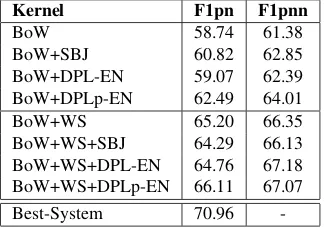
Similar trends can be noticed for the2014test set, as shown in Table 8. In this case, we were not able to rely on the complete test set, as, at the time of this experimentation, some of the messages were no longer available for down-load. Our evaluation is carried out on1,562test examples, while the full test set was composed by 1,853. It makes a direct comparison with the in challenge systems impos-sible, but it still can give an idea of the achievable perfor-mances. Again, performances are measured with the BoW and WS representations combined with SBJ and DPLs. As it can be noticed, the use of distributed word representa-tions is beneficial also in this scenario, as demonstrated by the BoW+WS row of Table 8, where a65.20% inF1pnn
and 66.35% in F1pnn are reported. Again, when using the automatically acquired polarity lexicons, improvements are noticeable, as demonstrated by the66.11%in theF1pn
and67.07%in theF1pnnof the BoW+WS+DPLp-EN set-ting. These are straightforward results if considering that no hand coded resource has been used. Notice that the Best-System11here reported is measured over the full test set.
5.2.
Sentiment Analysis in Twitter in Italian
The impact of the Italian lexicon is measured against the data of the Evalita 2014 Sentipolc (Basile et al., 2014) chal-lenge. Here, Twitter messages are annotated with respect to subjectivity,polarityandirony. We selected those messages annotated with polarity and that were not expressing any irony in order not to have been biased by polarity inversion phenomena typical of ironic texts. Our evaluations are carried out on2,566and1,175messages, used respectively for training and testing.
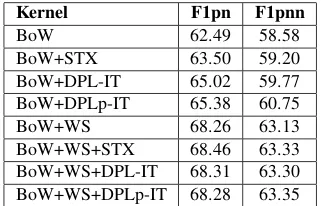
In Table 9, performances for this setting are reported.
10
The best system measured during the official competition adopted many polarity lexicons and ad-hoc features.
11The best system measured during the official competition
adopted many polarity lexicons as well as different syntactic (char-ngrams and word-ngrams) and semantic features (word senses and word clusters).
Kernel F1pn F1pnn
BoW 62.49 58.58
[image:7.595.342.503.68.171.2]BoW+STX 63.50 59.20 BoW+DPL-IT 65.02 59.77 BoW+DPLp-IT 65.38 60.75 BoW+WS 68.26 63.13 BoW+WS+STX 68.46 63.33 BoW+WS+DPL-IT 68.31 63.30 BoW+WS+DPLp-IT 68.28 63.35
Table 9: Twitter Polarity Classification in Italian.
Again, the F1 mean between the positive and negative classes (F1pn), as well as the mean between all the involved classes (F1pnn) are reported.
We compare the DPLs with another Italian polarity lexicon, called SENTIX in (Basile and Nissim, 2013). It consists of words automatically annotated with4sentiment scores, i.e.positive,negative,polarityandintensity. In our evalua-tion, tweets are described by 4-dimensional vectors, whose scores correspond to sums across all the tweet words (STX representation). In the results, the benefits of using a po-larity lexicon for augmenting the BoW representation is more evident, and the improvement in using the two re-sources is similar. In fact, the BoW kernel alone has a per-formance of58.58%inF1pnn; when augmented with the STX and the DPLp-IT, the performance increases respec-tively to59.20%and60.75%. Our lexicon is able to pro-vide more information to the learning algorithm, as demon-strated by the higher performance that is measured. When adopting the WS representation, performances increase up to63.13%inF1pnn. When using also the DPLs it seems that the interaction with the WS features is beneficial, as demonstrated by the further improvement up to63.35%in
F1pnnwith theDPLp-IT.
6.
Conclusion
In this paper, we acquired large-scale polarity lexicons in English and Italian with a methodology we recently defined in (Castellucci et al., 2015). Emotion related aspects are ob-served over annotated sentences and are transferred to lex-ical items. The transfer is made possible as both sentences and words are represented in a common feature space, char-acterized by a Distributional Model. The method proved to be quite general: it does not rely on any hand-coded re-source, but it mainly uses simple cues, e.g. emoticons, for generating a corpus of labeled sentences. Moreover, it is largely applicable to resource-poor languages, e.g. Italian. The generated resources are available for the download to the research community and have been evaluated in differ-ent Sdiffer-entimdiffer-ent Analysis in Twitter tasks.
7.
References
Baroni, M., Dinu, G., and Kruszewski, G. (2014). Don’t count, predict! a systematic comparison of context-counting vs. context-predicting semantic vectors. In
Proc. of ACL, pages 238–247. Association for Compu-tational Linguistics.
Basile, V. and Nissim, M. (2013). Sentiment analysis on Italian tweets. In Proc. of the 4th WS: Computational Approaches to Subjectivity, Sentiment and Social Media Analysis.
Basile, V., Bolioli, A., Nissim, M., Patti, V., and Rosso, P. (2014). Overview of the evalita 2014 sentiment polarity classification task. InProc. of the 4th EVALITA. Basili, R. and Zanzotto, F. M. (2002). Parsing engineering
and empirical robustness. Nat. Lang. Eng., 8(3):97–120, June.
Bengio, Y., Ducharme, R., Vincent, P., and Janvin, C. (2003). A neural probabilistic language model.J. Mach. Learn. Res., 3:1137–1155, March.
Castellucci, G., Croce, D., and Basili, R. (2015). Acquir-ing a large scale polarity lexicon through unsupervised distributional methods. In Chris Biemann, et al., editors,
Natural Language Processing and Information Systems, volume 9103 of LNCS, pages 73–86. Springer Interna-tional.
Esuli, A. and Sebastiani, F. (2006). Sentiwordnet: A pub-licly available lexical resource for opinion mining. InIn Proc. of 5th LREC, pages 417–422.
Filice, S., Castellucci, G., Croce, D., and Basili, R. (2015). Kelp: a kernel-based learning platform for natural lan-guage processing. InProceedings of ACL-IJCNLP 2015 System Demonstrations, pages 19–24, Beijing, China, July. Association for Computational Linguistics and The Asian Federation of Natural Language Processing. Go, A., Bhayani, R., and Huang, L. (2009). Twitter
sen-timent classification using distant supervision. Process-ing, pages 1–6.
Golub, G. and Kahan, W. (1965). Calculating the singular values and pseudo-inverse of a matrix. Journal of the Society for Industrial and Applied Mathematics: Series B, Numerical Analysis, 2(2):pp. 205–224.
Harris, Z. (1964). Distributional structure. In Jerrold J. Katz et al., editors, The Philosophy of Linguistics. Ox-ford University Press.
Hu, M. and Liu, B. (2004). Mining and summarizing cus-tomer reviews. InProc. of 10th Int. Conf. on Knowledge Discovery and Data Mining, pages 168–177. ACM. Kiritchenko, S., Zhu, X., and Mohammad, S. M. (2014).
Sentiment analysis of short informal texts. JAIR, 50:723–762, Aug.
Landauer, T. and Dumais, S. (1997). A solution to plato’s problem: The latent semantic analysis theory of acqui-sition, induction and representation of knowledge. Psy-chological Review, 104.
Mikolov, T., Chen, K., Corrado, G., and Dean, J. (2013a). Efficient estimation of word representations in vector space.CoRR, abs/1301.3781.
Mikolov, T., Yih, W.-t., and Zweig, G. (2013b). Linguistic regularities in continuous space word representations. In
Proc. of NAACL, pages 746–751. Association for Com-putational Linguistics.
Miller, G. A. (1995). Wordnet: A lexical database for en-glish.Commun. ACM, 38(11):39–41.
Mohammad, S. M. and Turney, P. D. (2010). Emotions evoked by common words and phrases: Using me-chanical turk to create an emotion lexicon. In Proc. of CAAGET Workshop.
Nakov, P., Rosenthal, S., Kozareva, Z., Stoyanov, V., Ritter, A., and Wilson, T. (2013). Semeval-2013 task 2: Sen-timent analysis in twitter. InIn Proc. of SemEval, USA, June. ACL.
Pang, B. and Lee, L. (2008). Opinion mining and senti-ment analysis. Found. Trends Inf. Retr., 2(1-2):1–135, January.
Rao, D. and Ravichandran, D. (2009). Semi-supervised polarity lexicon induction. InProc. of the EACL, pages 675–682. ACL.
Rosenthal, S., Ritter, A., Nakov, P., and Stoyanov, V. (2014). Semeval-2014 task 9: Sentiment analysis in twit-ter. InProc. SemEval. ACL and Dublin City University. Sahlgren, M. (2006). The Word-Space Model. Ph.D.
the-sis, Stockholm University.
Saif, H., Fernandez, M., He, Y., and Alani, H. (2014). Senticircles for contextual and conceptual semantic sen-timent analysis of twitter. In Valentina Presutti, et al., editors,The Semantic Web: Trends and Challenges, vol-ume 8465 ofLNCS, pages 83–98. Springer International. Shawe-Taylor, J. and Cristianini, N. (2004). Kernel Meth-ods for Pattern Analysis. Cambridge University Press, New York, NY, USA.
Stone, P. J., Dunphy, D. C., Smith, M. S., and Ogilvie, D. M. (1966). The General Inquirer: A Computer Ap-proach to Content Analysis. MIT Press.
Turney, P. D. and Littman, M. L. (2003). Measuring praise and criticism: Inference of semantic orientation from as-sociation.ACM Trans. Inf. Syst., 21(4):315–346. Wilson, T., Wiebe, J., and Hoffmann, P. (2005).
Recogniz-ing contextual polarity in phrase-level sentiment analy-sis. InProc. of EMNLP. ACL.