ZKPDL: A Language-Based System for Efficient Zero-Knowledge Proofs
and Electronic Cash
Sarah Meiklejohn
University of California, San Diego
smeiklej@ cs.ucsd.edu
C. Chris Erway
Brown University
cce@ cs.brown.edu
Alptekin Küpçü
Brown University
kupcu@ cs.brown.edu
Theodora Hinkle
University of Wisconsin, Madison
thea@ cs.wisc.edu
Anna Lysyanskaya
Brown University
anna@ cs.brown.edu
Abstract
In recent years, many advances have been made in cryptography, as well as in the performance of commu-nication networks and processors. As a result, many ad-vanced cryptographic protocols are now efficient enough to be considered practical, yet research in the area re-mains largely theoretical and little work has been done to use these protocols in practice, despite a wealth of po-tential applications.
This paper introduces a simple description language, ZKPDL, and an interpreter for this language. ZKPDL implements non-interactive zero-knowledge proofs of knowledge, a primitive which has received much atten-tion in recent years. Using our language, a single pro-gram may specify the computation required by both the prover and verifier of a zero-knowledge protocol, while our interpreter performs a number of optimizations to lower both computational and space overhead.
Our motivating application for ZKPDL has been the efficient implementation of electronic cash. As such, we have used our language to develop a cryptographic library,Cashlib, that provides an interface for using e-cash and fair exchange protocols without requiring ex-pert knowledge from the programmer.
1
Introduction
Modern cryptographic protocols are complicated, computationally intensive, and, given their security re-quirements, require great care to implement. However, one cannot expect all good cryptographers to be good programmers, or vice versa. As a result, many newly pro-posed protocols—often described as efficient enough for deployment by their authors—are left unimplemented, despite the potentially useful primitives they offer to sys-tem designers. We believe that a lack of high-level soft-ware support (such as that provided by OpenSSL, which provides basic encryption and hashing) presents a barrier to the implementation and deployment of advanced
cryp-tographic protocols, and in this work attempt to remove this obstacle.
One particular area of recent cryptographic research which has applications for privacy-preserving systems is zero-knowledge proofs[47, 46, 17, 39], which provide a way of proving that a statement is true without re-vealing anything beyond the validity of the statement. Among the applications of zero-knowledge proofs are electronic voting [49, 56, 38, 51], anonymous authenti-cation [21, 36, 62], anonymous electronic ticketing for public transportation [50], verifiable outsourced compu-tation [9, 43], and essentially any system in which hon-esty needs to be enforced without sacrificing privacy. Much recent attention has been paid to protocols based on anonymous credentials [30, 35, 24, 26, 11, 8], which allow users to anonymously prove possession of a valid credential (e.g., a driver’s license), or prove relationships based on data associated with that credential (e.g., that a user’s age lies within a certain range) without revealing their identity or other data. These protocols also prevent the person verifying a credential and the credential’s is-suer from colluding to link activity to specific users. As corporations and governments move to put an increas-ing amount of personal information online, the need for efficient privacy-preserving systems has become increas-ingly important and a major focus of recent research.
Another application of zero-knowledge proofs is elec-tronic cash. The primary aim of our work has been to enable the efficient deployment of secure, anonymous electronic cash (e-cash) in network applications. Like physical coins, e-coins cannot be forged; furthermore, given two e-coins it is impossible to tell who spent them, or even if they came from the same user. For this rea-son, e-cash holds promise for use in anonymous settings and privacy-preserving applications, where free-riding by users may threaten a system’s stability.
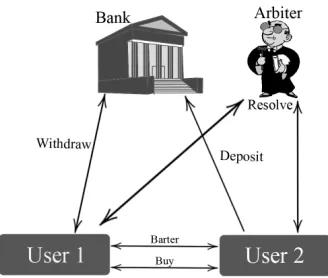
ac-Figure 1: An overview of the entities involved in our e-cash system. Users may engage in buy or barter transactions, with-draw and deposit coins as necessary, and consult the arbiter for resolution only in the case of a dispute.
count balances, lets the users withdraw money, and ac-cepts coin deposits. The arbiter (a trusted third party) re-solves any disputes that arise between users in the course of their fair exchanges. Once the users have obtained money from the bank, they are free to exchange coins for items (or just barter for items) and in this way create an economy.
In previous work [10] we describe a privacy-preserving P2P system based on BitTorrent that uses our e-cash and fair exchange protocols to incentivize users to share data. Here, the application of e-cash provides protection against selfish peers, as well as an incentive to upload for peers who have completed their download and thus have no need to continue participating. This system has been realized by our work on the Buy and Barter protocols, described in Section 6.2, which allow a user to fairly exchange e-coins for blocks of data, or barter one block of data for another.
These e-cash protocols can also be used for payments in other systems that face free-riding problems, such as anonymous onion routing [27]. In such a system, routers would be paid for forwarding messages using e-cash, thus providing incentives to route traffic on behalf of oth-ers in a manner similar to that proposed by Androulaki et al. [2]. Since P2P systems like these require each user to perform many cryptographic exchanges, the need to pro-vide high performance for repeated executions of these protocols is paramount.
1.1
Our contribution
In this paper, we hope to bridge the gap between de-sign and deployment by providing a language, ZKPDL (Zero-Knowledge Proof Description Language), that en-ables programmers and cryptographers to more easily
implement privacy-preserving protocols. We also pro-vide a library, Cashlib, that builds upon our language to provide simple access to cryptographic protocols such as electronic cash, blind signatures, verifiable encryption, and fair exchange.
The design and implementation of our language and library were motivated by collaborations with systems researchers interested in employing e-cash in high-throughput applications, such as the P2P systems de-scribed earlier. The resulting performance concerns, and the complexity of the protocols required, motivated our library’s focus on performance and ease of use for both the cryptographers designing the protocols and the sys-tems programmers charged with putting them into prac-tice. These twin concerns led to our language-based ap-proach and work on the interpreter.
The high-level nature of our language brings two ben-efits. First, it frees the programmer from having to worry about the implementation of cryptographic primitives, efficient mathematical operations, generating and pro-cessing messages, etc.; instead, ZKPDL allows the spec-ification of a protocol in a manner similar to that of theo-retical descriptions. Second, it allows our library to make performance optimizations based on analysis of the pro-tocol description itself.
ZKPDL permits the specification of many widely-used zero-knowledge proofs. We also provide an in-terpreter that generates and verifies proofs for protocols described by our language. The interpreter performs optimizations such as precomputation of expected ex-ponentiations, translations to prevent redundant proofs, and caching compiled versions of programs to be loaded when they are used again on different inputs. More de-tails on these optimizations are provided in Section 4.2.
Our e-cash library, Cashlib, described in Section 6, sits atop our language to provide simple access to higher-level cryptographic primitives such as e-cash [27], blind signatures [25], verifiable encryption [28], and optimistic fair exchange [10, 52]. Because of the modular nature of our language, we believe that the set of primitives pro-vided by our library can be easily extended to include other zero-knowledge protocols.
Finally, we hope that our efforts will encourage pro-grammers to use (and extend) our library to implement their cryptographic protocols, and that our language will make their job easier; we welcome contribution by our fellow researchers in this effort. Documentation and source code for our library can be found online athttp: //github.com/brownie/cashlib.
2
Cryptographic Background
zero-knowledge proofs. Briefly, a commitment scheme can be thought of as cryptographically analogous to an enve-lope. When a user Alice wants to commit to a value, she puts the value in the envelope and seals it. Upon receiv-ing a commitment, a second user Bob cannot tell which value is in the envelope; this property is calledhiding(in this analogy, let’s assume Alice is the only one who can open the envelope). Furthermore, because the envelope is sealed, Alice cannot sneak another value into the enve-lope without Bob knowing: this property is called bind-ing. To eventually reveal the value inside the envelope, all Alice has to do is open it (cryptographically, she does this by revealing the private value and any randomness used to form the commitment; this collection of values is aptly referred to as theopeningof the commitment). We employ both Pedersen commitments [65] and Fujisaki-Okamoto commitments [42, 37], which rely on the secu-rity of the Discrete Log assumption and the Strong RSA assumption respectively.
Zero-knowledge proofs [47, 46] provide a way of proving that a statement is true to someone without that person learning anything beyond the validity of the state-ment. For example, if the statement were “I have access to this sytem” then the verifier would learn only that I really do have access, and not, for example, how I gain access or what my access code is. In our library, we make use of sigma proofs [34], which are three-message proofs that achieve a weaker variant of zero-knowledge known ashonest-verifier zero-knowledge. We do not implement sigma protocols directly; instead, we use the Fiat-Shamir heuristic [41] that transforms sigma protocols into non-interactive (fully) zero-knowledge proofs, secure in the random oracle model [13].
A primitive similar to zero-knowledge is the idea of a proof of knowledge [12], in which the prover not only proves that a statement is true, but also proves that it knows a reason why the statement is true. Extending the above example, this would be equivalent to proving the statement “I have access to the system, and I know a password that makes this true.”
In addition to these cryptographic primitives, our li-brary also makes uses of hash functions (both univer-sal one-way hashes [61] and Merkle hashes [60]), digital signatures [48], pseudo-random functions [45], and sym-metric encryption [33]. The security of the protocols in our library relies on the security of each of these individ-ual components, as well as the security of any commit-ment schemes or zero-knowledge proofs used.
3
Design
The design of our library and language arose from our initial goal of providing a high-performance implemen-tation of protocols for e-cash and fair exchange for use
in applications such as those described in the introduc-tion. For these applications, the need to support many repeated interactions of the same protocol efficiently is a paramount concern for both the bank and the users. In the bank’s case, it must conduct withdraw and deposit pro-tocols with every user in the system, while in the user’s case it is possible that a user would want to conduct many transactions using the same system parameters.
Motivated by these performance requirements, we ini-tially developed a more straightforward implementation of our protocols using C++ and GMP [44], but found that our ability to modify and optimize our implementa-tion was hampered by the complexity of our protocols. High-level changes to protocols required significant ef-fort to re-implement; meanwhile, potentially useful per-formance optimizations became difficult to implement, and there was no way to easily extend the functionality of the library.
Verifier Prover
ZKPDL Program
Interpreter Prover
Interpreter Verifier compile()
public values (security parameters, public keys, groups, generators, etc)
private values to be proved
ZKProof Message
Proof verified? (true/false) serializa
tion
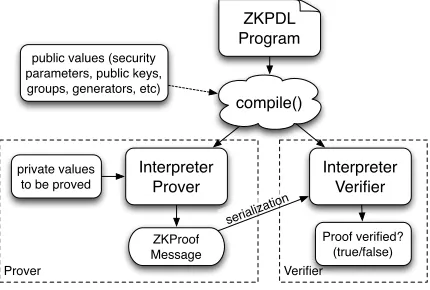
Figure 2: Usage of a ZKPDL program: the same program is compiled separately by the prover and verifier, who may also be provided with a set of fixed public parameters. This pro-duces an Interpreter object, which can be used by the prover to prove to a verifier that his private values satisfy a certain set of relationships. Serialization and processing of proof messages are provided by the library. Once compiled, an interpreter can be re-used on different private inputs, using the same public parameters that were originally provided.
verifier to verify these proofs.
Key to our approach is the simplicity of our language. It is not Turing-complete and does not allow for branch-ing or conditionals; it simply describes the variables, equations, and relationships required by a protocol, leav-ing the implementation details up to the interpreter and language framework. This framework, described in the following section, provides C++ classes that parse, ana-lyze, optimize, and interpret ZKPDL programs, employ-ing many common compiler techniques (e.g., constant substitution and propagation, type-checking, providing error messages when undefined variables are used, etc.) in the process. We are able to understand and transform mathematical expressions into forms that provide better performance (e.g., through techniques for fixed-base ex-ponentiation), and recognize relationships between val-ues to be proved in zero-knowledge. All of these low-level optimizations, as well as our high-low-level primitives, should enable a programmer to quickly implement and evaluate the efficiency of a protocol.
We also provide a number of C++ classes that wrap ZKPDL programs into interfaces for generating and ver-ifying proofs, as well as marshaling them between com-puters. We build upon these wrappers to additionally provide Cashlib, a collection of interfaces that allows a programmer to assume the role of buyer, seller, bank, or arbiter in a fair exchange system based on endorsed e-cash [27], as seen in Figure 1 and described in Sec-tion 5.3.
4
Implementation of ZKPDL
To enable implementation of the cryptographic prim-itives discussed in Section 2, we have designed a gramming language for specifying zero-knowledge pro-tocols, as well as an interpreter for this language. The interpreter is implemented in C++ and consists of ap-proximately6000lines of code. On the prover side, the interpreter will output a zero-knowledge proof for the re-lations specified in the program; on the verifier side, the interpreter will be given a proof and verify whether or not it is correct. Therefore, the output of the interpreter depends on the role of the user, although the program provided to the interpreter is the same for both.
4.1
Overview
Here we provide a brief overview of some fundamen-tal language features to give an idea of how programs are written; a full grammar for our language, containing all of its features, can be found in our documentation avail-able online, and further sample programs can be found in Section 5. A program can be broken down into two blocks: a computation block and a proof block. Each of these blocks is optional: if a user just wants a calculator
for modular (or even just integer) arithmetic then he will specify just the computation block; if, on the other hand, he has all the input values pre-computed and justs wants a zero-knowledge proof of relations between these values, he will specify just the proof block. Here is a sample pro-gram written in our language (indentations are included for readability, and are not required syntax).
sample.zkp
1 computation: //compute values required for proof
2 given: //declarations
3 group: G = <g,h>
4 exponents in G: x[2:3]
5 compute: //declarations and assignments
6 random exponents in G: r[1:3]
7 x_1 := x_2 * x_3
8 for(i, 1:3, c_i := g^x_i * h^r_i)
9 10 proof:
11 given: //declarations of public values
12 group: G = <g,h>
13 elements in G: c[1:3]
14 for(i, 1:3, commitment to x_i: c_i = g^x_i * h^r_i)
15 prove knowledge of: //declarations of private values
16 exponents in G: x[1:3], r[1:3]
17 such that: //protocol specification; i.e. relations
18 x_1 = x_2 * x_3
In this example, we are proving that the valuex1
con-tained within the commitment c1 is the product of the
two valuesx2andx3contained in the commitmentsc2
andc3. The program can be broken down in terms of how
variables are declared and used, and the computation and proof specifications. Note that some lines are repeated across the computation and proof blocks, as both are op-tional and hence considered independently.
4.1.1 Variable declaration
Two types of variables can be declared: group objects and numerical objects. Names of groups must start with a letter and cannot have any subscripts; sample group declarations can be seen in lines3 and12of the above program. In these lines, we also declare the group gen-erators, although this declaration is optional (as we will see later on in Section 5, it is also optional to name the group modulus).
Numerical variables must start with a letter and are al-lowed to have subscripts.
4.1.2 Computation
The computation block breaks down into two blocks of its own: thegivenblock and thecomputeblock. The givenblock specifies the parameters, as well as any val-ues that have already been computed by the user and are necessary for the computation (in the example, the group Gcan be considered a system parameter and the values x_2andx_3are just needed for the computation).
Thecomputeblock carries out the specified compu-tations. There are two types of computations: picking a random value, and defining a value by setting it equal to the right-hand side of an equation. We can see an ex-ample of the former in line 6 of our sample program; in this case, we are picking three random exponents in a group (noter[1:3]is just syntactic sugar for writing r_1, r_2, r_3). We also support picking a random in-teger from a specified range, and picking a random prime of a specified length (examples of these can be found in Section 5). As already noted, lines 7and8 provide examples of lines for computing equations. In line 8, the for syntax is again just syntactic sugar; this time to succintly specify the relationsc_1 = g^x_1*h^r_1, c_2 = g^x_2*h^r_2, and c_3 = g^x_3*h^r_3. We have a similar for syntax for specifying products or sums (much like Q or Pin conventional mathemati-cal notation), but neither of theseformacros should be confused with a for loop in a conventional programming language.
4.1.3 Proof specification
The proof block is comprised of three blocks: the givenblock, theprove knowledge ofblock, and the such that block. In the given block, the parame-ters for the proof are specified, as well as the public inputs known to both the prover and verifier for the zero-knowledge protocol. In theprove knowledge of block, the prover’s private inputs are specified. Finally, thesuch thatblock specifies the desired relations be-tween all the values; the zero-knowledge proof will be a proof that these relations are satisfied. We currently support four main types of relations:
• Proving knowledge of the opening of a commit-ment [67]. We can prove openings of Pedersen [65] or Fujisaki-Okamoto commitments [42, 37]. In both cases we allow for commitments to multiple values.
• Proving equality of the openings of different com-mitments. Given any number of commitments, we can prove the equality of any subset of the values contained within the commitments.
• Proving that a committed value is the product of two
other committed values [37, 18]. As seen in our sample program, we can prove that a valuex con-tained within a commitment is the product of two other valuesy, z contained within two other com-mitments; i.e.,x=y·z. As a special case, we can also prove thatx=y2.
• Proving that a committed value is contained within a public range [18, 55]. We can prove that the valuexcontained within a given commitment sat-isfieslo ≤x <hi, whereloandhi are both public values.
There are a number of other zero-knowledge proof types (e.g., proving a value is a Blum integer, proving that committed values satisfy some polynomial relation-ship, etc.), but we chose these four based on their wide usage in applications, in particular in e-cash and anony-mous credentials. We note, however, that adding other proof types to the language should require little work (as mentioned in Section 4.2), as we specifically designed the language and interpreter with modularity in mind. 4.1.4 Sample usage
In addition to showing a sample program, we would also like to demonstrate a sample usage of our interpreter API. In order to use the sample ZKPDL program from Section 4.1, one could use the following C++ code (as-suming there are already numerical variables namedx2 andx3, and a group namedG):
group_map g; variable_map v; g["G"] = G; v["x_2"] = x2; v["x_3"] = x3;
InterpreterProver prover; // compiles program with groups prover.check("sample.zkp", g);
// computes intermediate values needed for proof prover.compute(v);
// computes and outputs proof
ProofMessage proofMsg = (prover.getPublicVariables(), prover.computeProof());
for the zero-knowledge proof and any intermediate val-ues (e.g., commitments and group bases) that the verifier might need to verify the proof.
The method is almost identical for the verifier:
group_map g; variable_map v; g["G"] = G;
InterpreterVerifier verifier; verifier.check("sample.zkp", g); verifier.compute(v, proofMsg.publics);
bool verified = verifier.verify(proofMsg.proof);
As we can see, the main difference is that the verifier uses both its own public inputs and the prover’s public values at compute time (with its own inputs always tak-ing precedence over theProofMessageinputs), but still takes in the proof to be checked afterwards so that the actions of the prover and verifier remain symmetric.
4.2
Optimizations
In our interpreter, we have incorporated a number of optimizations that make using our language not only more convenient but also more efficient. Here we de-scribe the most significant optimizations, which include removing any redundancy when multiple proofs are com-bined and performing multi-exponentiations on cached bases when the same bases are used frequently. Other improvements specific to existing protocols can be found in Section 5.
4.2.1 Translation
To eliminate redundancy between different proofs, we first translate each proof described in Section 4.1.3 into a “fundamental discrete logarithm form.” In this form, each proof can be represented by a collection of equa-tions of the form A = Bx·Cy. For example, if the prover would like to prove that the value xcontained withinCx=gxhrx is equal to the product of the values yandzcontained withinCy =gyhry andCz =gzhrz respectively, this is equivalent to a proof of knowledge of the discrete logarithm equalities Cy = gyhry and Cx=Cyzhrx−zry.
Our sample program in the previous section is first translated into this discrete logarithm form. During run-time, the values provided to the prover are then used to generate the zero-knowledge proof. In addition to elim-inating redundancy between proofs of different relations in the program, this technique also allows our language to easily add new types of proofs as they become avail-able. To add any proof that can be broken down into this discrete logarithm form, we need to add only a transla-tion functransla-tion and a rule in the grammar for how we would like to specify this proof in a program, and the rest of the work will be handled by our existing framework.
4.2.2 Multi-exponentiation
The computational performance of many crypto-graphic protocols, especially those used by our library, is often dominated by the need to perform many modular exponentiation operations on large integers. These op-erations typically involve the use of systems parameters as bases, with exponents chosen at random or provided as private inputs (e.g., Pedersen commitments, which re-quire computation ofgx·hr, wheregandhare publicly known). Algorithms for simultaneous multiple expo-nentiation allow the result of multi-base expoexpo-nentiations such as these to be computed without performing each intermediate exponentiation individually; an overview of these protocols can be found in Section14.6of Menezes et al. [59].
Our interpreter leverages the descriptions of mathe-matical expressions in ZKPDL programs to recognize when fixed-base exponentiation operations occur, allow-ing it to precompute lookup tables at compile time that can speed up these computations dramatically. In addi-tion to single-table multi-exponentiaaddi-tion techniques (i.e., the 2w-ary method [59]), we offer programmers who expect to run the same protocol many times the abil-ity to take advantage of time/space tradeoffs by gener-ating large lookup tables of precomputed powers. This allows a programmer to choose parameters that balance the memory requirements of the interpreter against the need for fast exponentiation.
For single-base exponentiation, we employ window-based precomputation techniques similar to those used by PBC [57] to cache powers of fixed bases. For multi-base exponentiation ofkexponents, we currently extend the2w-ary method to store2kw-sized lookup tables for eachw-bit window of the expected exponent length, so that multi-exponentiations on exponents of lengthn re-quire onlyn/w multiplications of stored values. While we are also evaluating other algorithms offering similar time-space tradeoffs, we demonstrate the performance gains afforded by these techniques later in Table 1. 4.2.3 Interpreter caching
were re-parsed each time, it would take an extra10ms, as opposed to the fraction of a millisecond required to load a cached interpreter environment, saving the bank approximately10%of computation time per transaction by avoiding parsing overhead.
5
Sample Programs and Performance
Using our language, we have written programs for a wide variety of cryptographic primitives, including blind signatures [25], verifiable encryption [28], and endorsed e-cash [27]. In the following sections, we provide our programs for these three primitives; in addition, perfor-mance benchmarks for all of them can be found at the end of the section.
5.1
CL signatures
Using our language, we have implemented the blind signature scheme due to Camenisch and Lysyan-skaya [25]; as we will see in Section 5.3, CL signatures are integral to endorsed e-cash. Briefly, ablind signa-ture, as introduced by Chaum [29], enables a signature issuer to sign a message without learning the contents of the message. A CL signature works in two main phases: an issuing phase, in which a user actually obtains the sig-nature, and a proving phase, in which the user is able to prove (in zero-knowledge) to other users that he does in fact possess a valid CL signature.
The issuing phase is a one-round interaction between the recipient and the issuer, at the end of which the recip-ient obtains the blind signature on her message(s). Be-cause the protocol is interactive, we present one program for each stage of the protocol. At the end of this first stage, the signature issuer will return apartial signature to the recipient, who will then use this signature to com-pute the full signature on the hidden message.
cl-recipient-proof.zkp
1 computation:
2 given:
3 group: pkGroup = <fprime, gprime[1:L+k], hprime>
4 exponents in pkGroup: x[1:L]
5 integers: stat, modSize
6 compute:
7 random integer in [0,2^(modSize+stat)): vprime
8 C := hprime^vprime * for(i, 1:L, *, gprime_i^x_i)
9 10 proof:
11 given:
12 group: pkGroup = <fprime, gprime[1:L+k], hprime>
13 group: comGroup = <f, g, h, h1, h2>
14 element in pkGroup: C
15 elements in comGroup: c[1:L]
16 for(i, 1:L, commitment to x_i: c_i=g^x_i*h^r_i)
17 integer: l_x
18 prove knowledge of:
19 integers: x[1:L]
20 exponents in comGroup: r[1:L]
21 exponent in pkGroup: vprime
22 such that:
23 for(i, 1:l, range: (-(2^l_x-1)) <= x_i < 2^l_x)
24 C = hprime^vprime * for(i, 1:L, gprime_i^x_i)
25 for(i, 1:L, c_i = g^x_i * h^r_i)
Next, the issuer must prove the partial signature is computed correctly, as in the following program.
cl-issuer-proof.zkp
1 computation:
2 given:
3 group: pkGroup = <f, g[1:L+k], h>
4 element in pkGroup: C
5 exponents in pkGroup: x[1:k+L]
6 integers: stat, modSize, lx
7 compute:
8 random integer in [0,2^(modSize+lx+stat)): vpp
9 random prime of length lx+2: e
10 einverse := 1/e
11 A := (f*C*h^vpp * for(i,L+1:k+L,*,g_i^x_i))^einverse
12 13 proof:
14 given:
15 group: pkGroup = <f, g[1:L+k], h>
16 elements in pkGroup: A, C
17 exponents in pkGroup: e, vpp, x[L+1:k]
18 prove knowledge of:
19 exponents in pkGroup: einverse
20 such that:
21 A = (f*C*h^vpp * for(i,L+1:k+L,*,g_i^x_i))^einverse
Once the recipient obtains the partial signature, she can unblind it to obtain a full signature; this step com-pletes the issuing phase.
Now, the owner of a CL signature needs a way to prove that she has a signature, without revealing either the sig-nature or the values. To accomplish this, the prover first randomizes the CL signature and then attaches a zero-knowledge proof of zero-knowledge that the randomized sig-nature corresponds to the original sigsig-nature on the com-mitted message.
cl-possession-proof.zkp
1 computation:
2 given:
3 group: pkGroup = <fprime, gprime[1:L+k], hprime>
4 element in pkGroup: A
5 exponents in pkGroup: e, v, x[1:L]
6 integers: modSize, stat
7 compute:
8 random integers in [0,2^(modSize+stat)): r, r_C
9 vprime := v + r*e
10 Aprime := A * hprime^r
11 C := h^r_C * for(i, 1:L, *, gprime_i^x_i)
12 D := for(i, L+1:L+k, *, gprime_i^x_i)
13 fCD := f * C * D
14 15 proof:
16 given:
17 group: pkGroup = <fprime, gprime[1:L+k], hprime>
18 group: comGroup = <f, g, h, h1, h2>
19 elements in pkGroup: C, D, Aprime, fCD
20 elements in comGroup: c[1:L]
21 for(i, 1:L, commitment to x_i: c_i=g^x_i*h^r_i)
22 exponents in pkGroup: x[L+1:L+k]
23 integer: l_x
24 prove knowledge of:
25 integers: x[1:L]
26 exponents in comGroup: r[1:L]
27 exponents in pkGroup: e, vprime, r_C
28 such that:
29 for(i, 1:L, range: (-(2^l_x - 1)) <= x_i < 2^l_x)
30 C = hprime^r_C * for(i, 1:l, *, gprime_i^x_i)
31 for(i, 1:L, c_i = g^x_i * h^r_i)
5.2
Verifiable encryption
Briefly, verifiable encryption consists of a ciphertext under the public key of some trusted third party (in our case, the arbiter) and a zero-knowledge proof that the val-ues inside the ciphertext satisfy some relation; this pair is often referred to as averifiable escrow. Our implementa-tion of verifiable encrypimplementa-tion is based on the construcimplementa-tion of Camenisch and Shoup [28]. The main use of verifi-able encryption in e-cash is to allow a user to verifiably encrypt the opening of a commitment under the public key of the arbiter. A recipient of such a verifiable escrow can then verify that the encrypted values correspond to the opening of the commitment.
verifiable-encryption.zkp
1 computation:
2 given:
3 group: secondGroup = <g[1:m], h>
4 group: RSAGroup
5 modulus: N
6 group: G
7 group: cashGroup = <f_3, gprime, hprime, f_1, f_2>
8 exponents in G: x[1:m]
9 elements in G: u[1:m], v, w
10 compute:
11 random integer in [0,N/4): s
12 random exponents in secondGroup: r[1:m]
13 for(i, 1:m, c_i := g_1^x_i * g_2^r_i)
14 Xprime := for(i, 1:m, *, g_i^x_i) * h^s
15 vsquared := v^2
16 wsquared := w^2
17 for(i, 1:m, usquared_i := u_i^2)
18 19 proof:
20 given:
21 group: secondGroup = <g[1:m], h>
22 group: G
23 group: RSAGroup
24 modulus: N
25 group: cashGroup = <f_3, gprime, hprime, f_1, f_2>
26 element in cashGroup: X
27 elements in secondGroup: Xprime, c[1:m]
28 for(i,1:m,commitment to x_i: c_i=g_1^x_i*g_2^r_i)
29 elements in G: a[1:m], b, d, e, f, usquared[1:m],
30 vsquared, wsquared
31 prove knowledge of:
32 integers: x[1;M], r
33 exponent in G: hash
34 exponents in secondGroup: r[1:m], s
35 such that:
36 for(i, 1:m, range: -N/2 + 1 <= x_i < N/2)
37 vsquared = f^(2*r)
38 wsquared = (d * e^hash)^(2*r)
39 for(i, 1:m, usquared_i = b^(2*x_i) * a_i^(2*r))
40 X = for(i, 1:m, *, f_i^x_i)
41 Xprime = for(i, 1:m, *, g_i^x_i) * h^s
5.3
E-cash
Electronic cash, or e-cash for short, was first intro-duced by Chaum [29] and can be thought of as the electronic equivalent of cash; i.e., an electronic cur-rency that preserves users’ anonymity, as opposed to electronic checks [31] or credit cards. We implement endorsed e-cash, due to Camenisch, Lysyanskaya, and Meyerovich [27] (which is an extension of compact e-cash [22]), for two main reasons. Our first reason is that an endorsed e-coin can be split up into two parts, its endorsement and an unendorsed component; only with
both of these parts can the coin be considered complete. As we will see in Section 6.2.1, this property enables efficient fair exchange. The second reason for choos-ing endorsed e-cash is that it is offline, which means the bank does not need to be active in every transac-tion; this significantly reduces the burden placed on the bank. Although the bank does not check the coin in every interaction, endorsed e-cash has the property that double-spenders (i.e., users who try to spend the same coin twice) can be caught by the bank at the time of de-posit and punished accordingly. Because e-cash is meant to preserve privacy, however, a user is also guaranteed that unless she double spends a coin, her identity will be kept secret.
During the withdrawal phase of endorsed e-cash, a user contacts the bank. Before withdrawing, the user will have registered with the bank by storing a commitment. In order to prove her identity, then, the user will provide a proof that she knows the opening of the registered com-mitment. This can be accomplished using the following simple program:
user-id-proof.zkp
1 proof:
2 given:
3 group: cashGroup = <f,g,h,h1,h2>
4 elements in cashGroup: A, pk_u
5 commitment to sk_u: A = g^sk_u * h^r_u
6 prove knowledge of:
7 exponents in cashGroup: sk_u, r_u
8 such that:
9 pk_u = g^sk_u
10 A = g^sk_u * h^r_u
Once the bank has verified this proof, the user and the bank will run a protocol to obtain a CL signature (us-ing the programs we saw in Section 5.1) on the user’s identity and two pseudo-random function seeds. These private values and the signature on them define a wallet that containsW coins (whereWis a system-wide public parameter).
When a user wishes to spend one of her coins, she splits it up into its unendorsed part and the endorsement. She then sends the unendorsed component to a merchant and proves it is valid. If the merchant then sends her what she wanted to buy, she will follow up with the endorse-ment to complete the coin and the transaction is com-plete. The following program is used for proving the va-lidity of a coin.
coin-proof.zkp
1 computation:
2 given:
3 group: cashGroup = <f, g, h, h1, h2>
4 exponents in cashGroup: s, t, sk_u
5 integer: J
6 compute:
7 random exponents in cashGroup: r_B, r_C, r_D, x1,
8 x2, r_y, R
9 alpha := 1 / (s + J)
10 beta := 1 / (t + J)
12 D := g^t * h^r_D
13 y := h1^x1 * h2^x2 * f^r_y
14 B := g^sk_u * h^r_B
15 S := g^alpha * g^x1
16 T := g^sk_u * (g^R)^beta * g^x2
17 18 proof:
19 given:
20 group: cashGroup = <f, g, h, h1, h2>
21 elements in cashGroup: y, S, T, B, C, D
22 commitment to sk_u: B = g^sk_u * h^r_B
23 commitment to s: C = g^s * h^r_C
24 commitment to t: D = g^t * h^r_D
25 integer: J
26 prove knowledge of:
27 exponents in cashGroup: x1, x2, r_y, sk_u, alpha,
28 beta, s, t, r_B, r_C, r_D, R
29 such that:
30 y = h1^x1 * h2^x2 * f^r_y
31 S = g^alpha * g^x1
32 T = g^sk_u * (g^R)^beta * g^x2
33 g = (g^J * C)^alpha * h^(-r_C / (s+J))
34 g = (g^J * D)^beta * h^(-r_D / (t+J))
5.4
Performance
Here we measure the communication and computa-tional resources used by our system when running each of the programs above. The benchmarks presented in Ta-ble 1 were collected on a MacBook Pro with a2.53GHz Intel Core 2 Duo processor and4GB of RAM running OS X 10.6; we therefore expect that these results will reflect those of a typical home user with no special cryp-tographic hardware support.
As for speed, caching exponents of fixed bases re-sults in a significant performance increase, making it an important optimization for applications that require repeated protocol executions. The only caveat is that the exponent cache required for complex protocols can grow to hundreds of megabytes (using faster-performing parameters), and so our library allows users to choose whether to use caching, and if so how much of the cache should be used by this optimization.
The time taken for the higher-level protocols provides a clear view of the complexity of each protocol. For ex-ample, the marked difference between the time required to generate a CL issuer proof and a CL possession proof can be attributed to the fact that a CL issuer proof re-quires proving only one discrete log relation, while a CL possession proof on three private values requires three range proofs and five more discrete log relations.
Table 1 also shows that verifiable encryption is by far the biggest bottleneck, requiring almost three times as much time to compute as any other step. As seen in the program in Section 5.2, there is one range proof performed for each value contained in the verifiable es-crow. In order to perform a range proof, the value con-tained in the range must be decomposed as a sum of four squares [66]. Because the values used in our verifiable encryption program are much larger than the ones used in CL signatures (about1024vs. 160bits, to get80-bit security for both), this decomposition often takes
con-siderably more time for verifiable encryption than it does for CL signatures. Furthermore, since the values being verifiably encrypted are different each time, caching the decomposition of the values wouldn’t be of any use.
A final observation on computational performance is that proving possession of a CL signature completely dominates the time required to prove the validity of a coin, since the timings for the two proofs are within mil-liseconds. This suggests that the only way to signifi-cantly improve the performance of e-coins and verifiable encryption would be to develop more efficient techniques for range proofs (which has in fact been the subject of some recent cryptographic research [49, 19, 68]).
In terms of proof size, range proofs are much larger than proofs for discrete logarithms or multiplication. This is to be expected, as translating a range proof into discrete logarithm form (as described in Section 4.2) quires eleven equations, whereas a single DLR proof re-quires only one, and a multiplication proof rere-quires two.
6
Implementation of Cashlib
Using the primitives described in the previous section, we wrote a cryptographic library designed for optimistic fair exchange protocols. Fair exchange [32] involves a situation in which a buyer wants to make sure that she doesn’t pay a merchant unless she gets what she is buy-ing, while the merchant doesn’t want to give away his goods unless he is guaranteed to be paid. It is known that fair exchange cannot be done without a trusted third party [63], butoptimisticfair exchange [3, 4] describes the cases in which the trusted third party has to get in-volved only in the case of a dispute.
The library was written in C++ and consists of approx-imately11000lines of code in addition to the interpreter. A previous version of the library in which all the pro-tocols and proofs were hand-coded (i.e., the interpreter was not used) consisted of approximately20000 lines of code, meaning that the use of roughly400 lines of ZKPDL was able to replace9000lines of our original C++ code (and, as we will see, make our operations more efficient as well).
6.1
Endorsed e-cash
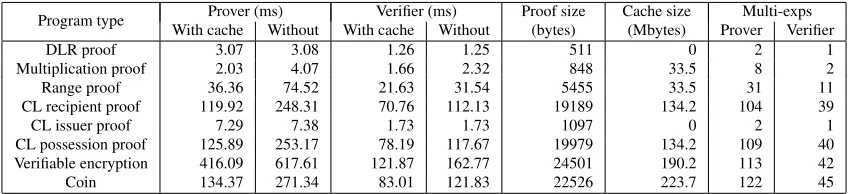
Program type Prover (ms) Verifier (ms) Proof size (bytes)
Cache size (Mbytes)
Multi-exps With cache Without With cache Without Prover Verifier
DLR proof 3.07 3.08 1.26 1.25 511 0 2 1
Multiplication proof 2.03 4.07 1.66 2.32 848 33.5 8 2
Range proof 36.36 74.52 21.63 31.54 5455 33.5 31 11
CL recipient proof 119.92 248.31 70.76 112.13 19189 134.2 104 39
CL issuer proof 7.29 7.38 1.73 1.73 1097 0 2 1
CL possession proof 125.89 253.17 78.19 117.67 19979 134.2 109 40 Verifiable encryption 416.09 617.61 121.87 162.77 24501 190.2 113 42
Coin 134.37 271.34 83.01 121.83 22526 223.7 122 45
Table 1: Time (in milliseconds) and size (in bytes) required for each of our proofs, averaged over twenty runs. Timings are considered from both the prover and verifier sides, as are the number of multi-exponentiations, and are considered both with and without caching for fixed-based exponentiations; the size of the cache is also measured (in megabytes). As we can see, using caching results on average in a48%speed improvement for the prover, and a31%improvement for the verifier.
the coin.
The program in Section 5.3 also reflects our decision to randomize the user’s spending order rather than hav-ing them perform a range proof that the coin index was contained within the proper range. As the random spend-ing order does not reveal how many coins are left in the wallet, the user’s privacy is still protected even though the index is publicly available. Furthermore, because range proofs are slow and require a fair amount of space (see Table 1 for a reminder), this optimization resulted in coins that were20%smaller and21%faster to generate and verify.
Finally, endorsed e-cash requires a random value con-tributed by both the merchant and the user. Since e-coin transactions should be done over a secure channel, in practice we expect that SSL connections will be used be-tween the user and the merchant. One useful feature of an SSL connection is that it already provides both parties with shared randomness, and thus this randomness can be used in our library to eliminate the need for a redun-dant message.
6.2
Buying and Bartering
Our library implements two efficient optimistic fair exchange protocols for use with e-cash. Belenkiy et al. [10] provide a buy protocol for exchanging a coin with a file, while Küpçü and Lysyanksaya [52] provide abarterprotocol for exchanging two files or blocks. The two protocols serve different purposes (buy vs. barter) and so we have implemented both.
Two of the main usage scenarios of fair exchange pro-tocols are e-commerce and peer-to-peer file sharing [10]. In e-commerce, one needs to employ a buy protocol to ensure that both the user and the merchant are protected; the user receives her item while the merchant receives his payment. In a peer-to-peer file sharing scenario, peers exchange files or blocks of files. In this setting, it is more beneficial to barter for the blocks than to buy them one at a time; for an exchange ofnblocks, buying all the blocks
requires O(n) verifiable escrow operations (which, as discussed in Section 5.4, are quite costly), whereas bar-tering for the blocks requires only one such operation, regardless of the number of blocks exchanged.
Although the solution might seem to be to barter all the time and never buy, Belenkiy et al. suggest that both protocols are useful in a peer-to-peer file sharing sce-nario. Peers who have nothing to offer but would still like to download can offer to buy the files, while peers who would like only to upload and have no interest in down-loading can act as the merchant and earn e-cash. Due to the resource considerations mentioned above, however, bartering should always be used if possible.
Because peers do not always know beforehand if they want to buy or barter for a file, we have modified the buy protocol to match up with the barter protocol in the first two messages. This modification, as well as outlines of both the protocols, can be seen in Figure 3. We further modified both protocols to let them exchange multiple blocks at once, so that one block of the fair exchange protocol might correspond to multiple blocks of the un-derlying file.
We give an overview of each protocol below, with the optimizations we have added. We have also implemented the trusted third parties (the bank and the arbiter) neces-sary for e-cash and fair exchange. Although we do not describe in detail the resolution and bank interaction pro-tocols, these can be found in the original papers [10, 52] and we provide performance benchmarks for the bank in Table 2.
6.2.1 Buying
Figure 3: This figure provides outlines of both our buy and barter protocols [10, 52]. Until the decision to buy or barter, the two protocols are identical; the main difference is that in a buy protocol, the setup message must be sent for each file exchange, which results in a linear efficiency loss as compared to bartering.
this message, the seller will use the programs in Section 5 to check the validity of the coin and the escrow. If these proofs verify, the seller will proceed by sending back an encrypted version of his file (or file block). Upon receiv-ing this ciphertext, the buyer will store it (and a Merkle hash of it, for use with the arbiter in case the protocol goes wrong later on) and send back a contract, which consists of a hash of the seller’s file and some session information. The seller will check this contract and, if satisfied with the details of the agreement, send back its decryption key. The buyer can then use this key to de-crypt the ciphertext it received in the second message of the protocol. If the decryption is successful, the buyer will send back his endorsement on the coin. If in these last steps either party is unsatisfied (for example, the file does not decrypt or the endorsement isn’t valid for the coin from the setup message), they can proceed to con-tact the arbiter and run resolution protocols [10]. 6.2.2 Bartering
This protocol is depicted on the right in Figure 3; be-cause the first two messages of the barter protocol (the setup message and the encrypted data) are identical to those in the buy protocol described in the previous sec-tion, we do not describe them again here and instead jump directly to the third message. Because bartering involves an exchange of data, the initiator will respond to the receipt of the ciphertext with a ciphertext of her own, corresponding to an encryption of her file. She will also send a contract, which is similar to the buy contract
but also contains hash information for her file. The re-sponder will then check this contract as the seller did in the buy protocol, and if satisfied with the agreement will send back his decryption key. If the ciphertext decrypts correctly (i.e., decrypts to the file described in the con-tract) then the initiator can respond in turn with her own decryption key. If this decryption key is also valid, both parties have successfully obtained the desired files and the barter protocol can be considered complete. If nei-ther party had to contact the arbiter (for similar reasons as in the buy protocol; i.e., a file did not decrypt cor-rectly) then they are free to engage in future barter proto-cols without the overhead of an additional setup message. Otherwise, they need to resolve with the arbiter [52].
6.3
Library performance
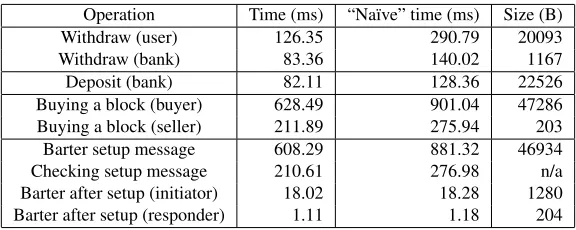
In Table 2, we can see the computation time and size complexity for the steps described above, as well as com-putation and communication overhead for the withdraw and deposit protocols involving the bank. The numbers in the table were computed on the same computer as those in Section 5.4.
The numbers in Table 2 clearly demonstrate our earlier observation that bartering is considerably more efficient than buying, both in terms of computation and commu-nication overhead. The setup message for both buying and bartering takes about600ms to generate and approx-imately46kB of space. In contrast, the rest of the barter protocol takes very little time; on the order of millisec-onds for both parties (and about1.5kB of total overhead). In addition, we consider the same protocols run us-ing a previous “naïve” version of our library, which pro-vided the same e-cash API and employed some multi-exponentation optimizations, but did not use ZKPDL. Using the optimizations available to the interpreter is considerably faster over our previous approach, mean-ing that our interpreter has not only made developmean-ing our protocols more convenient, but has also helped to im-prove efficiency.
7
Related work
Operation Time (ms) “Naïve” time (ms) Size (B)
Withdraw (user) 126.35 290.79 20093
Withdraw (bank) 83.36 140.02 1167
Deposit (bank) 82.11 128.36 22526
Buying a block (buyer) 628.49 901.04 47286 Buying a block (seller) 211.89 275.94 203 Barter setup message 608.29 881.32 46934 Checking setup message 210.61 276.98 n/a Barter after setup (initiator) 18.02 18.28 1280 Barter after setup (responder) 1.11 1.18 204
Table 2: Average time required and network overhead, in milliseconds and bytes respectively, for each stage in our e-cash imple-mentation. The timings were averaged over twenty runs, and caching and compression optimizations were used. For the naïve timings, an older version of the library was used, which uses some multi-exponentation optimization techniques but not the inter-preter; we can see a clear improvement when using ZKPDL. Parameters were used to provide a security level of80bits (160-bit SHA-1 hashing,128-bit AES encryption,1024-bit RSA moduli, and1024-bit DSA signatures).
is a very useful tool, it uses generic circuit techniques, and thus from an efficiency standpoint it is often more desirable to develop a multi-party computation scheme specific to the intended application.
IBM’s Idemix project [20, 15] has independently de-veloped a library for zero-knowledge proofs and anony-mous credentials using Java; their library provides a sys-tem for obtaining, proving, and verifying anonymous credentials for use in a privacy-preserving identity sys-tems. While Idemix and our work both provide im-plementations of anonymous credentials and CL signa-tures, our focus on efficient, repeated executions of e-cash transactions has led us to pursue our language-based strategy and develop a performance-optimized in-terpreter, unlike the Idemix implementation. The CACE project, independent of our efforts, has also designed a high-level language for zero-knowledge protocols; their work has focused on a compiler that can output imple-mentation and LATEX code from these descriptions [6, 5],
and automatically check the soundness of compiled pro-tocols using theorem proving techniques [1].
There are also compilers available [16, 7] for the gen-eration of proofs of security and correctness for crypto-graphic protocols. While this is an interesting and impor-tant area of research, these tools largely focus on static analysis of protocols rather than performance. Perhaps more similar to our work, the languages Cryptol [54] and Stupid [53] provide a simple interface for develop-ing low-level implementations of cryptographic primi-tives (such as hash functions) which can then be analyzed and translated into native code on different platforms.
8
Conclusions and Future Work
In this paper we have introduced a language for gener-ating (and verifying) widely-used zero-knowledge proofs of knowledge. Through sample programs, we have
demonstrated how our language is used to express ad-vanced cryptographic primitives such as blind signatures, verifiable encryption, and endorsed e-cash. We presented optimizations provided by our language’s interpreter and have shown they provide significant benefit.
Atop our language framework, we built a library that provides optimistic fair exchange protocols based on electronic cash. We have further presented optimizations for the protocols provided by Cashlib and argued for their practicality in network-based applications.
Much future work is possible for the ZKPDL lan-guage and interpreter. There are many other cryp-tographic primitives which could be incorporated into the language (e.g., encryption, signatures, hash func-tions), and other zero-knowledge protocols that could be added as relations (e.g., alternate and “fuzzy” schemes for range proofs). Incorporating these primitives, per-haps by allowing for subroutines and the composabil-ity of ZKPDL programs, would allow our library to be more easily extended and potentially have applicability to a broader range of secure systems. The analysis of ZKPDL programs—e.g., to automatically verify proto-cols and identify security errors through type analysis or formal verification techniques—provides another inter-esting area of study.
For increased performance on multicore architectures, we are working on analyzing dependencies among the expressions evaluated by our interpreter. The simplic-ity of our language, e.g., in computeblocks, allows a coarse-grained approach, as the only dependencies that arise between lines of ZKPDL are from variables which have been declared and assigned in previous lines.
Acknowledgments
We gratefully acknowledge George Danezis, our shep-herd, and our anonymous reviewers for their valuable feedback on earlier versions of this paper. We also would like to thank Gabriel Bender and Alex Hutter for their work developing earlier versions of Cashlib, as well as Carleton Coffrin for his assistance with ANTLR. This work is supported in part by NSF CyberTrust grant 0627553.
References
[1] ALMEIDA, J. B., BANGERTER, E., BARBOSA, M., KRENN, S., SADEGHI, A.-R.,ANDSCHNEIDER, T. A certifying com-piler for zero-knowledge proofs of knowledge based on sigma-protocols. InESORICS ’10(2010).
[2] ANDROULAKI, E., RAYKOVA, M., SRIVATSAN, S., STAVROU, A.,ANDBELLOVIN, S. PAR: payment for anonymous routing. InPrivacy Enhancing Technologies Symposium (PETS)(2008), vol. 5134 ofLecture Notes in Computer Science, Springer-Verlag, pp. 219–236.
[3] ASOKAN, N., SHOUP, V.,ANDWAIDNER, M. Optimistic fair exchange of digital signatures. InProc. Eurocrypt ’98(1998), vol. 1403 ofLecture Notes in Computer Science, Springer-Verlag, pp. 591–606.
[4] AVOINE, G., ANDVAUDENAY, S. Optimistic fair exchange based on publicly verifiable secret sharing. In ACISP(2004), vol. 3108 ofLecture Notes in Computer Science, Springer-Verlag, pp. 74–85.
[5] BANGERTER, E., BARZAN, S., KRENN, S., SADEGHI, A.-R., SCHNEIDER, T., ANDTSAY, J.-K. Bringing zero-knowledge proofs of knowledge to practice. In17th International Workshop on Security Protocols(2009).
[6] BANGERTER, E., CAMENISCH, J., KRENN, S., SADEGHI, A.-R.,AND SCHNEIDER, T. Automatic generation of sound zero-knowledge protocols. Cryptology ePrint Archive, Report 2008/471, 2008.http://eprint.iacr.org/2008/471.
[7] BARBOSA, M., NOAD, R., PAGE, D.,ANDSMART, N. First steps toward a cryptography-aware language and compiler. Cryp-tology ePrint Archive, Report 2005/160, 2005.http://eprint. iacr.org/2005/160.
[8] BELENKIY, M., CAMENISCH, J., CHASE, M., KOHLWEISS, M., LYSYANSKAYA, A., AND SHACHAM, H. Delegatable anonymous credentials. InProc. Crypto ’09(2009), vol. 5677 ofLecture Notes in Computer Science, Springer-Verlag, pp. 108– 125.
[9] BELENKIY, M., CHASE, M., ERWAY, C., JANNOTTI, J., KÜPÇÜ, A.,ANDLYSYANSKAYA, A. Incentivizing outsourced computation. InNetEcon(2008), pp. 85–90.
[10] BELENKIY, M., CHASE, M., ERWAY, C., JANNOTTI, J., KÜPÇÜ, A., LYSYANSKAYA, A.,ANDRACHLIN, E. Making P2P accountable without losing privacy. InWPES(2007), ACM, pp. 31–40.
[11] BELENKIY, M., CHASE, M., KOHLWEISS, M.,ANDLYSYAN -SKAYA, A. Non-interactive anonymous credentials. InProc. 5th Theory of Cryptography Conference (TCC)(2008), pp. 356–374.
[12] BELLARE, M., ANDGOLDREICH, O. On defining proofs of knowledge. InProc. Crypto ’92(1992), vol. 740 ofLecture Notes in Computer Science, Springer-Verlag, pp. 390–420.
[13] BELLARE, M.,ANDROGAWAY, P. Random oracles are practical: a paradigm for designing efficient protocols. InACM Conference
on Computer and Communications Security (CCS) ’93(1993), pp. 62–73.
[14] BEN-DAVID, A., NISAN, N.,ANDPINKAS, B. FairplayMP: a system for secure multi-party computation. InACM Conference on Computer and Communications Security (CCS) ’08(2008), pp. 257–266.
[15] BICHSEL, P., BINDING, C., CAMENISCH, J., GROSS, T., HEYDT-BENJAMIN, T., SOMMER, D.,ANDZAVERUCHA, G. Cryptographic protocols of the identity mixer library, v. 1.0. IBM Research Report RZ3730, 2009.
[16] BLANCHET, B.,ANDPOINTCHEVAL, D. Automated security proofs with sequences of games. InProc. Crypto ’06(2006), vol. 4117 ofLecture Notes in Computer Science, Springer-Verlag, pp. 537–554.
[17] BLUM, M.,DESANTIS, A., MICALI, S.,ANDPERSIANO, G. Non-interactive zero-knowledge.SIAM Journal of Computing 20, 6 (1991), 1084–1118.
[18] BOUDOT, F. Efficient proofs that a committed number lies in an interval. InProc. Eurocrypt ’00(2000), vol. 1807 ofLecture Notes in Computer Science, Springer-Verlag, pp. 431–444.
[19] CAMENISCH, J., CHAABOUNI, R.,AND ABHI SHELAT. Effi-cient protocols for set membership and range proofs. InProc. Asiacrypt ’08(2008), pp. 234–252.
[20] CAMENISCH, J.,ANDHERREWEGHEN, E. V. Design and im-plementation of the idemix anonymous credential system. In ACM Conference on Computer and Communications Security (CCS) ’02(2002), ACM, pp. 21–30.
[21] CAMENISCH, J., HOHENBERGER, S., KOHLWEISS, M., LYSYANSKAYA, A.,ANDMEYEROVICH, M. How to win the clonewars: efficient periodic n-times anonymous authentication. InACM Conference on Computer and Communications Security (CCS) ’06(2006), pp. 201–210.
[22] CAMENISCH, J., HOHENBERGER, S.,ANDLYSYANSKAYA, A. Compact e-cash. InProc. Eurocrypt ’05(2005), vol. 3494 of Lecture Notes in Computer Science, Springer-Verlag, pp. 302– 321.
[23] CAMENISCH, J., HOHENBERGER, S.,ANDPEDERSEN, M. Ø. Batch verification of short signatures. In Proc. Eurocrypt ’07(2007), vol. 4515 ofLecture Notes in Computer Science, Springer-Verlag, pp. 246–263.
[24] CAMENISCH, J., AND LYSYANSKAYA, A. An efficient sys-tem for non-transferable anonymous credentials with optional anonymity revocation. InProc. Eurocrypt ’01(2001), vol. 2045 ofLecture Notes in Computer Science, Springer-Verlag, pp. 93– 118.
[25] CAMENISCH, J.,ANDLYSYANSKAYA, A. A signature scheme with efficient protocols. InProc. SCN ’02(2002), vol. 2576 of Lecture Notes in Computer Science, Springer-Verlag, pp. 268– 289.
[26] CAMENISCH, J., ANDLYSYANSKAYA, A. Signature schemes and anonymous credentials from bilinear maps. InProc. Crypto ’04(2004), vol. 3152 ofLecture Notes in Computer Science, Springer-Verlag, pp. 56–72.
[27] CAMENISCH, J., LYSYANSKAYA, A.,ANDMEYEROVICH, M. Endorsed e-cash. InIEEE Symposium on Security and Privacy (2007), pp. 101–115.
[28] CAMENISCH, J., ANDSHOUP, V. Practical verifiable encryp-tion and decrypencryp-tion of discrete logarithms. InProc. Crypto ’03(2003), vol. 2729 ofLecture Notes in Computer Science, Springer-Verlag, pp. 126–144.
[30] CHAUM, D. Security without identification: transaction systems to make big brother obsolete. Communications of the ACM 28, 10 (1985), 1030–1044.
[31] CHAUM, D., DEN BOER, B., VAN HEYST, E., MJØLSNES, S. F.,ANDSTEENBEEK, A. Efficient offline electronic checks (extended abstract). InProc. Eurocrypt ’89(1989), pp. 294–301.
[32] COX, B., TYGAR, J., AND SIRBU, M. Netbill security and transaction protocol. InProc. 1st Usenix Workshop on Electronic Commerce(1995), pp. 77–88.
[33] DAEMEN, J.,ANDRIJMEN, V. Rijndael: AES – The Advanced Encryption Standard. Springer-Verlag, 2002.
[34] DAMGÅRD, I. On sigma protocols. http://www.daimi.au. dk/ivan/Sigma.pdf.
[35] DAMGÅRD, I. Payment systems and credential mechanism with provable security against abuse by individuals. InProc. Crypto ’88 (1988), vol. 403 of Lecture Notes in Computer Science, Springer-Verlag, pp. 328–335.
[36] DAMGÅRD, I., DUPONT, K., AND PEDERSEN, M. Ø. Un-clonable group identification. InProc. Eurocrypt ’06(2006), vol. 4004 ofLecture Notes in Computer Science, Springer-Verlag, pp. 555–572.
[37] DAMGÅRD, I.,ANDFUJISAKI, E. A statistically-hiding integer commitment scheme based on groups with hidden order. InProc. Asiacrypt ’02(2002), vol. 2501 ofLecture Notes in Computer Science, Springer-Verlag, pp. 125–142.
[38] DAMGÅRD, I., GROTH, J.,ANDSALOMONSEN, G. The the-ory and implementation of an electronic voting system. InProc. Secure Electronic Voting (SEC)(2003), pp. 77–100.
[39] FEIGE, U., LAPIDOT, D., ANDSHAMIR, A. Multiple non-interactive zero-knowledge proofs based on a single random string. InProc. 31st Symposium on Theory of Computing (STOC) (1990), pp. 308–317.
[40] FERRARA, A. L., GREEN, M., HOHENBERGER, S.,ANDPED -ERSEN, M. Ø. Practical short signature batch verification. In Proc. CT-RSA(2009), pp. 309–324.
[41] FIAT, A.,AND SHAMIR, A. How to prove yourself: practi-cal solutions to identification and signature problems. InProc. Crypto ’86(1986), vol. 263 ofLecture Notes in Computer Sci-ence, Springer-Verlag, pp. 186–194.
[42] FUJISAKI, E., ANDOKAMOTO, T. Statistical zero knowledge protocols to prove modular polynomial relations. InProc. Crypto ’97 (1997), vol. 1294 ofLecture Notes in Computer Science, Springer-Verlag, pp. 16–30.
[43] GENNARO, R., GENTRY, C.,ANDPARNO, B. Non-interactive verifiable computing: outsourcing computation to untrusted workers. Cryptology ePrint Archive, Report 2009/547, 2009.
http://eprint.iacr.org/2009/547.
[44] GMP. The GNU MP Bignum library.http://gmplib.org.
[45] GOLDREICH, O., GOLDWASSER, S.,ANDMICALI, S. How to construct random functions (extended abstract). InProc. 25th Symposium on the Foundations of Computer Science (FOCS) (1984), pp. 464–479.
[46] GOLDREICH, O., MICALI, S.,ANDWIGDERSON, A. Proofs that yield nothing but their validity or all languages in NP have zero-knowledge proof systems.J. ACM 38, 3 (1991), 691–729.
[47] GOLDWASSER, S., MICALI, S.,ANDRACKOFF, C. The knowl-edge complexity of interactive proof systems. InProc. 17th Sym-posium on the Theory of Computing (STOC)(1985), pp. 186–208.
[48] GOLDWASSER, S., MICALI, S.,ANDRIVEST, R. A digital sig-nature scheme secure against adaptive chosen-message attacks. SIAM Journal of Computing 17, 2 (1988), 281–308.
[49] GROTH, J. Non-interactive zero-knowledge arguments for vot-ing. InACNS(2005), vol. 3531 ofLecture Notes in Computer Science, Springer-Verlag, pp. 467–482.
[50] HEYDT-BENJAMIN, T., CHAE, H.-J., DEFEND, B.,ANDFU, K. Privacy for public transportation. InPrivacy Enhancing Tech-nologies Symposium (PETS)(2006), pp. 1–19.
[51] ISHIDA, N., MATSUO, S.,ANDOGATA, W. Divisible voting scheme. InProc. ISC ’03(2003), vol. 2851 ofLecture Notes in Computer Science, Springer-Verlag, pp. 137–150.
[52] KÜPÇÜ, A.,ANDLYSYANSKAYA, A. Usable optimistic fair ex-change. InProc. CT-RSA ’10(2010), vol. 5985 ofLecture Notes in Computer Science, Springer-Verlag, pp. 252–267.
[53] LAURIE, B., AND CLIFFORD, B. Stupid: a meta-language for cryptography, 2010. http://code.google.com/ p/stupid-crypto.
[54] LEWIS, J.,ANDMARTIN, B. Cryptol: high assurance, retar-getable crypto development, and validation. InProc. Military Communications Conference ’03(2003), pp. 820–825.
[55] LIPMAA, H. On Diophantine complexity and statistical zero-knowledge arguments. InProc. Asiacrypt ’03(2003), vol. 2894 ofLecture Notes in Computer Science, Springer-Verlag, pp. 398– 415.
[56] LIPMAA, H., ASOKAN, N., ANDNIEMI, V. Secure vickrey auctions without threshold trust. InProc. Financial Cryptogra-phy ’02(2002), vol. 2357 ofLecture Notes in Computer Science, Springer-Verlag, pp. 87–101.
[57] LYNN, B. PBC (pairing-based cryptography) library. http:// crypto.stanford.edu/pbc.
[58] MALKHI, D., NISAN, N., PINKAS, B.,ANDSELLA, Y. Fairplay - a secure two-party computation system. InUSENIX Security Symposium(2004), pp. 287–302.
[59] MENEZES, A. J., VANOORSCHOT, P.,AND VANSTONE, S. Handbook of Applied Cryptography. CRC Press, 1997.
[60] MERKLE, R. A digital signature based on a conventional encryp-tion funcencryp-tion. InProc. Crypto ’88(1987), vol. 293 ofLecture Notes in Computer Science, Springer-Verlag, pp. 369–378.
[61] NAOR, M.,ANDYUNG, M. Universal one-way hash functions and their cryptographic applications. InProc. 21st Symposium on Theory of Computing (STOC)(1989), pp. 33–43.
[62] NGUYEN, L.,ANDSAFAVI-NAINI, R. Dynamic k-times anony-mous authentication. InACNS(2005), vol. 3531 ofLecture Notes in Computer Science, Springer-Verlag, pp. 318–333.
[63] PAGNIA, H.,ANDGÄRTNER, F. On the impossibility of fair ex-change without a trusted third party. Darmstadt University Tech-nical Report TUD-BS-1999-02, 1999.
[64] PARR, T. ANTLR parser generator.http://www.antlr.org.
[65] PEDERSEN, T. P. Non-interactive and information-theoretic secure verifiable secret sharing. InProc. Crypto ’91 (1992), vol. 576 ofLecture Notes in Computer Science, Springer-Verlag.
[66] RABIN, M.,ANDSHALLIT, J. Randomized algorithms in num-ber theory. Communications on Pure and Applied Mathematics 39, 1 (1986), 239–256.
[67] SCHNORR, C.-P. Efficient signature generation by smart cards. Journal of Cryptology 4, 3 (1991), 161–174.
A
Translations of Proofs
In Section 4.2 we described the translation of a mul-tiplication proof into a collection of discrete logarithm equality proofs. Here, we describe the translations done for non-negative proofs, as well as the low-high range proofs that build on top of non-negative proofs.
For non-negative proofs, we would like to prove that a given committed valuexis non-negative, so thatx≥0. To accomplish this, we first need a commitmentCx to x. We now use a theorem of Lagrange that states that any non-negative integer can be written as a sum of (at most) four squares. To show thatxis non-negative, therefore, it suffices to find and prove its decomposition into a sum of four squares. The interpreter first finds this decomposition (using a randomized algorithm due to Rabin and Shallit [66]); namely the decomposition
x=x2
1+x22+x32+x24. For eachxi, the interpreter now computes a commitment Ci = gxihri to the value xi and a commitmentC2i = gx
2
ihr2i to the valuex2 i, with the special property that the commitment tox24uses
ran-domnessrx−(r21+r22+r23). It now needs to perform
a square proof (remember that this is just a special case of a multiplication proof) for each i. Finally, it needs to prove that this decomposition corresponds to the originalx. Because of the way the randomness forC24
is formed, if the commitments were formed correctly then the following equality will hold: Cx =Q
4
i=1C2i. Note that a separate proof does not need to be formed for this equality, since the verifier can check it directly given the commitmentsCxandC2i (due to the homomorphic property of the commitment scheme). This means that the final collection of discrete logarithm equalities needed to prove thatx ≥ 0will be four square proofs corresponding to the values xi andx2i contained in Ci andC2irespectively (for the explicit form of the discrete log equation for square proofs, refer back to Section 4.2. Once we have non-negative proofs, low-high range proofs follow almost directly. First, observe that to prove lo ≤ x < hi for some value xcontained in a commitmentCx, it suffices to show thatx−lo≥0and x−hi≥0. In fact, we can make this proof even more efficient by further observing that we can just prove (x−lo)(hi−x)≥0, thus eliminating one non-negative proof (note that we can do this because it is not possible for both of these quantities to be negative at the same time). Therefore, we first need to form commitments tox−lo andhi−x. Because the verifier knows the commitmentCxas well as the boundsloandhi, he can compute the commitments Cx−lo and Chi−x directly, as Cx−lo = Cx·g−lo andChi−x = ghi ·Cx−1. The prover will then need to form a commitment Cprod to the product(x−lo)(hi−x)and, using a multiplication proof, prove that the value contained withinCprodis the
B
ZKPDL Grammar
To enhance the brief overview of our language given in Section 4, we provide here a full EBNF grammar for our language.
spec := (computation)? (proof)?
computation := “computation” COLON “given” COLON givenList “compute” COLON computeRandomList computeEquationList
proof := “proof” COLON “given” COLON givenList “prove” “knowledge” “of” COLON knowledgeList “such” “that” COLON suchThatList
suchThatList := (suchThatRel)+
suchThatRel := equalRelation rangeRelation forRelation knowledgeList := (exponentDecl integerDecl)+
givenList := (groupDecl elementsDecl exponentDecl integerDecl)+
randomBndDecl := (“integer” “integers”) “in” LBRACKET expr COMMA expr RPAREN COLON idGeneralDeclList randomPrimeDecl := (“prime” “primes”) “of” “length” expr COLON idGeneralDeclList
computeRandomList := (“random” (randExponentDecl randomPrimeDecl randomBndDecl))*
groupDecl := “group” COLON identifierDecl (EQUAL setDecl)? (“modulus” COLON subscriptIdentifierDecl)? randExponentDecl := (“exponent” “exponents”) “in” identifier COLON idGeneralDeclList
exponentDecl := (“exponent” “exponents”) “in” identifier COLON idGeneralDeclList
elementsDecl := (“element” “elements”) “in” identifier COLON idGeneralDeclList (elementsEquationList)? integerDecl := (“integer” “integers”) COLON idGeneralDeclList
computeEquationList := (computeEquation)+
computeEquation := equalDeclRelation comRelation forRelation
forRelation := “for” LPAREN identifier COMMA expr COLON expr COMMA (rangeRelation genEqual) RPAREN forCom := “for” LPAREN identifier COMMA expr COLON expr COMMA comRelation RPAREN
elementsEquationList := (elementsEquation)+ elementsEquation := comRelation forCom
comRelation := “commitment” “to” idSubList COLON subscriptIdentifier EQUAL expr genEqual := identifier (SUBSCRIPT (ID INTLIT))? (EQUAL CEQUAL) expr
equalRelation := subscriptIdentifier EQUAL expr
equalDeclRelation := subscriptIdentifierDecl CEQUAL expr
rangeRelation := “range” COLON expr (LTHAN LEQ) expr (LTHAN LEQ) expr (GTHAN GEQ) expr (GTHAN GEQ) expr
expr := prodExpr (ADD prodExpr SUB prodExpr)*
forExpr := “for” LPAREN identifier COMMA expr COLON expr COMMA (ADD MUL) COMMA expr RPAREN prodExpr := powExpr (MUL powExpr DIV powExpr)*
powExpr := unaryExpr baseExpr unaryExpr := SUB baseExpr baseExpr
baseExpr := INTLIT subscriptIdentifier LPAREN expr RPAREN forExpr setDecl := LTHAN idGeneralDeclList GTHAN
idSubDeclList := (subscriptIdentifierDecl)+ idGeneralDeclList := (idDeclGeneral)+ idDeclList := (identifierDecl)+ idSubList := (subscriptIdentifier)+ idList := (identifier)+
idDeclGeneral := idDeclRange subscriptIdentifierDecl
idDeclRange := identifierDecl LBRACKET expr COLON expr RBRACKET subscriptIdentifierDecl := identifier (SUBSCRIPT (ID INTLIT))? identifierDecl := ID
subscriptIdentifier := identifier (SUBSCRIPT (ID INTLIT))? identifier := ID
![Figure 3: This figure provides outlines of both our buy andbarter protocols [10, 52]. Until the decision to buy or barter,the two protocols are identical; the main difference is that ina buy protocol, the setup message must be sent for each fileexchange, which results in a linear efficiency loss as comparedto bartering.](https://thumb-us.123doks.com/thumbv2/123dok_us/7891059.1309544/11.612.76.304.74.255/andbarter-protocols-identical-difference-leexchange-efciency-comparedto-bartering.webp)