Study of Design of MIMC-PID for Unstable
First Order Time Delay Process
Pravin D. Ingale1, Prof. C. B. Kadu 2
PG Student [Process Instru.], Dept. of Instrumentation & Control, Pravara Rural Engg. College, Loni, Maharashtra, India1
Associate Professor, Dept. of Instrumentation & Control, Pravara Rural Engg. College, Loni, Maharashtra, India2
ABSTRACT: The Internal ModelControl based approach to design controller is used in control applications in industries. It is because, for actual process in industries PID controller algorithm is simple and robust to handle the model inaccuracies and hence using IMC-PID tuning method is a compromise between closed-loop performance and robustness to model inaccuracies is achieved with a single tuning parameter. The IMC-PID controller allows good set-point tracking for the process with a small time-delay/time-constant ratio. In this paper, modified internal model control (MIMC) will be realized by equivalent PID control for unstable first order plus time delay system. This controller will be designed for good dynamic performance and robustness. The controller performance will be achieved by analyzing integral absolute error (IAE) and maximum sensitivity (Ms). The cost function (J) will be optimized for different cases of damping ratio on Ms-IAE curve. This will be implementing for different transfer functions for the model of UFOPTD for robust performance.
KEYWORDS:MIMC, PID, UFOPDT, Maximum sensitivity.
I.INTRODUCTION
The mathematical model of real time system is classified as stable, unstableand integrating systems with time delay. The control of unstable systems is a tough challenge to improve its time domain specifications. As the dynamic behaviour of many industrial processes contains inherent time delays and they are difficult to control. The conventional controller is only capable of stabilizing the system for a nominal plant and it fails to maintain the stability of the system under any parameter variations of the plant. The goals for an unstable process control should include stabilizing unstable poles, good servo tracking, and eliminating unknown disturbance. Actually, there are two problems for achieving the target. First is the problem of servo tracking and disturbance rejection, the other is the dilemma between robustness and performance. This leads to the concept of robust controller design, so the robust stability as well as the robust performance needs to be ensured while designing a robust controller. The Internal Model Control (IMC) based approach to design controller is one of them using IMC and its equivalent IMC based PID to be used in control applications in industries. One good thing about the IMC procedure is that it results in a controller with a single tuning parameter λ.
II.IMC-PID DESIGN
Assume that the process is an unstable first-order plus time delay system. Thus, its model has the following general form:
. ( )
1
s K e P s
Ts
(1)
Fig.1 Basic IMC Model
For the IMC controller,
1
( ) ( ). ( )
Q s P s f s (2)
Now find the PID equivalent,
( ) ( )
1 Q s( ). ( )
C s
P s Q s
(3)
The PID parameters are,
(2 )
Ti Kc
K
2 . 2 2
2
Ti T
3 6 2 2
2 . 2 2 2
2
T Td
Ti
(4)
III. MODIFIED INTERNAL MODEL CONTROL
Fig.2 Modified IMC Structure
The control system in Fig.2 with the controller C(s) = Q(s)/ (1 − P(s).Q(s)) is stable if and only if following expressions satisfied.
1. Q(s) is stable.
2. P(s).Q(s) is stable → Q(s) has to cancel all RHP poles of P(s): Q(s) has to have zeros wherever P(s) has unstable poles.
3. Q(s)/ (1 − P(s).Q(s)) is stable→[1 − P(s).Q(s)] has to cancel all RHP poles of P(s): [1 − P(s).Q(s)] has to have zeros wherever P(s) has unstable poles.
The equivalent PID controller is,
( ) ( )
1 ( ). ( )
=
-Q s C s
Q s P s (5)
Thus,
( ) ( )
1 ( ) ( )
= C s
Q s
C s P s (6)
From figure. 2 Output signal ‘y’ is,
( ) ( )
= ×
y u d P s (7)
Control signal ‘u’ is given by
[ ( )] ( ][ ( )]
l
u e C s r y C s (8)
( ) ( ) l ( )[1 ( ) ( )]
= × + - ×
y P s Q s r P s P s Q s d (9)
But by substitute the value of Q (S)/ C(S) from equation (6)
( ) ( )
( ) ( )
l
u r y C s
l
u r C s y C s
(10)
( ) ( ) ( )
l
= × - ×
u r Q s P s Q s d
The output y and the control signal u according to the input r' and the disturbance (d) are
( ) ( ) ( )[1 ( ) ( )] ( ) ( ) ( )
ly P s Q s P s P s Q s r
u Q s P s Q s d (11)
According to internal stability of IMC,
P(s).Q(s) should all be stable, For IMC to be stable
lim ( )
Q s 0s Pi (12) And s Pilim [1 - ( ) ( )]
P s Q s 0(13) Where Pi are unstable poles of process P(s), i=1, 2, 3…….m
For zero steady state error 1
lim [1 - ( ) ( )]
0
s
T
P s Q s
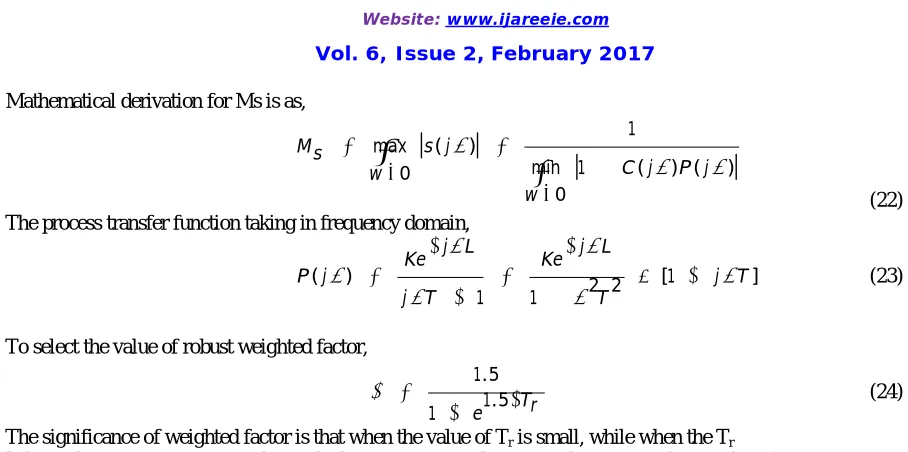
(14)The unstable first order plus time delay (UFOPTD) process is described as, ( ) 1 SL Ke P s
ST (15)
Where, K= Static gain, T=Time constant of unstable pole and L=Time delay and Tr =T/L is the ratio of unstable time to
delay time constant.
The modified internal model control Q(s) is given by,
( ) 1
( ) ( ). ( )
f s
Q S P s
F s (16)
Where, K= Static gain, T=Time constant of unstable pole and L=Time delay and Tr = T/L is the ratio of unstable time
to delay time constant.
Substituting Equation (15) & (16) in (14) i.e S=1/T .Then we get,
2 2
( 2 1) 1
L t e
T T T
(17)
For particular case,
(2 )
Ti
Kc k L
2 2 2 2 L L
Ti T
L
2 3 / 3
2 (2 )
T L L
Td Ti T
Ti Ti L
(18)
IV. PERFORMANCE AND ROBUSTENESS
The conventional IMC could not have the optimal robustness and the performance concluded by analysing the integral of absolute error (IAE) and the maximum sensitivity (Ms) of these control systems.
Here, the performance measure is evaluated with respect to an external input to the disturbance d.
. 0
IAE y d dt
(19)
IAE (). . 0
e t e st dt
(20)
By putting values of Q(s) and C(s) from equation (1) & (2) respectively, we get
1 C(s) 2 (1 ) s K KC
K sTi s T Ti d
Ti
Mathematical derivation for Ms is as,
1 max ( )
min 1 ( ) ( ) 0 0
Ms s j
C j P j w
w
(22) The process transfer function taking in frequency domain,
( ) 2 2 [1 ]
1 1
j L j L
Ke Ke
P j j T
j T T
(23)
To select the value of robust weighted factor,
1.5 1.5 1
e Tr
(24)
The significance of weighted factor is that when the value of Tr is small, while when the Tr
Is large the optimization is to achieve the best compromise between robustness and integral performance.
.
J IAE Ms
(25)
Where,
e (t) =error function according to disturbance d, s (jw) = sensitivity function of the PID control system, J = Robust performance index
β = Robust weighting factor.
If the value β is large then the system becomes robust and small β will have performance better. when the Tr ratio is large the optimization is to achieve the best compromise between robustness and performance.
The adjustable time constant parameter λ to be optimized on PID control by formula,
2
(4.16 4.95 ) 8.32 4.16 4.95
Tr Tr Tr
L
If (Tr < 5)
Or (26) L
If (Tr ≥ 5)
V. SIMULATIONS RESULT
Consideran unstable first order plus time delay process with small Tr = 2.5 is expressed as
0.4 ( ) 1 s e P s s (27)
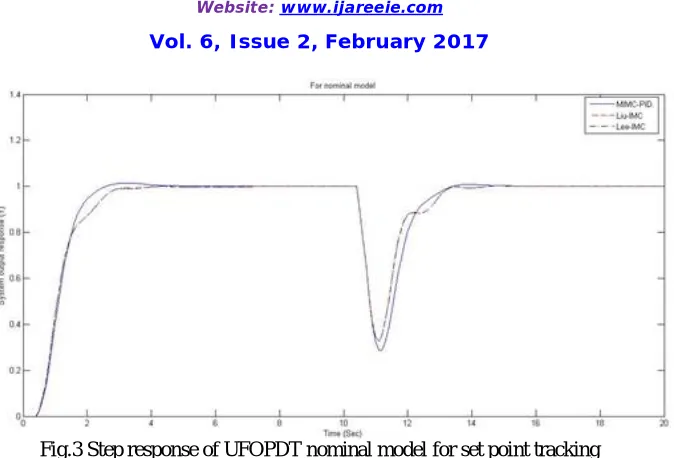
In this simulation study the MIMC-PID is compared with those of Liu et al.and Lee et al.For the set point response Liu uses IMC and Lee applied a set point filter. For the methods of both Liu and Lee λ=0.4. The tuning parameters of MIMC-PID, Lee-IMC, and Liu-IMC for nominal model are as follows,
For MS = 3.15, ξ=0.8, f=1/1.95s+1
Fig.3 Step response of UFOPDT nominal model for set point tracking
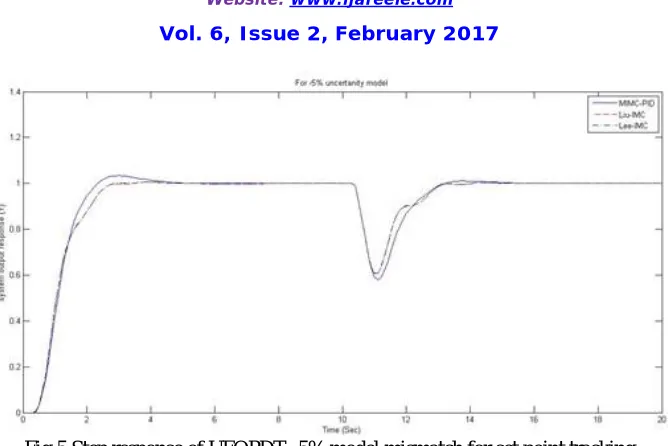
The robustness of controller is evaluated by inserting uncertainty of 5 % in all three parameters to obtain model mismatch. Fig. 4 and Fig. 5 presents simulation study for +5% and -5% model mismatch respectively.
Table 4.1. Tuning parameters of Example 1
Tuning Methods λ KC TI TD
MIMC-PID 0.47 2.65 2.113 0.149
Liu-IMC 0.4 2.897 2.097 0.161
Lee-IMC 0.4 2.894 2.101 0.161
Fig.5 Step response of UFOPDT -5% model mismatch for set point tracking
Table 4.2 Comparison of Dynamic Performance Indices of nominal UFOPDT Model
Method Performance Indices
ISE IAE ITSE ITAE
MIMC-PID 12.78 20.09 511.63 97.62
Lee-IMC 12.73 20.03 398.34 92.13
Liu-IMC 12.72 20.03 396.79 91.95
Fig 6 shows the controller efforts for set point tracking by all the three methods for nominal model.
VI.CONCLUSION
REFERENCES
[1] J S Lather, "Control of time delay systems: Brief Review" IJRCEE, Vol.2, Issue 3, ISSN2319- 376X, June 2013.
[2]G. Tan, Chen PID controller design with optimal robust performance for unstable first order plus time delay process, IEEE, 978-1-4673-0089-6/12, 2012.
[3] B.vanvali and A.S.Rao, "Improved performance with PID filter controllers for unstable process involving time delays", IEEE 978-1-61284-764-1/11, 2011.
[4] Y. Lee, J. Lee, S. Park Chem Eng. Sci.2000:55, 3481-3493 [5] T. Liu, W. Zhang. D. Gu. L. Process control, 2005:15,559-572
[6] Yagang Wang and Xiaoming Xu, "PID Controller for Unstable Objects Based on Sensitivity", Journal Of Shanghai University of Technology, vol.31 (2), Feb. 2009, pp.125-128, doi: cnki:SUN:HDGY. 2009- 02-005.
[7] A.Ali, S.Majhi, "Controller design for unstable FOPDT plants based on sensitivity."IFAC 2008 Seoul, 978-1-1234-7890-2/08
[8] Chan-Cheng Chen, Hsia-Ping Huang, and Horng-Jang Liaw, "Set-Point Weighted PID Controller Tuning for Time- Delayed Unstable Processes", Ind. Eng. Chem. Res., vol.47 (18), Aug. 2008,pp. 6983- 6990, doi: 10.1021/ie800001m.
[9] Hongdong Zhu and Huihe Shao, "The Control of Open-loop Unstable Processes with Time Delay Based on Modified IMC", Control and Decision, vol.20 (7), Jul. 2005, pp.727-731, doi: cnki:ISSN:1001-0920.0. 2005-07-001
[10] PID controllers for time-delay systems / GJ. Silva, A. Datta, S.P. Bhattacharyya.p. cm. - (Control engineering) ISBN 0-8176-4266-8
[11] Tan W, Horacio J. Marquez, Chen T W. IMC Design for Unstable Processes with Time Delays. Journal of Q. Jin et al. /Journal of Computational Information Systems 7:11 (2011) 4050-4056
[12] Kou Yamada, "Modified Internal Model Control for unstable systems", Proceedings of the 7th Mediterranean Conference on Control and Automation (MED99) Haifa, Israel - June 28-30, 1999