Vol. 6, Issue 10, October 2017
Power Quality Improvement Using Closed
Loop PI &FLC Controlled VSI Based
STATCOM
M.Deepa Rathinam, K.Sakthivel
PG Scholar, Dept. of EEE, Bharath University, Chennai, India
Asst. Professor, Dept. of EEE, Bharath University, Chennai, India
ABSTRACT: STATCOM is a popular device to improve voltage of weak buses in two bus systems. This work deals with modeling and simulation of closed loop controlled Three Phase voltage source inverter based STATCOM in eight bus system. Closed loop PI & FLC controlled STATCOM systems are investigated and their results are compared. The comparison is done in term of time domain response parameters like steady state error & settling time. The STATCOM with FLC is observed to be faster than PI controlled system.
KEYWORDS: Flexible Alternating Current Transmission System (FACTS); Static synchronous Compensator (STATCOM); Static VAR Compensator (SVC); PI –Proportional integral; FLC-Fuzzy logic controller; Total Harmonic Distortion (THD);
I. INTRODUCTION
FLEXIBLE AC transmission systems (FACTS) are being used extensively in power system to enhance the system utilization, power deportation quantity as well as the power quality of ac system interconnections [1], [2]. As a typical shunt FACTS device, static synchronous compensator (STATCOM) is employed at the point of common connection (PCC) to absorb or inject the appropriate reactive power, through which the voltage quality of PCC is improved [3]. In recent years, many topologies have been enforced to the STATCOM. Amid these various types of topology, H-bridge cascaded STATCOM has been extensively acknowledged in high-power applications for the following abilities: quick response speed, small volume, high efficiency, minimal synergy with the supply grid and its individual phase control ability [4]–[7]. Compared with other types of converter three phase VSI based STATCOM can obtain a high number of levels more easily and connected to the grid directly without using the bulky transformer. This empowers us to minimize cost and maximize the use of Three phase VSI based STATCOM [8].
ISSN (Print) : 2320 – 3765 ISSN (Online): 2278 – 8875
I
nternational
J
ournal of
A
dvanced
R
esearch in
E
lectrical,
E
lectronics and
I
nstrumentation
E
ngineering
(A High Impact Factor, Monthly, Peer Reviewed Journal)
Website: www.ijareeie.com
Vol. 6, Issue 10, October 2017
literature [16], [17], a popular dead-beat current controller is used. This control method has the maximum bandwidth and the speedy current tracking reference. The steady-state performance of Three phase VSI based STATCOM is improved, but the dynamic performance is not improved. In [18], a DC injection elimination method called IDCF is proposed to build an additional closed loop for the DC component of the output current. It can improve the output current quality of STATCOM. However, the circuit configuration of the cascaded STATCOM is the delta configuration, but not the star configuration. Moreover, an adaptive theory-based improved linear sinusoidal tracer control method is proposed in [19] and a leaky least mean square-based lured methodology is expected in [20]. But these methods are not for STATCOM with the VSI structure. By using the traditional linear control method, the controller is characterized by its simple control structure and parameter design convenience, but poor dynamic control stability.
Other control approaches apply nonlinear control which directly compensates for the system nonlinearities without requiring a linear approximation. In [21], a transfer function linearization controller is designed. By adding a damping term, the oscillation amplitude of the internal dynamics can be effectively decreased. However, the stability cannot be guaranteed [22]. Then, many new modified damping controllers are designed to enhance the stability and performance of the internal dynamics [23]–[26]. However, the implementation of these controllers is very complex. To enhance robustness and simplify the controller layout, a passivity-based controller (PBC) based on fault dynamics is proposed for STATCOM [27]–[30]. Furthermore, the exponential cohesion of system equilibrium point is guaranteed. Nevertheless, these methods are not designed on the basis of STATCOM with the three phase VSI based arrangement and no literature is verified experimentally.
In terms of DC voltage balancing control in capacitor, there are three major issues: overall voltage stabilization clustered stabilizing control, and specific balancing control. In literature [31], under the assumption of all DC capacitors being equally charged and balanced, they can only eliminate the imbalances caused by the inconsistent drive pulses without detecting all DC capacitor voltages. In [32]–[34], additional hardware circuits are required in the methods based on AC bus energy exchange and DC bus energy exchange, which will maximize the cost and the complexity of the system. In [35], a method based on zero-sequence volt-age interjection is enhanced and it will increase the DC capacitor voltage endurance capacity. On the confliction, the methodology using negative-sequence current in [36] do not require the maximum mar-gin of DC capacitor voltage, but the action of STATCOM is minimized. In [8], the individual phase with active power cluster is lured independently. In [37] and [38], it is super imposing the cosine component of the system voltage with clustered output voltage, but it can be easily affected by an inaccurate phase-locked loop (PLL). In [39], the active voltage vector superposition method is enhanced. The selective harmonic elimination modulation method is used in [40] and [41], in which DC voltage balancing control and low-frequency modulation are achieved. Compared with the method in [40] and [41], a methodology shifting phase angle for DC voltage stabilization control is proposed in [42] and [43], through which the desirable effect can be easily achieved, whereas it is limited by the capacity of STATCOM. In [44], the DC voltage and reactive power are lured. yet, it cannot be extensively used due to fact that many non-ideal factors are neglected. In [45] and [46], the proposed method assumes that all cells are distributed with equal reactive power and it uses the cosine value of the current phase angle. It could lead to system instability, when using the zero-crossing point of the cosine value. In [47] and [48], the results of experiments are obtained in the downscaled laboratory system. Thus, they are not very persuasive in this condition.
Vol. 6, Issue 10, October 2017
Fig.1.1 Block diagram of MLI based grid connected STATCOM
As the shunt converters of the STATCOM are single-phase, it gives an opportunity to STATCOM to control current in each bus dependently, which implies that both negative and zero sequence unbalanced voltage can be compensated. Additional controllers are supplemented to the existing STATCOM controller. Their control principle is to monitor the negative and zero sequences current through the transmission line and to force them to zero.
The above literature does not deal with comparison of PI and FLC controlled STATCOM systems used. The objective of this paper is to study the improvement in reactive power and reduction in THD using VSI.
II. PRINCIPLE OF THE STATCOM
A) Control Principle of STATCOM
The STATCOM system consists of MLI based converters, and each of PWM pulse technique control scheme. The block diagram of the STATCOM and its control is shown in Fig (2). The shunt converter is controlled to inject a constant odd harmonic current into the transmission line, which is intended to supply reactive power for the shunt converters.
ISSN (Print) : 2320 – 3765 ISSN (Online): 2278 – 8875
I
nternational
J
ournal of
A
dvanced
R
esearch in
E
lectrical,
E
lectronics and
I
nstrumentation
E
ngineering
(A High Impact Factor, Monthly, Peer Reviewed Journal)
Website: www.ijareeie.com
Vol. 6, Issue 10, October 2017
Fig.2. Block diagram of the bus radial STATCOM
The functions of each control block shown in Fig (2) are described here:
●Power flow control: Itreceives the set point for power flow from the system operator, and calculates the fundamental frequency voltage that should be injected by the shunt converters.
●AC voltage control: gives the set points to shunt converter for reactive power compensation at the fundamental frequency.
●Shunt converter control: generates odd harmonic current, the reactive power at the fundamental frequency and stabilizes the DC voltage.
III. SIMULATION RESULTS
Vol. 6, Issue 10, October 2017
Figure 3.1.Closed loop system with PI controller
ISSN (Print) : 2320 – 3765 ISSN (Online): 2278 – 8875
I
nternational
J
ournal of
A
dvanced
R
esearch in
E
lectrical,
E
lectronics and
I
nstrumentation
E
ngineering
(A High Impact Factor, Monthly, Peer Reviewed Journal)
Website: www.ijareeie.com
Vol. 6, Issue 10, October 2017
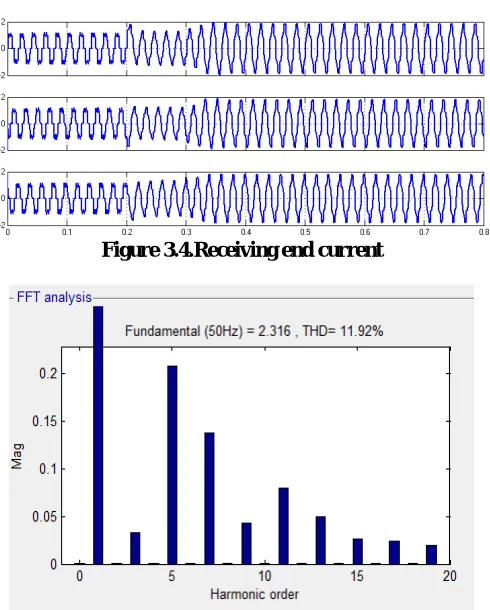
Figure 3.4.Receiving end current
Figure 3.5.Receiving end current THD
Vol. 6, Issue 10, October 2017
Figure 4.0.Closed loop system with FLC controller
ISSN (Print) : 2320 – 3765 ISSN (Online): 2278 – 8875
I
nternational
J
ournal of
A
dvanced
R
esearch in
E
lectrical,
E
lectronics and
I
nstrumentation
E
ngineering
(A High Impact Factor, Monthly, Peer Reviewed Journal)
Website: www.ijareeie.com
Vol. 6, Issue 10, October 2017
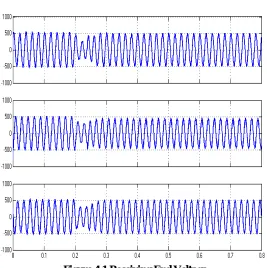
Figure 4.2.Receiving End Voltage
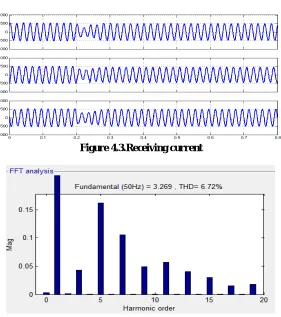
Figure 4.3.Receiving current
Vol. 6, Issue 10, October 2017
Table-1
Comparison of Time domain parameters
STATCOM Tr Ts Tp Ess
PI controller 0.32 0.43 0.35 5.6
FLC controller
0.25 0.30 0.26 1.3
Table-2
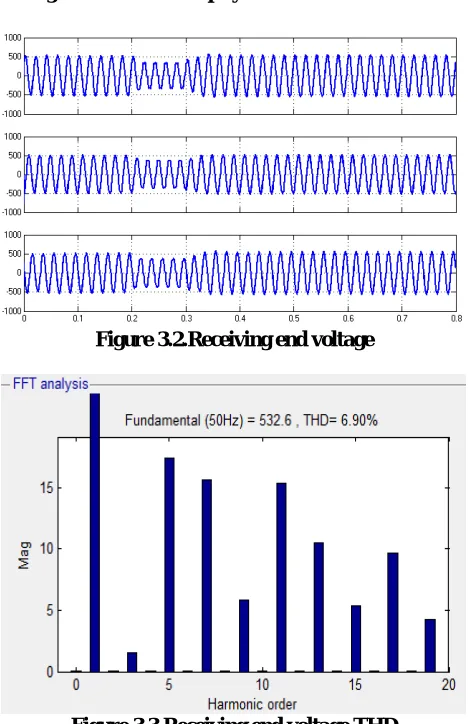
Comparison of voltage & current THD
STATCOM Voltage
THD
Current THD
PI controller 6.90% 11.92%
FLC controller 5.96% 6.72%
IV. CONCLUSION
The Closed loop PI and FLC controlled VSI based STATCOM systems are modeled and simulated successfully. Their results are compared which shows that FLC controlled system gives superior performance to PI controlled system. The proposed VSI based STATCOM system has advantages like low THD, Reduced losses and heating .The only disadvantage of VSI based STATCOM system is that it requires six switches.
The scope of present work is to compare PI and FLC controlled system. The response of above systems will be compared with fuzzy logic controlled system in future.And fabricate single phase prototype hardware module.
REFERENCES
[1] Gultekin and M. Ermis, “Cascaded multilevel converter-based transmission STATCOM: System design methodology and development of a 12
ISSN (Print) : 2320 – 3765 ISSN (Online): 2278 – 8875
I
nternational
J
ournal of
A
dvanced
R
esearch in
E
lectrical,
E
lectronics and
I
nstrumentation
E
ngineering
(A High Impact Factor, Monthly, Peer Reviewed Journal)
Website: www.ijareeie.com
Vol. 6, Issue 10, October 2017
[6] D. Soto and T. C. Green, “A comparison of high-power converter topologies for the implementation of FACTS controllers,” IEEE Trans.
Ind.Electron., vol. 49, no. 5, pp. 1072 1080, Oct. 2002.
[7] C. K. Lee, J. S. K. Leung, S. Y. R. Hui, and H. S.-H. Chung, “Circuit-level comparison of STATCOM technologies,” IEEE Trans. Power Electron., vol. 18, no. 4, pp. 1084–1092, Jul. 2003.
[8] H. Akagi, S. Inoue, and T. Yoshii, “Control and performance of a transformerlesscascade PWM STATCOM with star configuration,” IEEETrans.
Ind. Appl., vol. 43, no. 4, pp. 1041–1049, Jul./Aug. 2007.
[9] A. H. Norouzi and A. M. Sharaf, “Two control scheme to enhance the dynamic performance of the STATCOM and SSSC,” IEEE Trans.
PowerDel., vol. 20, no. 1, pp. 435–442, Jan. 2005.
[10] C. Schauder, M. Gernhardt, E. Stacey, T.Lemak, L. Gyugyi, T. W. Cease, and A. Edris, “Operation of ±100 MVAr TVA STATCOM,” IEEE
Trans.Power Del., vol. 12, no. 4, pp. 1805–1822, Oct. 1997.
[11] C. H. Liu and Y. Y. Hsu, “Design of a self-tuning PI controller for a STATCOM using particle swarm optimization,” IEEE Trans. Ind. Electron., vol. 57, no. 2, pp. 702–715, Feb. 2010.
[12] S. Mohagheghi, Y. Del Valle, G. K. Venayagamoorthy, and R. G. Harley, “A proportional-integrator type adaptive critic design-based
neurocontrollerfor a static compensator in a multimachine power system,” IEEETrans. Ind. Electron., vol. 54, no. 1, pp. 86–96, Feb. 2007.
[13] H. F. Wang, H. Li, and H. Chen, “Application of cell immune responsemodelling to power system voltage control by STATCOM,” Proc.
Inst.Elect.Eng. Gener.Transm.Distrib., vol. 149, no. 1, pp. 102–107, Jan. 2002.
[14] A. Jain, K. Joshi, A. Behal, and N. Mohan, “Voltage regulation with STATCOMs: Modeling, control and results,” IEEE Trans. Power Del., vol.
21, no. 2, pp. 726–735, Apr. 2006.
[15] V. Spitsa, A. Alexandrovitz, and E. Zeheb, “Design of a robust state feedback controller for a STATCOM using a zero set concept,” IEEETrans.
Power Del., vol. 25, no. 1, pp. 456–467, Jan. 2010.
[16] C. D. Townsend, T. J. Summers, and R. E. Betz, “Multigoal heuristic model predictive control technique applied to a cascaded H-bridge
STATCOM,” IEEE Trans. Power Electron., vol. 27, no. 3, pp. 1191–1200, Mar. 2012.
[17] C. D. Townsend, T. J. Summers, J. Vodden, A. J. Watson, R. E. Betz, and J. C. Clare, “Optimization of switching losses and capacitor voltage
ripple using model predictive control of a cascaded H-bridge multilevel STATCOM,” IEEE Trans. Power Electron., vol. 28, no. 7, pp. 3077–3087,
Jul. 2013.
[18] Y. Shi, B. Liu, and S. Duan, “Eliminating DC current injection in currenttransformer- sensed STATCOMs,” IEEE Trans. Power Electron., vol.
28, no. 8, pp. 3760–3767, Aug. 2013.
[19] B. Singh and S. R. Arya, “Adaptive theory-based improved linear sinusoidal tracer control algorithm for DSTATCOM,” IEEE Trans.
PowerElectron., vol. 28, no. 8, pp. 3768–3778, Aug. 2013.
[20] S. R. Arya and B. Singh, “Performance of DSTATCOM using leaky LMS control algorithm,” IEEE J. Emerging Select. Topics Power
Electron.,vol. 1, no. 2, pp. 104–113, Jun. 2013.
[21] P. Petitclair, S. Bacha, and J.-P.Fe rrieux, “Optimized linearization via feedback control law for a STATCOM,” in Proc. IEEE Ind. Appl. Soc.Annu. Meeting, 1997, pp. 880–885.
[22] H. Khalil, Nonlinear Systems, 3rd ed. Englewood Cliffs, NJ, USA: Prentice-Hall, 2002.
[23] Y. Han, Y. O. Lee, and C. C. Chung, “Modified non-linear damping of internal dynamics via feedback linearisation for static synchronous
compensator,” IET Gener. Transm.Distrib., vol. 5, no. 9, pp. 930–940, 2011.
[24] Y. O. Lee, Y. Han, and C. C. Chung, “Output tracking control with enhanced damping of internal dynamics and its output boundedness for
STATCOM system,” IET Control Theory Appl., vol. 6, no. 10, pp. 1445– 1455, 2012.
[25] Y. O. Lee, Y. Han, and C. C. Chung, “Output tracking control with enhanced damping of internal dynamics and its output boundedness,” in
Proc. IEEE Conf. Decision Control, 2010, pp. 3964–3971.
[26] Y. Han, Y. O. Lee, and C. C. Chung, “A modified nonlinear damping of zero-dynamics via feedback control for a STATCOM,” in Proc. IEEEPowerTech, 2009, pp. 880–885.
[27] G. E. Valderrama, P. Mattavelli, and A. M. Stankovic, “Reactive power and imbalance compensation using STATCOM with dissipativity-based
control,” IEEE Trans. Control Syst. Technol., vol. 9, no. 5, pp. 718–727, Sep. 2001.
[28] H. Tsai, C. Chu, and S. Lee, “Passivity-based nonlinear STATCOM controller design for improving transient stability of power systems,” presented at the IEEE/PES Transmission and Distribution Conference &Exhibition: Asia and Pacific, Dalian, China, 2005.
[29] Y. Gui, Y. O. Lee, H. J. Kang, Y. Han, and C. C. Chung, “Novel passivitybaseDController design for STATCOM,” in presented at the 2011