www.ijiset.com
ICT Role in Yemen Basic Education and Awareness
of Teachers
Dr. Adnan Y. Almutawkki1, Dr. Mossa M. Ghurab2 and Suhail M. Saeed3 1
Dept. of IT, Faculty of Computer and Information Technology, Sana'a University, Sana’a, Yemen
2
Dept. of CS, Faculty of Computer and Information Technology, Sana'a University, Sana’a, Yemen
3
Dept. of MBA, Open University Branch at Science and Technology University, Sana’a, Yemen
Abstract
In the last decade, the rapid growth and development in the information and communication technologies(ICT) motivates schools and institutes to enrich and add a new dimension to the teaching and learning process in terms of using infrastructures, communication and information technologies. Twenty years ago, ICTs were very limited in Yemen as central to the overall learning process. Even in the most advanced schools in Sana’a the capital city; also, ICTs not considered central to the teaching and learning process. Now the information and communication technologies and their direct interaction to the society living standards and style of life have forced themselves gradually in the education process as part of new potential for positive changes. This study has gone through these vital changes in Yemen schools and education in general. It was aimed to have a deeper insight view into Yemeni primary & secondary schools and their ICT usage in relation with their education policy followed, also to have an insight look to teachers' opinions and attitudes against the use of ICT in the teaching and learning process. The result obtained and recorded, it was very promising in terms of setting up education policies and encouraging schools and institutes to change their education culture from typical style to a more modern and sophisticated learning that based on ICT. Keywords: ICT, Yemen, School, Education, Learning Process.
1. Introduction
Yemen approved the National Strategy for Primary Education 2003-2015, the National Strategy for Technical Education and Vocational Training (2005-2014), in addition to the national strategy for the development of higher education 2006-2010 [1]. The majority of these strategies are looking forward to achieve the primary objectives of the integration of IT in the different stages of education [2,3]. The national ICT Policy meant to determine the long-term ICT goals, that support the mission of strengthening the education capacity in Yemen and to define the strategies that required reaching this goal [4]. Although the formal decision of such a policy is at the governmental level, it is important that all the actors
support the policy and have a sense of ownership for it. The Yemeni educational institutes expected to define the long-term ICT goals they consider necessary in supporting the national educational goals. Subsequently they should distinguish common goals that must be coordinated at the national level, and institutional goals, that would be more suitable for achievement, within the domain of their own educational institute. Yemen was included in the Fast Track Initiative for the development of education presented by the World Bank. There are currently more than 600 schools equipped with computers. In addition, Internet service introduced to 55 percent of the Republic's schools, in addition to a dedicated computer course that introduced to secondary education. At the same time the Yemeni government, through the newly formed Ministry of Higher Education and Scientific Research (MoHESR) has the intention to improve the quality of education in order to produce better-qualified graduates of the institutes for Higher Education (HE) [5]. In such a context, the effective use of ICT in the educational setting is necessary, as prerequisite issue. A review of the ICT status in Yemeni HE demonstrated that the current situation was disorganized, threatening waste with parallel efforts leading to less than optimal results, or even failure. This was reason for the MoHESR to strengthen the capacity of higher education institutes (HEIs) to plan for ICT growth before rushing into specific ICT projects. The results of this initiative are the national ICT policy and the subsequent national master plan for ICT HE in Yemen and institutional-specific master plans for the implementation phase of ICT in the sector. A specialized IT center established in the Ministry of Higher Education as part of a program to establish an IT institute that will link Yemeni universities to a single information network. A number of public and private universities facilities are also teaching a number of ICT courses like Communication, Engineering, programming, computer science, and information science, but the curricula are not being updated enough to keep pace with rapid developments [6, 7]. Unfortunately, the
www.ijiset.com government of Yemen did not announce clearly and specifically its ICT policies in a well-organized manner to be understood as a separate entity within its general national policy; as the ICT projects are taking a considerable amount of the yearly budget of the country [8].
1.1. Problem statement:
A challenging and promising project in Yemen was supposed to be active and ongoing; it was called (INTALEQ) and stands for “Innovations in Technology-Assisted Learning for Educational Quality”. It was supposed to be implement in 20 schools. These schools distributed within the capital Sana’a, Aden, Taiz and Hadramout. Starting February 2009.The project was supposed to focus on science and math subjects teaching through the web. For first grade of secondary education with skills and materials to prepare their students for the 21st century. Helping the country's educators learn how to integrate technology into the classroom and providing them with digital learning resources that fit the Yemeni curriculum. Unfortunately, this project and some other similar projects not implemented [9,10,11]. On the one hand, if those similar projects implemented and executed in a proper manner as planned then certainly the benefits of those kinds of projects were short-termed benefits that existed at that time for one complete year in the best scenario [12]. On the other hand, if the same conducted and performed in a poor manner, then this is another serious failure. Moreover, the same unsatisfactory progress existed in the sector of ICT vocational training and technical education that faces a number of specific challenges such as:
•Few number of schools has a limited ICT infrastructure. •Irregular distribution of these schools among governorates of Yemen.
•Under-utilization of current ICT infrastructures in the schools.
One of the main factors that should focus on properly in a detailed manner is to understand reasons behind projects failures in terms of improving education performance at these schools. In fact, there are plenty of factors strongly affect the project success or failures. Such as limited resources, budget, ministry or school education policy …etc. Nevertheless, the study of teachers’ perception and attitude towards the integration of ICT in teaching and learning process has importance that is more significant [13]. Hence, teacher perception study should include all factors influence that perception in a positive or negative way. Motivating and encouraging factors as well as frustrating factors and difficulties are all influencing
factors to teacher perception should considered in a form of research questions such as:
• What subject or course are you teaching mainly? • What type of ICT hardware are you using for
teaching? Tick all that apply
• What type of ICT software are you using for teaching? Tick all that apply
• How frequent ICT used in terms of teaching, management or something else?
• How would you describe your computer skills? Tick one only
• How did you gain skills in using computers? Tick all applicable
• Why do you think you are using ICT in your teaching?
In addition, the set of statements relates to barriers and factors that hinder ICT use considered in a similar form such as:
• Please state down in your own words the 3 things which are considered the most obstacles in preventing you from using ICT in your teaching (or use it very little):
• Does your school have ICT written statements? • Do you have any idea if the Ministry of Education
has an ICT policy?
• What about ICT use in education in general and how ICT use seen?
• What do you think will happen to the role of the teacher? (Tick as many as you like)
• What do you hope will happen in the future? • What is the condition and level of ICT usage in
Yemen schools?
• What is the impact of educational policy on ICT teaching in terms of hardware and software? • Is there any resistance toward using ICT from
teachers and staff to the ICT?
• What are the role of the government to encourage ICT usage?
• What are the role of the government to encourage ICT usage?
• What are the role of the government to encourage ICT usage?
• What are the motivators and encouragements for using ICT in teaching?
• What are the factors that obstruct teachers from using of ICT?
• What are teacher’s views and opinions on the future utilization of ICT in education?
www.ijiset.com The study targeted to achieve the following objectives:
•To provide rich descriptive information on ICT usage in Yemen schools.
•To investigate the impact of educational policy on ICT teaching practice.
•To develop a theoretical perspective for teachers on why to use ICT in their teaching practice.
•To recognize the supportive influences on ICT usage •To recognize the motivators and encouragements for using ICT in teaching
•To classify the factors that obstructs teachers from using of ICT.
•To explore teachers views and opinions on the future utilization of ICT in education.
2. Background of the Study
The country of Yemen has not made a major development during the last decade in implementing ICT in the teaching and learning environment in basic education [14]. The efforts made (if any) didn’t meet the fast growth in other world countries in terms of both public and private primary & secondary education infrastructure and the related opportunities of incorporating the technologies of information and communication into such infrastructure [15,16]. If this situation remains, it will have undesirable impact on the outreach and the sustainability of education system in general and specifically on the future opportunities of enhancing the education policies with more ICT delivery. By analyzing the situation in developing countries and third world countries that have almost a similar situation to Yemen, it indicates that the teacher is the main factor that should focus on, regardless to common barriers and constraints such as budget, time, and education system policies. Therefore, this study mainly targeted teacher perspective and attitude to ICT involvement in the basic education system [17,18, 19]. In another word, the purpose of the study is to identify strengths, weaknesses, opportunities and threats of the ICT integration in education of Yemen. It also, assess the awareness of teachers to the same in order to carry out all needs and assessment requirements for the ministry and school's policies improvement, regarding the same and to build the awareness to the importance of the role played by the ICT policy field executers who are the teachers.
3. Research Methodology:
This section provides an explanation of the research design, methodology, and justification for the selection of methods. It also describes research instruments for data collection and analysis. In addition to verification and validation, techniques utilized the analysis.
4.1. Instruments:
Since the research is concerned with teacher’s perceptions and feelings towards many issues related to the use of ICT in education, we had no choice to better explore and understand them other than plying data collection tools that associated with qualitative approaches [20].
Interviews focus on social interactions and socially constructed meanings, and have concentration on the individual [21]. Nevertheless, the interviews would not be enough to obtain a widespread picture of the current situation or enough to generalize the findings. Hence, a questionnaire also applied in this research. Now combining questionnaires with interviews would not mean combining qualitative and quantitative models or paradigms in one research, it is rather integration between both at an apparent level in a single model or paradigm [22] and giving the research more coverage. Moreover, the combination of qualitative and quantitative analyses addressed in the field of case study research. Many experts in the field of socio-scientific research suggest using and combining several methods and called cross-examination to obtain results that are more valid. Cross-examination or triangulation when particularly exists on the combination of qualitative methods and quantitative methods are the best scenario in order to gain deeper insight and a more general view of the object of research. Actually, triangulation by integrating quantitative and qualitative steps of analysis, which always supports scholars to be more confident of their findings and can lead to a synthesis or integration of theories [23]. To have a better understanding of the research methods, the data collection procedures described here. The research consists of two phases: the first phase of the study was done through conducting interviews and site visits with schoolteachers and the second phase conducted through questionnaire. Firstly, the interview divided into two parts covering the two main themes of the study. Teachers were asked very general questions (i.e. general views on ICT in education), then they were introduced to the research issues (i.e. teacher's ICT usage and their perceptions of it, and ICT educational policy of schools or ministry of Education). Such interview was a semi-structured. It was open to allow new ideas to come up during the interview, because of what the interviewee says.
Questionnaire designed then distributed. For statistical analysis of the responses. The questionnaire included a number of questions, which were of two types open-ended and closed-open-ended questions. An open-open-ended question asks the respondent to formulate his own
www.ijiset.com answer, whereas a closed-ended question has the
respondent pick an answer from a given number of options. Unfortunately, there are some limitations in terms of interviews as well as questionnaires, the interview limitations occur and increase in the following cases:
• Conservative society like Yemen where the cultural setting somehow separate males from females and restrict face to face interviews with some teachers of the opposite gender, so the interviews were not done.
• One of the schools participated in the study is located in Aden, which is 350 KM far from Sana’a; therefore, phone interviews took place instead.
• Analyzing and interpreting qualitative interviews is very time consuming and not carried out properly.
• Some teachers may be due to their personality or mood did not feel convenient having an interview and they suggested a questionnaire instead. The reason might be different that they need to free up, sometime from school-congested schedule, for the interview to be hold. • Misunderstanding of questions exist and cannot
be detected and clarified at that time.
• There is a possibility that Interviewees (here are teachers) have not described their true perceptions and feelings.
• The compromise between Good-looking Questionnaire with minimal number of pages and terms of quantity and quality. Design and layout with a less number of pages may affect the questionnaire’s content.
• Demographic limitation with the fact that respondents must be able to read the questions and respond to them.
4.2. Sampling Technique
It generally known quantitative studies usually use a much larger sample size than qualitative studies; this is because qualitative research usually aims to reflect the diversity within a given population instead of seeking a statistical form of representation.
4.3.1 Interviews & Questionnaire Sampling
For the Interview, five teachers elected from different experiences regarding their responsibilities in the school. Therefore, interviews included teachers with ICT coordinating responsibilities, and classroom teachers. In this study, teachers interviewed selected based on
purposive sampling technique. The goal of purposive sampling is not to randomly select units from a population to create a sample with the intention of generalizing. The goal is rather to focus on particular characteristics of a population that are of interest, which will best enable you to answer your research questions [24].
As for questionnaire sample, simple random sampling selected. Simple random sampling method used for population-based surveys. Rapid surveys are no exception, since they too use a more complex sampling scheme. The main reason is to learn the theory of sampling with the fact that simple random sampling is the basic selection process of sampling and is easiest to understand. If everyone in a population could be included in a survey, the analysis featured would be very simple. The average value for equal interval and binomial variables, respectively, could easily derived using some formulas. Of course, when measuring everyone in a population, the true value occurred. Thus, there is no need for confidence intervals. When the true value in a population estimated with a sample of persons, things get more complicated [25].
4.3.2 Schools Selection
Five schools selected for study in Yemen. Such selection based on the significance of the case for the objectives of the study, rather than statistical model. Diversity factors taken into consideration for the selection of schools included type (private / government), language of instruction, level of education, gender type (male/female) for secondary schools, enrolment (50 pupils to 500 students for primary schools), and geographic location. In order to emphasize on the diversity factors taken; the table 1 below shows major factors of diversity in selected schools where:
•Among five selected schools, which are located in major cities; four in Sana’a and one in Aden.
•Among selected schools are three English speaking school, and two Arabic speaking schools.
•Three of the selected schools are private and the other two are public.
•Three of the schools are mixed gender (male & female) students; one was gender male school, and the last one was gender female school.
www.ijiset.com Table1: Schools and their major factors of diversity
School Type of
ownership Gender
Type of education
Language of instructio
n
Location
Turkish school
Private Mixed Elementary &
d
English Sana’a
Abaan school
Government Female secondary Arabic Aden
Kids Planet school
Private Mixed elementary English Sana’a
Hawrash school
Government Male Elementary &
secondary
Arabic Sana’a
Manarat school
Private Mixed elementary English Sana’a
Schools characterized into either positively or negatively by the following:
• Teachers trained in ICT;
• Student access to computers for at least one hour per week during coursework and one hour for self-directed use;
• Use of ICT as an educational tool (in teaching, learning, auto-learning and research);
• Access to information related to the establishment (school results, training needs of school teachers, calendar, etc.);
• Commitment to making achievements in ICT durable.
4.4 Validity & Reliability
To ensure the validity of the tool, the questionnaire revised by a number of intermediaries with knowledge in ICT related issues to education and its applications. In testing the questionnaire’s validity, the requirements of the subjects are checked if they really covered the research problem, also the questions are checked whether they are easy understandable, and cause no confusion to participants when answering them. Researcher after consulting the concerned to critic the paragraphs of the questionnaire in terms of comprehensiveness, adequacy, and clarity of the paragraphs; he had to measure those amendments if they reflect the appropriate design for what it should measure in this subject. Reliability is the degree to which an assessment tool produces stable and consistent results. In this study; researcher will use the test-retest reliability to measure the reliability obtained by administering the same questionnaire twice over a period which two weeks to some individuals. The results from first time and results after two weeks correlated in order to evaluate the test for stability over time. The obtained
correlation coefficient indicated the stability of the results or scores.
5. Theoretical Framework:
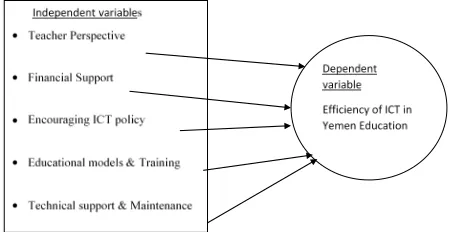
The theoretical framework shows dependent variable, independent variables and relations between them. In fact, dependent variable concerns about the efficiency of ICT in Education in Yemen; which means the productivity measures towards a successful implantation of Information & communication technologies in the teaching and learning processes. Whereas, independent variables concern about direct relationship with the dependent variable. Such variables indicated in figure1 and listed below as the following:
• Teacher perception towards ICT in Education • Reasonable Financial support
• Encouraging ICT policy from Ministry of Education or School
• Availability of ICT educational models and Training
• ICT Technical support & Maintenance
Figure 1: Theoretical Framework Summary
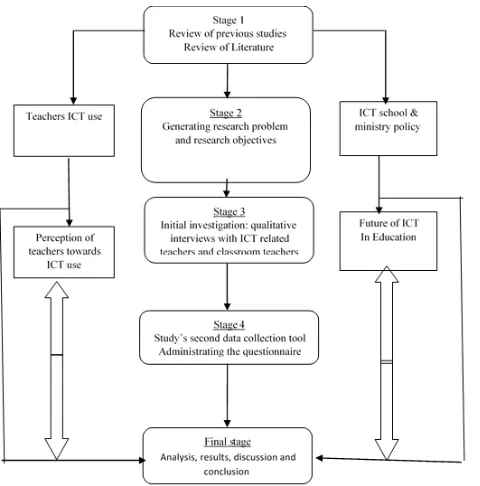
Based on the above a detailed planned overview on the design and methods of the study was prepared; describing the two main phases of the research: an initial qualitative phase, followed by survey development and administration. Figure 1 below describes the overall research design, which made to ensure the consistency and comprehensiveness of the study. Research questions carefully linked to the research design and methods in a way that answers the questions and satisfies the main seven objectives stated in section 1.2.
www.ijiset.com
Figure 2: Overall Research Design
6. Analysis of Experiment Results:
This section focuses on methods, instruments and design framework implementation in addition to presentation of findings derived from such techniques and collected data.
6.1 Interviews and Site Findings
The main purpose of the interview specified for ICT infrastructure availability in schools, important items are recorded in table 2.
Table2: ICT infrastructure availability in schools
School Computer Lab & Equipment Technical Support &Maintenance Turkish
school
2 computer lab with 26 networked PC’s in each lab
Most of classrooms equipped with an interactive whiteboard
Laptop to every teacher
Total of 100 PC’s + laptops
PCs in staff room
Printers available for teachers and many times for students
Nonstop Internet connection
School website
Maintenance department in school
More than one technician provide support for all the school
Sub-contract for on-demand support from vendors
Equipment warranty
Manarat school
One computer lab with 22 networked PC’s
Some classrooms are equipped with a PC and Data show.
PCs in staff room
Printers available for teachers and sometimes for students
Internet connection
School website
On-call maintenance contract
Phone technical support is used
ICT teacher provides technical support
Kids Planet school
One multimedia room with PC and fixed projector
One computer lab with 17 PC
Portable data show
2 PC’s & 1 laptop for Admin
Rare cases of contracted services from a free lancer
ICT teacher provides basic technical support
Printers fully allowed to staff & teachers and restricted use by students
No school website Hawrash
school
One resources or multimedia room
one PC & data show projector in resources room
One computer lab
21 networked PC’s in Lab
2 Printers available for teachers
Internet access for teachers and very limited for students
No school website
ICT teacher provides technical support.
Limited support from the ministry only on complicated escalated problems.
Abaan school
One Lab and the same is the resources multimedia room
25 PC & one data projector
Limited printing facilities
There was Internet access but now disconnected. It used to be for teachers only.
One laptop for the school head
No school website
ICT teacher provides technical support.
Limited support from the ministry only on complicated escalated problems.
Aden local provider equipment warranty
School School Management Awareness
Teachers & Staff Training
Turkish school
Teachers must use ICT in interactive teaching
Minimum level of ICT skills required
Preferential treatment for teachers who use ICT.
A plan to copy the Turkish initiation started by Ardogan to Yemen where all students will get Ipad. A pilot project started and still under review.
Initial training course for new teachers
Knowledge transfer sessions by Expats local teachers & staff
Continuous tailored ICT training courses based on teachers needs
Manarat school
A cancelled policy of giving laptops to students
Semi-interactive learning
E-mail communication with parents
Promotion of teachers‟ ICT use
Promotion of effective utilization of school website
New teachers should have minimum ICT skills
Well organized in-school training by a trainer.
Periodic ICT training programs to staff & teachers.
Acceptable outside ICT training for key staff.
Kids Planet school
primitive school plan for ICT implementation
Simple promotion of teachers‟ ICT use
Facilitate teachers‟ ICT training
Students are not allowed to bring laptops
Outside training funded by school to ICT teacher
Teacher-teacher training
Hawrash school
ICT teacher provides technical support.
Limited support from the ministry only on complicated escalated problems.
ICT dedicated teacher trained by ministry.
Teacher-teacher training
Unplanned in-school training by ICT teachers Abaan
school
Students are not allowed to bring laptops
No school plan for ICT implementation
Minimum encouragement of teachers‟ ICT use.
ICT dedicated teacher trained by ministry.
Teacher-teacher training
Outside private training by teachers themselves and on their pocket.
www.ijiset.com kinds of schools share the same other constraints. There is,
a considerable number of government schools, that have moderate computer labs, and this is because of donations that come from European Union and other donating organizations. The biggest one was on 2010 where two hundreds schools around Yemen was equipped with a computer labs.
1.1 6.2. Questionnaire’s Findings
Questionnaire finding focuses on some important factors, which listed as follows:
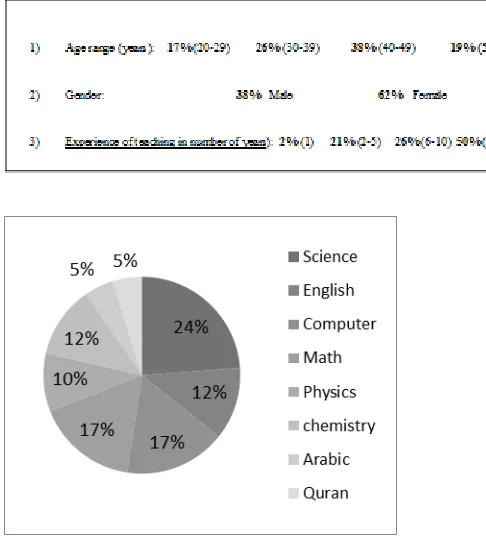
1) Participants’ features that include age, gender and experience in teaching. Table3 and figure 3 show the results.
Table 3: Participant’s’ features
Figure 3: Teachers with subjects of interest
2) Teachers' Use of ICT in terms of computer
access at home as well as at school. Table 4
shows a positive high rate of access to computer
at home and school. However, access does not
mean full usage; it just means that computers are
available for use.
Table 4: Access to Computers
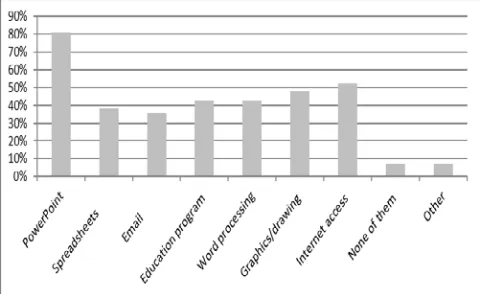
3) Teacher’s use of ICT in terms of hardware and
software in teaching, Figure 4 and Figure 5
shows a positive high rate of access to computer
at home and school. However, access does not
mean full usage; it just means that computers are
available for use
Figure 4: Hardware used in teaching
Figure 4 above illustrates that a PC or a desktop
computer is the common hardware used by all
teacher as a mean. Data projector comes after with
also high percentage of usage bearing in mind that
most of data projectors need a PC to work with.
Printer also is a tool for teacher to distribute specific
topics to student in addition to teacher admin work
of preparing exams and registering students score. If
this study made three years ago, we would find Zero
percentage of interactive whiteboard usage, but as
seen above there is a promising value that for sure
will increase in the future. In some countries, the
interactive white board, which considered as top
scale hardware used for integrating ICT in education
at least from teacher’s perspective.
You have good access to a computer at home 72% Yes 28% No
You have good access to a computer at school 82% Yes 18% No
www.ijiset.com
Figure 5 ICT Software used in teaching
ICT software used in teaching is actually
different from ICT software used by teachers; as
the second can be a lifestyle usage of the teacher
and is not related to the teaching process. From
the figure 4) PowerPoint application was most
used software and this is because it is the most
known presentation application by everyone; and
this also explains why data projector was a major
hardware in ICT. Internet access mentioned as a
second, followed by graphics and drawing
applications. It was expected that Word
Processing tool a higher rank but may be some
teachers thought it different and didn’t know it is
MS-Word which was reported to be used by
almost half of participants. Educational programs
unfortunately are not the major software used. In
some private schools, the ICT educational
programs are part of the curriculum and are part
of the teaching delivery process. While in
government schools, it is up to teacher to decide
on the software used and the delivery process.
5) Use of ICT in other aspects such as internet
access, emails, administration and
communication. Table 5.3 shows the results.
Table 5: Frequency Rate of ICT Use
Purpose
Very often
Often Some times
Rarely Never
How frequent, ICT used when you are
teaching classes? 17% 33% 21% 21% 7%
How frequent, Email used for professional
purposes? 31% 24% 21% 12% 12%
How frequent, Internet access is used for retrieving information, ideas
etc.? 14% 17% 31% 17% 21%
How frequent, ICT
used for administration
purposes (e.g. reports, students’
records, etc.)? 50% 24% 12% 10% 5%
How frequent, ICT
used for communicating
with students? 12% 17% 21% 26% 24%
How frequent, ICT
used by your
students in classroom lessons
you are teaching? 17% 21% 24% 19% 19%
How frequent, ICT
used for
communicating with other teachers
and school
colleagues? 24% 33% 24% 0% 19%
www.ijiset.com
administration purposes (e.g. reports, students’
records, etc.). However, Internet access not often
used for retrieving information and ideas.
6.3 Obstacles and Barriers in using ICT in
teaching & learning
1)
The set of statements relates to barriers and
factors that hinder ICT use, six statements to
the things, which obstruct teachers, were not
enough to cover all areas and things, which
hinder teachers from making efficient use of
ICT in teaching and other related professional
duties. As shown in Table 6; Five-point scale
was used to show the extent or degree to
which teachers agreed or disagreed with each
statement. The above table shows the
percentage of teachers selecting each of the
response keeping in mind that only one degree
of agreement/disagreement selected as asked
by the questionnaire, and this is to avoid the
ranked order based on the combined
strongly-agree/agree or disagree/strongly-disagree
percentages.
Table 6 Obstacles in using ICT for teaching
Obstacle stron gly agree
Agre e
Neutr al
Disag ree
stron gly disa
Lack of education al models on how to use ICT for
learning. 21% 31% 7% 19% 21% Insufficie
nt number of
computers and
resources 55% 24% 14% 7% 0%
School time organizati on (fixed
43% 24% 17% 12% 5%
School space organizati on (classroo m size and
furniture,
etc.) 31% 19% 17% 26% 7% Pressure
to prepare students for exams
and tests 36% 24% 5% 17% 19% Lack of
awareness of ICT advantage s. ICT not seen as a whole school
priority. 60% 12% 7% 21% 0%
The top ranked statements, which got agreement
levels (strongly agree + agree) was “Lack of
awareness of ICT advantages. ICT not seen as a
whole school priority” with (60% + 12%),
“Insufficient number of computers and
resources” got (55% + 24%) in addition to
“School time organization (fixed lessons time,
etc.)” statement with agreement level of (43% +
24%).
6. 4 Teacher perception towards ICT &
education future
1) Views about ICT use in education in general,
and how ICT use is seen, twelve statements were
presented using a five-point scale (ranging from
strongly agree to strongly disagree) to define
teachers' views, feeling, and perceptions towards
the use of ICT in education.
www.ijiset.com
Table 7: Teacher perception towards ICT
perception strongly agree
Agre e
neutr al
disa gree
strongly disagree
Greater efficiency throughout
the school 29% 45% 24% 2% 0%
Communic ation channels are increased through email, discussion groups and
chat rooms 29% 31% 31% 10
% 0%
ICT makes teaching enjoyable, changes
routine. 36% 33% 19% 5% 7%
ICT has an important part to play in teaching and learning
generally. 57% 29% 7% 7% 0%
ICT improves students result performan
ce. 24% 19% 38% 14
% 5%
Using ICT can save time and
effort 31% 38% 5%
17
% 10%
ICT increases
10% 29% 45%
12
5%
cooperatio n between teachers
%
ICT has a positive influence on student's interaction and
attention 45% 31% 19% 5% 0%
ICT use improves teachers & students research
skills 33% 50% 10% 7% 0%
Ability to represent concepts, experimen ts, and natural
phenomen
a 43% 31% 10%
10
% 7%
ICT use maintains quality in all lessons delivered during the
day 33% 26% 24%
12
% 5%
ICT makes work
easier 21% 43% 12%
17
% 7%
www.ijiset.com
ranked statements which got agreement levels
(strongly agree + agree) was “ICT has an
important part to play in teaching and learning
generally” with (57% + 29%), “ICT use
improves teachers & students research skills” got
(33% + 50%) in addition to “ICT has a positive
influence on student's interaction and attention”
statement with agreement level of (45% + 31%).
On the contrary; the statement “Using ICT can
save time and effort” was the most rated
disagreement by teachers, which reflects a
dominating impression that using ICT is a
time-consuming task and needs appropriate
preparation and in return, it is extra time and
effort instead of saving them.
2) What do you think will happen to the role of
the teacher? (Tick as many as you like), role of
teacher in the future is still under debate
everywhere for its ambiguity in determining
exactly the role played by schoolteachers in the
future. Nevertheless, our participating teachers
have ranged the future changes from a superficial
change such as “Teacher will not have a text
book” to a deep serious change like “Change to
facilitator and advisor” or “Change in terms of
relationship with students”.
Figure 6: Future role of teacher
As shown in figure 6, the most chosen response
was “Teacher will not have a text book” with a
percentage of (79%). After that, it was “Change
to facilitator and advisor” response with a
percentage of (64%). Nevertheless, 60% of
teachers believed that their role would not
change since students need someone to teach and
guide them where to find information.
3) What do you hope will happen in the future?
•Teacher - Take care of teachers in terms of
salary and standard of living (16 comments)
•System - Renew and improve the education
system in general (12 comments)
•Student – student respect for teachers and
knowledge in general (3 comments)
•Training – Continuous ICT training either
internal or external (13 comments)
•School setup – plenty of computer labs and
computers (8 comments)
•Curriculum
-
customized electronic
curriculums (4 comments)
•Generic – wish the peace and development to
Yemen (2 comments)
7. Conclusion and Recommendations:
1)
Introduction
This section summarizes the whole research
work based on the results of data analysis. It also
provides the general recommendations out of this
study and the future recommendation and
suggestions to continue the same study on a large
scale and have a solid assessment on ICT
integration in teaching and learning process and
current situation of Yemeni schools.
2)
Discussion
There is no clear policy from the ministry of
education on the use of ICT in schools, and
hence the relationship between this ambiguous
policy and the general perceptions towards ICT
is definitely lacking in Yemen basic education.
Yemeni teachers are not encouraged to make
routine use of ICT in their teaching and learning
process under such relationship. All private
schools and institutions; which are intending to
provide ICT experience in their education
programs, realize very well that they will bear all
costs and hence provide higher prices for
www.ijiset.com
students who are our targeted people to develop.
Hence, ministry of Education and ministry of
vocational and technical training along with
outside supporting countries donors should think
of a mechanism with which costs of such
integration of ICT shared between them and
private schools. On the university level, some
private education institutions tried to make a
number of courses available for students to study
through the websites within an initiative to adopt
the idea of distance education. However, there
were many limitations since distance education
applications are still in their establishment period
in Yemen.
3)
Conclusion
In Yemen, the biggest barriers to a successful
ICT implementation in Education are many, and
they summarized, under main categories of
constraints such as:
•Teacher motivation constraint
•Know-how constraint
•Budget constraint
Moreover, Yemeni educational organizations
and mainly the ministry of education seems not
be able at that moment to handle other related
issues to the ICT implementation such as
arrangement, organizing, inspections, staff
preparation …etc. Hence, it should be the whole
nation problem where prime minister and
president of country have to be concerned and
responsible about it. It should be on the top list,
of the country master plan, and should not be
underestimated. Throughout the study, it is
obvious that teachers are the main factor and
play a crucial role in promoting or delaying the
usage of ICT in the classroom. Moreover, they
can easily convey their opinions and principles to
their students and affect their attitudes towards
ICT usage in the learning environment. Hence, it
is important to understand and appreciate
teachers’ attitudes towards this challenging topic
and study their perceptions towards computers in
general. This will ensure to some extents that
students of this generation and the next
generation will have equal and fair ICT
experience in their learning process compared to
other nations.
4)
Recommendations and Future Work
Ministry of Education with the help of other
education authorities including private schools
have to setup proper and clear guidelines to
leverage the ICT role in education to another
level of real practice. This achieved, by setting
up education policies that force or at least
encourage schools to change their education
culture from typical style to a more modern and
sophisticated learning experience.
References
[1] United Nations New York, "Yemen Profile of the Information Society", 2009.
[2] Ministry of Planning and International Cooperation, "YEMEN COUNTRY REPORT" UNESCO, Yemen Report -http://www.unesco.org
[3]WikiPedia
(http://en.wikipedia.org/wiki/Yemen)
[4]The National Report Ministry of education,” Yemen National commission of Education & Culture and Sciences”.
[5] Yemen TVET and GTZ (German Organization for Technical Cooperation)
[6] WikiPedia “Information and Communications Technologies in first nation’s schools “2009 / 2010.
- http://en.wikipedia.org/wiki/Yemen)
- http://en.wikipedia.org/wiki/Semi-structured_interview [7] Dr. A. AlThawr- “Youth in Technology for Community
Development Situation analysis” - Sana’a University - August 2009.
[8] UNICEF, "Situation Analysis of Children in Yemen", 2014, available
at https://reliefweb.int/sites/reliefweb.int/files/resources/Yem en_Situation_Analysis_report_-_English_Final.pdf
[9] M. Moses, “Introduction of ICT in Schools and Classrooms in Cameroon”, 2008.
[10] M. Mbangwana, “Introduction of ICT in Schools and Classrooms in Cameroon”, In K. Toure, T.M.S. Tchombe, & T. Karsenti (Eds.), 2008.
[11] M.AlSharija, “Innovative leadership by school principals: Embedding information communication and technology in Kuwaiti schools”, JJ Watters - Journal of International Education Research, 2012
[12] S. Wheeler, “The role of the teacher in the use of ICT”, Keynote Speech delivered to the National. Czech teacher's conference, University of Western Bohemia, Czech Republic,
www.ijiset.com
[13] J. Hinostroza, “ICT in education policy and practice in Chile: Does it correlate?”, 2010 Paper presented at the 4th IEA International Research Conference, Gothenburg, Sweden, 1–3 july
[141] D. Light, "The role of ICT in enhancing education in developing countries: Findings from an evaluation of the Intel teach essentials course in India, Turkey, and Chile", Journal of Education for International Development, 4(2), 1-15, 2009
[15] E. Byker, "ICT in India’s elementary schools: The vision and realities", The International Education Journal: Comparative Perspectives, Vol 13, No 2, 2014
[16] Oyaid, "Education policy in Saudi Arabia and its relation to secondary school teachers’ ITC use, perceptions, and views of the future of ICT in education", (Unpublished doctoral dissertation). University of Exeter, Exeter, UK, 2009
[17] A. Pellicia, " What is the Role of ICT Teachers in 21st Century Teaching and Learning?: An Argentinian Perspective", Online edjournal, Vol. 1, No. 1, Nov. 2010. [18]Hamdy, A. (2007), “ICT in education in Egypt”, official
report, available at: www.infodev.org (accessed April 12, 2010).
[19] Hamdy, “ICT in Education in Sudan”. Infodev, World Bank, 2007, USA. Available:
http://www.infodev.org/en/Publication.430.html
[20] Bamenda and Langaa, “ICT and Changing Mindsets in Education” Mali: ERNWACA / ROCARE.
[21] Ministry of Labour, GTZ & UNESCO, accessed through www.unesco.org, 24 June 2008.
[22] A. Bryman, Social research methods (2nd ed.), New York: Oxford University Press, 2004.
[23] A. Diekmann, Empirical Social Research: Basics, Methods Application (10th Ed.), Hamburg: Rowohlt, 2003.
[24] Laerd Dissertation, "Research strategy – Purposive
sampling", available at: http://dissertation.laerd.com/purposive-sampling.php
[25] R. Frerichs, “Rapid Surveys”, (Unpublished), 2008, [Online]
Available at: http://www.ph.ucla.edu/epi/rapidsurveys/RScourse/RSbook_
ch3.pdf.
Dr. Adnan Yehia Almutawkkil, presently working as the dean of Faculty of Computer and IT, Sana'a University. In addition, he is working as an Assistance Professor in the Faculty of Computer and Information Technology at Sana’a University, Republic of Yemen. He held a PhD in International Information Technology Policy from Seoul National University, Korea. He completed his master’s degree in Agriculture and Extension Education from New Mexico State University, USA, and earned his B.S. in Computer Engineering from Faculty of Engineering-Sana'a University, Yemen.
Dr. Mossa Mosleh Ghurab, presently working as the Vice-dean of Academic Affairs, Faculty of Computer and IT, Sana'a University. In addition, he is working as an Assistance Professor in the Faculty of Computer and Information Technology at Sana’a University, Republic of Yemen. He held a PhD in Computer Science and Technology from Zhejiang University, China. He completed his master’s degree in Computer Application Technology from Central South University,
China, and earned his B.S. in Computer Science and Technology from Central South University, China.
Suhail M. Saeed master student at dept. of MBA, Open University Branch at Science and Technology University, Sana’a, Yemen