ISSN (Print) : 2320 – 3765 ISSN (Online): 2278 – 8875
I
nternational
J
ournal of
A
dvanced
R
esearch in
E
lectrical,
E
lectronics and
I
nstrumentation
E
ngineering
(An ISO 3297: 2007 Certified Organization)
Vol. 4, Issue 5, May 2015
A Digital Pen with a Trajectory Recognition
Algorithm Using MEMS and Powerpoint Slide
Movements Using IR Sensor
R. Sangeetha, P. Anitha
M.E Student [Applied Electronics], Dept. of ECE, Kingston Engineering College, Vellore, Tamil Nadu, India
HOD, Dept. of ECE, Kingston Engineering College, Vellore, Tamil Nadu, India
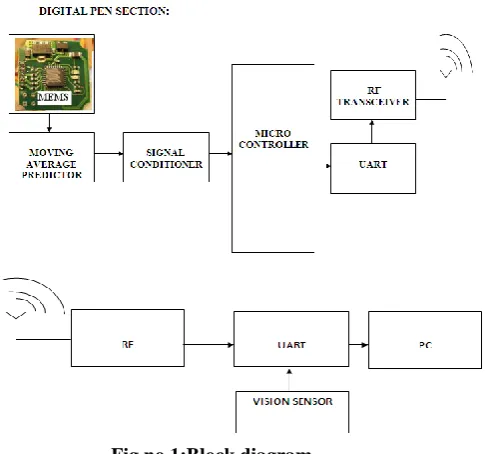
ABSTRACT: This paper presents an accelerometer-based digital pen for handwritten digit and gesture trajectory recognition applications. The digital pen consists of a tri-axial accelerometer, a microcontroller, and an RF wireless transceiver for sensing and collecting accelerations of handwriting and gesture trajectories. Using this project we can do human computer interaction. Users can use the pen to write digits or make hand gestures, and the accelerations of hand motions measured by the accelerometer are wirelessly transmitted to a computer for online trajectory recognition. So, by changing the position of MEMS we can able to show the alphabetical characters in the PC. The acceleration signals measured from the tri-axial accelerometer are transmitted to a computer via the wireless module. The IR semsor is also used to do the ppt slide transition in the wireless module.
KEYWORDS: MEMS,RF transceiver,sensor module
I. INTRODUCTION
The acceleration signals measured from the triaxial accelerometer are transmitted to a computer via the wireless module. The measured acceleration signals of these motions can be recognized by the trajectory recognition algorithm. A mems based digital pen, and a trajectory recognition algorithm have been developed in this paper. The digital pen consist of a triaxial accelerometer, a microcontroller and a RF wireless transmission module. The measured raw signals from the sensors are transmitted to a computer via the wireless module. Users can use the digital pen to write numerals, alphabets at normal speed without any space limitation. The movement trajectories can be reconstructed by the trajectory recognition algorithm. The advantages of our proposed human computer interaction input device include the following: 1)It is portable and can be used anywhere without any external reference device or writing ambit limitations, and 2)the trajectory recognition algorithm can reduce orientation and integral errors effectively and thus can reconstruct the trajectories of movements accurately. The arrangement of this paper is as follows, First the particulars of the hardware device, the accelerometer based digital pen for handwritten, microcontroller, RF transmission and trajectory recognition algorithm in detail, parallelly human computer interaction application respectively.
Recently, an attractive alternative,a portable device embedded with inertial sensors, has been proposed to sense the activities of human and to capture his/her motion trajectory information from accelerations for recognizing gestures or handwriting. A significant advantage of inertial sensors for general motion sensing is that they can be operated without any external reference and limitation in working conditions. However, motion trajectory recognition is relatively complicated because different users have different speeds and styles to generate various motion trajectories.
II. DIGITAL PEN COMPONENTS AND ITS BASIC OPERATIONAL ALGORITHM
ISSN (Print) : 2320 – 3765 ISSN (Online): 2278 – 8875
I
nternational
J
ournal of
A
dvanced
R
esearch in
E
lectrical,
E
lectronics and
I
nstrumentation
E
ngineering
(An ISO 3297: 2007 Certified Organization)
Vol. 4, Issue 5, May 2015
signals and converts the signal to digital signal via the A/D converter. The transmitter transmits the acceleration signals wirelessly to a personal computer, and the algorithm to measure the displacement from the acceleration.
A. Block Diagram:
Fig no 1:Block diagram
B. ATMEL Microcontroller :The AT89S52 is a low-power, high-performance CMOS 8-bit microcontroller with 8K bytes of in-system programmable Flash memory. The device is manufactured using Atmel’s high-density non-volatile memory technology and is compatible with the Indus-try-standard 80C51 instruction set and pin out. The on-chip Flash allows the program memory to be reprogrammed in-system or by a conventional non -volatile memory programmer.
III.MEMS TECHNOLOGY
Micro-Electro-Mechanical Systems (MEMS) is the combination of mechanical elements, sensors, actuators, and electronics on a common silicon substrate for the period of micro fabrication technology.MEMS is an enabling technology allowing the growth of stylish products, augmenting the computational capability of microelectronics. In the fashionable cases, the physics behind the performance of MEMS devices can be expressed by mathematical terminology. MEMS Solver mechanism by creating a mathematical model of the system and generates logical solutions to explain the presentation of the MEMS device. The user now has to enter the input parameters like length and width of the beam for example in a user friendly GUI, and the software will directly calculate the relevant results and plot graphs that fully give details of the MEMS device or part of it.
ISSN (Print) : 2320 – 3765 ISSN (Online): 2278 – 8875
I
nternational
J
ournal of
A
dvanced
R
esearch in
E
lectrical,
E
lectronics and
I
nstrumentation
E
ngineering
(An ISO 3297: 2007 Certified Organization)
Vol. 4, Issue 5, May 2015
used processes used in the development of MEMS devices. The data analysis module have a die calculator, unit conversion tool and lists the material properties of normally used MEMS materials
Fig no 2:MEMS Fabrication
The rising demand for MEMS (micro-electromechanical systems) technology is approaching from diverse industries such as automotive, space and user electronics. MEMS promises to develop almost every product category by bringing together silicon-based microelectronics with micromachining technology,manufacturing the possible of the realization of complete systems-on-a-chip. KLA-Tenor offers the tools and techniques, first developed for the included circuit industry, for this rising market.
A. Mems And Compliant Mems:
Micro-electro-mechanical systems (MEMS) technology has contributed to the better performance, reliability and lower-cost sensors that carry basic automobile functions within the automotive industry. MEMS technology is estimated to play an important role in the future of Research and Development of automotive industry particularly in the active safety area. MEMS sensors have the following advantages: they are deterioration-free and are long-lasting for long periods; they contain good dynamic characteristics, superior impact resistance, low power consumption, inexpensive, they are tiny in size, and simple for installation.
MEMS are measured to be as a key technology with potential to meet the necessities of the Intelligent Transportation Technology (ITS). MEMS sensors used in automotive systems etc. typically consist of micro beams and inertial mass twisted by etching part of a silicon substrate, and piezo-resistors twisted as strain gauges on the beams. Applications of MEMS sensors are unlimited to airbag systems. They are also worn in vehicle motion control systems, for example in the Antilock Braking System (ABS). Crash sensors can senses and calculate crash parameters such as velocity and acceleration. Existing technologies for active safety are being personalized using MEMS sensors to enhance the show of current systems; such as airbags or belt pre-tension devices. These systems reduce the opportunity of injury and its level for the period of a crash which motivates the development of Intelligent Safety Systems (ISS).
These mechanisms work on the standard of large deflecting arcs and the beams and reach motion by the deflection of their members. Prescribed motion profiles can be obtained more simply using buckling members in compliant mechanism design. If these mechanism’s people were inflexible the mechanism would have zero degree of freedom.
B. Ir Sensor :
ISSN (Print) : 2320 – 3765 ISSN (Online): 2278 – 8875
I
nternational
J
ournal of
A
dvanced
R
esearch in
E
lectrical,
E
lectronics and
I
nstrumentation
E
ngineering
(An ISO 3297: 2007 Certified Organization)
Vol. 4, Issue 5, May 2015
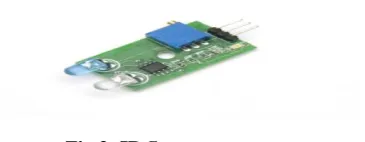
A InfraRed sensor(IR sensor) is an electronic device that measures infrared (IR) light radiating from objects in its field of view. IR sensors are often used in the construction of IR-based motion detectors . Apparent motion is detected when an infrared source with one temperature, such as a human, passes in front of an infrared source with another temperature, such as a wall.
All objects above absolute zero emit energy and is in reference to what is known as black body radiation. It is usually infrared radiation that is invisible to the human eye but can be detected by electronic devices designed for such a purpose.
The term passive in this instance means that the IR device does not emit an infrared beam but merely passively accepts incoming infrared radiation. ―Infra‖ meaning below our ability to detect it visually, and ―Red‖ because this color represents the lowest energy level that our eyes can sense before it becomes invisible.
Thus, infrared means below the energy level of the color red, and applies to many sources of invisible energy.
C. IR FUNDAMENTALS :
Infrared radiation enters through the front of the sensor, known as the sensor face. At the core of a IR sensor is a solid statesensor or set of sensors, made from an approximately 1/4 inch square of natural or artificial pyroelectric materials, usually in the form of a thin film, out of gallium nitride (GaN), caesium nitrate (CsNO3), polyvinyl fluorides, derivatives of phenylpyrazine, and cobaltphthalocyanine. (See pyroelectric crystals.) Lithium tantalate (LiTaO3) is a crystal exhibiting both piezoelectric and pyroelectric properties.
The sensor is often manufactured as part of an integrated circuit and may consist of one (1), two (2) or four (4) 'pixels' of equal areas of the pyroelectric material. Pairs of the sensor pixels may be wired as opposite inputs to a differential amplifier. In such a configuration, the IR measurements cancel each other so that the average temperature of the field of view is removed from the electrical signal; an increase of IR energy across the entire sensor is self-cancelling and will not trigger the device. This allows the device to resist false indications of change in the event of being exposed to flashes of light or field-wide illumination. At the same time, this differential arrangement minimizes common-mode interference, allowing the device to resist triggering due to nearby electric fields. However, a differential pair of sensors cannot measure temperature in that configuration and therefore this configuration is specialized for motion detectors.
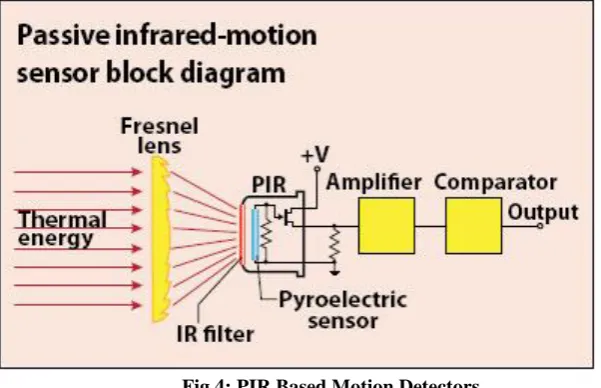
D.PIR BASED MOTION DETECTORS :
Fig 4: PIR Based Motion Detectors
ISSN (Print) : 2320 – 3765 ISSN (Online): 2278 – 8875
I
nternational
J
ournal of
A
dvanced
R
esearch in
E
lectrical,
E
lectronics and
I
nstrumentation
E
ngineering
(An ISO 3297: 2007 Certified Organization)
Vol. 4, Issue 5, May 2015
sensor chip. The complete assembly is contained within a housing mounted in a location where the sensor can view the area to be monitored. Infrared energy is able to reach the pyroelectric sensor through the window because the plastic used is transparent to infrared radiation (but only translucent to visible light).
IV. TRAJECTORY RECOGNITION ALGORITHM
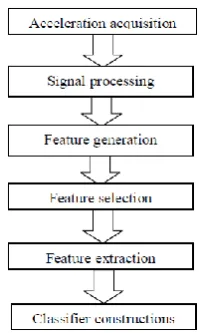
Fig 5:Trajectory recognition algorithm
Trajectory recognition algorithm consisting of acceleration acquisition, signal pre-processing, feature generation, feature selection, and feature extraction. The recognition procedure is composed of acceleration acquisition, signal preprocessing,feature generation, feature selection, and feature extraction. The acceleration signals of hand motions are measured by the pen-type portable device.
A. Block diagram of trajectory recognition algorithm:
Fig 6:Algorithm Block Diagram
B. signal pre-processing:
The signal pre-processing procedure consists of calibration, a moving average filter, a high-pass filter, and normalization. First, the accelerations are calibrated to remove drift errors and offsets from the raw signals. These two filters are applied to remove high frequency noise and gravitational acceleration from the raw data, respectively.
C. Feature Generation:
ISSN (Print) : 2320 – 3765 ISSN (Online): 2278 – 8875
I
nternational
J
ournal of
A
dvanced
R
esearch in
E
lectrical,
E
lectronics and
I
nstrumentation
E
ngineering
(An ISO 3297: 2007 Certified Organization)
Vol. 4, Issue 5, May 2015
D. Feature selection:
The objective of the feature selection and feature extraction methods is not only to ease the burden of computational load but also to increase the accuracy of classification. The reduced features are used as the inputs of classifiers.
E. Feature extraction
For pattern recognition problems, LDA [23] is an effective feature extraction (or dimensionality reduction (method) which uses a linear transformation to transform the original feature sets into a lower dimensional feature space.V.
F. PNN
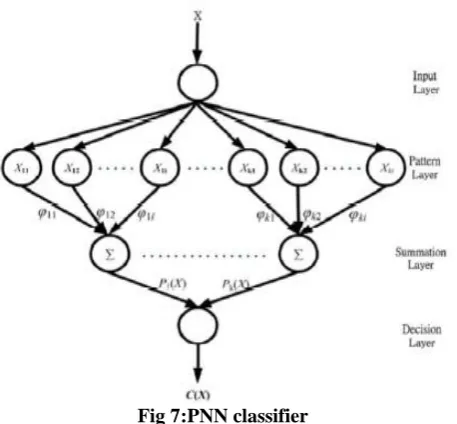
PNN is a probabilistic neural network used as a classifier for handwritten digit and hand gesture recognition. The PNN is guaranteed to converge to a Bayesian classifier, and thus, it has a great potential for making classification decisions accurately and providing probability and reliability measures for each classification. The most important advantage of using the PNN is its high speed of learning. Typically, the PNN consists of an input layer, a pattern layer, a summation layer, and a decision layer as shown in Fig. 4. The function of the neurons in each layer of the PNN is defined as follows.
Layer 1: The first layer is the input layer, and this layer performs no computation.
Layer 2: The second layer is the pattern layer, and the number of neurons in this layer is equal to NL.
Layer 3: The third layer is the summation layer. The contributions for each class of inputs are summed in this layer to produce the output as the vector of probabilities. Each neuron in the summation layer represents the active status of one class.
Layer 4: The fourth layer is the decision layer
Fig 7:PNN classifier G.Physics Of Trajectories
Consider a particle of mass , touching in a potential field . Physically speaking mass represents inertia, and the field represents external forces, of a particular kind known as "conservative". That is, given at all relevant positions, there is a method to infer the associated force that would operate at that position, say from gravity. Not all forces can be explained in this way, however.
ISSN (Print) : 2320 – 3765 ISSN (Online): 2278 – 8875
I
nternational
J
ournal of
A
dvanced
R
esearch in
E
lectrical,
E
lectronics and
I
nstrumentation
E
ngineering
(An ISO 3297: 2007 Certified Organization)
Vol. 4, Issue 5, May 2015
Fig 8:Trajectory recognition
V ATMEL MICROCONTROLLER
The AT89S52 is a low-power, high-performance CMOS 8-bit microcontroller with 8K bytes of in-system programmable Flash memory. The device is manufactured using Atmel’s high-density non-volatile memory technology and is compatible with the Indus-try-standard 80C51 instruction set and pin out. The on-chip Flash allows the program memory to be reprogrammed in-system or by a conventional non -volatile memory programmer.
By combining a versatile 8-bit CPU with in-system programmable Flash on a monolithic chip, the Atmel AT89S52 is a powerful microcontroller which provides a highly-flexible and cost-effective solution to many embedded control applications. The AT89S52 provides the following standard features: 8K bytes of Flash, 256 bytes of RAM, 32 I/O lines, Watchdog timer and two data pointers.
VI. HARDWARE DESCRIPTION
In the laboratory developed board, the power supply circuit built using filters, rectifiers and then voltage regulator, with an AC voltage, a steady DC voltage is obtained by rectifying the AC voltage then filtering to a DC level and finally regulating to obtain a desired, fixed Dc voltage. the accelerometer placed to measure the acceleration in three directions, and those signals are transmitted to microcontroller and converts the signals to digital form and transmitted to a computer via the wireless module by using RF technology.The IR semsor is also used to do the ppt slide transition in the wireless module.
VII. CONCLUSION
This paper presents an accelerometer-based digital pen for handwritten digit by with trajectory recognition applications. The digital pen consists of a triaxial accelerometer, a microcontroller, and an RF wireless transmission module for sensing and get-together the signals of accelerations of handwriting and gesture trajectories. By means of this technology we can put pen to paper & display the characters not including the keyboard for applying the human interaction to the computer.
REFERENCES
[1] S. Cimato, M. Gamassi, V. Piuri, R. Sassi, and F. Scotti, “Privacy-aware biometrics: design and implementation of a multimodal verification
system,” in Proc. Annu. Comp. Sec. Apps. Conf., 2008, pp. 130–138.
[2] D. Lopresti, F. Monrose., and L. Ballard, “Biometric authentication revisited: Understanding the impact of wolves in sheep’s clothing,” in Proc.
15th USENIX Sec. Symp., 2006.
[3] M. S. Obaidat and N. Boudriga, Sec of e-Sys and Comp Networks. Cambridge, MA: Cambridge Univ. Press, 2007.
[4] M. Obaidat and B. Sadoun, “Verification of comp. users using keystroke dynamics,” IEEE Trans. Syst., Man, Cybern., vol. 27, no. 2, pp. 261–
ISSN (Print) : 2320 – 3765 ISSN (Online): 2278 – 8875
I
nternational
J
ournal of
A
dvanced
R
esearch in
E
lectrical,
E
lectronics and
I
nstrumentation
E
ngineering
(An ISO 3297: 2007 Certified Organization)
Vol. 4, Issue 5, May 2015
[5] H. Gamboa and A. Fred, “A behavioral biometric system based on human-comp. inter,” in Proc. Conf. Biometric Tech. Human Identification, vol.
5404. 2004, pp. 381–392.
[6] A. A. E. Ahmed and I. Traor´e, “A new biometric tech. based on mouse dynamics,” IEEE Trans. Dependable Secure Comput., vol. 4, no. 3, pp.
165–179, Jul.–Sep. 2007.
[7] M. Pusara and C. E. Brodley, “User reauthentication via mouse movements,” in Proc. ACM Workshop Visualization Data Mining Comp. Sec.
(VizSEC/DMSEC), 2004, pp. 1–8.
[8] N. Zheng, A. Paloski, and H. Wang, “An efficient user verification system via mouse movements,” in Proc. 18th ACM Conf. Comp. Commun.
Sec., 2011, pp. 139–150
BIOGRAPHY
R. Sangeetha has completed her graduation in B.E Electrical and Electronics Engineering in the year 2013 at Ganadipathy tulsi’s Jain engineering College, Vellore affiliated to Anna University, Chennai, India and presently doing her post graduation in M.E Applied Electronics in the year 2013-15 at Kingston Engineering College, Vellore. She is working towards her research in the field of sensor networks. Her area of Specialization includes MEMS.