211 | P a g e
DEVELOPMENT OF PAVER BLOCK BY USING RICE
HUSK ASH WITH THE PARTIAL REPLACEMENT OF
CEMENT
Er. Atul Thakur
1*, Dr. V.S. Batra
2, Dr. Hemant Sood
3, Er. Sandeep Singla
41
MTech. student (Structures), Department of Civil Engineering, RIMT, Mandi Gobindgarh (India) 2
Professor, RIMT, Mandi Gobindgarh (India) 3
Professor & HOD, NITTTR, Chandigarh (India) 4
Associate Professor & HOD, RIMT, Mandi Gobindgarh (India)
ABSTRACT
Rice husk ash is pozzolanic material with high silica content. It is a byproduct of boilers industries, where rice
husk has been used as a fuel for burning and maintaining high temperature. Applications of rice husk ash in
Paver block, which is technically sound and environmentally safe for sustainable development. In this study,
partial replacement (by weight) of cement with RHA in paver blocks for determining the change in the
compressive strength, water absorption and abrasive resistance of paver blocks. Partial replacement of cement
in different percentage as like 0%, 15%, 20%, 25%, 30%, 35% and 45% has been done. The compressive
strength has been determined at the end of 7, 28 and 56 days, water absorption test and abrasion resistance has
been determined at 28 days.
Keywords :Abrasion resistance, compressive strength, paver block, rice husk ash (RHA), water
absorption.
I. INTRODUCTION
According to the IS 15658:2006 Paver Block is a solid, un-reinforced pre-cast cement concrete paving units used in the surface course of pavements, with minimum horizontal cross-section of 50mm from any edge in any direction, having aspect ratio not more than four, except for complementary products. Paver Block is a commonly used decorative method of creating a pavement or hard standing. The main benefit of using paver
blocks over other materials is that individual block can later be lifted up and replaced. Today precast concrete
paver blocks are the most preferred choice for paving of footpaths, parking lots, bus stops, industries, for
making roads in villages etc.
eco-212 | P a g e friendly methods for infrastructure development. Disposal of waste is another huge problem. This research has combined sustainability with waste management leading to a wonderful product called RHA paver blocks. The mechanical properties in terms of flexural and tensile strength have been significantly improved with the addition of RHA and the fine RHA exhibited the highest shrinkage value due to the effect of micro fine particles which increases its shrinkage values considerably. (Habeeb and Fayyadh, 2010)
The use of rice husk ash leads to enhanced resistance to segregation of fresh concrete compared to a control mixture with Portland cement alone. Also RHA can significantly reduce the mortar-bar expansion. The mechanical properties of concrete are enhanced when the substitution of Portland cement was done by RHA. (Alireza Naji Givi, et al 2010).
II. OBJECTIVE AND SCOPE
The objective of this dissertation is given below-
[1] To utilize the waste material such as rice husk ash in paver blocks. [2] To study properties of RHA used in paver blocks in lieu of cement.
[3] To study the effect of the partial replacement of cement with different replacement ratio i.e. 0%, 15%, 30%, 45% of RHA in the paver blocks used under light traffic conditions.
[4] To analyse/compare the properties like compressive strength, abrasive strength, water absorption and shape & size of RHA paver blocks with the conventional paver blocks.
[5] To develop RHA paver blocks using standard code of reference.
III. EXPERIMENTAL WORK
The Paver blocks were tested in terms of compressive strength, abrasion resistance and water absorption. In this study, normal cement concrete mix design for M 35 grade is used for the construction of Paver Block. IS 10262:2009 (Concrete Mix Proportioning Guideline) and IS 15658:2006 (Precast Concrete Block Paving - Specification) was used for design mix and different trials has been performed. In this concrete, cement, high water reducing & hardening admixture, coarse & fine aggregate and water is used. After the mix design is prepared, the replacement (by weight) of cement with RHA will be done with different ratios. The casting of paver blocks were done in a factory at Barwala with hydraulic press machine. The testing was conducted at NITTTR, Chandigarh.
213 | P a g e
IV. MATERIAL USED
4.1 Cement
Ordinary Portland cement of 43 grade was used throughout the investigation. The cement was available in the local market Chandigarh and kept in dry location. Table 1 shows the physical properties of OPC which were evaluated from the experimental work.
Table No. 1: Physical Properties Of Odinary Portland Cement
Sr. No. Property Results
1. Fineness 3%
2. Soundness 1 mm
3. Setting time Initial = 85 min
Final = 165 min
4. Specific gravity 3.15
5. Compressive strength
After 3 days = 27.00 MPa After 7 days = 34.20 MPa After 28 days = 44.22 MPa
4.2 Rice Husk Ash
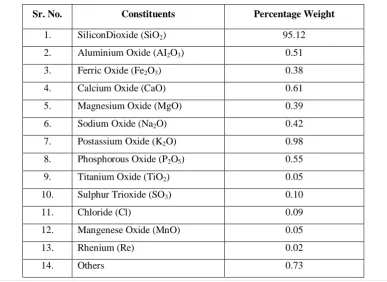
In this experimental work, rice husk ash is collected from Guru Metachem Pvt. Ltd. has been utilized. The chemical composition of the rice husk ash determined by X-Ray Fluorescence (XRF) analysis is shown in Table No.2 below.
Table No. 2: Composition Of Rice Husk Ash
Sr. No. Constituents Percentage Weight
1. SiliconDioxide (SiO2) 95.12
2. Aluminium Oxide (AI2O3) 0.51
3. Ferric Oxide (Fe2O3) 0.38
4. Calcium Oxide (CaO) 0.61
5. Magnesium Oxide (MgO) 0.39
6. Sodium Oxide (Na2O) 0.42
7. Postassium Oxide (K2O) 0.98
8. Phosphorous Oxide (P2O5) 0.55
9. Titanium Oxide (TiO2) 0.05
10. Sulphur Trioxide (SO3) 0.10
11. Chloride (Cl) 0.09
12. Mangenese Oxide (MnO) 0.05
13. Rhenium (Re) 0.02
214 | P a g e It can be seen from the above table that the rice husk ash contained a very high percentage of silicon dioxide as indicated by the values above. The specific gravity of rice husk ash using the density bottle test was found to be the 2.38.
4.3 Water
Prescribed in IS 456 : 2000, the potable water free from injurious amounts of deleterious materials and fit for drinking purposes was used for mixing as well as curing of concrete.
4.4 Aggregates
Aggregate plays an important role in concrete and its functioning. It account for 75-80% by mass in concrete. Aggregate is the granular material, such as gravel, crushed stone, sand, blast-furnace slag, or construction and demolition waste etc. that is used with a cementing medium to produce concrete.
4.4.1 Fine Aggregates
Fine aggregate (sand) are those that pass through No.4 (4.75 mm) sieve and are retained on the No. 200 (75 μm) sieve. The fine aggregates were tested as per IS: 383-1970. Washed sand from local crusher was used. The SSD (saturated surface dry) coarse and fine aggregates were used. The properties of F.A. used were as under:
Table No. 3: Properties of Washed Sand
Characteristics Value
Grading zone of fine aggregates Zone III
Specific Gravity 2.70
Silt Content 2.79%
4.4.2 Coarse Aggregate
Coarse aggregate are those, retained on the No. 4 (4.75 mm) sieve. Sieve analysis helps to find out size of aggregate and to determine the particle size distribution of coarse aggregates. The aggregates were tested as per IS: 383-1970. Crushed stone aggregate angular in nature is obtained from local crusher was used. The SSD
(saturated surface dry) coarse and fine aggregates were used. The 10mm coarse aggregate is used in the study.
Table No. 4: Properties Of Coarse Aggregates
Characteristics Value
Shape Angular
Maximum Size 10 mm
Specific Gravity 2.76
Impact Value 5.9 %
215 | P a g e 4.5 Admixture
High range water reducing agent/super plasticizer and high early strength is used in the mix to reduce the water content in the mix and to obtain the initial hardening of the paver blocks so that the paver blocks should be stacked as early as possible.
V. MIX PROPORTIONS
The mix proportion shown below was used in the study for the making or conventional paver blocks. Table No. 5: Mix Proportation
Material Material source / Type Weight Kg/m3
Cement Chandigarh City / OPC - 43 Grade 420
Sand Local Crushers / Washed Sand ( Zone III ) 980.64
Coarse Aggregate Local Crushers / Crushed Aggregates 1100.98
Rice Husk Ash Guru Metachem Pvt. Ltd., Ahemdabad Nil
Admixture High Early Strength and High Range Water Reducing Agent. 2.1
Water Clean and Portable Water 109.2
Further the cement is partially replaced (by weight) with RHA in the ratios of 0%, 15%, 20%, 25%, 30% 35% and 45%.
VI. RESULTS AND DISCUSSION
The Paver Block is designed on the basis of IS: 15658–2006 as per M-35 Grade Designation of-Paver Blocks. The results which are comes out from testing is given below:
6.1. Compressive Strength
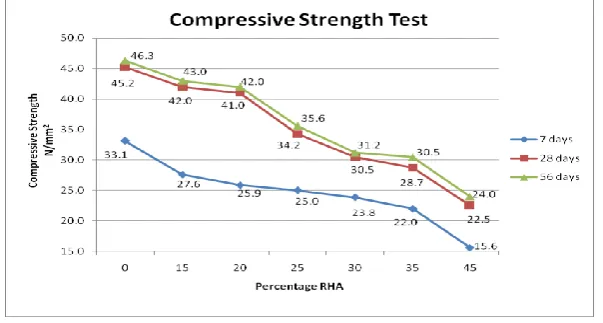
After casting, the specimens (paver blocks) were tested by compression testing machine at 7 day, 28 days and 56 days for compressive strength shown in table and graph below.
216 | P a g e 6.2. Water Absorption Test
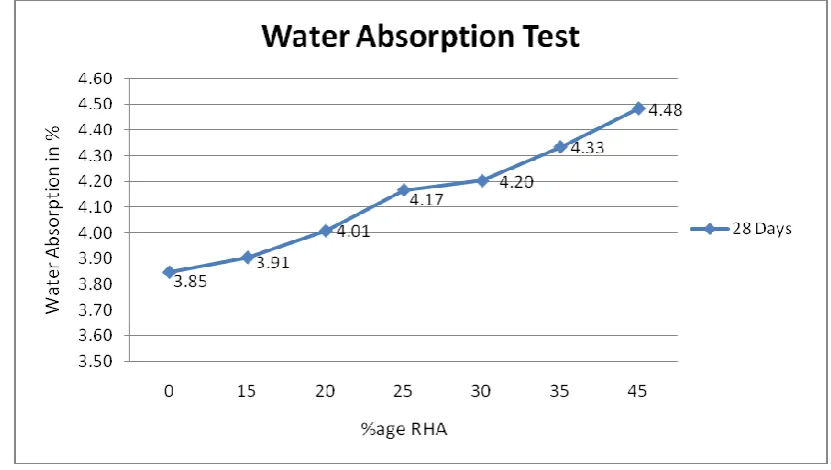
After casting the specimens (3 for each replacement ratio) were tested for water absorption at 28 days. The table & graph for the water absorption has been shown below.
Figure 2- Water Absorption Test Results
6.3. Abrasion Resistance Test
After casting, the specimens were tested by abrasion testing machine at 28 days for abrasion resistance shown in table and graph below.
217 | P a g e
VII. CONCLUSIONS
This work can be suitable for light traffic conditions as per IS 15658:2006. It has been seen from the above results that:
1. As the percentage of RHA increases the compressive strength of specimen decreases. 2. The abrasive resistance of the specimen decreases with increase in percentage of RHA.
3. The optimum level for the replacement (by weight) of RHA for light traffic condition i.e. M35 grade, I - shaped paver blocks made with hydraulic press/mechanical hydraulic machine is found to be 20%. 4. RHA based paver blocks are an economic environmental friendly solution to rice producing nations like
India. The price of 1 ton of RHA is only a small fraction of one ton production of Portland cement.
VIII. FUTURE SCOPE
1. Proper design mixes with varying percentages of RHA with cement should be prepared.
2. The behaviour of RHA paver bocks should be seen for longer duration of time with different parameters. 3. Behaviour of RHA paver blocks can be compared with paver blocks with other materials like fly ash. 4. A suitable code for practice for supplementary cementitious materials should be prepared in which suitable
properties of RHA should be given in detail.
5. Incorporating Rice Husk Ash in concrete should be explored for the technical and economic advantages for the rice growing nations.
REFERENCES
Journal Papers:
[1] Oyetola E. B. and Abdullahi. M., (2006), The Use of Rice Husk Ash in Low - Cost Sandcrete Block Production, Leonardo Electronic Journal of Practices and Technologies; ISSN 1583-1078 Issue 8, January-June.
[2] Muhammad Harunur Rashid, Md. Keramat Ali Molla, and Tarif Uddin Ahmed, (2010), Mortar Incorporating Rice Husk Ash: Strength and Porosity, European Journal of Scientific Research, ISSN 1450-216X Vol.40 No.3.
[3] Musa Alhassan and Alhaji Mohammed Mustapha, (2007), Effect of Rice Husk Ash on Cement Stabilized Laterite, Leonardo Electronic Journal of Practices and Technologies ISSN 1583-1078 Issue 11, July- December.
[4] Guilherme Chagas Cordeiro, Romildo Dias Toledo Filho, Eduardo de Moraes Rego Fairbairn, (2008), Use of ultrafine rice husk ash with high-carbon content as pozzolan in high performance concrete, Published online: 12 October.
218 | P a g e [6] Sivakumar. G, (2009), Investigation on the Hydration Properties of the Rice Husk Ash Cement Using Ftir and
Sem, Applied Physics Research, Annamalai University, India.
[7] Badorul Hisham Abu Bakar, Ramadhansyah Putrajaya.C and Hamidi Abdulaziz, (2009), Malaysian Rice Husk Ash – Improving the Durability and Corrosion Resistance of Concrete: Pre-review, Asia Pacific Structural Engineering Conference, APSEC.
[8] Habeeb. G. A, Fayyadh. M. M, Rice Husk Ash Concrete: the Effect of RHA Average Particle Size on Mechanical Properties and Drying Shrinkage, (2009), Australian Journal of Basic and Applied Sciences, 3(3): 1616-1622, ISSN 1991-8178. Dr. Jha J. N., Gill K.S. (2006), Effect of Rice Husk Ash on Lime Stabilization, Published in Journal of the Institution of Engineers (India), Volume 87, November 28.
[9] Hima Hemant, P.JeevaRekha, D.P.Preeti, “A STUDY ON PAVER BLOCKS USING RICE HUSK ASH”, proceedings of the International Conference on Science and Engineering (ICSE 2011) organized by INDIA CHAPTER OF ACI, PP 283-292.
[10] Mauro M. Tashima, Carlos A. R. Da Silva, Jorge L. Akasaki, Michele Beniti Barbosa, The Possibility of Adding the Rice Husk Ash (RHA) to the Concrete, Civil Engineering Department, FEIS/UNESP, Brazil. [11] S. D. Nagrale, Dr. Hemant Hajare, Pankaj R. Modak (2012) Utilization Of Rice Husk Ash. S. D. Nagrale,
Dr. Hemant Hajare, Pankaj R. Modak / International Journal of Engineering Research and Applications (IJERA) ISSN: 2248-9622 www.ijera.com Vol. 2, Issue 4, July-August 2012, pp.001-005.
[12] Deepa G Nair , K. Sivaraman, and Job Thomas (2013) Mechanical Properties of Rice Husk Ash (RHA) - High strength Concrete. American Journal of Engineering Research (AJER) e-ISSN : 2320-0847 p-ISSN : 2320-0936 Volume-3 pp-14-19 www.ajer.org.
[13] Dr. A.M. Pande and S.G.Makarande (2013) Effect of Rice Husk Ash on Concrete. Dr. A.M. Pande, S.G.Makarande / International Journal of Engineering Research and Applications (IJERA) ISSN: 2248-9622 www.ijera.com Vol. 3, Issue 1, January -February 2013, pp.1718-1723.
[14] Jayanti Rajput, R.K. Yadav and R. Chandak (2013) The Effect Of Rice Husk Ash Used As Supplementary Cementing Material On Strength Of Mortar. Jayanti Rajput, R.K. Yadav, R. Chandak / International Journal of Engineering Research and Applications (IJERA) ISSN: 2248-9622 www.ijera.com Vol. 3, Issue 3, May-Jun 2013, pp.133-136.
[15] S. I. Khassaf, A. T. Jasim, F.K. Mahdi (2014) Investigation The Properties Of Concrete Containing Rice Husk Ash To Reduction The Seepage In Canals. INTERNATIONAL JOURNAL OF SCIENTIFIC & TECHNOLOGY RESEARCH VOLUME 3, ISSUE 4, APRIL 2014 ISSN 2277-8616 IJSTR©2014 www.ijstr.org.
[16] Gyanen.Takhelmayum1, Ravi Prasad2, Savitha A.L3 (2014) Experimental Study on the Properties of cement concrete using Rice Husk Ash. ISSN: 2319-5967 ISO 9001:2008 Certified International Journal of Engineering Science and Innovative Technology (IJESIT) Volume 3, Issue 6, November 2014.
219 | P a g e [18] Padma Rao, A.Pradhan Kumar, B.Bhaskar Singh (2014) A Study on Use of Rice Husk Ash in Concrete.
ISSN: 2348-0033 (Online) ISSN : 2249-4944 (Print) IJEAR Vol. 4, Issue Spl-2, Jan - June 2014.
[19] OBILADE, I.O. (2014) USE OF RICE HUSK ASH AS PARTIAL REPLACEMENT FOR CEMENT IN CONCRETE. Sept. 2014. Vol. 5. No. 04 ISSN2305-8269 International Journal of Engineering and Applied Sciences © 2012 - 2014 EAAS & ARF. All rights reserved www.eaas-journal.org.
[20] Kalyan Kumar Moulick (2015) Prospective Use of Rice Husk Ash to Produce Concrete in India. World Academy of Science, Engineering and Technology International Journal of Civil, Structural, Construction and Architectural Engineering Vol:9, No:3, 2015.
Web Site References:
http://www.fao.org http://agricoop.nic.in http://www.igc.int http://npcs.in http://irri.org
http://www.youtube.com http://www.researchgate.net http://www.eng.ox.ac.uk http://www.nbmcw.com http://www.ricehuskash.com http://www.allbookez.com http://www.scielo.br List Of Codes:
Code for aggregate testing - IS: 383-1970