Infection and Drug Resistance
Dove
press
O R I g I n a l R e s e a R c h
open access to scientific and medical research
Open Access Full Text Article
Validation of the prediction rules identifying
drug-resistant pathogens in community-onset
pneumonia
Daisuke Kobayashi,1,2 Yuichiro
shindo,2 Ryota Ito,2,3 Mai
Iwaki,4,5 Junya Okumura,2,6
Toshihiro sakakibara,2,7 Ikuo
Yamaguchi,8 Tetsuya Yagi,9
Tomohiko Ogasawara,4
Yasuteru sugino,6 hiroyuki
Taniguchi,7 hiroshi saito,10
hideo saka,11 Takashi
Kawamura,1 Yoshinori
hasegawa2
On behalf of the central Japan lung study group
1Kyoto University health service, Kyoto,
Japan; 2Department of Respiratory Medicine,
nagoya University graduate school of Medicine, nagoya, Japan; 3Division of Infectious
Diseases, University of Pittsburgh school of Medicine, Pittsburgh, Pa, Usa; 4Department
of Respiratory Medicine, nagoya Daini Red cross hospital, nagoya, Japan; 5Department
of Respiratory Medicine, Kasugai Municipal hospital, Kasugai, Japan; 6Department of
Respiratory Medicine, Toyota Memorial hospital, Toyota, Japan; 7Department of
Respiratory Medicine and allergy, Tosei general hospital, seto, Japan; 8Department of central
laboratory, Toyohashi Municipal hospital, Toyohashi, Japan; 9Department of Infectious
Diseases, nagoya University hospital, nagoya, Japan; 10Department of Respiratory Medicine,
aichi cancer center aichi hospital, Okazaki, Japan; 11Department of Respiratory Medicine,
national hospital Organization, nagoya Medical center, nagoya, Japan
Background: Appropriate initial antibiotic treatment and avoiding administration of
unneces-sary broad-spectrum antibiotics are important for the treatment of pneumonia. To achieve this, assessment of risk for drug-resistant pathogens (DRPs) at diagnosis is essential.
Purpose: The aim of this study was to validate a predictive rule for DRPs that we previously
proposed (the community-acquired pneumonia drug-resistant pathogen [CAP-DRP] rule), comparing several other predictive methods.
Patients and methods: A prospective observational study was conducted in hospitalized
patients with community-onset pneumonia at four institutions in Japan. Pathogens identified as not susceptible to ceftriaxone, ampicillin–sulbactam, macrolides, and respiratory fluoroqui-nolones were defined as CAP-DRPs.
Results: CAP-DRPs were identified in 73 (10.1%) of 721 patients analyzed. The CAP-DRP rule
differentiated low vs high risk of CAP-DRP at the threshold of ≥3 points or 2 points plus any of methicillin-resistant Staphylococcus aureus specific factors with a sensitivity of 0.45, specificity of 0.87, positive predictive value of 0.47, negative predictive value of 0.87, and accuracy of 0.79. Its discrimination performance, area under the receiver operating characteristic curve, was 0.73 (95% confidence interval 0.66–0.79). Specificity of the CAP-DRP rule against CAP-DRPs was the highest among the six predictive rules tested.
Conclusion: The performance of the predictive rules and criteria for CAP-DRPs was limited.
However, the CAP-DRP rule yielded high specificity and could specify patients who should be treated with non-broad-spectrum antibiotics, eg, a non-pseudomonal β-lactam plus a macrolide, more precisely.
Keywords: antibiotic resistance, algorithms, community-acquired pneumonia,
healthcare-associated pneumonia
Introduction
Pneumonia is one of the lethal infectious diseases.1 To achieve appropriate initial anti-biotic treatment is essential for patients with pneumonia since inappropriate antianti-biotic treatment results in adverse outcomes.2,3 Identifying patients at risk for drug-resistant pathogens (DRPs) is therefore critical.
To classify patients at risk for DRPs, the 2005 American Thoracic Society (ATS) and Infectious Diseases Society of America (IDSA) guidelines for adult pneumonia proposed the concept of health care-associated pneumonia (HCAP).4 The HCAP cri-teria include nursing home residents, prior hospitalization, receiving home infusion therapy or home wound care, and chronic dialysis.4 However, previous studies have shown low prevalence of DRPs in patients with HCAP and low predictability of HCAP correspondence: Yuichiro shindo
Department of Respiratory Medicine, nagoya University graduate school of Medicine, 65 Tsurumai-cho, showa-ku, nagoya 466-8550, Japan
Tel +81 52 744 2167 Fax +81 52 744 2176
email [email protected]
Journal name: Infection and Drug Resistance Article Designation: Original Research Year: 2018
Volume: 11
Running head verso: Kobayashi et al
Running head recto: Prediction rules for antibiotic resistance in pneumonia DOI: http://dx.doi.org/10.2147/IDR.S165669
Infection and Drug Resistance downloaded from https://www.dovepress.com/ by 118.70.13.36 on 22-Aug-2020
For personal use only.
Dovepress
Kobayashi et al
criteria for identifying patients with DRPs.5–9 Thus, there has been an increase of unnecessary broad-spectrum antibiotic use.10 In fact, our previous study revealed that overuse of broad-spectrum antibiotics significantly increased the risk of death in patients with non-DRPs.3 Therefore, it is crucial to identify patients with pneumonia who do not need broad-spectrum antibiotics.
Our previous study also suggested that the treatment strategy for both patients with community-acquired pneu-monia (CAP) and HCAP could be unified because the risk factors for DRPs were identical between the two categories of pneumonia.11 Currently, the antibiotic treatment strategy should be considered combining CAP and HCAP, that is, community-onset pneumonia, based on their common risk factors for DRPs,5,11–13 and some investigators have proposed several prediction rules identifying patients with DRPs at the diagnosis of community-onset pneumonia.5,11,14–16 In our previous study, we elucidated six risk factors for CAP-DRPs that were not susceptible to antibiotics commonly used for patients with CAP. The risk factors for CAP-DRPs included prior hospitalization, immunosuppression, previous use of antibiotics, use of gastric acid suppressive agents, tube feed-ing, and nonambulatory status; and specific risk factors for methicillin-resistant Staphylococcus aureus (MRSA) included chronic dialysis, congestive heart failure, and positive MRSA history.11 We proposed a prediction rule based on the cumula-tive number of risk factors (the CAP-DRP rule).11 Practically, patients with no or one risk factor would be at a low risk for CAP-DRPs and those with three or more risk factors would be at a high risk. When patients have two risk factors for CAP-DRPs and no MRSA-specific risk factor, they could be also classified into the low risk group for CAP-DRPs.
The aim of this study was to validate the prediction rule, ie, CAP-DRP rule, and to compare its predictive performance with that of others. In addition, we considered it important to identify patients at low risk for CAP-DRPs in order to avoid unnecessary use of broad-spectrum antibiotics associated with worse outcomes.
Materials and methods
study design and setting
This was a prospective observational study conducted in four institutions (a 1,000-bed university hospital and three major community hospitals with >500 beds) located in central Japan. Patient data were collected from April 1, 2013 to March 31, 2014. The protocol of this study adhered to the Declaration of Helsinki and the Japanese Ethics Guidelines for Epidemiologi-cal Studies. Obtaining informed consent of the participants
was waived, but the opt-out method was adopted according to the ethics guidelines. Information about the study was dis-closed to the target patients through the Internet, brochures, or bulletin boards at the participating institutions to give the candidates the opportunity to decline participation. This study was approved by the ethical committee of Nagoya Univer-sity (No. 2012-0338) and the respective institutional review boards of the participating institutions; it was registered at University Hospital Medical Information Network in Japan (No. UMIN000009837; http://www.umin.ac.jp/).
Participants and categories of pneumonia
The study method was almost identical to that of our previ-ous study.11 Briefly, all adult patients (age ≥20 years) who newly developed CAP or HCAP in their daily community living and needed inpatient treatment were enrolled in the study and followed up 1 month later.
Data collection and microbiologic
evaluation
During the patient registration period, the study coordina-tor (DK) monicoordina-tored patient enrollment in all institutions to decrease missing and contradiction of data. Microbiologic evaluation was performed by a method similar to a previ-ous study.11 Briefly, microbiologic laboratories in all four institutions provided possible causative pathogens, which were cultured in a semiquantitative manner from respiratory tract samples (including sputum, tracheobronchial aspirates, and bronchoalveolar lavage fluid), pleural fluid, and blood. Serologic tests were performed to detect antibodies against Mycoplasma pneumoniae and Chlamydophila pneumoniae. Legionella pneumophila serogroup 1 antigen in urine was tested by immunochromatography. Microbiologic test results were independently reviewed by two investigators (DK and IY). Pathogens provided by the study institutions were re-cultured. Viruses, acid-fast bacilli, fungus, and anaerobes were not re-cultured. Antibiotic susceptibility tests were performed at a central laboratory (SRL, Inc., Tokyo, Japan).11 Microdilution was performed according to the guidelines of the Clinical and Laboratory Standards Institute.17 When no breakpoints were specified in these guidelines, clinical breakpoints for bacteria provided by the European Society of Clinical Microbiology and Infectious Diseases (version 1.2) were utilized.18
Definition of CAP-DRPs
Combination therapy with non-antipseudomonal β-lactam anti-biotics plus a macrolide or monotherapy with fluoroquinolone
Infection and Drug Resistance downloaded from https://www.dovepress.com/ by 118.70.13.36 on 22-Aug-2020
Dovepress Prediction rules for antibiotic resistance in pneumonia
has been recommended as the initial empirical antibiotic treatment in the international guidelines of CAP.19 Therefore, identified pathogens that were not susceptible to all of the fol-lowing types of antibiotics: non-antipseudomonal β-lactam antibiotics (ceftriaxone or ampicillin–sulbactam), macrolides (azithromycin or clarithromycin), and fluoroquinolones (moxifloxacin, levofloxacin, or garenoxacin) were defined as CAP-DRPs.
Outcomes
In this observational study, we defined the drug resistance of identified pathogens (occurrence of CAP-DRPs) as the main microbiologic outcome. The 30-day and in-hospital mortality were also assessed.
Prediction rules for caP-DRPs
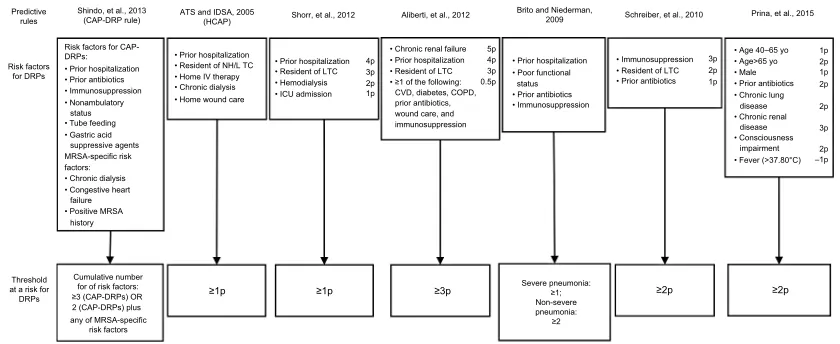
Definitions of various prediction rules to identify patients with CAP-DRPs including the CAP-DRP rule are shown in Figure 1.5,11,15,20–22
Prediction rules for MRsa
In our previous study, we elucidated risk factors for MRSA that included three MRSA-specific factors (chronic dialysis during the preceding 30 days, congestive heart failure, and positive MRSA history within the previous 90 days) and three common risk factors for all CAP-DRPs including MRSA
(prior hospitalization, prior antibiotic use, and use of gastric acid suppressive agents).11 The MRSA-specific risk score was determined on the basis of the cumulative number of risk factors for MRSA. Shorr’s MRSA score (range, 0–10) was also calculated according to the original article.14
statistical analysis
Demographic, clinical, and microbiologic characteristics were described. Categorical data were summarized as fre-quencies in percentage and continuous data as median with interquartile range.
The sensitivity, specificity, positive predictive value (PPV), negative predictive value (NPV), accuracy, and area under the receiver operating characteristic curve (AUROC) of the predic-tion rules for CAP-DRP prevalence were evaluated.5,11,14,15,20–22 Moreover, we calculated the Youden indexes to compare differ-ent thresholds of Shindo’s CAP-DRP score.23 In this procedure, point estimates and their 95% confidence intervals (CIs) of the respective parameters were calculated. In addition, the predictive performance of the rules was assessed to identify patients with MRSA.11,14 Calculation of sensitivity, specificity, PPV, NPV, and accuracy was performed using the R statistical package (version 3.0.2; R Foundation for Statistical Computing, Vienna, Austria). PASW Statistics 20 (IBM Corporation, Armonk, NY, USA) was used for other statistical analyses. All tests were two-tailed and a P-value <0.05 was considered statistically significant.
Figure 1 Definitions of predictive rules for identifying patients with DRPs.
Notes: The definitions of DRPs in each previous report are as follows. Shorr et al: MRSA, Pseudomonas aeruginosa, Acinetobacter baumannii, and esBl producing organisms; hcaP criteria by aTs and IDsa: P. aeruginosa, esBl producing Enterobacteriaceae, Acinetobacter sp., and MRsa; aliberti et al: MRsa, P. aeruginosa resistant to antipseudomonal penicillins, cephalosporins, carbapenems, and quinolones, Stenotrophomonas maltophilia, vancomycin-resistant Enterococcus sp., A. baumannii, esBl producing Enterobacteriaceae, and other non-fermenting gram-negative bacilli; Brito and Niederman: not defined clearly; Schreiber et al: MRSA, P. aeruginosa, and esBl producing organisms; Prina et al: MRsa, P. aeruginosa, and esBl producing Enterobacteriaceae.
Abbreviations: DRPs, drug-resistant pathogens; caP-DRPs, community-acquired pneumonia drug-resistant pathogens; MRsa, methicillin-resistant Staphylococcus aureus; hcaP, health care-associated pneumonia; nh, nursing home; lTc, long-term care facility; IV, intravenous; cVD, cerebrovascular disease; cOPD, chronic obstructive pulmonary disease; esBl, extended-spectrum β-lactamase; IcU, intensive care unit; aTs, american Thoracic society; IDsa, Infectious Diseases society of america.
• Prior hospitalization • Prior antibiotics • Immunosuppression • Nonambulatory
status • Tube feeding • Gastric acid
suppressive agents MRSA-specific risk factors: • Chronic dialysis • Congestive heart
failure • Positive MRSA
history
• Prior hospitalization • Resident of NH/L TC • Home IV therapy • Chronic dialysis • Home wound care
• Prior hospitalization • Resident of LTC 4p3p
2p 1p • Hemodialysis • ICU admission
• Chronic renal failure 5p 4p 3p 0.5p • Prior hospitalization • Resident of LTC • ≥1 of the following:
CVD, diabetes, COPD, prior antibiotics, wound care, and immunosuppression
• Prior hospitalization • Poor functional
status • Prior antibiotics • Immunosuppression
• Immunosuppression • Resident of LTC
3p 2p 1p • Prior antibiotics
• Age 40–65 yo 1p 1p 2p 2p 2p 2p –1p 3p • Age>65 yo • Male • Prior antibiotics • Chronic lung • Chronic renal disease disease • Consciousness
impairment • Fever (>37.80°C)
Threshold at a risk for
DRPs ≥1p ≥1p ≥3p ≥2p ≥2p
Cumulative number for of risk factors: ≥3 (CAP-DRPs) OR 2 (CAP-DRPs) plus any of MRSA-specific
risk factors Shindo, et al., 2013
(CAP-DRP rule) Predictive
rules
Risk factors for DRPs
Risk factors for CAP-DRPs:
ATS and IDSA, 2005
(HCAP) Shorr, et al., 2012 Aliberti, et al., 2012
Brito and Niederman,
2009 Schreiber, et al., 2010 Prina, et al., 2015
Severe pneumonia: ≥1; Non-severe pneumonia: ≥2
Infection and Drug Resistance downloaded from https://www.dovepress.com/ by 118.70.13.36 on 22-Aug-2020
Dovepress
Kobayashi et al
Results
Demographic and clinical data
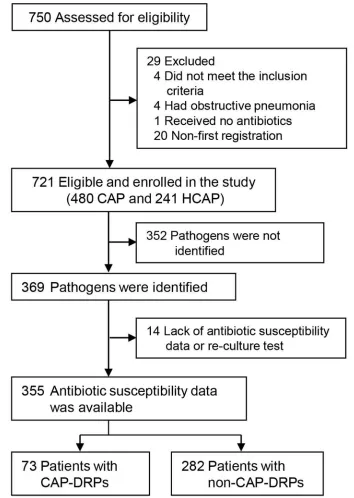
A total of 750 patients with community-onset pneumonia were assessed and 721 patients (480 CAP and 241 HCAP) were enrolled in this study as eligible patients (Figure 2). Among them, 355 patients in whom pathogens were identi-fied and antibiotic susceptibility data were clariidenti-fied were assessed to validate the prediction rules for CAP-DRPs.
Figure 2 Patient flow.
Abbreviations: caP, community-acquired pneumonia; hcaP, health care-associated pneumonia; caP-DRPs, community-acquired pneumonia drug-resistant pathogens. The baseline characteristics of the 721 eligible study patients are described in Table 1. Median age was 77 years and 66.9% were male. One hundred and twenty-one (16.8%) patients had a history of prior hospitalization; 265 (36.8%), prior antibiotic use; 51 (7.1%), immunosuppres-sion; 146 (20.2%), nonambulatory status; 25 (3.5%), tube feeding; and 205 (28.4%), use of gastric acid suppressive agents.
Infection and Drug Resistance downloaded from https://www.dovepress.com/ by 118.70.13.36 on 22-Aug-2020
Dovepress Prediction rules for antibiotic resistance in pneumonia
Microbiology and clinical outcomes
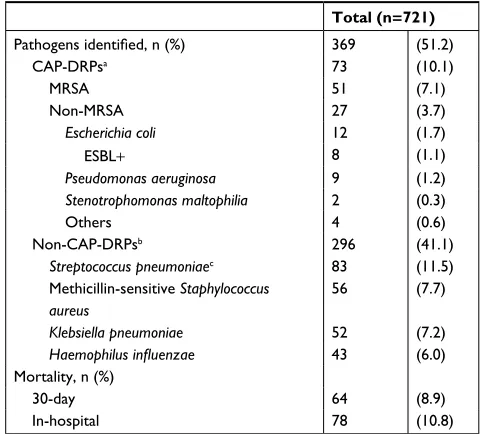
Pathogen distribution and clinical outcomes are shown in Table 2. Pathogens were identified in 369 (51.2%) patients. Non-CAP-DRPs (eg, Streptococcus pneumoniae, methicillin-sensitive S. aureus, Haemophilus influenzae, and antibiotic-sensitive enteric gram-negative bacilli) were isolated in 296 (41.1%) of 721 patients with community-onset pneumonia, and CAP-DRPs in 73 (10.1%). CAP-DRPs included MRSA (51 patients; 7.1%), Escherichia coli (12; 1.7%), and Pseudomonas aeruginosa (9; 1.2%). Among all the study
Table 1 Patient characteristics
Total (n=721)
age, median (IQR) years 77 (69–84)
Men, n (%) 482 (66.9)
health care-associated pneumonia, n (%) 241 (33.4) hospitalization for ≥2 days during the preceding
90 days
121 (16.8)
Resident in a nursing home or extended care facility
120 (16.6)
home intravenous therapy (including antibiotics and chemotherapy)
37 (5.1)
chronic dialysis during the preceding 30 days 12 (1.7) home wound care during the preceding 30 days 1 (0.1) comorbidities, n (%)
chronic lung diseases 255 (35.4)
congestive heart failure 123 (17.1)
chronic renal diseases 57 (7.9)
cns disorders 117 (16.2)
Diabetes 126 (17.5)
Immunosuppressiona 51 (7.1)
Use of antibiotics within the previous 90 days, n (%)
265 (36.8)
nonambulatory status, n (%) 146 (20.2)
Dementia, n (%) 112 (11.5)
Tube feeding, n (%) 25 (3.5)
Use of gastric suppressive agents,b n (%) 205 (28.4)
Positive MRsa history within the previous 90 days, n (%)
17 (2.4)
altered mental status,c n (%) 186 (25.8)
Fever (BT >37.8°c), n (%) 307 (42.6)
IcU admission, n (%) 52 (7.2)
PsI class,d n (%)
I–III 277 (39.2)
IV 270 (37.4)
V 160 (22.2)
Notes: aImmunosuppression included any immunosuppressive diseases, such as
congenital or acquired immunodeficiency, hematological diseases, and neutropenia (<1,000/mm3), treatment with immunosuppressive drugs within the previous 30 days,
or corticosteroids in daily doses of at least 10 mg/day of a prednisone equivalent for >2 weeks. bgastric suppressive agents included histamine h
2-receptor blockers and
proton pump inhibitors.cAltered mental status was defined as a Glasgow coma scale
<15. dPsI was evaluated in 707 patients.
Abbreviations: IQR, interquartile range; cns, central nervous system; MRsa, methicillin-resistant Staphylococcus aureus; BT, body temperature; IcU, intensive care unit; PsI, Pneumonia severity Index.
patients, 30-day and in-hospital mortality were 8.9% and 10.8%, respectively.
Prediction for patients with caP-DRPs
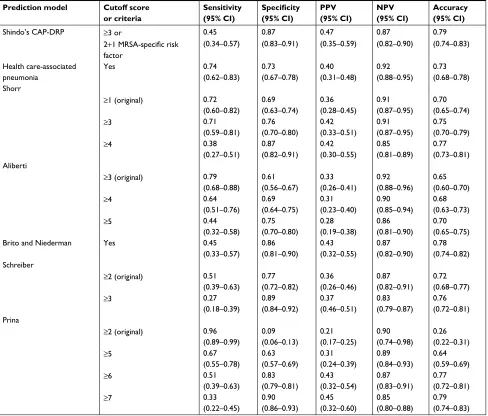
First, we examined the validity of the cutoff point of Shindo’s CAP-DRP rule. The CAP-DRP rule, ≥3 CAP-DRP risk fac-tors or 2 CAP-DRP risk facfac-tors plus any of MRSA-specific risk factors, differentiated patients at high risk from low risk of CAP-DRPs with a sensitivity of 0.45, specificity of 0.87, Youden index of 0.32, PPV of 0.47, NPV of 0.87, and accu-racy of 0.79. The simple cutoff to ≥2 and ≥3 CAP-DRP risk factors yielded sensitivity values of 0.59 and 0.33, specificity of 0.76 and 0.91, Youden indexes of 0.35 and 0.23, PPV of 0.37 and 0.46, NPV of 0.88 and 0.85, and accuracy of 0.72 and 0.79, respectively. Considering the Youden index and specificity, ≥3 CAP-DRP risk factors or 2 CAP-DRP risk factors plus any of MRSA-specific risk factors was most preferable.
Second, predictive performance was compared among the six prediction rules and criteria for CAP-DRPs including HCAP,4 Shorr,15 Aliberti,5 Brito and Niederman,20 Schreiber,22
Table 2 Microbiology and clinical outcomes
Total (n=721)
Pathogens identified, n (%) 369 (51.2)
caP-DRPsa 73 (10.1)
MRsa 51 (7.1)
non-MRsa 27 (3.7)
Escherichia coli 12 (1.7)
esBl+ 8 (1.1)
Pseudomonas aeruginosa 9 (1.2)
Stenotrophomonas maltophilia 2 (0.3)
Others 4 (0.6)
non-caP-DRPsb 296 (41.1)
Streptococcus pneumoniaec 83 (11.5)
Methicillin-sensitive Staphylococcus aureus
56 (7.7)
Klebsiella pneumoniae 52 (7.2)
Haemophilus influenzae 43 (6.0)
Mortality, n (%)
30-day 64 (8.9)
In-hospital 78 (10.8)
Notes: aIdentified pathogens which were not susceptible to β-lactam antibiotics
(ceftriaxone or ampicillin/sulbactam), macrolides (azithromycin or clarithromycin), and fluoroquinolones (moxifloxacin, levofloxacin, or garenoxacin) were defined as caP-DRPs. b25 isolates of P. aeruginosa and 7 of Acinetobacter baumannii were
classified as non-CAP-DRPs. cOf 81 isolates with antibiotic susceptibility data, 80
were penicillin-susceptible S. pneumoniae and one was penicillin intermediate S. pneumoniae; and 75 and 74 were resistant to clarithromycin and azithromycin, respectively. Data are presented as n (%).
Abbreviations: caP-DRP, community-acquired pneumonia drug-resistant pathogens; esBl, extended-spectrum β-lactamase; MRsa, methicillin-resistant S. aureus.
Infection and Drug Resistance downloaded from https://www.dovepress.com/ by 118.70.13.36 on 22-Aug-2020
Dovepress
Kobayashi et al
Prina,21 and Shindo’s CAP-DRP rule (Table 3).11 When comparing original cutoff scores or criteria that are shown in Figure 1, sensitivity of the CAP-DRP rule (0.45) was lower than those of the other prediction rules, among which that of Aliberti’s rule was the highest (0.79). However, specificity of the CAP-DRP rule (0.87) was the highest followed by Brito and Niederman’s criteria (0.86). This trend of specificity was almost the same while comparing the prediction rules with changing of cutoff scores so as to have similar levels of sensitivity of the CAP-DRP rule (Table 3). In addition, PPV of the CAP-DRP rule was also the highest. NPVs of all tested rules and criteria were around 0.90.
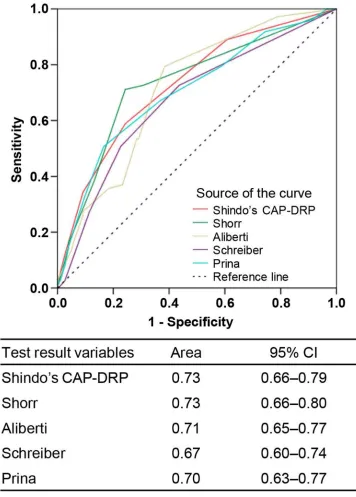
The CAP-DRP rule was predictive of CAP-DRPs with an AUROC of 0.73 (95% CI: 0.66–0.79) (Figure 3), which
Table 3 comparison of predictive rules or criteria for caP-DRPs Prediction model Cutoff score
or criteria
Sensitivity (95% CI)
Specificity
(95% CI)
PPV (95% CI)
NPV (95% CI)
Accuracy (95% CI)
shindo’s caP-DRP ≥3 or 0.45 0.87 0.47 0.87 0.79
2+1 MRSA-specific risk
factor
(0.34–0.57) (0.83–0.91) (0.35–0.59) (0.82–0.90) (0.74–0.83)
health care-associated pneumonia
Yes 0.74 0.73 0.40 0.92 0.73
(0.62–0.83) (0.67–0.78) (0.31–0.48) (0.88–0.95) (0.68–0.78) shorr
≥1 (original) 0.72 0.69 0.36 0.91 0.70
(0.60–0.82) (0.63–0.74) (0.28–0.45) (0.87–0.95) (0.65–0.74)
≥3 0.71 0.76 0.42 0.91 0.75
(0.59–0.81) (0.70–0.80) (0.33–0.51) (0.87–0.95) (0.70–0.79)
≥4 0.38 0.87 0.42 0.85 0.77
(0.27–0.51) (0.82–0.91) (0.30–0.55) (0.81–0.89) (0.73–0.81) aliberti
≥3 (original) 0.79 0.61 0.33 0.92 0.65
(0.68–0.88) (0.56–0.67) (0.26–0.41) (0.88–0.96) (0.60–0.70)
≥4 0.64 0.69 0.31 0.90 0.68
(0.51–0.76) (0.64–0.75) (0.23–0.40) (0.85–0.94) (0.63–0.73)
≥5 0.44 0.75 0.28 0.86 0.70
(0.32–0.58) (0.70–0.80) (0.19–0.38) (0.81–0.90) (0.65–0.75)
Brito and niederman Yes 0.45 0.86 0.43 0.87 0.78
(0.33–0.57) (0.81–0.90) (0.32–0.55) (0.82–0.90) (0.74–0.82) schreiber
≥2 (original) 0.51 0.77 0.36 0.87 0.72
(0.39–0.63) (0.72–0.82) (0.26–0.46) (0.82–0.91) (0.68–0.77)
≥3 0.27 0.89 0.37 0.83 0.76
(0.18–0.39) (0.84–0.92) (0.46–0.51) (0.79–0.87) (0.72–0.81) Prina
≥2 (original) 0.96 0.09 0.21 0.90 0.26
(0.89–0.99) (0.06–0.13) (0.17–0.25) (0.74–0.98) (0.22–0.31)
≥5 0.67 0.63 0.31 0.89 0.64
(0.55–0.78) (0.57–0.69) (0.24–0.39) (0.84–0.93) (0.59–0.69)
≥6 0.51 0.83 0.43 0.87 0.77
(0.39–0.63) (0.79–0.81) (0.32–0.54) (0.83–0.91) (0.72–0.81)
≥7 0.33 0.90 0.45 0.85 0.79
(0.22–0.45) (0.86–0.93) (0.32–0.60) (0.80–0.88) (0.74–0.83) Abbreviations: PPV, positive predictive value; NPV, negative predictive value; CI, confidence interval; CAP-DRP, community-acquired pneumonia drug-resistant pathogen; MRsa, methicillin-resistant Staphylococcus aureus.
was almost identical to those of Shorr’s rule (AUROC: 0.73 [95% CI: 0.66–0.88]) and Aliberti’s rule (AUROC: 0.71 [95% CI: 0.65–0.77]), and somewhat larger than that of Schreiber’s rule (AUROC: 0.67 [95% CI: 0.60–0.77]).
Prediction for non-MRsa caP-DRPs and
MRsa
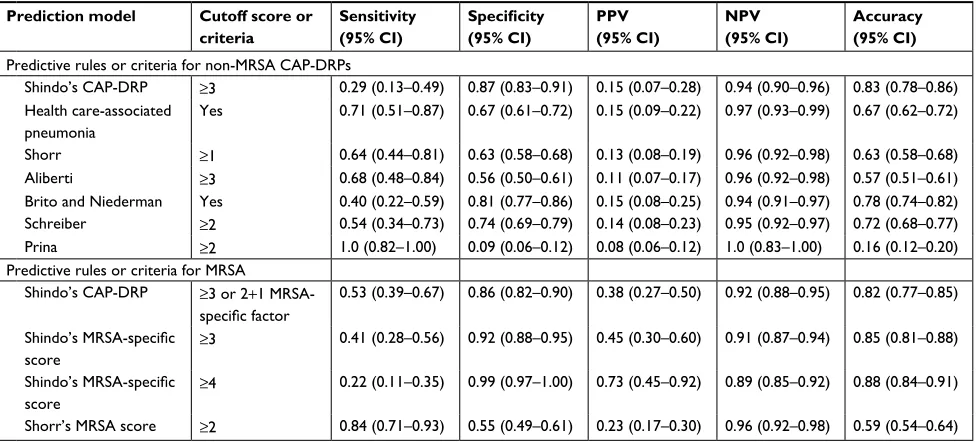
In our previous study, we proposed the threshold number of risk factors for CAP-DRPs to be three to identify patients with non-MRSA CAP-DRPs. In this validation study, the CAP-DRP rule registered a sensitivity of 0.29, specificity of 0.87, PPV of 0.15, NPV of 0.94, and accuracy of 0.83 (Table 4). This rule was less sensitive but more specific to non-CAP-DRPs than other rules.
Infection and Drug Resistance downloaded from https://www.dovepress.com/ by 118.70.13.36 on 22-Aug-2020
Dovepress Prediction rules for antibiotic resistance in pneumonia
The predictive performance of the CAP-DRP rule varying the threshold of MRSA-specific risk factors was also compared to Shorr’s MRSA score (Table 4). The CAP-DRP prediction rule of ≥3 CAP-DRP risk factors or that of 2 points plus any of MRSA-specific risk factors differentiated patients with MRSA and non-MRSA with a sensitivity of 0.53, specificity of 0.86, PPV of 0.38, NPV of 0.92, and accuracy of 0.82. Furthermore, we also assessed Figure 3 Receiver operating characteristic curves for predicting caP drug resistance.
Note: The definitions of each predictive rule are described in Figure 1.
Abbreviations: CI, confidence interval; CAP, community-acquired pneumonia; CAP-DRPs, community-acquired pneumonia drug-resistant pathogens.
the performance of our MRSA-specific risk estimation by changing the threshold number to 3 and 4. When the thresh-old of 4 was adopted, sensitivity and specificity were 0.22 and 0.99, respectively, with PPV of 0.73 and NPV of 0.89. Accuracy (0.88) was similar to that of the CAP-DRP rule. Compared to Shorr’s MRSA score, the CAP-DRP rule and the MRSA-specific risk factors indicated lower sensitivity and higher specificity.
Infection and Drug Resistance downloaded from https://www.dovepress.com/ by 118.70.13.36 on 22-Aug-2020
Dovepress
Kobayashi et al
Discussion
In this multicenter, prospective, observational study, we evaluated the predictive rules for CAP-DRP prevalence in patients with community-onset pneumonia. The CAP-DRP rule demonstrated high specificity in all the predictive rules tested and may reduce the use of unnecessary broad-spectrum antibiotics.
The definition of DRPs is important to discuss the pre-dictive methods. MRSA, extended-spectrum β -lactamase-producing Enterobacteriaceae, P. aeruginosa, and other non-fermenting gram-negative rods including Acinetobacter baumannii are often defined as potential DRPs.24,25 However, some isolates of P. aeruginosa and A. baumannii may be susceptible to third-generation cephalosporin and fluoro-quinolones.26–28 In fact, the definition based on antibiotic susceptibility test results avoided overdiagnosis of DRPs with a reduction of 6.7%.29 Therefore, we defined CAP-DRPs as being not susceptible to antibiotics commonly used for patients with CAP (non-pseudomonal β-lactams, macrolides, and respiratory fluoroquinolones) with emphasis on drug susceptibilities.11,29 Our previous study revealed that the risk factors for CAP-DRPs were identical between both patients with CAP and HCAP.11 The 2016 IDSA/ATS guidelines for hospital-acquired and ventilator-associated pneumonia state that patients with HCAP should be treated in the same way as CAP.12 Thus, a unified treatment strategy for both CAP and HCAP (community-onset pneumonia) should be established, and one of the most important points is to predict patients
with CAP-DRPs at diagnosis.11,13,30 However, validation studies on predictive rules for DRPs are limited.31,32 There-fore, we evaluated the validity of several predictive rules for CAP-DRPs including our proposed rule (CAP-DRP rule) in patients with community-onset pneumonia.
Among the predictive rules tested in this cohort, the CAP-DRP rule differentiated patients at low risk from high risk of CAP-DRPs with high specificity (0.87 [95% CI: 0.83–0.91]). That is, the CAP-DRP rule may identify patients who do not require empirical broad-spectrum antibiotics. Our previous study revealed that antipseudomonal antibiotic use significantly increased the risk of death within 30 days after diagnosis in patients with non-CAP-DRPs such as S. pneumoniae and H. influenzae.3 Therefore, through the avoid-ance of broad-spectrum antibiotic overuse, patients with no or one risk factor for CAP-DRPs and those with two risk factors for CAP-DRPs plus no MRSA-specific risk factors might improve their outcomes.33 However, the AUROC of the CAP-DRP rule was 0.73, indicating moderate discriminabil-ity.34 This performance was quite similar to that of Shorr’s and Aliberti’s rules. Furthermore, even though some tested predictive models had relatively high specificities, their sensitivities tended to be low (Table 3). Therefore, predictive methods may not be suitable for discriminating patients at high risk for CAP-DRPs. For clinical application, predictive methods including the CAP-DRP rule should be refined to achieve higher predictive performance by adding some fac-tors, eg, positive CAP-DRP history, and/or by combining
Table 4 Predictive rules or criteria for non-MRsa caP-DRPs and MRsa Prediction model Cutoff score or
criteria
Sensitivity (95% CI)
Specificity
(95% CI)
PPV (95% CI)
NPV (95% CI)
Accuracy (95% CI) Predictive rules or criteria for non-MRsa caP-DRPs
shindo’s caP-DRP ≥3 0.29 (0.13–0.49) 0.87 (0.83–0.91) 0.15 (0.07–0.28) 0.94 (0.90–0.96) 0.83 (0.78–0.86) health care-associated
pneumonia
Yes 0.71 (0.51–0.87) 0.67 (0.61–0.72) 0.15 (0.09–0.22) 0.97 (0.93–0.99) 0.67 (0.62–0.72)
shorr ≥1 0.64 (0.44–0.81) 0.63 (0.58–0.68) 0.13 (0.08–0.19) 0.96 (0.92–0.98) 0.63 (0.58–0.68) aliberti ≥3 0.68 (0.48–0.84) 0.56 (0.50–0.61) 0.11 (0.07–0.17) 0.96 (0.92–0.98) 0.57 (0.51–0.61) Brito and niederman Yes 0.40 (0.22–0.59) 0.81 (0.77–0.86) 0.15 (0.08–0.25) 0.94 (0.91–0.97) 0.78 (0.74–0.82) schreiber ≥2 0.54 (0.34–0.73) 0.74 (0.69–0.79) 0.14 (0.08–0.23) 0.95 (0.92–0.97) 0.72 (0.68–0.77)
Prina ≥2 1.0 (0.82–1.00) 0.09 (0.06–0.12) 0.08 (0.06–0.12) 1.0 (0.83–1.00) 0.16 (0.12–0.20)
Predictive rules or criteria for MRsa
shindo’s caP-DRP ≥3 or 2+1 MRsa-specific factor
0.53 (0.39–0.67) 0.86 (0.82–0.90) 0.38 (0.27–0.50) 0.92 (0.88–0.95) 0.82 (0.77–0.85)
Shindo’s MRSA-specific
score ≥
3 0.41 (0.28–0.56) 0.92 (0.88–0.95) 0.45 (0.30–0.60) 0.91 (0.87–0.94) 0.85 (0.81–0.88)
Shindo’s MRSA-specific
score ≥
4 0.22 (0.11–0.35) 0.99 (0.97–1.00) 0.73 (0.45–0.92) 0.89 (0.85–0.92) 0.88 (0.84–0.91)
shorr’s MRsa score ≥2 0.84 (0.71–0.93) 0.55 (0.49–0.61) 0.23 (0.17–0.30) 0.96 (0.92–0.98) 0.59 (0.54–0.64) Abbreviations: PPV, positive predictive value; NPV, negative predictive value; CI, confidence interval; CAP-DRP, community-acquired pneumonia drug-resistant pathogen; MRsa, methicillin-resistant Staphylococcus aureus.
Infection and Drug Resistance downloaded from https://www.dovepress.com/ by 118.70.13.36 on 22-Aug-2020
Dovepress Prediction rules for antibiotic resistance in pneumonia
with rapid diagnostic test results of antibiotic-resistant genes so that physicians can identify patients with CAP-DRPs in order to select appropriate initial antibiotics.
CAP-DRPs can be divided into MRSA and non-MRSA. Although the separation of MRSA from other CAP-DRPs is important for the selection of therapeutic regimens (ie, anti-MRSA or antipseudomonal antibiotics),35 many predic-tive rules have been created without any consideration for this separation.13 In this study, we additionally assessed the predictive performance for MRSA and non-MRSA CAP-DRPs separately. While the sensitivity of the CAP-DRP rule for non-MRSA CAP-DRPs was lower than other predic-tive rules, its specificity was higher than others. Therefore, when a patient has two or less risk factors for CAP-DRPs, antipseudomonal antibiotics should be refrained. Regarding prediction of MRSA, we assessed the predictive performance of the MRSA-specific risk score in addition to the CAP-DRP rule. When the cutoff point of ≥4 was adopted, the specific-ity was highest (0.99) with a PPV of 0.73 and NPV of 0.89. When patients have an MRSA-specific risk score of ≤3, anti-MRSA antibiotics would be unnecessary; similarly so in cases with no or one risk factor for CAP-DRPs and two risk factors for CAP-DRPs and none of three MRSA-specific risk factors. Thus, to ensure appropriate antibiotic treatment for patients with CAP-DRPs, it would be preferable to make a distinction between MRSA and non-MRSA CAP-DRPs such as P. aeruginosa.
There are some variations between countries or regions regarding risk factors for DRPs, proposed predictive rules, and results of validation studies.13,16,29,31,36,37 As Webb et al mentioned, risk factors for DRPs are composed of three fac-tors including host (intrinsic) facfac-tors, environment (extrinsic) factors, and selective antibiotic pressure,16 the latter of which would differ by countries or regions.29 Therefore, predictive rules for DRPs should be created based on local data in the respective countries or regions. If a predictive rule created in a different region is applied, it should be locally validated before clinical use.
In this study, we did not include patients without identi-fied pathogens. Labelle et al and Andruska et al demonstrated that patients with culture-negative pneumonia had lower severity of illness and hospital readmission rate compared with culture-positive patients.38,39 Therefore, we considered that patients without identified pathogens should ideally not be analyzed in the same manner as those with identi-fied pathogens. Although prediction models for identifying patients with DRPs were developed among only patients with identified pathogens in most previous studies,5,11,15,21,22
physicians must determine the initial antibiotics for both patients with identified pathogens and those without. There-fore, researchers in future should discuss whether patients without identified pathogens (about half of all patients with community-onset pneumonia) should be included when developing the prediction model.
Limitations
This study had some limitations. First, outpatients were not included in this study. Therefore, the results of this study should be applied in only patients admitted to the hospital. Second, the pathogens identified in this study may not have been the cause of pneumonia in some cases because the cultures were performed semiquantitatively rather than quan-titatively. Third, the prediction rules tested in this study were developed based on different definitions of DRPs. The dif-ference between this study and the original ones might affect each predictive performance. Fourth, we could not compare with the Drug Resistance in Pneumonia (DRIP) score that was recently published and includes prior DRP history as a risk factor for DRPs.32 We will obtain prior non-MRSA CAP-DRP history and evaluate the DRIP score in future studies.
Conclusion
This multicenter prospective study examined the performance of several predictive rules or criteria for CAP-DRPs in patients with community-onset pneumonia. The predictability of the predictive rules is limited. The CAP-DRP rule yielded high specificity among the tested rules, and can reduce the overuse of broad-spectrum antibiotics and identify patients who can be treated by non-broad-spectrum antibiotics such as a non-antipseudomonal β-lactam plus a macrolide.
Data availability
The data sets used and analyzed for the current study are available from the corresponding author on request.
Acknowledgments
We thank the laboratory staff (Mariko Mochizuki, Yoshiko Sugaki, Yusuke Nishida, Sachie Asai, and Nobuya Saka-gami), and all health care professionals who participated in the data collection. Funders of the Central Japan Lung Study Group (CJLSG) had no role in the design and conduct of the study; gathering, management, analysis, and interpretation of data; and preparation of the manuscript. This study was supported by JSPS KAKENHI grant number JP17K09610 and by CJLSG, a nonprofit organization supported by unrestricted donations from the following pharmaceutical
Infection and Drug Resistance downloaded from https://www.dovepress.com/ by 118.70.13.36 on 22-Aug-2020
Dovepress
Kobayashi et al
companies: Chugai Pharmaceutical Co, Ltd; Shionogi & Co, Ltd; Daiichi Sankyo Co, Ltd; Dainippon Sumitomo Pharma Co, Ltd; Janssen Pharmaceutical KK; Eli Lilly Japan KK; Taisho Toyama Pharmaceutical Co, Ltd; Meiji Seika Pharma Co, Ltd; MSD KK; Bayer Holding Ltd; Astellas Pharma Inc; and Nippon Boehringer Ingelheim Co, Ltd.
Author contributions
DK planned the study concept, collected the study mate-rial, prepared the first draft of the manuscript, and takes responsibility for the integrity of the data and the accuracy of the data analysis. YS, TK, and YH contributed to the study design, data interpretation, statistical analyses, and critical revision of the manuscript. All authors contributed toward data analysis, drafting and critically revising the paper and agree to be accountable for all aspects of the work. All authors read and approved the final manuscript.
Disclosure
All of the following information provide relevant financial activities outside the submitted work.
Dr Shindo reports receiving personal fees from Pfizer Inc, Shionogi & Co, Ltd, Beckman Coulter, Inc, MSD KK, Dainippon Sumitomo Pharma Co, Ltd, and Taisho Toyama Pharmaceutical Co, Ltd. Dr Yagi reports receiving grants from Taisho Toyama Pharmaceutical Co, Ltd, Shionogi & Co, Ltd, Pfizer Inc, Daiichi Sankyo Co, Ltd, Meiji Seika Pharma Co, Ltd, Astellas Pharma Inc, Dainippon Sumitomo Pharma Co, Ltd, and MSD KK; and receiving personal fees from Taisho Toyama Pharmaceutical Co, Ltd, Shionogi & Co, Ltd, Pfizer Inc, Asahi Kasei Pharma Co, Ltd, Daiichi Sankyo Co, Ltd, Meiji Seika Pharma Co, Ltd, Astellas Pharma Inc, Dainippon Sumitomo Pharma Co, Ltd, MSD KK, and Mitsubishi Tanabe Pharma. Dr Ogasawara reports receiving personal fees from Chugai Pharmaceutical Co, Ltd, Japan Boehringer Ingelheim Co, Ltd, Taiho Pharmaceutical Co, Ltd, Bristol-Myers Squibb Inc, Kyowa Hakko Kirin Pharmaceutical Co, Ltd, and KYORIN Pharmaceutical Co, Ltd. Dr Sugino reports receiving personal fees from Astellas Pharma Inc, Ono Pharmaceutical Co, Ltd, Shionogi & Co, Ltd, Chugai Pharmaceutical Co, Ltd, Abbott Japan Co, Ltd, MSD KK, Sanofi, GlaxoSmithKline plc, Mitsubishi Tanabe Pharma, Pfizer Inc, Novartis Pharma KK, AstraZeneca KK, KYORIN Pharmaceutical Co, Ltd, and Elsevier Japan KK. Dr Taniguchi reports receiving personal fees from Abbott Japan Co, Ltd, Actelion Pharmaceuticals Japan Ltd, Asahi Kasei Pharma Corp, Astellas Pharma Inc, AstraZeneca
KK, Bayer in Japan, Boehringer Ingelheim Co, Ltd, Chugai Pharmaceutical Co, Ltd, Eli Lilly Japan KK, Fukuda Denshi Co, Ltd, GlaxoSmithKline plc, KYORIN Pharmaceutical Co, Ltd, Meiji Seika Pharma Co, Ltd, Novartis Pharma KK, Ono Pharmaceutical Co, Ltd, Pfizer Japan Inc, Philips Res-pironics GK, Shionogi & Co, Ltd, TAIHO Pharmaceutical Co, Ltd, Terumo Corporation, and Teijin Pharma Ltd. Dr Saito reports receiving grants from Ono Pharmaceutical Co, Ltd, Taiho Pharmaceutical Co, Ltd, and Merck Serono Co, Ltd; and receiving personal fees from Ono Pharmaceutical Co, Ltd, Pfizer Inc, Astrazeneca KK, and Kyowa Hakko Kirin Co, Ltd. Dr Saka reports receiving grants from Taisho Toyama Pharmaceutical Co, Ltd, Shionogi & Co, Ltd, Pfizer Inc, Chugai Pharmaceutical Co, Ltd, Dainippon Sumitomo Pharma Co, Ltd, Bristol-Myers Squibb Company, Kyowa Hakko Kirin Co, Ltd, Eisai Co, Ltd, Ono Pharmaceutical Co, Ltd, Boehringer Ingelheim Co, Ltd, MSD KK, Eli Lilly Japan KK, Daiichi Sankyo Co, Ltd, Astrazeneca KK, Novartis Pharma KK, Taiho Pharmaceutical Co, Ltd, Sanofi KK, and Bayer Yakuhin, Ltd. Dr Kawamura reports receiving personal fees from Sanofi KK. Dr Hasegawa reports receiving grants from Chugai Pharmaceutical Co, Ltd, Daiichi Sankyo Co, Ltd, Astellas Pharma Inc, Dainippon Sumitomo Pharma Co, Ltd, and MSD KK; and receiving personal fees from Taisho Toyama Pharmaceutical Co, Ltd, Shionogi & Co, Ltd, Pfizer Inc, Chugai Pharmaceutical Co, Ltd, Daiichi Sankyo Co, Ltd, Astellas Pharma Inc, Dainippon Sumitomo Pharma Co, Ltd, MSD KK, Meiji Seika Pharma Co, Ltd, and Abbott Japan Co, Ltd. The other authors report no conflicts of interest in this work.
References
1. World Health Organization. World Health Statistics; 2014. Available from: http://www.who.int/mediacentre/news/releases/2014/world-health-statistics-2014/en/. Accessed October 28, 2016.
2. Shindo Y, Imaizumi K, Hasegawa Y. Health-Care-Associated Pneu-monia Is Primarily Due to Aspiration PneuPneu-monia: Response. Chest. 2009;136(6):1703.
3. Shindo Y, Ito R, Kobayashi D, et al. Risk factors for 30-day mortality in patients with pneumonia who receive appropriate initial antibiot-ics: an observational cohort study. Lancet Infect Dis. 2015;15(9): 1055–1065.
4. American Thoracic Society, Infectious Diseases Society of America. Guidelines for the management of adults with hospital-acquired, ventilator-associated, and healthcare-associated pneumonia. Am J Respir Crit Care Med. 2005;171(4):388–416.
5. Aliberti S, di Pasquale M, Zanaboni AM, et al. Stratifying risk factors for multidrug-resistant pathogens in hospitalized patients coming from the community with pneumonia. Clin Infect Dis. 2012;54(4):470–478. 6. Chalmers JD, Rother C, Salih W, Ewig S. Healthcare-associated pneu-monia does not accurately identify potentially resistant pathogens: a systematic review and meta-analysis. Clin Infect Dis. 2014;58(3): 330–339.
Infection and Drug Resistance downloaded from https://www.dovepress.com/ by 118.70.13.36 on 22-Aug-2020
Dovepress
Infection and Drug Resistance
Publish your work in this journal
Submit your manuscript here: https://www.dovepress.com/infection-and-drug-resistance-journal Infection and Drug Resistance is an international, peer-reviewed open-access journal that focuses on the optimal treatment of infection (bacte-rial, fungal and viral) and the development and institution of preventive strategies to minimize the development and spread of resistance. The journal is specifically concerned with the epidemiology of antibiotic
resistance and the mechanisms of resistance development and diffusion in both hospitals and the community. The manuscript management system is completely online and includes a very quick and fair peer-review system, which is all easy to use. Visit http://www.dovepress.com/ testimonials.php to read real quotes from published authors.
Dove
press
Prediction rules for antibiotic resistance in pneumonia
7. Garcia-Vidal C, Viasus D, Roset A, et al. Low incidence of multidrug-resistant organisms in patients with healthcare-associated pneumonia requiring hospitalization. Clin Microbiol Infect. 2011;17(11):1659–1665. 8. Grenier C, Pepin J, Nault V, et al. Impact of guideline-consistent therapy on outcome of patients with healthcare-associated and community-acquired pneumonia. J Antimicrob Chemother. 2011;66(7):1617–1624. 9. Jeong B-H, Koh W-J, Yoo H, et al. Risk Factors for Acquiring Potentially Drug-Resistant Pathogens in Immunocompetent Patients with Pneumo-nia Developed Out of Hospital. Respiration. 2014;88(3):190–198. 10. Yu VL. Guidelines for hospital-acquired pneumonia and
health-care-associated pneumonia: a vulnerability, a pitfall, and a fatal flaw. Lancet Infect Dis. 2011;11(3):248–252.
11. Shindo Y, Ito R, Kobayashi D, et al. Risk Factors for Drug-Resistant Pathogens in Community-acquired and Healthcare-associated Pneu-monia. Am J Respir Crit Care Med. 2013;188(8):985–995.
12. Kalil AC, Metersky ML, Klompas M, et al. Management of Adults With Hospital-acquired and Ventilator-associated Pneumonia: 2016 Clinical Practice Guidelines by the Infectious Diseases Society of America and the American Thoracic Society. Clin Infect Dis. 2016;63(5): e61–e111.
13. Webb BJ, Jones B, Dean NC. Empiric antibiotic selection and risk prediction of drug-resistant pathogens in community-onset pneumonia.
Curr Opin Infect Dis. 2016;29(2):167–177.
14. Shorr AF, Myers DE, Huang DB, Nathanson BH, Emons MF, Kollef MH. A risk score for identifying methicillin-resistant Staphylococcus aureus in patients presenting to the hospital with pneumonia. BMC Infect Dis. 2013;13(1):268.
15. Shorr AF, Zilberberg MD, Reichley R, et al. Validation of a clinical score for assessing the risk of resistant pathogens in patients with pneumonia presenting to the emergency department. Clin Infect Dis. 2012;54(2):193–198.
16. Webb BJ, Dascomb K, Stenehjem E, Dean N. Predicting risk of drug-resistant organisms in pneumonia: moving beyond the HCAP model.
Respir Med. 2015;109(1):1–10.
17. Clinical Laboratory Standards Institute (CLSI). Performance Standards for Antimicrobial Susceptibility Testing. CLSI document M100-S20. Wayne, PA: Clinical Laboratory Standards Institute; 2010.
18. European Society of Clinical Microbiology and Infectious Diseases, European Committee on Antimicrobial Susceptibility Testing. Break-point table for interpretation of MICs and zone diameters. Available from: http://www.eucast.org/fileadmin/src/media/PDFs/EUCAST_files/ Disk_test_documents/EUCAST_breakpoints_v1.2_101220.xls. Accessed July 21, 2012.
19. Mandell LA, Wunderink RG, Anzueto A, et al. Infectious Diseases Society of America/American Thoracic Society Consensus Guidelines on the Management of Community-Acquired Pneumonia in Adults. Clin Infect Dis. 2007;44(Suppl 2):S27–S72.
20. Brito V, Niederman MS. Healthcare-associated pneumonia is a hetero-geneous disease, and all patients do not need the same broad-spectrum antibiotic therapy as complex nosocomial pneumonia. Curr Opin Infect Dis. 2009;22(3):316–325.
21. Prina E, Ranzani OT, Polverino E, et al. Risk Factors Associated with Potentially Antibiotic-Resistant Pathogens in Community-Acquired Pneumonia. Ann Am Thorac Soc. 2015;12(2):153–160.
22. Schreiber MP, Chan CM, Shorr AF. Resistant pathogens in nonnosoco-mial pneumonia and respiratory failure: is it time to refine the definition of health-care-associated pneumonia? Chest. 2010;137(6):1283–1288. 23. Fluss R, Faraggi D, Reiser B. Estimation of the Youden Index and its
associated cutoff point. Biom J. 2005;47(4):458–472.
24. Park SC, Kang YA, Park BH, et al. Poor prediction of potentially drug-resistant pathogens using current criteria of health care-associated pneumonia. Respir Med. 2012;106(9):1311–1319.
25. Shorr AF, Zilberberg MD, Micek ST, Kollef MH. Prediction of infec-tion due to antibiotic-resistant bacteria by select risk factors for health care-associated pneumonia. Arch Intern Med. 2008;168(20):2205–2210. 26. Hui DS, Ip M, Ling T, et al. A multicentre surveillance study on the char-acteristics, bacterial aetiologies and in vitro antibiotic susceptibilities in patients with acute exacerbations of chronic bronchitis. Respirology. 2011;16(3):532–539.
27. Yamaguchi K, Ohno A, Ishii Y, Tateda K, Iwata M; Levofloxacin-Surveillance Group. [In vitro susceptibilities to levofloxacin and various antibacterial agents of 12,866 clinical isolates obtained from 72 centers in 2010]. Jpn J Antibiot. 2012;65(3):181–206. Japanese.
28. Zhanel GG, Adam HJ, Baxter MR, et al. Antimicrobial susceptibility of 22746 pathogens from Canadian hospitals: results of the CANWARD 2007-11 study. J Antimicrob Chemother. 2013;68(Suppl 1):i7–i22. 29. Shindo Y, Hasegawa Y. Regional differences in antibiotic-resistant
pathogens in patients with pneumonia: implications for clinicians.
Respirology. 2017;22(8):1536–1546.
30. Wunderink RG. Community-acquired Pneumonia versus Healthcare-associated Pneumonia. The Returning Pendulum. Am J Respir Crit Care Med. 2013;188(8):896–898.
31. Self WH, Wunderink RG, Williams DJ, Barrett TW, Baughman AH, Gri-jalva CG. Comparison of clinical prediction models for resistant bacteria in community-onset pneumonia. Acad Emerg Med. 2015;22(6):730–740. 32. Webb BJ, Dascomb K, Stenehjem E, et al. Derivation and Multicenter
Validation of the Drug Resistance in Pneumonia Clinical Prediction Score. Antimicrob Agents Chemother. 2016;60(5):2652–2663. 33. Okumura J, Shindo Y, Takahashi K, et al. Mortality in patients with
community-onset pneumonia at low risk of drug-resistant pathogens: Impact of beta-lactam plus macrolide combination therapy. Respirology. 2018;23(5):526–534.
34. Singanayagam A, Chalmers JD, Hill AT. Severity assessment in community-acquired pneumonia: a review. QJM. 2009;102(6):379–388. 35. Wunderink RG, Waterer GW. Clinical practice. Community-acquired
pneumonia. N Engl J Med. 2014;370(6):543–551.
36. Aliberti S, Cilloniz C, Chalmers JD, et al. Multidrug-resistant pathogens in hospitalised patients coming from the community with pneumonia: a European perspective. Thorax. 2013;68(11):997–999.
37. Sibila O, Rodrigo-Troyano A, Shindo Y, Aliberti S, Restrepo MI. Multidrug-resistant pathogens in patients with pneumonia coming from the community. Curr Opin Pulm Med. 2016;22(3):219–226. 38. Andruska A, Micek ST, Shindo Y, et al. Pneumonia Pathogen
Char-acterization Is an Independent Determinant of Hospital Readmission.
Chest. 2015;148(1):103–111.
39. Labelle AJ, Arnold H, Reichley RM, Micek ST, Kollef MH. A com-parison of culture-positive and culture-negative health-care-associated pneumonia. Chest. 2010;137(5):1130–1137.
Infection and Drug Resistance downloaded from https://www.dovepress.com/ by 118.70.13.36 on 22-Aug-2020