Volume 2009, Article ID 262813,8pages doi:10.1155/2009/262813
Research Article
Blind Coarse Timing Offset Estimation for CP-OFDM and
ZP-OFDM Transmission over Frequency Selective Channels
Vincent Le Nir (EURASIP Member),
1, 2Toon van Waterschoot,
1Jonathan Duplicy,
3and Marc Moonen (EURASIP Member)
11Department of Electrical Engineering (ESAT/SISTA), Katholieke Universiteit Leuven, Kasteelpark Arenberg 10,
B-3001 Leuven-Heverlee, Belgium
2Department of Communication Information Systems and Sensors (CISS), Royal Military Academy,
30 Avenue de la Renaissance, B-1000 Brussels, Belgium
3Agilent Technologies Labs, WingePark 51, 3110 Rotselaar, Belgium
Correspondence should be addressed to Vincent Le Nir,[email protected]
Received 9 May 2009; Revised 16 August 2009; Accepted 15 December 2009
Recommended by Wolfgang Gerstacker
We present a blind coarse timing offset estimation technique for CP-OFDM and ZP-OFDM transmission over frequency selective channels. The technique exploits the cyclic prefix or zero-padding structure to estimate the starting position of the OFDM symbols without requiring any additional pilots. Simulation results are performed on various channel models with timing and frequency offsets. The presented technique is compared with the autocorrelation-based technique and various techniques in frequency selective channels. Our algorithm shows better performance results than those of the autocorrelation-based technique in NLOS channels, where the most predominant channel path is usually not the first arrival path.
Copyright © 2009 Vincent Le Nir et al. This is an open access article distributed under the Creative Commons Attribution License, which permits unrestricted use, distribution, and reproduction in any medium, provided the original work is properly cited.
1. Introduction
In this paper, we describe a technique to blindly estimate the timing offset in digital communications systems employing orthogonal frequency division multiplexing (OFDM). The starting position of the OFDM symbols is estimated using the cyclic prefix (CP) or zero-padding (ZP) structure of the transmitted signal without requiring any additional pilots. The aim of the paper is to provide an alternative coarse timing offset estimation technique to the autocorrelation-based technique [1–3] which does not perform well in non-line-of-sight (NLOS) frequency selective channels as well as for ZP-OFDM transmission.
The literature on timing offset estimation and carrier frequency offset (CFO) estimation can be divided in two categories: data-aided and non-data-aided techniques. Data-aided techniques use additional pilot symbols known at the receive side to estimate the timing and frequency offsets based on autocorrelation and other features [4–6]. Non-data-aided techniques do not require additional pilot symbols and can exploit the cyclic prefix structure of the
transmitted signal in an autocorrelation metric [1,3] (which is a simplified version of the maximum likelihood (ML) algorithm requiring the knowledge of the received signal-to-noise ratio (SNR) [2]). However, these techniques fail when the channel exhibits strong multipath components. Other non-data-aided techniques require the knowledge of the pulse shaping filter and exploit the cyclostationarity of the OFDM signal by a cyclic autocorrelation metric [7,8], use bell-patterns to detect the symbol energy variations of the first subcarrier [9], require the knowledge of the maximum delay spread [10], or perform symbol timing and frequency offset estimation jointly [11].
exhibits good performance whenTcp< τmax(orTzp< τmax). Moreover, we assume the knowledge of the symbol duration Tu, the cyclic prefix duration Tcp (or the zero-padding durationTzp) and the number of subcarriersNc which can
indeed be estimated blindly with the algorithms described in [12]. The timing offset estimation technique exploits the cyclic prefix or zero-padding structure of the OFDM signal and tracks time domain symbol energy variations based on a transition metric. Contrary to the autocorrelation metric [1– 3], the transition metric-based technique is able to estimate the timing offset in frequency selective channels with strong multipath components.
The paper is organized as follows. In Section 2, we present the OFDM signal model, we review the technique for timing offset estimation based on the autocorrelation metric, and then the techniques based on the transition metric are presented for CP-OFDM and ZP-OFDM transmission. InSection 3, simulation results are presented with realistic channels models. Finally, conclusions are drawn inSection 4.
2. Description of the Algorithm
The non-data-aided technique presented in this paper has been developed in the context of radio surveillance and cog-nitive radio systems for multicarrier modulations. The wide-band received signal may contain multiple OFDM signals of interest. Therefore, the received signal is sampled in a large bandwidth to include existing and future OFDM standards, such as Wifi (2.4 GHz or 5 GHz), WiMAX (3.5 GHz), Long-Term Evolution (LTE), or WiMedia (ECMA-368) signals. The carrier frequencies, bandwidths, and average powers of the detected signals are estimated. After downconversion to baseband and low-pass filtering, each signal of interest is processed through a feature detection block to determine whether or not it is an OFDM signal and to estimate blindly its symbol durationTu, its cyclic prefix durationTcp(or its zero-padding duration Tzp) and its number of subcarriers Nc[12]. Each signal of interest can be modeled as a received
sequence [y(0)· · ·y(N−1)] of lengthNsuch that oversampled by the ratio between the cut-offfrequency of the low-pass filter and the transmitter maximum frequency, theh(τ)’s are the oversampled multipath channel coefficients withτmaxthe number of channel taps, [n(0)· · ·n(N−1)] is the vector of Additive White Gaussian Noise (AWGN),φthe receiver phase offset,the receiver frequency offset, andθ the receiver timing offset.
2.1. Timing Offset Estimation Techniques for CP-OFDM Transmission. The effect of the multipath replicas on the transmitted signal is shown onFigure 1. One can see that the multipath replicas reduce the number of samples in the cyclic prefix that are fully correlated to the samples in the last
part of the OFDM symbols (the number of samples being partially correlated increases, but the number of samples being fully correlated decreases). Assuming that the cyclic prefix lengthTcpis larger than the channel impulse response τmax, the length of the sequence showing such correlation is Tcp−τmax.
Knowing the symbol duration Tu and the cyclic prefix
duration Tcp, the techniques in [1–3] propose to use an autocorrelation metric to estimate the timing offset. In this case, the timing offset estimate corresponds to the maximum of the correlation between the received sequence and the conjugated received sequence shifted by the symbol duration Tu over windows of length Tcp, as seen on Figure 2. The received sequence of length N is divided into M blocks of size Ts = Tu + Tcp where the autocorrelation metric is performed on the available blocks except the last block. The autocorrelation metric is given by [3]
θopt=argmax
However, maximizing the autocorrelation metric over a window of length Tcp will rather provide a timing offset estimate of the most predominant channel path than a timing offset estimate of the starting position for the OFDM symbols. Indeed, only a duration of Tcp − τmax is fully correlated between the received sequence and the conjugated received sequence shifted by the symbol duration Tu. Therefore, the autocorrelation metric is expected to
work well in line-of-sight (LOS) scenarios where the most predominant channel path is the first arrival path, but it will fail in NLOS scenarios where the most predominant channel path is usually not the first arrival path.
First arrival path
Last arrival pathτmax
Received signaly(i)
Copy Copy
· · ·
· · ·
Tcp Tu +
=
Partially correlated parts Partially correlated parts
Fully correlated parts Fully correlated parts
|h(τ)|2
τmax τ
Figure1: Effect of the multipath replicas on the transmitted signal.
Received signaly(i)
Shifted received signaly(i−Tu) 0 θ
θ θ
Tcp Tcp
Ts
Figure2: Windows used for timing offset estimation.
One can see that the modulus operation| · |is used outside the difference operation. This formula is especially suited for small CFOs. However, one can apply the modulus operation
| · |to each component of the formula to make the algorithm insensitive to large CFOs. An algorithm that minimizes the difference metric between the received sequence and the same sequence shifted by the symbol durationTu over
a window duration Np has been presented in [4]. The
authors use prolonged guard intervals assuming a quite large ISI free period and known pilot symbols to provide fine-timing synchronization. In this paper, the ratio between two consecutive averaged difference metrics is calculated which require only one ISI free symbol to estimate the true timing offset (or even no ISI free symbol whenTcp < τmax as long as the largest ratio index corresponds to the true timing offset). Moreover, it can be shown that averaging over several symbols in the same block has a negative impact on the timing offset estimate because this time smoothing will create an uncertainty on the starting position of the OFDM symbol [4].
The transition metric can be evalued for each indexθ according to Figure 2and ranging from θ = τmax toθ = Ts+τmax. As the transition metric is the ratio between two
consecutive averaged metrics, we define the difference metric d(θ) = E[|y(θ)−y(θ−Tu)|2]. When applying the signal
model (1) to the difference metric (with = 0), it can be shown that
d(θ)= ⎧ ⎪ ⎪ ⎪ ⎪ ⎪ ⎪ ⎪ ⎪ ⎪ ⎪ ⎪ ⎪ ⎪ ⎪ ⎪ ⎪ ⎨ ⎪ ⎪ ⎪ ⎪ ⎪ ⎪ ⎪ ⎪ ⎪ ⎪ ⎪ ⎪ ⎪ ⎪ ⎪ ⎪ ⎩
2
⎛ ⎝τmax−1
τ=0
|h(l)|2σ2
x+σn2 ⎞
⎠, τmax≤θ < Tu,
2
⎛ ⎝ τmax−1
τ=θ−Tu+1
|h(l)|2σ2
x+σn2 ⎞
⎠, Tu≤θ < Tu+τmax−1,
2σ2
n Tu+τmax−1≤θ < Ts,
2
⎛ ⎝θ−Ts
τ=0
|h(l)|2 σ2
x+σn2 ⎞
⎠, Ts≤θ < Ts+τmax.
(4)
The transition metric can be rewritten as
θopt=argmax
θ
d(θ)
d(θ−1). (5)
The detection of the transition corresponding to (4) is given at delayθ=Ts:
d(Ts)
d(Ts−1) =
|h(0)|2σ2
x+σn2
σ2
n
, (6)
elements of (4)). In the caseTcp< τmax, the detection of the
This proves that the proposed transition metric-based tech-nique can exhibit good performance when Tcp < τmax as long as the channel has smaller power components for delays larger than the cyclic prefix duration than the first tap (which can be considered valid for an exponentially decreasing power delay profile). For low SNR, the performance of the algorithm can be improved by considering multiple ratiosK of the difference metric
θopt=argmax
The detection of the transition is also given at delayθ=Ts.
AsK increases, the performance of the algorithm improves as long as the denominator falls in the correlated duration (ISI free part)Tcp−τmax.
2.2. Timing Offset Estimation Techniques for ZP-OFDM Transmission. A similar algorithm which tracks time domain symbol energy variations can be used for ZP-OFDM signals, where the autocorrelation metric also fails. We assume that the symbol durationTsand the zero-padding durationTzp have been estimated blindly according to the algorithm described in [12]. We also assume that the zero-padding duration Tzp is larger than the channel impulse response τmax. In this case, the zero-padding structure of the received OFDM signal is exploited by tracking time domain symbol energy variations (transition metric) between the end of the durationTzp−τmax(noise only) and the beginning of a new OFDM symbol (the time domain symbol energy variations are not averaged over several symbols in the same block because this time smoothing has a negative impact on the timing offset estimate). The transition metric is performed on the available blocks except the last block and is given by
θopt=argmax
For ZP-OFDM signal, we define the difference metric d(θ) = E[|y(θ)|2]. When applying the signal model (1) to the difference metric, it can also be shown that
d(θ)=
The transition metric and the detection value at delay θ=Tsare also given by (5), (6). For the caseTzp< τmax, the detection value at delayθ=Tsis given by (7). Multiple ratios
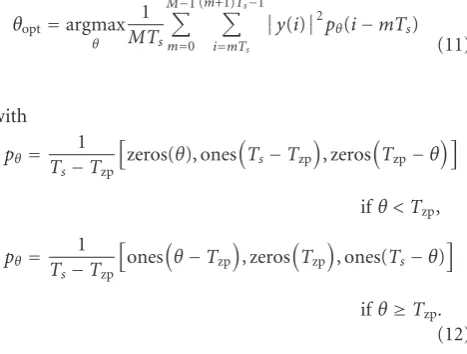
of the difference metric can also be considered to improve the performance at low SNR. The performance of the algorithm improves as long as the denominator falls in the ISI free part Tzp−τmax. In the next section, simulation results compare the autocorrelation metric and the transition metric for CP-OFDM signals. For ZP-OFDM signals, the transition metric can also be compared to a correlation metric-based on a power mask in the time domain. Indeed, knowing the symbol durationTsand the zero-padding durationTzp, the power correlation metric finds the power maskpθ of length
Tsthat maximize the correlation with the received power in
the time domain. Assuming that the received power has been normalized to unity, the power correlation metric is given by
θopt=argmax
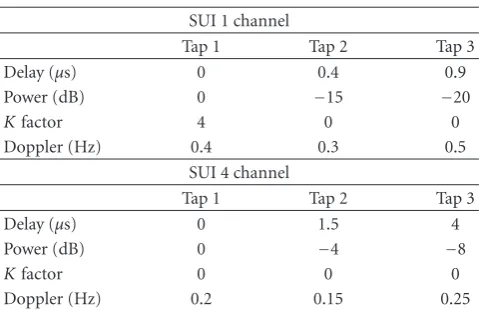
In this section, we evaluate the performance of the presented techniques for WiMAX [13] and WiMedia (ECMA-368) [14] signals on Stanford University Interim (SUI) [15] and IEEE 802.15.3a [16] channel models with various time and frequency offsets. Simulations’ results are performed on 1000 Monte Carlo trials with 10 OFDM symbols. Two types of channels are chosen, the SUI-1 and the CM-1 channels which have LOS components for flat terrain with light tree density and the SUI-4 channel which has NLOS components for hilly terrain with heavy tree density. The different characteristics of SUI channels models are given in Table 1. For the CM channel models we refer to [16]. The parameters used for the WiMAX (CP-OFDM) and the WiMedia (ZP-OFDM) transmitters are given inTable 2. One can notice thatTzp < τmaxfor the CM-1 channel.
Table1: SUI channel models.
SUI 1 channel
Tap 1 Tap 2 Tap 3
Delay (μs) 0 0.4 0.9
Power (dB) 0 −15 −20
Kfactor 4 0 0
Doppler (Hz) 0.4 0.3 0.5
SUI 4 channel
Tap 1 Tap 2 Tap 3
Delay (μs) 0 1.5 4
Power (dB) 0 −4 −8
Kfactor 0 0 0
Doppler (Hz) 0.2 0.15 0.25
Table2: OFDM signal parameters.
Parameters WiMAX WiMedia
Bandwidth 10 MHz 528 MHz
Nc 256 128
Number of samples inTcp,zp 64 37
Tu 25.6μs 242.42 ns
Tcp,zp 6.4μs 70.07 ns
Nb symbols 10 10
Channels SUI-1&4 CM1
τmax 0.9&4μs 113.63 ns
Number of samples inτmax 9&40 60
by [17] (MMSE1 and MC1) considering a summation length Tcp+τmax(therefore requiring the knowledge of the channel delay spread τmax), and the last one being the derivative metric-based technique proposed by [18]. The left figures plot the lock-in probability versus the SNR (the timing offset is simulated as an integer multiple of the receiver’s sampling period). The lock-in probability is defined as the probability of finding the timing offset estimate falling in the ISI free region. Indeed, for CP-OFDM signals, some symbol timming error is tolerable as long as the receiver FFT window starts within the guard interval of the first arriving path that is not affected by the previous symbol due to the multipath channel [17]. The right figures plot the Coefficient Variation Root Mean Square Deviation CV(RMSD) for the timing offset parameterθ, which is defined as
CV(RMSD)=
E(θ−θtrue)2
E[θ]
. (13)
The coefficient variation shows the dispersion of the timing offset parameter from its true value normalized to the mean of the observed value at a particular SNR threshold. One can see that the autocorrelation metric-based technique [1, 3] and the MMSE metric-based technique [4] give better results than the transition metric-based
technique for SUI-1 channels, with 3 dB difference at a lock-in probability of 0.8. As demonstrated lock-inSection 3, for LOS channels the most predominant channel path is the first arrival path and the transition metric is averaged over 10 blocks while the autocorrelation metric is averaged over 10 blocks times the cyclic prefix duration. Although we have considered multiple ratios for the transition metricK =55, the autocorrelation metric-based technique performs better than the transition metric-based technique owing to the exploitation of a larger number of symbols in the same OFDM block. Considering the knowledge of the channel delay spreadτmax, the performance of the MC1 and MMSE1 metric-based techniques [17] improves the SNR of the autocorrelation and MMSE metric-based techniques by 1 dB at a lock-in probability of 0.8. The derivative metric-based technique achieves the lowest SNR (−2 dB) at a lock-in probability of 0.8. However, the right figure shows that the derivative metric-based technique [18] gives the highest CV(RMSD) compared to the MC1 and MMSE1 based techniques. The autocorrelation and MMSE metric-based techniques have lower CV(RMSD) than the derivative metric-based technique. The minimum CV(RMSD) is given by the transition based technique for SNR larger than 8 dB. For SUI-4 channels, the autocorrelation and MMSE metric-based techniques have similar performance compared to the transition metric-based technique for low SNRs. However, the transition metric-based technique gives significantly better results than the autocorrelation and MMSE metric-based techniques when the SNR is larger than 3 dB (we have considered multiple ratios for the transition metric K = 24). In fact, the autocorrelation and MMSE metric-based techniques cannot exceed a lock-in probability of 0.5 even at high SNR because the most predominant channel path is usually not the first arrival path. The MC1, MMSE1 (considering the knowledge of the channel delay spread τmax), and derivative metric-based techniques achieve very good performance compared to the transition metric-based technique for SNRs lower than 13 dB. However, for higher SNRs, the transition metric-based technique outperforms the MC1, MMSE1, and derivative metric-based techniques which cannot exceed a lock-in probability of 0.8. The right figures show that the transition based technique gives closer estimates to the true value of the timing offset than the autocorrelation, MMSE, MC1, MMSE1, and derivative metric-based techniques at almost all SNR ranges for SUI-4 channels.
Figure 4 shows the performance comparison between the power correlation metric-based technique (knowing the symbol duration Ts and the zero-padding duration Tzp, the power correlation metric finds the power mask pθ of
lengthTs that maximizes the correlation with the received
20 15
10 5
0
−5
SNR (dB) Correlation [1,3]
Transition MC1 [17]
MMSE [4] MMSE1 [17] Derivative [18] 0
0.2 0.4 0.6 0.8 1
Lo
ck-i
n
p
ro
babi
li
ty
(a) SUI-1
20 15
10 5
0
SNR (dB) Correlation [1,3]
Transition MC1 [17]
MMSE [4] MMSE1 [17] Derivative [18] 10−4
10−3
10−2
10−1
100
CV
(RMSD)
(b) SUI-1
20 15
10 5
0
−5
SNR (dB) Correlation [1,3]
Transition MC1 [17]
MMSE [4] MMSE1 [17] Derivative [18] 0
0.2 0.4 0.6 0.8 1
Lo
ck-i
n
p
ro
babi
li
ty
(c) SUI-4
20 15
10 5
0
−5
SNR (dB) Correlation [1,3]
Transition MC1 [17]
MMSE [4] MMSE1 [17] Derivative [18] 10−3
10−2
10−1
100
CV
(RMSD)
(d) SUI-4
Figure3: Simulations’ results for CP-OFDM transmission.
timing offset estimate falling in the ISI free region is no longer valid. Therefore, the lock-in probability corresponds to the probability of finding the correct timing offset estimateθtrue. The right figures plot the CV(RMSD) for the timing offset parameter θ. For SUI-1 channels, the power correlation metric-based technique gives better results than the transition metric-based technique with 4 dB difference at lock-in probability of 0.8. As the transition metric is averaged over 10 blocks while the power correlation metric is averaged over 10 blocks times the symbol duration, the power correlation metric performs better than the transition
20 15
10 5
0
−5
SNR (dB) 0
0.2 0.4 0.6 0.8 1
Lo
ck-i
n
p
ro
babi
li
ty
(a) SUI-1
20 15
10 5
0
−5
SNR (dB) 10−5
10−4
10−3
10−2
10−1
100
CV
(RMSD)
(b) SUI-1
20 15
10 5
0
−5
SNR (dB) 0
0.2 0.4 0.6 0.8 1
Lo
ck-i
n
p
ro
babi
li
ty
(c) SUI-4
20 15
10 5
0
−5
SNR (dB) 10−2
10−1
100
CV
(RMSD)
(d) SUI-4
20 15
10 5
0
−5
SNR (dB) Correlation
Transition 0
0.2 0.4 0.6 0.8 1
Lo
ck-i
n
p
ro
babi
li
ty
(e) CM-1
20 15
10 5
0
−5
SNR (dB) Correlation
Transition 10−2
10−1
100
CV
(RMSD)
(f) CM-1
at high SNR because the most predominant channel path is usually not the first arrival path. The transition metric-based technique gives closer estimates to the true value of the timing offset when the SNR is larger than 2 dB. For CM-1 channels, the transition metric-based technique consider multiple ratios K = 10. The power correlation metric-based technique cannot exceed lock-in probability of 0.1 even at high SNR because of the nature of the UWB channels (Saleh-Valenzuela) which produces multipath channels with different clusters. The transition metric-based technique gives higher lock-in probability than the power correlation based technique for SNR higher than 2 dB and gives closer estimates to the true value of the timing offset when the SNR is larger than 5 dB.
4. Conclusion
In this paper, we have described a technique to blindly estimate the timing offset in digital communications sys-tems employing orthogonal frequency division multiplexing (OFDM). The starting position of the OFDM symbols has been estimated without any additional pilots using the cyclic prefix or zero-padding structure of the transmitted signal. This paper has provided an alternative coarse timing offset estimation technique to the autocorrelation-based technique which does not perform well in non-line-of-sight (NLOS) frequency selective channels as well as for ZP-OFDM trans-mission. The results confirm that the transition metric-based technique is able to estimate the timing offset in frequency selective channels with strong multipath components for CP-OFDM and ZP-CP-OFDM transmission.
Acknowledgment
This research work was carried out in the frame of the European FP7 UCELLS project. The scientific responsibility is assumed by its authors.
References
[1] T. Keller and L. Hanzo, “Orthogonal frequency division multiplex synchronisation techniques for wireless local area networks,” inProceedings of the 7th IEEE International Sym-posium on Personal, Indoor and Mobile Radio Communications (PIMRC ’96), vol. 3, pp. 963–967, Taipei, Taiwan, October 1996.
[2] J.-J. van de Beek, M. Sandell, and P. O. B¨orjesson, “ML estimation of time and frequency offset in OFDM systems,”
IEEE Transactions on Signal Processing, vol. 45, no. 7, pp. 1800– 1805, 1997.
[3] M. Speth, S. Fechtel, G. Fock, and H. Meyr, “Optimum receiver design for OFDM-based broadband transmission— part II: a case study,”IEEE Transactions on Communications, vol. 49, no. 4, pp. 571–578, 2001.
[4] M. Speth, F. Classen, and H. Meyr, “Frame synchronization of OFDM systems in frequency selective fading channels,” in
Proceedings of the 47th IEEE Vehicular Technology Conference, vol. 3, pp. 1807–1811, Phoenix, Ariz, USA, May 1997.
[5] T. M. Schmidl and D. C. Cox, “Robust frequency and timing synchronization for OFDM,” IEEE Transactions on Communications, vol. 45, no. 12, pp. 1613–1621, 1997. [6] H. Minn, V. K. Bhargava, and K. B. Letaief, “A robust timing
and frequency synchronization for OFDM systems,” IEEE Transactions on Wireless Communications, vol. 2, no. 4, pp. 822–839, 2003.
[7] H. B¨olcskei, “Blind estimation of symbol timing and carrier frequency offset in wireless OFDM systems,”IEEE Transactions on Communications, vol. 49, no. 6, pp. 988–999, 2001. [8] B. Park, H. Cheon, E. Ko, C. Kang, and D. Hong, “A
blind OFDM synchronization algorithm based on cyclic correlation,”IEEE Signal Processing Letters, vol. 11, no. 2, part 1, pp. 83–85, 2004.
[9] A. J. Al-Dweik, “A novel non-data-aided symbol timing recovery technique for OFDM systems,”IEEE Transactions on Communications, vol. 54, no. 1, pp. 37–40, 2006.
[10] R. Mo, Y. H. Chew, T. T. Tjhung, and C. C. Ko, “A new blind joint timing and frequency offset estimator for OFDM systems over multipath fading channels,”IEEE Transactions on Vehicular Technology, vol. 57, no. 5, pp. 2947–2957, 2008. [11] T. Fusco and M. Tanda, “ML-based symbol timing and
fre-quency offset estimation for OFDM systems with noncircular transmissions,”IEEE Transactions on Signal Processing, vol. 54, no. 9, pp. 3527–3541, 2006.
[12] V. Le Nir, T. Van Waterschoot, M. Moonen, and J. Duplicy, “Blind CP-OFDM and ZP-OFDM parameter estimation in frequency selective channels,” Eurasip Journal on Wireless Communications and Networking, vol. 2009, Article ID 315765, 10 pages, 2009.
[13] 802.16e-2005, “Air interface for fixed and mobile broadband wireless access systemsAmendment for physical and medium access control layers for combined fixed and mobile operation in licensed band,” 2005,IEEE Standard.
[14] Standard ECMA-368, “High Rate Ultra Wideband PHY and MAC standard,” 2007, http://www.ecma-interna-tional.org/publications/files/ECMA-ST/ECMA-368 .pdf. [15] IEEE 802.16 Broadband Wireless Access Working Group,
“Channel models for fixed wireless application,” 2003,IEEE 802.16a-03/01.
[16] J. Foerster, “IEEE 802.15.3a Channel modelling sub-committee,” Report Final IEEE P802.15 Working Group for WPAN, 2002.
[17] D. Lee and K. Cheun, “Coarse symbol synchronization algorithms for OFDM systems in multipath channels,”IEEE Communications Letters, vol. 6, no. 10, pp. 446–448, 2002. [18] C. Williams, S. McLaughlin, and M. A. Beach, “Robust OFDM