R E S E A R C H
Open Access
Alternate-continuous-control systems
with double-impulse
Xiang Hu
1*, Hongjuan Wu
1, Yuming Feng
2and Jiang Xiong
1*Correspondence:
[email protected] 1College of Computer Science and
Engineering, Chongqing Three Gorges University, Wanzhou, Chongqing 404100, P.R. China Full list of author information is available at the end of the article
Abstract
We propose a mathematical model that can control the stability of an unstable system. Periodicity is an important feature of the system. We add a continuous control to the first half of each period of the system and then add an impulse controlJ1 at the 1/2 period time. Again, we do not control the rest half of each period of the system. Finally, we add an impulse controlJ2 at the end of each period of the system. The system is called analternate-continuous-control system with double-impulse. We study the stability of the current system by constructing the Lyapunov function. Using the proposed method, we can control the Chua oscillator. The system has two impulse inputs per period, which is more in line with natural law than the system that only has a single-impulse input. Therefore, the system proposed in this paper is more practical than current mature control systems.
Keywords: alternate control; continuous control; double-impulse; Lyapunov function; index stability; Chua’s oscillator; memristors
1 Introduction
At present, the stability of the nonlinear system control methods are: intermittent control [–], adaptive fuzzy control [, ], alternate control [, ], impulsive control [–], nonimpulsive control, continuous control, and so on [–] and so on. Our goal is a good system control. We will design some better control systems by studying the system control methods that are currently commonly used.
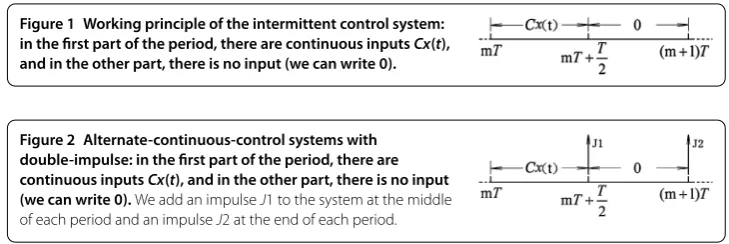
To make a nonlinear system stable, in this paper, first of all, each system period is divided into two equal parts. In the first part of the period, there are continuous inputsCx(t), and in the other part, there is no input. We call it intermittent control system. Figure provides the working principles of the intermittent control system. Next, we can add the impulsive control in the intermittent control system to control its better stability. We add an in-put of the impulsiveJ to the system at the middle of each period. Similarly, we add an impulseJ at the end of each period of the system. In this way, there are a continuous controlCx(t) and impulsive controlsJ andJ in each period of the system. We call it an alternate-continuous-control system with double-impulse. Figure provides the working principles ofalternate-continuous-control systems with double-impulse. The mathemat-ical model proposed in this paper can be applied in many fields. In the medmathemat-ical field, it can be used in large-scale surgery to control patient’s life characteristics. In the field of electronics, it can be used to control a variety of chaotic circuits, such as circuits that
Figure 1 Working principle of the intermittent control system: in the first part of the period, there are continuous inputsCx(t), and in the other part, there is no input (we can write 0).
Figure 2 Alternate-continuous-control systems with double-impulse: in the first part of the period, there are continuous inputsCx(t), and in the other part, there is no input (we can write 0).We add an impulseJ1 to the system at the middle of each period and an impulseJ2 at the end of each period.
corporate memristors. In the field of intelligent robots, it can be used to control the robot walking gait in real time. It can also play a great advantage in the field of environmental pollution control [–].
In this paper, we constructalternate-continuous-control systems with double-impulse. We investigate the stability of the systems and get an exponential stability criterion in terms of a set of linear matrix inequalities. Some mathematical proofs make our conclu-sions reliable. At last, the Chua oscillator is controlled by using the results obtained.
The rest of this paper is organized as follows. In Section , we introduce some basic mathematical knowledge and mathematical symbols about system control, and two com-monly used mathematical lemmas will be involved. In Section , we give the results of this paper and an exponential stability criterion, the main theory of this paper. In Section , we use this conclusion to control the Chua oscillator. Lastly, we give a summary of this paper.
2 Problem formulation and preliminaries A classic nonlinear system can be described as
⎧ ⎨ ⎩ ˙
x(t) =Hx(t) +f(x(t)) +u(t),
x(t) =x,
()
wherex∈Rnis a state vector,H∈Rn×nis a constant matrix,f :Rn→Rnis a continuous nonlinear function satisfyingf() = ; we assume that there exists a diagonal matrixL=
diag(a,a, . . . ,an)≥ such thatf(x)≤xTLxfor allx∈Rn.Hx(t) is the linear part of
the system,f(x(t)) is the nonlinear interference, andu(t) is the external input to system (). To stabilize the origin of system () by means ofalternate-continuous-control systems with double-impulse, we impose two kinds of control, that is, assuming that the period of the system isT andmis a nonnegative integer, frommTtomT+T, we setu(t) =Cx(t), whereC∈Rn×nis a constant matrix, at timemT+T, an impulseJ given, frommT+T to (m+ )T, no input to the system is given, and an impulseJ is given to the system at time (m+ )T.
So system () can be redefined as ⎧
⎪ ⎪ ⎪ ⎪ ⎪ ⎪ ⎪ ⎪ ⎨ ⎪ ⎪ ⎪ ⎪ ⎪ ⎪ ⎪ ⎪ ⎩ ˙
x(t) =Hx(t) +f(x(t)) +Cx(t), mT<t<mT+T,
x(t) =x(t–) +Jx(t–), t=mT+T
,
˙
x(t) =Hx(t) +f(x(t)), mT+T <t< (m+ )T,
x(t) =x(t–) +Jx(t–), t= (m+ )T,
x(t) =x, t= ,
whereC,J,J∈Rn×nare constant matrices, andT> denotes the period of control. We will use the following two mathematical lemmas.
Lemma (Sanchez and Perez []) For any three real matrices,,of appropriate
dimensions and a scalar≥such that <=T,we have the following inequality:
T+T≤T+–T– . ()
Lemma (Boyd et al. []) The LMI
W(x) Z(x) ZT(x) R(x)
> ,
whereW(x) =WT(x),R(x) =RT(x), andZ(x) depend affinely onx, is equivalent to
R(x) > , W(x) –Z(x)R–(x)ZT(x) > .
We denote byλm(D),λM(D), andDTthe minimum eigenvalue, the maximum eigenvalue, and the transpose of a square matrixD, respectively. The Euclidean norm of the vectorx is denotedx. The matrix norm · is also referred to the Euclidean norm. We will useD> to display a symmetric positive definite matrixD,D< to display a symmetric negative definite matrixD,D≤ to display a symmetric seminegative definite matrixD, andD≥ to display a symmetric semi-positive definite matrixD. We denotef(x(a–)) =
limt→af(x(t)).
3 Main results
Theorem Suppose that a symmetric and positive definite matrix D∈Rn×nand positive
scalar constants h> ,h> ,> ,and> satisfy the following conditions:
() DH+HTD+DC+CTD+
D+– L+hD≤,
() DH+HTD+
D+–L–hD≤,
() hT –hT –lnλ–lnλ> ,
whereλ=λM(D–(I+J)TD(I+J)),λ=λM(D–(I+J)TD(I+J)).Then the origin of system()is exponentially stable.
Proof First, we construct the Lyapunov function
Vx(t) =xT(t)Dx(t), ()
so that
λm(D)x(t)
≤Vx(t) ≤λM(D)x(t)
. ()
IfmT<t<mT+T, then by (), (), and () we get
˙
V(x) = xTD˙x
= xTDHx+ xTDf(x) + xTDCx
=xT[DH+ DC]x+ xTDf(x)
=xTDH+HTD+DC+CTDx+ xTDf(x)
≤xTDH+HTD+DC+CTDx
+xTDx+–xTLx
=xTDH+HTD+DC+CTD+D+–L
x
= –hV(x) +xT
DH+HTD+DC+CTD
+D+–L+hD
x
≤–hV(x),
whereDH+HTD+DC+CTD+
D+–L+hD≤. We get
Vx(t) ≤Vx(mT)+ exp–h
(t–mT) , ()
wheremT<t<mT+T. Ift=mT+T
, then we get
V(x)|t=mT+T
=
xt– +Jxt– TDxt– +Jxt–
=xt– T(I+J)TD(I+J)xt–
≤λV
xt– . ()
IfmT+T <t< (m+ )T, then we get
D+V(x) = xTDx˙
= xTDHx+f(x)
= xTDHx+ xTDf(x)
≤xTDH+HTDx+xTDx+–xTLx
=xTDH+HTD+D+–L
x
=hV(x)
+xTDH+HTD+D+–L–hD
x
≤hV(x),
whereDH+HTD+
D+–L–hD≤. We get
Vx(t) ≤λV
x
mT+T
–
exp
h
t–mT–T
, ()
Ift= (m+ )T, then we get
Subcase. If T+T ≤t< T, then we get
≤V(x)exp
which ends the proof.
Corollary As a consequence of Lemma,the first two conditions of Theoremare
equiv-alent to the following two LIMs:
Studying system examples, we can define the original and dimensionless form of Chua’s oscillator [] as follows:
⎧
whereωandγ are two parameters,g(x) is a piecewise linear characteristic of Chua’s diode. It can be defined by
g(x) =bx+ .(a–b)|x+ |–|x– | , ()
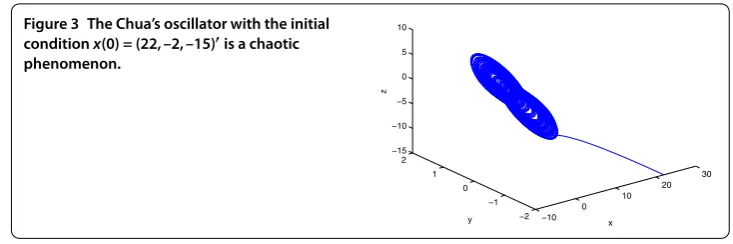
Figure 3 The Chua’s oscillator with the initial conditionx(0) = (22, –2, –15)is a chaotic phenomenon.
Next, we choose the parameters ω= ., γ = ., a= –., and b = –., which make Chua’s circuit () chaotic []. Figure shows that Chua’s oscilla-tor with the initial conditionx() = (, –, –)is a chaotic phenomenon.
We can redefine system () as follows:
˙
x=Hx+f(x), ()
where
H= ⎡ ⎢ ⎣
–ω–ωb ω
–
–γ
⎤ ⎥ ⎦
and
f(x) = ⎡ ⎢ ⎣
–.ω(a–b)(|x+ |–|x– |)
⎤ ⎥ ⎦.
So we get
f(x) = .ω(a–b)(x+ )+ (x– )– (x+ )(x– )
= .ω(a–b)x+ –x–
= ⎧ ⎨ ⎩
ω(a–b), x > ,
ω(a–b)x
, x≤
≤ω(a–b)x.
Thus we setL=diag(ω(a–b), , ) and choose
C=diag(–, –, –),
J = ⎡ ⎢ ⎣
– –. . . . .
⎤ ⎥ ⎦,
J = ⎡ ⎢ ⎣
– –. . . . .
Figure 4 Time response curves of Chua’s oscillator withalternate-continuous-control system with double-impulse.
WithT= ., solving LMIs () and () and the inequalityhT–hT–lnλ–lnλ> ,
we obtain a feasible solution
= ., = ., h= , h= ,
and
D= ⎡ ⎢ ⎣
. . . . . –. . –. .
⎤ ⎥ ⎦.
Thus, by Theorem we know that the origin of system () becomes exponentially sta-ble. The time response curves of Chua’s oscillator with the proposed method is shown in Figure .
5 Conclusions
We proposed a new model of a control system named analternate-continuous-control sys-tem with double-impulse. The introduction of an impulse input has played a positive role in the stability control of the system. Theorem gives stability criteria of the current new system control. Moreover, the chaotic Chua circuit can be controlled by the new method. Through the control method of this paper, we can control most of the nonlinear systems. The method can be used in physics, electronics, robotics, and other fields. Later, we can design more control methods to stabilize nonlinear systems by combining impulse control and intermittent control.
Funding
This work is supported by Research Foundation of Chongqing Municipal Education Commission (KJ1710253) and Chongqing Municipal Key Laboratory of Institutions of Higher Education (Grant No. C16).
Competing interests
The authors claim that they have no competitive interest.
Authors’ contributions
YF has provided the main idea of the paper. XH has proved the main results and prepared the paper by LATEX. HW and JX have provided some figures. All authors read the paper and approved the final version.
Author details
1College of Computer Science and Engineering, Chongqing Three Gorges University, Wanzhou, Chongqing 404100, P.R.
Publisher’s Note
Springer Nature remains neutral with regard to jurisdictional claims in published maps and institutional affiliations.
Received: 22 May 2017 Accepted: 26 August 2017
References
1. Chen, Q, Wang, X, Wan, H, Yang, R: A logic circuit design for perfecting memristor-based material implication. IEEE Trans. Comput.-Aided Des. Integr. Circuits Syst.36(2), 279-284 (2017)
2. Li, C, Feng, G, Liao, X: Stabilization of nonlinear systems via periodically intermittent control. IEEE Trans. Circuits Syst. II, Express Briefs54(11), 1019-1023 (2007)
3. Huang, J, Li, C, He, X: Stabilization of a memristor-based chaotic system by intermittent control and fuzzy processing. Int. J. Control. Autom. Syst.11(3), 643-647 (2013)
4. Huang, J, Li, C, Han, Q: Quasi-synchronization of chaotic neural networks with parameter mismatch by periodically intermittent control. In: Computer Science and Information Engineering, 2009 WRI World Congress on, Los Angeles, California, USA, 2009, March 31-April 2 (2009)
5. Huang, T, Li, C, Liu, X: Synchronization of chaotic systems with delay using intermittent linear state feedback. Chaos
18, 033122 (2008)
6. Yang, X, Feng, Z, Feng, J, Cao, J: Synchronization of discrete-time neural networks with delays and Markov jump topologies based on tracker information. Neural Netw.85, 157-164 (2017)
7. Yang, X, Cao, J, Liang, J: Exponential synchronization of memristive neural networks with delays: interval matrix method. IEEE Trans. Neural Netw. Learn. Syst. doi:10.1109/TNNLS.2016.2561298
8. Yin, S, Yu, H, Shanazi, R, Haghani, A: Fuzzy adaptive tracking control of constrained nonlinear switched stochastic pure-feedback systems. IEEE Trans. Cybern. (2017). doi:10.1109/TCYB.2016.2521179
9. Chen, L, Liu, W, Hou, Z, Huang, T, Yu, J, Tan, M: An adaptive Takagi-Sugeno fuzzy model based predictive controller for piezoelectric actuator. IEEE Trans. Ind. Electron.64, 3048-3058 (2017)
10. Wang, J, Wu, H, Huang, T: Passivity-based synchronization of a class of complex dynamical networks with time-varying delay. Automatica56, 105-112 (2015)
11. Huang, T, Li, C, Duan, S, Starzyk, JA: Robust exponential stability of uncertain delayed neural networks with stochastic perturbation and impulse effects. IEEE Trans. Neural Netw. Learn. Syst.23(6), 866-875 (2012)
12. Feng, Y, Li, C, Huang, T: Sandwich control systems with impulse time windows. Int. J. Mach. Learn. Cybern. (2016). doi:10.1007/s13042-016-0580-5
13. Feng, Y, Li, C, Huang, T: Periodically multiple state-jumps impulsive control systems with impulse time windows. Neurocomputing193, 7-13 (2016)
14. Feng, Y, Yu, J, Li, C, Huang, T, Che, H: Linear impulsive control system with impulse time windows. J. Vib. Control23(1), 111-118 (2017)
15. Feng, Y, Tu, D, Li, C, Huang, T: Uniformly stability of impulsive delayed linear systems with impulse time windows. Ital. J. Pure Appl. Math.34, 213-220 (2015)
16. Li, C, Zhou, Y, Wang, H, Huang, T: Stability of nonlinear systems with variable-time impulses, B-equivalence method. Int. J. Control. Autom. Syst.
17. Yang, Z, Xu, D: Stability analysis and design of impulsive control systems with time delay. IEEE Trans. Autom. Control
52(8), 1448-1454 (2007)
18. Yang, X, Yang, Z, Nie, X: Exponential synchronization of discontinuous chaotic systems via delayed impulsive control and its application to secure communication. Commun. Nonlinear Sci. Numer. Simul.19, 1529-1543 (2014) 19. Yang, X, Cao, J, Qiu, J: pth moment exponential stochastic synchronization of coupled memristor-based neural
networks with mixed delays via delayed impulsive control. Neural Netw.65, 80-91 (2015)
20. Yang, X, Lu, J: Finite-time synchronization of coupled networks with Markovian topology and impulsive effects. IEEE Trans. Autom. Control61(8), 2256-2261 (2016)
21. He, X, Huang, T, Yu, J, Li, C, Li, C: An inertial projection neural network for solving variational inequalities. IEEE Trans. Cybern.47(3), 809-814 (2017)
22. Li, H, Liao, X, Huang, T, Zhu, W: Event-triggering sampling based leader-following consensus in second-order multi-agent systems. IEEE Trans. Autom. Control60(7), 1998-2003 (2015)
23. Li, H, Chen, G, Huang, T, Dong, Z, Zhu, W, Gao, L: Event-triggered distributed average consensus over directed digital networks with limited communication bandwidth. IEEE Trans. Cybern.46(12), 3098 (2016)
24. Li, H, Chen, G, Huang, T, Dong, Z: High performance consensus control in networked systems with limited bandwidth communication and time-varying directed topologies. IEEE Trans. Neural Netw. Learn. Syst.28(5), 1043 (2017) 25. Li, H, Chen, G, Liao, X, Huang, T: Quantized data-based leader-following consensus of general discrete-time
multi-agent systems. IEEE Trans. Circuits Syst. II, Express Briefs63(4), 401-405 (2016)
26. Li, H, Liao, X, Chen, G, Dong, Z, Hill, D, Huang, T: Event-triggered asynchronous intermittent communication strategy for synchronization in complex networks. Neural Netw.66, 1-10 (2015)
27. Li, H, Liao, X, Huang, T, Zhu, W, Liu, Y: Second-order globally nonlinear consensus in multi-agent networks with random directional link failure. IEEE Trans. Neural Netw. Learn. Syst.26(3), 565-575 (2015)
28. He, X, Li, C, Huang, T, Li, C, Huang, J: A recurrent neural network for solving bilevel linear programming problem. IEEE Trans. Neural Netw. Learn. Syst.25(4), 824-830 (2014)
29. Morimoto, T, Hawkes, E, Okamura, A: Design of a compact actuation and control system for flexible medical robots. IEEE Rob. Autom. Lett.2(3), 1579-1585 (2017)
30. Zhang, L, Li, H: Evaluation system of urban environmental pollution based on the principal component analysis. In: 2016 International Conference on Smart City and Systems Engineering (ICSCSE)
31. Yu, D, Zheng, C, Iu, Ha, Fernando, T, Chua, L: A new circuit for emulating memristors using inductive coupling. IEEE Access5, 1284-1295 (2017)
32. Huang, T, Li, C, Yu, W, Chen, G: Synchronization of delayed chaotic systems with parameter mismatches by using intermittent linear state feedback. Nonlinearity22, 569-584 (2009)
33. Li, C, Liao, X, Yang, X, Huang, T: Impulsive stabilization and synchronization of a class of chaotic delay systems. Chaos
34. Feng, Y, Zou, L, Tu, Z: Stability analysis for a class of nonlinear impulsive switched systems. J. Nonlinear Sci. Appl.10, 4544-4551 (2017)
35. Sanchez, E, Perez, J: Input-to-state stability (ISS) analysis for dynamic NN. IEEE Trans. Circuits Syst. I, Regul. Pap.46(11), 1395-1398 (1999)
36. Boyd, S, El Ghaoui, L, Feron, E, Balakrishnan, V: Linear Matrix Inequalities in System and Control Theory. SIAM, Philadephia (1994)