International Journal of Computer Science and Mobile Computing
A Monthly Journal of Computer Science and Information Technology
ISSN 2320–088X
IMPACT FACTOR: 6.017IJCSMC, Vol. 8, Issue. 2, February 2019, pg.123 – 129
AN ANDROID BASED
INTELLIGENT ROBOT
FOR BORDER SECURITY
Dr. B. Ramesh
1; Yuvaraj B V
1; Shankarnag M
1; Pavan M K
1; Satwik J
11
(Computer Science, Malnad College of Engineering, Hassan, India)
ABSTRACT: Trespassers cross our borders unknowingly. It is not possible for our soldiers to watch the borders at each and every moment. By using this intelligent robot, we can detect the entry of trespassers in the borders. Android Based Autonomous Intelligent robot for Border Security, which identifies trespassers using PIR motion sensor, alerts security personnel by E-mail using GSM and captures image of trespassers using Raspberry Pi camera in android device and mail this image to corresponding email ID using android based application.
Keywords: Trespassers, Autonomous, Robot, Border security, GSM, raspberry-pi.
1. INTRODUCTION
The Indian border military force is facing a huge destruction from Pakistan, China, Myanmar, Sri-lanka and Bangladesh. Tensions rise between nuclear neighbors after deadly raid on army base close to disputed border with Pakistan. Highly trained militants are on essentially suicide missions – died in the three-hour assault on the base at Uri. Seven Indian soldiers killed in attack on army base, Nagrota. In Kashmir, near the militarized “line of control” that divides Kashmir from the Pakistan-controlled side. The Pathankot attack was a terrorist attack committed on 2 January 2016 by a heavily armed team which attacked the Pathankot air force station, part of the western air command of the Indian air force. The recent news is almost many soldiers were killed by Pakistani army and merely about soldiers injured, some critically.
An android-based intelligent Robot security system, [1] detects trespassers using face recognition algorithm. System can detect a trespasser using intruder detection subsystem which relies on invariant face recognition and it tracks the trespasser using intruder tracking subsystem based on streaming technology.
Intruder detection subsystem captures images periodically when it detects trespasser in a secure area and verifies whether the object detected is human using invariant face recognition algorithm then robot will alert the security guards through alert signal using internet. The security guards use the images in raspberry pi camera to control Robot motion and to recognize trespasser.
Android Based Autonomous Intelligent Robot for Border Security, which identifies trespassers using PIR motion sensor, alerts security personnel by E-mail using GSM and captures image of trespassers using Raspberry Pi camera in android device and mail this image to corresponding email ID using android based application [1].
2. LITERATURE SURVEY
One crucial application of intelligent robotic systems is remote surveillance using a security robot. A fundamental need in security is the ability to automatically verify an intruder into a secure or restricted area, to alert remote security personnel, and then to enable them to track the intruder. In this article, an Internet-based security robot system [1]. The face recognition approach possesses “invariant” recognition characteristics, including face recognition where facial expressions, viewing perspectives, three-dimensional poses, individual appearance, and lighting vary and occluding structures are present. The experiment uses a33.6-kb/s modem Internet connection to successfully remotely control a mobile robot, proving that the streaming technology-based approach greatly improves the “sensibility” of robot teleoperation. This improvement ensures that security personnel can effectively and at low cost use the Internet to remotely control a mobile robot to track and identify a potential intruder.
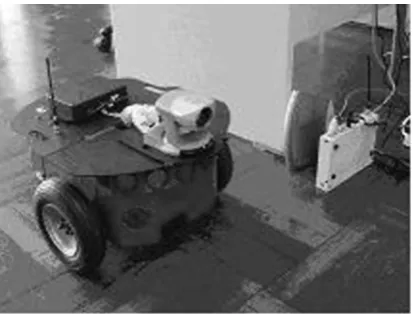
Figure 2.1 P3-DX8 mobile robot and its accessories.
The conventional border patrol systems suffer from intensive human involvement. Recently, unmanned border patrol systems employ high-tech devices, such as unmanned aerial vehicles, unattended ground sensors, and surveillance towers equipped with camera sensors. However, any single technique encounters inextricable problems, such as high false alarm rate and line-of-sight-constraints. There lacks a coherent system that coordinates various technologies to improve the system accuracy. In this paper, the concept of Border Sense [2], a hybrid wireless sensor network architecture for border patrol systems, is introduced. Border Sense utilizes the most advanced sensor network technologies, including the wireless multimedia sensor networks and the wireless underground sensor networks. The framework to deploy and operate Border Sense is developed. Based on the framework, research challenges and open research issues are discussed.
We have presented the design and implementation of a surveillance robot with hopping capabilities for home security. The proposed robot is capable of negotiating cluttered home environments by a hybrid rolling-hopping locomotion mode. It adopts the ZigBee protocol for wireless communication [3] and therefore can be added to a ZigBee-based home control network as a mobile video sensor node.
and law-enforcement robot architectures. In the survey, an attempt is made to explain the importance of intelligent methodologies, and their emergent effects in security tasks. The major findings of this analysis illustrate the minor contribution of intelligent architectures in crime-fighting robots, and what constitutes an intelligent security robot.
Today for real time applications it is important to monitor system in efficient way which puts limit in terms of accuracy and repeatability if a human is employed on plant to do this task. The traditional automated monitoring (surveillance) systems are wired and larger in size. It mostly uses only PC as a surveillance terminal, which works efficiently but does not give portability. The proposed system describes an intelligent Monitoring System which is based on android platform gives facility to access monitored parameters quickly on mobile handsets anywhere from the world. As the mobility provided by the mobile phones and the application supportability given by the android system [5] over 2G and 3G network there are infinite possibilities to expand monitoring system.
The Video Surveillance System architecture to improve surveillance applications which are best on the use of the service-oriented paradigm, with Android Smartphone’s as user terminal. It increases the flexibility of the system. This system allows to access the videos from different localization anywhere and anytime. This also presents the content sharing, which is based on peer to peer technology. In this, mobile will be considered as one peer of the network & the PC will be considered as the other peer of the network. Using internet connection at both the ends, we can connect two discrete system in a network & peer to peer networking is possible. This system is used for applications like Uploading or downloading the files which is there in a remote computer, Storing the files and images in a remote computer through the mobile phone and also, we can control remote computer by using mobile phone [6].
Many kinds of applications of the networked intelligent robot have already been designed and we believe that the networked intelligent robot will ultimately play an important part in our daily lives and Internet security services will no doubt be one direction for future developments. We address these issues by proposing an android-based intelligent robot for security system.
3. WORKING PRINCIPLE OF ANDROID BASED INTELLIGENT ROBOT
Basic principle of the system is waiting for the reflected signal from the intruder. To rotate the Robot, DC motor is used. Two-geared DC motor is used for the movement of Robot. The movement of Robot is enabled by our mobile phone.
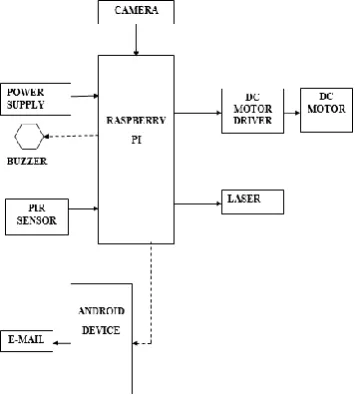
Here we are using an android device for controlling the movement of ROBOT and the Raspberry Pi camera for video surveillance. Then a PIR sensor is used for detecting the trespasser. The sensor is activated 40secs after the activation of the device, as it wants to cope up with the surroundings. If an intruder is detected, the output of PIR sensor is being sent to the Raspberry Pi and then the Wi-Fi module in the Raspberry Pi sends an information signal to the control room. The following figure will illustrate the block diagram of android based intelligent robot
Figure 3.1 Block diagram of military robot
after the activation of the device, as it wants to cope up with the surroundings. If an intruder is detected, the output of PIR sensor is being sent to the Raspberry Pi and then the Wi-Fi module in the Raspberry Pi sends an information signal to the control room.
If an intruder is detected a laser gun is provided for further purposes. The movement of laser can be controlled as per the directions given by the control room. If necessary, laser gun can be used for shooting or firing the intruder
Software and Hardware used Raspberry Pi
Raspberry Pi can be used to power robots, they can be strung together to create digital networks, and they have even been sent to near space. So, there is no mistaking that there is a lot that one can do with a Raspberry Pi board.
DC MOTOR DRIVER
The Device is a monolithic integrated high voltage, high current four channel driver designed to accept standard DTL or TTL logic levels and drive inductive loads (such as relays solenoids, DC and stepping motors) and switching power transistors. To simplify two bridges each pair of channels is equipped with an enable input is used. A separate input is provided for the logic, allowing operations at lower voltage and internal clamp diodes are included.
This device is suitable for use in switching applications at frequency up to 5 KHz. The L293D is assembled in a16 lead plastic package which has 4 center pins connected together and used for heat sinking. Since L293D is an integrated circuit motor driver it can be used for simultaneous bidirectional control of two small motors. L293D is limited to 600mA.
Operation of PIR Sensor
Pyroelectric devices, such as the PIR sensor, have elements made of a crystalline material that generates an electric charge when exposed to infrared radiation. The changes in the amount of infrared striking the element change the voltages generated, which are measured by an on-board amplifier. The device contains a special filter called a Fresnel lens, which focuses the infrared signals onto the element. As the ambient infrared signals change rapidly, the on-board amplifier trips the output to indicate motion.
Laser
For accurate target at the aim user can use this LASER. It is light emitting diode which generate long distance red laser beam. It is attached with machine gun so that it will move at machine gun’s direction.
In our project LASER is used for to point the accurate target. All sensor requires some laser light to return to them from the target surface in order to function. The amount of light needed is a measure of the sensitivity of the device.
In general, the most sensitive devices are the costliest, and accurate measurement at high sample rates requires stronger reflection than for lower sample rates. For diffuse targets, the higher the reflectance of the target, the better a sensor’s performance.
ADVANCED IP SCANNER
Advanced IP Scanner is a reliable and free network scanner to analyze LAN. The program shows all network devices, gives you access to shared folders, provides remote control of computers (via RDP and Radmin), and can even remotely switch computers off. It is easy to use and runs as a portable edition. Advanced IP Scanner 2.5 is a free, fast and powerful network scanner with a user-friendly interface. In a matter of seconds, Advanced IP Scanner can locate all the computers on your wired or wireless local network and conduct a scan of their ports. The program provides easy access to various network resources, such as HTTP, HTTPS, FTP and shared folders. It also enables you to detect all the IP addresses on your Wi-Fi network.
The remote PC shutdown feature lets you shut down any remote computer or group of computers running Windows. You can also wake these machines up remotely using Advanced IP Scanner, if their network cards support the Wake-On-LAN function.
Putty
Putty is a very useful application that can be used to connect to serial ports and Secure Shell (SSH) to Raspberry Pi's. Putty is mostly used on Windows to connect to remote devices but it can also run on a Raspberry Pi.
Putty is a client program for the SSH, Telnet and Rlogin network protocols. These protocols are all used to run a remote session on a computer, over a network. Putty implements the client end of that session: the end at which the session is displayed, rather than the end at which it runs.
In really simple terms: you run Putty on a Windows machine, and tell it to connect to (for example) a Unix machine. Putty opens a window. Then, anything you type into that window is sent straight to the Unix machine, and everything the Unix machine sends back is displayed in the window.
HARDWARE DESCRIPTION
The proposed system consists of components like Raspberry Pi, Raspberry Pi Camera, DC motor, DC motor driver, PIR sensor, Buzzer, Laser, Android device and Power supply.
RASPBERRY PI
The Raspberry Pi is a small, inexpensive, and programmable computer created by the Raspberry Pi Foundation. One of the foundation's co-founders, EbenUpton, has to say about the Raspberry Pi board's creation.
In simplest terms, the Raspberry Pi 3 is a computer. It's also an educational tool that has grown to be loved by all kinds of people with all levels of skill. Like a personal computer, a Raspberry Pi can have a screen for output and a mouse and keyboard for user input. It runs an operating system like Mac's OS and Microsoft's Windows 10. You can download applications to it like a word processor or play games on it like Mine craft. The name Raspberry Pi itself gives a sneak peek into what the board is about. The naming of Raspberry Pi comes after the naming of computer companies and products after fruit. That’s how the Raspberry half was born. The Pi half comes from Python, a programming language.
Raspberry Pi can be used to power robots, they can be strung together to create digital networks, and they have even been sent to near space. So, there is no mistaking that there is a lot that one can do with a Raspberry Pi board.
Figure 4.1Raspberry Pi Board
PARTS OF RASPBERRY PI
Figure 4.2 Parts of Raspberry Pi
Power source
The Raspberry Pi is a device which consumes 700mA or 3W of power. It is powered by a Micro USB charger or the GPIO header. Any good smart phone charger will do the work of powering the Raspberry Pi.
PIR SENSOR
view. It only has one output pin and another two pins is connected to 5V and GND separately. Apparent motion is detected when an infrared emitting source with one temperature, such as human body, passes in front of source with another temperature, such as wall. The unit output is high whenever there is motion detected. If the motion is continuous, the output remains high.
After motion stops, the output remains high for a few seconds (depend on the variable resistor adjusted). It will remain high for longer if H from the jumper is selected. For this paper, the resistant of variable resistor is adjusted to as low as possible so that the output of the sensor would not remain high for long time after motion stops.
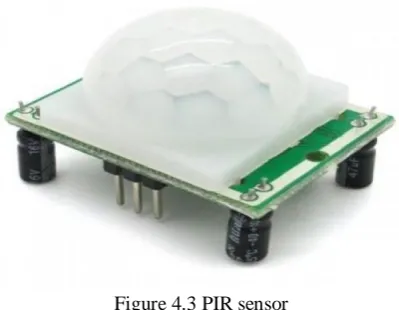
The following figure shows the typical PIR sensor
Figure 4.3 PIR sensor
A Passive Infrared sensor (PIR sensor) is an electronic device that measures infrared (IR) light radiating from objects in its field of view. PIR sensors are often used in the construction of PIR-based motion detectors. Apparent motion is detected when an infrared source with one temperature, such as a human, passes in front of an infrared source with another temperature, such as a wall. All objects emit what is known as black body radiation. It is usually infrared radiation that is invisible to the human eye but can be detected by electronic devices designed for such a purpose. The term passive in this instance means that the PIR device does not emit an infrared beam but merely passively accepts incoming infrared radiation.
Infrared radiation enters through the front of the sensor, known as the sensor face. At the core of a PIR sensor is a solid-state sensor or set of sensors, made from an approximately 1/4-inch square of natural or artificial pyroelectric materials. The sensor is often manufactured as part of an integrated circuit and may consist of one (1), two (2) or four (4) 'pixels' of equal areas of the pyroelectric material. Pairs of the sensor pixels may be wired as opposite inputs to a differential amplifier. In such a configuration, the PIR measurements cancel each other so that the average temperature of the field of view is removed from the electrical signal; an increase of IR energy across the entire sensor is self-cancelling and will not trigger the device. This allows the device to resist false indications of change in the event of being exposed to flashes of light or field-wide illumination. (Continuous bright light could still saturate the sensor materials and render the sensor unable to register further information.) At the same time, this differential arrangement minimizes common-mode interference, allowing the device to resist triggering due to nearby electric fields. However, a differential pair of sensors cannot measure temperature in that configuration and therefore this configuration is specialized for motion detectors. The human body radiates infrared waves with wavelengths of 8 to 12 micrometers. Any movement by a person leads to a change in the amount of infrared energy which a sensor can detect within its range. The PIR sensor reacts to this change in infrared energy and provides a low-frequency, small amplitude signal. This signal can be amplified and decoded using a ST7Lite05 microcontroller.
The sensor can sense the change in the amount of infrared energy within small distances, approximately up to 10 inches. For detecting movements at longer distance, infrared radiation has to be focused. This focusing is done by a Fresnel lens. A Fresnel lens divides the whole area into different zones. Any movement between zones leads to a change in the IR (infrared) energy received by the sensor. There are different types of Fresnel lenses depending on the range (distance) and coverage angle. For example, volumetric lenses and curtain lenses etc.
APPLICATIONS
a) The use of combat robots significantly affects the combat procedures requiring the development of new methods in the war as a result of technological progress.
b) The autonomous systems are less vulnerable as a result of their self-reliance and full compatibility (there is no need for managing personnel, communications channels, and other supporting and auxiliary systems). c) Their efficiency significantly enhanced by their cumulative capabilities of swarm mode application and a
d) Provides an outstanding level of camouflage, deployment time, velocity, detection, accuracy and resistance to environmental factors.
e) Only systems with similar potential capable an effective defence against them, which it must necessaril y raise the cyber warfare as the most effective option.
f) It is typical of this category of military equipment, they possess so abilities that are far beyond the possibilities of human perception, so the chances of people's fight against robots significantly disproportionate and the result is doubtful.
g) This is one of the main technical and technological solutions concerning to our current knowledge, which is probably relatively easier to implement, 28 which gives you the best chance that the most important quality characteristics of military operations can be met, such as: professional efficiency, reliability, precision, speed, timing, security, and mission success by all these.
ADVANTAGES
a) Enabling the spread of information across task boundaries to happen faster. b) Less size and weight, faster set-up time, and greater flexibility.
c) It is non-hackable.
d) Soldier casualty can be reduced.
4. CONCLUSION
There are few present security methods to safeguard our borders therefore implementation of android-based robot for border security could be more helpful. It reduces human involvement in the borders. This method reduces the risk in the lives of our soldiers. PIR sensor is used to track motion of intruder and camera for video surveillance. Alert message is being sent to the control room, and the provision for firing is passed on. This system provides more security and reducing the risk of soldiers.
A Security interface is obtained to Android mobile device. This is a short-range system and can be extended to long range by choosing proper PIR motion sensor and it is simple in its operation. The range and security features were achieved through the use of the internet in the mobile device. The system was able to send e-mail to specified number of the security personnel and to the android mobile which is on the robot when PIR motion sensor detects intruder.
PIR motion sensor is connected to one of the pin on the input port of raspberry pi and depending on sensor signal status; when it is high, raspberry pi sends the control signal to android device in order to send e-mail. After the reception of the e-mail application in the android mobile gets activated which in turns takes the image of the intruder and upload that image to pre-specified email id. Design and development of better battery backup system can be included for the future work. Improvements like video streaming could also be another aspect for future work. This work could also be extended to Nuclear Power Plant to restrict trespassers from reaching restricted area.
REFERENCES
[1] James N. K. Liu, M, Meng Wang, “iBotGuard: An Internet-Based Intelligent Robot Security System Using Invariant Face Recognition Against Intruder”, IEEE Transactions on Systems, Man, & Cybernetics Part C: Applications and Reviews, Vol. 35, No.1 February, 2005.
[2] Border Sense: Border patrol through advanced wireless sensor networks”, Zhi Sun, Pu Wang, Mehmet C, Vuran, Mznah A. Al-Rodhaan, AbdullahM.Al-Dhelaan, IanF.Akyildiz Ad Hoc Networks 9 pp. 468–477 [3] Guangming Song et. al., “A Surveillance Robot with Hopping Capabilities for Home Security”, IEEE
Transactions on Consumer Electronics, Vol. 55, No.4, NOVEMBER,2009.
[4] Theodoros Theodoridis and Huosheng Hu, Toward Intelligent Security Robots: A Survey, IEEE Transactions on Systems, Man, & Cybernetics Part C: Applications and Reviews, Vol. 42, No. 6, November, 2012.
[5] “Android based Remote Monitoring System” Abhishek Barve, Pragnesh shah, Proceedings published in International Journal of Computer Applications® (IJCA) (0975 – 8887)