Available online:
http://edupediapublications.org/journals/index.php/IJR/
P a g e | 924Error-Analysis in Journalistic Articles: Towards A Linguistic Intervention
Program for Campus Journalists
Lyoid C. Hunahunan
College Instructor
Surigao del Sur State University – Tagbina Campus
Tagbina, Surigao del Sur, Philippines
[email protected]
Abstract:
The complexity of writing especially using the second language causes learners to commit errors. In language instruction, the analysis of these errors is of vital importance in order for teachers to make sound instructional decisions in teaching the second language. Hence, this study employed exhaustive error-analysis technique by identifying, classifying, describing and explaining the causes of campus journalists’ errors. The present study is descriptive in nature which focused on accounting for the most
common graphological, lexico-semantic and
grammatical errors in the news articles written by school paper writers and subsequently explain the sources of these errors. Results revealed that errors are mostly global which are considered serious and may hinder effectiveness of communication. On the graphological level, errors on capitalization and punctuation are most prevalent. Meanwhile, errors on word choice and preposition topped the list of lexico-semantic errors while verb tense and verb form are the most common errors in grammatical level. The study further found out that these errors are mainly caused by the students’ inability to master the linguistic rules of the target language. Other sources of errors also include performance variables such as carelessness. Given this alarming number of linguistic errors of campus journalists in
their articles, the researcher designed an
intervention program which aims to give
remediation to the linguistic difficulty of the students as revealed in this study.
Keywords: campus journalists, error-analysis, intervention program, journalistic articles, linguistics Introduction
1.
Introduction
The complexity of language and linguistic processes leads many linguists to investigate them so as to determine the language rules that people use in communication (Owens, 2008). This complexity of English language is also upheld by other authors like Xu (2006) saying that this complexity of English rules leads second language learners to commit errors. Such errors provide evidence for a much more complex view of the learning process, in which the learner is considered as an active participant in the formation of and revision of hypotheses regarding the rules of the target language.
Edge (2009) contended that learning a second language always entails, or is attended by errors. Errors and mistakes are usually thought of as a problem. However, authorities in the field have now this area of agreement: errors are useful or necessary part of language learning. Learners who are learning the language always have to deal with errors. Language errors committed by language learners are considered an ordinary thing.
Meanwhile, Olasehinde (2006) also argued that it is inevitable that learners make errors. He cited that errors are unavoidable and a necessary part of the learning curve. Mitchell and Myles (2006) claimed that errors, if studied could reveal a developing system of the students’ L2 and this system is dynamic and open to changes and resetting of parameters.
Available online:
http://edupediapublications.org/journals/index.php/IJR/
P a g e | 925 provide suitable intervention. Hence, it is in thislight that the researcher is prompted to analyze the errors of high school paper writers in order to find out their linguistic difficulty and give appropriate intervention to it.
A string of relevant studies have been conducted which disclosed the prevalence of errors among students (Alawi, 2014; Ullah, 2014; Murad, 2015; & and Tizon, 2009). These studies, however, are concentrated on essays, compositions and other written works that are not specific to journalism. Error-analysis in the field of campus journalism should also be considered and given heed since the purpose of news writing is of vital importance not only to the writer himself but to the readers of this news in school who desire to get accurate facts and information about relevant issues in the school community, and also local and national issues relevant to students. To analyze the errors in this journalistic written article means ensuring the quality of journalism in school. Moreover, assessing its quality involves the effective application of grammar and syntax as well as its adherence to the rules and conventions of news writing. This study primarily explored this intent.
Studying the errors of campus journalists could come very beneficial in moving the frontiers in the field of linguistics and campus journalism as its results would provide new evidence as to the nature of second language learning among students and the writers’ application of the arts of campus journalism. In other words, by way of investigating the learners’ errors in their written articles, teacher-researchers could deduce evidences as to the learners’ status of acquiring English as their second language. Through this, appropriate intervention to the student-writers could also be designed. With this, school paper writers could even more develop their writing competence for them to be apt in their functions as purveyors of information and as vanguards of students’ rights.
2.
Methodology and Techniques Used
This study utilized the descriptive type of research through content analysis technique requiring a thorough, careful and exhaustive analysis in identifying and categorizing the errors in the news articles of the campus journalists of Barobo I and II
Districts secondary schools in the municipality of Barobo, Surigao del Sur, Philippines. This is a corpus-based study adopting the EA procedures of Corder (1982) in choosing the corpus, identifying, classifying, and evaluating of errors of the student-journalists’ news articles.
To categorize the errors, the study adopted the three linguistic levels of Corder namely: Graphological/Phonological, Lexico-Sematic, and Grammatical levels. The errors were analyzed further using the description of major error categories designed by Ferris (2005). This included the following: a.) verb errors covering errors in verb tense or form, including relevant subject verb-agreement errors; b.) noun-ending errors which cover incorrect plural or possessive ending; c.) article errors including incorrect, omitted, or unnecessary article or other determiner; d.) word wrong which includes all specific lexical errors in word choice or word form, including preposition and pronoun errors; and e.) sentence structure which refers to the errors in sentence/clause boundaries (run-ons, fragments, comma splices), word order, omitted words or phrases, unnecessary words or phrases, or other unidiomatic sentence construction.
The researcher employed the universal method of sampling where all the English writers of the school publication were included as respondents in the study. It also utilized the voluntary sampling technique which only included those who are willing to participate as subject of the study.
As a corpus-based study, the primary source of data in this research was the 118 news articles of the secondary school paper writers. Each of the writers was asked to write two news articles based on the news writing prompt which the researcher himself has crafted. This prompt was validated by experts in campus journalism in the Division of Surigao del Sur using a set of criteria for validation. The prompt made use of local events in the municipality which was reported in nationally circulating newspapers as bases of the students’ news articles for the school paper writers to better understand the context of the news.
Available online:
http://edupediapublications.org/journals/index.php/IJR/
P a g e | 926 researcher conducted interviews with thestudent-writers to elicit what they feel and how they feel about their errors. This was done to trace the possible sources of errors the campus journalists committed in their articles.
3.
Results and Discussion
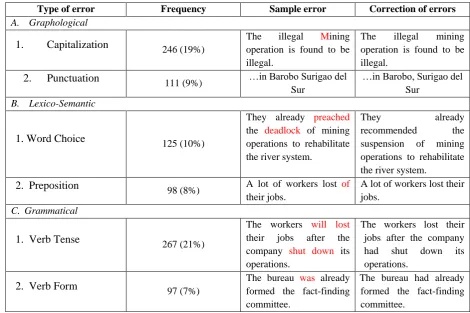
The most common errors of the news writers in terms of Corder’s Graphological, Lexico-Semantic, and Grammatical levels are presented in table 1. A
sample of each common error based on the student-writer’s article is also presented in the table.
Table 1. Common Errors Committed with Examples
Type of error Frequency Sample error Correction of errors
A. Graphological
1. Capitalization 246 (19%) The operation is found to be illegal Mining
illegal.
The illegal mining operation is found to be illegal.
2. Punctuation 111 (9%) …in Barobo Surigao del
Sur
…in Barobo, Surigao del Sur
B. Lexico-Semantic
1. Word Choice 125 (10%)
They already preached
the deadlock of mining operations to rehabilitate the river system.
They already recommended the suspension of mining operations to rehabilitate the river system.
2. Preposition
98 (8%) A lot of workers lost of their jobs.
A lot of workers lost their jobs.
C. Grammatical
1. Verb Tense 267 (21%)
The workers will lost
their jobs after the company shut down its operations.
The workers lost their jobs after the company had shut down its operations.
2. Verb Form 97 (7%) The bureau formed the fact-finding was already
committee.
The bureau had already formed the fact-finding committee.
Graphological Errors. As presented in
table 1, two of the most common errors in the graphological level are capitalization and punctuation with 246 frequency count or 19% and 111 count or 9% respectively in the overall total number of errors. One prevalent mistake in capitalization is that writers tend to capitalize the initial letters of common nouns as in the example: “The illegal Mining operation was found to be illegal,” where the initial letter M in the word mining which is not a proper noun as used in the sentence is written in uppercase. In the case of punctuations, some writers failed to add proper
punctuations in places where it is entailed just like in the given example: “…in Barobo Surigao del Sur,” where there is an error of omission of a comma after the word Barobo to set off elements in addresses. This problem on punctuation of the news writers is an affirmation to the studies of Juozulynas (2011) which claimed that punctuation is a common error among students.
Available online:
http://edupediapublications.org/journals/index.php/IJR/
P a g e | 927 education. Furthermore, it was observed that mosterrors in capitalization are committed in the proper capitalization of titles placed before and after names of persons. This is a manifestation that student-writers are not well-oriented of the Associated Press rule on capitalization of titles, thus the need to orient them on this matter.
Lexico-Semantic Errors. Word choice and
prepositionhave the most number of errors as used by the writers. These two categories were also identified as a common error by several language researchers like Eun-pyo (2006), Tan (2011) and Pormiento (2008). In the news articles of the students for instance, there was a misuse of the words preached and deadlock in the sentence: “They already preached the deadlock of mining operations to rehabilitate the river system,” where the writer actually meant recommended instead of preached and suspension instead of deadlock. Another error in this level is the wrong use of prepositions where students sometimes add prepositions in places where it is not required as in: “A lot of workers lost of their jobs.” In this sentence, the writer added the preposition of which should not be present in the acceptable form of the sentence.
This signifies that campus journalists are still on the process of exploring the use of words especially those unfamiliar to them and still have to enrich their vocabulary for them to be more competent in the proper use of words. In a casual talk with them, a certain journalist who committed an error on word choice said that she thought it was okay to replace a word with any item synonymous with it. There is therefore a need for the students to be explained on the appropriateness of a word in the context as an important element to convey the correct and exact message of the sentence. As Ellis (2005) put it: ‘superficial well-formedness only does not make a sentence error-free; it also needs to be appropriate in the communication context’.
Grammatical Errors. This levelis by far the most problematic level as recorded with verb tense topping the list of the most common errors from among the three linguistic levels. For example in the sentence: “The workers will lost their jobs after the company shut down its operations,” the writer committed an error by using the auxiliary verb will which denotes futurity in a sentence which
already took place in the past. More so, the word shut down, even if presumably used as past tense, is still incorrect as it should have been written in past perfect tense to denote a past action which happened first before the other past action. Thus, the sentence should have been worded as: “The workers lost their jobs after the company had shut down its operations.”
This vouches the findings of Darus (2009) and Bustomi (2009) who both named verb tense as a common error among learners. In the articles of the school paper writers, it could be observed that many writers failed to use the past tense in narrating the events which happened in the past. This goes to prove that most of the writers are not aware of the journalistic rule that news are generally presented using the past form of the verb especially in print media; thus the necessity to revisit this basic rule of news writing.
Another problem in the grammatical level is the formation of verbs where students failed to write the correct form of the verb in the sentence, thereby distorting the meaning of the sentence as in the sentence: “The bureau was already formed the fact-finding committee.” In this sentence, the journalist used the helping verb was where he/she actually intended to mean had.
Causes of Errors. In the error-analysis procedure espoused by Corder (1974), he pointed out that the fourth step is explaining the causes of learner’s errors.
In tracing the causes of campus journalists’ errors in their written compositions, the researcher conducted interview with them. He first showed them the errors they committed and asked them the reasons of committing such errors. Common response that surfaced was students’ non-mastery of the linguistic rule. Some also pronounced that they are aware of the rule but they missed on applying it in the sentence where it should have been applied.
Available online:
http://edupediapublications.org/journals/index.php/IJR/
P a g e | 928 grammatical rules of the target language. In somesimple errors, other sources of errors that could also be charged are some performance variables such as carelessness and slip or lapse which the learner, given the time, could be able to correct himself/herself.
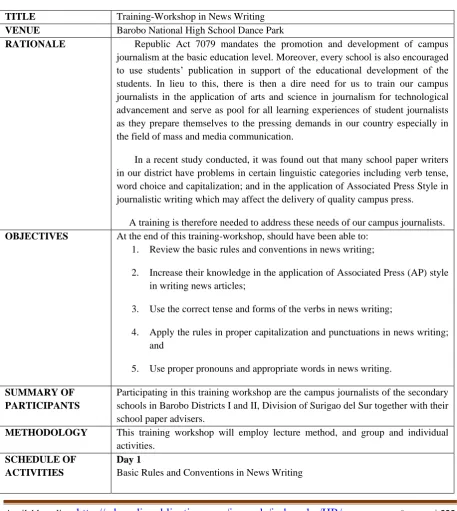
Intervention Program. Erdogan (2005)
contended that applied error analysis would help in designing appropriate intervention for the learners. To this account, given the disclosed linguistic
problems of the campus journalists, hereunder is a training design of the proposed intervention for campus journalists of the public and private secondary schools of Barobo Districts, Division of Surigao del Sur.
Table 2. TRAINING DESIGN
TITLE Training-Workshop in News Writing
VENUE Barobo National High School Dance Park
RATIONALE Republic Act 7079 mandates the promotion and development of campus
journalism at the basic education level. Moreover, every school is also encouraged to use students’ publication in support of the educational development of the students. In lieu to this, there is then a dire need for us to train our campus journalists in the application of arts and science in journalism for technological advancement and serve as pool for all learning experiences of student journalists as they prepare themselves to the pressing demands in our country especially in the field of mass and media communication.
In a recent study conducted, it was found out that many school paper writers in our district have problems in certain linguistic categories including verb tense, word choice and capitalization; and in the application of Associated Press Style in journalistic writing which may affect the delivery of quality campus press.
A training is therefore needed to address these needs of our campus journalists.
OBJECTIVES At the end of this training-workshop, should have been able to:
1. Review the basic rules and conventions in news writing;
2. Increase their knowledge in the application of Associated Press (AP) style in writing news articles;
3. Use the correct tense and forms of the verbs in news writing;
4. Apply the rules in proper capitalization and punctuations in news writing; and
5. Use proper pronouns and appropriate words in news writing.
SUMMARY OF PARTICIPANTS
Participating in this training workshop are the campus journalists of the secondary schools in Barobo Districts I and II, Division of Surigao del Sur together with their school paper advisers.
METHODOLOGY This training workshop will employ lecture method, and group and individual
activities. SCHEDULE OF
ACTIVITIES
Day 1
Available online:
http://edupediapublications.org/journals/index.php/IJR/
P a g e | 929 Day 2Associated Press Style in Journalistic Writing
Day 3
Tense and Forms of Verbs
Day 4
Proper Capitalization and Punctuation
Day 5
Pronouns and Correct Word Usage
SOURCE OF FUNDS School Paper Fund
BUDGETARY REQUIREMENTS
Breakdown of Proposed Expenditures (Expected Number of Participants: 70)
Snacks @ 50/pax/day x 5 days x 70 pax. . . P 17,500.00 Speaker’s Fare and Stipend ………. P 15,000.00 Training Kits, Materials and other Expenses P 2,500.00 Total . . . . .P 35,000.00 MONITORING
AND EVALUATION
This seminar will be monitored and evaluated by the District and the Division Coordinator for Training and Development.
Aside from this training workshop, English teachers in Barobo districts are also encouraged to incorporate in their lessons the linguistic items which the student-writers are struggling with. This is to ensure that the acquisition of these linguistic rules will not just rest on the training but is reinforced in the classroom since student-writers spend most of their time in the classroom with their English teachers than with their campus journalism advisers.
4.
Conclusion and Recommendation
Based on the findings above, it can be concluded that students’ errors in writing are serious which may hinder effectiveness of communication and thus the delivery of quality campus journalism. This problem calls for a sound intervention program in order to address the linguistic difficulty of the student-writers. School paper advisers and English teachers alike should work together to help improve the linguistic knowledge and writing skills of campus journalists. This could be addressed not only through the training proposed in this study, but more importantly, through effective instructional
strategies in the classroom, so that errors will not recur all over again.
References Cited
Abisamra, A. (2006). An analysis of errors in Arabic
speakers' English writings. Retrieved
September 21, 2016 from http://abisamra03.tripod.com/
/languageacq-erroranalysis.html
Alawi, T. (2014). An error analysis on academic writing: a look into the interlanguage of
university students. SDSSU
Multidisciplinary Research Journal. Vol. 2 No. 2.
Bustomi, A. (2009). An error-analysis on students’ descriptive writing. Master’s Thesis. State Islamic University. Retrieved September
11, 2016 from
http://www.readingmatrix.com/conference/ pp/proceedings0 05/bustomi.pdf
Available online:
http://edupediapublications.org/journals/index.php/IJR/
P a g e | 930 Edge, J. (2009). Mistakes and Corrections. London:Longman.
Ellis, R. (2005). Two approaches for investigating second language acquisition in context. In R. Ellis (Ed.), Second Language Acquisition in Context. London: Prentice-Hall.
Erdogan, V. (2005). Contribution of error analysis to foreign language teaching. Retrieved September 18, 2016 from http://efd.mersin.edu.tr/dergi/
meuefd_2005_001_002/
pdf/meuefd_2005_001_002_02610270_erd ogan.pdf
Darus, S. (2009). Error analysis of the written English essays of secondary school students
in Malaysia: a case study. European
Journal of Sciences – Volume 8. No. 3.
Eun-pyo, L. (2003). Error analysis on medical students' writing. Retrieved August 20,
2016 from
http://docs.google.com/viewer?a=v&q=cac he:
a4PVc8BqlogJ:www.stc.arts.chula.ac.th/IT UA/Papers_for_ITUA_Proceedings/Eunpy o-new.pdf+Eunpyo+study
+on+language+errors
Juozulynas, V. (2011). Errors in the compositions of second-year German students: an empirical study forparser-based Icali. Retrieved July 21, 2016
Ferris, D.R. (2005).Treatment of error in second
language writing. Ann Arbor: The
University of Michigan Press.
Lightbown, P., and Spada, N. (2006). How
languages are learned. Oxford: Oxford
University Press.
Mitchell, R. and Myles, M. (2006). Second language
learning theories. New York: Hodder
Arnold.
Murad, T. (2015). Analysis of errors in English writings committed by Arab first-year college students of the EFL in Israel.
Retrieved September 18, 2016 from http://dx.doi.org/10.17507//jltr.0603.02
Olasehinde, M. O. (2006). Error analysis and
remedial pedagogy. In Babatunde S. T. and
D. S. Adeyanju (eds.). Language, meaning and society. Ilorin: Itaytee Press and Publishing Co., Nigeria.
Onike, R. (2007). Analysis of errors of preposition in the learners’ use of English in second
language situation. Retrieved September
20, 2016 from
http://searchwap.com/swa129884.htm
Owens, R.E. Jr. (2008). Language development: an
introduction. (7th edition). Boston,
Paris,Munich: Pearson Educational. Retrieved August 20, 2016 from http://www.uab.ro/cercetare/ciel/jolie/jolie %202008/9.buja_ elena.pdf
Pormiento, U.G. (2008). Common errors in composition writing among first year college students of Philippine normal university- Agusan campus s.y. 2007-2008.
Tan, H. (2011). A study of efl learners' writing
errors and instructional strategies.
Retrieved September 6, 2016 from http://ir.lib.ksu.edu.tw:8080/dspace/ bitstream/AB(Writing%20Errors).pdf
Tizon, M. (2009). Error-analysis of LSU students’ written composition. Master’s Thesis. La Salle University. Retrieved August 16, 2016 from http://www.academia.edu/ languagestudies/htms.
Ullah, M. (2014). Analysis of the language errors in writing among BSEE and AB English students. Retrieved August 19, 2016 from http://www.euroessays.org