i
UTILIZATION OF DRAMATIC ELEMENTS IN DELINEATING HUMAN INTERACTION IN SELECTED DRAMA OF FRANCIS IMBUGA AND
JOHN RUGANDA
KARIUKI FAITH WAMBUI (B. ED, M.A.) (M88/24578/2010)
A RESEARCH THESIS SUBMITTED IN FULFILMENT OF THE REQUIREMENTS FOR THE AWARD OF THE DEGREE OF DOCTOR OF
PHILOSOPHY (THEATRE ARTS) IN THE SCHOOL OF CREATIVE AND PERFORMING ARTS, FILM AND MEDIA STUDIES OF KENYATTA
UNIVERSITY
ii
DECLARATION
This thesis is my original work and has not been presented for a degree in any other
University.
Signature__________________ Date__________________
Name: Kariuki W. S. Faith
M88/24578/2010
Supervisors: This thesis has been submitted for review with our approval as University
supervisors.
Signature ______________________________ Date__________________
Professor Wangari Mwai
United States International University-Africa
Signature _______________________________ Date___________________
Prof. John Mugubi
iii
DEDICATION
To my God, for so much grace. My Ebenezar. If you had not been on my side…
Ps.124:1-2.
To my dear late mother, Anna Nyawira Ngari, for taking care of me, taking me to school
and making me love the world of books. You are special to me, Mum.
To my beloved family starting with my husband, Nahashon Kariuki. Our children, Joan
and Emmanuel plus little Pearl Joy, who lights our home with her innocent smile. Your
iv
ACKNOWLEDGEMENT
The journey to this end has been long and bumpy. Many times I felt like giving up but
through the encouragement and support of many, I have managed to come this far.
First, I want to acknowledge the tireless efforts of my two supervisors, Professor Wangari
Mwai and Dr. John Mugubi. Thank you for your painstaking guidance and patience with
my innumerable mistakes. Your encouragement has helped me come this far.
I want to acknowledge the support of Jicho Four Theatre Group for its support in terms
of availing some video content and for allowing me to interview its actors and directors.
Worth special mention are Mr. Patrick, Mr. Mbalamusoma, Mr. Eric chege and others not
mentioned here.
I wish to appreciate the technical and moral support of many in the departments of
Literature as well as Communication, Media, Film and Theatre Studies, (K.U.),
beginning with Dr. Mbithi, Dr. Ndege, Dr. Zippy, Dr. Wallace, Dr. Oliver, Mwalimu
Mulwa, Dr. Hongo, Mrs. Ann Mungai, Dr. Shikuku, Dr. Pomak, Esther and many others.
Not to be forgotten is the Embu Campus fraternity for their support, led by the Director,
Dr. Okello and others like Dr. Ikaria, Dr. Kula, Dr. Jesse, Dr. Madaji plus others not
mentioned here.
I also wish to appreciate those who participated in interviews, acting, FGDs, especially (K.U.)‟s year 2014/2015 Film Technology and Theatre Arts students led by Ms.
Vigilance Atieno, Patrick Kariuki, Liz and others not mentioned here.
Special thanks go to the Kenya Institute of Curriculum Development team led by Mr.
Kimotho and Mr. Maina Mbutu for availing video content to me.
Worth special mention are my husband Nahashon, children, Joan and Immanuel, not
forgetting little Pearl Joy. Thank you for bearing with my absence during my long hours
of sitting in the library. You bore it all without complaint; So very special to me.
v
dear Mummy, your legacy lives on in us ” My siblings: Richard, Muthungu, Papetua
Wanja and Kariuki, thank you for encouraging me to soldier on even when I felt like
giving up was the only remaining option. Special thanks go to my uncle Ambass.
Ephraim Ngari, for your unfaltening support to this course in innumerable ways. To my
other uncles and aunts, and especially Aunts Charity and Lydia, your love and labour for
me is not forgotten.
Special thanks to Kenyatta University for sponsoring this course. Long live K.U!
Thanks to members of Deliverance Church (Kasarani), led by Bishop Dr. Jimmy Kimani,
for spiritual support and especially Hope Ladies Group and Ephesians Home Cell for
your unfailing prayers and encouragement.
To the many others who, in one way or another contributed to this work and who, due to
limitations of space I have not acknowledged, I say, MAY GOD BLESS YOU!
vi
TABLE OF CONTENTS
DECLARATION... ii
DEDICATION... iii
ACKNOWLEDGEMENT ... iv
TABLE OF CONTENTS ... vi
LIST OF FIGURES ... ix
LIST OF PICTURES ... x
ABBREVIATIONS AND ACRONYMS ... xiii
ABSTRACT ... xv
CHAPTER ONE ... 1
1.0 INTRODUCTION... 1
1.1Background to the Study ...1
1.2Statement of the Problem ...5
1.4 Research Questions ...6
1.5 Research Assumptions ...6
1.6 Justification of the Study ...7
1.7 Scope/ Delimitation ...8
1.8 Limitations ...8
1.9 Literature Review And Theoretical Framework ...9
1.9.1 Literature Review ... 9
1.9.2 Theoretical Framework ... 16
1.9.3 Conceptual Framework: Role of Dramatic Elements in Drama ... 21
1.10 Research Methodology ... 22
1.10.1 Research Design ... 22
1.10.2 Population and sampling ... 22
1.10.3 Target Population ... 22
1.10.4 Sampling procedures ... 23
1.11 Data Collection ... 27
1.13 Data Analysis ... 30
1.14 Ethical Considerations ... 31
1.15 Validity and Reliability ...32
vii
CHAPTER TWO ... 33
2.0 DRAMATIC ELEMENTS UTILIZED IN DELINEATING HUMAN INTERACTION IN THE SELECTED DRAMA ...33
2.1 Introduction ...33
2.2 Plot as a Dramatic Element ...34
2.2.1 Aminata ... 38
2.2.2 The Burdens ... 39
2.2.3 Shreds of Tenderness ... 41
2.2.5 The Return of Mgofu ... 49
2.2.6 The Floods ... 52
2. 3 Character as a Dramatic Element ...58
2.3.1 Aminata ... 62
2.3.2 The Burdens ... 63
2.3.3 Shreds of Tenderness ... 64
2.3.4 The Floods ... 65
2.3.5 Betrayal in the City ... 68
2.3.6 The Return of Mgofu ... 69
2.4 Spectacle as a Dramatic Element ...71
2.5. Music as a Dramatic Element ...79
2.6 Dialogue as a Dramatic Element ...85
2.7 Theme as a Dramatic Element ...89
2.8 Conclusion ...91
CHAPTER THREE ... 93
3.0 MANIPULATION OF DRAMATIC ELEMENTS IN DELINEATING FAMILY AND GENDER RELATIONS ... 93
3.1 Introduction ...93
3.2 Family Relations ...93
3.2.1 Relationships between Spouses ... 95
3.2.2 Relationships between Parents and Children ... 103
3.2.3 Relationships of Children... 111
3.2.4 Relationships among Extended Family Members... 117
viii
3.3.2 Conclusion ... 122
CHAPTER FOUR ... 124
4.0 DRAMATIC ELEMENTS DELINEATING INTRA AND INTER-COMMUNITY RELATIONS... 124
4.1 Introduction ...124
4.2 Intra-community Relations ...125
4.3 Inter-community Relations ...133
4.3.1 Conclusion ... 138
CHAPTER FIVE ... 139
5.0 MANIPULATION OF DRAMATIC ELEMENTS IN DELINEATING SOCIO-ECONOMIC CLASS RELATIONS ... 139
5.1 Introduction ...139
5.1.2 Political relations ... 148
5.1.3 Professional Class Relations ... 155
5.1.4 Religious Class Relations... 165
CHAPTER SIX ... 175
6.0 SUMMARY, CONCLUSION AND RECOMMENDATIONS... 175
6.1 Introduction ...175
6.2 Summary of Findings and Conclusion ...175
6.3 Recommendations for Further Studies...182
REFERENCES ... 183
APPENDICES………201
APPENDIX 1: Observation Check-list and Interview Guides………201
APPENDIX II: Consent Form………...…..203
ix
LIST OF FIGURES
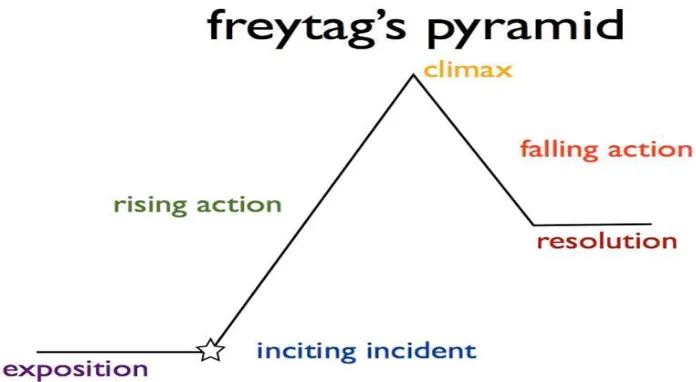
Fig. 1.0 Freytag‟s Pyramid………... 2
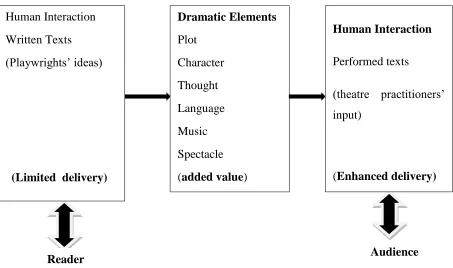
Fig. 1.1 Conceptual Framework………. 21
x
LIST OF PICTURES
PICTURE 1 Doga and Nina praying: (Note Doga‟s white beards; makeup; B.i. t.C) …44
PICTURE 2 Odie waving hands (gestures; Shreds of Tenderness) ……… …..74
PICTURE 3 Wamala‟s metamorphosis after wearing the teacher‟s suit (costumes; The Burdens) ……….………..76
PICTURE 4 (props: coins in a plate at Adika‟s grave; B.i.t.C) ………..77
PICTURE 5 (set and costume: Odie and Stella‟s expensively furnished
living room(Shreds of Tenderness) ……..………..78
xi
OPERATIONAL DEFINITION OF TERMS
In this study, the following terms are used in the manner explained.
Actor A male or female person who executes the role of a character in a dramatic performance.
Delineation This means portraying something precisely. The term is used interchangeably with the term „rendition‟ to refer to the portrayal of the theme of human/social relations.
Dialogue A conversation between people in a play or film. The term is used interchangeably with the terms „diction‟ and „language‟.
Diction A choice of words or phrases in a speech or writing. It could also mean enunciation in speech or singing. The term is used interchangeably with the terms „dialogue‟ and „language‟.
Drama A play for the theatre or television. This term is used interchangeably with the term „play‟.
Dramatic Elements The term refers to the six Aristotelian elements namely: plot, character, thought, diction, melody and spectacle.
East Africa The study has used the term East Africa to refer to the original East Africa, which included: Kenya, Uganda and Tanzania.
Human interaction The term refers to the way people relate with one another based on such factors as class, family etc. The term is used in the same way with the terms, „human/social relations‟ and „human/social relationships‟.
Inter-community Relations The term refers to interactions among people who regard each other as belonging to different community groups, especially based on language. It is used interchangeably with the term „inter-ethnic relations‟.
Inter-ethnic Relations The term refers to interactions among people who regard each other as belonging to different community groups, especially by virtue of using a different language. It is used interchangeably with the term „inter-community relations‟.
xii
Language The system of communication in speech and writing that is used by people of a particular country or area. The term is used interchangeably with the terms „diction‟ an „dialogue‟.
Melody A piece of music or a song with a clear or simple tune. The term is used interchangeably with the terms „music‟ and „rhythm‟.
Music Sounds that are arranged in a way that is pleasant or exciting to listen to. The term is used interchangeably with the terms „melody‟ and „rhythm‟.
Play A piece of writing performed by actors in a theatre or on a television.
Post-independence This refers to the period from 1962-1999; the period that followed the acquisition of independence in Kenya and Uganda. Some plays on which this study was based were published during this period.
Post-millennium This refers to the period beginning year 2000 up to date (2000- 2018), when some of the plays this study is based on were published.
Dramatists This refers to people involved in the process of writing and production of plays, such as playwrights, directors and actors.
Rendition The performance of something, especially a song or play. The term is used interchangeably with the term „delineation‟.
Rhythm A strong regular repeated pattern of sounds or movements. The term is used interchangeably with the terms „music‟ and „melody‟.
Social Relationships It refers to the way people who are joined together by such factors as geographical proximity, religion, class and language group interact. The term is used interchangeably with the term human interaction.
Spectacle A sight or view that is very impressive to look at. The term is used interchangeably with the term „staging‟.
xiii
ABBREVIATIONS AND ACRONYMS
AIDS Acquired Immune Deficiency Syndrome
B.i. t.C Betrayal in the City
CBD Central Business District
EAC East African Community
EALA East African Legislative Assembly
EU European Union
FGDs Focus Group Discussions
I.S.S. International Slogan Syndicate
JWC Journalist with Camera
JWM Journalist with Microphone
JWN Journalist with Notebook
LJ Lady Journalist
KCSE Kenya Certificate of Secondary Education
Ke. S. Kenya Shillings
KICD Kenya Institute of Curriculum Development
KNLS Kenya National Library Services
KNT Kenya National Theatre
KS & CNDF Kenya Schools‟ and Colleges‟ National Drama Festival
KU Kenyatta University
NATO North Atlantic Treaty Organization
xiv
SRB State Research Bureau
UN United Nations
UNHCR United Nations High Commission for Refugees
xv ABSTRACT
1
CHAPTER ONE
1.0 INTRODUCTION
This chapter focuses on the background of the study, statement of the problem, objectives
of the study, research questions and assumptions of the study. It also comprises the
justification of the study, scope and limitations, literature review, theoretical framework
and research methodology.
1.1 Background to the Study
As Aristotle observed in ThePoetics, (Aristotle, 1935) drama is mimetic, meaning that it
imitates reality. Consequently, it is a powerful medium of effecting social change. This is because as Sam Ukala rightly notes, “... it translates with greater immediacy than other creative genres and is accessible in performance to those who cannot or do not read”
(Branham, Gibbs and Osofisan, 2001, p. 29). For this to happen with maximum success, a
play must be performed on stage, in which case dramatic elements will help unveil the playwright‟s message.
Dramatic elements are the building blocks that make up a play. In The Poetics, Aristotle
(1935) argued that there are six major elements that make a play. These are: plot,
character, thought, dialogue, music and spectacle (Gassner & Sweetkind, 1963; Madden,
1996).
Aristotle believed that plot was the most important element, followed by character then
thought. These six dramatic elements, that have come to be accepted by scholars as the
basic elements of drama (Schempp et al, 1995), bring out the content of a play. It is
important to note that all these elements complement each other and therefore it is not
easy to divorce any of them from a play. We now take a look at these elements.
1. According to Aristotle, Plot is the most important element of a play and it should have a beginning, middle, then ending. Plot is again sub-divided into what later came to be known as Freytag‟s Pyramid (see Fig 1.0 below), comprising: exposition, rising action,
2 Fig 1.0: Freytag‟s Pyramid.
Source-http://jdspero.file.wordpress.com/2014/07/freytags.jpg-accessed17/6/17.
2. Character, another dramatic element, is important as the way a character moves and the expression s/he makes are directly influential on her/his behaviour (Laban, 1971).
Arnold opines that central to every drama are its characters and the stories they tell
through their actions (Arnold, 2001; Kernan, 1969; Kleberg 1993).
3. Dialogue refers to verbal communication between characters in a play and dialogue in drama includes not just what is said, but also gestures, props, costumes and even silence.
It also includes such aspects as tone, enunciation, tempo as all these have a
communicative role (Birch, 1991).
Hilton (1987) further observes that it may seem odd to talk about the language of
costume, gesture and movement, to say nothing of the language of silence, but that in
theatre, all these non-verbal things have something to say. In addition, Styan (1975)
opines that drama is not only made of words but a whole conglomeration of elements
such as sights, sounds, stillness and motion, noise, silence, relationships and responses.
3
and this includes such aspects as: monologue and asides. Dialogue is a very important
element to playwrights since it is through it that the plot of a play unfolds, as the
characters talk (Oscar, 1974; 1980).
4. Thought, which is the ultimate goal of the playwright, may be communicated directly through the title, dialogue or through spectacle. Through thought, we derive the message
of the play, but it is the characters mainly who deliver this message through their
dialogues (Beaty et al, 2002).
5. Music is another dramatic element that is used either directly or in the background to unveil the plot, theme or character. It can also add to the aesthetic value of the play as
well as provide comic relief (Kebede, 1995).
6. Spectacle as a dramatic element includes all the visual aspects that are employed during a performance. These include: costumes, makeup, lighting, props and set design.
Light for example, has both imaginative and practical aspects in a performance as it is a
dominant source of theatrical imagery and one of the principal indicators of time (Hilton,
1987; Selden and Hunton, 1959). Hilton further observes that the primary function of
stage lighting is to light the performers and to illuminate the performance space, while
costume and makeup constitute the connection between the animate and the inanimate in
performance.
Costume and makeup establish age, sex, rank, taste, identify special features, nationality,
religion, social affiliation and become an index of character and personality. In a wider
sense, both costume and makeup complement set and lighting in the way they offer
concepts of shape, colour, time and style to the audience. Thus, they have partly the
function of being mobile aspect of the setting (Hilton, 1987).
Props include such items as knives, guns, letters, rings, purses etc. and even when they
change hands, either by design or accident, it is to advance the plot or enable its
advancement. They also tend, as with weapons, crowns, musical instruments or tools, to
4
argument, Hilton (1987) very aptly summarises dramatic elements and their functions. In
conclusion, we concur with Chambers (2005) who notes that a play is an event in two
parts. The first appears on the page and the other on the stage. What this means then is
that without performance, a play is incomplete. During a performance, dramatists
manipulate dramatic elements in order to create desired meanings. It is through dramatic
elements that the play is experienced in totality. Dramatic elements therefore act as a
bridge between the playwright and the audience. The importance of dramatic elements in
the delineation of a theme in a play cannot therefore be overemphasized.
In a nutshell, it is clear that dramatic elements have a variety of seminal roles that they
play in communicating the content of a play. These include plot development, character
development, style and even thematic development. Out of all these, thematic
development is key because communication of thought is the core reason a playwright
sets out to write a play.
Among the many thematic concerns that can be highlighted in a play is that of human
interaction, simply because plays are about people. Human beings are social beings, with
none being an island, meaning they will always seek relationships with other human
beings. The notable thing about this is that these interactions, far from being haphazard,
are governed by certain factors (Haralambos and Heald, 1980). These factors may come
into play consciously or even spontaneously. The important question that comes into the
mind then is what factors determine these relationships? This is an important question
for the dramatist, who is the mirror of the society, because these relationships can
generate both positive and negative results. A closer look at this issue will reveal that the
factors that govern human interaction include: family, community, ethnic, class, gender,
religion among others (Bujo, 2003). It is thus an issue that deserves scholarly scrutiny.
The two playwrights; the late Francis Imbuga and the late John Ruganda, whose works
the study focuses on, have been leading dramatists in Kenya and Uganda respectively,
where they dominated the dramatic scene for about four decades. While Imbuga has the largest number of published plays in Kenya (over ten), Ruganda also leads in the
5
findings of this study. They are lauded not only in East Africa but in Africa and beyond,
first for their unique style and dexterity in articulating pertinent socio-economic issues.
Their fame again derives not just from the number of their published plays, but also from
the fact that they were accomplished thespians, with dramatic careers dating from their
student days and deep into their lecturing careers. Their subtlety and creativity in
manoeuvring hostile political eras, by exploiting diverse dramatic techniques in
articulating issues of societal concern, is still highly lauded. In this, they use seemingly „harmless tools‟ like humour and oral literature, but which are heavily loaded with
arsenal to fight evils in the society. Imbuga, for instance, is known for using humour
and oral literature, while Ruganda is reputed for using both oral literature and the play
within a play style. Consequently, one cannot discuss drama in East Africa without
mentioning these two playwrights.
1.2 Statement of the Problem
As noted in the background, drama is mimetic in that it mirrors the society, thus
translating into a powerful socialization tool. Through their written plays, Imbuga and
Ruganda have exploited this mimetic element of drama with the aim of communicating
with the societies they mirror. For this to happen effectively, the complete cycle of
communication in drama, which involves performance, has to take place. This is where
dramatic elements come into play to unveil the thought of a writer.
Numerous literary studies have been done on the plays of Imbuga and Ruganda, focusing
on such areas as style, theme as well as character analysis. Many of these look at plays
as “texts” and thus analyse literary elements (Penfield, 1995). This leaves a gap in the
arena of dramatic scholarship where plays are viewed as “productions” and performance
of plays on the stage is found to be key. It is during performance that dramatic elements
come into play to unveil the content of a work of drama. The literature review reveals
that that the utilization of dramatic elements in the rendering of human interaction in Imbuga‟s and Ruganda‟s plays has not been adequately addressed. Unfortunately,
without employing dramatic elements to unlock the content, the study presupposes that
6
filled by carrying out a comprehensive study of the contribution of dramatic elements in
the delineation of human interaction in their plays.
Aim and objectives of the Study
The aim of this study was to investigate the utilization of dramatic elements in the
delineation of human relations in selected drama of Imbuga and Ruganda.
The specific objectives of this study were to :
1. Identify the dramatic elements utilised in the delineation of human interaction in
selected drama of Imbuga and Ruganda.
2. Examine how dramatic elements are manipulated in order to unlock human
interaction in selected drama of Imbuga and Ruganda.
3. Investigate the themes that accrue from analysing the utilisation of dramatic
elements in the delineation of human interaction in selected drama of Imbuga and
Ruganda.
1.4 Research Questions
1. What dramatic elements are utilised in the delineation of human interaction in
selected drama of Imbuga and Ruganda?
2. How are dramatic elements manipulated in order to unlock human interaction in
selected drama of Imbuga and Ruganda?
3. What themes accrue from analysing the utilisation of dramatic elements in the
delineation of human interaction in selected drama of Imbuga and Ruganda?
1.5 Research Assumptions
1. All the six dramatic elements are manipulated in the delineation of human
interaction in selected drama of Imbuga and Ruganda.
2. Several strategies are employed to manipulate dramatic elements in order to
unlock human interaction in selected drama of Imbuga and Ruganda.
3. At least five themes accrue from analysing the utilisation of dramatic elements in
7 1.6 Justification of the Study
This study was motivated by the need to develop a comprehensive body of knowledge on
the contribution of dramatic elements towards the delineation of the content of selected
plays of Imbuga and Ruganda. An investigation of the role that dramatic elements play
in this would help in the consumption of the content of the plays of Imbuga and Ruganda,
which the study presupposes have previously only been partly consumed, without the
incorporation of the role of dramatic elements in communicating meaning.
Since the two have established themselves as powerful dramatic voices and opinion
shapers on many social issues in drama, their voice on this very important theme of
human interaction needed to be fully examined. This could only be achieved through a
scholarly exegesis of the contribution of dramatic elements to the rendition of the same.
In addition, it was deemed that an investigation of the utilisation of dramatic elements in
the delineation of human interaction in selected plays of Imbuga and Ruganda would help
to emphasize the importance of theatre and stage performances in contemporary East
Africa. This is an area, which has received little critical attention in the past, largely due
to competition from such genres as Film and Television. This will in turn increase
viewership of stage performances, which will consequently create more jobs for theatre
practitioners. Moreover, playwrights, directors and other practitioners in the field of
drama will benefit from the findings of this study as they will help them improve the
quality of productions and thus help theatre compete favourably with Film and Television
media.
Being key East African dramatists, Imbuga and Ruganda have highlighted many socio-economic and political issues, affecting Africa in general and East Africa in particular.
Such include corruption, dictatorship and tribalism. Numerous studies have been done on
these themes making the duo very powerful voices in effecting social change.
Unfortunately, little critical attention has been accorded to the contribution of dramatic
elements towards extracting the messages of the playwrights on human interaction. The
study assumes that the lessons we would have learnt as a society, for the purpose of
8
critical analysis of the utilisation of dramatic elements in the delineation of this key
concept therefore needed urgent attention, to be able to avail these lessons to the society.
The study of the utilization of dramatic elements in the delineation of human interaction in Imbuga‟s and Ruganda‟s plays consequently, was an attempt to fill this gap.
In summary, the findings of this study are deemed insightful to scholars in the area of
drama and also to practitioners in diverse fields that focus on human interaction. Such
include: sociologists, theologians, psychologists, educationists and even administrators.
1.7 Scope/ Delimitation
Out of the population of over seventy (as per the time of compiling the findings, 2017/18)
stage plays from East Africa, the study restricted itself to six purposively selected plays
from the writings of Imbuga and Ruganda. These are stage plays in which human
interaction as a thematic concern is prominent. These are: Betrayal in the City (1976),
Aminata (1988) and The Return of Mgofu (2011) by Imbuga. The other three are: The
Burdens (1972), The Floods (1988) and Shreds of Tenderness (2001) by Ruganda. The
plays were purposively selected on the basis of their relevance to the theme of human
interaction.
1.8 Limitations
The study faced a lot of challenges, one of them being that it was very difficult to locate
and/or even secure interviews with the experts who were supposed to provide the
researcher the information needed for the research. Another problem that the researcher
faced was time constraint, considering that the research work had to go hand in hand with
the normal career responsibilities. The third problem that the study faced was the
difficulty of securing recorded formats of the stage plays. This did not however
compromise the quality of the research, as after persistent pleas, the researcher finally
9
1.9 LITERATURE REVIEW AND THEORETICAL FRAMEWORK
1.9.1 Literature Review
This chapter looks at studies on utilization of dramatic elements in drama globally, in
Africa and then in East Africa. It concludes the section by examining some works on
utilisation of dramatic elements in the plays of Imbuga and Ruganda.
1.9.1.1 Utilisation of dramatic elements in drama: A global perspective
Williams and Williams‟ (1898) journal article analyses some dramatic elements that are
used in Indian drama, and which have parallels in the English theatre. The four dramatic
elements analyzed are: play within a play as a method of plot development and
restoration of the dead to life on the stage. The third is the employment of scenes of
intoxication as a humorous device, and finally the utilization of letters as a device of
complicating or unravelling the plot. The study then proceeds to draw parallels of the
same on the English stage. Williams and William‟s study is relevant to this research as it
interrogates the use of dramatic elements in performance. Nevertheless, it differs from the researcher‟s interest in that it is comparative in nature while this study focuses on the use
of these dramatic elements for thematic development.
Bordman (1994) provides an analysis of American non-musical theatre from 1869-1914,
which comprises all plays in the period covered. It goes on to chronicle the plot
synopses, their principal characters, as well as describe the costumes and the scenery.
The book also includes some play extracts to enhance the understanding of these plays.
It contribute to this study in that it highlights such dramatic elements as character, plot
and spectacle. However, it does not delve into a thorough exegesis of the elements or
show their relevance in as far as thematic development is concerned.
1.9.1.2 Utilisation of dramatic elements in African Drama
Morgan (1994) interrogates traditional African drama against selected issues in theatre
and performance criticism. The article approaches the topic from two perspectives, one of
10
looks at traditional African drama specifically as an aesthetic activity. While noting the
theatricality of African societies, Morgan observes that in traditional African societies,
individual conduct and inter-group relationships were guided by what some role-theory
sociologists have called a social script. He gives such examples as stylized gestures,
patterned dances and symbolic movements and actions.
Morgan sees the orality of the cultures and interactive style of communication as the
second element of traditional African cultures. He notes the seminal role played by such
dramatic elements as the voice, facial expression, gestures, body movements such as
kneeling and crouching, in communicating meaning. In addition, Morgan opines that
other than the theatricality of general life in traditional societies, indigenous African
theatre is a more formal and conscious activity, performed in sacred areas such as a
sacred grove or a public square. The article is relevant to our research in the sense that it
analyses dramatic elements. However, it does not show the relevance of these elements to
the advancement of thematic content which is an important concern of this study.
Dosunmu‟s (2005) thesis attempts an analysis of the utilisation of traditional music in
Yoruba drama. His analysis is based on Soyinka‟s Death and the King’s Horseman
(1975). The study interrogates the extent to which the use of traditional music in modern
Yoruba drama represents a cultural self-apprehension on the part of the dramatist.
Dosunmu posits that even with the coming of new genres of drama, the music remained
characteristically traditional. He notes the utilization of the elements of music, dance and
miming which characterise traditional theatrical forms, such as, Alarinjo. It compares the
techniques of dramatic development in traditional forms such as Alarinjo with those in Soyinka‟s play. The study does a detailed analysis of traditional musical forms and how they have been utilised in Soyinka‟s play, which enhances our understanding of this
element. The study is relevant to our research in that it focuses on one of the dramatic
elements: music, which is part of our interest. This study is diffeent from Dosunmu‟s in
that it deals with all forms of music and not just the traditional. Again, the study does not show how music contributes to thematic development which is an important concern
11
Affia and Usuagwu (2012), address the issue of the ever, elusive search for a universal
theory of African drama. They refer to the two schools of thought propagated with regard
to African drama, in which case one denies its existence (Evolutionists), with the other
affirming its existence (Relativists). The study examines the weaknesses of evolutionists
who deny the existence of African drama and whose major preoccupation is
„deindigenising‟ and „detraditionalising‟Africa drama. „Deindigenisation‟ is an
anthropological term they use to refer to the process of making something foreign more
native or local. They also borrow the term, „detraditionalising‟ from social theory, to refer
to erosion of tradition in society. The study affirms the need to continue with a search for
a universal African theory through conceptualising and operationalising African drama. It
further emphasizes the need to continue crystallizing and reiterating the defining
characteristics of African drama. Though the study acknowledges the existence of
dramatic elements in the indigenous forms of African drama, it does not delve into any
comprehensive exegesis of the same or even how these dramatic elements can be used to
relay meaning.
1.9.1.3 Utilisation of dramatic elements in East African Drama
Kabui (1997) seeks to establish the status of children‟s theatre in Nairobi. While noting
the forms that reveal children‟s theatre in Nairobi, the study examines creative elements
such as plot, character and style of plays performed for children in Nairobi. Though the
study falls more into children‟s literature and has a literary perspective of drama rather
than a performative one, it is relevant to our research in that the creative elements it
analyses are also dramatic elements.
Outa (2001), in a journal article investigates the portrayal of power and politics in
postcolonial Kenyan drama. Basing his study on selected plays of Ngugi Wa Thiong‟o
and Francis Imbuga, he seeks to establish for instance how Imbuga was able to survive in
a dictatorial environment, while Wa Thiong‟o became a victim of political harassment, yet both wrote political material. The relevance of this article to this study is that it is
12
seeks to study. Again, the researcher‟s study touches on dramatic strategies employed by
the writers, an area closely related to dramatic elements.
Kinya (2008) focuses on the analysis of the dramatised narrative of the Kenya Schools‟
and Colleges‟ National Drama Festival. Her study interrogates the seemingly
contradictory narrative and drama elements in the dramatized oral narrative. She sees the
integration of both the aspects of narration and drama in the performance of the oral
narrative within the KS &CNDF as a case of the oral narrative adapting itself to
contemporary contexts. Though the study belongs to the genre of oral literature, it is
relevant to this research in that it recognizes the place of dramatic elements in the
dramatised oral narrative at the drama festival. These are aspects of performance that are
a major concern of this study.
Were (2009) interrogates the utilisation of Brecht‟s concept of alienation in Theatre for
Development practices in Kenya. This study focuses on evaluating the effectiveness of
theatre for development troupes in interpreting and applying the conceptual frameworks
that define theatre for development. The study is concerned with ensuring that what is
practised is focused and systematic and most importantly, that the methodology does not
contravene the set processes as commonly understood. Though this study did not so much
focus on dramatic elements, it is relevant to this research in that it deals with Brecht‟s
concept of alienation, that is part of the theoretical concern of the study.
Fashua (2009), a journal article, investigates the principles of alienation and
revolutionary ethos in two postcolonial East African plays. The two plays under exegesis
are: The Trial of Dedan Kimathi (1976) and I Will Marry When I Want (1982). The
paper demonstrates how dramatists in East Africa used drama as a tool of rebellion
against colonial and postcolonial capitalist forces. It recognizes the role played by post
independent African intellectuals and scholars in the struggles against colonialism and the subsequent neocolonialism that took root after independence in Kenya. It
demonstrates how drama then became a tool to address the myriad socio-economic and
political maladies that faced Africa after independence. This article is relevant to this
13
Imbuga and Ruganda. This is in line with the Sociological Literary theory which this
study utilizes.
Obiero (2010) attempts an analysis of Kenyan children‟s response to selected plays by
adult playwrights. The study evaluates the suitability of the plays to the child reader with
reference to the synthesis of style, plot, characterization and themes. In doing this, the
study employs the Reader Response theory. While the study is deemed significant to
this research in the sense that it identified key dramatic elements, its departure from this
study is that it adopts a literary rather than a performative approach. This is derived from
the fact that it focuses on the „reader‟ while this research focuses on the „audience‟.
Karanja (2011) interrogates the utilisation of tragicomedy techniques in three plays by
Kenyan playwright, David Mulwa. The three plays that are analysed are: Redemption
(1990), Clean Hands (2000) and Glasshouses (2000). The study seeks to establish the
impact of the use of tragicomedy techniques on communication and the aesthetic quality
of the plays. Using Northrop Frye's theory of tragicomedy known as the ironic mode, the
study focuses on such areas as thematic concerns, artistic techniques, plot and
characterization as features of tragicomedy found in each play. The study is relevant to
our research in that the tragicomedy techniques it interrogated are actually dramatic
elements. Moreso, the study seeks to establish their utilisation on communication of
meaning in the texts, a concern that is similar to that of this research. This study will thus
prove insightful to our research though our study is wider in that it deals not just with
tragicomedy techniques but all the six dramatic elements.
1.9.1.4 Utilisation of dramatic elements by/on the two playwrights
Obyerodhiambo (1990) analyses the symbolic aspects that Ruganda employs to bring out
his thematic concerns. He notes Ruganda‟s utilisation of African oral tradition in
constructing these symbols. Such include Nalubale, the goddess of the lake and also
Chief Ngoma and his daughter, Nyenje. The study focuses on how symbolism as an aspect of style aids thematic portrayal, thus making it related with our study. Though it
14
dramatic elements can be used in the construction of the symbols for thematic
enhancement.
Imbuga (1991) investigates thematic trends and circumstances in John Ruganda‟s drama.
He examined the main themes highlighted in the plays which include, domestic strife and
dictatorship. The study thus provides useful insights on human interaction.
Ruganda (1992), explores Imbuga‟s use of humour as a strategy to expose societal ills,
while at the same time evading victimization by the political functionaries of the day.
Dramatic elements are useful ingredients of creating humour and so the study provides
useful insights on how the two intersect, and on how some aspects of humour have been
used as dramatic strategies for thematic development.
Kyallo (1992) attempts a comparative study of the works of Imbuga and Ruganda from a
socio-political perspective, and how this affects their thematic and stylistic elements. The
study looks at the similarities and differences in the various dramatic techniques they
employ to transmit their worldview. This study is significant to this research in that it is
based on the works of the two playwrights who are also the focus of this research. It is
important to mention here that there are numerous studies on these two playwrights
individually or with other writers, but as far as the researcher has established, Kyallo is
the only scholar who brings the two together in the manner the researcher doos. Kyallo‟s socio-political perspective in the interrogation of thematic and stylistic elements
is also a point of convergence with this research because human interaction is a
sociological element and moreso, because he analyses dramatic elements. It thus
provides useful insights to this research. The research‟s point of departure with this study
however, is that while it generally focuses on socio-political issues, this research
specifically studies how dramatic elements help to delineate human interaction.
Mugarizi (1996) examined the nature and purpose of the mode of absurd drama as
portrayed in selected plays of Robert Serumaga, Francis Imbuga and John Ruganda. The
15
circumstance as shown by these playwrights. The study is regarded as significant to this
research in the sense that it focuses on three dramatists, two of whom are the subjects of
this research. However, while Mugarizi‟s study is stylistic in outlook, focusing on
absurd drama, this study combines thematic development and dramatic elements.
Olilo (2002) investigates the use of myths and rituals in Imbuga‟s works. The study
analyses how Imbuga employs the two as artistic tools to investigate the realities of
contemporary Africa. The research focuses on cultural rites such as burials, weddings and
circumcision. It provides some insights on some of the socio-economic and political
issues that the writer deals with and their importance on the human interaction.
Waliula (2003) looks at gender relations in the plays of John Ruganda. The study
interrogates the extent to which gender aspects influence form and content in John Ruganda‟ s six plays. It takes note of the close correlation between gender relations and
characterisation in the plays. The study is useful to this study in the sense that gender
relations comprise an important aspect of human interaction.
Kasigwa (2010) interrogates the concept of death as a running motif in John Ruganda‟s
drama. The study examines John Ruganda‟s preoccupation with the theme of death and
why death seems to be a gravitating focal point around which he builds his dramatic
action. The study is significant to this research in the sense that it is a thematic study,
partly like this one, which enriches the researcher‟s understanding, and is based on a
16 1.9.2 Theoretical Framework
In an endeavour to critically appreciate the topic under discussion, the study adopted two
theoretical approaches namely: the Dramatic theory and the Sociological Literary theory.
Dramatic theory deals with performance of plays on stage. The major proponents of the
Dramatic theory include Aristotle (1935), Bentley (1964), Stanislavski (1936; 1989;
2008) and Brecht (Thomson & Sacks, 1994). In The Poetics (Aristotle, 1935), Aristotle
focuses on performance of drama by actors and before an audience. He saw drama as the
imitation of reality (mimesis). Aristotle laid the foundation of dramatic works by coming
up with the six dramatic elements which he believed were the heart of every play. The six
are: plot, character, thought, diction, melody and spectacle. In his analysis of Sophocles‟
Oedipus Rex, Aristotle outlined the six as important elements of a tragedy. He also came
up with the concept of dramatic integrity which comprised a set of rules governing
dramatic form. These came to be known as the three dramatic unities of time, place and
action; specifying one plot, that takes place in one day in a single setting. Aristotle (1935)
opined that tragedy is superior to comedy and must incorporate catharsis. He believed
that the audience should be immersed in the drama in which case they would be purged
of negative emotions during catharsis. During catharsis, the audience would experience
pity and fear; pity for the protagonist who would undergo untold suffering in a tragedy,
and fear that the same fate might also befall them. He also came up with the concept of „harmatia‟ which referred to tragic flaw, which meant error of judgment on the part of the
hero/heroine that brought about their fall. He privileged plot over character. Aristotle‟s
six dramatic elements became the springboard upon which the themes mirrored in the
selected plays were communicated.
We also utilised the ideas of Constantin Stanislavski, a famous Russian actor, director,
and teacher, who profoundly influenced the theater of the 20th century and beyond.
Together with directors Alexander Fedotov and Vladimir Nemirovich-Danchenko,
Stanislavski co-founded the Moscow Art Theatre in 1898. Stanislavski, who is still one of the greatest influences in the world of performance today, developed his theories of
"method acting" which are explained in his three books: An Actor Prepares (1936),
17
for acting that enables actors to create truthful and believable characters. His method
involved training actors to become their characters rather than to merely memorise and
play a role (Brockett & Ball, 2004; Stanislavski, 2010). Hence, his method developed,
revolutionising acting techniques throughout Europe, and eventually the world. One of
the basic goals of the "Stanislavski System" was to portray believable, natural people on
stage as opposed to the 19th century actors whose acting was very unnatural. In many ways, Stanislavski is the father of today's style of „Method Acting‟, a process in which
actors immerse themselves into their characters as much as possible. Major elements of the „Method‟ are: the "Magic If”, Re-education, Observation, Motivation and Emotional
Memory (Brockett & Ball, 2004).
Under the “Magic If”, Stanislavski required actors to think of how they would react in
various situations, while under Re-education. He demanded that actors find ways to
portray true-to-life human nature, and still be able to project loud enough for audiences to
hear. Stanislavski encouraged his students to observe people and also to decipher the
motivation of the words and actions of characters on the stage. He also wanted the actors
to immerse themselves completely in the emotion of the character, without being superficial. Stanislavski‟s method is useful during interviews with actors and also when
analysing the data on them. His ideas were useful in helping the researcher interrogate
how the actors immersed themselves into their roles and also went about the process of
becoming true to the characters they embodied.
While Aristotle was the earliest critic to formulate ideas that shaped the dramatic theory,
it was Eric Bently in his work, The Life of Drama (1964), who came up with a systematic organization of the theory. Bentley‟s dramatic theory focuses on the
structure and effects of five genres of theatre, which comprise: tragedy, comedy,
tragicomedy, farce, and melodrama. He opined that art must rescue humanity from
meaninglessness. While rejecting simple theories, he argued that artists must blend
creativity and reason. Bently was known for covering practical, aesthetic and philosophical aspects of theatre. This meant that drama had to highlight problems in the
society and try to give solutions. He challenged Aristotle‟s and Stanislavski‟s idea of
18
entertainment with the giving of practical solutions to the society were employed both
during the process of data collection and data analysis. This was especially with regard
to the third objective where the study sought to extract themes that accrued from the
selected plays. This was done during the watching of the DVDs, FGDs and interviews.
The themes extracted helped bring out the practical and didactic element of theatre.
In many ways radical to both Aristotelian and Stanislavskian ideas, Bertolt Brecht came
up with the Brechtian theatre techniques that included the epic theater and his alienation
effect (Brustein, 1962; Worthern, 2007). This is a type of theatre genre that emphasizes
the need for the audience to respond to issues highlighted in a play intellectually rather
than emotionally. Epic theatre developed in Germany in the 1920s during the rise of
expressionism (Brockett & Ball, 2004). On Aristotle‟s idea of catharsis which required
identification on the part of the audience, Brecht argued that theatre needed to be
unemotional, detached and objective for it to be productive towards societal
development, rather than just being a mirror of society. In branding his theatre as
non-Aristotelian, Brecht was questioning the traditional formal categorization between epic
and drama genres (Thomson and Sacks, 1994).
Whereas Stanislavski wanted his audience to leave the theatre having lost themselves in
the characters and plot, having watched people live their lives as though unobserved,
Brecht wanted his audience to leave the theatre having been moved to change the social
and political make up of society, to redress the injustices and to demand a fairer, more
egalitarian life. Brecht wanted to develop the means of entertainment into an object of
instruction, and to change theatre institutions from places of amusement into organs of public communication. Brecht‟s work and ideas were deeply influenced by the social,
political and cultural events that surrounded him (O‟ Brien & Sutton, 2012; Tengya,
2016).
Brecht‟s practices are best built on the foundation that Stanslavki‟s system gives. Brecht
believed in using a number of experiences that are based on Stanislavski and adapts them in order to create characters that deliver a political and social message. The majority of
19
trained using the Stanslavski system. His primary aim was creating a political theatre that
communicates and educates its audience. Brecht‟s new technical aesthetics was based on
a view of the audience that radically departed from the Wagnerian or Aristotelian style.
His attempt to refunctionalise the theatre aimed to combine aesthetic pleasure or
entertainment with teaching (Kleberg 1993).
Brecht opined that theatre should be experimental and dynamic and not just normative,
reactionary and static. In contrast with the 'dramatic' approach which gets the characters
and the audience caught up in the action, the 'epic' approach relegates both actors and
audience into 'third-person' observers (Kleberg 1993). At the heart of the 'epic' approach
is the element of detachment on the part the audience so as to analyse events and come up
with ways of improving society in the future (Brockett & Ball, 2004). Brecht used the
term V-Effekt or Verfremdungs to refer to the sum total of techniques required to produce the right atmosphere for creation of epic theatre and also for generation of
desired audience responses. These basically involved creating of natural surrounding for
the audience to experience the true picture. As part of his alienation effect, Brecht
introduced some new conventions to the practice of theatre, such as: unmasking of
lighting instruments, fragmenting of scenery, making musicians visible and projecting
maps, captions and other images on the screen. All this was meant to remind the
audience that they were in the theatre so that they could retain their critical faculties.
Contrary to Stanislavskian ideas, Brecht sometimes advised his actors to present rather
than become their characters. Other methods he used in alienation included: his handling
of theatrical elements and distancing the story either through time or place. Brecht had a
strong didactic stance through which in Marxist terms, he intended to create on stage a
dialectical society comprising forces that oppose one another. He aimed at provoking in
the audience an attitude of criticism and enquiry (Pickering, 2005). While these
conventions may portray him as heavily didactic, Brecht was keen on entertaining his
audience (Brockett & Ball, 2004). The Brechtian approach was useful during FGDs, interviews with directors and actors and also during the data analysis process. Brecht‟s
idea of a didactic and political theatre which would help members of the audience leave
20
seek for a solution to societal problems was utilized. This helped extract socio-political
themes during interviews with theatre stakeholders, FGDs and also during the researcher‟s own process of observation of the plays.
The other theoretical framework that the researcher utilised is the Sociological Literary
theory whose original proponent was Hippolyte Taine in 1906. Though Plato, a Greek
philosopher was the first to link literature and the society in his theory of mimesis, Taine,
a French philosopher became the first to device a systematic framework of the
relationship between literature and the society (Mugubi, 2003). The theory concerns itself
with the relationship between creative works and the society. We utilised the ideas of
Taine (1906), Plekhanov (1953), Ngugi (1981; 1986), Ngara (1985; 1990), and Finnegan
(1977). The theory perceives the relationship between literature (creative works) and
society as dialectical in the sense that while creative works influence society, they are
also influenced by the society (Ngugi, 1981). This relationship may then be said to be
symbiotic in that each needs the other.
While dismissing art for art‟s sake, Plekhanov (1953) emphasizes the need for realism in
a work of art whereby he argues that it should illuminate, arouse and convey matters of
relevance to the society. Realism refers to the practice of reflecting a convincing picture
of life in creative works as opposed to idealism. On commitment to societal issues, Ngara
(1985; 1990) observes that committed African writers are very sensitive to the social
problems of their day and they are always seeking to bring positive change. Finnegan
(1977), in concurrence with Ngara (1985; 1990), notes that you cannot divorce creative
works from the societies in which they are situated. From the above observations, it is
clear that the Sociological Literary theory seeks to show the relationship between creative
works and the society. This theory helped the researcher to analyse how occurrences in
the society provide these creative writers with material for writing, in their endeavour to
change the society. The theory was useful in helping the researcher interrogate the way
Imbuga and Ruganda mirror the society in their creative works. During the watching of the DVDs, FGDs and interviews, in line with objective three, the researcher sought to
21
1.9.3 Conceptual Framework: Role of Dramatic Elements in Drama
The diagram below is the researcher‟s conceptualization of the idea propounded by
Chambers (2005) that a play is an event in two parts; on the page and on the stage.
Therefore, it must go through the two stages for its communicative ability to be fully
realized. The cycle begins with the playwright who writes his/her ideas in a play script.
At this level, the play is only available to those who are literate, „on the page‟. In the
second level, dramatic elements are utilized by theatre personalities to bring the play „on
the stage‟. This is the second and final level. At this performance stage, drama reaches its
optimum level of communicative ability to the entire audience, regardless of whether
they can read or not.
Fig 1.1 Conceptual Framework: Source: Researcher
Audience Reader
Human Interaction
Performed texts
(theatre practitioners‟
input)
(Enhanced delivery) Dramatic Elements
Plot
Character
Thought
Language
Music
Spectacle
(added value) Human Interaction
Written Texts (Playwrights‟ ideas)
22 1.10 RESEARCH METHODOLOGY
This chapter looks at the methodology employed in data collection and analysis. This is
categorized under: research design, population and sampling and sampling techniques.
The chapter also elucidates the research instruments as well as research techniques
utilised.
1.10.1 Research Design
The study adopted a qualitative approach and this was used with regard to data collection,
interpretation and analysis. The qualitative approach observes research specimen in their
natural environment with an interpretivist orientation (Punch, 2009; Phelps, 1980; Blaxter
et al, 1997). Qualitative research involves such data collection techniques as observation
and interviews as a way of triangulating results. This in turn helps to get a better
understanding of the phenomenon under investigation (Daly, 2007). This is contrary to
what happens in quantitative research which basically involves numerical analysis of
data collected. This study sought to investigate the utilization of dramatic elements in the
delineation of human relations in selected plays of Imbuga and Ruganda. The researcher
employed varied sampling strategies in a bid to interrogate a cross-section of theatre
practitioners who were deemed to have useful information that could help shed light on
human interaction. During the process of data collection, the researcher began to code the
data into categories as they arose. Daly (2007) opines that this involves choosing a word
or creating a phrase that serves to indicate the meaning of a segment of data. We coded
the data into the recurrent phrases that appeared under the umbrella of the terms: “dramatic elements” and “human interaction”. This proved to be very useful later during
the process of data analysis as data was already under categories which made the process
manageable.
1.10.2 Population and sampling
1.10.3 Target Population
23
based in Nairobi. These mostly comprised: university lecturers in literature and drama
departments, theatre arts students, directors of professional theatre groups, actors and
some general members of the public.
1.10.4 Sampling procedures
To ensure validity of data collection and analysis, the study utilized three types of
sampling procedures, namely: Purposive, Snowball and Random sampling.
1.10.4.1 Purposive Sampling
In order to sample plays that were relevant to the topic of study, the researcher read about
fifty randomly selected plays from different literary backgrounds of the world. This was
for the purpose of getting a glimpse of the dramatic scene globally. The East African
dramatic scene boasts over seventy (as per the time of compiling this thesis) published
plays arising from a population of more than twenty playwrights. Many other
unpublished plays exist, for example those presented at such fora as the annual Kenya
Schools‟ and Colleges‟ National Drama Festivals (KS&CNDF), but the researcher
chose to focus on the published ones as they are the ones in wide circulation (Shikuku,
2008). Most of these are written in English, others in Kiswahili while a few others are in
vernacular languages. The researcher chose to focus on English plays as they are
accessible to more people than Kiswahili ones. Vernacular plays were left out as they
would introduce technicalities of translation which was not part of the study‟s interest.
Out of a population of about twenty playwrights, the researcher purposively sampled
Imbuga and Ruganda who had the largest body of published plays in Kenya and Uganda
respectively, by the time of doing this study. Apart from the size of their repertoire, the
two have been acclaimed not only for their dexterity in highlighting issues of social
significance, but also for their unique style of delivery (Kyallo, 1992; Atwoli, 2012).
Another reason for sampling Imbuga and Ruganda is that they wrote relatively within the
same period. The researcher thus wanted to see how they rendered the theme of human
24
Purposive sampling was further employed to select six plays from their repertoire, which
give prominence to the theme of human interaction in diverse environments. These comprise three from Imbuga‟s ten and three from Ruganda‟s seven published stage plays
respectively (by the time of doing this study). The six selected plays are: Betrayal in the
City (1976), Aminata (1988) and The Return of Mgofu (2011) by Imbuga. The other
three are: The Burdens (1972), The Floods (1988) and Shreds of Tenderness (2001) by
Ruganda. They are among the plays of the two playwrights that have received public
acclaim for highlighting issues of social significance in a unique style (Kyallo, 1992).
The characters in the drama cut across the social cross-section in terms of age, gender,
class, education level and even religion.
The other factor that guided the researcher in sampling was the period of publishing of
the plays. The researcher selected the plays based on two historical periods. First, there
were the post-independence plays that give the study the picture of human interaction in
diverse environments from the time of acquisition of independence in Kenya and Uganda
respectively, to the end of the millennium. Then, there are the post-millennium plays that
availed to the researcher a picture of the human interaction in diverse environments from
the onset of the new millennium to date (2018).
In addition, purposive sampling was employed to select Kenya Institute of Curriculum
Development (KICD) as the study‟s main data source because KICD prepares videotaped
plays as teaching support material, and so it was deemed a ready source of data. KICD
was preferred over theatre groups in Kenya (which were deemed the study‟s alternative
data source) because they concentrate on performing plays on current KCSE school
syllabi. Thus, the researcher foresaw the danger of only being able to get data on
Betrayal in the City, alone, since it was the only one on KCSE literature syllabus then.
The videotaped plays were preferred because it is not easy to get live performances of
such plays when they are not on the KCSE syllabus.
The directors of each of the plays were also purposively sampled for interview. In