Nonparametric Estimation of Mean Residual Life Function
Using Scale Mixtures
Shufang Liu
PRA International, Charlottesville, VA
Sujit K. Ghosh∗
Department of Statistics, North Carolina State University, Raleigh, NC 27695 ∗email: [email protected]
Institute of Statistical Mimeo Series # 2612
Abstract
The mean residual life function (mrlf) of a subject is defined as the average residual lifetime of the subject given that the subject has survived up to a given time point. A smooth nonparametric estimator of the mrlf is proposed using a scale mixtures of the empirical estimate of the mrlf. Asymptotic properties are established. The performances of the proposed estimator are studied based on simulated data sets and finally, a real data set is used to illustrate the practical relevance of the proposed estimator.
Keywords: Mean residual life function; Right-censored data; Scale mixtures; Smooth nonparametric estimate.
1
Introduction
The mean residual life function, the hazard function, and the survival function are complementary in understanding aging process, since each of them can be obtained from any one of the other two functions. The mean residual life function can serve as a more useful tool than the survival function and the hazard function to assess the remaining life expectancy. The mean residual life function (mrlf ) of a lifetime random variable T with a finite expectation is defined as
m(t)≡E[T −t|T > t] =
∞
t S(u)
S(t)du, S(t)>0,
0 , otherwise, (1)
form can be specified. Tsang and Jardine (1993), Agarwal and Kalla (1996), Kalla et al. (2001), Gupta and Bradley (2003), Lai et al. (2004), and Gupta and Lvin (2005) utilized parametric approaches to estimate the mrlf. However, an incorrect specification of parametric assumptions is undesirable, especially when prediction is of interest. Many researchers then focus on using nonparametric estimation procedures to study m(t).
Yang (1978) employed the empirical survival function ˆS(t) in (1) to obtain the empirical estimate of m(t) for complete data. Ghorai et al. (1982) first used the estimator of Kaplan and Meier (1958) of S(t) into (1) to obtain the empirical estimate of m(t) for censored data. Since the empirical estimators of Yang and Ghorai et al. are discontinuous at each observation, smooth estimation of the mrlf has been developed. Essentially, all the methods derive the smooth versions of
m(t) by smoothing the survival functions. The kernel density method is often used. Kulasekara (1991) used the classical kernel density method. Ruiz and Guillamon (1996) used the recursive kernel density method. Abdous and Berred (2005) used the classical kernel density method with local linear fitting technique. Chaubey and Sen (1999) used the so called Hille’s theorem (Hille, 1948) to smooth the survival function only for complete data, which is given by
˜
mn(t) = 1
λn
n
k=0
k
r=0((tλn)(k−r)/(k−r)!)Sn(k/λn)
(k=0)((tλn)k/k!)Sn(k/λn)
. (2)
In the simulation study, we extend the method of Chaubey and Sen (1999) to right-censored data. In this study, we propose scale mixtures to smooth ˆme(t) directly instead of first obtaining a smooth estimate of ˆS(t) in Section 2. In Section 3, we present a simulation study to evaluate the performance of the proposed mrlf, the empirical mrlf, and the smooth mrlf (Chauby and Sen, 1999). In Section 4, we compare the performance of the three mrlf estimators based on a real data set. In Section 5, we present some discussion and directions for further extensions.
2
A Scale Mixtures of the mrlf
Let Ti denote the survival time of the i-th subject for i= 1,2, . . . , n subjects. We denote the complete data set as D0 ={Ti : i= 1,2, . . . , n}. In many applications
given byD1 ={(Xi,Δi) :i= 1,2, . . . , n}. We assume that (Ti, Ci) are independent and identically distributed (iid) and further we assume that T is independent of
C.
In this section, we first introduce the Fellar Approximation Lemma and the Scale Mixture Theory. We then develop a smooth estimator ˆmm(t) of m(t) us-ing the Feller Approximation Lemma. ˆmm(t) happens to be a scale mixtures of the empirical mrlf ˆme(t). In the sense of the Scale Mixture Theory, ˆmm(t) is a proper mrlf which satisfies the Characterization Thereom (Hall and Weller, 1981). We then present closed calculation forms for ˆme(t) and ˆmm(t) for complete and censored data. Finally, we provide the asymptotic properties of ˆmm(·).
First, we restate the result due to Petrone and Veronese (2002) based on Feller (1966, p.219).
Lemma 1. Feller Approximation Lemma:
Let g(·) be a bounded and right continuous function on R for each t. Let Zk(t) be a sequence of random variables for each t such that μk(t) ≡ E[Zk(t)] → t and
σk2(t)≡V ar[Zk(t)]→0 as k → ∞. Then
E[g(Zk(t))]→ g(t) ∀t.
The proof of the lemma is given in Appendix A. Now, we introduce the Scale Mixture Theory.
Theorem 1. Scale Mixture Theory: Let m(t) =E[T −t|T > t] be an mrlf. Then
(a) m(θtθ)is a proper mrlf for any θ >0; (b) 0+∞m(tθ)
θ π(θ)dθ is a proper mrlf for any density π(·) for [0,∞).
The proof of the theory is given in Appendix B. Now we propose a scale mix-tures of the empirical mrlf ˆme(t). It is known that ˆme(t) is a right continuous function on [0, T(n)] and ˆme(t) = 0 fort > T(n) and hence ˆme(t) is a bounded func-tion. Then, we can use the Feller Approximation Lemma to approximate ˆme(t) by ˆmm(t). Let Zn(t) ∼Ga(kn, t
kn) for t >0, where Ga(kn,
t
kn) denotes a Gamma
distribution with meanμn(t) =t and varianceσn2(t) = kt2
n and the density function
is given by
fkn,t(z) =f
zkn, t kn
=
kn t
kn 1
Γ(kn)z
Define,
ˆ
mm(t) = E[ ˆme(Zn(t))] = ∞
0
ˆ
me(u)dFkn,t(u) (3)
= ∞
0
ˆ
me(tθ)
θ π(θ|kn)dθ, (4)
where π(θ|kn) = kknn Γ(kn)θ
kne−knθ is the density function of a Ga(k
n + 1,k1n)
distri-bution, and hence it follows from (b) of Theorem 1 that ˆmm(t) is a scale mixture mrlf and it is a proper mrlf.
We give a unified closed calculation form for ˆme(t) for complete and censored data. Let the ordered observed data be 0 def= X0 < X1 < . . . < Xn < Xn+1 def= ∞. The empirical mrlf ˆme(t) can be expressed as
ˆ
me(t) =
n
j=1(Xj−t)I(Xj−t)wj
n
j=1I(Xj−t)wj , if 0< t≤Xn,
0 , if t > Xn, (5)
=
n
j=l+1Xjwj
n
j=l+1wj −t, if Xl ≤t < Xl+1, l= 0,1, . . . , n−1,
0 , if t > Xn, (6)
where wj = Fn(Xj)− Fn(Xj−) and Fn(Xj) is the KM estimate. Notice that
wj = 1/n for complete data.
Then, ˆmm(t) can also be calculated with the same closed form for complete and censored data. The details of the calculation are given in the Appendix C.
ˆ mm(t) =
∞
0
ˆ me(u)f
ukn, t
kn
du (7)
=
n−1
l=0
n
j=l+1Xjwj
n
j=l+1wj
F
Xl+1kn, t kn
−F
Xlkn, t kn
−tF
Xnkn+ 1, t kn
, (8)
where F(·|kn, t
kn) is the cdf of Ga(kn,
t
kn).
Remark1. If Fn(Xj)is the cdf estimate for data with tied observations, mˆe(t) and mˆm(t) based on data with tied observations can be caluculated using the same closed forms as (6,8).
Next we show that ˆmm(t) is a smooth mrlf. To be a smooth estimate ofm(t), ˆ
mm(t) must satisfy the following conditions:
(i) π(θ|kn) is a smooth density on [0,∞) such that 0∞ 1
θπ(θ|kn)dθ < ∞ for all
(ii) If Yn∼πn(·|kn) then Yn→P 1 as n → ∞.
Since
∞
0
1
θπ(θ|kn)dθ =
∞
0
1
θ kkn
n
Γ(kn)θ
kne−knθ = 1,
condition (i) is satisfied.
SinceYn∼Ga(kn+ 1,1/kn),
E[Yn] = kn+ 1
kn = 1 +
1
kn →1 as n→ ∞
and
var[Yn] = kn+ 1
kn2 =
kn+ 1
kn
1
kn →0 as n → ∞,
then condition (ii) is satisfied. Therefore ˆmm(t) is a smooth estimator.
Under conditions (i) and (ii) and the assumption of kn = cn1+ where > 0 and c is a constant, we claim that ˆmm(t) has the following properties:
Theorem 2. mˆm(t) pointwisely converges in probability to m(t).
Theorem 3. √n( ˆmm(t) − m(t)) is asymptotically a Gaussian process with mean identically zero and covaraince function σ(s, t), where
σ(s, t) = 1
S(s)S(t) ∞
t
u2dF(u)− 1
S(t)
∞
t
udF(u) 2
, 0≤s≤t <∞
for complete data and
σ(s, t) = 1
S(s)S(t) ∞
t
φ2(ν)
(S(ν)G(ν))2dH(ν), 0≤s≤t <∞,
where φ(t) = ∞
t S(u)du, G(t) = P r[C > t], and H(t) = P r[Δ1 = 1, X1 ≤ t] for
censored data.
We know that ˆme(t) for complete data by Yang(1978) and ˆme(t) for right-censored by Ghorai et al. (1982) have the following asymptotic properties:
(a) ˆme(t) pointwisely converges in probability to m(t):
lim
n→∞P(|mˆe(t)−m(t)| ≥) = 0.
Now we prove Theorem 2.
Proof:
Since ˆme(t) pointwisely converges in probability to m(t) from Yang (1978) and Ghorai et al. (1982), i.e.,
ˆ
me(t)→P m(t) as n→ ∞
and
Yn→P 1 as n → ∞,
then by Slutsky’s Theorem
ˆ
me(tYn)
Yn
P
→ m(t∗1)
1 =m(t).
Notice that mˆeY(tYn)
n is the mrlf of ˜
Tn
Yn, where ˜Tn takes T1, . . . , Tn with probability of 1
n each. Then we can see thatE[ ˜
Tn
Yn−t|
˜
Tn
Yn > t, Yn] is bounded. Thus we can obtain
the following relationship by DCT
E
ˆ
me(tYn)
Yn
P
→E[m(t)] wrtπ,
i.e.,
ˆ
mm(t)→P m(t).
This completes the proof of Theorem 2.
Now we prove Theorem 3.
Proof:
√
n( ˆmm(t)−m(t)) = √n( ˆmm(t)−mˆe(t)) +√n( ˆme(t)−m(t)),
where √n( ˆme(t)−m(t))∼GP(0, σ(·,·)).
Now we consider √n( ˆmm(t)−mˆe(t)) = √nE[mˆe(tYn)
Yn −mˆe(t)].
First, we take Taylor’s expansion on mˆe(tYn)
Yn
ˆ
me(tYn)
Yn =
ˆ
me(t)
Yn +
(tYn−t) ˆme(t∗n)
Yn ,
where t∗n→P t asn → ∞. It can be seen from (6) that ˆme(t) is differentiable ifft ∈
Second, we substitute the Taylor’s expansion into√nE[mˆe(tYn)
Yn −mˆe(t)]
√
n( ˆmm(t)−mˆe(t)) = √nE[mˆe(tYn)
Yn −mˆe(t)]
= √nE
ˆ
me(t)
Yn −mˆe(t) +
(tYn−t) ˆme(t∗n)
Yn = E √ n 1
Yn −1
ˆ
me(t)−√n
1
Yn −1
tmˆe(t∗n)
If we can prove√n
1
Yn −1
P
→0 asn → ∞, then we can obtain√n( ˆmm(t)−
ˆ
me(t))→P 0 as n → ∞and the proof is complete. SinceYn∼Ga(kn+ 1,1/kn), then
E
√
n
1
Yn −1
=√n
E 1 Yn −1 =√n
kn
kn+ 1−1 −1 = 0 and V ar √ n 1
Yn −1
=n∗V ar
1
Yn
=n k
2 n
k2n(kn−1) =
n kn−1.
Since we assumekn =cn1+where >0, it can be seen thatvar√n1
Yn −1
→
0 as n→ ∞. Therefore, √n
1
Yn −1
P
→0 asn → ∞is proved. Hence, this com-pletes the proof of Theorem 3.
Remark 2. Notice that the asymptotic properties of mˆm(t) are the same as those of the estimator of Yang (1978) for complete data and the same as those of the estimator of Ghorai et al. (1982) for censored data.
3
A Simulation Study
• The data are generated from Wei(2, 2). The performance of emrlf, smrlf, and mmrlf is evaluated at the time points from quantile 0.01 to quantile 0.90 of this distribution.
• The censoring distribution is Exp(λ). The choices ofλto obtain the averaged censoring rates of 0%, 20%, 40%, and 60% are listed in the following table:
Censoring Rate Exp
0% λ=∞
20% λ= 7.633
40% λ= 3.225 60% λ= 1.667
• A sample size of n = 100 and a Monte Carlo sample size of N = 1000 are used.
• The parameter kn in the Gamma distribution to calculate the scale mixture mrlf ˆmm(t) (mmrlf) is set to be n1.01.
• The bias can be estimated as ˆB(t) =
N
i=1mˆi(t)
N −m(t), and then the relative
bias is Bmˆ((tt)). The MSE can be estimated as M SE(t) = N1−1Ni=1( ˆmi(t)− ¯
ˆ
m(t))2 + ( ¯mˆ(t)−m(t))2. The relative efficiency M SEemrlf(t)
M SEmmrlf(t) and
M SEemrlf(t)
M SEsmrlf(t)
is compared.
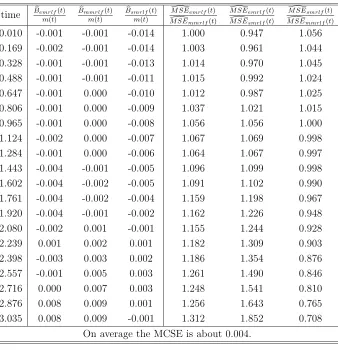
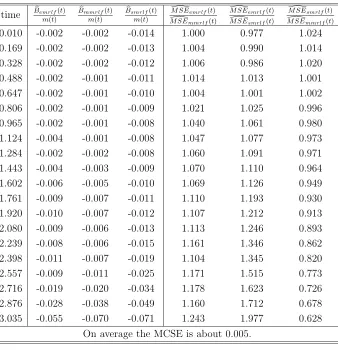
Figures 1-4 show the graphical summary of the simulation for the targeted censoring rates of 0%, 20%, 40%, and 60%, respectively. In each figure, Panels 1, 3, and 5 feature the boxplots of the 1000 replications of ˆm(t) changing with time for emrlf, mmrlf, and smrlf, respectively. Panel 2 compares the averaged emrlf, mmrlf, and smrlf from the 1000 replications with the true mrlf. Panel 4 compares the bias of averaged emrlf, mmrlf, and smrlf with 0. Panel 6 shows the relative efficiency (RE) of emrlf to mmrlf (in dotted line), emrlf to smrlf (in dash line). Tables 2-5 list the relative bias and the relative efficiency for the experiments of the censoring rates of 0%, 20%, 40%, and 60%, respectively.
mmrlf, and smrlf increases with the censoring rate as expected. With the increase of the censoring rate, the bias for emrlf, mmrlf, and smrlf also increase. These are reasonable results, because the information provided by the data is limited by the censored observations.
Figure 1 and Table 2 present the simulation results for data with 0% censoring rate, i.e., complete data. It can be seen from Figure 1 that emrlf, mmrlf, and smrlf have the similar performance for the small and moderate time points. While emrlf has the largest variation and the smrlf has the least variation for the extreme time points. From Table 2, it can be seen that smrlf has larger relative biases at small time points compared to emrlf and mmrlf. It turns out that these biases of smrlf are statistically significant (P-value < 0.05) for all time points smaller than 1.92 (the 33%tile of this Weibull distribution). Generally, mmrlf has smaller biases than emrlf, though none of the biases from emrlf or mmrlf are significantly different from 0. In terms of relative efficiency, mmrlf is always better than emrlf. The smrlf is less efficient for small time points and more efficient for large time points compared to emrlf and smrlf. Therefore, based on relative bias and relative efficiency, mmrlf is a better estimator compared to emrlf, and mmrlf is a better estimator for small time points compared to smrlf. The reason why smrlf does better for large time points might be that the number of the observations used to calculate mmrlf and emrlf decreases with the increase of time, while the number of the observation used to calculate smrlf stays the same. In summary, mmrlf is a definitely better estimator compared to emrlf and a competitive estimator to smrlf for complete data.
Figure 2 and Table 3 present the simulation results for data with 20% censoring rate. We get the similar results for slightly censored data as for the complete data, i.e., mmrlf is a better estimator compared to emrlf and a better estimator for small data points compared to smrlf.
Figure 3 and Table 4 present the simulation results for data with 40% censoring rate. For all the time points studied in this simulation, smrlf is significantly biased. It appears that emrlf and mmrlf are only biased for time points larger than quantile 0.875 (P-value <0.05). Therefore, for moderately censored data, mmrlf is better than emrlf and smrlf.
and smrlf are smaller than those from smrlf. Therefore, for highly censored data, emrlf, smrlf and mmrlf are not so good estimators.
Considering the fact that we sometimes may encounter data sets with a very large sample size, we attempted to compare the performance of emrlf, mmrlf, and smrlf for a simulation study for data with a sample size of 5000. We set the other conditions as before, except that the sample size n changed to 5000 from 100. Since the calculation of smrlf involves smoothing the survival function in the numerator and denominator (see (2)), the computation for data with a sample size of 5000 is very intensive. We failed to do the simulation for smrlf under our computing resource. Since ˆme(t) and ˆmm(t) have closed calculation forms, it did not take much time to do the simulation for emrlf and mmrlf. The results show that mmrlf is more efficient compared to emrlf for data with a very large sample size.
4
Application to a Melanoma Study
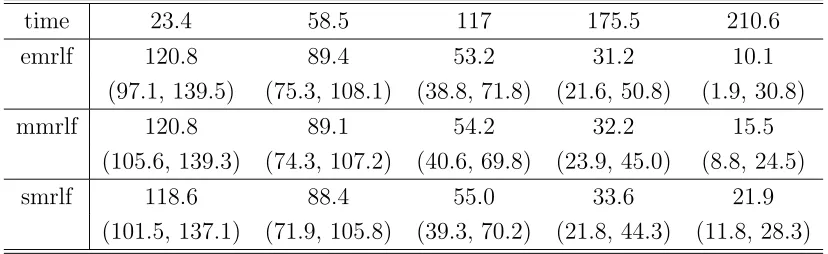
We apply our estimation methods to the data set given in Ghorai et al. (1982). This data set has the survival times (in weeks) of 68 participants of a melanoma study conducted by the Central Oncology Group with headquarters at the Univer-sity of Wisconsin-Madison. This data set has a censoring rate of 58.8%.
Figure 5 shows the results of the three methods. Panel 1 compares emrlf, mmrlf, and smrlf. Panel 2-4 show the 95% asymptotic confidence interval from case resampling for emrlf, mmrlf, and smrlf, respectively. It can be seen that emrlf, mmrlf, and smrlf have similar results for this highly censored data. However, unlike emrlf is a discontinuous estimator, mmrlf and smrlf are smooth estimators. It also can be seen that emrlf vanishes at the largest time point, while mmrlf and smrlf can take positive values. This indicates that mmrlf and smrlf can have a better prediction performance than emrlf even outside the observed time range.
Table 1: Estimated mrlf’s with 95% CI at some time points for the Melanoma study
time 23.4 58.5 117 175.5 210.6
emrlf 120.8 89.4 53.2 31.2 10.1
(97.1, 139.5) (75.3, 108.1) (38.8, 71.8) (21.6, 50.8) (1.9, 30.8)
mmrlf 120.8 89.1 54.2 32.2 15.5
(105.6, 139.3) (74.3, 107.2) (40.6, 69.8) (23.9, 45.0) (8.8, 24.5)
smrlf 118.6 88.4 55.0 33.6 21.9
(101.5, 137.1) (71.9, 105.8) (39.3, 70.2) (21.8, 44.3) (11.8, 28.3)
given that the patient has already survived at least 117 weeks after entering the study. Also a 95% confidence interval for ˆmm(117) is (40.6, 69.8), which indicates that it is highly unlikely that the patient will survival beyond about 70 weeks and it is also highly unlikely that the patient will survival less than about 40 weeks after entering the study for 117 weeks.
Notice that the conclusions derived from Table 1 can not be made using the hazard function directly. This illustrates one of the advantages of using the mean residual life function over the traditional hazard function.
5
Discussion
In the literature, researchers often first estimate the survival function and then calculate ˆme(t). The closed form of ˆme(t) from (6) provides an easy and unified calculation procedure for complete data and right-censored data. The closed form of our scale mixture mrlf ˆmm(t) from (8) is a nonparametric smooth estimator of the mrlf for complete and right censored data.
ˆ
mm(t) is always a better estimator compared to ˆme(t). In terms of bias, ˆmm(t) is always a better estimator compared to the Chaubey and Sen’s (1999) estimator
ˆ
ms(t). In terms of MSE, ˆmm(t) is competitive to ˆms(t).
Finally, ˆme(t) and ˆmm(t) are computationally less demanding compared to the ˆ
0.01 0.68 1.35 2.03 2.7
0123
emrlf
0.0 0.5 1.0 1.5 2.0 2.5 3.0
0.6
1.0
1.4
1.8
averaged mrlf
0.01 0.68 1.35 2.03 2.7
0123
mmrlf
0.0 0.5 1.0 1.5 2.0 2.5 3.0
−0.03
−0.01
0.01
bias emrlf
mmrlf smrlf
0.01 0.68 1.35 2.03 2.7
0123
time points
smrlf
0.0 0.5 1.0 1.5 2.0 2.5 3.0
0.8
1.2
1.6
2.0
time points
RE
emrlf/mmrlf emrlf/smrlf
Figure 1: Estimated emrlf, mmrlf, and smrlf under 0% censoring rate
0.01 0.68 1.35 2.03 2.7
0123
emrlf
0.0 0.5 1.0 1.5 2.0 2.5 3.0
0.6
1.0
1.4
1.8
averaged mrlf
0.01 0.68 1.35 2.03 2.7
0123
mmrlf
0.0 0.5 1.0 1.5 2.0 2.5 3.0
−0.03
−0.01
0.01
bias emrlf
mmrlf smrlf
0.01 0.68 1.35 2.03 2.7
0123
time points
smrlf
0.0 0.5 1.0 1.5 2.0 2.5 3.0
0.8
1.2
1.6
2.0
time points
RE
emrlf/mmrlf emrlf/smrlf
0.01 0.68 1.35 2.03 2.7
0123
emrlf
0.0 0.5 1.0 1.5 2.0 2.5 3.0
0.6
1.0
1.4
1.8
averaged mrlf
0.01 0.68 1.35 2.03 2.7
0123
mmrlf
0.0 0.5 1.0 1.5 2.0 2.5 3.0
−0.03
−0.01
0.01
bias
emrlf mmrlf smrlf
0.01 0.68 1.35 2.03 2.7
0123
time points
smrlf
0.0 0.5 1.0 1.5 2.0 2.5 3.0
0.8
1.2
1.6
2.0
time points
RE
emrlf/mmrlf emrlf/smrlf
Figure 3: Estimated emrlf, mmrlf, and smrlf under 40% censoring rate
0.01 0.68 1.35 2.03 2.7
0123
emrlf
0.0 0.5 1.0 1.5 2.0 2.5 3.0
0.6
1.0
1.4
1.8
averaged mrlf
0.01 0.68 1.35 2.03 2.7
0123
mmrlf
0.0 0.5 1.0 1.5 2.0 2.5 3.0
−0.20
−0.10
0.00
bias emrlf
mmrlf smrlf
0.01 0.68 1.35 2.03 2.7
0123
time points
smrlf
0.0 0.5 1.0 1.5 2.0 2.5 3.0
0.8
1.2
1.6
2.0
time points
RE
emrlf/mmrlf emrlf/smrlf
Table 2: Relative biases and efficiency of estimated mrlf’s under 0% censoring rate
time Bemrlf(t) m(t)
Bmmrlf(t) m(t)
Bsmrlf(t) m(t)
M SEemrlf(t)
M SEmmrlf(t)
M SEemrlf(t)
M SEsmrlf(t)
M SEsmrlf(t)
M SEmmrlf(t)
0.010 -0.001 -0.001 -0.014 1.000 0.947 1.056 0.169 -0.002 -0.001 -0.014 1.003 0.961 1.044 0.328 -0.001 -0.001 -0.013 1.014 0.970 1.045 0.488 -0.001 -0.001 -0.011 1.015 0.992 1.024 0.647 -0.001 0.000 -0.010 1.012 0.987 1.025 0.806 -0.001 0.000 -0.009 1.037 1.021 1.015 0.965 -0.001 0.000 -0.008 1.056 1.056 1.000 1.124 -0.002 0.000 -0.007 1.067 1.069 0.998 1.284 -0.001 0.000 -0.006 1.064 1.067 0.997 1.443 -0.004 -0.001 -0.005 1.096 1.099 0.998 1.602 -0.004 -0.002 -0.005 1.091 1.102 0.990 1.761 -0.004 -0.002 -0.004 1.159 1.198 0.967 1.920 -0.004 -0.001 -0.002 1.162 1.226 0.948 2.080 -0.002 0.001 -0.001 1.155 1.244 0.928 2.239 0.001 0.002 0.001 1.182 1.309 0.903 2.398 -0.003 0.003 0.002 1.186 1.354 0.876 2.557 -0.001 0.005 0.003 1.261 1.490 0.846 2.716 0.000 0.007 0.003 1.248 1.541 0.810 2.876 0.008 0.009 0.001 1.256 1.643 0.765 3.035 0.008 0.009 -0.001 1.312 1.852 0.708
On average the MCSE is about 0.004.
Table 3: Relative biases and efficiency of estimated mrlf’s under 20% censoring rate
time Bemrlf(t) m(t)
Bmmrlf(t) m(t)
Bsmrlf(t) m(t)
M SEemrlf(t)
M SEmmrlf(t)
M SEemrlf(t)
M SEsmrlf(t)
M SEsmrlf(t)
M SEmmrlf(t)
0.010 -0.001 -0.001 -0.013 1.000 0.966 1.036 0.169 -0.001 -0.001 -0.013 1.002 0.977 1.026 0.328 -0.001 -0.001 -0.012 1.010 0.981 1.030 0.488 0.000 0.000 -0.010 1.013 1.007 1.006 0.647 0.000 0.001 -0.009 1.010 1.002 1.008 0.806 0.000 0.001 -0.007 1.035 1.038 0.998 0.965 0.000 0.001 -0.006 1.052 1.067 0.986 1.124 -0.001 0.001 -0.005 1.057 1.077 0.981 1.284 0.001 0.001 -0.005 1.063 1.084 0.981 1.443 -0.001 0.001 -0.004 1.083 1.105 0.980 1.602 -0.002 -0.001 -0.004 1.083 1.117 0.969 1.761 -0.005 -0.002 -0.004 1.124 1.187 0.947 1.920 -0.005 -0.002 -0.004 1.152 1.240 0.929 2.080 -0.005 -0.001 -0.004 1.143 1.253 0.912 2.239 -0.002 0.000 -0.004 1.160 1.308 0.887 2.398 -0.006 0.000 -0.004 1.177 1.374 0.857 2.557 -0.002 0.002 -0.005 1.222 1.486 0.822 2.716 -0.005 0.003 -0.008 1.178 1.517 0.777 2.876 0.002 0.003 -0.012 1.237 1.722 0.718 3.035 0.000 -0.002 -0.018 1.292 1.963 0.658
Table 4: Relative biases and efficiency of estimated mrlf’s under 40% censoring rate
time Bemrlf(t) m(t)
Bmmrlf(t) m(t)
Bsmrlf(t) m(t)
M SEemrlf(t)
M SEmmrlf(t)
M SEemrlf(t)
M SEsmrlf(t)
M SEsmrlf(t)
M SEmmrlf(t)
0.010 -0.002 -0.002 -0.014 1.000 0.977 1.024 0.169 -0.002 -0.002 -0.013 1.004 0.990 1.014 0.328 -0.002 -0.002 -0.012 1.006 0.986 1.020 0.488 -0.002 -0.001 -0.011 1.014 1.013 1.001 0.647 -0.002 -0.001 -0.010 1.004 1.001 1.002 0.806 -0.002 -0.001 -0.009 1.021 1.025 0.996 0.965 -0.002 -0.001 -0.008 1.040 1.061 0.980 1.124 -0.004 -0.001 -0.008 1.047 1.077 0.973 1.284 -0.002 -0.002 -0.008 1.060 1.091 0.971 1.443 -0.004 -0.003 -0.009 1.070 1.110 0.964 1.602 -0.006 -0.005 -0.010 1.069 1.126 0.949 1.761 -0.009 -0.007 -0.011 1.110 1.193 0.930 1.920 -0.010 -0.007 -0.012 1.107 1.212 0.913 2.080 -0.009 -0.006 -0.013 1.113 1.246 0.893 2.239 -0.008 -0.006 -0.015 1.161 1.346 0.862 2.398 -0.011 -0.007 -0.019 1.104 1.345 0.820 2.557 -0.009 -0.011 -0.025 1.171 1.515 0.773 2.716 -0.019 -0.020 -0.034 1.178 1.623 0.726 2.876 -0.028 -0.038 -0.049 1.160 1.712 0.678 3.035 -0.055 -0.070 -0.071 1.243 1.977 0.628
On average the MCSE is about 0.005.
Table 5: Relative biases and efficiency of estimated mrlf’s under 60% censoring rate
time Bemrlf(t) m(t)
Bmmrlf(t) m(t)
Bsmrlf(t) m(t)
M SEemrlf(t)
M SEmmrlf(t)
M SEemrlf(t)
M SEsmrlf(t)
M SEsmrlf(t)
M SEmmrlf(t)
0.010 -0.010 -0.010 -0.020 1.000 0.974 1.027 0.169 -0.010 -0.010 -0.021 1.003 0.980 1.023 0.328 -0.011 -0.011 -0.021 1.007 0.986 1.022 0.488 -0.011 -0.011 -0.020 1.010 0.988 1.023 0.647 -0.013 -0.012 -0.021 1.005 0.987 1.018 0.806 -0.014 -0.013 -0.022 1.022 1.014 1.008 0.965 -0.017 -0.016 -0.024 1.020 1.026 0.994 1.124 -0.022 -0.019 -0.027 1.043 1.063 0.981 1.284 -0.023 -0.022 -0.030 1.046 1.073 0.975 1.443 -0.028 -0.026 -0.034 1.030 1.074 0.959 1.602 -0.033 -0.031 -0.039 1.092 1.174 0.930 1.761 -0.039 -0.037 -0.046 1.088 1.201 0.906 1.920 -0.047 -0.044 -0.054 1.095 1.242 0.882 2.080 -0.055 -0.052 -0.065 1.102 1.300 0.848 2.239 -0.058 -0.065 -0.081 1.114 1.394 0.799 2.398 -0.081 -0.087 -0.102 1.132 1.531 0.739 2.557 -0.110 -0.124 -0.131 1.162 1.711 0.680 2.716 -0.155 -0.176 -0.168 1.206 1.921 0.628 2.876 -0.233 -0.246 -0.213 1.196 2.066 0.579 3.035 -0.332 -0.329 -0.266 1.203 2.295 0.524
50 100 150 200
0
2
0
4
0
6
0
8
0
100
120
mrlf
emrlf mmrlf smrlf
50 100 150 200
0
2
0
4
0
6
0
8
0
100
120
emrlf
50 100 150 200
20
40
60
80
100
120
time points
mmrlf
50 100 150 200
20
40
60
80
100
120
time points
smrlf
References
Abdous, B. and Berred, A. (2005). Mean Residual Life Estimation. Journal of Statistical Planning and Inference 132, 3-19.
Agarwal, S.L. and Kalla, S.L. (1996). A Generalized Gamma Distribution and its Application in Reliability, Communications in Statistics, Theory and Meth-ods 25, 201-210.
Chaubey, Y.P. and Sen, P.K. (1999). On Smooth Estimation of Mean Residual Life. Journal of Statistical Planning and Inference 75, 223-236.
Feller W. (1966). An Introduction to Probability Theory and its Applications. Vol. II. Wiley, New York.
Ghorai, J., Susarla, A., Susarla, V., and Van-Ryzin, J. (1982). Nonparametric Estimation of Mean Residual Life Time with Censored Data. Nonparametric Statistical Inference. Vol.I, Colloquia Mathematica Societatis, 32. North-Holland, Amsterdam-New York, 269-291.
Gupta, R.C. and Bradley, D.M. (2003). Representing the Mean Residual Life in Terms of the Failure Rate. Mathematical and Computer Modelling 37, 1271-1280.
Gupta, R.C. and Lvin, S. (2005). Monotonicity of Failure Rate and Mean Resid-ual Life Function of a Gamma-type Model. Applied Mathematics and Com-putation 165, 623-633.
Hall, W.J. and Wellner, J.A. (1981). Mean Residual Life. Statistics and Related Topics. Edited by M. Csorgo, D.A. Dawson, J.N.K. Rao , and A.K.Md.E. Saleh. North-Holland, Amsterdam. 169-184.
Hille, E. (1948). Functional Analysis and Semigruops. Am.Math.Soc.Colloq. Pub., Vol.31, American Mathematical Society.
Kalla, S.L., Al-Saqabi, H.G., Khajah, H.G. (2001). A Unified Form of Gamma-type Distributions. Applied Mathematics and Computation 118, 175-187.
Kulasekera, K.B. (1991). Smooth Nonparametric Estimation of Mean Residual Life. Microelectron. Reliability 31(1), 97-108.
Lai, C.D., Zhang, L., Xie, M. (2004). Mean Residual Life and Other Properties of Weibull Related Bathtub Shape Failure Rate Distributions. International Journal of Reliability, Quality and Safety Engineering 11, 113-132.
Petrone, S. and Veronese, P. (2002). Non Parametric Mixture Priors Based on an Exponential Random Scheme. Statistical Methods and Applications 11, 105-116.
Ruiz, J.M. and Guillamon, A. (1996). Nonparametric Recursive Estimator of Residual Life and Vitality Funcitons under Mixing Dependence Condtions. Communcation in Statistics, Theory and Methods 4, 1999-2011.
Tsang, A.H.C. and Jardine, A.K.S. (1993). Estimation of 2-parameter Weibull Distribution from Incomplete Data with Residual Lifetimes. IEEE Thans. Reliablity 42, 291-298.
Appendix A
Proof of Feller Approximation Lemma:
Let Fk,t denote the cumulative distribution function of Zk(t). Since g is right continuous at t, given > 0 there exists δ1 > 0 such that z ∈ (t, t+ δ1) ⇒
|g(z)−g(t)|< and P[t−δ1 < Zk(t)< t]< . Since g is bounded, we can find a
δ0 such that |g| ≤M for all z−t ≥δ0. Take δ=max(δ1, δ0), then
|E(g(Zk(t)))−g(t)| ≤E[|g(Zk(t))−g(t)|]
=
|g(z)−g(t)|dFk,t(z)
=
z∈(t,t+δ)
|g(z)−g(t)|dFk,t(z) +
z /∈(t,t+δ)
|g(z)−g(t)|dFk,t(z)
≤ P[t < Zk(t)< t+δ] + 2M P[Zk(t)< t orZk(t)> t+δ]
≤ + 2M{P[|Zk(t)−t|> δ] +P[t−δ1 < Zk(t)< t]}
≤ + 2M
σk2(t)
δ2 +
Let k→ ∞, we get σk2(t)→0 and
lim
k→∞E[|g(Zk(t))−g(t)|]≤.
But >0 is arbitrary, so
lim
k→∞E[|g(Zk(t))−g(t)|] = 0,
i.e.,
lim
k→∞E(g(Zk(t))) =g(t).
Appendix B
Proof of the Scale Mixture Theory:
Proof: Notice that, for θ >0,
m(tθ)
θ = E[T −tθ|T > tθ]
1
θ
= E
T θ −t
T θ > t
.
Hence m(θtθ) is the mrlf of Tθ and (a) is proved. Next,
∞
0
m(tθ)
θ π(θ)dθ = Eπ
E
T θ −t
Tθ > tθ
= E
T θ −t
Tθ > t
Hence, 0∞ m(tθ)
θ π(θ)dθ is the mrlf of Tθ where Tθ|θ∼ m(tθ)
θ and θ∼ π(·), and (b) is
proved. Notice that the mrlf uniquely determines a distribution, thus Tθ|θ∼ m(θtθ), which means that the conditional distribution of T
θ given θ is the distribution
Appendix C
The details of the calculation of mˆm(t):
ˆ
mm(t), the smooth estimator of m(t) for censored data ( complete data are special case of censored data where weight functionwj = 1
n), can be calulated with
a closed form. The details of the calculation are given here.
ˆ mm(t) =
∞
0 mˆe(u)f
ukn, t kn du= n−1 l=0 Xl+1 Xl ˆ me(u)f
ukn, t kn du = n−1 l=0 n
j=l+1Xjwj
n
j=l+1wj
Xl+1
Xl
f
ukn, t
kn du− Xl+1 Xl uf
ukn, t
kn du = n−1 l=0 ⎡ ⎢ ⎣ n
j=l+1Xjwj
n
j=l+1wj
Xl+1
Xl
f
ukn, t kn du− Xl+1 Xl uu
kn−1
t kn
kn
Γ(kn) e
−( t kn)udu
⎤ ⎥ ⎦ = n−1 l=0 n
j=l+1Xjwj
n
j=l+1wj
Xl+1
Xl
f
ukn, t
kn du− t kn kn 1 Γ(kn)
Xl+1
Xl
ukne−(knt )udu
= n−1 l=0 ⎡ ⎢ ⎣ n
j=l+1Xjwj
n
j=l+1wj
Xl+1
Xl
f
ukn, t
kn
du−Γ(kn+ 1) Γ(kn)
t kn
Xl+1
Xl
ukn
t kn
kn+1
Γ(kn+ 1) e
−( t kn)udu
⎤ ⎥ ⎦ = n−1 l=0 n
j=l+1Xjwj
n
j=l+1wj
Xl+1
Xl
f
ukn, t kn
du−t
Xl+1
Xl
f
ukn+ 1, t kn du = n−1 l=0 n
j=l+1Xjwj
n
j=l+1wj
F
Xl+1
kn, t
kn −F Xl kn, t
kn − n−1 l=0 t F
Xl+1kn+ 1, t
kn
−F
Xlkn+ 1, t
kn = n−1 l=0 n
j=l+1Xjwj
n
j=l+1wj
F
Xl+1kn, t kn
−F
Xlkn, t kn −t F
Xnkn+ 1, t kn
−F
X0kn+ 1, t kn = n−1 l=0 n
j=l+1Xjwj
n
j=l+1wj
F
Xl+1kn, t kn
−F
Xlkn, t kn
−tF
Xnkn+ 1, t kn
,