High Quality Digital Watermarking based on
SVD-DWT Scheme with Noise Attacks
Pooja Subhash Patil1, Prof. Kamal Niwaria2, Dr. Manish Jain3
M. E. Scholar, Department of Electronics and Communication, R.K.D.F. Institute of Science and Technology,
Bhopal, India1
Assistant Professor, Department of Electronics and Communication, R.K.D.F. Institute of Science and Technology,
Bhopal, India 2
Head of Department, Department of Electronics and Communication, R.K.D.F. Institute of Science and Technology,
Bhopal, India 3
ABSTRACT: In order to improve the robustness and imperceptibleness of the algorithm, a new embedding and
extracting method with DWT-SVD is proposed. The approximation matrix of the third level of image in DWT domain is modified with SVD to embed the singular value of watermark to the singular value of DWT coefficient. The proposed embedding and extracting method was employed to accelerate the hybrid DWT-SVD watermarking and to avoid the leak of watermark. This hybrid technique leads to optimize both the fundamentally conflicting requirements. The experimental results show both the good robustness under numerous attacks and the high fidelity. The time needed to perform the program is greatly decreased.
KEYWORDS: Discrete Wavelet Transform, SVD, PSNR, MSE
I. INTRODUCTION
In the recent few years, there is a serious problem about unauthorized and illegal access and manipulation of multimedia files over internet. Everybody can obtain copies of copyrighted multimedia openly. So we need to generate a robust method in order to protect the copy rights of media. Digital watermarking provides copyright protection of data. It is done by embedding additional information called digital signature or watermark into the digital contents such that it can be detected, extracted later to make an assertion about the multimedia data. [1, 2] For image watermarking, the algorithms can be categorized into one of the two domains: spatial domain or transform domain. [1, 2] In Spatial domain the data is embedded directly by modifying pixel values of the host image, while transform domain schemes embed data by modifying transform domain coefficients. Algorithms used for special domain are less robust for various attacks as the changes are made at least Significant Substitution (LSB) of original data. While in the transform-domain the watermark is embedded by changing the magnitude of coefficients in a transform domain with the help of discrete cosine transform, discrete wavelet transform (DWT), and singular value decomposition (SVD) techniques[3, 5]. This provide most robust algorithm for many common attacks. [7] In this paper we proposed a hybrid watermarking using DWT and SVD technique in order to achieve high robustness and transparency.
This particular application area is known as fingerprinting and thus has numerous financial implications. The most serious attack for fingerprinting is the “collusion attack”. If attacker has access to more than one copy of watermarked image, he/she can predict/ remove the watermark data by colluding them. Researchers working on “fingerprinting” primarily focus on the “collusion attack”.
So, while designing a watermark scheme, we decided that our proposed schemes must be designed in such a way that schemes are inherently collusion attack resistant. Therefore this thesis presents a new term “ICAR (Inherently Collusion Attack Resistant)” as a requirement for a watermarking system. The other 3 issues are taken into account while developing the watermarking schemes.
The first chapter is devoted to the introduction of the watermarking area. Data hiding background is represented and the related terminologies are explained. Then various application areas of watermarking are represented and what may the key requirements of a successful watermarking system are discussed. Since watermarking can be classified on various parameters, the various types of watermarking are represented based on different classifications.
ISSUE 1: Till now there is no “Generic” nature in the watermarking algorithms available. More precisely, if certain approach is applicable for a gray level image, the same approach does not work for the other formats of an image.
ISSUE 2: Even if gray color image watermarking algorithms are extended for RGB color images, the maximum work has been done for BLUE color channel only because human eyes are less sensitive to detect the changes in BLUE color channel. No attack impact analysis, i.e, which color channel may be affected by a particular attack, has been carried out.
Therefore, apart from choosing digital Image Watermarking as a major problem, we have chosen to identify the suitability of a color channel with respect to attack (if any) for multicolor channel images (True color windows BMP, uncompressed JPEG). We also decided to explore the ways such that attack impacts may be minimized before the watermark embedding process.
ISSUE 3: In most of the research papers, once the watermarking scheme is finalized, it is applied to all test images. Since each image is different and has certain characteristics and after embedding the watermark data by a particular watermarking scheme, its performance against a particular attack may not be similar with other image. No study is conducted to make the embedding scheme based on some image characteristics.
II. DIGITAL WATERMARKING
The information to be embedded in a signal is called a digital watermark, although in some contexts the phrase digital watermark means the difference between the watermarked signal and the cover signal. The signal where the watermark is to be embedded is called the host signal. A watermarking system is usually divided into three distinct steps, embedding, attack, and detection. In embedding, an algorithm accepts the host and the data to be embedded, and produces a watermarked signal.
Then the watermarked digital signal is transmitted or stored, usually transmitted to another person. If this person makes a modification, this is called an attack. While the modification may not be malicious, the term attack arises from copyright protection application, where third parties may attempt to remove the digital watermark through modification. There are many possible modifications, for example, lossy compression of the data (in which resolution is diminished), cropping an image or video, or intentionally adding noise.
Figure 1: General digital watermark life-cycle phases with embedding-, attacking-, and detection and retrieval functions
III. DISCRETE WAVELET TRANSFORM
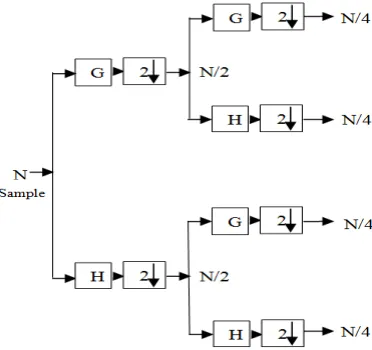
The model used in [5] to implement the tree structure of Direct Wavelet Transform (DWT) is based on the filtering process. Figure 1 depicted a complete 2-level Direct WT. In this figure G and H is the high pass and low pass filter respectively.
Computation period is the number of the input cycles for one time produces output samples. In general, the computation period is M= for a j-level DWT. The period of the 2-level computation is 8. Figure 1, The Sub band Coding Algorithm As an example, suppose that the original signal X[n] has N- sample points, spanning a frequency band of zero to π rad/s. At the first decomposition level, the signal passed through the high pass and low pass filters, followed by subsampling by 2. The output of the high pass filter has N/2- sample points (hence half the time resolution) but it only spans the frequencies /2 to rad/s (hence double the frequency resolution).
The output of the low-pass filer also has N/2- sample points, but it spans the other half of the frequency band, frequencies from 0 to /2 rad/s. Again low and high-pass filter output passed through the same low pass and high pass filters for further decomposition. The output of the second low pass filter followed by sub sampling has N/4 samples spanning a frequency band of 0 to /4 rad/s, and the output of the second high pass filter followed by sub sampling has N/4 samples spanning a frequency band of /4 to /2 rad/s. The second high pass filtered signal constitutes the second level of DWT coefficients. This signal has half the time resolution, but twice the frequency resolution of the first level signal. This process continues until two samples are left. For this specific example there would be 3 levels of decomposition, each having half the number of samples of the previous level.
FIGURE 2:2-LEVELS FOR DWT.WHERE G,H ARE THE HIGH-PASS AND LOW-PASS FILTER COEFFICIENT
IV. PROPOSED METHODOLOGY
DWT involves decomposition of image into frequency channel of constant bandwidth. This causes the similarity of available decomposition at every level. DWT is implemented as multistage transformation. Level wise decomposition is done in multistage transformation.
S is a diagonal matrix of singular values in decreasing order. The basic idea behind SVD technique of watermarking is to find SVD of image and the altering the singular value to embed the watermark. In Digital watermarking schemes, SVD is used due to its main properties:
1) A s mall agitation added in the image, does not cause large variation in its singular values. 2) 2) The singular value represents intrinsic algebraic image properties. [3]
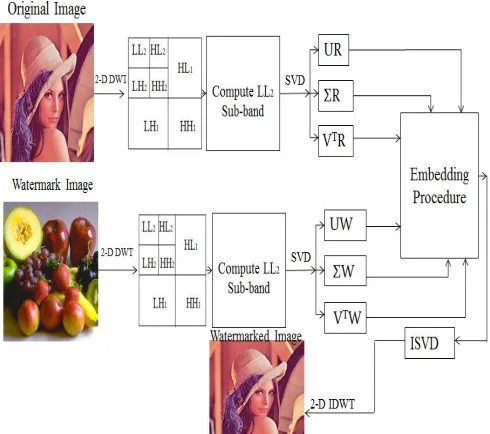
Figure 3: Flow Chart of Proposed Methodology
Algorithm for Watermark Embedding
Step 1: Take host image as input and convert it into Rearrange image original (RIO).
Step 2: Apply 2-D DWT on rearranged image original (RIO) to decompose it into seven sub-bands. Step 3: Select sub-band LL2 of RI.
Step 4: Then apply SVD to sub-bands LL2 to get UR, ΣR and VTR.
Step 5: Take watermark image as input and convert it into Rearrange image watermark (RIW). Apply 2-D DWT on rearranged image watermark (RIO) to decompose into seven sub-bands.
Step 6: Select sub-bands LL2 of Wi.
Step 7: Then apply SVD to sub-bands LL2 to get UW, ΣW and VTW.
Step 8: Modify UR, ΣR and VTR by using equation UR* = UR + (0.10*UW);
ΣR* = ΣR + (0.10* ΣW); VTR* = VTR +(0.10* VTW);
Step 9: Construct modified SVD matrix UR*, ΣR* and VTR*. Step 10: Apply inverse SVD.
V. SIMULATION RESULT
Discrete Wavelet Transform (DWT): The digital wavelet transform are scalable in nature. DWT more frequently used in digital image watermarking because of its excellent spatial localization and multi resolution techniques. The excellent spatial localization property is very convenient to recognize the area in the cover image in which the watermark is embedded efficiently.
Singular value decomposition (SVD): Singular value decomposition is a linear algebra technique used to solve many mathematical problems. Any image can be considered as a square matrix without loss of generality. So SVD technique can be applied to any kind of images. The SVD belongs to orthogonal transform which decompose the given matrix into three matrices of same size.
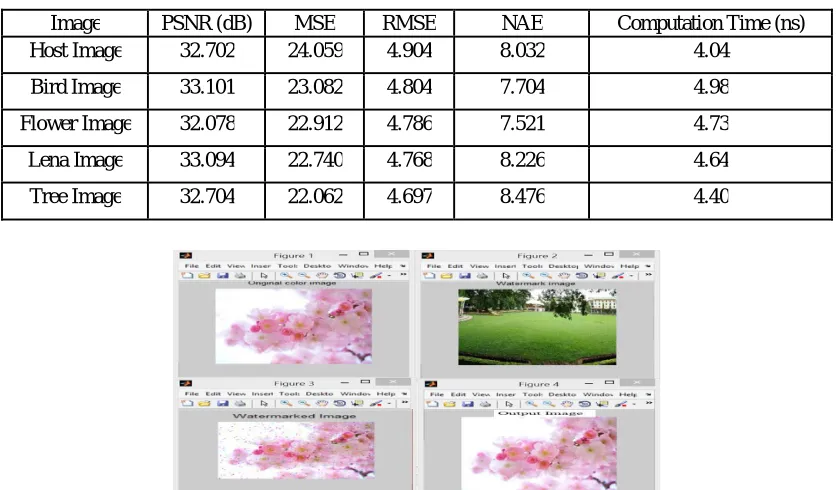
Figure 5: DWT-SVD Technique is applied to the without noise attack
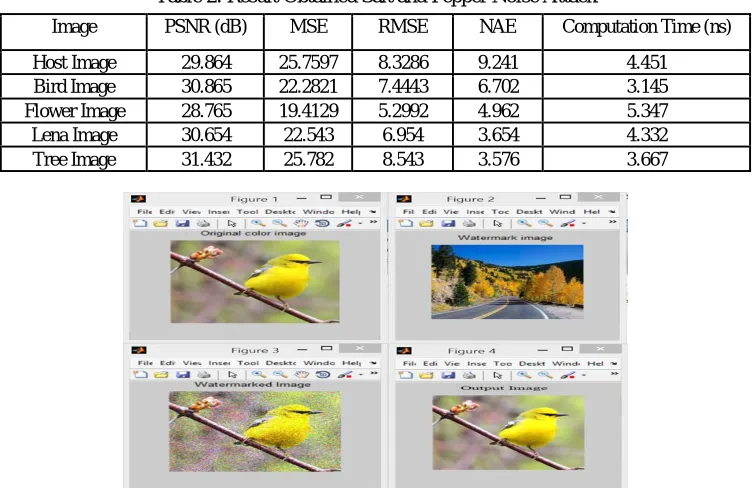
Figure 6: DWT-SVD Technique are applied to the Salt and Pepper Noise Attack
Image PSNR (dB) MSE RMSE NAE Computation Time (ns)
Host Image 32.702 24.059 4.904 8.032 4.04
Bird Image 33.101 23.082 4.804 7.704 4.98
Flower Image 32.078 22.912 4.786 7.521 4.73
Lena Image 33.094 22.740 4.768 8.226 4.64
Tree Image 32.704 22.062 4.697 8.476 4.40
Table 2: Result Obtained Salt and Pepper Noise Attack
Figure 7: DWT-SVD Technique are applied to the Gaussian Noise Attack
Table 3: Result Obtained Gaussian Noise Attack
Figure 8: DWT-SVD Technique are applied to Gaussian Localvar Noise Attack Image PSNR (dB) MSE RMSE NAE Computation Time (ns)
Host Image 29.864 25.7597 8.3286 9.241 4.451 Bird Image 30.865 22.2821 7.4443 6.702 3.145 Flower Image 28.765 19.4129 5.2992 4.962 5.347 Lena Image 30.654 22.543 6.954 3.654 4.332 Tree Image 31.432 25.782 8.543 3.576 3.667
Image PSNR (dB) MSE RMSE NAE Computation Time (ns)
Host Image 33.902 23.759 4.874 7.893 4.89
Bird Image 32.901 21.982 4.688 7.904 4.43
Flower Image 33.078 20.412 4.517 7.021 4.84
Lena Image 34.094 21.540 4.641 7.226 4.63
Table 4: Result Obtained Gaussian Localvar Noise Attack
Figure 8: DWT-SVD Technique are applied to Poisson Noise Attack
Table 5: Result Obtained Poisson Noise Attack
VI. CONCLUSION
It has been proved that the use of DWT-SVD with fusion method has improved the security of the watermarking scheme. Particular attention is given to the proposed scheme to guarantee secure watermark embedding and easy extraction. The watermark is imperceptible to the human eye and recoverable most of the time. The watermarked images were assessed for fidelity by using PSNR and MSE. The new techniques could offer significant advantages to the digital watermark field and provide additional benefits to the copyright protection industry.
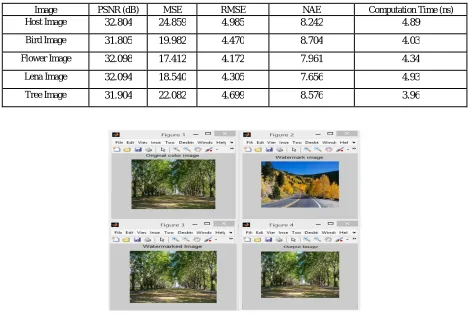
Image PSNR (dB) MSE RMSE NAE Computation Time (ns)
Host Image 32.804 24.859 4.985 8.242 4.89
Bird Image 31.805 19.982 4.470 8.704 4.03
Flower Image 32.098 17.412 4.172 7.961 4.34
Lena Image 32.094 18.540 4.305 7.656 4.93
Tree Image 31.904 22.082 4.699 8.576 3.96
Image PSNR (dB) MSE RMSE NAE Computation Time (ns) Host Image 34.702 24.059 4.904 8.032 4.04
Bird Image 34.501 23.082 4.804 7.704 4.98
Flower Image 34.278 22.912 4.786 7.521 4.73
Lena Image 34.194 22.740 4.768 8.226 4.64
REFRENCES
[1] N. Senthil Kumaran, and S. Abinaya, “Comparison Analysis of Digital Image Watermarking using DWT and LSB Technique”, International Conference on Communication and Signal Processing, April 6-8, 2016, India.
[2] Aase, S.O., Husoy, J.H. and Waldemar, P. (2014) A Critique of SVD-Based Image Coding Systems, IEEE International Symposium on Circuits and Systems VLSI, Orlando, FL, Vol. 4, Pp. 13-16.
[3] Ahmed, F. and Moskowitz, I.S. (2014) Composite Signature Based Watermarking for Fingerprint Authentication, ACM Multimedia and Security Workshop, New York, Pp.1-8.
[4] Akhaee, M.A., Sahraeian, S.M.E. and Jin, C. (2013) Blind Image Watermarking Using a Sample Projection Approach, IEEE Transactions on Information Forensics and Security, Vol. 6, Issue 3, Pp.883-893.
[5] Ali, J.M.H. and Hassanien, A.E. (2012) An Iris Recognition System to Enhance E-security Environment Based on Wavelet Theory, Advanced Modeling and Optimization, Vol. 5, No. 2, Pp. 93-104.
[6] Al-Otum, H.M. and Samara, N.A. (2009) A robust blind color image watermarking based on wavelet-tree bit host difference selection, Signal Processing, Vol. 90, Issue 8, Pp. 2498-2512.
[7] Ateniese, G., Blundo, C., De Santis, A. and Stinson, D.R. (1996) Visual cryptography for general access structures, Information Computation, Vol. 129, Pp. 86-106.
[8] Baaziz, N., Zheng, D. and Wang, D. (2011) Image quality assessment based on multiple watermarking approach, IEEE 13th International Workshop on Multimedia Signal Processing (MMSP), Hangzhou, Pp.1-5.
[9] Bao, F., Deng, R., Deing, X. and Yang, Y. (2008) Private Query on Encrypted Data in Multi-User Settings, Proceedings of 4th International Conference on Information Security Practice and Experience (ISPEC 2008), Pp. 71-85, 2008.
[10] Barni, M. and Bartolini, F. (2004) Watermarking systems engineering: Enabling digital assets security and other application, Signal processing and communications series, Marcel Dekker Inc., New York.