ISSN(Online): 2319-8753 ISSN (Print) : 2347-6710
I
nternational
J
ournal of
I
nnovative
R
esearch in
S
cience,
E
ngineering and
T
echnology
(An ISO 3297: 2007 Certified Organization)
Vol. 5, Issue 6, June 2016
Secure and Authorized Data Deduplication
Using Hybrid Cloud Technique
Miss.Supriya Jadhav1, Prof. S. B. Chaudhari2
M.E Student, Dept. of Computer, Trinity College of Engineering, Pune, Maharastra, India 1 Asst. Professor, Dept. of Computer, Trinity College of Engineering, Pune, Maharastra, India2
ABSTRACT: Today onwards cloud computing concept is the market blasting .In that uploading and downloading operation performed as well as how much data we use that much we want to pay for it . Everyday data duplication difficulty come in scenario because huge amount of data uploaded on it .To diminish the size of same data uploaded on cloud one method we used is checking data duplication which data can get uploaded check it before uploading .For data uploading MD5 algorithm is used in this technique .In this technique user has allocate a special rights according to it perform duplicate check for achieving deduplication we had used hybrid cloud i.e private as well as public cloud .Finally results proves that proposed way is consume less resources of cloud and give safer proposed way .As compared simple deduplication technique this method has very less overhead .By using token generation step in proposed method check power of user and offer they allow for accessing of data .That privilege checking done at private cloud. After that data uploading as well as downloading happen as per PoW .In that proposed system we also add one advantage that is the data partitioning means two or more public cloud we want to use for strictly more security .In that concept he know if user attack on public cloud then may he know or have privileges of single cloud at that time he/she can get information partially and this is meaningless.
KEYWORDS: Authorization; data security; privilege; duplication; credentials; public cloud; private cloud..
I. INTRODUCTION
Today, Day after day cloud computing become famous as well as popular term .It hides platform as well as OS on the basis of large amount virtual environment .As per use of resources payment want to make. Today many cloud services are available in low cost also give high reliability. Sharing of data or file forwarding by large number of user done on cloud. It has three service modules like PaaS IaaS and SaaS. Managing of data on cloud everyday becoming a critical task. Handling or managing [2] on cloud, many managing technique are use, data deduplication is one of them.
ISSN(Online): 2319-8753 ISSN (Print) : 2347-6710
I
nternational
J
ournal of
I
nnovative
R
esearch in
S
cience,
E
ngineering and
T
echnology
(An ISO 3297: 2007 Certified Organization)
Vol. 5, Issue 6, June 2016
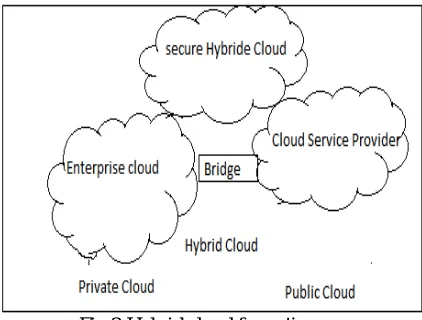
Fig 2:Hybrid cloud formation
To detect data duplication, deduplication of data is perfect or effective technique. It is simpler method, because of that it is on the way of famousing technique. Data compression is also done in that method .Data management as well as networking is done in data deduplication. It remove the copied and only keep original also references of original. First is file level and second is block level are two techniques of duplication checking. In first technique remove file of same name after checking from the storage. In second techniques removed the block which are duplicate data analysing security done in data deduplication. For users delicate data it give security as well as privacy .In traditional way many secret files created because of that need to encrypt data. Data deduplication come in scenario to avoid data duplication[5], for uploading as well as sharing of data check the user authentication in hybrid cloud .If user want to download the file he want to have PoW.
II. RELATEDWORK
ISSN(Online): 2319-8753 ISSN (Print) : 2347-6710
I
nternational
J
ournal of
I
nnovative
R
esearch in
S
cience,
E
ngineering and
T
echnology
(An ISO 3297: 2007 Certified Organization)
Vol. 5, Issue 6, June 2016
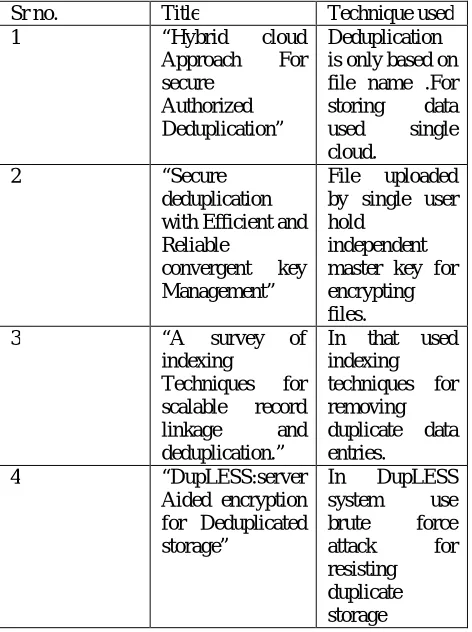
A. Different methods comparison
Sr no. Title Technique used 1 “Hybrid cloud
Approach For secure
Authorized Deduplication”
Deduplication is only based on file name .For storing data used single cloud.
2 “Secure deduplication with Efficient and Reliable
convergent key Management”
File uploaded by single user hold
independent master key for encrypting files. 3 “A survey of
indexing
Techniques for scalable record linkage and deduplication.”
In that used indexing techniques for removing duplicate data entries.
4 “DupLESS:server Aided encryption for Deduplicated storage”
In DupLESS system use brute force attack for resisting duplicate storage For these checking many authors’ works some of them are mention in the table.
III.PROPOSED SYSTEM
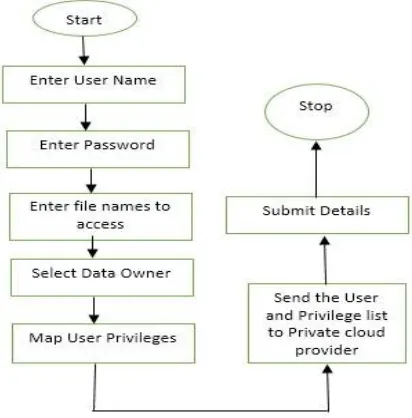
In proposed system we used authenticated way for checking of duplication. In file checking of duplication. In file level duplication checking at the time of uploading of data is done and also decide file level privilege access .Firstly user want to submit PoW for sending duplicate check request. Only all conditions of PoW get satisfied then request accepted for uploading file.
3.1 System Architecture
ISSN(Online): 2319-8753 ISSN (Print) : 2347-6710
I
nternational
J
ournal of
I
nnovative
R
esearch in
S
cience,
E
ngineering and
T
echnology
(An ISO 3297: 2007 Certified Organization)
Vol. 5, Issue 6, June 2016
Fig 3. Whole system overview
3.1.1 File Encryption:
The key received from the private cloud That secrete key e are using for encryption , the same key is useful for encrypting plain text in cipher text also for decryption.
Following are the 3 core functions to encrypt and decrypt data.
KeyGenSE:K is algorithm for key generation. Secrete file is generated by these algorithm using parameter of security. EncSE(K,M):M is message text and K-Secreat key cipher text is generated by using K and M.
DECSE(K,C): C-cipher text
K-key of encryption there by using K and C plain text is generated.
3.1.2:Credential data encryption:
CDE ensures confidentiality of data duplication. Convergent key generation is done by user based on original data and also the encryption of plain text. User adds unique identification tag to identify and eliminate duplicate data. CK generation algorithm is useful for key generation algorithm is useful for key generation and same key is useful in data encryption .User can upload encrypted data on cloud server which make sure both data security and authority.
ISSN(Online): 2319-8753 ISSN (Print) : 2347-6710
I
nternational
J
ournal of
I
nnovative
R
esearch in
S
cience,
E
ngineering and
T
echnology
(An ISO 3297: 2007 Certified Organization)
Vol. 5, Issue 6, June 2016
3.1.3 Proof of data:
To upload and download data it is mandatory to have proof of it convergent key generation is needful for uploading the file .We are using MD5 algorithm to generate hash value of data .Hash value varies with respect to variation of data
IV.MATHEMATICAL MODEL
S={R,T,P,H,O}
R=Registration for specifying size of user on cloud.
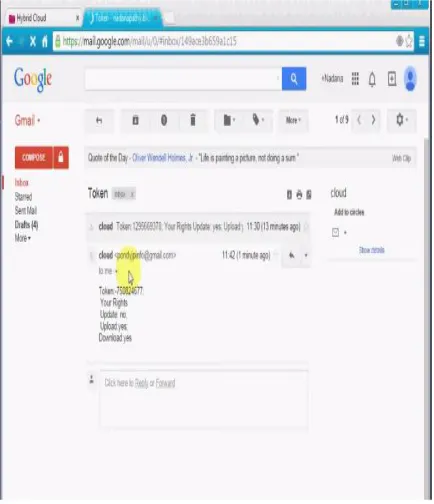
T=Generation and forwarding token through mail for user activation. P=User privileges
H=Calculation of hash function.
D=Content matched which are uploading data of existing database. R={r0,r1} where
r0=For registration authority information provider. r1=Information validity for registration authority. r2=user id as well as cloud id
r0->t1 T={t1,t2}
t1=Token send through mail to user. t2=Get credentials to user
D={d0,d1,d2,d3} where d0=key and name of file get
d1=encrypt file and hash function generation
d2=matching content checking by using upload button T2->d3
d3=download/upload/update file by giving key/token.
V. COMPARISON OF PROPOSED AND EXISTING SYSTEM
Sr no. Existing system Proposed system 1 It cann’t
provide support for differential authentication to duplicate check.
It provide strong support for differential check.
2 When system get initializes issue starting set of credentials.
In that system firstly
outsourcing of data has been done.
3 In that only one copy of user data.
ISSN(Online): 2319-8753 ISSN (Print) : 2347-6710
I
nternational
J
ournal of
I
nnovative
R
esearch in
S
cience,
E
ngineering and
T
echnology
(An ISO 3297: 2007 Certified Organization)
Vol. 5, Issue 6, June 2016
VI.EXPERIMENTAL RESULTS
Proposed system should avoid user to upload duplicate data .Encryption method used to upload duplicate data will stored on cloud downloading or uploading data operations unable to do by malicious user which user have PoW only that can modify data. The main goal of system is checking file duplication at the time of upload also avoid wastage of space of cloud
Fig 5.Cloud user activation mail
ISSN(Online): 2319-8753 ISSN (Print) : 2347-6710
I
nternational
J
ournal of
I
nnovative
R
esearch in
S
cience,
E
ngineering and
T
echnology
(An ISO 3297: 2007 Certified Organization)
Vol. 5, Issue 6, June 2016
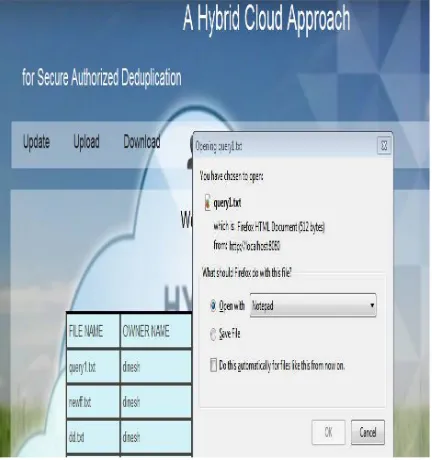
Fig 6.Files on public cloud
In this project we are using ADrive as a public cloud .This is freely available uploaded files after checking content level duplication get stored on public cloud . Which user has PoW can download data or file through public cloud.
ISSN(Online): 2319-8753 ISSN (Print) : 2347-6710
I
nternational
J
ournal of
I
nnovative
R
esearch in
S
cience,
E
ngineering and
T
echnology
(An ISO 3297: 2007 Certified Organization)
Vol. 5, Issue 6, June 2016
VII. CONCLUSION
In that proposed system shown that completion of secure deduplication and proposed system’s data deduplication method is authorized .Also for private files we have proposed token generation technique .As a PoW with the convergent key user submit privilege .We try to solve critical part of storing of data on cloud server it can tolerate by many methods .Proposed method give surety of secure deduplication data
.
REFERENCES
[1] M. Bellare, S. Keelveedhi, and T. Ristenpart. Dupless: Serveraided encryption for deduplicated storage. In USENIX Security Symposium, 2013.
[2] P. Anderson and L. Zhang. Fast and secure laptop backups with encrypted de-duplication. In Proc. of USENIX LISA, 2010.
[3] J. Li, X. Chen, M. Li, J. Li, P. Lee, andW. Lou. Secure deduplication with efficient and reliable convergent key management. In IEEE Transactions on Parallel and Distributed Systems, 2013.
[4] S. Halevi, D. Harnik, B. Pinkas, and A. Shulman-Peleg. Proofs of ownership in remote storage systems. In Y. Chen, G. Danezis, and V. Shmatikov, editors, ACM Conference on Computer and Communications Security, pages 491–500. ACM, 2011.
[5] J. Li, X. Chen, M. Li, J. Li, P. Lee, andW. Lou. Secure deduplication with efficient and reliable convergent key management. In IEEE Transactions on Parallel and Distributed Systems, 2013.
[6] C. Ng and P. Lee. Revdedup: A reverse deduplication storage system optimized for reads to latest backups. In Proc. of APSYS, Apr 2013. [7] C.-K Huang, L.-F Chien, and Y.-J Oyang, “Relevant TermSuggestion in Interactive Web Search Based on ContextualInformation in Query
Session Logs,” J. Am. Soc. for Information science and Technology, vol. 54, no. 7, pp. 638-649, 2003.
[8] S. Bugiel, S. Nurnberger, A. Sadeghi, and T. Schneider. Twin clouds: An architecture for secure cloud computing. In Workshop on Cryptography and Security in Clouds (WCSC 2011), 2011.
[9] W. K. Ng, Y. Wen, and H. Zhu. Private data deduplication protocols in cloud storage. In S. Ossowski and P. Lecca, editors, Proceedings of the 27th Annual ACM Symposium on Applied Computing, pages 441–446. ACM, 2012.
[10] R. D. Pietro and A. Sorniotti. Boosting efficiency and security in proof of ownership for deduplication. In H. Y. Youm and Y. Won, editors,
ACM Symposium on Information, Computer and communications Security, pages 81–82. ACM. [11] S. Quinlan and S. Dorward. Venti: a new approach to archival storage. In Proc. USENIX FAST, Jan 2002.
[12] A. Rahumed, H. C. H. Chen, Y. Tang, P. P. C. Lee, and J. C. S. Lui. A secure cloud backup system with assured deletion and version control. In
3rd International Workshop on Security in Cloud Computing, 2011.
[13] R. S. Sandhu, E. J. Coyne, H. L. Feinstein, and C. E. Youman. Role-based access control models. IEEE Computer, 29:38–47, Feb 1996. [14] J. Stanek, A. Sorniotti, E. Androulaki, and L. Kencl. A secure data deduplication scheme for cloud storage. In Technical Report, 2013.