DOI: 10.1534/genetics.110.114249
Bayesian Inference of Genetic Parameters Based on Conditional
Decompositions of Multivariate Normal Distributions
Jon Hallander,*
,1Patrik Waldmann,
†Chunkao Wang
‡and Mikko J. Sillanpa¨a¨
§,**
*Department of Forest Genetics and Plant Physiology, Swedish University of Agricultural Sciences, SE-90183 Umea˚, Sweden,§Department of Mathematics and Statistics, Rolf Nevanlinna Institute, University of Helsinki,
FIN-00014 Helsinki, Finland,**Department of Agricultural Sciences, University of Helsinki, FIN-00014 Helsinki, Finland,†Thetastats, Uardava¨gen 91, SE-22471 Lund, Sweden
and‡Department of Animal Science, Iowa State University, Ames, Iowa 50011-3150 Manuscript received January 15, 2010
Accepted for publication March 22, 2010
ABSTRACT
It is widely recognized that the mixed linear model is an important tool for parameter estimation in the analysis of complex pedigrees, which includes both pedigree and genomic information, and where mutually dependent genetic factors are often assumed to follow multivariate normal distributions of high dimension. We have developed a Bayesian statistical method based on the decomposition of the multivariate normal prior distribution into products of conditional univariate distributions. This procedure permits com-putationally demanding genetic evaluations of complex pedigrees, within the user-friendly computer package WinBUGS. To demonstrate and evaluate the flexibility of the method, we analyzed two example pedigrees: a large noninbred pedigree of Scots pine (Pinus sylvestrisL.) that includes additive and dominance polygenic relationships and a simulated pedigree where genomic relationships have been calculated on the basis of a dense marker map. The analysis showed that our method was fast and provided accurate estimates and that it should therefore be a helpful tool for estimating genetic parameters of complex pedigrees quickly and reliably.
M
UCH effort in genetics has been devoted to revealing the underlying genetic architecture of quantitative or complex traits. Traditionally, the poly-genic model has been used extensively to estimate genetic variances and breeding values of natural and breeding populations, where an infinite number of genes is assumed to code for the trait of interest (Bulmer 1971; Falconer and Mackay 1996). The genetic variance of a quantitative trait can be decomposed into an additive part that corresponds to the effects of indivi-dual alleles and a part that is nonadditive because of interactions between alleles. Attention has generally been focused on the estimation of additive genetic variance (and heritability), since additive variation is directly proportional to the response of selection via the breeder’s equation (Falconerand Mackay1996, Chap. 11). However, to estimate additive genetic variation and heritability accurately, it can be important to identify potential nonadditive sources in genetic evaluations (Misztal1997; Ovaskainenet al. 2008; Waldmannet al. 2008), especially if the pedigree being analyzed contains a large proportion of full-sibs and clones, as these inparticular give rise to nonadditive genetic relationships (Lynchand Walsh1998, pp. 145). The polygenic model using pedigree and phenotypic information, i.e., the animal model (Henderson1984), has been the model of choice for estimating genetic parameters in breeding and natural populations (Abneyet al. 2000; Sorensen and Gianola2002; O9Haraet al. 2008).
Recent breakthroughs in molecular techniques have made it possible to create genome-wide, single nucleo-tide polymorphism (SNP) maps. These maps have helped to uncover a vast amount of new loci responsible for trait expression and have provided general insights into the genetic architecture of quantitative traits (e.g., Valdaret al. 2006; Visscher2008; Flintand Mackay 2009). These insights can help when calculating disease risks in humans, when attempting to increase the yield from breeding programs, and when estimating related-ness in conservation programs. High-density SNPs of many species of importance to science and agriculture can now be scored quickly and relatively cheaply, for example, in mice (Valdaret al. 2006), chickens (Muir
et al. 2008), and dairy cattle (VanRadenet al. 2009). In the analysis of populations of breeding stock, the inclusion of dense marker data has improved the predictive ability (i.e.,reliability) of genetic evaluations compared to the traditional phenotype model, both in simulations (Meuwissenet al. 2001; Caluset al. 2008; Hayeset al. 2009) and when using real data (Legarra
Supporting information available online athttp://www.genetics.org/ cgi/content/full/genetics.110.114249/DC1.
1Corresponding author: Department of Forest Genetics and Plant Physiology, Swedish University of Agricultural Sciences, KBC Lastplats, SE-90183 Umea˚, Sweden. E-mail: [email protected]
et al. 2008; VanRadenet al. 2009; Gonza´ lez-Recioet al. 2009). Meuwissenet al. (2001) suggested that the effect of all markers should first be estimated, and then summed, to obtain genomic estimated breeding values (GEBVs). An alternative procedure, where all markers are used to compute the genomic relationship matrix (in place of the additive polygenic relationship matrix) has also been suggested (e.g., Villanueva et al. 2005; VanRaden2008; Hayeset al. 2009); this matrix is then incorporated into the statistical analysis to estimate GEBVs. A comparison of both procedures (VanRaden 2008) yielded similar estimates of GEBVs in cases where the effect of an individual allele was small. In addition, if not all pedigree members have marker information, a combined relationship matrix derived from both gen-otyped and ungengen-otyped individuals could be com-puted; this has been shown to increase the accuracy of GEBVs (Legarra et al. 2009; Misztal et al. 2009). Another plausible option to incorporate marker in-formation is to use low-density SNP panels within families and to trace the effect of SNPs from high-density genotyped ancestors, as suggested by Habier
et al. (2009) and Weigelet al. (2009). However, fast and powerful computer algorithms, which can use the mark-er information as efficiently as possible in the analysis of quantitative traits, are needed to obtain accurate GEBVs from genome-wide marker data.
This study describes the development of an efficient Bayesian method for incorporating general relation-ships into the genetic evaluation procedure. The method is based on expressing the multivariate normal prior distribution as a product of one-dimensional normal dis-tributions, each conditioned on the descending varia-bles. When evaluating the genetic parameters of natural and breeding populations, high-dimensional distribu-tions are often used as prior distribudistribu-tions of various ge-netic effects, such as the additive polygenic effect (Wang
et al. 1993), multivariate additive polygenic effects (Van Tassell and Van Vleck 1996), and quantitative trait loci (QTL) effects via the identical-by-decent matrix (Yi and Xu 2000). A Bayesian framework is adopted to obtain posterior distributions of all unknown parame-ters, estimated by using Markov chain Monte Carlo (MCMC) sampling algorithms in the software package WinBUGS (Lunnet al. 2000, 2009). By performing prior calculations in the form of the factorized product of simple univariate conditional distributions, the compu-tational time of the MCMC estimation procedure is reduced considerably. This feature permits rapid in-ference for both the polygenic model and the genomic relationship model. Moreover, the decomposition al-lows for inbreeding of varying degree, since the correct genetic covariance structure can be inferred into the analysis. In this article, we test the method on two previously published pedigree data sets: phenotype data from a large pedigree of Scots pine, incorporation of information on both additive and dominance genetic
relationships (Waldmann et al. 2008); and genomic information obtained from a genome-wide scan of a simulated animal population (Lundet al. 2009).
METHODS
Statistical model: Following Henderson(1984), we made use of the following linear mixed effect model under Gaussian assumptions,
y¼Xb1Zu1e; ð1Þ
whereyis a vector of sizen31 containing phenotypic records of a continuous trait for all members in the population; b is a vector of size p 3 1 containing systematic environmental effects; u is a vector of size n31 containing genetic effects that follow a multivar-iate normal distribution with zero mean vector and covariance structureGs2
u;XandZare known incidence matrices relating phenotypic records to respective location parameters included in (1); ande is a vector containing independent residual errors that follow a multivariate normal distribution with zero mean vector and covariance structure Is2
e, where I is the identity matrix of ordern. Note that records can be missing for some pedigree members (here, yi ¼ NA if individual ihas a missing record). Typically,ucontains the additive polygenic effect, although nonadditive genetic effects such as dominance, or QTL effects estimated from marker data, could be included in the model. To make inferences in model (1), the mixed model equations can be formed, so thatyis associated toGs2
u. A well-known, efficient Bayesian technique for the estimation of genetic parameters in the linear mixed effect model is MCMC methods (e.g., Wanget al. 1993; Sorensenand Gianola2002; Baueret al. 2009).
The most common distribution used foruin model (1) is the multivariate normal distribution (Lynchand Walsh1998, pp. 194), sinceucontainsnvariables (u1,
with an imposed dependency structure given by the pedigree, estimated relatedness from markers, or both. The factorization of the dependency structure in the graph gives (1) a Markov property (Lauritzen et al. 1990), which can be successfully utilized in Bayesian MCMC methods. See Rueand Held(2005) for a com-prehensive survey of this topic and see Steinslandand Jensen(2010) for how to use the Markov property for making inference in the classical animal model. In addition, the standard decomposition procedure of the additive polygenic effect (Thomas1992; Lin1999; Waldmann 2009) utilizes the Markov property of the animal model, where an offspring is conditioned on its parents in the analyzed pedigree.
Conditional expressions of multivariate normal distributions: Drawing samples from multivariate nor-mal distributions quickly becomes computationally de-manding as the number of parameters becomes large, e.g., when performing genetic evaluations of complex pedigrees. A reasonable alternative, therefore, is to decompose the multivariate normal distribution into conditionally dependent parts. If we replace the multi-variate normal prior, with the product of these (lower dimensional) distributions, both the mean and the variance are shifted, for each conditional distribution. Let us assume that we wish to decompose u into two subsets of column vectors,uT¼ ½uT
1uT2], whereu1andu2
are of length land n – l, respectively. The mean and variance can be expressed as
EðuÞ ¼ Eðu1Þ
Eðu2Þ
and
VarðuÞ ¼ Varðu1Þ Covðu1;u2Þ Covðu1;u2ÞT Varðu2Þ
; ð2Þ
where Var(u)¼Gs2
uis believed to be a positive definite, symmetric matrix of order n. By decomposing the multivariate normal distribution ( Jensen 1998), we obtain:
Eðu2ju1Þ ¼Eðu2Þ1ðu1Eðu1ÞÞTVarðu1Þ1Covðu2;u1Þ; ð3Þ
Varðu2ju1Þ ¼Varðu2Þ Covðu2;u1ÞTVarðu1Þ1Covðu2;u1Þ: ð4Þ
Hence, the distribution of u2 conditional on u1 is
multivariate normal according to
u2ju1 MVNðEðu2ju1Þ;Varðu2ju1ÞÞ: ð5Þ
More generally, foru¼ fu1;u2;u3;. . . ;uNg, whereNis the number of partitions ofu(typically the number of members in the pedigree,i.e., N¼n), we have
pðu1;u2;u3;. . .;uNjs2uÞ ¼ YN
i¼1
pðuijui1;. . .;u1;s2uÞ
¼pðu1js2uÞpðu2ju1;s2uÞpðu3ju2;u1;s2uÞ. . .;
ð6Þ wheres2
uis the variance component ofu. Our target is to generate u, which is a realization from a multivariate normal distribution with given mean (vector of zeros) and covariance structure Gs2
u. The vector u is here generated by element-wise draws,ui :ði¼1;2;. . .;NÞ, from univariate (lower-dimensional) normal distribu-tions conditioned on all the elements that have been drawn so far, i.e., frompðuiju1;u2;. . .;ui1;s2uÞ. It should be emphasized that this sequential strategy is exact and will lead to the correct vectoru, drawn from the full multivariate normal distributionMVN(0,Gs2
u). First, let us assume individual-wise partitions for u. Conditional expectation and conditional variance of pðuiju1;. . . ;ui1;s2uÞare thought of here as the weighted mean and the weighted variance for pedigree memberi. To compute weights for the mean (for individuali), the following general expression can be used:
WðiÞ ¼X
i1
j¼1
wði;jÞuj: ð7Þ
Bayesian inference of the factorized model: Follow-ing Waldmann (2009), uniform distributions were assigned as priors to the standard deviations, since this prior distribution was shown to be a good and robust noninformative choice of prior for variance compo-nents (Gelman 2006). This prior corresponds to a truncated inverse-x2 distribution with 1 degree of freedom, that is, p(s2
i) } si1, i ¼ u, e. To obtain an upper boundary for the uniform distributions, we performed a preliminary analysis in which uninforma-tive inverse-gamma distributions were assigned as priors for the variance components, thereby obtaining esti-mates of standard deviations; these were then multiplied by 5 to obtain the upper bounds.The chosen upper bounds were considerably larger than the upper bounds of the 95% highest probability density (HPD; Boxand Tiao1973) regions obtained in the preliminary analysis. Note that this procedure is a pragmatic solution and should not be viewed as a strictly Bayesian solution. A flat, noninformative prior was assigned to the systematic environmental fixed effect in both examples, asbjN(0, 106) for systematic effect level j. For u, we used the common multivariate normal distribution as prior:u MVN(0,Gs2
u) (Sorensenand Gianola2002) and then used the decomposition of the multivariate normal distribution into univariate normal distributions, proposed here aspðujs2
uÞ ¼ Qn
i¼1pðuiju1;u2;. . . ;ui1;s2uÞ. The vectoryis assumed to follow a Gaussian distribution; thus the likelihood function is given as
pðyjb;u;s2
eÞ ¼
Yn
i¼1
pðyijbj;ui;s2eÞ
¼Y
i2O
1 ffiffiffiffiffiffi 2p
p
se
exp ðyibjuiÞ 2 2s2
e
; ð8Þ
where bj is the corresponding systematic effect level (covariate) of pedigree memberi, connected through X, andOis the set of members in the pedigree for which phenotypic records are available. If conditioning on hyperparameters is neglected, and the location param-eters are believed to be independenta priori, the joint distribution of all parameters conditional on the data is proportional to
pðb;u;s2u;s2ejyÞ}pðbÞpðujs2uÞpðs2uÞpðs2eÞpðyjb;u;s2eÞ: ð9Þ
The phenotype model (1) was run in the Bayesian software package WinBUGS (Lunnet al. 2000) version 1.4.3, which is freely available on http://www.mrc-bsu.cam.ac.uk/bugs/. WinBUGS exploits a graphical modeling technique to translate the supplied prior distributions of the parameters into corresponding full conditional distributions. The computation of the weights (7) using (3) and (4) was executed in ANSI C. The WinBUGS code is available insupporting
informa-tion, File S1, while the computer code used for calculating weights is available in File S2. Because we place NA for phenotypes for individuals without a re-cord, phenotype predictions for them are obtained as a by-product of the WinBUGS analysis. However, these predicted values do not influence the estimation of underlying model parameters. Therefore, random ef-fects for those individuals are estimated on the basis of covariance structure only. To check mixing properties of our implementation in WinBUGS and compare the mixing to alternative implementations, we calculated the effective sample size (ESS) of the obtained MCMC chains (Kasset al. 1998; Waagepetersenet al. 2008). ESS can be seen as the number of independent samples from the estimated posterior that contain amounts of in-formation equivalent to those of our dependent MCMC samples (i.e., exceed same-estimation accuracy). Low ESS values indicate poor mixing (i.e.,high autocorrela-tion between consequtive samples) in the MCMC chain. Polygenic example: To verify our proposed decom-position method, data acquired from a 26-year-old field trial of Scots pine (Pinus sylvestris L.), previously pub-lished by Waldmannet al. (2008), Finleyet al. (2009), Hallander and Waldmann (2009), and Waldmann (2009), were analyzed to obtain posterior distributions of additive and dominance polygenic effects for all trees in the pedigree. The pedigree consists of 52 parents crossed according to a partial diallel design resulting in mixed half-sib and full-sib families totaling 4970 surviving offspring. The parents were assumed to be nonrelated and noninbred. In total, 202 families were distributed over approximately 4 ha of forest. The field trial was subdivided into 70 square (or nearly square) blocks, which were used in the subsequent evaluations as a systematic environmental effect. Several traits of in-terest for breeding purposes were measured in 1997, although for the current study we chose to analyze only trunk diameter at breast height (DBH). The mean value of DBH was 114 mm. We made use of the following covariance structure in the mixed linear model:G1s2u1¼ As2
a andG2s2u2¼Ds
2
d, whereAis the additive
relation-ship matrix;s2
a is the variance component of additive
genetic effects;Dis the dominance relationship matrix; ands2
dis the variance component of dominance genetic
effects.A andD were calculated using standard equa-tions (Lynch and Walsh 1998, pp. 763 and 768). Uniform densities were assigned as prior distributions forsaandsdas described in the previous section. See
Waldmann et al. (2008), Finley et al. (2009), and Hallanderand Waldmann(2009), for a more detailed analysis of the Scots pine pedigree.
DATA.html (Lund et al. 2009). Six thousand loci are evenly distributed over six chromosomes (1000 markers per chromosome), with 0.1 cM between markers. Forty-eight QTL, each of small effect, were assumed to code for the trait of interest. Pedigree and phenotype in-formation were available from the first four generations of animals. The animals from generations five to seven had no given phenotype, but did have complete marker information. From each generation, 15 males and 150 females were randomly selected and mated according to a hierarchical mating design, resulting in a total of 1500 animals being born per generation. Interested readers are invited to consult Lund et al. (2009) for further details of the data set. The genomic relationship matrix (or realized relationship matrix) was computed using the second method proposed by VanRaden (2008), which followsG¼ZDZ9. In this article,Z¼M–P, where Mis a matrix of sizen3mcontaining genotypes at allm loci for allnmembers of the pedigree;Pis a matrix of the same size containing allele frequencies that differ from 0.5 at all loci; and finally,Dis a diagonal matrix of size m3mwith diagonal elements 1/m[2pi(1pi)], wherepi is the allele frequency at locusi. We analyzed a subset of the complete pedigree consisting of the first four generations (1014 animals in total) to reduce compu-tational time. See Table S1 for original identifica-tion numbers of pedigree members in the analyzed subpopulation.
RESULTS
Polygenic example: To facilitate a comparison be-tween the results obtained from our proposed method and the results reported by Waldmannet al. (2008), we performed the same procedure as Waldmann et al. (2008) when analyzing the Scots pine pedigree. One MCMC was run for a total of 225,000 iterations, from which the first 25,000 iterations were omitted (burn-in) from the analysis, and every 10th iteration was saved (thinned), resulting in an effective sample of 20,000 iterations. Table 1 shows the results of the analysis using
our method, together with the results from Waldmann
et al. (2008) for the trait DBH. Our posterior point estimates and their 95% HPD regions closely agree with those obtained by Waldmann et al. (2008), although slightly different degrees of freedom for the inverse-x2 distributions used as prior to the variance components (1 in our method while Waldmannet al. 2008 used2 in theirs) could cause some differences in the respective posterior distributions. We believe, however, that the priors have little influence on the parameter estimates obtained from the analyzed data, mainly due to both the large size of the pedigree and the similar parameter estimates obtained by Waldmann et al. (2008) and Finleyet al. (2009) using different priors.
The additive and dominance covariance structures resulted in 9940 and 61,247 nonzero weights, respec-tively. For variance components and heritability, 95% HPD intervals were estimated using the R library, ‘‘boa’’ (Smith2007). In WinBUGS, each scan of the MCMC took 0.4241 sec on an AMD Opteron Dual Core Pro-cessor (2.39 GHz) with 1 GB of RAM. The corresponding average time, for each MCMC scan, using the method in Waldmannet al. (2008) was 1.840 sec. In each iteration in the MCMC procedure, all nonzero weights for means need to be multiplied by the corresponding genetic parameter of the preceding pedigree members (a matrix–vector multiplication: see Equation 7). The actual number of nonzero weights depends on the covariance structure, as more nonzero relationships will result in a higher number of nonzero weights. For the Scots pine data, little computational time was needed to obtain reliable posterior estimates due to the sparseness of the additive and dominance polygenic relationship matrices. Consequently, the total computational time is greatly reduced in the current example because of the few nonzero weights. Hence, our proposed method seems to be very beneficial for analyzing polygenic data. The slightly lower ESS (sample size adjusted for autocorrelation) obtained by our method reflects the fact that single-site Gibbs sampling is performed in WinBUGS, while the hybrid Gibbs sampler, proposed by TABLE 1
Summary statistics including posterior estimates (mode, mean and median) and effective ESS obtained from the WinBUGS analysis in the polygenic model example for additive genetic variance (s2
a), dominance genetic variance (s
2
d), residual variance (s2
e), heritability (h2), and dominance proportion (d2)
Mode Mean Median 95% HPD region ESS REML
Parameter DEC HYB DEC HYB DEC HYB DEC HYB DEC HYB HYB
s2
a 53.16 54.70 63.29 62.52 60.49 59.62 [29.47, 103.1] [27.67, 103.7] 376.4 417.2 55.95 s2
d 77.56 82.88 84.69 88.41 82.5 85.71 [39.86, 136.9] [39.70, 142.2] 399.2 456.8 83.06 s2
e 726.4 722.2 724.3 721.7 725.0 722.6 [670.7, 778.3] [665.3, 776.8] 733.2 756.1 728.5 h2 0.0617 0.0630 0.0724 0.0714 0.0694 0.0685 [0.0340, 0.1158] [0.0327, 0.1170 372.2 420.9 0.0645
d2 0.0894 0.0939 0.0970 0.1014 0.0946 0.0983 [0.0463, 0.1567] [0.0500, 0.1616] 394.5 447.5 0.0957
The results of the decomposition approach are denoted DEC while the results of Waldmannet al.(2008) are denoted HYB
Waldmannet al. (2008), also applies block updating of parameters, which is known to improve the mixing of the MCMC chain. In addition, the transformation of genetic covariance structures applied in Waldmannet al. (2008) improves the ESS further. However, in this case, the marginally lower ESS of the current method is well compensated for by the improved speed. Furthermore, we tested two additional updating options (block hybrid and conjugated multivariate) in OpenBUGS version 3.0.3 (Thomaset al. 2006), to see whether the ESS was improved. Only the ESS of dominance genetic effects was improved while the ESS of the other parameters was unaffected or even decreased (results not shown). On the other hand, the computing time increased markedly: we therefore believe that the standard updating (mul-tivariate forward) option in WinBUGS/OpenBUGS gives acceptable mixing of the MCMC. Furthermore, we investigated whether changing the sequential order of conditioning would generate a different number of weights and, thereby, a difference in computational time. However, the number of weights remained the same, regardless of the sequence, and we therefore can conclude that the order is unimportant from a compu-tational perspective.
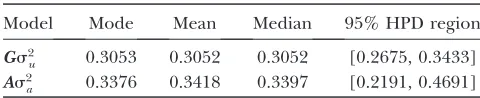
Genomic example: First, a purely additive polygenic model was used to obtain initial values of the variance components for all 225,000 iterations. A preliminary analysis was then conducted to estimate the standard deviations of the variance components, which were used to set the upper limit of the uniform prior distributions. The MCMC procedure was run for 45,000 scans in total, from which the first 35,000 scans were discarded to give 10,000 saved iterations. The heritability estimates ob-tained are shown in Table 2. The posterior point es-timates from our analyzed subset agree closely with the true corresponding parameter values given in Lundet al. (2009), both for posterior mean and mode. However, the additive polygenic model resulted in heritability point estimate being too large, although with both models, true value is included within the estimated 95% HPD regions. In addition, in Table 2, it is important to note that the 95% HPD region obtained by a genomic model is clearly more narrow than the one given by a polygenic model, suggesting that the inclusion of the genomic relationship matrix improves the estimation accuracy of heritability. Similar conclusions have been drawn by, for example, Meuwissen et al. (2001), Villanueva
et al. (2005) and Hayeset al. (2009). For a thorough explanation of improved accuracy, see Xu(2006).
The computational effort in the genomic example was unfortunately massive, due to the large number of non-zero weights (in total, 513,591). On the same computer as that used for the polygenic example, each scan took 39.40 sec. Initially, we truncated small elements in the genomic relationship matrix to reduce the number of nonzero elements, but this modification effectively prevented convergence of the MCMC chain. Truncating small values
in the resulting weight matrix, instead of the genomic matrix itself, might be a more suitable procedure because the individual weights for computing the variance of each genetic parameter (i.e., each normal distribution) are correctly calculated given the genomic covariance matrix, and only weights used for computing the mean of each normal distribution are affected. Conversely, if elements in the genomic covariance structure are truncated before the decomposition procedure, then weights for comput-ing the means and the variances of the normal distribu-tions of all parameters are affected. By truncating small elements in the weight matrix, the computational time could potentially be greatly reduced, although the accuracy of estimated posterior and 95% HPD regions would be negatively affected. However, some preliminary experiments on truncating weights have given promising results (i.e., the obtained posterior estimates were only slightly affected), although we chose to include the full-weight matrix when analyzing the simulated data (other results not shown).
DISCUSSION
Decomposition of high-dimensional multivariate normal distributions provides a very flexible Bayesian method that allows us to make inferences in linear mixed effect models with a large number of genetic parameters. For example, the proposed method can be used for the following: variance component-based linkage and asso-ciation mapping methods for the estimation of QTL effects; estimating nonadditive genetic effects, such as dominance and epistasis; estimation of genomic breed-ing values; and estimation of maternal and permanent environmental effects, which are important in breeding evaluations. The approach was implemented in the user-friendly computer software WinBUGS and was shown to be fast and accurate on both real and simulated data. By using this approach, researchers will be able to perform advanced genetic evaluations of complex traits and pedigrees without possessing advanced knowledge in animal models and programming.
Recently, several studies have shown that the accuracy of genetic evaluations can be increased by incorporating
TABLE 2
Posterior estimates obtained from the WinBUGS analysis in the genomic model example for heritability (h2) using a
model including genomic relationship matrix (Gs2 u) and a model including additive polygenic
relationship matrix (As2
a)
Model Mode Mean Median 95% HPD region
Gs2
u 0.3053 0.3052 0.3052 [0.2675, 0.3433]
As2
the genomic relationship matrix (Villanueva et al. 2005; Hayeset al. 2009; Misztalet al. 2009). For large, complex pedigrees with a high number of polymorphic markers, the resulting genomic relationship matrix will probably be dense,i.e.,most pedigree members will have nonzero, pairwise estimated relatedness. A general problem with this approach is that when making in-ferences in animal models, most currently available methods rely on either sparse solvers (e.g., Schaeffer and Kennedy 1986; Johnson and Thompson 1995; Waldmann et al. 2008) or efficient graph model tech-niques (Wilkinson and Yeung 2004; Rue and Held 2005; Steinsland and Jensen 2010). Compared to standard, nonsparse methods, these methods will not result in the same reduction in computational time when incorporating sparse covariance structures (i.e., when using pedigree information only). Unfortunately, even though our proposed method can handle dense genetic covariance structures, as demonstrated in the genomic example, the computational time required is massive. One way to overcome this hurdle would be to truncate small elements in the weight matrix obtained by our approach, thereby obtaining a good approxima-tion of the genetic covariance matrix. An alternative method would be to apply transformation on the covariance matrix to facilitate the inference of parame-ter estimation as, for example, suggested by Mrodeand Thompson(1989), Wilkinsonand Yeung(2004), and Waldmannet al. (2008). As a result, estimating param-eters using the linear mixed model does not depend on the sparsity of the genetic covariance structure.
A good mixing property of the MCMC method is very important in Bayesian analysis to obtain reliable poste-rior estimates, especially if parameters are highly corre-lated in the model. In Gibbs sampling, the updater samples from the fully conditional posterior distribu-tion, which is proportional to the likelihood function and the prior distribution through Bayes theorem. Our proposed method samples from the multivariate nor-mal distribution for the prior, but samples from the likelihood function are taken for one parameter at a time, which introduces dependencies to the posterior (i.e.,introduces higher correlation between parameters in the posterior as these are drawn elementwise). Thus, the mixing property of our algorithm does not match the mixing properties achieved with block updating of parameters, where sampling from both prior distribu-tion and the likelihood are performed in a block (Garcı´a-Corte´ s and Sorensen 1996; Roberts and Sahu 1997). On the other hand, for elementwise or single-site updating (without decomposition), sampling from both likelihood and prior are made for each parameter, which introduces heavy dependencies to the posterior distribution, resulting in poor mixing proper-ties of the MCMC chain (Sorensenand Gianola2002). Hence, our method should result in better mixing than single-site updating but should result in less effective
mixing than block updating of parameters. This insight is confirmed, to some extent, empirically when the mixing property in our approach was compared to the mixing property of the standard single-site sampler (Sorensen and Gianola 2002) implemented in C (results not shown). However, this comparison should be interpreted while bearing in mind that WinBUGS uses an expert system that attempts to utilize the most appropriate sampling scheme for each stochastic node (Lunnet al. 2000, pp. 328).
If a better mixing property is warranted, one plausible alternative might be to combine our suggested decom-position approach with block updating of parameters into a hybrid sampler. A similar approach (i.e., combin-ing scombin-ingle-site and block samplcombin-ing) was implemented by Waldmannet al. (2008), which resulted in better mixing of the MCMC chain than was obtained in pure single-site updating. However, it would not be possible to imple-ment the combined sampling approach in WinBUGS, as the block updating requires a large equation system to be solved during each iteration in the MCMC procedure. If only single-site sampling is possible (due to computa-tional limitations), the parameters can be randomly updated in each MCMC step and not in the same sequential order, as suggested by Levineand Casella (2006). An additional alternative to improve mixing is to apply transformation of the location parameters in the model (Vineset al. 1996; Waldmannet al. 2008).
The lack of freely available computer packages designed for the genetic evaluation of complex pedi-grees using a Bayesian framework has, unfortunately, prevented more regular use of these models. The graphical model representation within the Bayesian software package WinBUGS is very well suited for decomposition of joint distributions into products of local components, i.e., parent and offspring nodes in a directed acyclical graph (Lunn et al. 2000, 2009). WinBUGS also applies an intelligent, automatic ap-proach to the choice of updaters needed in the imple-mentation of the MCMC procedure. Both Damgaard (2007) and Waldmann(2009) successfully executed the animal model in WinBUGS and produced results that show how evaluating the genetics of complex pedigrees can be performed smoothly without the need of expen-sive hardware and software. As an extension to these studies, we have shown how general relationship struc-tures can be decomposed and hence can be efficiently implemented in WinBUGS.
the pedigree. Problems with handling inbred pedigrees arise with the standard model because the covariances between parents are assumed to be zero. Since it is not uncommon to have some degree of inbreeding in both breeding and natural populations of animals and plants, the standard factorization of additive polygenic relation-ships can be erroneous. Differences in the estimated posterior of the polygenic variance components, obtained by the standard factorization model and our approach, need further verification in extensive computer simula-tions. It should be noted that the nonadditive genetic relationships, introduced by inbreeding, can have a considerable influence on the genetic variances (Harris 1964; Abneyet al. 2000).
We have, in this study, demonstrated the benefit of decomposing the multivariate normal distribution, often used as prior for genetic effects in the standard, linear mixed effect model. To our knowledge, this procedure of decomposing the prior distribution has not been utilized before, in the context of parameter estimation in genetics. The decomposion approach was put forward and excecuted successfully in WinBUGS by Vineset al. (1996); they utilized a random effect model to analyze clinical data in the context of epidemiology. However, they did not include covariance between random effects, which makes the decomposition pro-cedure more complex. In general, there also exist alternative procedures for efficiently implementing the prior distribution, which deserves more attention. One such alternative, which is likely to be equally as efficient as the approach presented here, is obtained by multiplying vector of univariate normal distributed variables by a Cholesky factor (square root) of the original covariance matrix (Golub and Van Loan 1996). As in our approach, (Cholesky) weights can be calculated once, prior to the WinBUGS analysis. Both procedures involves one matrix–vector multiplication each iteration in the MCMC process and are, therefore, likely to be computational equally time consuming for analysis of large pedigrees.
We thank the associate editor and three anonymous reviewers for comments that improved the manuscript.This work was supported by funding from the Research School of Tree Breeding and Forest Genetics for J.H. and P.W.; Fo¨reningen svensk skogstra¨dsfo¨ra¨dling for C.W. and P.W.; and research grants from the Academy of Finland and the University of Helsinki’s Research Funds for M.J.S. In addition, the Scots pine data used in the polygenic example were provided by the Forestry Research Institute of Sweden, Skogforsk.
LITERATURE CITED
Abney, M., M. S. McPeekand C. Ober, 2000 Estimation of variance components of quantitative traits in inbred populations. Am. J. Hum. Genet.66:629–650.
Bauer, A. M., T. C. Reetz, F. Hoti, W.-D. Schuh, J. Le´ on et al., 2009 Bayesian prediction of breeding values by accounting for genotype-by-environment interaction in self-pollinating crops. Genet. Res.91:193–207.
Box, G. E. P., and G. C. Tiao, 1973 Bayesian Inference in Statistical
Analysis.Wiley, New York.
Bulmer, M. G., 1971 Effect of selection on genetic variability. Am. Nat.105:201–210.
Calus, M. P. L., T. H. E. Meuwissen, A. P. W.deRoosand R. F. Veerkamp, 2008 Accuracy of genomic selection using different methods to define haplotypes. Genetics178:553–561. Damgaard, L. H., 2007 How to use Winbugs to draw inferences in
animal models. J. Anim. Sci.85:1363–1368.
Falconer, D. S., and T. F. C. Mackay, 1996 Introduction to
Quantita-tive Genetics.Longman, New York.
Finley, A. O., S. Banerjee, P. Waldmann and T. Ericsson, 2009 Hierarchical spatial modeling of additive and dominance genetic variance for large spatial trial datasets. Biometrics65:
441–451.
Flint, J., and T. F. C. Mackay, 2009 Genetic architectures of quan-titative traits in flies, mice and human. Genome Res.19:723–733. Garcı´a-Corte´ s, L. A., and D. Sorensen, 1996 On a multivariate im-plementation of the Gibbs sampler. Genet. Sel. Evol.28:121–126. Gelman, A., 2006 Prior distributions for variance parameters in
hi-erarchical models. Bayesian Anal.1:515–534.
Golub, G. H., and C. F. VanLoan, 1996 Matrix Computations,Ed. 3. Johns Hopkins University Press, Baltimore.
Gonza´ lez-Recio, O., D. Gianola, G. J. Rosa, K. A. Weigeland A. Kranis, 2009 Genome-assisted prediction of a quantitative trait measured in parents and progeny: application to food conver-sion rate in chickens. Genet. Sel. Evol.41:3.
Habier, D., R. L. Fernandoand J. C. M. Dekkers, 2009 Genomic selection using low-density marker panels. Genetics182:343– 353.
Hallander, J., and P. Waldmann, 2009 Optimum contribution se-lection in large general tree breeding populations with an appli-cation to Scots pine. Theor. Appl. Genet.118:1133–1142. Harris, D. L., 1964 Genotypic covariances between inbred relatives.
Genetics50:1319–1348.
Hayes, B. J., P. M. Vissherand M. E. Goddard, 2009 Increased accuracy of artificial selection by using the realized relationship matrix. Genet. Res.91:47–60.
Henderson, C. R., 1984 Applications of Linear Models in Animal
Breed-ing.University of Guelph, Guelph, ON, Canada.
Jensen, D. R., 1998 Multivariate normal distribution, pp. 2906–2911 inEncyclopedia of Biostatistics,edited by P. Armitageand T. Colton. Wiley, Chichester, UK.
Johnson, D. L., and R. Thompson, 1995 Restricted maximum likeli-hood estimation of variance components for univariate animal models using sparse matrix techniques and average information. J. Dairy Sci.87:449–456.
Kass, R. E., B. P. Carlin, A. Gelmanand R. Neal, 1998 Markov chain Monte Carlo in practice: a roundtable discussion. Am. Stat.
52:93–100.
Lauritzen, S. L., A. P. Dawid, B. N. Larsen and H.-G. Leimer, 1990 Independence properties of directed Markov fields. Net-works20:491–505.
Legarra, A., C. Robert-Granie, E. Manfredi and J. M. Elsen, 2008 Performance of genomic selection in mice. Genetics
180:611–618.
Legarra, A., I. Aguilarand I. Misztal, 2009 A relationship matrix including full pedigree and genomic information. J. Dairy Sci.
92:4656–4663.
Levine, R. A., and G. Casella, 2006 Optimizing random scan Gibbs samplers. J. Mult. Anal.97:2071–2100.
Lin, S., 1999 Monte Carlo Bayesian methods for quantitative traits. Comp. Stat. Data Anal.31:89–108.
Lund, M. S., G. Sahana, D. J.deKoning, G. Suand O¨ . Carlborg, 2009 Comparison of analyses of the QTLMAS XII common da-taset. I. Genomic selection. BMC Proc.3:S1.
Lunn, D. J., A. Thomas, N. Best and D. Spiegelhalter, 2000 WinBUGS—a Bayesian modelling framework: concepts, structure, and extensibility. Stat. Comp.10:325–337.
Lunn, D. J., D. Spiegelhalter, A. Thomasand N. Best, 2009 The BUGS project: evolution, critique and future directions. Stat. Med.28:3049–3067.
Lynch, M., and B. Walsh, 1998 Genetics and Analysis of Quantitative
Traits.Sinauer Associates, Sunderland, MA.
Misztal, I., 1997 Estimation of variance components with large-scale dominance models. J. Dairy Sci.80:965–974.
Misztal, I., A. Legarraand I. Aguilar, 2009 Computing proce-dures for genetic evaluation including phenotypic, full pedigree, and genomic information. J. Dairy Sci.92:4648–4655. Mrode, R., and R. Thompson, 1989 An alternative algorithm for
in-corporating the relationships between animals in estimating var-iance components. J. Anim. Breed. Genet.106:89–95. Muir, W. M., K. S. G. Wong, Y. Zhang, J. Wang, M. A. M. Groenen
et al., 2008 Genome-wide assessment of worldwide chicken SNP genetic diversity indicates significant absence of rare alleles in commercial breeds. Proc. Natl. Acad. Sci. USA105:17312–17317. O9HaraR. B., J. M. Cano, O. Ovaskainen, C. Teplitsky, and J. S. Alho, 2008 Bayesian approaches in evolutionary quantitative genetics. J. Evol. Biol.21:949–957.
Ovaskainen, O., J. M. Canoand J. Merila¨, 2008 A Bayesian frame-work for comparative quantitative genetics. Proc. R. Soc. Lond., B, Biol. Sci.275:669–678.
Roberts, G. O., and S. K. Sahu, 1997 Updating schemes, correla-tion structure, blocking and parameterizacorrela-tion for the Gibbs sam-pler. J. R. Stat. Soc. Series B, Stat. Methodol.59:291–317. Rue, H., and L. Held, 2005 Gaussian Markov Random Fields: Theory
and Applications.Chapman & Hall, London.
Schaeffer, L. R., and B. W. Kennedy, 1986 Computing solutions to mixed model equations. J. Dairy Sci.69:575–579.
Smith, B. J., 2007 boa: an R package for MCMC output convergence assessment and posterior inference. J. Stat. Soft.21:1–37. Sorensen, D., and D. Gianola, 2002 Likelihood, Bayesian and MCMC
Methods in Quantitative Genetics.Springer-Verlag, New York. Steinsland, I., and H. Jensen, 2010 Utilising Gaussian Markov
ran-dom field properties of Bayesian animal models. Biometrics (in press).
Thomas, A., R. B. O’Hara, U. Liggesand S. Sturtz, 2006 Making BUGS open. R. News6:12–17.
Thomas, D. C., 1992 Fitting genetic data using Gibbs sampling: an application to nevus counts in 38 Utah kindreds. Cytogenet. Cell Genet.59:228–230.
Valdar, W., L. C. Solberg, D. Gauguier, S. Burnett, P. Klenerman
et al., 2006 Genome-wide genetic association of complex traits in heterogeneous stock mice. Nat. Genet.38:879–887. VanRaden, P. M., 2008 Efficient methods to compute genomic
pre-dictions. J. Dairy Sci.91:4414–4423.
VanRaden, P. M., C. P. VanTassell, G. R. Wiggans, T. S. Sonstegard, R. D. Schnabelet al., 2009 Reliability of genomic predictions for North American Holstein bulls. J. Dairy Sci.92:16–24.
VanTassell, C. P., and L. D. VanVleck, 1996 Multiple-trait Gibbs sampler for animal models: flexible programs for Bayesian and likelihood-based (covariance) component inference. J. Anim. Sci.74:2586–2597.
Villanueva, B., R. Pong-Wong, J. Ferna´ ndez and M. A. Toro, 2005 Benefits from marker-assisted selection under an additive polygenic genetic model. J. Anim. Sci.83:1747–1752. Vines, S. K., W. R. Gilksand P. Wild, 1996 Fitting Bayesian multiple
random effects models. Stat. Comp.6:337–346.
Visscher, P. M., 2008 Sizing up human height variation. Nat. Genet.
40:489–490.
Waagepetersen, R., N. Iba´ neˆz-Escricheand D. Sorensen, 2008 A comparison of strategies for Markov chain Monte Carlo compu-tation in quantitative genetics. Genet. Sel. Evol.40:161–176. Waldmann, P., 2009 Easy and flexible Bayesian inference of
quan-titative genetic parameters. Evolution63:1640–1643.
Waldmann, P., J. Hallander, F. Hoti and M. J. Sillanpa¨ a¨, 2008 Efficient Markov chain Monte Carlo implementation of Bayesian inference of additive and dominance genetic variances in non-inbred pedigrees. Genetics179:1101–1112.
Wang, C. S., J. J. Rutledgeand D. Gianola, 1993 Marginal infer-ence about variance components in a mixed linear model using Gibbs sampling. Genet. Sel. Evol.21:41–62.
Weigel, K. A., G.de losCampos, O. Gonza´ lez-Recio, H. Naya, X. L. Wuet al., 2009 Predictive ability of direct genomic values for life-time net merit of Holstein sires using selected subsets of single nu-cleotide polymorphism markers. J. Dairy Sci.92:5248–5257. Wilkinson, D. J., and S. K. H. Yeung, 2004 A sparse matrix
ap-proach to Bayesian computation in large linear models. Comp. Stat. Data Anal.44:493–516.
Xu, S., 2006 Separating nurture from nature in estimating heritabil-ity. Heredity97:256–257.
Yi, N., and S. Xu, 2000 Bayesian mapping of quantitative trait loci under the identity-by-descent-based variance component model. Genetics156:411–422.
Communicating editor: J. Wakefield
APPENDIX: CALCULATION OF WEIGHTS FOR DOMINANCE RELATIONSHIPS
We calculate conditional prior distributions for dom-inance genetic effects from the pedigree given in Table 3. The corresponding dominance polygenic relation-ship matrix, D, can be obtained as described in, for example, Waldmannet al.(2008) as
D¼
1 0 0 0
0 1 0 0
0 0 1 0:25
0 0 0:25 1 2
6 6 4
3 7 7 5:
For individual 1:E(d1js2d)¼0, Var(d1)¼s2d, andd1js2d
N(0,s2 d).
For individual 2:Eðd2jd1;s2dÞ ¼Eðd2Þ1½d1½1=s2d½0 ¼0,
Varðd2jd1;s2dÞ ¼Varðd2Þ ½0½1=s2d½0andd2jd1,s2d
N(0,s2 d).
For individual 3:
Eðd3jd1;d2;sd2Þ ¼Eðd3Þ1½d1 d2 1
s2 d
0
0 1
s2 d
" #
0 0 ¼0;
Varðd3jd1;d2;s2dÞ ¼Varðd3Þ ½0 0 1
s2 d
0
0 1
s2 d 2 4
3
5 0
0 ¼s 2 d
and
d3jd1;d2;s2d Nð0;s
2
dÞ:
Finally, for individual 4:
Eðd4jd1;d2;d3;s2dÞ ¼Eðd4Þ1½d1 d2 d3 1
s2
d 0 0 0 s12
d 0
0 0 1
s2 d 2
6 6 6 4
3 7 7 7 5
0 0 1 4s
2
d
2 6 4
3 7 5¼1
TABLE 3
Example pedigree for sampling of dominance polygenic effects where a 0 indicates that an individual has an
unknown father or mother
Individual Father Mother
1 0 0
2 0 0
3 1 2
4 1 2
Varðd4jd1;d2;d3;s2dÞ ¼Varðd4Þ ½0 0 1 4s
2
d
1
s2d
0 0
0 s12 d
0
0 0 1
s2d 2 6 6 4 3 7 7 5 0 0 1 4s 2 d 2 4 3
5¼s2d 1 16s
2
d ¼1516s
2
d
and
d4jd1;d2;d3;s2d N
1 4d3;
15 16s 2 d :
For individual 4, both mean and variance are shifted (reduced) because individuals 3 and 4 are full sibs. The following weights for reduction in mean are, consequently, obtained for individual 4:w(4, 1)¼0, w(4, 2)¼0, andw(4, 3)¼0.25. Using Equation 7, we obtain W(4) ¼ 0.25d3. Hence, instead of drawing d
from MVN(0, Ds2
d), we make use of the following
univariate normal distributions: d1 j s2d N(0, s2d),
d2 j d1, sd2 N(0, s2d), d3 j d1, d2, s2d N(0, s2d)
andd4jd1;d2;d3;s2d N 14d3;1516s2d
.
Inbreeding affects calculation of additive weights as follows. In Table 4, an example pedigree that includes a loop is shown; this will cause pedigree member 6 to be inbred. The corresponding additive relationship matrix is
A¼
1 0 0 0:5 0 0:25
0 1 0 0:5 0:5 0:5
0 0 1 0 0:5 0:25
0:5 0:5 0 1 0:25 0:625 0 0:5 0:5 0:25 1 0:625 0:25 0:5 0:25 0:625 0:625 1:125 2 6 6 6 6 6 6 4 3 7 7 7 7 7 7 5 :
When obtaining realization from additive polygenic effects of pedigree members 1 to 5, our proposed method and the standard factorization method (e.g., Lin1999) give exactly the same mean and variance used in the normal univariate distributions asa1,a2,a3N(0,s2a),
TABLE 4
Example pedigree for sampling of additive polygenic effects where a 0 indicates that an individual has an
unknown father or mother
Individual Father Mother
1 0 0
2 0 0
3 0 0
4 1 2
5 3 2
6 4 5
a4 N
a11a2
2 ;
s2a 2
and
a5 N
a31a2
2 ;
s2a 2
:
However, for pedigree member 6, the standard factor-ization method yields
a6 N
a41a5
2 ;
s2a 2
:
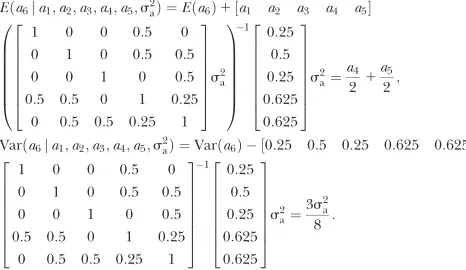
Our proposed method, on the other hand, gives
Eða6ja1;a2;a3;a4;a5;s2aÞ ¼Eða6Þ1½a1 a2 a3 a4 a5
1 0 0 0:5 0
0 1 0 0:5 0:5
0 0 1 0 0:5
0:5 0:5 0 1 0:25 0 0:5 0:5 0:25 1 2 6 6 6 6 6 6 4 3 7 7 7 7 7 7 5 s2 a 0 B B B B B B @ 1 C C C C C C A 1
0:25 0:5 0:25 0:625 0:625 2 6 6 6 6 6 6 4 3 7 7 7 7 7 7 5 s2 a¼ a4 2 1 a5 2;
Varða6ja1;a2;a3;a4;a5;sa2Þ ¼Varða6Þ ½0:25 0:5 0:25 0:625 0:625
1 0 0 0:5 0
0 1 0 0:5 0:5
0 0 1 0 0:5
0:5 0:5 0 1 0:25 0 0:5 0:5 0:25 1 2 6 6 6 6 6 6 4 3 7 7 7 7 7 7 5 1
0:25 0:5 0:25 0:625 0:625 2 6 6 6 6 6 6 4 3 7 7 7 7 7 7 5 s2 a¼
3s2 a 8 :
Using our proposed method, for individual 6, we make use of the following normal univariate distribution:
a6ja1;a2;a3;a4;a5;s2a N
a41a5 2 ;
3s2 a 8
:
Consequently, the weight for the variance component differs between our method (3/8) and the standard method (1/2); this will causea6to be sampled from an