ISSN(Online): 2319-8753 ISSN (Print): 2347-6710
I
nternational
J
ournal of
I
nnovative
R
esearch in
S
cience,
E
ngineering and
T
echnology
(An ISO 3297: 2007 Certified Organization)
Website: www.ijirset.com
Vol. 6, Issue 8, August 2017
Case Study on Solid Waste Management & Its
Impact on Groundwater Quality by Drastic
Method
Rohan S Gurav1, Vipul R Patil2
Assistant Professor, Department of Water & Land Management,VTU, Belgaum, Karnataka, India1
P.G. Studies, Department of Water & Land Management,VTU, Belgaum, Karnataka, India2
ABSTRACT:Solid waste is the unacceptable or useless solid materials generated from mutually residential, mechanical & commercial activities in a supposing area. Managing the SW deals with the maintenance of healthy environment to remove any waste as early as possible after its formation. Due to rapid population growth & economic development in the country there has been a significant increase in MSW generation. MSW in cities is collected by respective municipalities and transported to low lying area on the outskirts of the city. The present study is on SWM&impact of SW disposal on ground water quality using DRASTIC method on Belgaum District where all the solid waste management is done by Municipal Corporation. Study area is about 94 sq.km. & Total amount of SW retained is about 200 TPD. Area of 66 acres of land at village Turamuri, District and TalukBelgaum is accrued for the dumping and treating of SW.
KEYWORDS:Municipal Solid Waste Management, Environmental Impact, Groundwater Quality, DRASTIC Method.
I. INTRODUCTION
Solid waste is the unwanted or useless solid materials generated from combined residential, industrial & commercial activities in a given area. Managing the solid waste deals with the maintenance of healthy environment to remove any waste as early as possible after its formation. Methods of waste reduction, waste reuse & recycling are the preferred options when managing waste. Improper disposal of waste often results in spread of diseases & contamination of water bodies & soil. The impact of these wastes on the economy cannot be ignored & managing them has become a major problem.The different types of refuse are collected separately & each type is carried & suitably disposed of. The refuse is collected from roads or streets in pans & baskets. It is then conveyed by carts, trucks, etc. It is then buried into the ground & is thus converted into manure.There are many environmental benefits that can be derived from the use of the some methods. They reduce or prevent greenhouse gas emissions, reduce the release of pollutants, conserve resources, save energy & reduce the demand for waste treatment technology & landfill space.
ISSN(Online): 2319-8753 ISSN (Print): 2347-6710
I
nternational
J
ournal of
I
nnovative
R
esearch in
S
cience,
E
ngineering and
T
echnology
(An ISO 3297: 2007 Certified Organization)
Website: www.ijirset.com
Vol. 6, Issue 8, August 2017
scientific disposal of MSW by generating enough revenues either from the generators or by identifying activities that generate resources from waste management.Necessity of SWM isurban population of about 27% of the country’s total population, urban MSW in India today represents a formidable challenge. While the country overall annual population growth rate is about 2% the estimated urban population growth rate is much higher around 3.5% per annum. In addition the per capita income of the urban population has increased resulting in the rise of approximately 1.3% of urban waste generation per head in the last five years. Current Populace of India, with more than 1,210,193,422 (1.21 billion) individuals is the second most crowded nation on the planet, while China is on the top with more than 1,350,044,605 (1.35 billion) individuals. India is good to go to take the various positions by 2030. With the populace development rate at 1.58 for each penny, India is anticipated to have more than 1.53 billion individuals before the end of 2030.
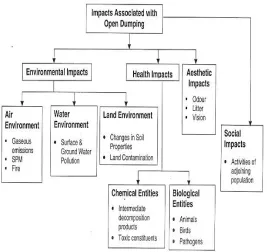
Figure describes the flowchart of Impact Associated with Open Dumpingon human health. Improper storage, handling, transportation, treatment and disposal of hazardous waste results in adverse impact on ecosystems including the human environment. When discharged on land, heavy metals and certain organic compounds are phototoxic and at relatively low levels can adversely affect soil productivity.
Fig 1.1 Flowchart of Health Impacts of Solid Waste on Environment
SOURCES OF GW CONTAMINATION: Sources of contamination can be divided basically into two groups, natural & cultural (those caused by man). The source can be further classified as either point or non-point source of pollution. Point sources enter the pollution transport routes as discrete, identifiable locations & can be measured directly or otherwise quantified, & their impact can be evaluated directly. Major point sources include effluent from industrial & sewage treatment plants, & effluent from farm buildings or SW disposal sites. The non-point sources include, effluents from agriculture activity, urban runoff, mining activities etc. Assessment of non-point sources are difficult & needs detailed field & laboratory investigations.
THE DRASTIC METHOD: AN OVERLAY AND INDEX METHOD: Developed by US EPA;Provides a basis for
ISSN(Online): 2319-8753 ISSN (Print): 2347-6710
I
nternational
J
ournal of
I
nnovative
R
esearch in
S
cience,
E
ngineering and
T
echnology
(An ISO 3297: 2007 Certified Organization)
Website: www.ijirset.com
Vol. 6, Issue 8, August 2017
ASSISSING GW VULNERABILITY: There are three traditional methods for assessing GWvulnerability to pollution,Process-based: Involves numerical modelling & is useful at the local levels but not the regional level;Statistical: Involves correlating actual water quality data to special variables & requires a large amount of site specific data;Overlay & Index : Involves obtaining & combining maps of the parameters that affects the transport of contaminants from the surface of GW, then assigning an index value to those parameters; the results are a spatially oriented vulnerability index.
OBJECTIVES: To study the impact of SW on health; To study the GW quality parameters in & around the landfill site; To study & evaluate the effects of SW dumps on GW Quality; To study & observe the existing pollution in GWQ & its ill effects on human beings; To study the existing collection & transportation practices of MSWM including public participation; To study quantity of Municipal SW generated in Belgaum City; To determine the future population of Belgaum city & to adopt the proper SWM system; Study of Drastic Method for assessing the vulnerability to GWpollution for the SW dumping site.
II. LITERATUREREVIEW
SOLID WASTE MANAGEMENT: SWM is associated with the control of waste generation, its storage, collection, transfer & transport, processing & disposal manner that is in accordance with the best principles of public health, economics, engineering, conservation, aesthetics, public attitude & other environmental consideration.
THE MSW (MANAGEMENT AND HANDLING) RULES 2000: The Rules 2000 came into force from 25.9.2000. It is obligatory on the part of all the municipal authorities to arrange for collection, segregation, transportation & suitable disposal of municipal wastes of the municipal towns/cities. Under these rules all municipal authorities responsible for collection, segregation, storage, transportation, processing & disposal of MSW are covered. The municipal authority or an operator of a facility needs to make an application, for grant of authorization for setting up of waste processing & disposal facility including landfills, to the state Board.
Rachamanda, T. V.et al.,(2007) in their paper entitled “Environmental audit of Municipal Solid Waste Management”.The MSWM has become an acute problem due to enhanced economic activities & rapid urbanization. Increased attention has been given by the government in recent years to handle this problem in a safe & hygienic manner. In this regard, MSWMenvironmental audit has been carried out for Bangalore city through the collection of secondary data from government agencies, & interviews with stakeholders & field surveys. Field surveys were carried out in seven wards (representative samples of the city) to understand the practice & identify the lacunae. The MSWM audit that was carried out functional-element-wise in selected wards to understand the efficacy & shortfalls.
ISSN(Online): 2319-8753 ISSN (Print): 2347-6710
I
nternational
J
ournal of
I
nnovative
R
esearch in
S
cience,
E
ngineering and
T
echnology
(An ISO 3297: 2007 Certified Organization)
Website: www.ijirset.com
Vol. 6, Issue 8, August 2017
III.PROFILEOFSTUDYREGION
HISTORICAL BACKGROUND: Belgaum is the most established city in Karnataka with unmistakable social history. Belgaum is the quickest developing urban focus. It is creating as a rich business center& training focus being arranged in the focal point of Karnataka state. Belgaum is the fourth biggest city in the state. It lies in the social move between Karnataka, Maharashtra & Goa. Belgaum is one of the 57 urban communities in Karnataka in the Nirmalanagar civil e-administration extend. Belgaum as a farming base is most appropriate for the money crops like cotton, groundnuts & tobacco. The city is becoming mechanically quick with numerous fare units. Belgaum is neighboring a portion of the all-around created business focuses like Hubli, Kolhapur, &Sangli&Panaji.
(a) (b)
Historical details (a)Demographic Profile of Karnataka State and Belgaum District, 2011, (b) Location details of Belgaum City.
Consequently, the city is pulling in more financial specialists from everywhere throughout the nation furthermore NRI's with its rich Bauxite & Uranium stores. Belgaum city is arranged on the slanting territory viz; inclining South West to South East .The general ground level differs from 815 m Malmaruti Augmentation to 74m in old Belgaum. Belgaum city is arranged about 2500 ft (762m) over the ocean level. The city is situated at 15.87◦North, 74.5◦ east.Belgaum is
outstanding for its charming atmosphere consistently. The temperature shifts, it is charmingly warm amid summer at 25◦ C-40◦C. In the winter the temperature is 18◦C - 26◦C. The normal rainfalls are 200cm. Belgaum is named as
Review 1 Metropolitan Partnership with 58 wards.
COLLECTION OF MSW IN THE CITY LIMITS: To avoid dumping of garbage on street corners, open drains etc., corporation has started door to door collection of garbage in corporation limit and it is covered 70%. In addition to that the corporation also provided metallic bins in the designated places of the city limits.To avoid open dumping of garbage on the street corners & other places as per the MSW rules, the City Corporation of Belgaum has procured closed metal containers of size 4.5 Cum & 3.00 Cum.
ISSN(Online): 2319-8753 ISSN (Print): 2347-6710
I
nternational
J
ournal of
I
nnovative
R
esearch in
S
cience,
E
ngineering and
T
echnology
(An ISO 3297: 2007 Certified Organization)
Website: www.ijirset.com
Vol. 6, Issue 8, August 2017
association has staff of 13 members who are working for the BMW collection, transportation & disposal. The city is divided in to 8 zones with 8 people for the purpose of collection & secondary storage of BMW from various hospitals & store it in the secondary storage pints.The secondary storage is done in big cement box covered with metallic top door which is kept locked. There 5 secondary storage points situated in different parts of cities the association has one vehicle which collects the BMW from the secondary storage point to the incineration site.
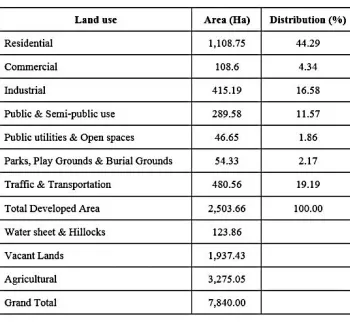
Table indicates Belgaum city has 7840.00 hectares of aggregate range in 1989 out of which 2503.66 hectares is produced. The current land use detail in the year 1989 as exhibited in the CDP. An unlimited belt from west to east in the middle of old city &Shahapuris under horticultural utilize.
Fig 3.1Existing land Use (1989 - Existing)
IV.MATERIAL AND METHODOLOGY
MATERIALS: The collection of set of data required for the study of SWM. SWM is associated with the control of waste generation, its storage, collection, transfer & transport, processing & disposal manner that is in accordance with the best principles of public health, economics, engineering, conservation, aesthetics, public attitude & other environmental consideration.
WASTE GENERATION ON SOURCES-BASED: Historically, the sources of SW have been consistent, dependent on sector & activities, these include the following:Residential: This refers to wastes from dwelling, apartments, etc.; Commercial: This refers to wastes generated from store, restaurants, markets, hotels, motels, auto repair shops, medical facilities, etc.; Institutional: This mainly generated from educational, administrative & public buildings;Municipal: This mainly generated from various municipal activities like construction & demolition, stress cleaning, landscaping, etc.;Industrial: This mainly consists of process wastes, ashes, demolition & construction wastes, hazardous wastes, etc. due to industrial activities; Agricultural: This mainly generated from field, orchards, vineyards, farms, etc.
ISSN(Online): 2319-8753 ISSN (Print): 2347-6710
I
nternational
J
ournal of
I
nnovative
R
esearch in
S
cience,
E
ngineering and
T
echnology
(An ISO 3297: 2007 Certified Organization)
Website: www.ijirset.com
Vol. 6, Issue 8, August 2017
COLLECTION OF SW: Littering of MSW shall be prohibited in cities, towns & in urban areas notified by the State Governments. To prohibit littering & facilitate compliance, the following steps shall be taken by the municipal authority, namely: - Organizing house-to-house collection of MSW; Devising collection of waste from slums & squatter areas; Wastes from slaughter houses, shall be managed to make use of such wastes;BMW& industrial wastes shall not be mixed with MSW;Collected waste from residential & other areas shall be transferred to community bin;Horticultural & construction or demolition wastes or debris shall be separately collected & disposed;Waste (garbage, dry leaves) shall not be burnt;Stray animals shall not be allowed to move around waste.
TRANSPORTATION OF MSW: Vehicles used for transportation of wastes shall be covered. Waste should not be visible to public, nor exposed to open environment preventing their scattering.The following criteria shall be met, namely:The storage facilities set up by municipal authorities shall be daily attended for clearing of wastes. The bins or containers wherever placed shall be cleaned before they start overflowing;Transportation vehicles shall be so designed that multiple Handling of wastes, prior to final disposal, is avoided.
SEGREGATION OF MSW: In order to encourage the citizens, municipal authority shall organize awareness programmes for segregation of wastes & shall promote Recycling or reuse of segregated materials. The municipal authority shall undertake phased programmer to ensure Community participation in waste segregation. For this purpose, regular Meetings at quarterly intervals shall be arranged by the municipal Authorities with representatives of local resident welfare associations & non-governmental organizations.
PROCESSING OF MSW: Municipal authorities shall adopt suitable technology or combination of such technologies to make use of wastes so as to minimize burden on landfill.Following criteria shall be adopted, namely: -The biodegradable wastes shall be processed by composting, vermicomposting, anaerobic digestion or any other appropriate biological processing for stabilization of wastes;Mixed waste containing recoverable resources shall follow the route of recycling. Incineration with or without energy recovery including pulverization can also be used for processing wastes in specific cases. Shall approach the Central Pollution Control Board to get the standards laid down before applying for grant of authorization.
DISPOSAL OF SW: Land filling shall be restricted to non-biodegradable, inert waste & other waste that are not suitable either for recycling or for biological Processing. Land filling shall also be carried out for residues of waste processing facilities as well as pre-processing rejects from waste processing facilities. Land filling of mixed waste shall be avoided unless the same is found unsuitable for waste processing. Under unavoidable circumstances or till installation of alternate facilities, landfilling shall be done following proper norms.
Methods Adopted For the Disposal of Treatment: Thermal Treatment- Incineration, Gasification, Open Burning; Dumps & Landfills- Sanitary Landfills, Controlled Dumps, Bioreactor landfill; Biological Waste Treatment- Composting, Anaerobic Digestion; Vermin-Composting.
SOLID WASTE CHARACTERISTICS:MSW is necessary to analyse their physical & chemical parameters.
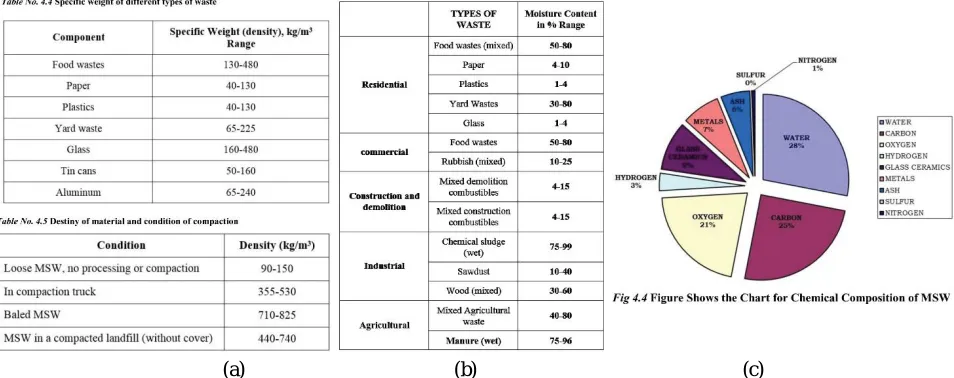
Physical Characteristics: Refuse characteristics depends on a number of factors such as food habits, cultural traditions, socio – economic & climatic conditions& it not onlyvary from city to city but even within the same city limits & also seasonally.The collected sample is physically sorted out on a sorting platform into various ingredients such as paper, glass, plastics, etc. The individual components are sorted in bins & weighted& expressed as a percent of the original sample on a wet weight basis.In Indian there is a small percentage of recyclable material & more of compostable & inert material like ash & road dust as waste. There is very large informal sector of rag pickers which collects recyclable waste from the streets, bins & disposal sites. They take away paper, plastic, metal, glass rubber etc. for their livelihood. The physical characteristics of Indian waste are as shown in table 4.1. Physical Characteristics of MSW:Specific Weight (Density); Moisture Content; Particle Size & Distribution; Field Capacity; Permeability of Compacted Waste.
ISSN(Online): 2319-8753 ISSN (Print): 2347-6710
I
nternational
J
ournal of
I
nnovative
R
esearch in
S
cience,
E
ngineering and
T
echnology
(An ISO 3297: 2007 Certified Organization)
Website: www.ijirset.com
Vol. 6, Issue 8, August 2017
Biological Characteristics of MSW: The biological characteristics of the organic fraction of MSW is that almost all of the organic components can be converted biologically to gases & relatively inert organic & inorganic solids. The product of odors& the generation of flies are related to the putrescible nature of the organic materials found in MSW.
(a) (b) (c)
Fig (a) Specific weight and density of materials, (b) Moisture content, (c) Chart for Chemical Composition of MSW.
METHODOLOGY: Methods formanaging SWM& impact of SW disposal on GW quality, using drastic method.
METHODS OF ANALYSIS: MSW is analyses in the laboratory to find its physical composition, & chemical composition by means of its, Physical &Chemical Characteristics.
KEY ASSUMPTIONS OF DRASTIC METHOD: Contamination occurs at the ground surface; The contaminant enters the water table when rain falls on the surface & percolates into the saturated zone; The contaminant travels with water, at the same rate as water; The method will be applied to no greater than 100 acers; The aquifer is unconfined (the method can be modified for a confined aquifer); The dominant pollutants are not pesticides (the method can be modified to include pesticides)
ESTIMATION OF DRASTIC INDICES: A numerical ranking system has been devised in order to assess the GW pollution potential in hydrogeological settings using the DRASTIC factors. DRASTIC is derived from the seven factors.D = Depth of water in meters; R = Net recharge in meters; A = Aquifer media; S = Soil media; T = Topography (slope %); I = Impact of vadose zone media; C = Hydraulic conductivity of aquifer.
DRASTIC model contains three significant factors viz. weights, ranges, ratings.
Weights (w): Each of the DRASTIC parameters has been assigned a weight rating from 1 to 5 to describe relative importance in the pollution processes as compared to other parameters.
Ranges: Each DRASTIC factor has been divided into either ranges or significant media types which have an impact on pollution potential.
Ratings (r): The ratings vary from 1 to 10 for each range in DRASTIC factor. The DRASTIC factors have been assigned one value per range. The factors A and I have been assigned a typical rating & variable rating. The variable rating allows the user to choose either a typical rating or variable rating. The variable rating allows the user to choose either a typical value based on more specific knowledge.Once all the factors have been assigned a rate, each rate is multiplied by the assigned weight & the resultant numbers are summed up to get what is called DRASTIC index or pollution potential. This model is formulated as an equation using a linear combination methodology.
DI = (Dr x Dw) + (Rr x Rw) + (Ar x Aw) + (Sr x Sw) + (Tr x Tw) + (Ir x Tw) + (Cr x Cw)= pollution potential
ISSN(Online): 2319-8753 ISSN (Print): 2347-6710
I
nternational
J
ournal of
I
nnovative
R
esearch in
S
cience,
E
ngineering and
T
echnology
(An ISO 3297: 2007 Certified Organization)
Website: www.ijirset.com
Vol. 6, Issue 8, August 2017
V. RESULTANDDISCUSSION
EVALUATION OF GW POLLUTION POTENTIAL USING DRASTIC MODEL: The DRASTIC model is
applied for the systematic determination of GW pollution susceptibility of any hydrogeological setting on the basis of available data. Hydrogeological setting incorporates the major hydrogeological factors which are used to infer the potential for contamination to enter GW. This model is used for the present study as a part of the GW modelling.
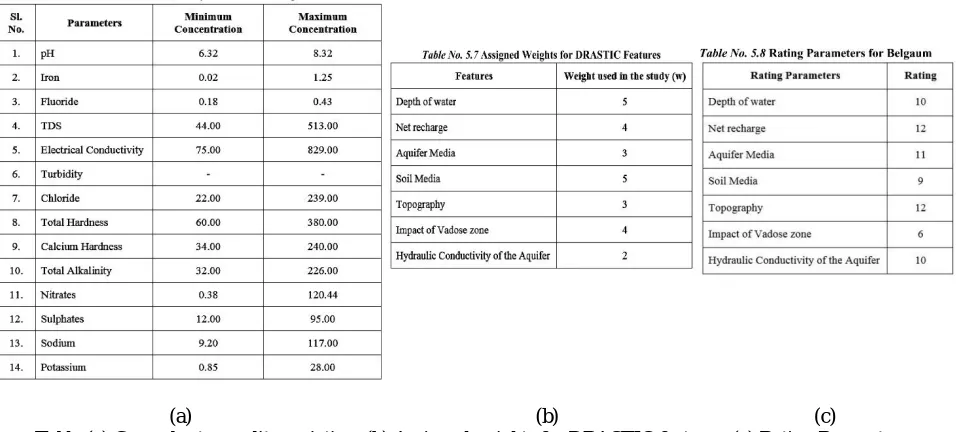
Parameter EstimationBased on the relative importance of various hydrogeological parameters in characterizing GW quality, certain weights are assigned in below table for each factor to calculate the DRASTIC index.
(a) (b) (c)
Table (a) Groundwater quality variation, (b) Assigned weights for DRASTIC features, (c) Rating Parameters.
Depth of Water Table: The depth of water table is important in any hydrological pollution study, primarily because it determines the depth of material through which a contaminant must travel before it reaches the aquifer. There is a greater chance for attenuation to occur as the depth to water increases because deeper water levels require long travel times.
Net Recharge: For estimating the net recharge, infiltration data has been used. It indicates the amount of water per unit area of land, which penetrates the ground surface & reaches the water table. It expresses the transportation mechanism of contaminant vertically to the water table & horizontally within the aquifer.
Aquifer Media: Aquifer parameters were estimated fromthe data provided from State & Central GW Departments.
Soil Media: Soil Media refers to uppermost portion of the vadose zone characterized by significant biological activity. Major soil types distributed in the study area are black cotton soils, Lateritic soils & mixed soils.
Topography: Topography refers to the slope & slope variability of the land surface. Topography influences a pollutant to remain on the surface longer enough to infiltrate or to wash away. The slope of the study area varies between 0 to 8%.
Impact of VadoseZone (VZ): The VZ is defined as the zone above the water table, which is unsaturated. The type of vadose media determines the attenuation characteristics of material below the typical soil horizon & above the WT.
Hydraulic conductivity: Hydraulic conductivity data has been collected from State GW Department.
ISSN(Online): 2319-8753 ISSN (Print): 2347-6710
I
nternational
J
ournal of
I
nnovative
R
esearch in
S
cience,
E
ngineering and
T
echnology
(An ISO 3297: 2007 Certified Organization)
Website: www.ijirset.com
Vol. 6, Issue 8, August 2017
DRASTIC indices value for Belgaum is 256.From the above estimated index values, it is concluded that, if the Index value exceeds 170 mark, the area is highly prone to pollution. Further, the DRASTIC index ranging between 170 – 160 may be considered as marginal, which indicate that immediate steps should be taken to control the pollution activities. The index less than 160 is considered as relatively least vulnerable regions to pollution.In order to arrive at definite conclusion, it is necessary to evaluate all the hydrogeological parameters through intensive field & laboratory investigations.
PROBLEMS RELATED TO SWM SYSTEM: Storage of waste at source; Segregation recyclable waste; Collection from door step; Transportation of waste; Processing of waste; Disposal of waste at sanitary landfill.
PROBLEMS RELATED TO STORAGE OF WASTE AT SOURCE: Following are the problems related to storage of waste at source, Lack of public awareness, motivation & education; Lack of civic sense & bad habits of people to litter; Lack of co-operation from households, trade & commerce; Lack of powers to levy spot fines; Lack of litter bins in the city; Long distance between community bins; Resistance to change in attitude.
PROBLEMS RELATED TO SAGREGATION OF RECYCLABLE WASTE: Following are the problems related
to segregation of recycle waste,Lack of wide publicity through electronic & print media waste; Lack of public awareness & motivation resulting in poor response from citizen; Lack of citizen’s understanding & how to use separate bins for storage of recyclable;Lack of sufficient knowledge of benefits if segregation;Lack of co-operation & negative attitude of people;Lack of finances to create awareness;Difficulty of educating slum dwellers;Lack of effective legal remedy.
PROBLEMS RELATED TO TRANSPOTAION OF WASTE: Old vehicles those are difficult to replace;Trucks & tractors have open bed during transport, waste spills from the truck thereby causing nuisance; Practiced manual loading of waste without use protective gears is dangerous to the health of workers;The problems arise when the transport fleet is modernized, because waste at secondary storage system is still dumped on the ground;If the secondary storage system is modernized without an adequate fleet of modern vehicles, similar problems arise;Multiple handling of waste results in low labour & equipment productivity;Overflowing secondary waste storage depots result from irregular & untimely transport of waste;Vehicles are poorly maintained because of inadequate workshop facilities & maintenance procedures. This problem leads to frequent breakdowns & trucks that are out of service for long periods;Unplanned routing of vehicles results in insufficient transport logistics.
PROBLEMS RELATED TO PROCESSING OF WASTE: Lack of financial resources;Lack of technical know-how;Lack of skilled personnel; Unavailability of appropriate land;Lack of basic facilities to set up treatment plants;Lack of institution capacity.
PROBLEMS RELATED TO DISPOSAL OF WASTE AT THE SANITARY LANDFILL: Lack of financial resources;Lack of technical know-how for scientific disposal of waste;Unavailability of appropriate land;Lack of institutional capacity;Lack of skilled personnel.
VI. CONCLUSION
Conclusion made from the results obtained through DRASTIC indices methodology for Belgaum is 256 marks which is more than the limit 170 marks, so the area is highly prone to pollution, which indicates that immediate steps should be taken to treat the affected land fill site and Ground water.
REFERENCES
[1] Rachamanda, T. V., "Environmental audit of Municipal Solid Waste Management",Int.J. Environmental Technology and Management, vol.7,
pp.369-391, 2007.
[2] Choudhary, N. K., "Impact of Solid Waste Disposal on Ground Water Quality near Gazipur Dumping site, Delhi, India",Journal of Applied
Natural Science, vol 5, pp.306-212, 2013.
[3] Dr.B.K.Purandara, "Groundwater Quality Studies in Belgaum District, belgaum", National Institute of Hydrology Jalvigyan Bhawan
Roorkee-(Uttaranchal), pp.247-667, 2000.
[4] Jovanovic, N., Adams, S., Thomas, A., Fey, M., Beekman, H., Campbell, R.,"Improved DRASSTIC method for assessment of groundwater
vulnerability to generic aqueous phase contaminants", WIT Trasaction Ecology and the Environment, pp.1743-3541, 2006.
ISSN(Online): 2319-8753 ISSN (Print): 2347-6710
I
nternational
J
ournal of
I
nnovative
R
esearch in
S
cience,
E
ngineering and
T
echnology
(An ISO 3297: 2007 Certified Organization)
Website: www.ijirset.com
Vol. 6, Issue 8, August 2017
[6] Gajendra Mohan Dev Sarma, D. M., "Municipal Solid Waste Management (MSWM): A Case Study of Nagaon Town in Assam,
India",Internatioinal Journal of Science and Research (IJSR), Vol 4, pp.2806-2809, 2015.
[7] Pandey, S. S.,"Solid waste Management in India: status and uture direction",TERI Information Monitor on Environmental Science, vol6(1),
pp.1-4, 1998.
[8] Sandeep K. Pandey, P. T.,"Municipal Solid Waste Management in Ghazipur city - A case Study",ARPN Journal of Agriculture and Biological
Science, Vol 2, pp.41-43, 2007.
[9] Vipin Upadhyay, J. A., "Solid Waste Collection and Segregation: A Case Study of MNIT Campus, Jaipur",International Journal of
Engineering and Innovative Technology (IJEIT), Vol 1, pp.144-148, 2012.
[10] Ministry of Environment and Forest, Go I –“Municipal Solid Wastes (Management and Handling) Rules, 2000”.
[11] Central pollution Control Board, Status of Solid Waste Generation, Collection, Treatment and Disposal in Class –II Towns, Control of Urban
Pollution Series: CUPS/50/1999-2000.
[12] Agarwal, A., Singhmar, A., Kulshrestha, M., Mittal, A.K., “Municipal solid waste recycling and associated markets in Delhi, India”, Journal of
Resources, Conservation and Recycling,2005.
[13] Karjinni.Vilas .V. R.KJain, Dr.O.P Bhatia, “Urban Land use- Transport Planning of Belgaum: A New Approach”, The Institution of