Full-Round Differential Attack on DoT
Block Cipher
Manoj Kumar
Scientific Analysis Group, DRDO, Metcalfe House Complex,
Delhi-110 054, INDIA.
[email protected]
Abstract
The lightweight encryption design DoT was published by Patil et al in 2019. It is based on SPN (substitution permutation network) structure. Its block and key size are 64-bit and 128-bit respectively. In this paper, we analyse the security of DoT against differential attack and present a series of differential distinguishers for full-round DOT. Our analysis proves that DoT we can be distinguished from a random permutation with probability equal to 2−62. Diffusion layer of DoT is a
combination of byte shuffling, 8-P permutation, 32-bit word shuffling and circular shift operations. We analyse the security of DoT with and without 8-P permutation in its diffusion layer. Our results indicate that DoT provides better resistance to differential attack without using the 8-P permutation.
Keywords: Block Cipher, Lightweight Block Cipher, Differential Cryptanalysis, Branch-and-bound Algorithm.
1
Introduction
Lightweight cryptography has evolved to provide the security solutions during automatic connections between humans and machines through advanced technologies. Lightweight block ciphers are used to secure the applications like RFID tags, wireless sensor nodes and Internet of things etc [13]. Memory and throughput requirements are considered as important design parameters for these applications. DoT is claimed as a compact and smallest cipher which requires 993 GEs only and it is presented as a significant option for low power and compact memory applications [12]. We analyse the security of DoT against differential attack and present a distinguisher for full rounds.
(SPN) structure [2]. Round function in each structure is designed to satisfy the confusion and diffusion properties. DoT is based on SPN structure that processes the full input block through its round function in each round. It applies single 4-bit S-box sixteen times in parallel but its diffusion layer is made up of various components like byte and word shifts, bit permutation and circular shift operations. S-box is used to provide the confusion and diffusion is achieved by combining the bit/byte/word permutations. We also analyse the diffusion layer of DoT and report our results in this paper.
Rest part of the paper is organised in the following way. In section 2, we discuss block ciphers DoT and its key expansion algorithm in brief. In section 3, we apply branch-and-bound based algorithm to search the differential trails and present full-round differential distinguisher for DoT. We analyse the diffusion layer with and without 8-P permutation in section 4.
Notations: The following notations are used throughout the paper: - P :64-bit input plaintext block
- C :64-bit output ciphertext block - P64
i :64-bit input to round function - K :128 bits master key
- U K :128-bit updated key register - RKi :64-bit round subkey
- T64
1 :64-bit temporary block
- TL32 :Left 32-bit block - T32
R :Right 32-bit block - T4
1, T24 :4-bit temporary nibbles
- ⊕ :Bitwise exclusive-OR operation - ≪n :Left cyclic shift by n bits - ≫n :Right cyclic shift byn bits
- k :Concatenation of two n-bit strings - [i]2 :Binary value of integer i
2
Lightweight Encryption Design: DoT
Lightweight block cipher DoT was published by Patil et al at advances in intelligent systems and computing 2019 [12]. It is presented as the compact and smallest design till date for memory requirement and execution time. It consists of a single S-box, shift operations and XOR gates. We provide a brief description of DoT in this section.
2.1
Description
Full-Round Differential Attack on DoT Block Cipher
2.2
Encryption Algorithm
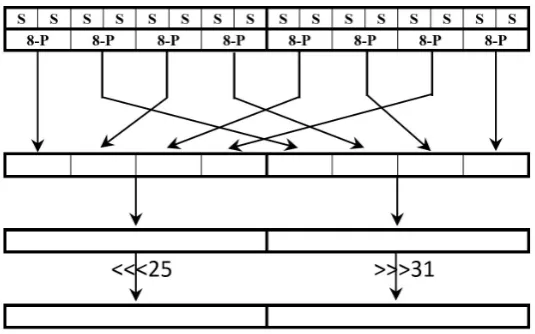
We describe the encryption algorithm using substitution operationSB, 8-bit permutation
P8, shuffling of ith byte Bi and circular shift operations (Algorithm 1, Fig. 1). Round function applies the substitution operationSBon 64-bit state valuePi64⊕RKiby dividing the 64-bit word into 4-bit nibbles. It applies the 4-bit S-box (Table 1) 16 times in parallel on each nibble. After that, 8-bit permutation P8 is applied on each byte that outputs a
64-bit valueT64
1 which is divided into eight bytes (Fig. 2). These bytes are rearranged to
produce two 32-bit outputs TL32 and TR32. Finally, left circular shift by 25 bits is applied on T32
L and right circular shift by 31 bits is applied on TR32 and the output values are concatenated to produce P64
i+1. These operations are applied 31 times to get the 64-bit
ciphertext. In each round, we need 64-bit round subkey (RKi) which is obtained from the 128-bit master secret key (K) by using a key expansion algorithm (Algorithm 2) [12].
Algorithm 1: Encryption Algorithm
1 Input: P =P164 and RKi obtained fromK
2 Output: C =P3264⊕RK32 3 for i=1 to 31 do
4 T164=P8(SB(Pi64⊕RKi))
5 T164→(B1||B2||B3||B4||B5||B6||B7||B8) 6 TL32= (B1||B3||B5||B7)
7 TR32= (B2||B4||B6||B8)
8 Pi64+1 = (TL32 <<25)||(TR32>>31) 9 end
Algorithm 2: Key Expansion Algorithm
1 Input: 128-bit master key K 2 Output: 64-bit round subkeys RKi
3 for i=1 to 31 do
4 RKi = 64 leftmost bits of K
5 U K ←K <<<13
6 T14 = (U K >>124) & 0xF 7 T24 = (U K >>120) & 0xF
8 K =S(T14)<< 124||S(T24)<< 120||((U K <<8)>> 8)⊕([i]2 <<59)
9 end
x 0 1 2 3 4 5 6 7 8 9 A B C D E F
S(x) 3 F E 1 0 A 5 8 C 4 B 2 9 7 6 D
Figure 2: 8-P Permutation
3
Differential Attack on DoT
Full-Round Differential Attack on DoT Block Cipher
Algorithm 3: Branch-and-bound based algorithm for differential trail
1 Input: X, S-box size (bits) =m,least=A, optimal=B and NSB = 0 2 Output: Optimal Differential Trails with best probability PT
3 for i=1 to t do
4 for j=1 to 2m−1 do
5 N ibblei =j;N ibble(6=i) = 0;
6 X = (N ibble1, N ibble2, . . . , N ibblet); 7 for Round=1 to r do
8 Count(6= Non-zero nibbles in X); 9 NSB =NSB+Count;
10 for k1 = 1 to 15 do 11 for k2 = 1 to 15 do 12 ...
13 for kt = 1 to 15 do
14 p1 =DDT[N ibble1][k1];
15 If(p1 = 0) continue;
16 p2 =DDT[N ibble2][k2];
17 If(p2 = 0) continue;
18 ...
19 pt=DDT[N ibblet][kt];
20 If(pt = 0) continue;
21 Y = (k1, k2, . . . , kt);
22 X =PLayer(Y);
23 PRound =p1∗p2∗...∗pt
24 end
25 end
26 end
27 end
28 PT =P1∗P2∗...∗Pr
29 if NSB ≤least and PT ≤optimal then
30 return: Optimal differential trail with probability PT
31 end
DoT applies round key addition, 4-bit S-box, permutation on 8 bits, word shifts and left/right rotations in each round [12]. Word shift, 8-bit permutation and rotations are linear operations that always generates a fixed output difference for a particular input difference. We also get the same difference value 4U = U1 ⊕U2 before and after the
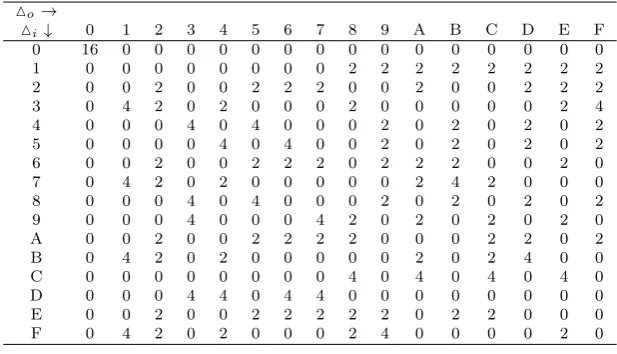
add round key operation. However, substitute nibble operation does not provide the fix output difference for any input difference due to its non-linearity. Therefore, we need to construct the probabilistic relations for each input and corresponding output differences to S-box. This is tabulated to get a 24 ×24 difference distribution table (DDT) [5] for
4-bit S-box. For any non-zero input (Mi6= 0), we get more than one non-zero outcomes (Mo6= 0). For DoT S-box, there are 256 possible input and output difference pairs (Mi,Mo) that are presented in the following table.
Mo→
Mi↓ 0 1 2 3 4 5 6 7 8 9 A B C D E F
0 16 0 0 0 0 0 0 0 0 0 0 0 0 0 0 0 1 0 0 0 0 0 0 0 0 2 2 2 2 2 2 2 2 2 0 0 2 0 0 2 2 2 0 0 2 0 0 2 2 2 3 0 4 2 0 2 0 0 0 2 0 0 0 0 0 2 4 4 0 0 0 4 0 4 0 0 0 2 0 2 0 2 0 2 5 0 0 0 0 4 0 4 0 0 2 0 2 0 2 0 2 6 0 0 2 0 0 2 2 2 0 2 2 2 0 0 2 0 7 0 4 2 0 2 0 0 0 0 0 2 4 2 0 0 0 8 0 0 0 4 0 4 0 0 0 2 0 2 0 2 0 2 9 0 0 0 4 0 0 0 4 2 0 2 0 2 0 2 0 A 0 0 2 0 0 2 2 2 2 0 0 0 2 2 0 2 B 0 4 2 0 2 0 0 0 0 0 2 0 2 4 0 0 C 0 0 0 0 0 0 0 0 4 0 4 0 4 0 4 0 D 0 0 0 4 4 0 4 4 0 0 0 0 0 0 0 0 E 0 0 2 0 0 2 2 2 2 2 0 2 2 0 0 0 F 0 4 2 0 2 0 0 0 2 4 0 0 0 0 2 0
Table 2: Difference Distribution Table of DoT
In table 2, trivial pair (0,0) appears 16 times and any non-trivial pair (Mi,Mo) appears 0/2/4 times. We use algorithm 3 to construct the differential trails and search for the trail covering maximum number of rounds with highest probability. It proceeds by dividing the 64-bit input data into sixteen 4-bit nibbles then it perform the trail search for all non-zero values of 4-bit nibble. The trails with least number of active S-boxes and highest probability are filtered out to get the optimal differential trails.
We constructed the 31-round differential distinguisher by extending the 2-round and 6-round trails that produce an output difference equals to the input difference after 2 and 6 rounds respectively. We start with input difference 0000000000000050 which results in the output difference 0000000000000008 after first round with probability 2−2. This
difference is the input difference for the second round which generates the difference 0000000000000050 after 2 rounds with probability 2−2. In this way, we get 2-round trail
with probability 2−4. We also constructed several 6-round trails with equal values of
input and output difference. We constructed total 37 distinct differential distinguihers for full-round DoT by extending these 2-round and 6-round differential trails. Some of the 2-round and 6-round trails are as shown below.
Full-Round Differential Attack on DoT Block Cipher
3. 0050000000000000→0000000008000000→0000005000000000 →0000000000080000
→0000000000005000→0800000000000000 →0050000000000000
4. 0000000000800000→0000000000000c00→8000000000000000→000c000000000000
→0000000080000000→0000000c00000000 →0000000000800000
We get thirty seven differential trails that serves as full-round differential distinguisher for DoT encryption algorithm with probability equal to 2−62. We compare the lower
bound on the number of active S-boxes in any differential trail of DoT with the designers bound (Table 3). This shows that our results provide the significant improvements to the security claims of DoT. One of the full-round differential distinguisher is presented in table 4 with 0000000400000000 as first-round input difference and output difference after 31 rounds as 0000000000500000 with probability 2−62.
Round #Active S-boxes # Active S-boxes Index (Lower Bound) (Lower Bound)
2 2 2
6 7 6
30 35 30
Ref. [12] This Paper
Table 3: Bounds on number of active S-boxes
Round Input Difference #Active Prob. Prob.
index 4Pi S-box (−log2pi) (−Σilog2pi)
1 00000004 00000000 1 2 2
2 00000000 00500000 1 2 4
3 00000000 00000800 1 2 6
4 50000000 00000000 1 2 8
5 00080000 00000000 1 2 10
6 00000000 50000000 1 2 12
7 00000008 00000000 1 2 14
8 00000000 00500000 1 2 16
9 00000000 00000800 1 2 18
10 50000000 00000000 1 2 20
11 00080000 00000000 1 2 22
12 00000000 50000000 1 2 24
13 00000008 00000000 1 2 26
14 00000000 00500000 1 2 28
15 00000000 00000800 1 2 30
16 50000000 00000000 1 2 32
17 00080000 00000000 1 2 34
18 00000000 50000000 1 2 36
19 00000008 00000000 1 2 38
20 00000000 00500000 1 2 40
21 00000000 00000800 1 2 42
22 50000000 00000000 1 2 44
23 00080000 00000000 1 2 46
24 00000000 50000000 1 2 48
25 00000008 00000000 1 2 50
26 00000000 00500000 1 2 52
27 00000000 00000800 1 2 54
28 50000000 00000000 1 2 56
29 00080000 00000000 1 2 58
30 00000000 50000000 1 2 60
31 00000008 00000000 1 2 62
– 00000000 00500000 - - –
Table 4: Full-Round Differential Distinguisher
4
Analysis of Diffusion Layer
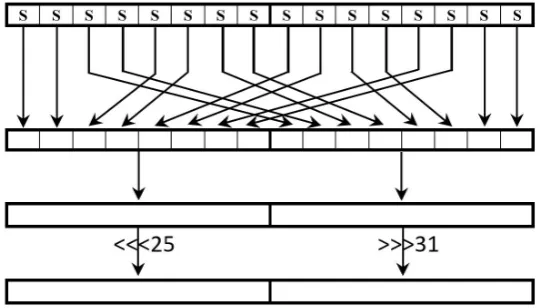
of DoT block cipher. We apply our trail search algorithm on both versions of DoT and observe that MDoT provides the better security in comparison to the original DoT block cipher. We observe that any 10-round differential trail of MDoT have at least 10 active S-boxes with probability 2−25 while 10-round differential trail of original DoT have 10
active S-boxes with probability 2−20. We have extended the 10-round differential trail of DoT to 31 rounds and presented a full-round differential distinguisher for original DoT. But, this is not possible in case of modified design MDoT. Any 30-round differential trail of MDoT cipher have 30 active S-boxes with probability 2−75. We conclude that it is not possible to construct any full-round differential distinguisher for MDoT block cipher.
Figure 3: Round Function of MDoT
5
Conclusion
We constructed 31-round differential trails with probability equal to 2−62and presented 37
differential distinguisher for full-round DoT. We can use 30-round differential trails with probability 2−60 for key recovery purpose. We also analysed the diffusion layer used in
DoT and proposed an improved design named MDoT by removing the 8-P permutation. This analysis shows that MDoT provides the better resistance in comaprison to the original DoT proposal. Our analysis presents the best result for differential attack on DoT block cipher which suggest that 31-round DoT is prone to differential attack. We should either increase the number of rounds or use the modified design MDoT to resist the differential attack.
Acknowledgements
Full-Round Differential Attack on DoT Block Cipher
References
[1] Biham, E., Shamir, A., Differential Cryptanalysis of the full 16-round DES, CRYPTO 92, LNCS, Vol. 740, pp. 487-496, Springer, 1992.
[2] Bogdanov, A., Analysis and Design of Block Cipher Constructions, Ph.D. thesis, 2009.
[3] Bogdanov, A., Knudsen, L.R., Leander, G., Paar, C., Poschmann, A., Robshaw, M.J.B., Seurin, Y., Vikkelsoe, C., PRESENT: An Ultra-Lightweight Block Cipher, CHES 2007, LNCS, Vol. 4727, pp. 450-466, Springer, 2007.
[4] Daemen, J., Rijmen, V., The Design of Rijndael, Springer-Verlag, 2002.
[5] Hays, H.M., A Tutorial on Linear and Differential Cryptanalysis, Cryptologia, Vol. 26, No. 3, pp. 188-221, 2002.
[6] Knudsen, L., Robshaw, M.J.B., Block Cipher Companion, Book Springer, ISBN 978-3-642-17341-7, 2011.
[7] Kumar, M., Design and Analysis of Symmetric Cryptographic Primitives, Ph.D. thesis, 2019.
[8] Kumar, M., Pal, S.K., Panigrahi, A., FeW : A Lightweight Block Cipher, Cryptology ePrint Archive, Report 2014/326, 2014.
[9] Kumar, M., Yadav, P., Pal, S.K., Panigrahi, A., Secure and Efficient Diffusion Layers for Block Ciphers, JACSM, 2017.
[10] Kumar, M., Suresh, T. S., Pal, S.K., Panigrahi, A., Optimal Differential Trails in Lightweight Block Ciphers ANU and PICO, Cryptologia, 2019.
[11] Matsui, M., On Correlation between the Order of S-boxes and the Strength of DES, EUROCRYPT 94, LNCS, Vol 950, pp. 366-375, Springer, 1994.
[12] Patil, J., Bansod, G., Kumar, S. K., DoT: A New Ultra-Lightweight SP Network Encryption Design for Resource-Constrained Environment, Advances in Intelligent Systems and Computing 828, pp. 249-257, 2019.