REMOVAL OF HAZARDOUS REACTIVE VIOLET
DYES USING AN ELECTROACTIVE CONDUCTING
POLYMER
S. Supriya
1, P.N. Palanisamy
21
Department of Chemistry, Jansons Institute of Technology, Coimbatore
2
Department of Chemistry, Kongu Engineering College, Perundurai, Erode
ABSTRACT
Conducting Electroactive polymer, Polypyrrole (PPy/SD) was synthesized chemically on the surface of saw dust
(SD) to remove Reactive Violet 5 (RV) from an aqueous solution. The important parameters such as pH, initial
concentration, sorbent dosage and contact time on uptake of RV solution were also investigated. The
experiments were carried out using batch system at room temperature. It was found that PPy/SD can be used to
remove anionic dye such as RV from aqueous solutions very efficiently. The adsorption process using
polypyrrole coated onto sawdust termed as PPy/SD was dependent on the pH of the solutions. Kinetic studies
revealed that the experimental data correlated well with intra-particle diffusion model and pseudo second-order
model possessing regression coefficient of R2 ≥ 0.9896. The experimental data were also analyzed by the Langmuir and Freundlich models of adsorption.The isotherm data could be well described via Langmuir
equation with the correlation coefficient of 0.9866. Scanning Electron Micrographs provided a supporting
evidence to evaluate surface area, total pore volume and pore diameter. The present study confirms the
potentiality of a carbon embedded in conducting electroactive polymer matrix and its availability for the
removal of reactive dyes from aqueous solution.
Keywords:Adsorption, Intra-Particle Diffusion, Langmuir Equation, Polypyrrole, Reactive Violet,
Saw Dust
I. INTRODUCTION
The world-wide high level of production and use of dyes generates colored wastewaters, which give cause of
environmental concern. Textile companies, dye manufacturing industries, paper and pulp mills, tanneries,
electroplating factories, distilleries, food companies and a host of other industries discharge colored wastewater
[1]. Use of reactive dyes has been enhanced due to the increased consumption of cellulose fibers in which other
dyes suffer from technical and economical practical limitations in comparison with reactive dyes [2].Among the
treatment options, adsorption appears to have considerable potential for the removal of colour from industrial
effluents. Thus, the safe removal of such a dye is the prime aim of our present research and this is accomplished
by using novel adsorbents.
Conducting electroactive polymer such as Polypyrrole has attracted a great deal of attention in recent years[3-8].
This class of new polymeric material can be easily synthesized from both aqueous and non-aqueous solutions.
applications such as sensors, separation devices, rechargeable batteries and controlled drug release. All other
applications of these polymers are based on their electrical conductivity and unique electrochemical properties
[9-12]. However, this paper deals with a quite different application of this reactive and functional polymer. Our
recent studies have shown that these polymers can effectively remove or uptake the ions and dyes from aqueous
solutions.
In this study, PPy/SD was synthesized directly on the surface of sawdust via chemical route at room
temperature. The anion exchange properties of polypyrrole conducting polymer are well established and
documented [10-12]. Sawdust, the same as other biomaterials or agricultural wastes is a good adsorbent for
adsorption of basic dyes such as methylene blue, malachite green [13-15]. Our research is mainly focused on
Polypyrrole coated sawdust (PPy/SD) for investigation of RV dye removal from aqueous solutions. The main
objective of this study is to evaluate the potentiality of PPy/SD, the polymer prepared from saw dust to remove
reactive dyes from wastewater. The study also includes an evaluation of the effects of various operational
parameters such as initial dye concentration, contact time, pH and temperature on the dye removal process. The
adsorption kinetic models and equilibrium isotherm models related to adsorption processes were also performed
and reported.
II. EXPERIMENTAL SECTION 2.1. Materials and Methods
Saw dust prepared from Casuarina wood was used for the preparation of electroactive Polymer. The saw dust
was first washed with distilled water in order to remove the impurities and finally dried at 333 K for 2 hours. In
order to prepare polymer coated saw dust, 5.0 g of saw dust was immersed in 50 ml of 0.20M freshly distilled
pyrrole solution for 12 hours before polymerization. 50 ml of 0.5 M FeCl3 as the oxidant solution was added
into the mixture gradually and the reaction was allowed to continue for 4 hours at room temperature [16]. The
polymer coated saw dust was filtered, washed with distilled water, dried in an oven at 55-600 C and sieved
before use [17]
Reactive violet 5 (M.Wt: 735.58, Mol.Formula: C20H16N3Na3O15S4, λ max: 545 nm) used in this study is of
commercial quality and used without further purification. Different initial concentrations were prepared by
diluting the stock solution using double distilled water as solvent. Dye concentration was analyzed by measuring
the absorbance values with UV-VIS spectrophotometer (Model: JASCO V-570) at a wavelength of 545 nm. The
pH measurements were made using pH meter (Model LI 610 ELICO). The pH adjustments of the solution were
made by 0.1M HCl or 0.1M NaOH. The chemicals were of analar grade and all the adsorption experiments were
carried out at room temperature (27±20C).
Physico-chemical characteristics of PPy/SD were studied as per the standard testing methods [18, 19]. In order
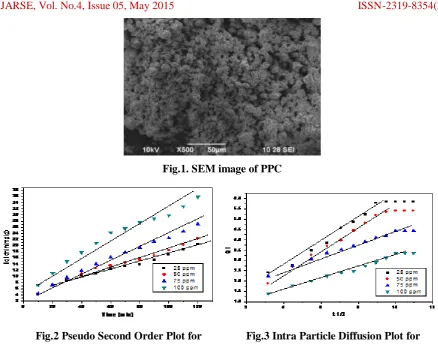
to characterize the surface structure and morphology of PPy/SD, SEM analysis was carried out using Scanning
Electron Microscope as shown in Fig.1. The experiments were carried out in a mechanical shaker (KHAN
shaker - KEMI make) working at a speed of 150 rpm. Dye solutions (50mL) of desired concentrations and initial
pH values were used. Blank samples were run under similar experimental conditions without using adsorbents.
After shaking, the adsorbents were separated by centrifugation and the supernatant solutions were estimated by
measuring absorbance at maximum wavelengths. The effect of each parameter like adsorbent dose, adsorbent
particle size, different dye concentrations and agitation time was studied by fixing the values of other parameters
o e
(c c )
qe v w
(1)
where qe (mgg-1) is the amount of dye adsorbed at equilibrium onto PPy/SD; Co and Ce(mgL-1), the initial and
equilibrium liquid-phase concentrations of dye; V(L), the initial volume of dye solution; and W(g), the weight of
PPy/SD.
III. RESULTS AND DISCUSSION
Initial dye concentration of RV5 ranging from 10mgL-1 to120 mgL-1 was prepared and adsorption experiments
were conducted using 2g of PPy/SD. The overall removal percentage decreases [21]since the adsorbent has
limited number of active sites which becomes saturated at certain concentration. The amount of RV5 dye
removal by PPy/SD is found to be higher due to the heterogeneity obtained by the presence of functional groups
present on the surface of the polymer composites [22]. From the literature,it was suggested that the dye removal
was high due to the ion exchange mechanism between the oppositely charged functionalities originating from
monomer and the ionic dye molecules.
The effect of contact time was studied by agitating 2 g of PPy/SD with 50mgL-1 of RV5 solution. The
adsorption efficiency increases with increase in time. PPy/SD shows 77.8 % removal of RV5 within 50 min.
The adsorbent attain equilibrium at 90 min and hence it is selected as the equilibrium time for further studies. In
the process of adsorption, initially, the dye molecules have to first encounter the boundary layer effect and then
it has to diffuse from boundary layer film onto adsorbent surface. Finally, it has to diffuse into the porous
structure of the adsorbent. This phenomenon will take relatively longer contact time [23].
Adsorption process for the treatment of dye containing waste water is pH dependent. The effect of pH on the
dye removal efficiency of PPy/SD was studied at varied pH range of 2 - 10. The maximum percentage removal
of RV5 occurs at acidic pH 2.5 and adsorption decreases with increase in pH. The adsorption of these charged
dye groups onto the adsorbent surface is primarily influenced by the surface charge on the adsorbent, which, in
turn, is influenced by the pH of the solution. Similar results have been reported for adsorption of Eosin Y using
conducting electro polymers [24].
The effect of temperature on dye adsorption was studied at 30, 35 and 40 0 C. The results indicated that the
amount of dye adsorbed at equilibrium increases with increasing temperature.This is due to the increase in the
mobility of the dye molecules with increase in temperature [25]. The percentage removal of RV5 increased
from 42.6 % to 98.4 % for PPy/SD indicating that the adsorption is an endothermic process.
3.1 Kinetics
Thepseudo first order model of Lagergren [26] is based on the assumption that the rate of change of adsorbed
solute with time is proportional to the difference in equilibrium adsorption capacity and the adsorbed amount.
The pseudo-first order equation is expressed as follows:
(2)
The integrated form of equation is expressed as follows:
(3)
Where qe(mgg-1) and qt(mgg-1) are the adsorption capacity per unit weight of adsorbent at equilibrium and at
value of rate constant k1. The values of first order rate constant k1 and qe were calculated from the intercepts and
slopes of the plot of log (qe - qt) versus t and the results are summarized in Table 1.The correlation coefficients
are low for PPy/SD and it is found that the pseudo-first order equation does not fit well with whole range of
adsorption process, as it is applicable for the initial stages of adsorption processes and after that it starts
deviating from the theory. This infers that the adsorption of RV5 onto PPy/SD does not follow first order
mechanism.
The pseudo second order model [27] is based on the assumption that the rate - limiting step involves
chemisorption. The dye adsorption described by a modified second order equation is expressed as follows:
= (4)
Where k2 is the pseudo second order rate constant (gmg-1min-1). The value of k2 was found to decrease with
increase in dye concentration due to decrease in available vacant sites for adsorption. The values of second order
rate constant k2 and qe (Table 2) were calculated from the intercepts and slopes of the plot of t/qtversus t as
shown in Fig.2. Based on the values of the correlation co-efficient which is greater than 0.9957, the second
order kinetic model is found to be more suitable to describe the adsorption process than Pseudo-first order
model.
3.2 Intraparticle Diffusion
In a rapidly stirred batch reactor, the transport of adsorbent species takes place from the bulk of the solution into
solid phase through intra particle diffusion process [28]. The expression for the intra-particle diffusion model is
given by the following equation:
qt = Kdif t ½ + C (5)
Where C (mgg−1) is the intercept; and Kdif is the intra-particle diffusion rate constant (mgg−1min−1/2). The values
of qt are found linearly correlating with values of t1/2 for both the adsorbents and the rate constant Kdif was
directly evaluated from the slope of the regression line. The values of intercept C provide information about the
thickness of the boundary layer. The results are shown in Table 2. The plot qt versus t1/2 as shown in Fig.3.
indicates that it does not pass through the origin. The correlation coefficient values from Table 3. indicate that
pore diffusion [29] plays a major role for the adsorption of RV5 onto PPy/SD.
3.3. Isotherm
Langmuir [30] isotherm is used to determine the maximum capacity of the adsorbent. The Langmuir equation
can be written as follows:
= + (6)
Where Ce is the equilibrium concentration (mg/L), qe is the amount of dye adsorbed at equilibrium (mg/g) and
Q0 (mg/g) and bL (L/mg) are Langmuir constants related to adsorption capacity and energy of adsorption
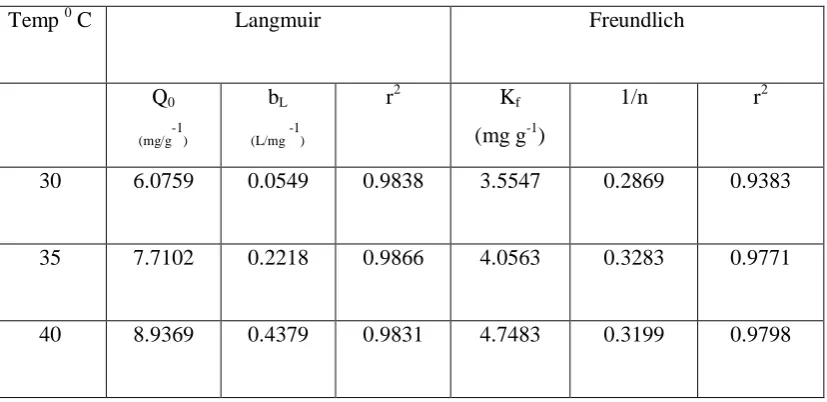
respectively. The value of Q0 and bL for PPy/SD is calculated from the slope and intercept of the linear plot of
Ce / qe and the results are summarized in Table 2. The values of adsorption efficiency Q0 and adsorption energy
bL increases with increasing temperature which confirms the endothermic nature of processes involved in the
system. The essential characteristics of Langmuir isotherm can be expressed by a dimensionless constant called
equilibrium parameter RL which could be defined by the following equation:
Where C0 is the highest initial solute concentration. RL value indicates the type of adsorption isotherm either to
be unfavorable (RL> 1), favorable (RL =1) or irreversible (RL = 0). Langmuir model is more appropriate to
explain the nature of adsorption of RV5 with correlation coefficient of 0.98341to 0.9866.
The Freundlich [31] equation is an empirical relationship describing the sorption of solutes from a liquid to a
solid surface. Linear form of Freundlich equation is expressed as follows:
log qe = log Kf +
(8)
Where Kf is a constant for the system, related to the bonding energy. 1/n indicates the adsorption intensity of
dye onto the adsorbent or surface heterogeneity, becoming more heterogeneous as its value gets closer to zero.
The data obtained by plotting log qeVs log Ce from linear Freundlich isotherm for the adsorption of RV5 onto
PPy/SD is presented in Table 2. The value of 1/n lesser than 1 (Table 2) indicates that the adsorption of RV5
onto PPy/SD is favourable.
IV. CONCLUSION
Electroactive conducting Polypyrrole polymers can be easily synthesized via chemical oxidation directly on the
surface of sawdust from aqueous solutions. Reactive Violet 5 dye removal by the PPy/SD is supposed to occur
mainly through anion-exchange process. The amount of dye adsorbed is found to vary with initial pH,
temperature and contact time. Maximum adsorption occurs at pH 2-3 for RV5.Two simplified kinetic models,
pseudo-first order and second-order were tested to investigate the adsorption mechanism and concluded that the
adsorption of RV5 onto PPy/SD follows pseudo second-order kinetics. The equilibrium data fits very well into
the Langmuir isotherm model which indicates monolayer adsorption. The adsorption capacity of PPy/SD
increased with rise in temperature indicating endothermic nature of adsorption. An Intraparticle diffusion model
predicts that pore diffusion plays a major role for the adsorption of RV5 onto PPy/SD. The adsorption system
currently introduced (PPy/SD) seem to be very economical and efficient for the removal of dyes such as RV
from aqueous solutions. The findings in this paper seem to be very important from application point of view for
water and wastewater treatments in dye removal technology using batch systems compared to other materials
previously reported for removal of RV.
REFERENCES
[1] McKay.G, Porter, J.F. and G.R. Prasad, The removal of dye colours from aqueous solutions by
adsorption on low-cost materials, Water, Air Soil Pollut., 114 ,1998, 423–438.
[2] J.Silva, A.Pereira, Barata, Fonseca and J.Faria, J. Colloid Interf. Sci. 296, 2006, 480-489.
[3] Skotheim.T.A, Elsenbaumer.R.L, Reynolds.J.R. Handbook of Conducting Polymers, 1998, 2nd ed,
Marcel & Dekker, New York.
[4] Mirmohseni.A, Oladegaragoze. A, Farbodi. M, Synthesis and characterization of processable
Conducting polyaniline/polystyrene composite. Iran Polym J. 17, 2008, 135-140.
[5] Zeng.X.R, Ko.T.M. Structures and properties of chemically reduced polyanilines. Polymer 39, 1998,
1187- 1195,
[6] Gospondinova.N, Terlemezyan. L. Polyaniline conducting polymers prepared by oxidative
[7] Kang.E.T, Neoh. K.G, Tan.K.L. 1998. Polyaniline- a polymer with many interesting intrinsic redox
States. J. Prog Polym Sci. 23: 277-324.
[8] Huang.W.S, Humphrey. B.D, MacDiarmid. A.G. 1986. Polyaniline, a novel conducting polymer.
Morphology and chemistry of its oxidation and reduction in aqueous electrolytes. J Chem Soc Faraday
Trans. 82: 2385-2400.
[9] Miras. M.C, Acevedo. D.F, Monge. N, Frontera. E, Ansari. R et al. 2008. Iranian Polymer Journal.
Rivarola.C.R, Barbero .C.A. Organic chemistry of polyanilines: tailoring properties to technological
Applications. J Open Macromol. 1: 58-73.
[10] Parsa. A, Hosseini. S.H, Asefoddoleh. M. 2009. Anion exchange properties and kinetic behavior of
polyaniline-coated silica GEL for anion phosphates. Eur J Sci Res. 26: 369-375.
[11] Ansari. R, Price. W.E, Wallace. G.G.2003. Quartz crystal microbalance studies of the effect of
Solution temperature on the ion-exchange properties of polypyrrole conducting electroactive
Polymers. React. Funct Polym. 56: 141-146.
[12] Hosseini.S.H, Noor.P. 2005. Ion exchange properties and kinetic behavior of polyaniline-coated Silica
gel for p-toluenesulphonic acid and methanesulphonic acid . Iran Polym .J. 14: 55-60.
[13] Ahmad. A, Rafatullah. M, Sulaiman. O, Ibrahim. M.H, Hashim. R. 2009. Scavenging behaviour of
meranti sawdust in the removal of methylene blue from aqueous solution. J Hazard Mater. 170:
357-365.
[14] Wang. X.S, Zhou.Y, Jiang.Y, Sun. C. 2008.The removal of basic dyes from aqueous solutions using
agricultural by-products. J. Hazard Mater. 157: 374-385.
[15] Ansari.R, Zanjanchi.M.A, Mohammadkhah. A, Mosayebzadeh. Z. 2009. Removal of basic dyes from
textile wastewaters using sawdust. 1st Int 7th National Conf Textile Eng, Rasht, Iran. 27-29 .
[16] Ansari.R. (2005).J.Electrochem. 41: 950.
[17] Reza Ansari, Zahra Mosayebzadeh, mohammed Banimahd Keivani and Ali Mohammed khan. 2011.
J.Adv.Sci.Res. 2(2): 27-34.
[18] Hsieh.C.T and Teng.H. 2000. J. Colloid Interface Sci. 230: 171.
[19] Ilhan.U. 2006. Dyes Pigments. 70: 76.
[20] Vinod. K. Gupta, Srivastava Suresh. K and Dinesh Mohan. 1997. Ind Eng Chem Res. 36 (6) : 2207.
[21] Khashayar Badii, Faramarz Doulati Ardejani, Masoud Aziz Saberi, Narges Yousefi Limaee and
Seyedzia-e-din Shafaei. 2010. Indian J Chem Technol. 17:7.
[22] Ansari.R. 2006. Acta Chim Slov. 53 : 88-94.
[23] Santhi. T, Manonmani. S and Smitha .T. 2010. J Hazard Mater. 179 : 178.
[24] Pavel Janos, Hana Buchtova and Milena Rlyznarov. Water Res. 37 : 4938.
[25] Alkan.M and Dogen.M. 2003. Environ. Bull. 12: 418.
[26] Langregren. S, Zur theorie der sogenannten adsorption geloster stoffe, Kunlinga and
Ventenskapsakedemiens. 1898. Handlingar. 24 : 1-39 .
[27] Gupta Vinod. K and Ali Imran. 2007. Environ Sci Technol. 42 (3): 3307 .
[28] McKay. G. 1983. Chem Eng J. 27 : 187.
[29] Gupta Vinot Kumar, Ali Imran and Saini Vipin Kumar. 2007. Water Res. 41 (15): 3307.
[30] Langmuir.I. 1918. J.Amer Chem Soc. 40 : 1361.
Fig.1. SEM image of PPC
Fig.2 Pseudo Second Order Plot for Fig.3 Intra Particle Diffusion Plot for the Adsorption of RV5 on to PPC the Adsorption of RV5 on to PPC
TABLES
Table 1 Comparison of First-Order and Second-Order Rate Constants and Correlation Coefficients
Conc
mg/L
First order kinetics Second order kinetics
k1
(min-1)
qe
(mg/g)
r2 k2X 10
-2
(g/mg min)
qe
(mg/g)
r2
25 0.02468 0.9331 0.9532 1.178 6.2454 0.9966
50 0.01463 1.5741 0.9627 1.304 5.6197 0.9982
75 0.01024 2.2489 0.9695 0.896 5.1913 0.9957
Table 2. The Values of Parameters and Correlation Coefficient for Each Isotherm Model
Temp 0 C Langmuir Freundlich
Q0
(mg/g -1
)
bL
(L/mg -1
)
r2 Kf
(mg g-1)
1/n r2
30 6.0759 0.0549 0.9838 3.5547 0.2869 0.9383
35 7.7102 0.2218 0.9866 4.0563 0.3283 0.9771