CoPS STYLE CGE MODELLING
AND ANALYSIS
CoPS Working Paper No. G-264, November 2016
The Centre of Policy Studies (CoPS), incorporating the IMPACT project, is a research centre at Victoria University devoted to quantitative analysis of issues relevant to economic policy. Address: Centre of Policy Studies, Victoria University, PO Box 14428, Melbourne, Victoria, 8001 home page: www.vu.edu.au/CoPS/ email: [email protected] Telephone +61 3 9919 1877
Esmedekh Lkhanaajav
Centre of Policy Studies, Victoria University
Page | 1
CoPS style CGE Modelling and Analysis
By
Esmedekh Lkhanaajav
Centre of Policy Studies,
Victoria University
Abstract
CoPS is a world leader in CGE modelling. This paper describes a brief history of CoPS style of CGE modelling; from ORANI to new generation CoPS models, and discusses the distinctive features of CoPS style models. In addition, it introduces solution methods, notations, and tools that are used in CoPS style of CGE modelling and analysis.
Keywords: CGE modelling; CoPS style CGE modelling
Page | 2
Contents
1. Introduction ... 3
2. A Brief History: From ORANI to new generation CoPS models ... 7
2.1. ORANI ... 7
2.2. CoPS style dynamic models ... 11
2.3. CoPS style regional models... 12
2.4. Global Trade Analysis Project (GTAP) ... 13
2.5. New generation CoPS models ... 14
3. A General form of CoPS style CGE model ... 16
4. Solution methods ... 17
4.1. Johansen solution procedure ... 18
4.2. Johansen/Euler solution procedure... 19
4.3. Gragg’s method ... 19
4.4. Richardson’s extrapolation ... 20
5. Standard notations and conventions ... 20
6. Data requirement ... 23
7. GEMPACK ... 23
Page | 3
1. Introduction
Economics is the study of how economic agents – producers, investors, households, foreigners and governments – make choices under conditions of scarcity, and of the results and efficiency of those choices. In any economic system, scarce resources have to be allocated among competing uses. These resources are allocated by the combined choices and interactions of economic agents in an economy. Inevitably, the choices of economic agents come down to the relative importance of competing uses, thereby creating trade-offs. Economic theories postulate the optimising behaviour of economic agents under given resource and technology constraints, with signalling from market prices. Households maximise their utility subject to their budget constraints, and producers maximise their profits subject to their production technology constraints. Prices, determined by market equilibria, play a crucial role in resource allocation. Hence, the optimising behaviours of economic agents are the means of introducing market or price mechanisms to the model (Dixon & Rimmer 2002).
Interactions of agents and repercussions of episodes in an economy are capable of being captured in an economy-wide general equilibrium framework. The theory of general equilibrium analysis was pioneered by Walras (1877) and Edgeworth (1881). Leon Walras provided the first general equilibrium description of a complex economic system with the interactions of independent economic agents. Francis Edgeworth introduced the well-known tool of general equilibrium analysis of exchange that is named after him – the Edgeworth box. Major theoretical contributions related to the existence, uniqueness, stability and optimality of general equilibria were made also by Kenneth Arrow, Gerard Debreu, Hiroshi Atsumi, Hirofumi Uzawa and Michio Morishima from 1950 to the 1970s.
Page | 4 determines quantities and prices’. Shoven and Whalley (1992) defined CGE modelling as a conversion of the Walrasian general equilibrium structure into realistic models of actual economies by specifying production and demand parameters, and incorporating data reflective of real economies. Dixon and Parmenter (1996) described the distinguishing characteristics of CGE models as follows:
(i) CGE models are general since they include explicit specifications of the behaviour of several economic agents/actors;
(ii) CGE models employ market equilibrium assumptions as they describe how demand and supply decisions made by different economic agents determine the prices of at least some commodities and factors that in turn ensure market equilibria; and
(iii) CGE models are computable and produce numerical results.
CGE modelling can therefore be characterised by its applied nature and quantitative approach in general equilibrium analysis. Applied general equilibrium (AGE) modelling is an alternative term used to describe CGE modelling.
CGE models belong to the economy-wide class of models. Hence, they provide industry disaggregation and the behaviours of economic agents in a quantitative description of the whole economy. According to Dixon and Rimmer (2010), the original empirical economy-wide model was Leontief’s input-output system (Leontief 1936). Leontief’s input-output system portrays ‘both an entire economy and its fine structure by plotting the production of each industry against its consumption from every other’ (Leontief 1951, p. 15). He provided a tabular representation of the economy – the input-output tables. These tables show a detailed disaggregation of the supply and use of inputs and outputs in the economy.
Leontief’s input-output system in matrix form can be shown as:
𝑋𝑋 = 𝐴𝐴𝑋𝑋 + 𝑌𝑌
(1)
where X is a vector of outputs; Y is a vector of final demands; and A is the input-output coefficient matrix. In input-output modelling, the production of each commodity (the vector
X) satisfies the intermediate (the matrix AX) and final (the vector Y) demands with given technology specified by the input-output coefficient matrix (A). Each input-output or technical coefficient (𝑎𝑎𝑗𝑗𝑗𝑗) in matrix A defines the value of intermediate inputs that are
Page | 5 where 𝑍𝑍𝑗𝑗𝑗𝑗 is the intermediate input sales from industry j to industry i). Input-output analysis,
as Leontief described (1951, p. 21), is ‘a method of analysis that takes advantage of the flow of goods and services among the elements of the economy to bring a much detailed statistical picture of the system into the range of manipulation by economic theory’. Input-output modelling is still popular in applied economic research.
The next stage of economy-wide modelling was the programming model pioneered by Sandee (1960). In his demonstration of the planning model for India, Sandee used a linear programming method to maximise a welfare (material consumption) function, subject to Leontief’s technology specification. Notable contributions to the programming models were made by Manne (1963) and Evans (1972). H. D. Evans’ internationally acclaimed study of protection in Australia was an important methodological contribution to the analysis of protection and to the applied general equilibrium framework (Dixon & Butlin 1977).
Input-output and programming models could not provide underlying market mechanism of interactions in the economy and lacked clear descriptions of the behaviour of individual agents (Dixon & Rimmer 2010a). In these models, the economy is visualised as a single agent (Dixon & Jorgenson 2013).
Lief Johansen (1960) advanced economy-wide modelling through the explicit identification of behaviour by economic agents in his model of Norway’s economy. The publication of Johansen’s book, ‘A Multi-sectoral Study of Economic Growth’, marked the birth of CGE modelling (Dixon & Jorgenson 2013). In Johansen’s 22-sector model, households maximise utility subject to their income constraints; industries choose primary and intermediate inputs to minimise their costs of producing any given level of output, subject to their production frontiers and the need to satisfy demands for their outputs; and investors allocate the economy’s capital stock between industries to maximise their returns. The overall outcome for the economy is determined by the actions of individual agents driven by the price adjustment mechanism (invisible hand) that equalises demand and supply in various markets.
Dixon (2010a) reminds us that there was no single starting point for CGE modelling even though Johansen was ‘the first one to plant a seed in what has now become the CGE forest’ (p. 5).
Page | 6 method, however, has been largely abandoned in favour of much simpler methods used by other approaches (Dixon 2006).
Dale Jorgenson and his associates solved their CGE model by iterative methods independently. They continue to make path-breaking contribution to CGE modelling through theoretical and econometric innovations (Dixon & Jorgenson 2013; Dixon & Rimmer 2010a). Irma Adelman, Sherman Robinson and their associates at the World Bank developed another widely used CGE approach. The models developed using their framework belong to the tradition of World Bank CGE modelling (Bandara 1991a). The Generalized Algebraic Modelling System (GAMS) software (Brooke, Kendrick & Meeraus 1996) is used in their Social Accounting Matrix based models.
Peter Dixon and his associates developed the Centre of Policy Studies (CoPS) approach, adopting and extending Johansen strategies for computing, and for organising and understanding results. In this sense, CoPS style modelling is directly descended from Johansen. The influence of Johansen, combined with the institutional arrangements under which CoPS style models have been developed, has given this form of modelling some distinctive technical characteristics (Dixon, Koopman & Rimmer 2013). CoPS style models are solved with the General Equilibrium Modelling Package (GEMPACK) software (Harrison & Pearson 1996). The progress of CGE modelling software and the differences among the main systems such as GEMPACK and the GAMS are detailed in Horridge et al. (2012). CoPS style modelling is also known as ‘Australian style’ CGE modelling (Hertel, 2013).
Page | 7
2. A Brief History: From ORANI to new generation CoPS models
This section briefly describes the history of CoPS style of CGE modelling; from ORANI to new generation CoPS models. ORANI and other CoPS style models can be readily identified as belonging to the Johansen class of multi-sectoral models (Dixon, Koopman & Rimmer 2013; Dixon et al. 1982). Retaining the advantages of Johansen’s approach and combining them with the institutional arrangements under which CoPS style models have been developed, CoPS style modelling has become a well-recognised school of economic modelling, thought and analysis with distinctive technical characteristics and a transferable know-how.
2.1. ORANI
CoPS style models evolved from ORANI (Dixon et al. 1982). ORANI is a comparative static model of the Australian economy. It was developed in the late 1970s in the framework of the IMPACT project and has served as a foundation for CGE models of many countries. Its first applications (Dixon et al. 1977; Dixon, Powell & Harrower 1977) brought a wide exposure in the Australian economic policy debate (Powell & Snape 1992).
When summarising the most important developments in economic policy during 1967-1975, Corden (1995) highlighted a long-run perspective of economic policy analysis. He wrote:
Thanks to Mr. Whitlam and the initiative of Mr. Rattigan, the Tariff Board was replaced by the Industries Assistance Commission (IAC), with Mr. Rattigan the chairman of the new IAC. Its mandate was much wider than that of the Tariff Board, and it was conceived on a much more ambitious scale. This was the beginning of an important and remarkable organisation, one which acquired a world reputation and which, through its careful empirical work and strong and consistent “economic rationalist” analysis, undoubtedly influenced informed thinking and policy-making in the broad area of industry assistance subsequently. There is really a remarkable contrast between the Tariff Board reports of the early sixties (and some of the reports reviewed in my 1967 lecture) which were empty of serious economic analysis, and the highly professional reports of the IAC, backed up with effective rate and subsidy equivalent measures and the use of general equilibrium modelling resulting from the IMPACT project (Anderson 2014, pp. 370-2).
Page | 8 To fully account for general equilibrium effects [of the rapid growth of mineral
exports] would require a much more complex and computerised model such as the IMPACT model being developed by a number of Australian government departments (p. 75).
The abovementioned institutional arrangements have played an essential role for the development of CoPS school of modelling. The Australian government-initiated IAC had set up the IMPACT project under the direction of Powell, aimed at improving available policy information systems for governments as well as for private and academic analysts. More specifically, the IMPACT project was to build policy-oriented economy-wide models and to organise training associated with these models (Dee 1994; Powell & Snape 1992).
The Productivity Commission (PC) acknowledged the origin of the IMPACT project as a source of its strong analytical tradition in its 30th anniversary book titled ‘From industry assistance to productivity: 30 years of the Commission’ as:
While the number of detailed tariff inquiries fell, their breadth and complexity increased, as did the depth of the analytical approaches employed. GA (Marshall) Rattigan, the first Chairman of the IAC, together with one of his senior advisors at the Commission, Bill Carmichael (later to become Chairman himself), realised the importance of developing quantitative models capable of analysing the economy-wide consequences of policy and policy changes for economic activity and employment, as well as for regions, sectors and individual industries. Effective rate calculations, although revealing, were not enough. Consequently, the IAC helped construct increasingly sophisticated quantitative economic models of the Australian economy (PC 2003a, pp. 4-5).
The integrity and vison of outstanding public servants (notably, A. Rattigan, W. Carmicheal and B. Kelly), the insights and influences of Australian leading economists (notably, M. Corden, B. Gregory and R. Snape) and the policy problem of much debated tariff were the preconditions of the IMPACT project and its brainchild ORANI becoming influential in Australian policy analysis immediately.
Page | 9 replicability of an experiment is necessary for economics to earn its status as a science and emphasised that ‘this can amount to a tall order’ in the case of CGE work (p. xiii). In fact, ORANI showcases this ‘tall order’.
Dixon is the founder and leader of CoPS style modelling. After graduating with Honours in Economics from Monash in 1967, he pursued his PhD at Harvard under Leontief’s supervision. His PhD was awarded in 1972 by Harvard (Parmenter 2004). Titled ‘The Theory of Joint Maximisation’, this thesis was subsequently published in the North Holland Contributions to Economic Analysis series (Dixon 1975). His thesis made a number of contributions to economic analysis, particularly to the literature on the computations of numerical solution to general equilibrium models (Mackinnon 1976). Dixon introduced the joint maximisation approach for the computation of equilibria and developed effective algorithms, providing an alternative to Scarf’s combinatorial approach. The essence of the theory of joint maximisation is ‘the notion that general equilibrium solutions may be found by solving suitably chosen programming problems’ (Dixon 1975). Dixon acknowledged that Evans’ 1968 PhD thesis inspired him to study for his PhD and named Evans as one of three people who influenced him greatly. He was brought to the IMPACT project by Powell, one of the founders for this school of modelling and also one of three people who influenced Dixon greatly, to build an economy-wide model. Dixon integrated Armington’s imperfect substitution specification (Armington 1969) with Leontief’s input-output model to build ORANI. Originally, ORANI introduced a number of innovations such as: flexible closures; multi-product industries and multi-industry products; the CRESH and CRETH substitution possibilities; specifications of technical change and indirect taxes associated with every input-output flow; explicit modelling of transport, wholesale and retail margins; and a regional dimension (Dixon & Rimmer 2010a).
Page | 10 ORANI was designed to provide results that would be persuasive to practical policy makers rather than to academics, hence it encompassed considerable detail. The first version of ORANI had 113 industries and a facility for generating results for Australia’s eight states and territories. In addition to its industry and regional details, ORANI was equipped with detail in other areas such as detailed specifications of margins that were normally ignored in academic research (Dixon 2006).
Since 1977, ORANI has been used in numerous analyses and simulations on the effects of mineral discoveries, major infrastructure projects, new technologies, mining booms and busts, and the impacts of various government policies changes in policy instruments such as import tariffs, other tax rates, public spending, interest rates, microeconomic and labour market reform, as well as other environmental and legal regulations on the Australian economy.
Reviews of several hundred published ORANI applications of early years in Australian context can be found in Powell and Snape (1992) and Dee (1994).
ORANI, furthermore, has become the most diversely exported know-how or technology of Australia, and has served as the foundation and starting template of models for many other countries, including South Korea (Vincent 1982), New Zealand (Nana & Philpott 1983), Papua New Guinea (Vincent 1991), the Philippines (Coxhead & Warr 1995; Coxhead, Warr & Crawford 1991), South Africa (Horridge et al. 1995), Indonesia (Wittwer 1999), China (Adams et al. 2000b) and many others. ORANI-Generic (Horridge 2000, 2014; Horridge, Parmenter & Pearson 1998) is a modern version of ORANI designed for teaching purposes as well as to serve as a foundation from which to construct new models.
Adaptations of ORANI-G have been created for many countries, including Brazil, Denmark, Japan, Ireland, Italy, Malaysia, Mongolia, Pakistan, Qatar, Saudi Arabia, Sri Lanka, Taiwan, Thailand, Venezuela and Vietnam. ORANI has still been used extensively for applied research in Australia and worldwide. As of today, there are well over fifteen hundred published ORANI applications and ORANI based analyses1.
Dixon and Rimmer (2002) summarised and attributed the success of ORANI to five factors. The first factor is a full documentation of methods, data and results (Dixon et al. 1982; Horridge 2000, 2014; Horridge, Parmenter & Pearson 1993). The second factor is the
Page | 11 dissemination and transfer of know-how through training courses and active connection with stakeholders such as clients, academics, other users and potential users. The third one is the availability of the GEMPACK package which allows modellers and other users to deal with very large systems with relative ease and control. The fourth factor is the versatility of ORANI associated with the flexible closure that enables it to analyse a wide variety of issues. The last factor is the usage of back-of-the-envelope (BOTE) calculations to identify principal mechanisms and data and check the plausibility of the results as well as help others to digest and understand the results from a particular application.
2.2. CoPS style dynamic models
The evolution of ORANI brought about the CoPS style dynamic model of the Australian economy, MONASH, in early 1990s. MONASH is fully documented by Dixon and Rimmer (2002). It has served as a platform for dynamic models of other countries, including the USAGE model of the U.S. and the CHINAGEM model of China (Mai, Dixon & Rimmer 2010). CoPS style dynamic models advanced ORANI with regard to dynamics and closures in addition to the further technical development. Equipped with dynamic features, CoPS style CGE models are used to generate forecasts of the prospects of overall economies, different industries, labour occupations and regions on the top of ‘what if’ policy analysis.
In dynamic CGE analysis, base-case (reference-case) forecasts are important, which is not the case for comparative static CGE analysis. MONASH incorporates four types of inter-temporal linkages: physical capital accumulation and rate-of-return-sensitive investment; foreign debt accumulation and the balance of payments; public debt accumulation and the public sector deficit; and dynamic adjustment of wage rates in response to gaps between the demand for and supply of labour.
Further, it allowed both static and forward-looking (rational) expectations in the mechanism for determining investment. CoPS style models are capable of producing estimates of changes in technologies and consumer tastes, decomposing the impacts of those structural changes, forecasting for industries, commodities/trade, regions, occupations and households, and the impacts of proposed policy change and other shocks to the economic environment (Dixon & Rimmer 2002).
Page | 12 analysing the effects of trade barriers and their removal, assessing free trade agreements (FTAs), quantifying the impact of immigration and border control, evaluating the impacts of terrorism, catastrophic events and flu epidemics, and estimating the effects of environmental policy changes in the North American context. Mini-USAGE (Dixon & Rimmer 2005), a smaller version of USAGE designed for teaching, has made a significant difference to novice modellers.
2.3. CoPS style regional models
There are three types of CoPS style regional models: ‘top-down’, ‘bottom-up’ and ‘stand-alone’ models. ‘Top-down’ models have regional disaggregation attachment that is used to decompose the results of national models. Originally, ORANI had a regional ‘top down’ extension called ORANI Equation Systems (ORES). ORES was based on the LMPST method (Leontief et al. 1965) for disaggregating results from a national input-output model named after initials of its authors. The main idea of the method was to divide industries into national and local groups. ORES is widely acknowledged as the first regional CGE model in the world (Madden 1990). Original ORANI analyses identified those regions that were winners and those regions that were losers from a policy change, and estimated the relative sizes of wins or losses in terms of the percentage of gross output (Dixon et al. 1982).
Page | 13 MMRF has been used extensively as a chief policy analysis model in important organisations like the PC. In a tradition of ORANI, MMRF serves as a platform for multiregional CGE model of other countries. Notable drawbacks for ‘bottom-up’ models like MMRF are the data requirement and dimensionality problems as these become larger and larger.
‘Stand-alone’ models are those developed for a single region analysis. Giesecke (2011) constructed CoPS style ‘stand-alone’ CGE model for a single U.S. region. Using regional IOTs and ORANI-G as a platform, he devised a method for building a single region model and then applied it to the construction of Los Angeles County’s CGE model.
2.4. Global Trade Analysis Project (GTAP)
The GTAP model (Hertel, Thomas 1997) is the most significant application and extension of ORANI technology in an international arena (Dixon & Rimmer 2002). GTAP aspires to support a standardised database and CGE modelling platform for international economic analysis (Hertel, Thomas 2013).
GTAP was innovated with a multifaceted approach so that it can be characterised by four different dimensions. Firstly, GTAP is an institutional innovation. The GTAP consortium was established in 1993, bringing crucial players such as World Bank together in its early stages. Secondly, it is a network. Since its inception in 1991, GTAP has become the largest cooperative network of organisations and researchers in Economics (Dixon & Jorgenson 2013). Thirdly, it is a database. GTAP provides a fully documented, publicly available global database which contains complete bilateral trade information, transport and protection linkages. GTAP 9 Data Base, the latest release, features 147 countries/regions and 57 sectors/commodities. As of today, the GTAP database is ‘by far the most widely used trade and protection database in the world’ (Anderson, Martin & Van der Mensbrugghe 2012, p. 879). The GTAP database is also used in the applications of different multi-country/global models such as World Bank’s LINKAGE global economic model (Anderson, Giesecke & Valenzuela 2010; Anderson, Martin & Van der Mensbrugghe 2012). Fourthly, GTAP is a global economic model. The standard GTAP model is a comparative, static, and global CGE model based on ORANI (Dixon et al. 1982) and SALTER2 (Jomini et al. 1994). It is based on
2
The acronym SALTER stands for Sectoral Analysis of Liberalising Trade in the East Asian Region. SALTER, named in
honour of W. Salter, was itself ORANI style world trade model developed in IAC (current PC) for conducting an analysis of
the economic effects of alternative trade liberalisation scenarios. GTAP founders T. Hertel and M. Tsigas contributed to the
Page | 14 microeconomic foundations with a symmetric specification of economic agents (producers and households) in individual economies and of their trade linkages. The global transportation and international mobility of savings are also recognised in the model.
GTAP aims to facilitate multi-country economy-wide analyses on trade, climate change, economic growth and a wide range of other issues affecting the world as a whole. However, its vision is not to build a definitive model, as not only do most of its 27 consortium members have their own in-house models (i.e., the World Bank’s LINKAGE, ENVISAGE and MAMS, OECD’s METRO and GREEN, and ABARE’s GTEM and its predecessor MEGABARE etc.), but its member organisations and individuals continue develop and use various customised models. Hence the standard modelling framework has been developed and designed to run with no additional data or parameters beyond those provided in the GTAP database (Hertel, 2013). Since the standard GTAP model is a platform for development, there have been a number of extensions and variations. For instance, the GTAP-E (Burniaux & Truong 2002), one of the extended versions of the standard GTAP model, incorporates GHG emissions and provides for a mechanism to trade these emissions globally.
2.5. New generation CoPS models
VU-National, where VU denotes Victoria University (Dixon, Giesecke & Rimmer 2015), is a new generation CoPS style CGE model. It is a dynamic multi-sectoral CGE model with a financial sector extension that can capture elements of financial repercussions. One of criticisms of CGE models is the absence of the role of money (Bandara 1991b). VU-National addresses this issue and has explicit treatments of financial intermediaries and their interactions/transactions with economic agents, financial instruments describing assets and liabilities, financial flows related to these instruments, rates of return on individual assets and liabilities, and links between the real and monetary sides of the economy. One of the earliest CoPS style models of financial markets was created by Adams (1989). It is expected that financial CGE components will become a standard feature of CoPS style models in near future.
Page | 15 modelling to create TERM. TERM approach assumes identical technology in each region and splits national when this is not the case. TERM uses highly disaggregated regional IOT data obtained through the ‘Horridge method’, which generates sourcing shares. The key achievement of TERM is its ability to handle a greater number of regions or sectors. The latest version of TERM identifies 182 sectors in 205 statistical sub-divisions of Australia. In addition, it is solved relatively quickly due to its innovative approach enabled by identical proportions or common sourcing assumptions in inter-regional imports. With this assumption, inter-regional sourcing and associated margins data can be stored separately in two smaller satellite matrices in TERM. Its predecessors such as MMRF have a single huge matrix which restricts computational speed (Wittwer & Horridge 2010).
Let us have a look at following simplified example. If we consider USE and TRADE matrices in TERM, the USE matrix shows each commodity, user (intermediate and four final), source (domestic and imported) and regional origin but not the regional destination while the TRADE matrix shows each commodity, source (domestic and imported), regional origin and regional destination, but not the user. Let us consider the example of 40 commodities/industries and 20 regional origins/destinations. In this case, the dimensions of USE and TRADE matrices in TERM are 40 x 2 x (40 + 4) x 20 = 70,400 and 40 x 2 x 20 x 20 = 32,000 respectively. In a single matrix case (as in MMRF), the dimension for each matrix is 40 x (20+1) x (40+4) x 20 = 739,200. This is more than seven times as large as the summed dimensions of the USE and TRADE matrices in TERM. The sizable reduction of dimensions of matrices in TERM is due to a common sourcing assumption and dimensional restrictions of prices adopted from the GTAP model.
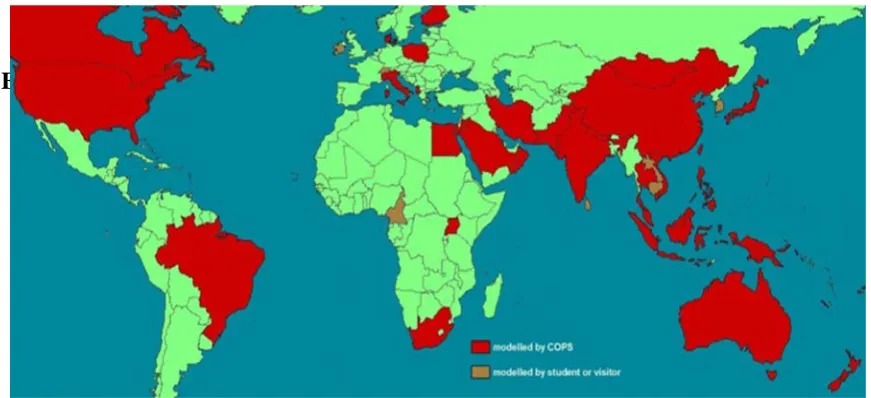
Source: www.copsmodels.com
Page | 16 TERM has been used in various analyses, including natural disasters (Horridge, Madden & Wittwer 2005), agricultural management (Wittwer 2012), mining booms (Horridge & Wittwer 2006) and infrastructure development (Horridge & Wittwer 2008). The model provides opportunities to analyse the effects of small-region specific policy changes such as tourism impacts. TERM has also been served as a platform for the development of multi-regional models for several countries including China (Horridge & Wittwer 2008) and Indonesia (Horridge & Wittwer 2006). Figure 2.1 shows the countries for which CoPS style models (not including GTAP) have been developed and used in policy analysis.
3. A General form of CoPS style CGE model
Let us define a general CoPS style model by:
𝐹𝐹(𝑋𝑋) = 0 (3)
where F is an m-vector of differentiable functions of n variables X.
For CGE models, n>m is generally the case. Each equation explains a variable but since
Page | 17 In addition to the closure, another important tool to solve a CGE model is a numeraire. Broadly speaking, a numaraire is the essential standard of measurement that enables the comparison of values relative to a common unit or denominator. Traditional CoPS style CGE models follow a neoclassical property in which economic agents respond to changes in relative prices. There should be at least one exogenous variable measured in domestic currency. The relative prices of all commodities and inputs are specified and measured by a
numeraire. Hence, all prices change relative to the numeraire. The choice of a numeraire is up to modellers and model users depending on the economic environment. During the years of fixed exchange regime, a nominal exchange rate was commonly used as a numeraire. With new and neo Keynesian wage rigidity, a nominal wage has often been used as a numeraire.
4. Solution methods
Many of the equations in CoPS style models are essentially non-linear. Following Johansen, the models are solved by representing them as a series of linear equations relating percentage changes in model variables. There are two main approaches for solving CGE models: non-linear programming and derivative methods. Today, almost all CGE models are solved by the derivative method (Adams et al. 1994). The main advantage of the derivative method is that it provides the matrix of an initial solution and generates deviations in endogenous variables from their initial values created by deviations in exogenous variables from their initial values. The derivative method works by replacing the non-linear levels representation of the model with a linear first-order differential representation. The replacement can be either explicit or implicit. The explicit approach involves equations presented to the computer in linear first order differential form and the implicit approach involves equations presented in nonlinear form and converted to differential form in the computer via numerical means.
Page | 18 This section explains solution methods and their applications to CoPS style models.
4.1. Johansen solution procedure
As in equation (3), a CoPS style model can be defined as an equilibrium vector, X, of length n
variables satisfying a system of equations. F is a vector of functions of length m, where n >
m. The Johansen approach is to derive from (3) a system of linear equations in which the variables are changes, percentage changes or changes in the logarithms of the components of X. Since the system (3) contains more variables than equations, we need to assign exogenously given values to n-m variables and solve for the remaining m endogenous variables.
The Johansen solution procedure can be defined using the following steps.
First, the system of equations for the model is represented in its original levels form as
𝐹𝐹(𝑋𝑋) = 0;
where F is an m-vector of differentiable functions of n level variables X.
Second, the total differential is taken of each equation in the model;
Third, the expressions for the total differential of each equation are expressed in
percentage change form. In our case, we obtain:
𝐴𝐴(𝑋𝑋)𝑥𝑥 = 0
where 𝐴𝐴(𝑋𝑋) is and 𝑛𝑛 × 𝑚𝑚 matrix whose components are functions of X. 𝑥𝑥 is the vector of percentage changes in X.
Fourth, the percentage change equations are evaluated at an initial solution to the
levels form.
𝐴𝐴(𝑋𝑋) is evaluated at 𝑋𝑋 = 𝑋𝑋𝐼𝐼.
Fifth, a closure of the model is defined. Then, the model is solved for the percentage
change movements in the endogenous variables away from their initial values given changes in the exogenous variables.
𝐴𝐴𝛼𝛼(𝑋𝑋𝐼𝐼)𝑥𝑥𝛼𝛼+ 𝐴𝐴𝛽𝛽(𝑋𝑋𝐼𝐼)𝑥𝑥𝛽𝛽= 0;
where 𝑥𝑥𝛼𝛼 is the 𝑚𝑚×1 sub-vector of endogenous components of 𝑥𝑥;
Then the model is solved, assuming that the relevant inverse matrix exists:
𝑥𝑥𝛼𝛼= −𝐴𝐴𝛼𝛼−1(𝑋𝑋𝐼𝐼)𝐴𝐴𝛽𝛽(𝑋𝑋𝐼𝐼)𝑥𝑥𝛽𝛽
Page | 19
𝑥𝑥𝛼𝛼 = 𝐵𝐵(𝑋𝑋𝐼𝐼)𝑥𝑥𝛽𝛽;
where 𝐵𝐵(𝑋𝑋𝐼𝐼) = −𝐴𝐴𝛼𝛼−1(𝑋𝑋𝐼𝐼)𝐴𝐴𝛽𝛽(𝑋𝑋𝐼𝐼).
𝐴𝐴(𝑋𝑋𝐼𝐼) matrix defined in Johansen solution procedure is called the Tableau matrix. The
Tableau matrix shows the sensitivity (elasticity in our example since we defined 𝑥𝑥 as a percentage change) of every endogenous variable with respect to every exogenous variable. In his seminal work, Johansen used the Tableau matrix to decompose movements in industry outputs, prices and primary factor inputs into parts attributable to observed changes in six sets of exogenous variables: aggregate employment; aggregate capital; population; Hicks-neutral primary factor technical change in each industry; exogenous demand for each commodity; and the price of non-competing imports. Hence, the Tableau matrix enables us to understand the CGE model and its results, to assess it against reality or to do the checking of computed results (Dixon & Rimmer 2010a).
Due to linearization, the deviation from true value or linearization error may occur. The larger the shock, the greater the proportional linearization error is in general. Johansen recognized the linearization error in his computations and acknowledged that the solutions from his model were approximate.
4.2. Johansen/Euler solution procedure
Dixon et al. (1982) set out an extension to the Johansen method which eliminates linearization errors while retaining the simplifying advantages of linearized algebra. They employed Euler’s method and added multiple steps. The Johansen method described above can be interpreted as a one-step Euler solution.
Johansen/Euler solution procedure breaks up the shock into a number of equal parts or steps. The linearized model is solved in each step for smaller shocks. After each step, the value of every endogenous variable affected by the shock is updated. In general, the more steps the shock is broken into, the more accurate the results are. However, for the level of convergence toward the true solution that the Euler method provides, it is computationally expensive.
4.3. Gragg’s method
Page | 20 4.4. Richardson’s extrapolation
Richardson’s extrapolation infers the results for an Euler or Gragg simulation of an infinite number of steps by using information on the rate at which the gap between simulations of different step sizes changes as the number of steps increases.
If we denote the results for endogenous variables from Euler/Gragg simulation of N steps as R(N), the following approximation often holds for CoPS style model simulations:
(1) 𝑅𝑅(2) − 𝑅𝑅(1) ≈ 2(𝑅𝑅(4) − 𝑅𝑅(2))
………
(∞) 𝑅𝑅(∞) ≈ 2. 𝑅𝑅(2) − 𝑅𝑅(1))
When Euler method is supplemented with Richardson’s extrapolation, the number of steps (N) can be very small. As we can see from (∞), the number of steps can be 2 in normal applications of the model. Pearson (1991) showed multi-step Euler method complemented with Richardson’s extrapolation can solve CoPS style CGE models with any desired degree of precision.
5. Standard notations and conventions
This section introduces the notations and conventions used in CoPS style modelling. One of
the distinctive technical characteristics of CoPS style models is the naming system invented
with ORANI for ease of reference. There are four types of notations in CoPS style models.
The first type is a ‘letter’ notation. Lowercase symbols are used to represent percentage
changes in the variables denoted by the corresponding uppercase symbols. For instance, a, p,
w and x represent the percentage changes in A, P, V and X where they are technology
parameter, price, value, and quantity respectively. The second one is a ‘number’ notation.
One of the digits 0 to 6 indicates and identifies the user. The third type is ‘a combination of
letters’ for further information. For example, TOT denotes total over all inputs for some user,
MAR represents margins and LAB indicates labour.
To illustrate the second and third types of standard notation, let us have a look at the identity
Page | 21
Z+IMP=A(Z+IMP)+I+C+EX
𝑃𝑃 + 𝐺𝐺 + ∆𝐼𝐼𝐼𝐼𝐼𝐼
(5.1)
where Z is a domestic output; IMP is imports; A(Z+IMP) is an intermediate use by producers/industries where A is a technology; I is an investment (use by investors); C is an consumption by households; EXP is exports; 𝐺𝐺 is government use; and ∆𝐼𝐼𝐼𝐼𝐼𝐼 is a change in inventories.
From (5.1), we can see that imports and domestic supply can be either used as intermediate inputs -A(Z+IMP) by various industries, or consumed by investors (I), households (C), foreigners (EXP), governments (G) or set aside for future use 𝐼𝐼𝐼𝐼𝐼𝐼. Household consumption (and government use if the government is wiser) determines society’s economic welfare while intermediate inputs and investment contribute to a further increase of an output.
We denote and identify industries by 1, investors by 2, households by 3, exports by 4, governments by 5 and inventory by 6.
Then for demonstration purposes, we can define (5.1) in terms of values using second and third types of notation as:
V0TOT+V0CIF=V1TOT+V2TOT+V3TOT+V4TOT+V5TOT+V6TOT
(5.2)
where V0TOT is the value of domestic output; V0CIF is a value of imports used by ALL users; V1TOT is a value of intermediate use by producers/industries; V2TOT is a value of investment use by investors; V3TOT is the value of consumption by households; V4TOT is a value of exports; V5TOT is a value of government use; and V6TOT is the value of a change in inventories.
The following subscript set and index definitions are used in CoPS models with slight difference on some occasions: i for industries; c for commodities; m for margin commodities;
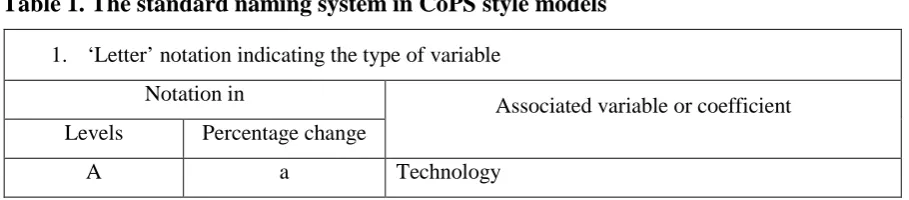
s for commodity sources; and o for occupation types. The complete list of notations used in CoPS style models is shown in Table 1 below.
Table 1. The standard naming system in CoPS style models
1. ‘Letter’ notation indicating the type of variable
Notation in
Associated variable or coefficient Levels Percentage change
Page | 22 P PF X V T F p pf x w t f
Price, local currency
Price, foreign currency
Input quantity
Value, local currency
Tax
Shifter
2. ‘Number’ notation indicating user
Notation User
1 2 3 4 5 6 0
Current production (industries)
Investment (investors)
Consumption (households)
Export (foreigners)
Government(s)
Inventories
All users, or user distinction irrelevant
3. ‘Combination of letters’ notation for further information
Notation Information
BAS or bas
CAP or cap
CIF or cif
DOM or dom
FAC or fac
IMP or imp
LAB or lab
LND or lnd
LUX or lux
MAR or mar
OCT or oct
PRIM or prim
PUR or pur
SUB or sub
TAR or tar
TAX or taxes
TOT or tot
Basic
Capital
Imports at border prices
Domestic
All factors
Imports (duty paid) or imported
Labour
Land
Linear expenditure system (supernumerary part)
Margin
Other cost tickets
All primary factors
At purchaser’s prices
Linear expenditure system (subsistence part)
Tariffs
Taxes
Total or average over all inputs for some user
Page | 23
Notation Information
COM or C
IND or I
OCC or O
SRC or S
c
i
o
s
_c
_i
_s
_o
_oi (_io)
Set of commodities
Set of industries
Set of occupations
Set of sources (domestic and imported)
Index for commodities
Index for industries
Index for occupational types
Index for sources
Summed over COM
Summed over IND
Summed over SRC
Summed over OCC
Summed over OCC and IND or IND and OCC
Source: Modified from Horridge (2014, pp. 11-2)
6. Data requirement
Input-output tables are the main data input to CoPS style CGE models. In the models, input-output tables provide an initial solution. A CoPS model’s computations start from an initial solution defined by input-output tables of certain year and generate deviations away from that solution due to the shocks under consideration. In addition, input-output tables provide the data for evaluation of numerous coefficients in the models (Dixon & Rimmer 2002). In addition to IOTs, a wide range of data from national accounts, government budgets, balance of payment, national surveys and censuses, and other statistical data are used. More data are often required for dynamic CGE models in their forecasting analysis and for micro-simulation CGE models in their distributional impact analysis. New generation CoPS style financial CGE models require additional information about loanable fund markets and financial intermediaries. As computing power and software capability increase, CGE models contain greater details and thus require more and more information.
7. GEMPACK
Page | 24 (Horridge 2014). The implementation of CGE models can be written in levels and equations, percentage change equations or a mixture of them via algebra-like language used to describe and document the implementation. Then the GEMPACK program TABLO translates these texts into model-specific programs which solve the models. GEMPACK is equipped to handle a wide range of economic behaviour and contains an advanced method solving inter-temporal models with adaptive and rational expectations. It is used in over 500 organisations in 100 countries.
A key motivation in designing and adopting GEMPACK was to allow economists to construct and run models without the hassle of complicated algorithms. The advances in GEMPACK, including user friendly Windows programs, have substantially increased modellers’ and users’ productivity. Some of GEMPACK’s integrated development environments can identify and zip up all the original or source files needed to produce a simulation (Horridge et al. 2012). These developments have facilitated and expedited the transfer of CGE technology across the world. GEMPACK’s speed to solve large CGE models is substantially faster than its counterparts. GEMPACK can solve the equations using one of four related solution methods: Johansen, Euler, Gragg’s or the midpoint methods discussed in section 4. .
8. Back-of-The-Envelope (BOTE) Analysis
A back-of-the-envelope (BOTE) model is a small model which can be managed with pencil and paper, designed to explain a particular application of a full-scale model. BOTE modelling is as old as CGE modelling. In his seminal work, Johansen (1960) used a one-sector BOTE model to guide his discussion of the huge number of results generated by his CGE model of Norway’s economy. There has been a robust, well-established tradition among CoPS style CGE modellers to use BOTE models and calculations for assessing model results. The usage of BOTE models and calculations is one of the distinctive characteristics of CoPS style modelling.
In the original ORANI publication (Dixon et al. 1977, pp. 194-9), BOTE models were described as having the following roles:
Page | 25 particular results; and to access the plausibility of particular results by seeing which real-world phenomena have been considered and which have been ignored. Third, … by modifying and extending [BOTE] calculations … the reader will be able to obtain reasonably accurate idea of how some of the projections would respond to various changes in the underlying assumptions and data.
Page | 26
References
Adams, PD 1989, 'Incorporating financial assets into ORANI: the extended Walrasian paradigm', University of Melbourne.
Adams, PD, Dixon, PB, McDonald, D, Meagher, GA & Parmenter, BR 1994, 'Forecasts for the Australian economy using the MONASH model', International Journal of Forecasting, vol. 10, no. 4, pp. 557-71.
Adams, PD, Horridge, M & Parmenter, BR 2000a, MMRF-GREEN: A Dynamic, Multi-Sectoral, Multi-Regional Model of Australia, Victoria University, Centre of Policy Studies/IMPACT Centre.
Adams, PD, Horridge, M, Parmenter, BR & Zhang, XG 2000b, 'Long‐run Effects on China of APEC Trade Liberalization', Pacific Economic Review, vol. 5, no. 1, pp. 15-47.
Anderson, K 2014, Australia's Economy in its International Context, vol. II, 2 vols., University of Adelaide Press, Adelaide, SA.
Anderson, K, Giesecke, J & Valenzuela, E 2010, 'How would global trade liberalization affect rural and regional incomes in Australia?', Australian Journal of Agricultural and Resource Economics, vol. 54, no. 4, pp. 389-406.
Anderson, K, Martin, W & Van der Mensbrugghe, D 2012, 'Estimating effects of price-distorting policies using alternative distortions databases', in Handbook of Computable General Equilibrium Modeling, Oxford, pp. 877-932.
Armington, PS 1969, 'The Geographic Pattern of Trade and the Effects of Price Changes (Structure géographique des échanges et incidences des variations de prix) (Estructura geográfica del comercio y efectos de la variación de los precios)', Staff Papers (International Monetary Fund), vol. 16, no. 2, pp. 179-201.
Bandara, J 1991a, 'An investigation of “Dutch disease” economics with a miniature CGE model', Journal of Policy Modeling, vol. 13, no. 1, pp. 67-92.
Bandara, J 1991b, 'Computable general equilibrium models for development policy analysis in LDCs', Journal of economic surveys, vol. 5, no. 1, pp. 3-69.
Brooke, A, Kendrick, D & Meeraus, A 1996, GAMS Release 2.25: A user's guide, GAMS Development Corporation Washington, DC.
Burniaux, J-M & Truong, TP 2002, 'GTAP-E: an energy-environmental version of the GTAP model', GTAP Technical Papers, p. 18.
Corden, WM 1995, Protection and liberalization in Australia and abroad, University of Adelaide.
Page | 27 Coxhead, IA, Warr, PG & Crawford, J 1991, 'Technical change, land quality, and income
distribution: a general equilibrium analysis', American Journal of Agricultural Economics, vol. 73, no. 2, pp. 345-60.
Dee, PS 1994, General equilibrium models and policy advice in Australia, Australian Government Pub. Service.
Dervis, K & Robinson, S 1982, General equilibrium models for development policy, Cambridge university press.
Dixon, PB 1975, The theory of joint maximization, vol. 91, North-Holland Publishing Company.
Dixon, PB 1978, 'The computation of economic equilibria: A joint maximization approach',
Metroeconomica, vol. 30, no. 1‐2‐3, pp. 173-85.
Dixon, PB 2006, 'Evidence-based Trade Policy Decision Making in Australia and the Development of Computable General Equilibrium Modelling'.
Dixon, PB & Butlin, MW 1977, 'Notes on the Evans Model of Protection*', Economic Record, vol. 53, no. 3, pp. 337-49.
Dixon, PB, Giesecke, JA & Rimmer, MT 2015, 'Superannuation within a financial CGE model of the Australian economy ', paper presented to GTAP 18th Annual Conference on Global Economic Analysis, Melbourne.
Dixon, PB & Jorgenson, D 2013, Handbook of Computable General Equilibrium Modeling SET, Vols. 1A and 1B, Newnes.
Dixon, PB, Koopman, R & Rimmer, MT 2013, 'The MONASH style of CGE modeling: a framework for practical policy analysis', Chapter, vol. 2, pp. 23-102.
Dixon, PB & Parmenter, BR 1996, 'Computable general equilibrium modelling for policy analysis and forecasting', Handbook of computational economics, vol. 1, pp. 3-85.
Dixon, PB, Parmenter, BR, Powell, AA & Wilcoxen, PJ 1992, 'Notes and problems in applied general equilibrium analysis', Advanced Textbooks in Economics, no. 32.
Dixon, PB, Parmenter, BR, Ryland, GJ & Sutton, JP 1977, ORANI, a general equilibrium model of the Australian economy: Current specification and illustrations of use for policy analysis.
Dixon, PB, Parmenter, BR, Sutton, J & Vincent, DP 1982, ORANI: A Multisectoral Model of the Australian Economy, North-Holland Publishing Company, Amsterdam.
Page | 28 Dixon, PB & Rimmer, MT 2002, Dynamic General Equilibrium Modelling for Forecasting
and Policy: A Practical Guide and Documentation of MONASH, Contribution to Economic Analysis, North Holland, Amsterdam.
Dixon, PB & Rimmer, MT 2005, 'Mini-USAGE: Reducing Barriers to Entry in Dynamic CGE Modelling.”', in 8th Annual Conference on Global Economic Analysis, Lübeck, Germany, and June.
Dixon, PB & Rimmer, MT 2010, Johansen’s Contribution to CGE Modelling: Originator and Guiding Light for 50 Years, G-203, Centre of Policy Studies, Monash University, Melbourne.
Dixon, PB & Rimmer, MT 2010a, Johansen's contribution to CGE modelling: originator and guiding light for 50 years, Monash University, Centre of Policy Studies and the Impact Project.
Edgeworth, FY 1881, Mathematical psychics: An essay on the application of mathematics to the moral sciences, CK Paul.
Elliott, AC & Woodward, WA 2007, Statistical analysis quick reference guidebook: With SPSS examples, Sage.
Evans, HD 1972, A General Equilibrium Analysis of Protection: the Effects of Protection in Australia, North-Hollan Publishing Company, Amsterdam.
Giesecke, JA 2000, 'FEDERAL-F: A multi-regional multi-sectoral dynamic model of the Australian economy'.
Giesecke, JA 2011, 'Development of a large-scale single US region CGE model using IMPLAN data: A Los Angeles County example with a productivity shock application',
Spatial Economic Analysis, vol. 6, no. 3, pp. 331-50.
Giesecke, JA & Madden, JR 2013, 'Regional computable general equilibrium modeling',
Handbook of Computable General Equilibrium Modeling, vol. 1, pp. 379-475.
Gregory, RG 1976, 'SOME IMPLICATIONS OF THE GROWTH OF THE MINERAL SECTOR*', Australian Journal of Agricultural Economics, vol. 20, no. 2, pp. 71-91.
Harrison, WJ & Pearson, KR 1996, 'Computing solutions for large general equilibrium models using GEMPACK', Computational Economics, vol. 9, no. 2, pp. 83-127.
Hertel, T 1997, Global trade analysis: modeling and applications, Cambridge university press, USA.
Page | 29 Horridge, M 2000, ORANI-G: A General Equilibrium Model of the Australian Economy,
OP-93, Centre of Policy Studies, Victoria University,
<http://www.copsmodels.com/elecpapr/op-93.htm>.
Horridge, M 2014, 'ORANI-G: A generic single-country computable general equilibrium model', Centre of Policy Studies—CoPS. Monash University. Austrália.
Horridge, M, Madden, J & Wittwer, G 2005, 'The impact of the 2002–2003 drought on Australia', Journal of Policy Modeling, vol. 27, no. 3, pp. 285-308.
Horridge, M, Parmenter, BR, Cameron, M, Joubert, R, Suleman, A & de Jongh, D 1995, The macroeconomic, industrial, distributional and regional effects of government spending programs in South Africa, Victoria University, Centre of Policy Studies/IMPACT Centre.
Horridge, M, Parmenter, BR & Pearson, KR 1993, 'ORANI-F: A General Equilibrium Model', Economic and Financial Computing, vol. 3, no. 2, pp. 71-140.
1998, ORANI-G: A General Equilibrium Model of the Australian Economy, by Horridge, M, Parmenter, BR & Pearson, KR, Monash University, Centre of Policy Studies and the Impact Project.
Horridge, M, Pearson, K, Meeraus, A & Rutherford, T 2012, Solution Software for CGE Modeling. chapter 20 in: Dixon PB, Jorgensen D.(eds), Handbook of CGE modeling, Elsevier. ISBN.
Horridge, M & Wittwer, G 2006, The Impacts of Higher Energy Prices on Indonesia’s and West Java’s Economies using INDOTERM, a Multiregional Model of Indonesia, Department of Economics, Padjadjaran University.
Horridge, M & Wittwer, G 2008, 'SinoTERM, a multi-regional CGE model of China', China Economic Review, vol. 19, no. 4, pp. 628-34.
Johansen, L 1960, A multi-sector study of economic growth, vol. 21, North-Holland Pub. Co.
Jomini, P, McDougall, R, Watts, G & Dee, PS 1994, The SALTER Model of the World Economy: Model, Structure, Database and Parameters, Industry Commission, Melbourne.
Leontief, WW 1936, 'Quantitative input and output relations in the economic systems of the United States', The review of economic statistics, pp. 105-25.
Leontief, WW 1951, 'Input-output economics', Sci Am, vol. 185, no. 4, pp. 15-21.
Leontief, WW, Morgan, A, Polenske, K, Simpson, D & Tower, E 1965, 'The economic impact--industrial and regional--of an arms cut', The Review of Economics and Statistics, pp. 217-41.
Page | 30 Madden, JR 1990, 'FEDERAL: A two-region multisectoral fiscal model of the Australian
economy', University of Tasmania.
Mai, Y, Dixon, PB & Rimmer, MT 2010, CHINAGEM: A Monash-styled dynamic CGE model of China, Centre of Policy Studies and the Impact Project.
Manne, AS 1963, 'Key Sectors of the Mexican Economy, 1960-1970', Studies in Process Analysis Cowles Foundation Monograph, vol. 18.
Marshall, A 1890, 'Principles of political economy', Maxmillan, New York.
Nana, G & Philpott, B 1983, The 38 Sector Joanna Model, Victoria University of Wellington, Research Project on Economic Planning.
Naqvi, F & Peter, MW 1996, 'A MULTIREGIONAL, MULTISECTORAL MODEL OF THE AUSTRALIAN ECONOMY WITH AN ILLUSTRATIVE APPLICATION*',
Australian Economic Papers, vol. 35, no. 66, pp. 94-113.
Parmenter, B 2004, Distinguished Fellow of the Economic Society of Australia, 2003: Peter Dixon, Wiley-Blackwell, 00130249, Other.
PC 2003a, 'From industry assistance to productivity: 30 years of ‘the Commission’',
Melbourne: Productivity Commission.
Pearson, KR 1991, Solving nonlinear economic models accurately via a linear representation, Victoria University, Centre of Policy Studies/IMPACT Centre.
Peter, MW, Horridge, M, Meagher, GA, Naqvi, F & Parmenter, BR 1996, The theoretical structure of MONASH-MRF, Victoria University, Centre of Policy Studies/IMPACT Centre.
Powell, AA 2007, '“Why, How and When did GTAP Happen? What has it Achieved? Where is ti Heading?”', GTAP Working Paper, vol. 38.
Powell, AA & Snape, R 1992, 'The Contribution of Applied General Equlibrium Analysis to Policy Reform in Australia', CoPS/Impact Project Paper series, vol. General paper, no. No G-98.
Sandee, J 1960, A Demonstration Planning Model for India, Asia Publishin House, Calcutta.
Scarf, H 1967, 'The Approximation of Fixed Points of a Continuous Mapping', SIAM Journal on Applied Mathematics, vol. 15, no. 5, pp. 1328-43.
Scarf, H & Hansen, T 1973, 'The computation of economic equilibria', New Haven.
Shoven, JB & Whalley, J 1992, Applying general equilibrium, Cambridge university press.
Page | 31 Vincent, DP 1991, An Economy-wide model of Papua New Guinea: theory, data and
implementation, National Centre for Development Studies.
Walras, L 1877, Elements of pure economics, Routledge.
Wittwer, G 1999, WAYANG: a general equilibrium model adapted for the Indonesian economy, Centre for International Economic Studies.
Wittwer, G 2012, Economic Modeling of Water: The Australian CGE Experience, vol. 3, Springer Science & Business Media.
Wittwer, G & Anderson, K 1999, 'Accounting for Growth in Australia's Grape and Wine Industries 1986 to 2003', vol. 99, no. 2.