Available Online atwww.ijcsmc.com
International Journal of Computer Science and Mobile Computing
A Monthly Journal of Computer Science and Information Technology
ISSN 2320–088X
IJCSMC, Vol. 3, Issue. 9, September 2014, pg.277 – 283
RESEARCH ARTICLE
PERFORMANCE EVALUATION
OF AODV AND AOMDV ON THE
BASIS OF THROUGHPUT
1
POOJA DAHIYA,
2GUNJAN MADAN,
3REEMA GUPTA
1,2ASSISTANT PROFESSOR, ARYA PG COLLEGE, PANIPAT, INDIA
3M.Tech Student, NCCE, ISRANA, HARYANA, INDIA
1 [email protected], 2 [email protected], 3 [email protected]
Abstract: Since their emergence in 1970's, wireless networks have become increasingly popular in
the computing industry. These networks provide mobile users with ubiquitous computing capability
and information access regardless of the location. There are currently two variations of mobile
wireless networks- infrastructured and infrastructure less networks. The infra-structured networks,
also known as Cellular network, have fixed and wired gateways. They have fixed base stations
which are connected to other base stations through wires. The other type of network (25),
infrastructure less network, is known as Mobile Ad Network (MANET). These networks have no
fixed routers
Keywords:- MANET, Reactive, Proactive, AODV, AOMDV, Cellular Network
I.
INTRODUCTION
Wireless networks have become increasingly popular in the computing industry. These networks provide mobile users with ubiquitous computing capability and information access regardless of the location. There are currently two variations of mobile wireless networks- infrastructured and infrastructure less networks.
The other type of network (25), infrastructure less network, is known as Mobile Ad Network (MANET). These networks have no fixed routers. All nodes are capable of movement and can be connected dynamically in arbitrary manner. The responsibilities for organizing and controlling the network are distributed among the terminals themselves. The entire network is mobile, and the individual terminals are allowed to move at will relative to each other.
In this type of network, some pairs of terminals may not be able to communicate directly to with each Other and relaying of some messages is required so that they are delivered to their destinations. Such networks are often referred to as multihop or
store-and-forward networks. The nodes of these networks function as routers, which discover and maintain routes to other nodes in the networks. The nodes may be located in or on airplanes, ships, trucks, cars, perhaps even on people or very small devices.
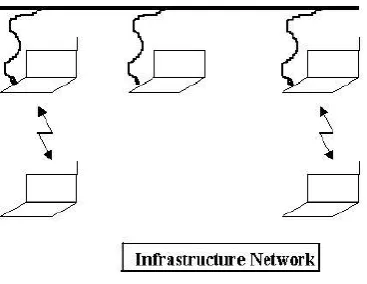
Figure .2 Infrastructures Network
II.
CHARACTERSTICS OF MANETs
Dynamic Topologies: Since nodes are free to move arbitrarily, the network topology may change randomly and rapidly at unpredictable times. The links may be unidirectional bi-directional.
Bandwidth constrained, variable capacity links: Wireless links have significantly lower capacity than their hardwired counterparts. Also, due to multiple access, fading, noise, and interference conditions etc. the wireless links have low throughput.
Energy constrained operation: Some or all of the nodes in a MANET may rely on batteries. In this scenario, the most important system design criteria for optimization may be energy conservation.
III.
ESSENTIAL PARAMETERS THAT SHOULD BE VARIED INCLUDED
Network size: measured in terms of the number of nodes?
Network connectivity: the average degree of a node (i.e. the average number of neighbors of a node)?
Topological rate of change: the speed with which a network topology is changing?
Link capacity: effective link speed measured in bits/second, after accounting for losses due to multiple access,
coding, framing, etc.
Fraction of unidirectional links: how effectively does a protocol perform as a function of the presence of
unidirectional links?
Traffic patterns: how effective is a protocol in adapting to non-uniform or bursty traffic patterns.
Mobility: when, and under what circumstances, is temporal and spatial topological correlation relevant to the performance of a routing protocol? In these cases, what is the most appropriate model for simulating node mobility in a MANET?
IV.
TWO TYPES OF ROUTING SCHEMES
In proactive schemes, also known as Table-driven approaches, every node continuously maintains the complete routing information of the network. When a node needs to forward a packet, the route is readily available; thus there is no delay in searching for a route. However, for a highly dynamic topology, the proactive schemes spend a significant amount of scarce wireless resource in keeping the complete routing information correct. E.g. Distance Vector Routing, Link State Routing.
On the other hand, in reactive schemes (also known as Demand-based schemes) nodes only maintain routes to active destinations. A route search is needed for every new destination. Therefore, the communication overhead is reduced at the expense of delay due to route search. These schemes are significant for the ad-hoc environment since battery power is conserved both by not sending the advertisements and by not needing to receive them (since a host could otherwise reduce its power usage by putting itself into the "sleep" or "standby" mode when not busy with other tasks). e.g. Dynamic Source Routing.
On Demand routing protocols work on the principle of creating routes as and when required between a source and destination node pair in a network topology.
Ad-hoc On-Demand Distance Vector Routing (AODV)
AODV is a reactive protocol that discovers routes on an as needed basis using a route discovery mechanism. It uses traditional routing tables with one entry per destination. Without using source routing, AODV relies on its routing table entries to propagate an RREP (Route Reply) back to the source and also to route data packets to the destination. AODV uses sequence numbers maintained at each destination to determine freshness of routing information and to prevent routing loops [1]. All routing packets carry these sequence numbers. AODV maintains timer-based states in each node, for utilization of individual routing table entries, whereby older unused entries are removed from the table. Predecessor node sets are maintained for each routing table entry, indicating the neighboring nodes sets which use that entry to route packets. These nodes are notified with RERR (Route Error) packets when the next-hop link breaks. This packet gets forwarded by each predecessor node to its predecessors, effectively erasing all routes using the broken link. Route error propagation in AODV can be visualized conceptually as a tree whose root is the node at the point of failure and all sources using the failed link as the leaves [1]. The advantages of AODV are that less memory space is required as information of only active routes are maintained, in turn increasing the performance, while the disadvantage is that this protocol is not scalable and in large networks it does not perform well and does not support asymmetric links.
Ad-hoc On-demand Multi path Distance Vector Routing (AOMDV)
each node does not immediately reject duplicate RREQs. Each RREQs arriving via a different neighbor of the source defines a node-disjoint path. This is because nodes cannot be broadcast duplicate RREQs, so any two RREQs arriving at an intermediate node via a different neighbor of the source could not have traversed the same node. In an attempt to get multiple link-disjoint routes, the destination replies to duplicate RREQs, the destination only replies to RREQs arriving via unique neighbors. After the first hop, the RREPs follow the reverse paths, which are node disjoint and thus link-disjoint. The trajectories of each RREP may intersect at an intermediate node, but each takes a different reverse path to the source to ensure link disjointness. The advantage of using AOMDV is that it allows intermediate nodes to reply to RREQs, while still selecting disjoint paths. But, AOMDV has more message overheads during route discovery due to increased flooding and since it is a multipath routing protocol, the destination replies to the multiple RREQs those results are in longer overhead.
V.
LITERATURE REVIEW
R. Manoharan and E. Ilavarasan “Impact of mobility On the Performance of Multicast Routing Protocols in MANET” studied the impact of mobility models in performance of multicast routing protocols in MANET. In this work, three widely used mobility models such as Random Way Point, Reference Point Group and Manhattan mobility models and three popular multicast routing protocols such as On-Demand Multicast Routing Protocol, Multicast Ad hoc On-demand Distance Vector Routing protocol and Adaptive Demand driven Multicast Routing protocol have been chosen and implemented in NS2.
R.Balakrishna, U.Rajeswar Rao , N.Geethanjali N “Performance issues on AODV and AOMDV for MANETS” compared and evaluate the performance of two types of On demand routing protocols- Ad-hoc On-demand Distance Vector (AODV) routing protocol, which is unipath and Adhoc On-demand Multi path Distance Vector(AOMDV) routing protocol.
H.D.Trung, W.Benjapolakul, P.M.Duc “Performance evaluation and comparison of different ad hoc routing protocols” states that the topology of the ad-hoc network depends on the transmission power of the nodes and the location of the mobile nodes, which may change from time to time. Even though route maintenance for reactive algorithms is restricted to the routes currently in use, it may still generate an important amount of network traffic when the topology of the network changes frequently. Finally, packets to the destination are likely to be lost if the route to the destination changes.
Er.Punardeep Singh, Er.Harpal Kaur, Er. Satinder Pal Ahuja “ Brief Description of Routing Protocols in MANETS And Performance And Analysis (AODV, AOMDV, TORA)” compared and evaluate the performance of three types of On demand routing protocols- Ad-hoc demand Distance Vector (AODV) routing protocol, which is unipath , Adhoc On-demand Multipath Distance Vector (AOMDV) routing protocol and Temporally Ordered Routing Algorithm (TORA) . In this paper we note that on comparing the performance of AODV and AOMDV, AOMDV incurs more routing overhead and packet delay than AODV but it had a better efficiency when it comes to number of packets dropped and packet delivery. Vivek B. Kute, M. U. Kharat “Analysis of Quality of Service for the AOMDV Routing Protocol” Due to the dynamic nature of Mobile Ad-hoc Networks(MANETs), the provision of Quality of Service (QoS) guarantees is challenging. The route failure probability in a MANET is increased due to the mobility of nodes, which increases routing overhead. Multi-path routing protocols have relatively greater ability to reduce the routing overheads. This paper discuses the performance analysis of the Ad-hoc On-Demand Multi-Path Distance Vector (AOMDV) routing protocol. AOMDV is a multipath extension of a very well known single path routing protocol, (AODV).
M. K. Marina, S. R. Das ““Ad hoc on-demand multipath distance vector routing”
On-demand multi-path routing protocols discover multiple paths between a source-destination pair, in a single route discovery. So a new discovery is needed only when all these paths fail. In contrast, a single path routing protocol has to invoke a new route discovery whenever the only path from source to destination fails.
V. C. Patil, R. V. Biradar, R. R. Mudholkar, S. R. Sawant, “On-demand multipath routing protocols for mobile ad hoc networks issues and comparison” explained principal advantage of MANET is that it is deployed without planning in unknown terrains, hazardous conditions and its members can change dynamically. This makes it difficult to have any centralized control. Hence the controlling activities will be distributed among the nodes, which require lot of information exchange. This also adds up to the routing overheads.
Jain, Simmi; Gupta, Hitesh; Baghel, M. K ., "Survey on MANET Routing Protocol and proposed Multipath Extension in AODV" developed AOMDV with the route discovery and route maintenance phase similar to AODV. The main difference lies in the route discovery process which has been modified to enable multiple paths.
data. Different routing algorithms define a scheme to transfer the data ways. Adhoc network differ from the traditional ways as they need to discover path every time as path varies with changes in the topology.
Amith Khandakar “Step by Step Procedural Comparison of DSR, AODV and DSDV
Routing protocol” compare 3 popular routing protocols,DSR, AODV and DSDV based on performance metrics Packet Delivery Fraction (Pdf), End to end delay and Normalized Routing load while varying the number of nodes, speed and Pause time.
Comparison between AODV & AOMDV is made depending on these parameters:-
Throughput of generating packets Throughput of sending packets Throughput of dropping packets Throughput of forwarding packets Throughput of receiving packets
VI.
CONCLUSION
In case of AOMDV, dropping no. of packets is higher as compared to AODV. For e.g. at 45,62,112, 115,125 Values at AOMDV is higher as compared to AODV and all peaks are higher in case of AOMDV as compared to AODV. No. of generated packets is higher in case of AOMDV protocol as compared to AODV but its receiving power is smaller as compared to AODV. Forwarding Packets capacity is more in AODV as compared to AOMDV.
Parameters AODV AOMDV
Update Information Route Error Route Error
Update Destination Source Source
Method Unicast Broadcast
Topology Full Full
REFERENCES
[1] R.Balakrishna1, U.Rajeswar Rao2 , N.Geethanjali N “Performance issues on AODV and AOMDV for MANETS”(IJCSIT) International Journal of Computer Science and Information Technologies, Vol. 1 (2) , 2010, 38-43
[2] Er.Punardeep Singh, Er.Harpal Kaur, Er. Satinder Pal Ahuja “ Brief Description of Routing Protocols in MANETS And Performance And Analysis (AODV, AOMDV, TORA)” International Journal of Advanced Research in Computer Science and Software Engineering.
[3] Jain, Simmi; Gupta, Hitesh; Baghel, M. K ., "Survey on MANET Routing Protocol and proposed Multipath Extension in AODV", International Journal of Advanced Research in Computer Science and Software Engineering, Vol. 2, pp. 337-343,Issue 7, July 2012.
[4] Brahm Prakash Dahiya “Performance Analysis and Evaluation of AODV& AOMDV in MANET” International Journal of Advanced Research in Electrical, Electronics and Instrumentation Engineering.
[5] H.D.Trung, W.Benjapolakul, P.M.Duc,“Performance evaluation and comparison of different ad hoc routing protocols”, Department of Electrical Engineering, Chulalongkorn University,Bangkok, Thailand, May 2007.
[6] M. K. Marina, S. R. Das, “Ad hoc on-demand multipath distance vector routing”, Wirel. Commun. Mob. Comput., Vol. 6, pp. 969-988, 2006
[7] V. C. Patil, R. V. Biradar, R. R. Mudholkar, S. R. Sawant, “On-demand multipath routing protocols for mobile ad hoc networks issues and comparison”, International Journal of Wireless Communication and Simulation, Vol. 2, No 1, pp. 21-38, 2010
[8] V. B. Kute, M. U. Kharat, “Survey on QoS for multi-path routing protocols in mobile ad-hoc networks”, 3rd International Conference on Machine Learning and Computing (ICMLC 2011), Vol. 4, pp. 524-528, 2011
[9] K. Fall, K. Varadhan, The Ns Manual, http://www.isi.edu/nsnam/ns/nsdocumentation.Html.
[10] Prashant Kumar Maurya ,Gaurav Sharma ,Vaishali Sahu , ”An Overview Of AODV Routing Protocol” International Journal of Modern Engineering Research (IJMER) Vol.2, Issue.3, pp-728-732 May-June 2012 .
[11] Manveen Singh Chadha, Rambir Joon, Sandeep “Simulation and Comparison of AODV, DSR and AOMDV Routing Protocols in MANETs” International Journal of Soft Computing and Engineering (IJSCE) ISSN: 2231-2307, Volume-2, Issue-3, July 2012
[12] Gupta, Anuj K; Kaur, Jatinder and Kaur, Sandeep, "Comparison of DYMO, AODV, DSR and DSDV MANET routing protocols over varying traffic", International Journal of Research in Engineering & Applied Science, Vol. 1, Issue 2, pp. 71- 83 ,October, 2011.
[13] Sunil Taneja and Ashwani Kush“A Survey of Routing Protocols in Mobile Ad Hoc Networks” in International Journal of Innovation ,Management and Technology, Vol. 1, No. 3, August 2010 ,ISSN: 2010-0248
[14] Vipul Maheshwari and Shrikant Jadhav, “Survey on MANET Routing Protocol and Multipath Exten sion in AODV”,International Journal of Applied Information Systems 2(4):1-6, May 2012. Published by Foundation of Computer Science,New York, USA.
[15] R. Manoharan and E. Ilavarasan “ Impact of mobility On the performance of multicast Routing protocols In manet “International Journal of wireless and mobile networks(IJWMN) Vol2,No.2,2010.
[16] K.Vanaja 1 , Dr. R. Umarani “An Analysis of Single Path AODV Vs Multipath AOMDV on Link Break Using ns-2”
International Journal of Electronics and Computer Science Engineering.
[17] Abdur Rashid Sangi, Jiawei Liu, Zhiping Liu, “Performance Comparison of Single and Multipath Routing Protocol in MANET with Selfish Behaviors”, World Academy of Science, Engineering and Technology,2010.
[18] Amith Khandakar “Step by Step Procedural Comparison of DSR, AODV and DSDV