Available Online at www.ijcsmc.com
International Journal of Computer Science and Mobile Computing
A Monthly Journal of Computer Science and Information Technology
ISSN 2320–088X
IMPACT FACTOR: 5.258
IJCSMC, Vol. 5, Issue. 7, July 2016, pg.22 – 29
Open Issues using LEACH
Algorithm in Sensor Networks
Suman
(M.Tech Scholar), Ms. Savita Bishnoi
(Associate Professor)Department of Computer Sciences & Engineering
Rohtak Institute of Engineering & Management
Abstract: Ad hoc sensor networks are ad hoc networks that are characterized by decentralized structure and ad hoc deployment. Sensor networks have all the basic features of ad hoc networks but to different degrees – for example, much lower mobility and much more stringent energy requirements. We analyze the current state of research and evaluate open issues in development of routing techniques in wireless sensor networks.
Keywords: General Sensor Network, MANETs, PODS
Introduction
Consider a wireless network made up of units that perform both measurements and communications. These units are totally independent and are capable of recording data from sensors. The mobility of these units is very low but the data forwarding strategy is robust enough to be fault tolerant and to allow occasional mobility among units.
For example, we consider the sensor network being developed for the PODS project at UH Manoa [9]. One of the major objectives of the project is to implement a sensor network to study endangered plants such as “Silene Hawaiiensis”, in order to determine what is essential for the plant’s survival in its native habitat. The challenge is to implement an ad hoc network comprised of hundreds of small sensors or pods, which monitor wind, rain, temperature, light and moisture, and which are used for determining spatial or temporal patterns in the environment of the plant being studied.
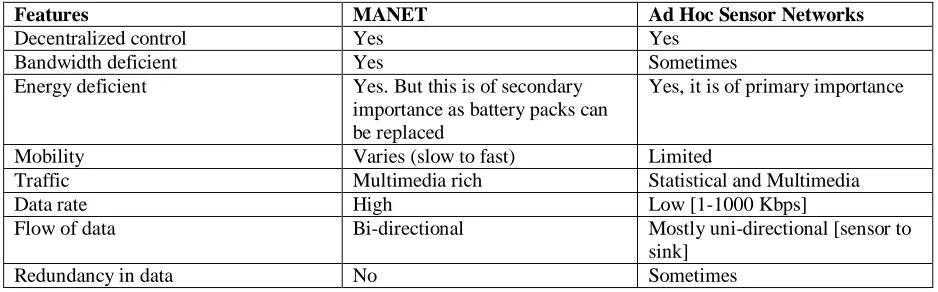
sensor networks can be expected to grow to many thousands of nodes, so any algorithms used in these networks must be scalable. Finally, these networks should use multiple paths whenever possible, both for redundancy and to distribute the energy expenditure of forwarding packets. These requirements distinguish ad-hoc wireless sensor networks from mobile ad-hoc networks (MANETs). Table 2 compares MANETs with ad hoc sensor networks.
A sensor network such as the PODS network also differs from many of the wireless sensor networks considered in the literature. Though some data can be combined and summarized, other data, for example camera images, must be delivered unchanged to a base station. The PODS network is designed to have multiple base stations if possible. In addition, communication is not limited to sending data to base stations: interaction between individual sensor nodes may be needed to allow distributed computation among nodes in close geographic proximity, to support occasional communication from the base stations to the individual nodes, and for a variety of reasons including fault-tolerance. These requirements mean that a PODS-style network needs to be able to support any-to-any communication, though the common mode of communication is from nodes to one or more base stations.
There has been a lot of research in wireless routing protocols. Existing protocols provide different tradeoffs among the following desirable characteristics: fault tolerance, distributed computation, robustness, scalability, and reliability. Wireless protocols proposed so far for wireless sensor networks are very limited, generally focusing on communication to a single base station or on merging sensor data. While these protocols are suitable for their intended purposes, in this paper we explore the use of protocols developed for MANETs to provide more general communication among nodes in a sensor network.
Low Energy Consumption
Protocols for MANETs are designed for communication among laptops. Even though laptops are battery-powered, their power budget far exceeds that of a node in a wireless sensor network. Such nodes are often deployed in remote locations. Whether powered by batteries, solar energy, or some other method, reducing energy consumption lessens the weight or extends the lifetime of the package and makes the sensor easier to conceal. Each node in a wireless sensor network only needs to record, transmit, and forward data, unlike a laptop which might have to perform much more complex tasks. As a result, the computational engine in a sensor node consumes significantly less energy than a laptop, and communications must likewise use less energy.
efficiency but provide other practical advantages. Because of these limitations, we consider a variety of protocols, not only those which claim to use “minimal” energy.
The SensIT program at DARPA notes that many MANET protocols focus on fast topology changes, and that a focus on power-aware metrics, location information, and the energy usage of each node can lead to more power-aware routing. Location information is used by some MANET protocols [2, 5, 20, 25, 28, 29] both to improve scalability and, in some cases, also to minimize energy consumption [14, 27, 29]. Some authors [29] point out that an optimal geographic route may provide power savings and network lifetime extension compared to a similar route that does not use location information. However, at least for the GEAR protocol this has only been tested under a very limited number of relatively favorable network configurations.
LEACH [27] proposes a clustering based protocol that utilizes randomized rotation of local cluster heads to evenly distribute energy load among the sensors in the network. In LEACH each local cluster head performs “local data fusion” to compress the information. It is a single path routing technique whose scalability is provided by its hierarchical nature. However, some of their assumptions may not be true when compared to general sensor networks like PODS. LEACH requires a fixed base station to which data needs to be routed. Leach only supports sensors which do not move and send data at fixed rate, with symmetric radio channels, and adjustable transmit power. Leach also assumes that the cluster heads can talk directly to the gateway node. LEACH may be a good solution for a smaller subset of the problem but for a general sensor network like PODS, it does not address the situation when more than one fixed base station is present, where sensors are not static, and where a node can communicate to another node in an arbitrary fashion.
GEAR [29] presented an alternative to this by incorporating the technique of data diffusion and using geographic computations to find low energy paths. They propose that if the destination is quite far from the packet then the path found by geographic routing may be nearly as energy efficient as an optimal route. Some of their techniques that are not useful for the more general sensor networks we are interested in, include the use of data diffusion, which is only useful to deliver the data to a single or a few base stations, and does not support communication between arbitrary nodes. The paper by Doshi et al. [21] showed that a path which is primarily discovered using location information may not be the most energy efficient path.
Low mobility
that the nodes in a sensor network are static where as in PODS at least some of the nodes (e.g. a hand-held base station) may be mobile.
Self-configuring nature
Ad hoc wireless sensor networks are self-configuring in nature. This can be considered an added feature to the existing ad hoc nature of the network. The network is adaptable to the changing requirements and is able to diagnose when a link / sensor node goes down and when it comes up. There are two main schemes to design a wireless sensor network, the address centric scheme and the data centric scheme. The address centric scheme has been used by various routing protocols such as LAR, GSPR, and DREAM etc. In this scheme we assign IP addresses to each sensor node, simplifying the process of routing. This concept is similar to that of normal wired networks. A unique IP address will help the source sensor node to know the sensor node to which data must be routed. However in [5] a new concept of data centric model is presented which is not address oriented. The mechanism and goal of self-configuration in these networks is different from those of the address centric scheme.
Multipath desirable
Macker and Corson [13] listed qualitative and quantitative independent metrics for judging the performance of mobile ad hoc network routing protocols. One of these qualitative metrics was path strategy. There are a number of different path strategies. One that is very common is shortest path [2, 8, 21, and 28] where one copy of the message is in the network at any time. At the other extreme is the flooding based approach [10, 20] where the message is flooded through the whole network area. A good example of this approach is the Multi-path On-demand Routing (MOR) Protocol [10] which is a on-demand, load balancing routing protocol designed for the PODS project at the University of Hawaii at Manoa. MOR may require as little as one network flood to establish necessary routes and its energy efficient and robust in low mobility and low energy networks such as PODS. Broadcasting usually solves the routing in highly mobile conditions but considering our requirement for a general sensor network for PODS this is undesirable. The compromise between these two approaches is a multipath strategy, where data packets are routed through a few distinct paths and successive packets follow different paths whenever possible. This not only provides robustness to the network using multiple paths but also helps in distribution of the energy requirement of the network evenly across the network. In [1] A.Nasipuri et al., prove that the use of multiple paths in DSR can keep correct end to end connections, but they did not study the performance improvement on network load balancing. M.R Perlman et al., demonstrate [16] that multipath routing can balance loads. They propose a diversity injection method to find more node-disjoint paths compared to DSR. However, their work is based on multiple channel networks, which are contention free but may not be available in some applications. [14] applies the multipath strategy to DSR’s source routing technique and achieves some scalability under mobile conditions. However the energy distribution component of the multipath strategy has not been adequately explored in the paper.
Scalability
is caching. The third way to provide scalability is using geographic information. Using hierarchy to provide scalability is the most widely deployed approach to scale routing as the number of destinations increases. Two main strategies used to combine nodes location and hierarchical network structures are the Zone Based Routing and the Dominating Set Routing. Online power-aware routing routing [28] schemes are example of Zone Based Routing and GRID is an example of dominating set routing.
Caching is becoming a widely deployed technique for scaling ad hoc routing protocols in MANET [6, 8]. Caching reduces the routing protocols message load in two ways: It avoids pushing topological information where the forwarding load does not require it (like ideal routers) and it often reduces the number of hops between the router that has topological information and the router that requires it. However, Doshi et al.,[21] demonstrated with their implementation of energy aware DSR protocol using old routes from the cache does not necessarily mean that a low energy route is selected every time.
The last and most frequently used technique to provide scalability to ad hoc routing protocols is to use the geographic location information. This technique assumes that all wireless nodes know their positions and links are bi-directional. This approach has been adapted in GPSR, GEAR and gradient routing.
For a general sensor network a combination of the above-mentioned strategies would be sufficient to provide scalability, as mobility is limited in these networks.
Conclusion
In this paper we have evaluated the necessary features of the routing protocols for general wireless sensor network like PODS [9]. Current research into routing protocols for MANETs and ad hoc sensor networks tend to make many tradeoffs in various features and are generally tested in a much regulated environment. As seen from the paper that the needs and requirements of routing protocols for general ad hoc sensor networks is very unique compared to routing protocols for MANETs and other sensor networks. Hence, there is a need for further research into this new field as it poses some of its unique challenges and we would be continuing our research in this area in future.
References
[1] A.Nasipuri and S.R Das, “On demand Multipath Routing for Mobile Ad Hoc Networks”, Proceedings
of the 8th International Conference on Computer Communications and Networks (IC3N), Boston, 1999
[2] B.Karp and HT.Kung, “GPSR: Greedy peimeter stateless routing for wireless networks”, Proc.
MOBICOM, August 2000, pp 243-254.
[3] B.Krishnamachari et al., “Modeling Data-Centric Routing in Wireless sensor networks”
[4] C.E.Jones et al.,”A Survey of energy efficient network protocols for wireless networks”
[5] Chalermek Intanagonwiwat, R.Govindan and D.Estrin, “Directed Diffusion: A scalable and robust communication paradigm for sensor networks”, in proc. ACM MOBICOMM, Boston, MA, 2000
[6] C.Perkins, E.Royer, “Ad hoc on demand distance vector routing”, Proc. 2nd IEEE Workshop on Mobile Computer System and Applications, February 1999, pp. 90-100.
[8] D.Johnson , D.Maltz, “Dynamic source routing in ad hoc wireless networks”, Mobile computing,
Chapter 5, pp. 153-181, Luwer Academic Publishers, 1996.
[9] Edoardo Biagioni, Kent Bridges and B.J.S Chee, “PODS: A remote ecological Micro sensor network “, http://www.botany.hawaii.edu/pods/overview.htm
[10]Edoardo Biagioni, Kent Bridges, “The Application of Remote Sensor Technology to Assist the Recovery of Rare and Endangered Species”, Accepted for publication in a special issue on Distributed
Sensor Networks for the International Journal of High Performance Computing Applications, Vol. 16, N. 3 (August 2002).
[11] I.D.Aron., “On the scalability of on-demand routing protocols for mobile ad hoc networks: an analytical study”
[12] I.Stojmenovic and Xu Lin, “Power-aware localized routing in wireless networks”, IEEE Int. Parallel
and distributed processing symp., Cancun, Mexico, May 1-5, 2000, pp. 371-376.
[13] J.P. Macker and M.S. Corson, “Mobile ad-hoc networking and the IETF”, Mobile computing and
communications review, 2, 1, 1998, 9-14.
[14] K.Wu and J.Harms, “On-demand multipath routing for mobile ad-hoc networks”, Computer science
department, University of Alberta, AB, Canada.
[15] M.Mauve, J.Widmer, “A Survey on Position-Based Routing in Mobile Ad Hoc Networks”
[16] M.R Perlman, Z.J.Hass, P.Sholander and S.S Tabrizi, “On the impact of Alternate Path Routing for load balancing in Mobile Ad Hoc Networks”, Proceedings of IEEE/ACM MobiHoc 2000, Boston, 2000
[17] Nitin Nagar and A.Kongmunvattana, "Analysis of Routing Protocol Performance on Multi-Hop Wireless Ad HocNetworks", The 2001 International Conference on Parallel and Distributed Processing Techniques and Applications (PDPTA'2001), Las Vegas, June 25-28, 2001
[18] Robert D.Poor, “Gradient Routing in Ad Hoc Networks”
[19] R.Ramanathan, R.Rosales-hain, “Topology control of multi-hop wireless networks using transmit power adjustment”, IEEE INFOCOM 2000, pp. 404-413.
[20] S.Basagni, I.Chtamtac, V.R.Syrotiuk, B.A Woodward, “A distance routing effect algorithm for mobility (DREAM)”, Proceedings of MOBICOM, 1998, 76-84.
[21] S.Doshi, T.X.Brown, “Minimum energy routing schemes for a wireless ad hoc network”, IEEE
INFOCOM 2002.
[22] S.Giordano, I.Stojmenovic et al.,”Position based Routing: Algorithms for Ad Hoc Networks: ATaxonomy”
[23] S.Singh, M., and C.S.Raghavendra, “Power aware routing in mobile ad-hoc networks”, Proceedings
[24] V.Ruduplu, T.Meng, “Minimum energy mobile wireless networks”, IEEE JSAC, v.17, n.8, August
1999, pp. 13333-44.
[25] W.H. Liao, Y.C. Tseng. J.P. Sheu, “GRID: A fully location-aware routing protocols for mobile ad-hoc networks”, Proc. IEEE HICSS, January 2000.
[26] W.R.Heinzelman, A.Chandrakasan and H.Balakrishnan, “Energy efficient routing protocols for wireless microsensor networks”, Proc. HICSS, Hawaii, January 2000.
[27] W., Rabiner, A.Heinzelman, A.Chandrakasan and H.Balakrishnan, “Energy-efficient communication protocol for wireless microsensor networks”, in proceedings of the 33rd HICSS, 2000
[28] Y.B.Ko and N.H Vaidhya, “Location-aided routing (LAR) in mobile ad hoc networks”, Proc.
MOBICOM, 1998, pp. 66-75.
[29] Yan Yu, R.Govindan, D.Estrin, “Geographical and Energy Aware Routing: a recursive data
dissemination protocol for wireless sensor networks”
Table 1: Comparison of three different energy efficient routing protocols for ad hoc sensor networks
Method Distributed Metrics Scalability Comm. Without merging
Multiple base stations
Mobility Fault Tolerance
Robustness
New DSR [4]
No Shortest path
Caching Yes Yes Sufficient Single path Yes: Limited LEACH [19] Yes : Location aware: clustering
Location, Hierarchical No No No Single path No GEAR [28] Yes: Location aware Shortest Path, Location
Geographic No Yes Not tested
Single path
No
Table 2: Comparison of features of MANETs and Ad Hoc Sensor Networks.
Features MANET Ad Hoc Sensor Networks
Decentralized control Yes Yes Bandwidth deficient Yes Sometimes Energy deficient Yes. But this is of secondary
importance as battery packs can be replaced
Yes, it is of primary importance
Mobility Varies (slow to fast) Limited
Traffic Multimedia rich Statistical and Multimedia Data rate High Low [1-1000 Kbps]
Flow of data Bi-directional Mostly uni-directional [sensor to sink]
Main Goal To optimize QoS and high bandwidth efficiency
Prolonging the life of the network through aggressive energy management, to prevent connectivity degradation. Fault tolerance Needed as mobility increases Needed only if nodes exhaust
available energy or are moved Basic features of routing protocol Loop free, energy and bandwidth
efficient, secure, provides QoS, fault tolerant and reactive instead of proactive, and distributed in nature