Mitigating Server Breaches in Password-Based Authentication:
Secure and Efficient Solutions
Olivier Blazy1, C´eline Chevalier2, and Damien Vergnaud3
1
Universit´e de Limoges, XLim, France 2
Universit´e Panth´eon-Assas, Paris, France
3 ENS, CNRS, INRIA, and PSL Research University, Paris, France
Abstract. Password-Authenticated Key Exchange allows users to generate a strong cryptographic key based on a shared “human-memorable” password without requiring a public-key infrastructure. It is one of the most widely used and fundamental cryptographic primitives. Unfortunately, mass password theft from organizations is continually in the news and, even if passwords are salted and hashed, brute force breaking of password hashing is usually very successful in practice.
In this paper, we propose two efficient protocols where the password database is somehow shared among two servers (or more), and authentication requires a distributed computation involving the client and the servers. In this scenario, even if a server compromise is doable, the secret exposure is not valuable to the adversary since it reveals only a share of the password database and does not permit to brute force guess a password without further interactions with the parties for each guess. Our protocols rely onsmooth projective hash functionsand are proven secure under classical assumption in the standard model (i.e.do not require idealized assumption, such as random oracles).
Keywords.Password-Authenticated Key Exchange, Distributed Computation, Decision Diffie-Hellman, Smooth Projective Hashing
1 Introduction
Authenticated Key Exchange protocols enable two parties to establish a shared cryptographically strong key over an insecure network under the complete control of an adversary. This primitive is one of the most widely used and fundamental cryptographic primitives and it obviously requires the parties to have authentication means,e.g. (public or secret) cryptographic keys or short (i.e., low-entropy) secret keys.
PAKE, for Password-Authenticated Key Exchange, allows users to generate a strong cryptographic key based on a shared “human-memorable” password without requiring a public-key infrastructure. In this setting, an adversary controlling all communication in the network should not be able to mount an
offline dictionary attack. More precisely, an eavesdropper should not obtain enough information to be able to brute force guess a password without further interactions with the parties for each guess. Note that online dictionary attacks in which an adversary simply attempts to log-in repeatedly, trying each possible low-entropy password can be dealt with using other computer security methods (such as limiting the number of attempts). In particular, strong security can be obtained even using passwords chosen from a small set of possible values (a four-digit pin, for example).
Incidents of sensitive customer information ”hacking” (including leaking of passwords) in e-commerce systems are frequently revealed in the newspaper. In addition to major reputational damage, a com-pany with a significant data breach may be sued by its clients for the breach and may be suspended or disqualified from future public sector or government work.
and it forces the attacker who breaks into the server and is willing to recover passwords to perform an additional costly offline dictionary attack.
We consider an alternative approach inspired by the multi-party computation paradigm (and first suggested by Ford and Kaliski [FK00]). The password database on the server side is somehow shared among two servers (or more, but we focus here on two for sake of simplicity), and authentication requires a distributed computation involving the client – who still does not need an additional cryptographic device capable of storing high-entropy secret keys – and the two servers who will use some additional shared secret information. The interaction is performed using a gateway that does not know any secret information and ends up in the gateway and the client sharing a common key. The lifetime of the protocol is divided into distinct periods (for simplicity, one may think of these time periods as being of equal length; e.g. one day) and at the beginning of each period, the two servers interact and update their sharing of the password database. Similarly to proactive schemes in multi-party computation, we allow the adversary multiple corruptions of each server, limiting only the corruptions to one server for each period. The user does not need to update his password nor to perform any kind of computations and its interaction with the two servers (performed using the gateway) remains the same for the lifetime of the protocol. In this scenario, even if a server compromise is doable, the secret exposure is not valuable to the adversary since it reveals only a share of the password database and does not permit to run an offline dictionary attack. The goal of our paper is to present practical realizations based on classical cryptographic assumptions in the standard security model.
Related work. EKE (for Encrypted Key Exchange) is the most famous instantiation of Password-Authenticated Key Exchange. It has been proposed by Bellovin and Merritt [BM92] and simply consists of a Diffie-Hellman key exchange [DH76], where the flows are symmetrically encrypted under the shared password.
A first formal security model was proposed by Bellare, Pointcheval and Rogaway [BPR00] (the BPR model), to deal with offline dictionary attacks. It essentially says that the best attack should be the online exhaustive search, consisting in trying all the passwords by successive executions of the protocol with the server. Several variants of EKE with BPR-security proofs have been proposed in the ideal-cipher model or the random-oracle model (see the survey [Poi12] for details). Katz, Ostrovsky and Yung [KOY01] proposed the first practical scheme, provably secure in the standard model under the Decision Diffie-Hellman assumption (DDH). It has been generalized by Gennaro and Lindell [GL03], making use of smooth projective hash functions.
As mentioned above, Ford and Kaliski [FK00] were the first to propose to distribute the capability to test passwords over multiple servers. Building on this approach, several such protocols were subse-quently proposed in various settings (e.g.[Jab01,MSJ02,BJKS03,DG03,DG06,SK05,KMTG05,KMTG12, ACFP05, KM14]) and it is worth noting that the protocol from [BJKS03] is commercially available as EMC’s RSA Distributed Credential Protection. Recently, Camenisch, Enderlein and Neven [CEN15] re-visited this approach and proposed a scheme in the universal composability framework [Can01] (which has obvious advantages for password-based protocols since users often use related passwords for many providers). Camenisch et al.gave interesting details about the steps that need to be taken when a com-promise actually occurs. Unfortunately, due to the inherent difficulties of construction of the simulator in the universal composability framework, their scheme is inefficient since users and servers have to perform a few hundred exponentiations each.
Our contributions. In order to achieve practical constructions in the standard security model, we consider the variant of the BPR model1 in the distributed setting proposed by Katz, MacKenzie, Taban and Gligor in [KMTG12]. In this security model, we assume that the communication between the client
and the authentication servers, is carried on a basically insecure network. Messages can be tapped and modified by an adversary and the communication between the clients and the servers is asynchronous. The adversary should not be able to brute force guess a password without further interactions with the client for each guess even if he corrupts and impersonates a server in an active way.
Our first construction uses a similar approach to the schemes from [Jab01, MSJ02, BJKS03, DG06, SK05, KMTG12, ACFP05, KM14]: the user generates information theoretic shares of his password and sends them to the servers. In the authentication phase, the parties run a dedicated protocol to verify that the provided password equals the priorly shared one. Our solution then consists in some sort of three-partyPAKE, in which (1) the user implicitly checks (using a smooth projective hash function) that its password is indeed the sum of the shares owned by the two servers, and (2) each server implicitly checks that its share is the difference of the password owned by the user and the share owned by the other server. Contrary to the popular approach initiated in [KOY01, GL03] forPAKE, we cannot use two smooth projective hash functions (one for the client and one for the server) so we propose a technique in order to combine in a secure way six smooth projective hash functions. This new method (which may be of independent interest) allows us to prove the security of this construction under classical cryptographic assumptions (namely theDDHassumption) in the standard security model from [KMTG12] (without any idealized assumptions).
The main weakness of this first solution is that at each time period, the servers have to refresh the information-theoretic sharing of the password of all users. This can be handled easily using well-known techniques from proactive multi-party computation but if the number of users is large, this can be really time-consuming (in particular if the time period is very short). Our second construction (which is the main contribution of the paper) is built on the ideas from the first one but passwords are now encrypted using a public-key encryption scheme where the corresponding secret key is shared among the servers. At the beginning of each time period, the servers only need to refresh the sharing of this secret key but the password database is not modified (and can actually be public). Password verification and the authenticated key exchange is then carried out without ever decrypting the database. A secure protocol is run to verify that the password sent by the user matches the encrypted password. It is similar to the protocol we design for the first construction except that the user encrypts its password and the parties implicitly check (using in this case five smooth projective hash functions) that the message encrypted in this ciphertext is the same as the message encrypted in the database (using the secret key shared upon the servers). Both constructions consist in only two flows (one from the client and one from the servers) and a (private) flow from the servers to the gateway.
2 Preliminaries
In this section we recall various classical definitions, tools used throughout this paper. We use classical notions and notations and the familiar reader may skip this section.
Public-Key Encryption Scheme. An encryption schemeEis described through four algorithms (Setup,
KeyGen,Encrypt,Decrypt):
– Setup(1K), where Kis the security parameter, generates the global parameters paramof the scheme; – KeyGen(param) outputs a pair of keys, a (public) encryption keyekand a (private) decryption keydk; – Encrypt(ek, M;ρ) outputs a ciphertext C, on the message M, under the encryption key ek, with
ran-domness ρ;
– Decrypt(dk,C) outputs the plaintextM, encrypted in the ciphertextC or⊥.
Such encryption scheme is required to have the classical properties, Correctness and Indistinguisha-bility under Chosen Plaintext/Ciphertext Attack [GM84]:
– Correctness: For every pair of keys (ek,dk) generated byKeyGen, every messagesM, and every random
– Indistinguishability under Chosen Plaintext Attack [GM84]: This notion (IND-CPA), formalized by the adjacent game, states that an adversary shouldn’t be able to efficiently guess which message has been encrypted even if he chooses the two original plaintexts.
The advantages are:
AdvindE,A(K) =|Pr[ExpindE,A−1(K) = 1]−Pr[ExpindE,A−0(K) = 1]| AdvindE (K, t) = max
A≤tAdv
ind
E,A(K).
ExpindE,A−b(K)
1.param←Setup(1K) 2. (pk,dk)←KeyGen(param) 3. (M0, M1)← A(FIND:pk)
4.c∗ ←Encrypt(ek, Mb)
5.b0 ← A(GUESS:c∗) 6.RETURN b0
One might want to increase the requirements on the security of an encryption, in this case the IND-CPA
notion can be strengthened into Indistinguishability under Adaptive Chosen Ciphertext AttackIND-CCA. The non-adaptive notion was introduced in [NY90], while the adaptive one was in [RS92]:
– IND-CCA: This notion states that an adversary should not be able to efficiently guess which mes-sage has been encrypted even if he chooses the two original plaintexts, and can ask several decryption of ciphertexts as long as they are not the challenge one.
ExpindE,A-cca−b(K)
1.param←Setup(1K) 2. (pk,dk)←KeyGen(param)
3. (M0, M1)← A(FIND:pk,ODecrypt(·))
4.c∗←Encrypt(ek, Mb)
5.b0 ← A(GUESS:c∗,ODecrypt(·)) 6.IF (c∗)∈ CT RETURN 0
7.ELSE RETURN b0
• Where theODecryptoracle outputs the decryption ofcunder the challenge decryption keydk. The input queries (c) are added to the list CT of decrypted ciphertexts.
Smooth Projective Hash Functions. Smooth Projective Hash Functions [CS02] were introduced by Cramer and Shoup. A projective hashing family is a family of hash functions that can be evaluated in two ways: using the (secret) hashing key, one can compute the function on every point in its domain, whereas using the (public) projected key one can only compute the function on a special subset of its domain. Such a family is deemed smooth if the value of the hash function on any point outside the special subset is independent of the projected key. The notion of SPHF has found applications in various contexts in cryptography (e.g.[GL03, Kal05, ACP09, BPV12]).
Smooth Projective Hashing System: A Smooth Projective Hash Function over a languageL ⊂X, onto a setG, is defined by five algorithms (Setup,HashKG,ProjKG,Hash,ProjHash):
– Setup(1K) where K is the security parameter, generates the global parameters param of the scheme, and the description of an N P languageL;
– HashKG(L,param), outputs a hashing keyhk for the language L;
– ProjKG(hk,(L,param), W), derives the projection keyhp, possibly depending on the word W [GL03, ACP09] thanks to the hashing key hk.
– Hash(hk,(L,param), W), outputs a hash value v∈G, thanks to the hashing keyhk, and W
– ProjHash(hp,(L,param), W, w), outputs the hash value v0 ∈ G, thanks to the projection key hp and the witness w thatW ∈ L.
In the following, we consider L as a hard-partitioned subset of X, i.e. it is computationally hard to distinguish a random element inLfrom a random element inX\ L. A Smooth Projective Hash Function
SPHF should satisfy the following properties:
– Correctness: LetW ∈ Land w a witness of this membership. For all hashing keys hk and associated projection keys hp we haveHash(hk,(L,param), W) =ProjHash(hp,(L,param), W, w).
∆0=
(L,param, W,hp, v)
param=Setup(1K),
hk=HashKG(L,param),
hp=ProjKG(hk,(L,param), W), v=Hash(hk,(L,param), W)
∆1=
(L,param, W,hp, v)
param=Setup(1K),
hk=HashKG(L,param),
hp=ProjKG(hk,(L,param), W), v←$ G
.
– Pseudo-Randomness: IfW ∈ L, then without a witness of membership the two previous distributions should remain computationally indistinguishable.
Classical Instantiations. For our needs, we consider discrete-logarithm based encryption schemes and related smooth projective hash functions. The underlying setting is a group G(denoted multiplicatively)
of prime order p and we denoteg a random generator of G=hgi. The security of our constructions will
rely on the standard Decisional Diffie Hellman problems inG:
Decisional Diffie Hellman (DDH)[Bon98]: The Decisional Diffie-Hellman hypothesis states that in a group (p,G, g) (written in multiplicative notation), given (gµ, gν, gψ) for unknownµ, ν ←$ Zp, it is hard to decide
whether ψ=µν.
ElGamal encryption [ElG84] is defined by the following four algorithms:
– Setup(1K): The scheme needs a multiplicative group (p,G, g). The global parametersparam consist of
these elements (p,G, g).
– KeyGen(param): Chooses one random scalar α ←$ Zp, which define the secret key dk = α, and the public key pk=h=gα.
– Encrypt(pk =h, M;r): For a message M ∈ Gand a random scalar r ←$ Zp, computes the ciphertext as C= c1=hrM, c2 =gr
.
– Decrypt(dk=α, C = (c1, c2)): One computes M =c1/(cα2).
As shown by Boneh [Bon98], this scheme is IND-CPA under the hardness of DDH.
Cramer-Shoup encryption scheme [CS98] is an IND-CCAversion of the ElGamal Encryption. – Setup(1K) generates a group Gof orderp, with a generatorg
– KeyGen(param) generates (g1, g2)←$ G2,dk= (x1, x2, y1, y2, z)←$ Z5p, and sets,c=g1x1g x2 2 ,d=g
y1 1 g
y2 2 ,
and h =g1z. It also chooses a Collision-Resistant hash function HK in a hash family H (or simply a Universal One-Way Hash Function). The encryption key isek= (g1, g2, c, d, h,HK).
– Encrypt(ek, M;r), for a message M ∈ G and a random scalar r ∈ Zp, the ciphertext is C = (u = (gr1, g2r), e=M·hr, v = (cdξ)r), where v is computed afterwards withξ=HK(u, e).
– Decrypt(`,dk, C): one first computes ξ = HK(u, e) and checks whether ux1+ξy11 ·ux2+ξy22 ?
= v. If the equality holds, one computes M =e/(uz1) and outputs M. Otherwise, one outputs ⊥.
The security of the scheme is proven under the DDHassumption and the fact the hash function used is a Universal One-Way Hash Function (see [CS98]for details).
3 Security Model
is that the gateway itself interacts with two servers, and none of the three owns enough information to be able to recover the passwords of the clients on its own2. Such a scheme is correct if the interaction
between a client with a correct password and the gateway succeeds. An honest execution of a distributed PAKE protocol should result in the client holding a session key KU and the gateway holding a session
key KG =KU.
We propose in this paper two settings that describe well this situation. In a first setting, we consider that the passwords of the clients are shared information-theoretically between the servers, such as π =
π1 +π2 (if the password π belongs to an appropriate group) or with the help of any secret sharing
protocol. At the beginning of each time period, the shares are updated, in a probabilistic way, using a public functionRefresh, depending on the sharing protocol used.
In a second setting, we consider that the gateway owns a database of encrypted passwords (which can be considered public), and the servers each own a share of the corresponding private keys (obtained by a secret sharing protocol). Again, at the beginning of each time period, the shares are updated, in a probabilistic way, using a public function Refresh, depending on the sharing protocol used.
Since the security of our schemes is not analyzed in the universal composability framework (contrary to the recent paper [CEN15]), the Refresh procedure can be handled easily using classical techniques from computational proactive secret sharing (see [OY91, HJKY95] for instance).
Security Model. We consider the classical model [BPR00] for authenticated key-exchange, adapted to the two-server setting by [ACFP05, KMTG12]. In the latter model, the authors assume that every client in the system shares its password with exactly two servers. We loosen this requirement here, depending on the setting considered, as described above. We refer the interested reader to these articles for the details and we give the high-level ideas in the Appendix A.
4 Our Simple Protocol
In this first setting, we consider a clientU owning a passwordπ and willing to interact with a gatewayG. The gateway interacts with two servers S1 (owning π1) and S2 (owning π2), such that π = π1+π2. It
should be noted that only the client’s password is assumed to be small and human-memorable. The two “passwords” owned by the servers can be arbitrarily big. The aim of the protocol is to establish a shared session key between the client and the gateway.
A simple solution to this problem consists in considering some sort of three-partyPAKE, in which the client implicitly checks (using anSPHF) whether its password is the sum of the shares owned by the two servers, and the servers implicitly check (also using anSPHF) whether their share is the difference of the password owned by the client and the share owned by the other server. For sake of simplicity, we denote the clientU asS0 and its passwordπ as π0.
4.1 Building Blocks
Cramer-Shoup encryption and SPHF. We consider Cramer-Shoup encryption as described in Section 2. The public key is denoted byek= (g1, g2, c, d, h,HK) and the private key bydk= (x1, x2, y1, y2, z)←$ Z5p.
The public parameters (G, p, g,ek) are given as a common reference string.
We denote the ciphertext of a messageM ∈Gwith the scalarr∈ZpbyC=CSek(M;r) = (u1, u2, e, v),
withv=cdξ and ξ =HK(u1, u2, e).
We use the SPHF described in [BBC+13] for the language of the valid ciphertexts of M under the
public key ek. Its main advantage is that it can be computed without using the associated ciphertext, and in particular before having seen it. This allows all the participants to send their ciphertext and their projected keys in only one flow. The classical use of thisSPHFis as follows: userU (owning a messageM)
2
andV (owning a messageM0) are supposed to share a common message, so thatM =M0. UserU wants to implicitly check this equality. To this aim, userV sends an encryption CofM0 under randomnessr. In order for U to implicitly check that C is a valid encryption ofM, it chooses a hash keyhk and computes and sends a projection key hp to V. If M = M0 and if the encryption was computed correctly, then the hash value H computed by U using the private valuehk is the same as the projected hash value H0
computed byV using the public valuehpand its private witnessr. TheSPHFis described by the following algorithms.
Setup(1K): param= (ek, M)
L={C= (u1, u2, e, v)∈G4 | ∃r∈Zp such that C=CSek(M;r)}
HashKG(L,(ek, M)): hk= (η, γ, θ, λ, κ)←$ Z5 p
ProjKG(hk,(L,(ek, M))):hp= (hp1=gη1gθ2hλcκ,hp2 =gγ1dκ)∈G2 Hash(hk,(L,(ek, M)),C): H=Hash(hk,(ek, M),C) =u(η+ξγ)1 uθ
2(e/M)λvκ ProjHash(hp,(L,(ek, M0)),C, r): H0 = (hp1hpξ2)r
It has been known to be correct, smooth and pseudo-random since [BBC+13].
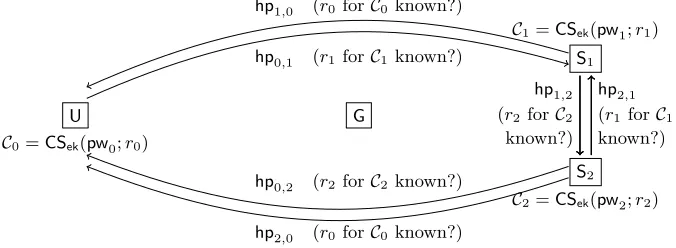
Main Idea of the Construction. In our setting, we denote bypwb =gπb. The main idea of the protocol is
depicted on Figure 1. For sake of readability, the participants which have a real role in the computations are directly linked by arrows in the picture, but one should keep in mind that all the participants (U,S1
and S2) only communicate with G, which then broadcasts all the messages.
In a classicalSPHF-based two-party key-exchange betweenUandG, the client and the gateway would compute a Cramer-Shoup encryption of their password:C0 =CSek(pw0;r0) andCG =CSek(pwG;rG). The
gateway would then send a projection key hpG,0 in order to implicitly check via anSPHF whether C0 is a valid Cramer-Shoup encryption of pwG, and the client would send a projection key hp0,G in order to implicitly check via an SPHF whether CG is a valid Cramer-Shoup encryption of pw0.
Here, since S0 owns pw0 = pw1 ·pw2, so that the players do not share the same password, we
consider an SPHF between each pair of players (Si,Sj), in which player Si computes the ciphertext Ci = CSek(pwi;ri), the keys hki,j and hpi,j and sends (Ci,hpi,j) to Sj. It also computes the hash value
Hi,j =Hash(hki,j,(ek,pwi),Cj) and projected hash value Hj,i0 =ProjHash(hpj,i,(ek, Mi),Ci, ri). Formally,
for each pair of users (Si,Sj), the language checked on Sj by Si is defined as follows: Cj ∈ Li,j = {C =
(u1, u2, e, v) ∈ G4 | ∃r ∈ Zp such that C = CSek(pwj;r)} but it cannot be checked directly by a unique SPHF since the passwords are different (and thus Si does not know pwj). Rather, we combine in the protocol the six SPHF described to globally ensure the correctness (each one remaining smooth and pseudo-random), as described in the next part. The correctness of the SPHF for the pair (Si,Sj) im-plies that if everything was computed honestly, then one gets the equalities Hi,j(pwi/pwj)λi = Hi,j0 and
Hj,i(pwj/pwi)λj =Hj,i0 .
4.2 Login procedure
– Each participant Sb picks rb at random and computes a Cramer-Shoup encryption of its password Cb =CSek(pwb;rb), with vb=cdξb.
It also chooses, for i∈ {0,1,2} \ {b}, a random hash keyhkb,i = (ηb,i, γb,i, θb,i, λb, κb,i) and setshpb,i=
(hpb,i;1,hpb,i;2) = (g1ηb,ig2θb,ihλbcκb,i, g1γb,idκb,i) as the projection key intended to the participantSi.
It sends (Cb,(hpb,i)i∈{0,1,2}\{b}) to the gateway G, which broadcasts these values to the other
partici-pants.
U C0=CSek(pw0;r0)
G
S1
C1=CSek(pw1;r1)
S2
C2=CSek(pw2;r2)
hp1,2 (r2 forC2 known?)
hp2,1 (r1 forC1 known?)
hp1,0 (r0 forC0 known?)
hp0,1 (r1 forC1 known?)
hp2,0 (r0 forC0 known?)
hp0,2 (r2 forC2 known?)
Fig. 1.Main idea of the construction
After receiving the first flow from the other server and the client, the server Sb computes, for i ∈ {0,3−b}, Hi,b0 = hpi,b;1rbhp
i,b;2ξbrb. It also computes Hb = Hb,0/(Hb,3−b·pwλbb), and sets its partial
key Kb asKb=H0,b0 ·H3−b,b0 ·Hb. It privately sends this value Kb to the gatewayG.
– The gateway finally sets KG=K1·K2.
Correctness. Recall that Hi,j0 =Hi,j(pwi/pwj)λi for all pairs (i, j) ∈ {0,1,2}2, so that the session key of
the gateway is equal toKG =K1·K2,i.e.
KG = H
0
0,1H20,1H1,0 H1,2pwλ11
H0
0,2H10,2H2,0 H2,1pwλ22
=H0,1H1,0H0,2H2,0
1
pw2
λ1
1
pw1
λ2
(pw0)2
pw1pw2
λ0
while the session key of the client is KU=H1,00 ·H2,00 ·H0,i.e.
KU=H1,00 ·H2,00 ·H0,1·H0,2·pw0λ0 =H0,1H1,0H0,2H2,0
pw
1
pw0
λ1pw
2
pw0
λ2
(pw0)λ0
and these two values are equal as soon as pw0 =pw1·pw2.
Complexity. The following table sums up the number of group elements needed for each participant. It should be noted that in case one of the servers is the gateway, its communication costs are reduced.
Ciphertext (Broadcast)
Projection Keys (Overall)
To the Gateway
Client 4 4 0
Server (each) 4 4 1
Proof of Security. The proof follows the spirit of the proofs given in [KV11, BBC+13]. For lack of space, a sketch is given in the Appendix B.
5 Our Efficient Protocol
In this second setting, we consider again a client U owning a password π and willing to interact with a gateway G. The gateway owns a public database of encrypted passwords, and it interacts with two serversS1 andS2, each owning a share of the secret key of the encryption scheme. The aim of the protocol is to establish a shared session key between the client and the gateway.
5.1 Building Blocks
Cramer-Shoup encryption and SPHF. We consider Cramer-Shoup encryption as described in Section 2. The public key is denoted byek= (g1, g2, c, d, h,HK) and the private key bydk= (x1, x2, y1, y2, z)←$ Z5p.
The public parameters (G, p, g,ek) are given as a common reference string.
We denote the ciphertext of a messageM ∈Gwith the scalarr∈ZpbyC=CSek(M;r) = (u1, u2, e, v),
withv=cdξ and ξ =HK(u1, u2, e).
We use here the simplerSPHFdescribed in [GL03] for the language of the valid ciphertexts ofM under the public keyek, in which the participants need to see the ciphertext before being able to compute their projection keys. Since only the servers will be required to compute such projection keys and since they are not required to compute a ciphertext anymore, all the participants will be able to do all their computation in only one round as in the former protocol. TheSPHF is described by the following algorithms.
Setup(1K): param= (ek, M)
L={C= (u1, u2, e, v)∈G4 | ∃r∈Zp such that C=CSek(M;r)}
HashKG(L,(ek, M)): hk= (η, θ, λ, κ)←$ Z4p ProjKG(hk,(L,(ek, M)),C): hp=g1ηg2θhλ(cdξ)κ∈G
Hash(hk,(L,(ek, M)),C): H=uη1uθ
2(e/M)λvκ ProjHash(hp,(L,(ek, M0)),C, r): H0 =hpr
It has been known to be correct, smooth and pseudo-random since [GL03].
El Gamal encryption and SPHF. We consider El Gamal encryption as described in Section 2. The public key is denoted bypk=h=gαand the private key bysk=α←$ Zp. The public parameters (G, p, g,pk) are
given as a common reference string. We denote the ciphertext of a messageM ∈Gwith the scalarr∈Zp
by C=EGpk(M;r) = (e, u) = (hrM, gr).
The regular SPHF used throughout the literature [CS02] on the language {C = (e, u) ∈ G2 | ∃r ∈ Zp such thatC = EGpk(M;r)} of the valid encryptions of M, with r being the witness of the word C,
usually allows a server to check whether the ciphertext was honestly computed on the value M by a client, by generating a pair of keys (hk,hp) and sending hp to the client.
Here, on the contrary, we now want a client to implicitly check that a server knows the decryption key of the encryption scheme. This means that the client computes both the ciphertext (or the ciphertext is publicly available in a database, as here) and the pair of keys (hk,hp) and sends the ciphertext as well as
hpto the server, which now uses the decryption key as a witness. This implies the following modifications to the algorithms of theSPHF:
Setup(1K): param= (pk, M)
L={C= (e, u)∈G2 | ∃α∈
Zp such that
h=gα and e/uα=M}
HashKG(L,(pk, M)): hk= (λ, µ)←$ Z2p ProjKG(hk,(L,(pk, M)),C): hp=uλgµ∈G
Hash(hk,(L,(pk, M)),C): H=hµ(e/M)λ
ProjHash(hp,(L,(pk, M0)),C, α): H0=hpα
and we show that this SPHF satisfies the usual properties:
– Correctness: ifC ∈ Lwith witness α, one directly getsH =H0;
– Smoothness: assumeC∈ L/ . It can then be parsed asC= (e, u) withu=gr ande=hrM0 =gαrM gδM
The smoothness is then easy to see by considering the following equality of matrices: logg(hp)
logg(H) !
= r 1
αr+δM α
!
· λ
µ
!
which shows that as soon as the word is not a valid encryption ofM, and soδM is not equal to 0, the
Hash value H is not in the span of the projection key hp so that the two distributions described in Section 2 are indistinguishable.
– Pseudo-Randomness.Since El Gamal encryption isIND-CPA, it is impossible to distinguish between a real encryption and a random value without knowing the decryption key. Since the decryption key is the witness of theSPHF, without knowing the witness, the two distributions remain indistinguishable.
Main Idea of the Construction. Again, we denote the clientUasS0and its passwordπasπ0. In our setting,
we denote bypwk=gπk for allk. The database contains El Gamal encryptions of each ciphertext pw Ui,
under randomness sUi: Cdb
Ui = EGpk(pwUi;sUi) = (hsUipwUi, gsUi), so that here, CUdb = EGpk(pwU;sU) =
(hsUpwU, gsU). The client computes a Cramer-Shoup encryption of its password: C0 = CSek(pw0;r0) =
(u1, u2, e, v) with v =cdξ. The execution of the protocol should succeed if these encryptions are correct
and pw0 =pwU. Recall that the serverSi knowsαi such thatα=α1+α2 is the decryption key of the El
Gamal encryption.
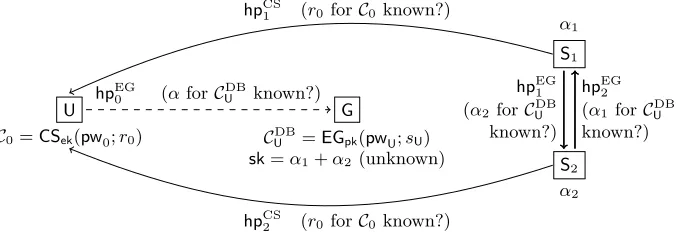
The main idea is depicted on Figure 2. For sake of readability, the participants which have a real role in the computations are directly linked by arrows in the picture, but one should keep in mind that all the participants (U,S1 and S2) only communicate withG, which then broadcasts all the messages.
In a classical SPHF-based two-party key-exchange betweenU and G, the gateway would check if C0
is a valid Cramer-Shoup encryption of pwU. Since here the password pwU is unknown to the servers S1
and S2, this is done in our setting by two SPHF, using hpCS1 (sent by S1) and hpCS2 (sent by S2), where the servers use the first term of the public encryptionCDB
U (hsUpwU) in order to cancel the unknownpwU.
In a classicalSPHF-based two-party key-exchange betweenUandG, the client would also check whether
CDB
U is a valid El Gamal encryption of its passwordpw0,i.e.whether the gateway knows a witness for its
ciphertext CDB
U (sU in the usual constructions,α here). Since α is unknown to the gateway, this is done
in our setting by the combination of three SPHF, using hpEG0 (sent by the client),hpEG1 (sent by S1) and hpEG2 (sent byS2). These threeSPHF allow the client and the servers to implicitly check that the servers know α1 and α2 such that CUDB can be decrypted (using the decryption key α = α1+α2) to the same
password pw0 than the one encrypted in C0 sent by the client. Formally, the languages checked are as follows:
– by the client:
CDB
U ∈ L0={C= (e, u)∈G2 | ∃α∈Zp such thath=gα and e/uα=pw0}
– by server Si (with respect to the client S0 and server Sj):
C0 ∈ Li,0 = {C = (u1, u2, e, v) ∈ G4 | ∃r ∈ Zp such that C = CSek(pwU;r) and CUDB ∈ Li,j = {C =
(e, u)∈G2 | ∃α
j ∈Zp such that h=gαi+αj} ande/uαi+αj =pwU}
but they cannot be checked directly by a unique SPHF since the value pwU appearing in the languages is unknown to the verifier Si. Rather, the server Si will use the first term of the public encryption CDB
U
(hsUpwU) in order to cancel this unknownpwU. To achieve this goal, we combine the fiveSPHF described to globally ensure the correctness (each one remaining smooth and pseudo-randomness), as described in the next part.
5.2 Login procedure
– The client U = S0 chooses r0 at random and computes a Cramer-Shoup encryption of its password C0 =CSek(pw0;r0) = (u1, u2, e, v) withv=cdξ.
It also chooses a random (El Gamal) hash key hkEG0 = (λ0, µ0) and computes the corresponding
projected key on the ciphertext CDB
U = EGpk(pwU;sU) = (hsUpwU, gsU) contained in the database:
U C0=CSek(pw0;r0)
G CDB
U =EGpk(pwU;sU)
sk=α1+α2 (unknown)
S1
α1
S2
α2
hpEG0 (αforC DB
U known?) hp
EG 1 (α2 forCDBU
known?)
hpEG2 (α1 forCDBU known?)
hpCS
1 (r0 forC0 known?)
hpCS
2 (r0 forC0 known?)
Fig. 2.Main idea of the construction
It sends (C0,hpEG0 ) to the gateway, which broadcasts these values to the servers.
– After receiving this flow from the client, the servers S1 and S2 also choose a random (El Gamal) hash
key hkEGb = (λb, µb) and compute the corresponding projected key on the ciphertextCUDB contained in
the database:hpEGb =gsUλbgµb.
The servers S1 andS2 also choose a random (Cramer-Shoup) hash keyhkCSb = (ηb, θb, λb, κb) (with the
same value λb) and compute the corresponding projected key on the ciphertextC0 sent by the client: hpCSb = (g1ηbg2θbhλb(cdξ)κb).
Each server sends (hpEGb ,hpCSb ) to the gateway G, which broadcasts these values to the other partici-pants.
– After receiving the projected keys from the servers, the client computes, fori∈ {1,2},Hi,00 = (hpCSi )r0. It also computesH0 = (hsUpwU/pw0)λ0hµ0 by dividing the first term of the ciphertext CUDBcontained
in the database by its password pw0. It finally sets its session keyKU asKU=K0 =H1,00 ·H2,00 ·H0.
After receiving the first flow from the other server and the client, the server Sb computes, for i ∈ {0,3−b},Hi,b0 = (hpEGi )αb.
It also computes Hb,0 = (u1)ηb(u2)θb[e/(hsUpwU)]λbvκb and Hb = Hb,0 ·(hpEGb )αb/hµb, and sets its
partial key Kb asKb =H0,b0 ·H 0
3−b,b·Hb. It privately sends this value Kb to the gatewayG.
– The gateway finally sets KG=K1·K2.
Correctness. Due to the correctness of the Cramer-Shoup SPHF, we have Hb,00 = Hb,0
hsUpw U
pw0
λb
for
b∈ {1,2}. The session key of the gateway is thus equal toKG =K1·K2 = (H0,10 ·H2,10 ·H1)·(H0,20 ·H1,20 ·H2)
where, after computation, Kb =h(λ0+λ1+λ2)αbg(µ0+µ1+µ2)αbHb,00 (pw0/pwU)λbh−sUλbh−µb.
If pw0 =pwU,h =gα and α=α
1+α2,KG =hsUλ0hµ0H1,00 H2,00 , which is equal to the session key of the
clientKU=K0 =H1,00 ·H2,00 ·H0=H1,00 ·H2,00 ·hsUλ0hµ0.
Complexity. The following table sums up the number of group elements needed for each participant. It should be noted that in case one of the servers is the gateway, its communication costs are reduced.
Ciphertext (Broadcast)
Projection Keys (Overall)
To the Gateway
Client 4 2 0
Server (each) 0 2 1
most 1.5 exponentiations. The client performs the equivalent of 8 full exponentiations, while each server performs 7 exponentiations (instead of 15 and 13 respectively in [KMTG12]).
Proof of Security. The proof follows the idea of the former one. For lack of space, a sketch is given in the Appendix B.
6 Conclusion
We presented two constructions of distributed Password-Authenticated Key Exchange between a user and several servers. We focused on presenting them in a classical group setting (with only two servers). Very efficient implementations of our protocols can be readily obtained using standard cryptographic libraries and do not require pairings.
Our methods can be generalized to the setting wherenservers share the (encryption of the) password.
SPHF can further handle polynomials of variables and the use of secret sharing techniques `a la Shamir, allows to share polynomials evaluation between n servers and to provide a threshold distributed PAKE such that security is ensured as long as less than a certain arbitrary thresholdt∈ {1, . . . , n}of servers are compromised (contrary to the protocol from [DG06] which requires an honest majority of the servers).
Smooth projective hashing is mostly used in a classical discrete-logarithm-based setting (or pairing-based setting) but constructions were also proposed for Paillier encryption [CS02] and for LWE encryp-tion [KV09]. TheseSPHF would allow a readily adaptation of our techniques to other classical settings of cryptography.
Acknowledgements. This work was supported in part by the French ANR Project ANR-14-CE28-0003 EnBiD.
References
[ACFP05] Michel Abdalla, Olivier Chevassut, Pierre-Alain Fouque, and David Pointcheval. A simple threshold authenticated key exchange from short secrets. In Bimal K. Roy, editor,ASIACRYPT 2005, volume 3788 ofLNCS, pages 566– 584. Springer, December 2005.
[ACP09] Michel Abdalla, C´eline Chevalier, and David Pointcheval. Smooth projective hashing for conditionally extractable commitments. In Shai Halevi, editor,CRYPTO 2009, volume 5677 ofLNCS, pages 671–689. Springer, August 2009.
[BBC+13] Fabrice Benhamouda, Olivier Blazy, C´eline Chevalier, David Pointcheval, and Damien Vergnaud. New techniques for SPHFs and efficient one-round PAKE protocols. In Ran Canetti and Juan A. Garay, editors,CRYPTO 2013, Part I, volume 8042 ofLNCS, pages 449–475. Springer, August 2013.
[BJKS03] John G. Brainard, Ari Juels, Burt Kaliski, and Michael Szydlo. A new two-server approach for authentication with short secrets. In Proceedings of the 12th USENIX Security Symposium, Washington, D.C., USA, August 4-8, 2003, 2003.
[BM92] Steven M. Bellovin and Michael Merritt. Encrypted key exchange: Password-based protocols secure against dictionary attacks. In1992 IEEE Symposium on Security and Privacy, pages 72–84. IEEE Computer Society Press, May 1992.
[Bon98] Dan Boneh. The decision Diffie-Hellman problem. In Third Algorithmic Number Theory Symposium (ANTS), volume 1423 ofLNCS. Springer, 1998. Invited paper.
[BPR00] Mihir Bellare, David Pointcheval, and Phillip Rogaway. Authenticated key exchange secure against dictionary attacks. In Bart Preneel, editor,EUROCRYPT 2000, volume 1807 ofLNCS, pages 139–155. Springer, May 2000. [BPV12] Olivier Blazy, David Pointcheval, and Damien Vergnaud. Round-optimal privacy-preserving protocols with smooth projective hash functions. In Ronald Cramer, editor,TCC 2012, volume 7194 of LNCS, pages 94–111. Springer, March 2012.
[Can01] Ran Canetti. Universally composable security: A new paradigm for cryptographic protocols. In 42nd FOCS, pages 136–145. IEEE Computer Society Press, October 2001.
[CS98] Ronald Cramer and Victor Shoup. A practical public key cryptosystem provably secure against adaptive chosen ciphertext attack. In Hugo Krawczyk, editor,CRYPTO’98, volume 1462 ofLNCS, pages 13–25. Springer, August 1998.
[CS02] Ronald Cramer and Victor Shoup. Universal hash proofs and a paradigm for adaptive chosen ciphertext secure public-key encryption. In Lars R. Knudsen, editor, EUROCRYPT 2002, volume 2332 ofLNCS, pages 45–64. Springer, April / May 2002.
[DG03] Mario Di Raimondo and Rosario Gennaro. Provably secure threshold password-authenticated key exchange. In Eli Biham, editor,EUROCRYPT 2003, volume 2656 ofLNCS, pages 507–523. Springer, May 2003.
[DG06] Mario Di Raimondo and Rosario Gennaro. Provably secure threshold password-authenticated key exchange. J. Comput. Syst. Sci., 72(6):978–1001, 2006.
[DH76] Whitfield Diffie and Martin E. Hellman. New directions in cryptography. IEEE Transactions on Information Theory, 22(6):644–654, 1976.
[ElG84] Taher ElGamal. A public key cryptosystem and a signature scheme based on discrete logarithms. In G. R. Blakley and David Chaum, editors,CRYPTO’84, volume 196 ofLNCS, pages 10–18. Springer, August 1984. [FK00] Warwick Ford and Burton S. Kaliski Jr. Server-assisted generation of a strong secret from a password. In9th
IEEE International Workshops on Enabling Technologies: Infrastructure for Collaborative Enterprises (WETICE 2000), 4-16 June 2000, Gaithersburg, MD, USA, pages 176–180, 2000.
[GL03] Rosario Gennaro and Yehuda Lindell. A framework for password-based authenticated key exchange. In Eli Biham, editor,EUROCRYPT 2003, volume 2656 ofLNCS, pages 524–543. Springer, May 2003.http://eprint. iacr.org/2003/032.ps.gz.
[GM84] Shafi Goldwasser and Silvio Micali. Probabilistic encryption. Journal of Computer and System Sciences, 28(2):270–299, 1984.
[HJKY95] Amir Herzberg, Stanislaw Jarecki, Hugo Krawczyk, and Moti Yung. Proactive secret sharing or: How to cope with perpetual leakage. In Don Coppersmith, editor,CRYPTO’95, volume 963 ofLNCS, pages 339–352. Springer, August 1995.
[Jab01] David P. Jablon. Password authentication using multiple servers. In David Naccache, editor, CT-RSA 2001, volume 2020 ofLNCS, pages 344–360. Springer, April 2001.
[Kal05] Yael Tauman Kalai. Smooth projective hashing and two-message oblivious transfer. In Ronald Cramer, editor,
EUROCRYPT 2005, volume 3494 ofLNCS, pages 78–95. Springer, May 2005.
[KM14] Franziskus Kiefer and Mark Manulis. Distributed smooth projective hashing and its application to two-server password authenticated key exchange. In Ioana Boureanu, Philippe Owesarski, and Serge Vaudenay, editors,
ACNS 14, volume 8479 ofLNCS, pages 199–216. Springer, June 2014.
[KMTG05] Jonathan Katz, Philip D. MacKenzie, Gelareh Taban, and Virgil D. Gligor. Two-server password-only authen-ticated key exchange. In John Ioannidis, Angelos Keromytis, and Moti Yung, editors,ACNS 05, volume 3531 of
LNCS, pages 1–16. Springer, June 2005.
[KMTG12] Jonathan Katz, Philip D. MacKenzie, Gelareh Taban, and Virgil D. Gligor. Two-server password-only authen-ticated key exchange. J. Comput. Syst. Sci., 78(2):651–669, 2012.
[KOY01] Jonathan Katz, Rafail Ostrovsky, and Moti Yung. Efficient password-authenticated key exchange using human-memorable passwords. In Birgit Pfitzmann, editor,EUROCRYPT 2001, volume 2045 ofLNCS, pages 475–494. Springer, May 2001.
[KV09] Jonathan Katz and Vinod Vaikuntanathan. Smooth projective hashing and password-based authenticated key exchange from lattices. In Mitsuru Matsui, editor, ASIACRYPT 2009, volume 5912 of LNCS, pages 636–652. Springer, December 2009.
[KV11] Jonathan Katz and Vinod Vaikuntanathan. Round-optimal password-based authenticated key exchange. In Yuval Ishai, editor,TCC 2011, volume 6597 ofLNCS, pages 293–310. Springer, March 2011.
[MSJ02] Philip D. MacKenzie, Thomas Shrimpton, and Markus Jakobsson. Threshold password-authenticated key ex-change. In Moti Yung, editor,CRYPTO 2002, volume 2442 ofLNCS, pages 385–400. Springer, August 2002. [NY90] Moni Naor and Moti Yung. Public-key cryptosystems provably secure against chosen ciphertext attacks. In22nd
ACM STOC, pages 427–437. ACM Press, May 1990.
[OY91] Rafail Ostrovsky and Moti Yung. How to withstand mobile virus attacks (extended abstract). In Luigi Logrippo, editor,10th ACM PODC, pages 51–59. ACM, August 1991.
[Poi12] David Pointcheval. Password-based authenticated key exchange (invited talk). In Marc Fischlin, Johannes Buchmann, and Mark Manulis, editors,PKC 2012, volume 7293 ofLNCS, pages 390–397. Springer, May 2012. [RS92] Charles Rackoff and Daniel R. Simon. Non-interactive zero-knowledge proof of knowledge and chosen ciphertext
attack. In Joan Feigenbaum, editor,CRYPTO’91, volume 576 ofLNCS, pages 433–444. Springer, August 1992. [SK05] Michael Szydlo and Burton S. Kaliski Jr. Proofs for two-server password authentication. In Alfred Menezes,
editor,CT-RSA 2005, volume 3376 ofLNCS, pages 227–244. Springer, February 2005.
A Security Model
We assume the existence of a timestamp, only allowing the adversary to corrupt one server once during each time period, which means that the client interacts with at most one corrupted server. We also assume that the gateway is the only entity which directly communicates with the client: messages to and from the servers and the client are all transmitted by the gateway. Similarly, we assume there is no direct communication between the servers. For the sake of efficiency, the gateway may sometimes be merged with one of the servers. As in [ACFP05], we assume the existence of a private channel between the gateway and the servers, only used for the final computation of the session key of the gateway (we only need the secret communication to be possible from the servers to the gateway).
Each participant is assumed to be able to execute the protocol many times, possibly concurrently, which is modeled by allowing it to have an unlimited number of instances (used only once). Each instance maintains a local state during the execution of the protocol and is associated with several variables: its session identifier (i.e.its identity), its partner identifier (i.e.the identity of the participants with whom it believes to be interacting), its session key and two boolean variables useful to indicate whether the instance has terminated and/or accepted. Terminated means that the instance has finished sending and receiving messages according to the description of the protocol whereas in our case, accepted means that the instance believes it has established a session key with its partner.
The session identifier of an instance is defined as the ordered sequence of incoming and outgoing messages for this instance sent through the gateway. This is clear from the oracle queries made by the adversary. Instances of client and servers are called partners if session identifiers are equal (they share the same transcript of execution) and the identity of each is included into the partner identifier of the other. Since the gateway does not formally participate in the computation, an instancej of the serversS1
and S2 implicitly defines an instancej of the gateway.
The adversary is assumed to have complete control over the public communication between the par-ticipants and the gateway. This is formally modeled by letting him have access to the instances via the following oracles. Note that the adversary also receives the internal state of any corrupted participant. Furthermore, since we consider active corruptions, he also controls all messages sent by corrupted partic-ipants.
– Send(U, i, m): this sends message m to the gateway, which then forwards it appropriately to the
ith instance of the clientU, which behaves in response as described in the protocol. Its output is given to the adversary.
– Send(G, j, m): this sends message m to the gateway, which then forwards it appropriately to the
jth instance of the servers S1 and S2, which behave in response as described in the protocol. Their
output is given to the adversary.
– Execute(U, i,G, j): this oracle executes the protocol between the ith instance of the client C and the
jth instance of the servers S1 and S2 (via the gateway) and outputs the transcript of the execution (i.e.all the public communication) to the adversary.
– Reveal(U, i,G, j): this outputs the session key hold by theith instance of the clientU in an execution
with the jthinstance of the servers S1 andS2 (assuming these participants are partners). This models possible leakage of the key for several reasons such as misuse, compromise of a computer, etc. Similarly,
Reveal(G, j,U, i) outputs the session key hold by the gatewayGin an execution between theithinstance
of the clientUand thejthinstance of the serversS1 andS2(assuming these participants are partners). – Test(U, i,G, j): this is the query needed in order to properly define the security of the protocol. As-suming the ith instance of the clientUand the jth instance of the serversS1 andS2 are partners, the
oracle outputs ⊥ if the session key of theith instance of the client C computed during an execution with the jth instance of the servers has not yet been set. Otherwise, it generates a random bit b: if
The correctness of an execution of the protocol is defined as follows: if the ith instance of the client U
and the jth instance of the servers S
1 and S2 are partners and they have all terminated and accepted,
then theith instance of the client and thejthinstance of the gateway conclude with the same session key. A session key is saidfresh if none of the participants is corrupted, the adversary never asked a Reveal
query for the particular instance of either the client or the gateway. We say that the adversary succeeds (event Succ) if he asks a single query Test(U, i,G, j) or Test(G, j,U, i) on a fresh key skiU,G or skjG,U and outputs a single bitb0 such asb0 is equal to the bit bchosen by theTestoracle. His advantage against the protocolπ is then defined as AdvA(π) = 2Pr(Succ)−1, the probability being taken over all the random coins used by the adversary and the participants during the execution of the protocol.
The number of on-line attacks are counted by the number of Send queries corresponding to this execution of the protocol. (The Execute queries are not counted in the on-line attacks.)
Definition 1. A protocolπ is said to be a secure two-server password-authenticated key-exchange if there exists a constant c such that, for all dictionary sizes N and all probabilistic polynomial-time adversaries making at most qs on-line attacks and corrupting at most one server partnered with a client, AdvA(π)≤
cqs
N +ε(k), where k is the security parameter and ε a negligible function.
Here,c= 1 in our security proofs, which means that the adversary can try one password by execution,
i.e.on-line dictionary attack (the authors of [KMTG12] only achieve c= 2 with their protocol).
B Sketch of Proofs
B.1 Simple Protocol
The proof follows the spirit of the proof given in [KV11, BBC+13]. Recall that at most one server is corrupted during the execution of the protocol (meaning that the adversary cannot trivially recover the password of the client) and all the communication goes through the gateway so that the client apparently interacts with a unique server (it receives a unique message from the gateway (concatenation of the messages sent by the servers) even if it sends messages destined to a set of two servers). One can thus see that the security of our distributed password-authenticated key-exchange, constructed as some sort of three-party PAKE, can be reduced to that of thePAKE proven in the BPR model in [BBC+13]. More precisely, its security can be proven through the following games:
– Game0: this is the real game, where the adversary has a certain advantage (that we are willing to
upper-bound) to win.
– Game1: we modify the wayExecute-queries are answered, by replacing the ciphertextsCi by correct
encryptions of a random password pwf, so that Ci is not in Lj,i anymore, for j 6= i. This is indistin-guishable under the IND-CPA property of the Cramer-Shoup encryption scheme.
– Game2: we modify the way Execute-queries are answered, by replacing the common session key by
a random value. Since the languages are not satisfied from the former game, the smoothness ensures the indistinguishability from the former game.
– Game3: we modify the waySend1-queries (when the adversary sent a flow and waits for the answer) are
answered, by using a decryption oracle or alternatively knowing the decryption key. If the ciphertext has been generated by the adversary who used the good password, one declares that A succeeds and terminates the game (event Badhappens). If it is not correct or consistent with the other participant’s value, one chooses the session key at random. If it is a replay of a previous flow sent by the simulator, one knows the hashing keys and can compute the session keys using them. The advantage of the adversary only increases if event Bad happens, which probability is computed later on.
– Game4: we modify again the waySend1-queries are answered: if the message was already received by
– Game5: we now modify the way Send0-queries (when the adversary asks a user for a first flow) are
answered: as in Game1, one encrypts a random value pw. Since decryptions are now required (to
answerSend1-queries from Game3), this game is indistinguishable under theIND-CCAproperty of the
Cramer-Shoup encryption scheme.
– Game6: since the hashing and projection keys only depend on public values given in the common
reference string, the private values of the honest players are not used anymore in this final game, except for checking whether the adversary has won (event Bad). They can thus be chosen at random, at the very end of the execution, only to check if this event happened. The advantage of the adversary in this last game is thus exactly the probability of this event, which is bounded byqs/N, withqsbeing
the number of Send-queries (i.e.on-line dictionary attacks) andN the size of the dictionary.
B.2 Efficient Protocol
The proof is conducted exactly as in the former protocol, even simpler since the servers do not need to compute any ciphertext. We thus construct exactly the same security games, except that, when receiving an Execute or a Send(G, j, m) query from the adversary, we only have to compute the hashing keys and send the projected keys on behalf of the servers, since they do not need to compute any ciphertext (CDB
U is
public). The simulation of the client remains the same. Overall, the advantage of the adversary is bounded by qs/N, withqs being the number of Send-queries (i.e.on-line dictionary attacks) and N the size of the