VOLUME 6
March 1953
Number 2
In this Issue
Editorial-The Place of Range Research in Our Expanding
Economy... ... ... ... E.W. Tisdale
81
The Contribution of Elias Emanuel Nelson to Range
Management ... ... .... Alan A. Beetle
84
Utilization of Grasslands in the Flint Hills of Kansas
Kling L. Anderson
86
The Influence of Intensity and Frequency of Clipping on
The Root System of Brownseed Paspalum
Ellis S. Ruby and Vernon A. Young
94
Seasonal Trends of Minerals and Proteins in Prairie Grasses
John S. Williams
100
Controlling Big Sagebrush with Growth Regulators
Donald H. Hyder
109
Annual Fluctuation in Production of Some Eastern Oregon
and Washington Shrubs... George A. Garrison
117
Book Reviews
James Bridges (Three book by Alter, Garst, and Honig)
Alan A. Beetle
122
Indicators of Condition and Trend on High
Range-Watersheds of the Intermountain Region
(Ellison et al.)... E.W. Tisdale
123
Beef Cattle (Snapp) ... ... Henry P. Holzman
126
Current Literature... ... Robert R. Humphrey
127
News and Notes ... ... ... ... 132
With the Sections... ... ... ... 137
Published Quarterly by
When there’s a need in Grassland Agriculture. . .
THERE'S
AN ANSWER
AT
NORTHRUP
KING
For overgrazed
range lands..
- .For depleted
meadow
lands...
-
..t@
For irrigated
pastures..
.
N K
produces
dependable
seed! \
Seed of proven quality
and purity for every
grassland situation are
available through your
nearest Northrup King
Branch office:
BOISE, IDAHO . SALT LAKE CITY, UTAH
ALBANY, OREGON . BERKELEY, CALIFORNIA
PHOENIX, ARIZONA . DALLAS, TEXAS
ORTHRUP
KING & CO.
RANGE SURVEYS G APPRAISAL RANGE PLANNING G- MANAGEMENT
Write or wire
PAUL C. LEMON Range ConsuZtad 1205 Kearney Ave. Denver 20, Colorado
PRACTICAL
GRASSLAND MANAGEMENT
By B. W. ALLRED
Regional Range Conservationist, 77. S. Soil Conservation Service, Fort Worth, Texas
Most Practical Grass 3ook Published!
Written for students and ranchmen, this book has 15 well-illustrated, readable chapters on growth, care, and management, of the country’s most valuable crop-- grass.
FEATURES.. . latest facts about economic and conser- vation values of important range plants . . . guide for seeding 64 native and domestic grasses. . . glossary of range terms.. . check list of nearly 1000 important range plants, with common and scientific names.
The first printing was sold out within six months. Im- mediately adopted as text by the Veterans’ Vocational Training program, many colleges and schools in west and southwest.
COMMENTS.. . “Of all the trained men in range man- agement, I know of no one individual better qualified through professional training and applied experience to write a book on the subject of Practical Grassland Management. . . “VERNON A. YOUNG, Head, Dept. of
Range and Forestry, A & M College of Texas. $5.00 PP. - Second Printing
Publisher:
SHEEP AND GOAT RAISER San Angelo, Texas
sP
e&Z
TO MEMBERS
Bind your copies of the Journal into Per- manent 1 olumes. Green Library Buckram - (1) Name of Journal, (2) Volume (3) Year and (4) your name gold stamped on back. $2.80 per volume, postpaid, in the u. s.
Ship Journals to us parcel post or book post. Send letter with your check or money order, giving name you desire on Volumes. Be sure to include your com- plete address.
Y
VALTERS
AND SONS
3827 Ravenswood Ave., Chicago 13,111.Book Binders for Six Generations
RANCH k Management Service * Consulting & Appraisals * Reseeding Contracrors * Investment Agents
Throughout the Western States & Canada Call or \\‘ire:
R. B. (Dick) Peck, WESTERN RANCHING SERVICES
THE
AMERICAN SOCIETY
OF RANGE MANAGEMENT
OBJECTIVES
To foster advancement in the science and art of grazing land management, to promote progress in the conservation and greatest sustained use of forage and soil resources, to stimulate discussion and understanding of scientific and practical range and pasture problems, to provide a medium for the exchange of ideas and facts among society members and with allied technologists, and to encourage professional improvement of its members.
MEMBERSHIP
Persons shall be eligible for membership who are interested in or engaged in practicing range or pasture management or animal husbandry; administering grazing lands; or teaching, or conducting research, or engaged in extension activities in range or pasture management or related subjects.
OFFICERS
PRESIDENT: B. W. Allred, U. S. Soil Conservation Service, Fort Worth 1, Texas
VICE-PRESIDENT: Floyd D. Larson, U. S. Bureau of Land Management, 326 Stapleton Bldg., Billings, Montana
EXECUTIVE SiCRETARY: W. T. White, 209 S.W. 5th Ave., Portland 4, Oregon
BOARD OF DIRECTORS
PAST PRESIDENT: L. A. Stoddart, Dept. of Range Management, Utah State Agricultural College, Logan, Utah
1951-53
A. P. Atkins, P. 0. Box 270, Guymon, Oklahoma
Fred H. Kennedy, U. S. Forest Service, Federal Center, Bldg. No. 85, Denver, Colorado
1952-54
E. J. Dyksterhuis, U. S. Soil Conservation Service, Lincoln 1, Nebraska
Harold F. Heady, School of Forestry, University of California, Berkeley 4, California
1953-55
David F. Costello, Pacific Northwest Forest and Range Experiment Station, 423 U. S. Court House, Portland 5, Oregon Vernon A. Young, Department of Range and Forestry, Agricultural
Editorial
The Place of Range Research in Our Expanding
Economy
1
T IS 4 matter of common obsmvation.
:.
t,hat me hve m it period of rapidly graving demand for livestock products and hence for range and pasture forage. The big problem ahead appears to be that of producing enough meat and allied products to keep up with this demand, and of producing it on about the same amount of land t,hat is no,%- available!
Under the circumstances, it seems
pertinent to consider the place of range research in meeting this situation. What sort of guidance has research provided for the range industry in the past and what arc t,he prospects for the future?
scienre, and animal nutrition themselves
still in an early stage of derelopment, a
considerable knowledge of the range
resource and its efficient use has been built up. The pioneers in range research developed sound principles of manage- ment, including such t,hings as the effects of grazing on plant succession, allowi~ble levels of forage utilization, and proper leasons of US”.
Until the middle 1930’5, the size of the total group engaged in range research was extremely small in relation to the importance of the resource involved. At
Anyone who considers the history of range research can hardly fail to be impressed vith the length of time by which the “art” preceded the “science.” The use (and misuse) of grazing lands dates back into the early history of mankind, while the scientific approach is so recent that the earliest investigators have in their own lifetime spanned the interval from the pioneering stage to the
present. Research on p&u-c lands in
Europe and Great Rritain can he traced hack a little farther, but even here the field is new. Small wonder that WC do not yet have all the answers!
Vie&d from the standpoint of its
comparative infancy, the past perform-
ance of range research is a creditable one. Starting almost from scratch with such essential tools as plant ecology, soil
Volume 6,Number 2, ~Mareh, 1953
Journal
of
RANGE
MANAGEMENT
82 EDITORIAL
this time the pace was quickened as more personnel and funds became avail- able. The successful development of large-scale range reseeding introduced a whole new approach to range renovation and increased production. More recently, the development of range condition and trend techniques has brought new vital- ity and usefulness to range survey and management planning. Other recent advances worthy of note include studies of the economics of range management, of the nutrition of livestock on the range and of the ecology and control of un- desirable range plants.
In spite of these accomplishments, range research will not lack for tasks in the years ahead. Emphasis on more intensive use of grazing lands will require a better understanding than we now possess. We still know relatively little about the long-term response of many range types to different kinds of grazing use, or about the life history and require- ments of many important range plants. Economically feasibIe means have still to be worked out for reasonably fast renovation of many range types, such as shadscale and desert shrub. The encroach- ment of undesirable plants still presents a serious threat to forage production in large range areas. These are only a few of the more obvious problems that must be attacked in the near future.
As members of the Range Society, we have a vital interest in the ability of range research to meet the challenge created by the need for higher, sustained production. How then can each of us help to ensure the success of research? To answer this, we must consider what factors are involved. Two of the most important are the quality of research and the effectiveness with which research findings are put to use.
Quality of research is of the utmost importance and depends mainly on quality of personnel. The research worker,
in range as elsewhere, needs to be an individual of keen mentality, with the best training obtainable, and an absorbing interest in his work. To attract and to hold the kind of men needed are problems for research institutions these days, in view of the greater financial rewards available in many other occupations. The need for advanced training has in- creased as the science of range manage- ment has advanced. Encouragement of graduate study and some concrete recognition for staff members who under- take such studies can constitute a valu- able contribution by research agencies. At the same time the colleges need to strive continually to improve the quality and usefulness of their instruction. An effective type of graduate work, especially for relatively inexperienced men, is that involving research fellowships. Here the student gets valuable training in actual research by taking part in well supervised college research programs, using some of the data so obtained for his thesis.
Even the best of research is of little value unless its findings can be put to use within a reasonable time. That a gap exists between available knowledge and common practice in range manage- ment is evident, and has been the subject of several articles in this Journal. We are all concerned with ways in which this gap can be narrowed. Obviously three main groups are involved, namely re- search workers, the extension services, and the range users or administrators. Each of these groups can help in this vitally important business of getting research results disseminated and put into practice.
EDITORIAL 83
deliver an effective message because (a) the experiment did not produce con- clusive results or (b) the author failed to give a clear and complete picture of tlhe information obtained. These faults, rather than excessive use of technical terms seem to be the major factors re- ducing the effectiveness of the written word, which should be the mainstay of the research worker.
The second group needed is that of the extension men. Actually, they are the key group, for it is their particular job to create a connecting link between research and the land user, and this function has long been recognized and promoted in the fields of cultivated agriculture. In the past, range manage- ment has been weak on the extension side; this has been a principal reason for the frequent failure of research to carry through to the range user. The suggestion sometimes made that range research men should do their own exten- sion work reveals a lack of understanding of the function and responsibilities of research as well as an under estimation of the particular training and personality needed for successful extension effort.
The recent appointment in several states of range extension specialists is helping this situation, but there are still
states without such workers, and in some states one man constitutes a rather small force. Appointment of county agents with good range training for work in predominantly range counties is still not as common as one might expect. Further development of range extension both state and federal, is a real need.
The third group involved in this mat- ter is that of the range users and ad- ministrators themselves. They can help greatly by maintaining a receptive atti- tude and a willingness to discard old practices and adopt new ones when the evidence indicates that this is desirable. By showing an interest in using proven results and sympathy for the difficulties and limitations of research, range users can do a great deal to encourage and stimulate the range research worker.
The Contribution
of Elias Emanuel Nelson to
Range Management’
I I %S EM 42 UEL NELSON \vas a
E,-.
native of S\yeden, born on Septem-A--,
her 7, 1876. His American education included two degrees in hotany at the University of Wyoming, the A.B. in 1898
and the M.A. in 1899. He was then
Assistant in Horticulture and Agrostol- ogy at the Wyoming Agricultural Experi- ment Station, resigning in 1905 to go to
the Washington Experiment Station. It
was during this six-year period that he
made his main contributions to the
science of range management.
Although not a relative, he studied under and made collections wit,h Aven K&on, long-time member of the Cni- versity faculty and who passed axay in
1952. E. E. Nelson married Emma Nelson (also no relation) rho was graduated from the University of Wyoming about 1907. His first scientific contribution vas a “Re- vision of the Western North American Phloxes” which was his Master’s degree thesis published as part of the ninth re- port of the Wyoming Agricultural College in 1899 (1). This added a number of new names to the plants of the West, includ- ing Phlox glnOrata (then described as P. hoodii glabrata n. var.) the common in- creaser on shortgrass ranges.
At about the same time Nielson v&s int,erested in the genus Antcnnaria and
published four short papers on that
genus, two in 1899 and one each in t,he two following years, again including a
1 Published m-ith npprovnl of the Director,
Wpming Agricultural Experiment Station, as Jaurnnl Paper No. 12.
84
number of new spwies (3,4, 5, 6). During this period he found time to work for the United St,ates Department of Agri- culture, IXrision of Agrostology, during the summer of 1900, as Scientific Aid, doing field rork (descriptive rango SIX- vey and plant collection) in southern Wyoming (17).
Nelson’s “Shrubs of Wyoming” con-
tains a list of those shrubs he knew to he present in the state, a brief description of them, their hahitat, and their uses and grazing value (8). His part of the hull&in
“Wheatgrasses of Wyoming” (the other
CONTRIBUTION O‘F NELSON 85
recommendations for the culture of 11
species which he says “are the most nutritious hay and pasture grasses that we have. Only the seed of slender wheat- grass can be obtained from seedmen” (9). His Agropyron bakeri, Baker wheat- grass, is still accepted as a valid species
(19).
Nelson’s “Native and introduced salt- bushes, Three season’s trials” includes a list and description of both native and introduced saltbushespresent in Wyoming describing their natural habitat, forage value, use for cultivation and reseeding range land, and methods of seeding (11). He states “Nuttall and Nelson saltbush may be grown for pasturage. They make good stands under favorable conditions, but grow slowly and require several seasons to attain full size.”
In the Wyoming Station Report for 1902 on pages 34 and 37 Nelson has an article on “The management and im- provement of the range.” Methods of range management and improvement are briefly discussed. Among the means described are resting, rotative pasturing, reseeding, harrowing, and disking.
Nelson was later with the U.S.D.A. Experiment Farm at Bent, Oregon, devoting his chief attention to forbs; with the Idaho Experiment Station working primarily with farming prob- lems, both dryland and irrigated; and with the U. S. Irrigation Department at Twin Falls, Idaho. After his retirement from active status at the Washington Experiment Station he lived in Yakima, Washington, where he carried on his research. He wrote regularly for a horti- cultural column in the Yalcima Morning
Herald, a daily newspaper. He was work- ing on hybrid iris (16) at the time of death on August 9, 1949.
LITERATURE CITED
(1) NELSON, ELIAS E. 1899. Revision of the Western American Phloxes. Wyo. Agr. College Report 9. 36 pp.
(2) ---. 1899. Some new western species. Erythea 7: 166-170.
(3) -. 1899. The Wyoming species of
Antennaria. Bot. Gaz. 27: 208212 (in reprints, pp. 209-213).
(4) ---. 1899. A new Colorado Anten- naria. Bot. Gaz. 27: 212 (in reprints, p. 213).
(5) ----. 1900. Some new species of Wyoming plants. Bot. Gaz. 30: 117-122. (6) ----. 1901. A revision of certain species of plants of the genus Anten- naria. U. S. National Museum Proc. 23: 697-713.
(7) ----. 1902. Notes on certain species of Antennaria. Bot. Gaz. 34: 114-124. (8) --. 1902. The shrubs of Wyoming.
Wyo. Agr. Expt. Sta. Bul. 54. 47 pp. (9) ---. 1903. The wheat-grasses of Wyo-
ming. Part II. Wheat-grasses at the Laramie Experiment Farm. Wyo. Agr. Expt. Sta. Bul. 59, pp. 19-34.
(10) ---. 1904. Some western species of
Agropyron. Bot. Gaz. 38: 378.
(11) -p. 1904. Native and introduced salt-bushes: Three seasons’ trials. Wyo. Agr. Expt. Sta. Bul. 63. 19 pp.
(12) ---. 1902. Forage plants for arid and semi-arid regions. Twentieth Cen- tury Farmer. April issue.
(13) ---. 1902. Native hay grasses in arid regions. Twentieth Century Far- mer. April issue.
(14) p-. 1902. Cultivated hay grasses and forage plants. Twentieth Century Farmer. May issue. Reprinted in part as Wyoming Range Management No. 22, 2 pp., April 1950. (mimeographed)
(15) -p. 1902. Forage plants for alkali lands. Twentieth Century Farmer. May issue.
(16) ---. 1948. Varietal notes on red Irises. American Iris Sot. Bul. 110: 91- 94. July.
Utilization of Grasslands in the Flint Hills of
Kansas’
KLING L. ANDERSON
Professor of Pasture Improvement, Kansas State College, and Agronomist, Kansas Agricultural Experiment Station, Manhattan
T
HE Flint Hills of Kansas constitute one of the last large segments of true prairie in the United States. They cross Kansas between the 96th and 97th meridians, narrowing abruptly to the north and ending before the Nebraska boundary is reached. To the westward there occurs a gradual transition to mixed prairie and to the east lies a diversified farming area once covered by true prairie but now largely broken, except for the rougher portions. Toward the south, however, the eastern side of the Flint Hills is bounded by sandstone hills with similar terrain and with a vege- tative cover of true prairie and in sandy places savanna. On ,their southern end the Flint Hills join the Osage range lands of Oklahoma, a region of similar grass- lands.As the name Flint Hills suggests, this is a hilly region with the cherty, lime- stone beds strongly dissected by erosion that is still somewhat active in spite of the rather good grass cover. The ridges tend to be narrow and the side slopes steep. The soils are shallow in terms of cultivation but the limestone of the slopes is broken, thus allowing good penetration of moisture and of plant roots. The ridgetops often have shallow soils over dense clay and with less favor- able moisture relations. The soils gen- erally are rocky, often with ‘cherty ma- terials at the surface, and thus only
1 Contribution No. 455, Department of Agronomy, Kansas Agricultural Experiment Station.
limited areas can be brought under cultivation. Cultivation is limited to the small valleys and to certain gently sloping uplands. The terrain and soil conditions have been described by Fly (1946).
Native vegetation is the only agricul- tural crop that these rough lands are capable of supporting. Should it be destroyed, the productive capacity ‘of the land would be lost until such time as the vegetation could be restored. On rough, rocky lands such as most of these, revegetation by any means other than natural succession may be so costly as to be impractical, and may even be im- possible. It is therefore imperative that utilization practices be compatible with the ecological and physiological needs of the vegetation. Aldous (1935) and Ander- son (1940) have discussed pasture prac- tices for this area.
HISTORICAL
The Flint Hills have been used in- tensively for grazing since the early 1880’s when southwestern cattlemen discovered that animals could be fat- tened to market conditions on them in a single summer season. There devel- oped a grazing system in which the grasslands are leased by cattlemen of the Southwest and cattle are shipped to the area at or near the beginning of spring growth of the vegetation. This leasing for summer grazing has set the pattern for grazing management through- out the Flint Hills.
GRASSLANDS IN FLINT HILLS OF KANSAS 87
The Flint Hills rapidly came under fence after their use by southwestern cattle began and, therefore, have prac- tically no history of intensive use as open range. For this reason they were not subjected to the abuses inherent in the uncontrolled use which began on the mixed prairie of Kansas with the coming of the railroads in the mid 1860’s.
The cattle shipped to the Flint Hills in the early days were all mature animals, many of them 4- or &year-olds, or even older. As the demand for smaller animals has developed, there has been a shift to younger cattle. Some aged cattle are still pastured there, but the most common age is 2 years and a few groups of year- lings are to be found among the transient animals.
IMPORTANCE OF THE AREA The agricultural and economic im- portance of the Flint Hills bluestem grazing lands has been emphasized by the reports of the Kansas State Board of Agriculture (1950 and 1951b) which show that, in addition to approximately one-half million head of local beef cattle, an average of nearly 300,000 head are shipped each spring from the ranges of the Southwest to fatten on the summer- growing bluestems. Pastures for these so-called transient animals are leased by the cattlemen on a “per head” basis, the leases stipulating acreage allowances, grazing dates, and other conditions of management agreed upon at the time the leases are drawn in late winter or early spring.
The southwestern cattle reach the Flint Hills in the late spring, usually late April, but sometimes earlier or later than this. They are considered to be in transit to market, stopping enroute to fatten. They are then moved to market when the owner deems them to be ready for sale, the better ones attaining this
condition by late July or August. Ship- ment continues well into the fall.
Livestock gains are high on good or excellent Flint Hills pasture. Weight gains of 200 to 300 pounds per head are not uncommon for 2-year-old steers, while thin, mature animals may gain up to 350 pounds or more in a grazing season.
The Flint Hills are traditionally a cattle country, very few livestock of other classes occurring there. Cattle lend themselves to undisturbed grazing in large pastures. Here they are visited at regular intervals by riders who check on the condition of the cattle and the grass, and who tend the fences and the watering and salting facilities. The land owner, or his agent who arranges for the lease and distributes the cattle, is re- sponsible for the care of the animals and is required to deliver them at the close of the grazing period or to furnish evi- dence of their death in the event of loss. Practically all leases stipulate the grazing fee and the acreage allowance per head of stock. Recently a few contracts have been written in which the grazing fee is determined by the amount of gain made by the animals.
88 KLING L. ANDERSON
of oilseed cake the animals wintered on it may be expected to maintain their body weights or, in favorable seasons, gain 50 or 75 pounds during the winter.
UTILIZATION BY GRAZING ANIMALS
The management of grazing on range pastures generally is concerned with obtaining the maximum degree of utiliza- tion that is compatible with efficient livestock production and with main- tenance of the forage resource. In the Flint Hills, on the contrary, the major objective has been to obtain rapid steer gains during the early part of the growing season. To this end annual spring burning and early stocking have been practiced since the 1880's, when these grasslands
first came into extensive use.
That so much of the Flint Hills range land has been maintained in a relatively good condition is due in part to the leas- ing arrangements. To bring about rapid livestock gains at a time of year when the major forage species are just beginning to grow rapidly, the cattlemen have demanded adequate acreage allowances. This, together with the fact that many animals attain market condition during midsummer and are then removed for sale, has left these pastures understocked in the last half of the growing period, thus, a large volume of growth and rela- tively adequate carbohydrate food re- serves have been allowed to accumulate each season. This has tended to com- pensate for the depleting effects of early stocking and annual spring burning, but some degree of deterioration has occurred even under this system. Pastures grazed the full season without reduction in stocking load, and especially the smaller ones that nearly always are stocked heavily, have suffered moderate to severe depletion.
ECOLOGICAL STRUCTURE
The Vegetation
The vegetation of the Flint Hills is that of true prairie, the two bluestems being the most abundant species. Ander- son (1951) reported that little bluestem
(Andropogon scoparius) made up 24 percent and big bluestem (A. gerardi) 18 percent of the vegetation of experimental pastures in typical Flint Hills range near Manhattan, Kansas. Other species of major importance in this study were indiangrass (Sorghastrum nutans) and sideoats grama (Bouteloua curtipendula)
each 8 percent, blue grama (Bouteloua gracilis) and hairy grama (B. hirsuta)
taken together 6 percent, buffalograss
(Buchloe dactyloides) nearly 5 percent, and the introduced Kentucky bluegrass
(Poa pratensis) 8 percent of the popula- tion. Perennial grasses made up 84 per- cent of the vegetation of these pastures, sedges and rushes (Carex and Juncus
species) 6 percent, annual grasses less than 2 percent, perennial forbs a little more than 5 percent, annual forbs 2 percent, and shrubs only 0.3 percent.
Cover
Bluestem vegetation of the Flint Hills provides a full vegetative cover. The undisturbed or only moderately grazed canopy of living tops, or of frosted top growth in winter, gives complete cover- age of the soil and full protection against accelerated erosion. Runoff losses are minimized by this protective mantle of grass tops, as are moisture losses by evaporation from the soil surface. Basal cover, on the other hand, is quite sparse in good bluestem vegetation. Anderson (1951) found the area occupied by basal portions of plants to be only 21 percent
GRASSLANDS IN FLINT HILLS OF KANSAS 89
excellent range condition, and any de- cline in range condition due to excessive grazing will result in at least a temporary increase in percentage basal cover as certain species increase and others in- vade. Increasing perennial grasses in- clude Kentucky bluegrass, buffalograss, the gramas, certain dropseeds (SporoboZus species), the rosette forming panicums
(Panicum species) and others.
Herbage Production
Climax prairie vegetation in the Flint Hills contains very little non- palatable plant growth. The yield gen- erally is high and all of the tops are accessible and more or less readily avail- able to grazing. Yields of 2000 to 3000 pounds of dry matter per acre per season are not uncommon under excellent range condition, and yields upward of 1000 pounds are the rule rather than the exception. Assuming that at least half of the forage can safely be removed by grazing and that an average of 20 pounds of dry matter per day would.be sufficient for the average grazing animal, it will be seen that production will vary from nearly 1 to about 235 animal-unit-months of grazing per acre. This is in agreement with the acreage allowances in Flint Hills commercial pastures, although they are seldom stocked at the heavier of these rates. The Kansas State Board of Agriculture (1951a) reported that 1951 acreage guarantees for a 6-month grazing season ranged from 3.5 to 6.5 for steers and cows and 2.5 to 4.5 for young cattle, although fattening animals often are marketed before the end of the 6 months.
Climatic Reactions
The Flint Hills lie in the 30-36 inch rainfall belt in an area of relatively mild temperatures. Forest generally has been
excluded except in postclimax sites, although during favorable periods there does occur some extension of forest onto the uplands.
Deep penetration of rainfall allows deep-rooted prairie species to dominate on all but the driest upland sites. There reduced infiltration and water loss by runoff and evaporation bring about preclimax conditions favoring the shorter grasses. These often become the major species on such sites even under moderate grazing.
It has been said that the true prairie would have been forest except for such factors as frequent fires and occasional periods of extreme drought. These have been natural factors of the environment however, and the Flint Hills can there- fore be considered to exhibit a true grass- land climate. As Borchert (1950) has pointed out, “The prairie has had a climate more like that of the steppe than the eastern forests during most winters and the summers of major drought years. But during most summers the climate is more like that of the eastern forest.”
Prior to 1934 there had, in fact, oc- curred some extension of forest vegetation from its postclimax position along streams and draws out onto the true prairie up- lands of the Flint Hills. Its destruction during the drought of the mid 1930’s was striking evidence of the influence of climate on the character of the vege- tation.
Major Influents
90 KLING L.
trolled fires set by Indians or by natural causes. At present the grazing is prin- cipally by cattle and the burning by the more or less controlled fires employed in the management of the pastures.
ECOLOGICAL SUCCESSION Ecological succession is profoundly affected by grazing. Close forage removal results in retrogression as evidenced by rapid decrease of certain major grass species typified by the bluestems and by such forbs as perennial sunflowers and legumes. At the same time other grasses such as the gramas and certain dropseeds, and numerous forbs and shrubs such as ironweed (Veronia) , verbena (Verbena),
ragweed (Ambrosia), coralberry (Sym-
phoricarpos), and sumac (Rhus) become more abundant. Invasion, principally by annual grasses and forbs at first and later by perennials, also occurs.
Succession Induced by Grazing
Succession following depletion, if en- couraged by carefully controlled grazing, may advance rapidly toward climax in pastures where the retrogression has not been too great. The prairie dominants recover rapidly under protection and spread by vegetative means as well as by natural reseeding to reoccupy the ground lost by depletion. Seedlings of the major species compete successfully, establishing themselves in stands either of increasers or of invaders.
Succession following severe depletion is slowed to the extent that the dominant forage species have been eliminated. If a pasture has been so depleted that little or no seed is available for natural re- vegetation, the restoration of the blue- stems must depend on outside sources of seed. Fortunately, relatively little of the region has been plowed but remains in natural vegetation, so the source of seed is as near as the nearest pasture or
ANDERSON
fence row. However, pastures so severely depleted as this are likely to be so weedy and brushy that reestablishment of the bluestem vegetation would be seriously delayed even if seed were available. In this event, weed eradication measures are needed.
This extreme situation exists in very few Flint Hills pastures, so restoration is mostly a matter of encouraging natural succession. Only a few small farm pas- tures or parts of pastures near farmsteads or near watering facilities have become so depleted as to require reseeding. This is indeed fortunate because the steep terrain and rocky soils may preclude seedbed preparation and seeding.
Succession Induced by Cultivation
GRASSLANDS IN FLINT IIILLS OF KANSAS 91
“go back” areas have not received pro- tection, but have simply been thrown into the large pastures.
Succession Induced by Fire
Fire plays an important role in the management of Flint Hills pastures. Most leased pastures are lightly stocked in the latter months of the growing season, leaving a large accumulation of tops which remain on the land over winter. Pasture leases commonly con- tain clauses requiring its removal by burning prior to the beginning of the new grazing season. Since it is difficult to control the spread of fire and also because the commercial grazing manage- ment tends to set the pattern for the entire region, annual spring burning is widely practiced throughout the Flint Hills. Cattlemen maintain that the purpose of the burning is to prevent patchy grazing, but another factor is the increased rate of spring growth that occurs for a time on pastures burned early in the spring. Aldous (1934) showed that burned pasture plots outyielded unburned ones for a few weeks in the spring, but that the unburned ones rapidly overtook them during the sum- mer months and greatly exceeded them in total growth for the season. It is important for transient cattle to fatten as rapidly and as early as possible, how- ever, and the additional early-season growth afforded by early burning helps hasten these southwestern cattle to market.
The overall effect of pasture burning is to reduce total forage yields. The chief factor responsible for this is the reduction in soil moisture resulting from long spring exposure to runoff and from surface evaporation during the period between the date of burning and the beginning of growth of the summer growing prairie dominants. Needless to
say, this effect is more pronounced in dry summers than in favorable ones.
Burning influences ecological succes- sion. First, it removes all old growth, exposing the new growth to earlier use by animals. Thus, close grazing is en- couraged, and should it be continued, depletion is hastened, not so much by the burning as by the abusive grazing. Secondly, burning may cause population changes even where grazing is not in- volved. Aldous (1934) showed that early spring burning caused an increase in density and favored the finer stemmed species such as little bluestem and prairie dropseed, while burning as late as pos- sible before spring growth started caused a decrease in density and induced a trend toward the taller, coarser species such as big bluestem, indiangrass, and switchgrass (Panicum virgatum) .
A study of the experiments by Aldous will reveal the reason for the population shift brought about by early burning. Species like little bluestem and prairie dropseed (Sporobolus heterolepis) are the natural dominants of relatively dry sites in the prairie. Early burning brought about reductions in soil moisture, thus making the environment less favorable for the larger species that are naturally more abundant in sites of favorable moisture conditions. The reason for the shift to taller, coarser species following annual late burnings is not clear.
THE FUTURE
92 KLING L. ANDERSON
maintenance of the pastures and those who understand the needs of the forage species practice moderate grazing.
There is little opportunity to increase the cultivated acreage for the production of the supplemental forage crops because of the rough, rocky nature of the soils, so the bulk of the forage must continue to come from native vegetation. Tillage is not reducing the natural grassland acreage of the Flint Hills materially, so this is not to be considered a vanishing grassland. The grazing may not always be too carefully regulated, but acreage allowances generally are sufficient, after the pattern set by the commercial grazing, so abusive grazing is not reduc- ing the grassland acreage.
There is little likelihood, on the other hand, that the acreage of native grasses can be increased to any great degree. Most of the land now tilled will remain in cultivation for the production of feeds and forages to supplement the native pastures. Actually, there is too little tillable land to support completely balanced livestock husbandry. Only fields depleted by abusive farming practices will be returned to permanent pasture and only part of this will be sown to native grasses because cool-season crops such as smooth brome can be grown to extend the grazing season. Returning land to native pasture usually consists merely of extending the pasture fence to include the abandoned field in the hope that natural reseeding will take place. Some few depleted fields probably will be reseeded to bluestem mixtures, however.
Since continued productivity of these range pastures is dependent ehiefly upon management of the grazing, it is impera- tive that correct practices be understood and applied to these grasslands. To this end an adequate grazing research pro-
gram is a major requirement, and it must be accompanied by an active and enlightened extension program to carry the results of research to those who man- age the grazing.
Because range condition is judged in terms of the vegetation that might be expected to occur naturally, the need for the preservation of undisturbed or primi- tive areas is emphasized for the main- tenance of bluestem grasslands in their climax condition or as near to it as pos- sible. These would be important supple- ments to grassland research and would serve as living museums for generations to come.
SUMMARY
The Flint Hills bluestem prairie is not in great danger of destruction. The fact that it generally has not shown severe decline in condition is evidence that grazing has not been extremely abusive. This cannot be attributed entirely to good management based on full under- standing of the growth requirements of the vegetation, but rather to the for- tuitous circumstance that pasture leasing has been dominated by cattlemen of the Southwest. They have demanded an ample acreage allowance to permit quick fattening of the transient cattle and have begun removing finished animals in midseason, thus leaving the pastures lightly stocked during the latter part of the growing season. This has permitted the storage of sufficient organic reserves to maintain these pastures in relatively good condition in spite of annual burning and early stocking.
GRASSLANDS IN FLINT HILLS OF KANSAS 93
ments of the forage grasses is therefore essential for every grassland manager.
LITERATURE CITED
ALDOUS, A. E. 1934. Effect of burning on Kansas bluestem pastures. Kans. Agr. Expt. Sta. Tech. Bul. 38. 65 pp.
-. 1935. Management of Kansas per- manent pastures. Kans. Agr. Expt. %a. Bul. 272. 44 pp.
ANDERSON, K. L. 1940. Deferred grazing of bluestem pastures. Kans. Agr. Expt. Sta. Bul. 291. 27 pp.
. 1951. The effects of grazing man- agement and site conditions on Flint Hills bluestem pastures in Kansas. Unpublished thesis.
BORCHERT, J. E. 1950. The climate of the central North American grassland. Ann. Assoc. Amer. Geog. 60: l-39.
FLY, C. L. 1946. Natural agricultural re- source areas of Kansas. Kans. State Bd. Agr. Rpt. 65, No. 271: 126-195.
Kansas State Board of Agriculture. 1950. Cattle on pastures in the Blue Stem (Flint Hills) and Osage sections of Kansas and Oklahoma, June 1, 1950. Kans. State Bd. Agr. and U. S. Dept. Agr. Bur. Agr. Econ. Rpt. June 14, 1950. (Mimeographed)
. 1951a. Osage-Blue Stem (Flint Hills) pasture report, April 1, 1951. Kans. State Bd. Agr. Rpt. and U. S. Dept. Agr. Bur. Agr. Econ., April 11, 1951. (Mimeo- graphed).
. 1951b. Cattle on pastures in the Blue Stem (Flint Hills) and Osage sections of Kansas and Oklahoma, June 1, 1951. Kans. State Bd. Agr. and U. S. Dept. Agr. Bur. Agr. Econ. Rpt, June 13, 1951. (Mimeographed).
CALL FOR PAPERS FOR 1954 ANNUAL MEETING
Members who wish to present papers at the annual meeting in Omaha, Nebraska in January, 1954 are invited to offer them now. This is in accordance with Article V, Section 6 of the Bylaws (See March 1951 Journal, Vol. 4 : 134).
The Influence of Intensity and Frequency
of Clip-
ping on the Root System of Brownseed Paspalum
ELLIS S. RUBY AND VERNON A. YOUNG
Assistant Animal Husbandman, Department of Animal Industry and Veterinary Science, University of Arkansas, Fayetteville, Arkansas, and Head, Department of Range and Forestry, Texas
Agricultural Experiment Station, A. Ce: M. College System, College Station, Texas, respectively
I
T IS common knowledge that the frequent removal of a large percentage of the leaf and stem growth of grasses over long periods of time will not only reduce their vitality and production, but may cause the death of such plants. To what extent the root system of the grass plant suffers from various intensities and frequencies of utilization in different en- vironments is only generally understood, Such investigators as Fitts (1925), Weaver (1926), Harrison (1931), and Parker and Sampson (1931), working outside the boundaries of Texas, report that intensive clipping on certain grasses was detri- mental to root production. In addition, McCarty and Price (1942) state that root reserves were influenced less by the num- ber of clippings than by the time and degree of clipping on annual range, while Harrison (1931) found that mineral fertilizers did not compensate for a lack of top growth due to clipping in the production of roots.With these points in mind, a study was introduced on the Encino Experimental Range of the King Ranch, South Texas, in 1948. The objectives were to determine what effect different intensities (heights) and frequencies of clipping might have on the root systems of the “key” range grasses of the area. The grasses included are of the bunch grass type common to the better sites on the sandy soils of the large area within the general region (Fig. 1A). Since these are of the better grasses of the region, they have suffered severely in
the past from heavy utilization and especially during years of low rainfall (Fig. 1B). Thus it is apparent that any information on the volume and depth of the root systems in relation to clipping heights and intensities would be of great value in the formulation of proper man- agement practices for such grasses to obtain a sustained forage yield. Since the preliminary trials to obtain such informa- tion revealed that time and funds were the limiting factors in testing all the important grass species, brownseed paspa- lum (Paspalum plicatulum) was selected because it was the most abundant among the grasses and equally as palatable.
The study area provides a means whereby data could be obtained under different utilization practices as asso- ciated with clipping and grazing on both non-fertilized and fertilized (phosphate) treatments for given periods of time. This particular paper gives the results of the first 18 months of the over-all study.
EXPERIMENTAL AREA
The Encino Experimental Range con- sists of seven, 640-acre, native pastures. The Nueces soil found on this Range is a gray, loose, fine soil to a depth of about three feet overlying a gray or yellowish noncalcareous friable subsoil. The parent material is a windblown sand beach de- posit over Pleistocene clays. The three pastures among the seven selected to obtain root samples from were: Number 1, unfertilized, Number 3, fertilized with
300 pounds 20 per rent superphosphate per acre, and Number 4, fertilized with 300 pounds raw rock phosphate per acre. The region has a marine climate with comparatively pleasant summers, mild winters and cool springs, with an average growing sezuon of about 290 days. The average annual precipitation reported for a 32.year period is 23.92 inches; however, the area is subjected to long periods of drought and occasional severe tropical storms.
effects of intensity and frequency of clipping. One plant vas taken from each of eighteen strips. Six of these WM from check strips. Two strips were cut at a height of 6 inches and at a low frequency of clipping. This low frequency was one- half that of the two strips clipped at high frequency. Likewise, there vere two strips at each frequency for the 4 and 2 inch heights of clipping. The bronmsend paspalum plants had been clipped ac- cording to the above specification over
Veget,ation common to this ILT~B. is a bunch grass type composed principally of such desirable grasses as brownseed paspalum, seacoast bluestem Andropogon Zittoralis, thin paspalum Paspalum seta- eeum, purple dropseed Sporobolus pur- purascenns, hairy grama Bouteloua hirmta, as well as a number of less desirable grass species.
EXPERIMENTAL PROCEDURE Eighteen plants of brornseed paspalum mere randomly selected in each of two one-acre enclosures in pastures 1, 3, and 4, as well as four plants outside but ad- jacent to each enclosure which were sub- jected to grazing. The enclosures con- sisted of a replicated experiment on the
a period of 18 months rhile the grazed plots outside the enclosures nwe grazed for a similar period under the grazing rates of 42 cattle per section in pastures 1 and 4 and 63 in pasture 3.
many cases did not exceed 8 inches. When details concerning the entire root system were necessary for any particular grass,
the soil blork method was employed
2”. ;-’ -,:_ ,.; . . ;:-.,,; ., ‘::.::” “,..a-_‘::_: ,_I, -; 1. ‘. .-. GA:. 2
and the soil screen. The roots ohtained were dried at G”C. for 24 hours and weighed to the nearest tenth of a gram.
Previous data indicated that small
samples reached a constant weight at the above temperature and time. Data were obtained on root weights, per unit volume of soil, from each of the K-inch acgmcntu. 411 roots present in the soil core nwe used in this analysis. Xo separation of live and dead roots was possible. Thus there IY~S a militat,ing effect on the results obtained.
Two 12-&h segments ~rere obtained of the root systems of 132 bro\\mseed paspalum plants. The menn weights per unit volume soil are listed in Table 1 for each segment.
Effect on roots in surface foot of soil The mean root weights of the O-12 inch segment in pastures 1, 3, and 4 re- veal a difference between pasture 1. and pastures 1 and 3. This difference may be due to the rock phosphate fertilizer ap- plied to pasture 4, !T-hereas pasture 1 was not fertilized and pasture 3 was fertilized with superphosphate, or it may he due to the location of the errlosures. There is also a possibility that the depth to the claypsn may he a factor. Hoverer, the difference in depth of claypan he- tweerr the er~closures in pasture 4 xx not as great as betwen the past,ures, even though the depth to the claypan in one cr~clorjure IVES 24.8 inches while the other VW approximately 34 inches. This differ- ence in depth to the claypan KU greater than the differewe hetwzn pastures.
On the hasis of statistical analysis, in- tensity and frequency of clipping did not significantly influence the weight of roots in the surface 12 inches of soil. Neither was t,he interaction of intensity and fre-
98 ELLIS S. RUBY AND VERNON A. YOUNG
frequencies are reported in Table 1. The weight of roots in this section were sig- nificantly (P. 05) reduced by the high frequency of clipping as compared with the low frequency of clipping. Effect of intensity of clipping was not significant in the second foot of soil.
The lack of significance for intensity of clipping was due probably to the growth habit of brownseed paspalum. This grass produces a leafy basal growth that enables it to continue photosynthetic activity even after being clipped to a height of 2 inches, thus reducing the demand on the root reserves for the pro- duction of new growth.
Frequency of clipping did not influence the weight of roots in the surface 12 inches of soil. The initial response of brownseed paspalum to clipping is thus a decrease in depth of the root systems. This reduction occurred above the clay- pan which may serve as a water reservoir and as a source of nutrients during periods of drought.
The difference in the root weights be- tween the check plants and the grazed plants was not significant (P .05), which indicates that the intensity of grazing practiced on the areas surrounding the enclosures had little effect on the root system of brownseed paspalum. The claypan formation beneath the sand has a decided influence on the character of the root system. The weight of root’s per unit volume of soil in the claypan samples was twice the weight of roots found in the sand immediately above the claypan (Table 1).
The roots in the claypan fraction of the soil show the same response to fre- quency of clipping as did the .roots in the 12 to 24 inch segment of the roots which were in the sandy soil. Under the as- sumption that the claypan serves as the principal source of nutrients and water during drought periods, it becomes ob-
vious that the shortening of the root systems will result in decreased forage production. The greater weight of roots in the claypan in comparison with the sand fraction above the claypan is a plant response to increased moisture and nutrients.
The claypan intra-faces were charac- terized by a fine network of roots and by a darker color which was probably due to an accumulation of organic matter. Roots passing through the sand or claypan areas free of fissures did not show such extreme branching. The penetration of the roots may have permitted more water to enter the claypan and the additional organic matter increased the water holding capacity of the soil.
SUMMARY AND CONCLUSIONS Data obtained on the amount of roots of brownseed paspalum in the surface 12 inches of soil did not indicate that in- tensity or frequency of clipping during an H-month period influenced the amount of roots in the surface soil. Decreasing the intensity of clipping was shown to com- pensate for increasing frequency’ of clip- ping in the surface soil.
Frequency of clipping had a detri- mental influence on the amount of roots in the second foot of soil. Grazing was not detrimental to the root systems of the plants under the conditions of the experi- ment where over-utilization was not ap- parent for this period.
The amount of roots in the claypan was twice as great as the amount of roots in the sandy soil just above the claypan in all three pastures. Roots of brownsee+d paspalum were found to be concentrated on the claypan intra-faces wherever ex- amined. Frequency of clipping appeared to be detrimental to the amount of roots in the claypan soil fraction.
EFFECT OF CLIPPING ON PASPALUM 99
perennial bunch grasses of the general Swift & Company and was conducted on region. Thus it may be assumed that the Encino Division of the King Ranch. heavy utilization of the foliage over a
comparatively long period of time in- fluences the root development by both quantity and length, and the plants are unable to contact the claypan which is the principal source of needed water supply during the long hot summers and death ultimately results. This may be one of the principal reasons why the perennial grasses of the bunch grass type in the general region have been replaced by the less desirable perennial and annual grasses and forbs with shorter roots.
ACKNOWLEDGMENT
This work was supported in part from Grant-in-aid Funds made available by
LITERATURE CITED
FITTS, 0. B. 1925. Root growth of fine grasses. U. S. Golf Assoc., Greens Sect. Bul. 5: 58-62.
HARRISON, C. M. 1931. Effect of cutting and iertilization on grass development. Plant Physiol. 6: 669-684.
MCCARTY, E. E. AND R. PRICE. 1942. Growth and carbohydrate content of important mountain forage plants in Central Utah as affected by clipping and grazing. U. S. Dept. Agr. Tech. Bul. 818, 51 pp.
PARKER, K. W., AND A. W. SAMPSON. 1931.
Growth and yield of certain Graminae as influenced by reduction of photosynthetic tissue. Hilgardia 5 : 361-381.
WEAVER, J E 1926 Root development of field crops. McGraw-Hill Book Co. Inc., New York. 291 pp.
MOVING? CHANGING ADDRESS? Don’t miss a copy of the JOURNAL
IF YOU FAIL TO NOTIFY the Secretary when you change your address, here’s what happens: The Journal is returned to the publisher by the Post Office. Your Society pays 3 cts. return postage. Publisher notifies Secretary. Cost 3 cts. When 2 numbers are returned, Secretary notifies publisher to suspend-14 cts. You send us new address, we advise publisher to again place your name on list-14 cts. Postage on 2 returned Journals-6 cts. Total cost to the Society-40 cts.
Seasonal Trends of Minerals and Proteins in
Prairie Grasses
JOHN S. WILLIAMS
Associate Professor of Agriculture, Agricultural Department, Unjyersity of Houston, Houston, Texas
E
FFECTS of nitrogen and phosphorus fertilization on seasonal trends of minerals and protein in prairie grasses from virgin sod are valuable to agrono- mists in depicting certain soil-plant- animal relationships. Mineral and protein content of dominant grazing forages often reliably reflect soil characteristics. Analy- ses of calcium, phosphorus, and nitrogen, with certain restrictions, are widely used as a convenient alternative approach to more exacting but more expensive actual livestock assays. These constituents are often used for estimating the adequacy of mineral and protein for animal pro- duction.Among the more comprehensive of the many reviews relating to minerals and protein in grazing forage are those of Theiler (1932 and 1941), Orr (1929), Watkins (1943)) Stanley (1938), Vande- caveye (1940), Maynard (1941), and Beeson (1946). Beeson evaluates the present consensus of the various inves- tigators in this field. Apparently, the important factors which tend to affect the nutritive content of grasses can be summarized as the inherent charac- teristics of the species, its stage of growth, the fertility of the soil, fertilizer applica- tions, and the climate as it affects pri- marily the stage of growth, uptake of nutrients, weathering, and leaching of the tissues. Theiler’s review is particularly devoted to the effect on animal per- formance of phosphorus deficiencies un- complicated with various other nutritional deficiencies in natural grasslands of the
world. His successors, Du Toit et al
(1940), after extensive studies of the
literature, nutrition balance studies, and the analysis of herbage samples from native grasslands, proposed levels of calcium, phosphorus, and protein re- quired by cattle. United States authori- ties also have proposed well-accepted and widely used standards, however, for evaluating the nutritional qualities of the grasses in the present study, those of Du Toit in South Africa are used because of environmental similarities of natural grasslands.
The present study, concerned prin- cipally with the plant-animal relation- ship, reports the effects of nitrogen and phosphorus topdressings on the seasonal variation and differential concentration of calcium, phosphorus, and nitrogen in eight dominant grasses from a native prairie habitat near Lincoln, Nebraska. The general object was to relate quantita- tive variation of these plant constituents to differences in stage of maturity of the grasses and to a recommended nutritional standard for cattle on native grassland.
EXPERIMENTAL METHODS
MINERALS AND PROTEINS IN GRASSES 101
nal mowing for hay (Clements, 1934). Three fertilizer treatments were applied to >~OO acre plots (3 x 72.6 feet) in a randomized block design with four repli- cations. These treatments consisted of topdressings of ammonium nitrate ferti- lizer, superphosphate, and an untreated check. The superphosphate, containing 43 per cent available phosphoric acid, was applied on February 15, 1947, at the rate of 80 pounds PZ05 per acre. The ammonium nitrate was applied on April 14, 1947, at the rate of 60 pounds of N per acre. Two-foot guard strips separated the individual treatments.
The common and scientific names of the species investigated are arranged below into two groups according to the season in which growth is most active (Hitch- cock, 1951).
Common Name Scientific Name
Cool-season Species
Junegrass Koeleria cristata (L.) Pers.
Western wheatgrass Agropyron smithii Rydb. Needlegrass Stipa spartea Trin.
Warm-season Species
Prairie dropseed Sporobolus heterolepis
A. Gray
Little bluestem Andropogon scoparius
Michx.
Big bluestem Andropogon jurcatus
Muhl.
Blue grama Bouteloua gracilis (H. B.K.) Lag.
Side-oats grama Bouteloua curtipendula
(Michx.) Torr.
In sampling, all plants were clipped about 1.5 inches above ground. With the exception of blue grama, samples for the first growth stage consisted of new vegetative material produced since dor- mancy. Samples for successive growth stages prior to and including jointing were made up of vegetation produced after the first clipping. Clippings at the early jointing growth stage removed the flowering culms from original sub-samples.
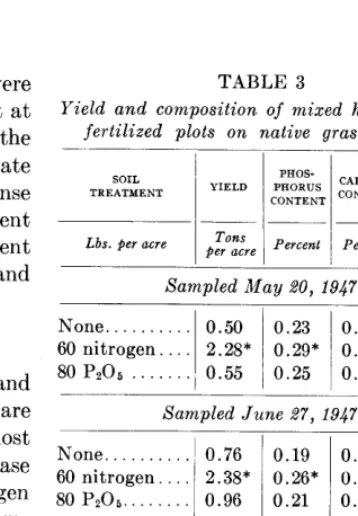
Later growth from tillers in these sub- samples, although available for animal consumption, was not sampled, conse- quently, all clippings at growth stages subsequent to the removal of the first flowering culms were taken from pre- viously unclipped subsamples. This method of harvesting follows the nutri- tive levels of young growth from dor- mancy, vegetative regrowth through the time of early jointing, and mature growth subsequent to the removal of flowering culms. Hence it was possible to follow the maturation and weathering trend of original growth during the later season. For estimating comparative yields re- sulting from fertilizer treatments, the total mixed vegetation in quadrats 2 x 6 feet was clipped at three dates during the growing season. Clippings in this in- cidence were taken from previously un- clipped areas and hence consisted of the total year’s growth up to the time of harvest.
102 JOHN S. WILLIAMS
Kjeldahl-Gunning method, modified to include nitrate. All data reported are the average of four replications, calculated to a moisture-free basis. Percentage protein is expressed as percent total nitrogen times 6.25, and percentage phosphorus as the elemental form.
RESULTS
For convenient evaluation of the grasses in the present study, Du Toit’s
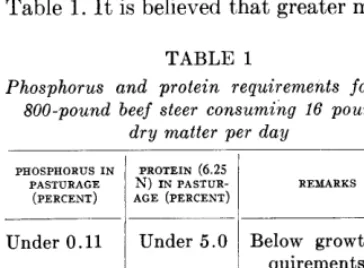
(1940) proposed requirements for an 800- pound beef steer consuming 16 pounds of dry matter per day are tabulated in Table 1. It is believed that greater mean-
TABLE 1
Phosphorus and protein requirements for an 800-pound beef steer consuming 16 pounds
dry matter per day
PHOSPHORUS IN PROTEIN (6.25
PASTURAGE N) IN PASTUR- REMARKS (PERCENT) AGE (PERCENT)
Under 0.11 Under 5.0 Below growth re- quirements 0.11 to 0.14 5.0 to 7.0 Limited growth Over 0.14 Over 7.0. Sufficient for nor-
mal growth
ing can be had from the analytical figures if the animal requirement is kept in mind. Limiting levels of calcium above the minimum requirement for growth are not given, but Du Toit concluded that pasturage containing a minimum of 0.14 percent calcium in the dry matter fur- nished the minimum requirement for an 800 pound beef steer consuming 16 pounds of dry matter per day. Younger animals may be expected to consume less than 16 pounds dry matter, and hence the nu- tritive constituents in the herbage should be higher for younger than for older animals. Similarly, in pregnant or lactat- ing animals, amounts of phosphorus calcium, and protein should be super- imposed on the requirements listed above or given in Table 1.
Crude Protein
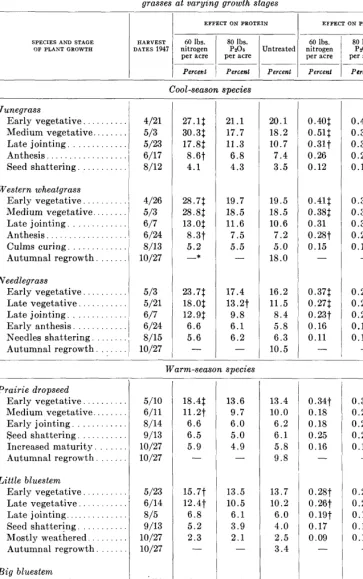
The data for the nutrient constituents of the grasses at varying growth stages at successive harvest dates are shown in Table 2. It may be observed that the crude protein of the native grasses ranged from 30.3 percent, in nitrogen-treated j unegrass at the medium vegetative growth stage, to 1.8 percent in phos- phorus-treated big bluestem harvested October 27. It may be further observed that nitrogen-treated cool-season grasses were higher in crude protein at growth stages up to jointing time than were nitro- gen-treated warm-season grasses at corre- sponding growth stages. Cool-season grasses at earlier growth stages also showed greater differences in crude pro- tein between treatments than warm-sea- son grasses at corresponding growth stages. Moreover, cool-season species usu- ally retained the increased crude protein at a more advanced growth stage, but such advantage was seldom apparent after the jointing growth stage, and not discernible in mature, cured, or seed-shattering ma- terial. Superphosphate generally produced no significant effect on protein content of any grass at any time, with the single ex- ception of needlegrass sampled May 21.
Phosphorus Content