Corrections to “Further Improving Efficiency of
Higher-Order Masking Schemes by Decreasing
Randomness Complexity”
Shuang Qiu, Rui Zhang, Yongbin Zhou, Wei Cheng
Abstract—Provably secure masking schemes always require too many random generations, which significantly increas-es the implementation cost. Recently in IEEE TRANSAC -TIONS ON INFORMATION FORENSICS AND SECURITY (TIFS) (DOI:10.1109/TIFS.2017.2713323), Zhang, Qiu, and Zhou im-prove the efficiency of the CPRR scheme by decreasing the random generations. Recently, Barthe et al. claim that security flaws exist in both proposals and provide the counter-examples. In this paper, we fix these security flaws by changing the addition order. In this way, the two proposals are corrected with no extra random generation.
Index Terms—masking scheme, side-channel attacks, probing model, randomness complexity.
I. INTRODUCTION
M
ASKING is the most widely deployed countermeasure against the Side-Channel Attack (SCA). In the scope of higher-order masking, randomness reduction is a crucial and tough task. Recently in the above paper [8], Zhang, Qiu, and Zhou have proposed two variants of the CPRR scheme, which outperform the original CPRR scheme with 50% and 50%-75% randomness reductions, respectively. Furthermore, under the probing model, they prove that the two schemes, called the ZQZ schemes, satisfy SNI and TNI, respectively.Subsequently, Barthe, Dupressoir, and Gr´egoire [3] find two security flaws and a typo existing in the ZQZ schemes with the automated verifier MaskVerif[2], [1]:
1) the first proposal (the ZQZ-1 scheme) fail to achieve SNI, as the first output sharec0 shows dependence on the first
input share a0.
2) the second proposal (the ZQZ-2 scheme), which is de-rived from the ZQZ-1 scheme, cannot achieve TNI. 3) there is a typo in the ZQZ-2 scheme, which makes it
unable to be generalized to odd orders d.
After revisiting the two masking schemes, we found that both Problem 1 and Problem 2 are due to one simple mistake. In the ZQZ schemes, the terms h(ri,j) + h(ai +ri,j) and
h(ai+ri,j+aj) +h(aj+ri,j) are dependent on the input shareai, as the randomnessri,j is unfortunately counteracted. In fact, this means that the random values are not correctly added and each term in the ZQZ schemes is left unprotected. As a result, the ZQZ-1 scheme cannot even achieve TNI, as all
The authors are with the State Key Laboratory of Information Security, Institute of Information Engineering, Chinese Academy of Sciences, Beijing 100093, China, and the School of Cyber Security, University of Chinese Academy of Sciences, Beijing 100049, China (Corresponding author: Rui Zhang, e-mail: [email protected]).
the random variablesri,jare invalid. As the ZQZ-2 scheme is
obtained by decreasing the randomness of the ZQZ-1 scheme, the ZQZ-2 scheme cannot achieve TNI, either.
In order to fix the ZQZ schemes, we replace the two terms
h(ri,j) +h(ai+ri,j)andh(ai+ri,j+aj) +h(aj+ri,j)with
the modified terms h(ri,j) and h(ai+ri,j) +h(ai+ri,j+ aj) +h(aj+ri,j), which are independent of the input shares.
In this way, each two terms are protected by one randomness
ri,j, and thus the security bias is fixed.
II. PRELIMINARIES
A. Notations
Linear function is denoted as `(·). The arrow ← means to assign the value of the right variable to the left variable.
$
←−−means to randomly pick one value from the right set and assign this value to the left variable.x7→y means a function which maps fromx toy. +denotes bit-xor operation, and ·
denotes the field multiplication on the finite fieldF2n. Pmi=0
represents the xor-sum, namelyPm
i=0xi=x0+x1+· · ·+xm. B. Security Notions
Two security notions are involved in this paper, i.e. Non-Interference (NI) and Strong-Non-Non-Interference (SNI) [1]. Their definitions are based on the notion of simulatability, which is first proposed by Ishaiet al.in [6] and then utilized by almost all subsequent masking schemes.
Definition 1 (Simulatability):Denote byV ={v1, . . . , vm}
the set of m variables of a multiplication algorithm. If there exists two sets I = {i1, . . . , it} and J = {j1, . . . , jt} of t
indices from set{0, . . . , d}and a random functionS taking as input2tbits and outputtingmbits such that for any fixed bits
(ai)0≤i≤d and (bj)0≤j≤d, the distributions of {v1, . . . , vm}
and {S(ai1, . . . , ait, bj1, . . . , bjt)} are identical, we say the setV can be simulated with at most t shares of each input1
aI andbJ.
Definition 2 (d-Tight-Non-Interference): An algorithm sat-isfies d-Tight-Non-Interference (d-TNI) if and only if every tuple of t ≤ d variables can be perfectly simulated with at mostt shares of each input.
Definition 3 (d-Strong-Non-Interference):An algorithm sat-isfies d-Strong-Non-Interference (d-SNI) if and only if for every set I of variables on intermediate variables (i.e. no
1The set {a
i1, . . . , ait} is written asaI, and the set{bj1, . . . , bjt} is
Algorithm 1: ZQZ-1 Scheme.
Input: sharing (ai)0≤i≤d satisfying Piai=a, a LUT
for h(a) =a·`(a)
Output: sharing (ci)0≤i≤d satisfyingPici=a·`(a)
1 fori= 0to ddo 2 forj =i+ 1to ddo 3 ri,j←−$−F2n
4 ti,j←h(ri,j) +h(ai+ri,j)
5 tj,i←h(ai+ri,j+aj) +h(aj+ri,j) 6 fori= 0to ddo
7 ci←h(ai)
8 forj = 0to d,j 6=i do 9 ci←ci+ti,j
output shares) and every set O of variables on output shares such that |I|+|O| ≤d, the set I ∪ O can be simulated by only|I|shares of each input.
C. ZQZ Schemes
In [5], Coron et al. propose d-th order masking scheme for the dependent-input multiplication a·`(a), i.e. the CPRR scheme. In [8], authors reduce the randomness complexity of the CPRR scheme, and propose two masking schemes, which we call the ZQZ-1 scheme and the ZQZ-2 scheme in the sequel. The description of ZQZ-1 scheme is given in Alg. 1. It is noteworthy that the involved functionh(x) =x·`(x)is computed by calling a Look-Up-Table (LUT).
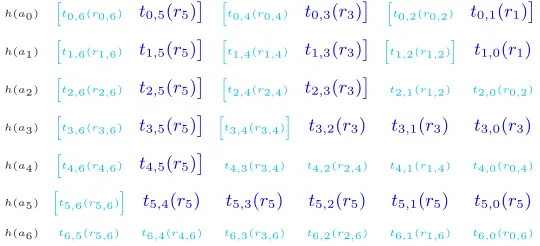
The ZQZ-2 scheme is obtained by reusing the random numbers of ZQZ-1, according to the randomness reusing strategy in [4]. For clarity, an illustration of the ZQZ-2 scheme in cased= 6is given in Fig. 1, whereti,j(r)represents term
ti,j involving random value r, and the sum of all terms on the i-th line equals thei-th output shareci. The reused terms are printed in a larger blue font. It is noteworthy that, in the ZQZ-2 scheme, termsti,j, ti,j−1
in one bracket is combined into one termti,j.
III. SECURITYANALYSIS OFZQZ SCHEMES
Based on the observation of Bartheet al.[3], we revisit the security of the ZQZ schemes. Furthermore, we trace to the source of the security flaws.
A. Counteracted Randomness and Undesirable Dependence
In the CPRR scheme [5] and the ZQZ schemes [8], ordinary multiplications are replaced with quadratic function h(x) =
x·`(x). Each quadratic functionh(x) =x·`(x)is implemented by calling a precomputed LUT. In the ZQZ-1 scheme (Alg. 1),
ti,j andtj,i satisfies:
ti,j=h(ri,j) +h(ai+ri,j)
tj,i=h(ai+ri,j+aj) +h(aj+ri,j). (1)
According to the description of functionh(·), termti,j can be rewritten as
h(ai+ri,j) +h(ri,j) =ai`(ri,j) +ri,j`(ai) +ai`(ai). (2)
According to Eq. (2), whenaiequals zero, ti,j will definitely
equal zero2. Namely,t
i,j can be seen as the product ofai and
a function of (ai, ri,j):
ti,j =ai·f(ai, ri,j). (3)
Obviously, ti,j leaksai. Similarly, term tj,i can be rewritten
as
tj,i=h(aj+ri,j) +h(ai+ (ri,j+aj))
=ai·f(aj+ri,j, ai). (4)
According to Eq. (4),tj,i also leaksai3.
B. Invalid Assumptions in Security Proofs
Given that ti,j leaks ai and tj,i leaks ai (j > i), the
assumption in the security proof for ZQZ-1 in [8] can no longer hold:
1) variables in the fourth set h(ai) +P j0
j=0[h(ai+rj,i+ aj) +h(ai +rj,i)] (refer to [8], Page 7, right column,
Line 8) cannot be simulated with onlyai, as each term
h(ai+rj,i+aj) +h(ai+rj,i)leaksaj. Hence, it should be simulated with{ai, a0, a1,· · ·, aj0}.
2) the observed output shareci also leaks{a0, a1,· · · , ai},
which contradicts with the security proof (refer to [8], Page 7, right column, Line 42).
Accordingly, the security proof for the ZQZ-1 scheme cannot hold.
C. Counter Example to TNI
In [3], authors propose a counter-example to show that the ZQZ-1 scheme is not SNI. Here, we further propose an example to show that the ZQZ-1 scheme is not even TNI. The last output sharecd can be rewritten as,
cd=h(ad) +
d−1
X
j=0
[h(aj+rj,i+ai) +h(ai+rj,i)]
=h(ad) +
d−1
X
j=0
aj·f(ai+rj,i, aj).
(5)
According to Eq. (5), it is easy to figure out that when
a0, a1,· · · , ad are all set to zero, the output share cd are
definitely zero, which implies that the output share cd show some dependence on the joint distribution ofd+1input shares ofa. Moreover, as the 2 scheme is derived from the ZQZ-1 scheme, the ZQZ-2 scheme can hardly preserve its security level, either.
IV. FIXEDVERSIONS OFZQZ-1ANDZQZ-2
By eliminating the undesirable dependence (Sec. III), we fix the security flaws in the ZQZ schemes, and thus obtain the modified ZQZ schemes.
2In this paper, the linear function `(·) is assumed to be the squaring
operation over the finite field. In this case, whenaiequals zero,`(ai)equals
zero as well.
3Note thatt
h(a0 )
t0,6 (r0,6 ) t0,5(r5)
t0,4 (r0,4 ) t0,3(r3)
t0,2 (r0,2 ) t0,1(r1)
h(a1 )
t1,6 (r1,6 ) t1,5(r5)
t1,4 (r1,4 ) t1,3(r3)
t1,2 (r1,2 )
t1,0(r1)
h(a2 )
t2,6 (r2,6 ) t2,5(r5)
t2,4 (r2,4 ) t2,3(r3)
t2,1 (r1,2 ) t2,0 (r0,2 )
h(a3 )
t3,6 (r3,6 ) t3,5(r5)
t3,4 (r3,4 )
t3,2(r3) t3,1(r3) t3,0(r3)
h(a4 )
t4,6 (r4,6 ) t4,5(r5)
t4,3 (r3,4 ) t4,2 (r2,4 ) t4,1 (r1,4 ) t4,0 (r0,4 )
h(a5 )
t5,6 (r5,6 )
t5,4(r5) t5,3(r5) t5,2(r5) t5,1(r5) t5,0(r5)
h(a6 ) t6,5 (r5,6 ) t6,4 (r4,6 ) t6,3 (r3,6 ) t6,2 (r2,6 ) t6,1 (r1,6 ) t6,0 (r0,6 )
Fig. 1: Illustration of randomness reusing in the ZQZ-2 scheme ford= 6.
Algorithm 2: Modified ZQZ-1 Scheme.
Input: sharing (ai)0≤i≤d satisfying Piai=a, a LUT
for h(a) =a·`(a)
Output: sharing (ci)0≤i≤d satisfyingPici=a·`(a)
1 fori= 0to ddo 2 forj =i+ 1to ddo 3 ri,j←−$−F2n 4 ti,j←h(ri,j)
5 tj,i←h(ai+ri,j)+h(ai+ri,j+aj)+h(aj+ri,j) 6 fori= 0to ddo
7 ci←h(ai)
8 forj = 0to d,j 6=i do 9 ci←ci+ti,j
A. Modified ZQZ-1 Scheme
In order to fix the above security bias of the ZQZ schemes, we first slightly modify the ZQZ-1 scheme, as is given in Alg. 2. In the modified ZQZ-1 scheme, ti,j and tj,i are
changed:
ti,j ←h(ri,j)
tj,i←
h(ai+ri,j)+h(ai+ri,j+aj)
+h(aj+ri,j).
(6) Obviously, ti,j and tj,i are independent of ai andaj, due to
the randomness ri,j. Till now, the security bias in the ZQZ-1 scheme has been fixed, and the modified ZQZ-ZQZ-1 scheme achieves d-SNI. The security proof is given in Appendix A.
It is noteworthy that the addition order of tj,i in Eq. (6) should be carefully chosen. During the computation of tj,i, there exists one intermediate, where in the case of Eq. (6) it is
h(ai+ri,j) +h(ai+ri,j+aj). In order to make the security proof valid, this intermediate variable should be dependent on at most one input share. In this case, h(ai+ri,j) +h(ai+ ri,j+aj)can be rewritten as:
h(ai+ri,j) +h(ai+ri,j+aj)
=(ai+ri,j)`(aj) +aj`(ai+ri,j) +aj`(aj) =aj·f(ai+ri,j, aj).
(7)
Hence, h(ai+ri,j) +h(ai+ri,j+aj)only depends onaj.
Otherwise, iftj,i is computed following the order below:
tj,i=
h(ai+ri,j) +h(aj+ri,j)
+h(ai+ri,j+aj), (8)
the intermediate variable ish(ai+ri,j) +h(aj+ri,j), which satisfies:
h(ai+ri,j)+h(aj+ri,j)
=ai·f(ai, ri,j) +aj·f(aj, ri,j).
(9)
In this case, the intermediate will depend on bothai andaj4, and the masking scheme will be insecure.
B. Modified ZQZ-2 Scheme
In [8], the ZQZ-2 scheme is obtained by decreasing the ran-domness of the ZQZ-1 scheme, with the ranran-domness reduction strategy proposed in [4]. As shown above, the ZQZ-1 scheme is flawed and cannot achieved-TNI. Since the ZQZ-2 scheme is a randomness reduction version of the ZQZ-1 scheme, the ZQZ-2 scheme cannot achieved-TNI as well.
In this section, we obtain the modified ZQZ-2 scheme by applying the randomness reduction strategy (see Fig. 1) to the modified ZQZ-1 scheme. The modified ZQZ-2 is given in Alg. 3. We claim that the modified ZQZ-2 scheme achieves its claimed security level, thed-TNI. The security proof is given in Appendix B.
Moreover, we modify the 14-th line of Alg. 3 and make the description can be generalized to odd orders.
It is noteworthy that the addition order of ti,j (line 9) is carefully chosen. Any change in addition order may lead to security bias. As a counter-example, if the term ti,j is computed according to the following order, where the fourth term and the sixth term switch positions,
ti,j=
h(aj+ri,j) +h(aj+ri,j+ai) +h(ai+ri,j)
+h(ai+rj−1) +h(aj−1+rj−1+ai)
+h(aj−1+rj−1)
,
(10)
4Whena
Algorithm 3: Modified ZQZ-2 Scheme.
Input: sharing (ai)0≤i≤d satisfying Piai=a, a LUT
for h(a) =a·`(a)
Output: sharing (ci)0≤i≤d satisfyingPici=a·`(a)
1 fori= 0to ddo
2 forj = 0to d−i−1 by2 do 3 ri,d−j
$ ←−−F2n
4 forj=d−1 downto1 by2 do 5 rj ←−$−F2n
6 fori= 0to ddo 7 ci←h(ai)
8 forj =ddownto i+ 2 by2 do
9 ti,j←h(aj+ri,j)+h(aj+ri,j+ai) +h(ai+ ri,j) +h(aj−1+rj−1)+h(aj−1+rj−1+ai) + h(ai+rj−1)
10 ci←ci+ti,j 11 if i6=d(mod 2)then
12 ti,i+1←h(ai+1+ri,i+1)+h(ai+1+ri,i+1+
ai) +h(ai+ri,i+1)
13 ci←ci+ti,i+1
14 if d=0(mod 2) then
15 ci←ci+h(ri) 16 else
17 forj =i−1downto 0 do 18 ci←ci+h(rj,i)
there will be intermediatet0
i,j during the computation,
t0i,j =
h(ri,j) +aj`(ai) +ai`(aj)
+h(ai+rj−1)
+h(aj−1+rj−1+ai)
=h(ri,j) +aj`(ai) +ai`(aj) +aj−1·f(ai+rj−1, aj−1).
(11)
This intermediatet0i,j depends onai,aj,aj−1, andri,j. Thus,
the joint distribution of two intermediate variables (t0i,j, ri,j)
depends on three input sharesai,aj,aj−1, which makes the
scheme insecure.
In the modified ZQZ-2 scheme, the intermediate sum t0
i,j
satisfies
t0i,j=
h(ri,j) +aj`(ai) +ai`(aj)+h(aj−1+rj−1)
+h(aj−1+rj−1+ai)
=
h(ri,j) +aj`(ai) +ai`(aj)
+ai·f(aj−1+rj−1, ai),
(12)
hence the joint distribution of two intermediate variables
(t0
i,j, ri,j)depends on only two input sharesaiandaj, which
satisfies the requirement of TNI.
V. CONCLUSION ANDPERSPECTIVE
In this paper, we fix the security flaws of the ZQZ schemes. In this way, the randomness reduction expected in the original paper [8] can be achieved. Besides, we suggest that any further
randomness reduction strategy for ISW-like schemes, e.g. the new progress in CRYPTO 2017 [7], can also be securely applied to the modified ZQZ-1 scheme, and thus one can obtain a more efficient ZQZ-2 scheme achieving TNI.
APPENDIXA PROOF OFMODIFIEDZQZ-1
Denote a tuple observations(I,O), where |I|+|O| ≤d. We aim to prove that this scheme is SNI, i.e. one can always simulate(I,O)utilizing|I|shares of each input. Hence, this proof consists in constructing setSof indices in{0,1,· · · , d}
of size at most |I| and perfectly simulate (I,O) with the shares (ai)i∈I.
First, we show how to construct set S. Initially, set S is empty. We fill it in the following specific order according to the possible leaked intermediate variables inI.
1) for any observed variablesai andh(ai), additoS.
2) for any observed variables ri,j, h(ri,j), ai +ri,j, and
h(ai+ri,j), additoS.
3) for any observed variablesai+ri,j+aj,h(ai+ri,j+aj),
aj+ri,j, h(aj+ri,j): if i /∈ S, add i toS, otherwise addj toS.
4) for any observed variables tj,i =h(ai+ri,j) +h(ai+
ri,j+aj) +h(aj+ri,j): ifi /∈ S, addi toS, otherwise addj toS.
5) for the observed variableh(ai+ri,j) +h(ai+ri,j+aj), addj toS.
6) for any observed variablesh(ai) +P j0 j=0
h(aj+rj,i) + h(aj+rj,i+ai) +h(ai+rj,i)with1≤j0≤i−1and
h(ai) +P i−1
j=0
h(aj+rj,i) +h(aj+rj,i+ai) +h(ai+ rj,i)
+Pj0
j=i+1 h(ri,j)withj0< i < d, addi toS.
The output shares are the final valueci, which are included in setO.
Now the setS has been determined. Each observation inI
adds at most one index to setS. Hence, the simulator satisfies
|S| ≤ |I|. Then, we prove that every observed value can be perfectly simulated with the input shares whose indices are amongS.
• any variable in group 1 can be simulated with ai.
• any variable in group 2 can be simulated withaiandri,j.
• for each variable in Group 3, we consider two cases. If
i∈ S and we addj toS, any variable in Group 3 can be simulated withai,aj, andri,j. Ifi /∈ S and we addito S, thenri,jandai+ri,jdoes not enter in the computation
of any other variables. Hence,ai+ri,j+aj andaj+ri,j
can be assigned to a fresh random value.
• for variables in group 4,tj,ican be rewritten ash(ri,j) +
ai`(aj) +aj`(ai). If i∈ S and we add j toS,tj,i can be simulated withai,aj, andri,j. Ifi /∈ S and we addi
toS, then ri,j does not enter in the computation of any other variables. Hence, tj,i can be assigned to a fresh random value.
• for variables in group 5, according to Eq. (7), h(ai +
ri,j) +h(ai+ri,j+aj)can be rewritten as aj·f(ai+
ri,j, aj). Ifi∈ S,h(ai+ri,j) +h(ai+ri,j+aj)can be simulated withai, aj, and ri,j. Ifi /∈ S, then ai+ri,j
Hence,h(ai+ri,j) +h(ai+ri,j+aj)can be simulated
withaj and a fresh random value.
• for each variable in group 6, we consider the different terms. The first term h(ai) can be simulated with ai. Then, for the sum of h(aj+rj,i) +h(aj+rj,i+ai) +
h(ai+rj,i), we consider two cases. Ifj ∈ S, this sum can be perfectly simulated withai,ajandrj,i. Otherwise,
rj,i does not enter in the computation of other variables. Hence, it can be assigned to a fresh random value. In order to prove SNI, we still have to simulate the ob-served output values for rows on which no internal values are observed. Remarking that simulating the i-th line also necessarily fixed the value of all random variables appearing in thei-th column (so that dependencies between variables are preserved). After internal observations are simulated, at most
|I|lines of the matrix are fully filled. Therefore, at least|O|
random values are not yet simulated on lines on which no internal observations are made. For each output observation made on one such line (sayi), we can therefore pick a different
ri,j that we fix so that outputican be simulated using a fresh
random value.
APPENDIXB PROOF OFMODIFIEDZQZ-2
This proof consists in constructing set S of indices in
{0,· · ·, d} of size at most d and perfectly simulate any d -tuple observations I ∪ O of intermediate variables with the shares (ai)i∈S. As the shares(ai)i∈S are independent of the sensitive variable a, any d-tuple of intermediate variables are independent ofa. We now describe the construction of S.
First, we show how to construct the set S. Initially, set S
is empty. We fill it in the following specific order according to the possible leaked intermediate variables.
1) for any observed variablesai andh(ai), addi toS. 2) for any observed variable rj, putj toS.
3) for any intermediate sum occurring during the compu-tation of ci, assign from shortest sums (in terms of number of terms) to longest sums: if i /∈ S, addi toS. Otherwise, if ci involves corrective terms (i.e., randoms
not in ri,j), consider them successively (from left to
right). For a random of the form rj,i, ifj /∈J, addj to S, otherwise, consider the next random. For a random of
rj, if j /∈ S, addj toS. If there are no more corrective
terms to consider, or if ci does not involve corrective terms, consider the involved ti,j in reverse order (from right to left). Add to S the first indexj that is not inS. 4) for any observed variables ri,j, ai +ri,j, h(ri,j), and
h(ai+ri,j): ifi /∈ S, additoS, otherwise addj toS. 5) for any observed intermediate sum t0i,j occurring during the computation ofti,jwith at most three terms (norj−1).
If i /∈ S, additoS, otherwise addj toS.
6) for any observed intermediate sum t0i,j occurring during the computation ofti,jwith strictly more than three terms (withrj−1). Ifj−1∈ S/ , addj−1toS. Otherwise, add
i toS, otherwise addj toS.
Now that the set S has been determined, and note that each observation adds at most one index in S. With at most
d variables, their cardinals hence cannot be greater than d. Before simulating, the following observations are given,
1) all variables involves ri,j areti,j,ci, andcj,
2) all variables involvesrj−1are tk,j,cj−1andck, for any
k≤j−2,
3) all variables involves bothri,j andrj−1 areci andti,j.
Then, we prove that every observed value can be perfectly simulated with the input shares whose indices are amongS.
1) any variable in group 1 can be trivially simulated with
ai.
2) any variable in group 4 can be trivially simulated withai
andri,j.
3) any variablerj (group 2) is assigned to a fresh random
value.
4) for any intermediate (group 5)t0
i,jduring the computation
ofti,jwith at most three terms (includingaj+ri,j+aiand
aj+ri,j): ifj∈ S, intermediate variables can be perfectly simulated with ai, aj andri,j. Otherwise, ifj /∈ S, we show that these observations can be assigned to a random value (variable h(aj +ri,j) +h(aj+ri,j+ai) can be simulated withai and a random value). In particular, we show that if they are non-random, we must havei, j∈ S. All those intermediate variables involveri,j. This variable can only appear in intermediate variables of group 4, in
ci, incj, int0i,j of less than three terms part ofti,j, or in t0i,j of more than three terms part ofti,j.
• ri,j appears in group 4: this probe involved i ∈ S,
and hence the probe in group 5 addedj toS. • ri,j appears in an observed ci: this probe involved
i∈ S, and hence the probe of group 5 addedjtoS. • ri,j appears in an observed cj: this probe involved
j∈ S, and hence the probe of group 5 addeditoS. • ri,j appears in an observed t0
i,j of less than three
terms: this probe involvedi∈ S, and hence the probe of group 5 added j toS.
• ri,j appears in an observedt0i,j of strictly more than three terms: in this case, this probe also involves the random rj−1. We know that rj−1 can either be
observed alone, in cj−1, in t0i,j of more than three
terms part of tk,j or in ck. Once again, considering rj−1, in cj−1, and t0i,j, we get that j−1, j, i∈ S.
Considering t0
i,j of more than three terms, or ck, if k=i, we have already treated this case and we have
i, j ∈ S, otherwise, the variable involves rk,j. All
variables whose expression involves rk,j are: rk,j, tk,j, ck andcj. It can be checked that i, j, k, j−1
are in S for each variables that are not part of ck
or tk,j. Consequently, each other probe that does not imply i, j ∈ S are variables of these kinds. However, each of these variables involve both rj−1
andrk,j for a certaink. To summarize,t0
i,j has been
queried, which involves onlyri,j, and the only other possible variables involve rj−1 and rl,j, which l is
the index of the line. Hence, the parity of the number of occurrences ofrj−1 is different from the parity of
at the same time. Therefore, in those cases t0
i,j can
be assigned to a random value.
5) if t0
i,j is a sum of strictly more than three terms (group
6):
• ifi, j, j−1∈ S, thentcan be simulated withai,aj
and random numbers.
• t0i,j involvesri,j andrj−1. Observations (1) and (2)
provide us the variables in which these randomness are involved. For all but four cases, we trivially have
i, j, j−1 ∈ S. These four cases are the queries of
(ri,j, t0
k,j)witht0k,j part oftk,j and involving strictly
more than three terms, (c0
i, c1i), where c0i and c1i
are part of ci, (t1i,j, t0k,j) with t
1
i,j part of ti,j and t0k,j part of tk,j, where t0k,j is assigned before t0i,j, both involving more than three terms, and finally, any other couple involving a part ofck.
– the cases (ri,j, t0k,j) and (t
1
i,j, t0k,j) imply the
in-volvement of rk,j. Thanks to Observation (1), all
possible cases can be exhausted, and we obtain
i, j, j−1∈ S. – the case(c0
i, c1i) is particular. Indeed, we can
as-sume thatc0
i is computed during the computation
ofc1
i. We can hence safely assignt0i,j to a random
variable if this is the only case whereri,jandrj−1
have been involved.
– the query of a c0k, part of ck involving rj−1
in-volves the variablerk,j. From Observation (i), we can exhaust the possible cases. For each of these cases except five, we havei, j, j−1∈ S. The five remaining cases are (cj, cj), (cj, ck), (rk,j, ck),
(ci, ck),(ti,j, ck). With the case involving cj, by
construction we have that rk,j and ri,j appear
after the addition of all the terms of the formtjl.
Consequently, this expression involves the term
rj−1,j. Using Observation (i), we find out that
the only way not to have i, j, j−1 ∈ S is to make another probe to cj. However, this case is similar to the one we just observed: it is safe to randomly assign t0i,j. For any another case, the random tk,j reappears, and we must hence query another variable to get rid of it. The only possibility is to query ck once more. Hence t0i,j
can be randomly assigned.
6) for each variable in group 3, we consider the different terms. The first termh(ai)can be simulated withai. For termti,jwithrj−1(more than three terms), ifi, j, j−1∈ S, it can be perfectly simulated. Otherwise, it can be assigned to a random value. For term ti,j without rj−1
(at most three terms), it can be perfectly simulated with
i, j∈ S. Otherwise, it can be assigned to a random value.
REFERENCES
[1] G. Barthe, S. Bela¨ıd, F. Dupressoir, and P.-A. Fouque et al. Strong Non-Interference and Type-Directed Higher-Order Masking. InProceedings of the 2016 ACM SIGSAC Conference on Computer and Communications Security, pages 116–129. ACM, 2016.
[2] G. Barthe, S. Belaid, F. Dupressoir, A. Fouque, B. Gregoire, and P.-Y. Strub. Verified Proofs of Higher-Order Masking. In E. Oswald and M. Fischlin, editors,EUROCRYPT 2015, volume 9056 ofLNCS, pages 457–485. Springer, 2015.
[3] G. Barthe, F. Dupressoir, and B. Gr´egoire. A Note on ‘Further Improving Efficiency of Higher-Order Masking Scheme by Decreasing Randomness Complexity’. Cryptology ePrint Archive, Report 2017/1053 (2017), http://eprint.iacr.org/, 2017.
[4] S. Bela¨ıd, F. Benhamouda, A. Passel`egue, and E. Prouff et al. Random-ness Complexity of Private Circuits for Multiplication. In M. Fischlin and J.-S. Coron, editors,EUROCRYPT 2016, volume 9666 ofLNCS, pages 616–648. Springer, 2016.
[5] J.-S. Coron, E. Prouff, M. Rivain, and T. Roche. Higher-Order Side Channel Security and Mask Refreshing. In S. Moriai, editor,FSE 2013, volume 8424 ofLNCS, pages 410–424. Springer, 2014.
[6] Y. Ishai, A. Sahai, and D. Wagner. Private Circuits: Securing Hardware against Probing Attacks. In D. Boneh, editor,CRYPTO 2003, volume 2729 ofLNCS, pages 463–481. Springer, 2003.
[7] A. Passel`egue E. Prouff A. Thillard D. Vergnaud S. Bela¨ıd, F. Benhamou-da. Private Multiplication over Finite Fields. In J. Katz and H. Shacham, editors,CRYPTO 2017, volume 10403 ofLNCS, pages 397–426. Springer, 2017.