Strong Non-Interference and Type-Directed
Higher-Order Masking
∗Gilles Barthe1, Sonia Bela¨ıd2, Franc¸ois Dupressoir3†, Pierre-Alain Fouque4, Benjamin Gr´egoire5, Pierre-Yves Strub6†, and R´ebecca Zucchini5,7
([email protected]) 1 IMDEA Software Institute
2
Thales Communications & Security 3
University of Surrey 4
Universit´e de Rennes 1 5
Inria Sophia Antipolis – M´editerran´ee 6 ´
Ecole Polytechnique 7 ´
Ecole Normale Sup´erieure de Cachan
Abstract. Differential power analysis (DPA) is a side-channel attack in which an adversary retrieves cryptographic material by measuring and analyzing the power consumption of the device on which the cryptographic algorithm under attack executes. An effective countermeasure against DPA is tomasksecrets by probabilistically encoding them over a set of shares, and to runmaskedalgorithms that compute on these encodings. Masked algorithms are often expected to provide, at least, a certain level ofprobing security.
Leveraging the deep connections between probabilistic information flow and probing security, we develop a precise, scalable, and fully automated methodology to verify the probing security of masked algorithms, and generate them from unprotected descriptions of the algorithm. Our methodology relies on several contributions of independent interest, including a stronger notion of probing security that supports compositional reasoning, and a type system for enforcing an expressive class of probing policies. Finally, we validate our methodology on examples that go significantly beyond the state-of-the-art.
1
Introduction
Differential power analysis, or DPA [25], is a class of side-channel attacks in which an adversary extracts secret data from the power consumption of the device on which a pro-gram manipulating the data executes. One practical countermeasure against DPA, called
masking[11,22], transforms an algorithm that performs computations over a finite ring ∗
This work appears in the Proceedings of CCS 2016. This is the long version. A preliminary ver-sion, made public in 2015 under the title “Compositional Verification of Higher-Order Masking: Application to a Verifying Masking Compiler”, can be found as revision 20150527:192221 of this report.
†
Kinto a randomized algorithm that manipulates probabilistic encodings.8At an abstract level, any masking transformation performs two tasks. First, it replaces every algebraic operation performed by the original algorithm by a call to agadget, i.e. a probabilistic algorithm that simulates the behavior of algebraic operations on probabilistic encodings. Second, it insertsrefreshinggadgets, i.e. gadgets that take a probabilistic encoding of vand rerandomizes its shares in order to produce another probabilistic encodingwof v. Inserting refreshing gadgets does not change the functional behavior of the masked algorithm, and increases the randomness complexity and execution time of the masked program. However, it is also compulsory for achieving security. Therefore, an important line of research is to find suitable trade-offs that ensure security while minimizing the performance overhead of masking; see [8] for recent developments in this direction.
The baseline notion of security for masked algorithms ist-probing security. Infor-mally, an algorithmPist-probing secure if the values taken by at mosttintermediate variables ofP during execution do not leak any information about secrets (held by its inputs). More formally, an algorithm P achievest-probing security iff for every set of at mosttintermediate variables, the joint distributions of the values taken by these intermediate variables coincide for any two executions initiated from initial inputs that agree ontshares of each input encoding. Stated in this form, probing security is an instance of probabilistic information flow, universally quantified over all position sets that meet a cardinality constraint, and is therefore potentially amenable to formal analysis using a well-developed body of work on language-based security and program verification. Indeed, the connection between probing security and information flow has been instrumental in a promising line of research, initiated in [27] and further developed in [7,20,19,4], which uses type systems, program logics, SMT solvers and other methods for verifying or synthesizing masked algorithms at small (≤5) orders. However, none of these works addresses the problem of composition, and all fail to scale either to higher orders or to larger algorithms.
Contributions We develop precise and scalable techniques for synthesizing masked algorithms that achieve probing security. Our techniques apply to a wide range of probing policies, including existing policies and new policies defined in this paper, and deliver masked algorithms that outperform (in terms of randomness complexity and computational efficiency) prior approaches. In more detail, we make the following broad contributions:
1. Strong non-interference. We introduce a stronger notion of probing security, which we call strong non-interference, and prove that it is in fact satisfied by many (but not all) gadgets from the literature. Furthermore, we justify that strong non-interference is the desired property for refreshing gadgets, by reconsidering known negative and positive results [15] for a simplified example extracted from Rivain and Prouff’s inversion algorithm [31]. We first observe that the refreshing gadget used in the original, flawed, algorithm does not enjoy strong non-interference. Second, we note that the refreshing gadget used in the fixed, secure, algorithm is indeed strongly non-interfering, and we
8At-encoding of an elementv ∈
Kis a(t+ 1)-tuplev = hv0, . . . ,vtisuch thatJvK
4 =
v0⊕. . .⊕vt=v. Each of thevı∈Kin an encodingvofvis called ashare. Moreover,tis
show that one can prove the probing security of the fixed algorithm, based simply on the assumption that the refreshing gadget is strongly non-interfering. Generalizing these observations, we prove that every non-interfering algorithm can be turned into a strongly interfering algorithm, by processing its inputs or its output with a strongly non-interfering refreshing gadget. We also provide more general results about the composition of strongly non-interfering gadgets.
2. Formal proofs.We develop and implement an automated method, inspired from [4], for checking strong interference. We apply our automated verifier for strong non-interference to several gadgets from the literature and some other interesting com-positions, for orders t ≤ 6. For several more widely-used gadgets, we further use EasyCrypt[5] to provide machine-checked proofs oft-probing security for allt.
3. Type-based enforcement of probing security.We define an expressive language for specifying a large class of non-interference properties with cardinality constraints. Our language can be seen as a variant of the first-order theory of finite sets with cardinality constraints [32,3], and can be used to specify baseline probing security and strong non-interference, among others. Then, we define a type system that enforces probing policies and prove its soundness. Furthermore, we show how to model in our language of probing policies the notion of affine gadget, and we show how it helps improve the precision of type-checking.
4. Certifying Masking Transformation. As a proof of concept, we implement a type inference algorithm and a certifying masking transformation that takes as input an arithmetic expression and returns a masked algorithm typable by our type system.9Our transformation improves over prior works by selectively inserting refreshing gadgets only at points where type-checking would otherwise fail. This strategy leads to improved efficiency while retaining provable soundness.
5. Practical evaluation.We evaluate our type system and masking transformation on complete algorithms at various orders, often achieving provablet-probing security levels far beyond the state-of-the-art for algorithms of those sizes, and with better performance than most known (provably secure) algorithms in terms of time, memory and randomness complexity.
Related work Section 9 discusses related work in more detail. Here we focus on recent work on automated tools for the verification of synthesis of masked algorithms, starting with Moss et al. [27], who point out and leverage connections between probing security and probabilistic information-flow for first-order boolean masking schemes. Subsequent works in this direction accommodate higher-order and arithmetic masking, using type systems and SMT solvers [7], or model counting and SMT solvers [20,19]. Although approaches based on model counting are more precise than early approaches based on type systems and can be extended to higher-order masking schemes, their algorithmic complexity constrains their applicability. In particular, existing tools based on model counting can only analyze first or second order masked implementations, and can only deal with round-reduced versions of the algorithms they consider (for instance, only
9The cryptography literature often refers to such transformations as
analyzing a single round of Keccak at order 1, and algorithms for field operations at orders 2 and higher). Breaking away from model counting, Barthe et al. [4] develop efficient algorithms for analyzing the security of masked algorithms in the probing model. Their approach outperforms previous work and can analyze a full block of AES at first-order, reduced-round (4 rounds) AES at the second-order, and several S-box computation algorithms masked at the third and fourth orders. However, their work does not readily scale either to higher orders or to larger algorithms, mainly due to the lack of composition results.
Our work also bears some connections with language-based security, and in particular with work on the specification and the enforcement of confidentiality policies using techniques from programming languages. For instance, our work has similarities with the work of Pettai and Laud [29], who develop techniques for proving security of multi-party computations in the presence of strong adversaries, and work by Zdancewic et al. [33], who propose a compiler that partitions programs for secure distributed execution.
Mathematical preliminaries A functionµ:B→R≥0is a (discrete)distributionover Bif the subsetsupp(µ)ofBwith non-zero weight underµis discrete and moreover P
b∈supp(µ)µ(b) = 1. We letD(B)denote the set of discrete distributions over B. Equality of distributions is defined as pointwise equality of functions. Distributions can be given a monadic structure with the two operatorsmunit(·)andmlet·=·. For everyb∈B,munit(b)is the unique distributionµsuch thatµ(b) = 1. Moreover, given µ:D(B)andM :B→ D(C),mletx=µinM xis the unique distributionµ0overC such thatµ0(c) =P
bµ(b)M(b)(c).
We often use the notion of marginals. The first and second marginals of a distribution µ∈ D(B1×B2)are the distributionsπ1(µ)∈ D(B1)andπ2(µ)∈ D(B2)given by
π1(µ)(b1) = X
b2∈B2
µ(b1, b2) π2(µ)(b2) = X
b1∈B1
µ(b1, b2).
The notion of marginal readily extends to distributions over finite maps (rather than pairs).
2
A bird’s eye view of strong non-interference
Before formalizing our definitions, we give an intuitive description of our language for gadgets and of our security notions, based on simple examples.
Gadgets and Positions Gadget RefreshM2 (Gadget 1) shows the description in our language of a mask refreshing gadget fort= 2. The gadget takes as input an encoding variablea ∈ K3, where Kis some finite ring and returns a new encoding c ∈ K3 such thatJaK=JcK. The gadget first makes local copies of individual input sharesa
ı
Gadget 1SNIMask Refreshing witht= 2
functionRefreshM2(a)
c0,0←a0;c1,0←a1;c2,0←a2;
r0 $
←K;c0,1←c0,0⊕r0;c1,1←c1,0 r0;
r1 $
←K;c0,2←c0,1⊕r1;c2,1←c2,0 r1; r2
$
←K;c1,2←c1,1⊕r2;c2,2←c2,1 r2; returnhc0,2, c1,2, c2,2i
Note that the gadget is written insingle static assignment(SSA) form, an intermediate representation in which each variable is defined exactly once. Having gadgets written in SSA form allows us to easily refer to the value of a particular variable at a particular point in the program–simply by referring to its name, which corresponds to a unique definition. In this paper, we refer topositionsin gadgets and algorithms, which correspond exactly to intermediate variables. We distinguish between three different kinds of positions:
input positions, which correspond to shares of the gadget’s input (here,IRefreshM2 = {a0,a1,a2}),output positions, which correspond to the variables that appear in the gad-get’s return vector (here,OintRefreshM2={c0,2, c1,2, c2,2}), andinternal positions, which
refer to all other positions (here,OextRefreshM2 ={c0,0, c1,0, c2,0, c0,1, c1,1, c2,1, r0, r1, r2}).
Intuitively, this separation allows us to distinguish between direct observations made by the adversary into a gadget (asinternalpositions), output shares about which the adversary may have learned some information by probing gadgets that use them as input (asoutputpositions), and shares of the gadget’s inputs (asinputpositions) about which the adversary is now learning information. In the following, we often write “the joint distribution of a set of positions” to discuss the joint distribution of the variables defined at these positions in the gadget (in order). For example, referring toRefreshM2, the joint distribution of the ordered setO=hc0,1, c2,2iof positions can be described as the following function ofa, where we use$to denote a fresh uniform random sample inK (using indices to denote distinct samples):JRefreshM2KO(a)
4
=ha0⊕$0,(a2 $
1) $2i.
Probing Security and Non-Interference TheRefreshM2gadget is known to be 2-probing secure, or 2-non-interfering (2-NI) in our terminology, in the sense that the joint distribu-tion of any set of at most 2 of its posidistribu-tions, corresponding to adversaryprobes, depends on at most 2 shares of the gadget’s inputs. This guarantees, if the input encoding is uniform, that no information about it leaks through any 2 probes in the circuit.
Considering again the setO=hc0,1, c2,2iof positions inRefreshM2and its distri-butionJRefreshM2KO, it is easy to see–purely syntactically–that it depends at most on sharesa0anda2of the gadget’s input encoding. Similarly considering all possible pairs of positions, we can prove that each of them has a joint distribution that depends on at most two shares ofa.
dubstrong non-interference(orSNI), which does support some compositional reason-ing.SNIreinforces probing security by requiring that the number of input shares on which the distribution of a given position set may depend be determined only by the number ofinternalpositions present in that set. For example, consider again position setO=hc0,1, c2,2iinRefreshM2, and note that it contains only one internal position (c0,1). We have seen that the joint distributionJRefreshM2KO of that position set syn-tactically depends on two shares ofa. However, it can be equivalently expressed as JRefreshM2KO(a) =h$0,(a
2 $
1) $2i(since the ring addition⊕is a bijection of each of its arguments and$0is a fresh and uniform ring element). This shows that the distribution in fact depends on at most one share ofa(herea2). In fact, it can be shown thatRefreshM2is 2-SNI. More generally, surprisingly many gadgets from the literature achieveSNI.
However, and not unexpectedly, some gadgets from the literature do not satisfySNI. Consider for instanceRefreshA2(Gadget 2). It is easy to see that the gadget is 2-NI (each positioncı,depends only on input shareaı, and each positionriis completely independent from the input encoding). Still, looking at position setO0 =hc0,1, c1,1i, which is composed of one internal position and one external one, we see that the distributionJRefreshA2KO0 4=ha0⊕$0,a1⊕$0idoes depend on more than one share
ofa.RefreshA2is therefore not 2-SNI.
Gadget 2NIMask Refreshing witht= 2
functionRefreshA2(a)
c0,0←a0;c1,0←a1;c2,0←a2;
r0 $
←K;c0,1←c0,0⊕r0;c1,1←c1,0 r0; r1
$
←K;c0,2←c0,1⊕r1;c2,1←c2,0 r1; returnhc0,2, c1,1, c2,1i
Compositional Probing Security This small difference between NI and SNI has a significant effect on security when used in larger circuits. Indeed, the output positions of a strongly non-interfering gadgets do not depend on any of its input positions: when considered independently from internal positions (in the absence of internal probes), their distribution is uniform; and in the presence of internal probes, their joint distribution is entirely determined by that of the probed internal positions. This is essential in supporting
compositionalreasoning about the probing security of larger algorithms. In particular, this makes algorithms of the form shown in Algorithm 3 (for some gadgetsRandGof the appropriate types that work on2-encodings) easy to provet-NIifRisRefreshM2, and illustrates why composition might fail ifRis instantiated withRefreshA2. A key observation to make is that an adversary that observes 2 positions internal toGmay learn 2 shares of bothaandb. IfRis instantiated withRefreshA2(and is thus only2-probing secure), the 2 shares ofbcan be used to infer information about 2 further shares ofa, which may give the adversary full knowledge of all 3 shares ofa. On the other hand, if
Alg. 3An abstract algorithm functionAlg2(a)
b:=R(a);
c:=G(a,b);
returnc
Broader uses ofSNI The notion of strong non-interference, and the masking transforma-tion we define here have already found applicatransforma-tions in follow-up work. Bela¨ıd et al. [8] prove using our compositional techniques that their new non-interfering multiplication can be securely combined with the strongly non-interfering one of Rivain and Prouff [31] to build a strongly non-interfering AES S-box with reduced randomness complexity. Similarly, Goudarzi and Rivain [23] use our method to ensure the compositional security of their bitsliced software implementation of AES. Battistelo et al. [6] use and prove t-SNIfor theirO(n·logn)mask refreshing gadget, allowing further randomness com-plexity reductions without loss of probing security. Coron et al. [16] use and provet-SNI for their efficient parallel algorithms for the evaluation of SBoxes.
Outline The rest of the paper is organized as follows. Section 3 formalizes our two-tier language for masked gadgets and algorithms, the notion of position, and their seman-tics, as well as the joint distribution of a set of positions. Sections 4, and 5 formalize probing security ast-non-interference, and formally define our new notion of t-strong-non-interference before illustrating it more generally with simple examples. In Section 6, we define a language to describe probing policies, and define a simple type system for enforcing probing policies of algorithms, formalizing and generalizing the simple compositional arguments outlined here. In Section 7, we present an automated method to verify the strong non-interference of arbitrary gadgets at small fixed orders, that follows the approach used above in arguing thatRefreshM2is 2-SNI, and adapts algorithms by Barthe et al. [4] to reduce the number of position sets to consider. In Section 8, we extend our type system into a masking transformation which automatically builds a masked algo-rithm from an unprotected program, carefully choosing the proper locations for strongly non-interfering refreshing gadgets. We evaluate on full cryptographic algorithms the performance of the type system, of the resulting transformation, and of the transformed algorithms. Section 9 discusses related work on leakage models, composition for probing security, and other masking transformations. We interleave discussions of interesting leads for future work.
3
Masked algorithms
The formal development of this paper is based on a minimalist 2-tier language.10The lower tier models gagdets as sequences of probabilistic and (three-address code)
deter-10
However, the verification tool supports richer settings to which the theory extends smoothly and our examples are written in a more general language, closer to our implementation, that supports staticforloops, direct assignments to shares (aı←e), arbitrary expressions on the
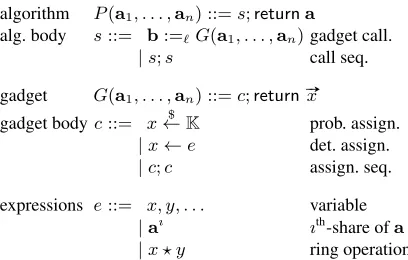
algorithm P(a1, . . . ,an) ::=s;returna
alg. body s::= b:=`G(a1, . . . ,an)gadget call.
|s;s call seq.
gadget G(a1, . . . ,an) ::=c;return#»x
gadget bodyc::= x←$ K prob. assign. |x←e det. assign.
|c;c assign. seq.
expressions e::= x, y, . . . variable
|aı ıth-share ofa |x ? y ring operation
Fig. 1: Syntax of masked algorithms
ministic assignments, whereas the upper tier models algorithms as sequences of gadget calls (we assume that each gadget call is tagged with its instruction number`∈N). The formal definition of the language is given in Figure 1, where we use vector notations (#»x, . . . ) to denote(t+ 1)-tuples of scalar variables,ıto denote indices (such that0≤ı≤t) in such a tuple or in encoding variables, and exponents·ıto denote the projection of a component out of a(t+ 1)-tuple (for exampleaı, or #»xı). We require gadgets and algorithms to be well-formed, in the following sense. A gadget Giswell-formed if its body is in SSA form, i.e. its scalar variables appear at most once on the left-hand side of an assignment. An algorithmP is well-formed if all its gadgets are defined and well-formed, and if, in all gadget callsb:=G(a1, . . . ,an), variablesb,a1, . . . ,akare pairwise disjoint.
We now turn to the semantics of gadgets and algorithms. Crucially, the semantics of gadgets and algorithms is instrumented to keep track of the joint distribution ofall
intermediate values computed during execution. Formally, we assume that scalar and encoding variables take values inKandKt+1, whereKis the carrier set of a finite ring
(K,0,1,⊕, ,). We letVal=Kt+1denote the set of encoded values. Furthermore, we letAdenote the set of encoding variables and define the set of global memories asMem = A → Kt+1. Likewise, we let V denote the set of scalar variables and define the set of local memories asLMem=V *Kand extended local memories as
ELMem= (N× V)*K. Then, the semantics of a gagdetGis a functionJGKthat takes as input a global memory and returns a distribution over pairs of local memories and values. Likewise, the semantics of an algorithmP is a functionJPKthat takes as input a global memory and returns a distribution over extended local memories and values. The semantics is outlined in Figure 2.
In order to define probing security, we first define a notion of position that corre-sponds to the intuition illustrated in Section 2. First, we define the setI=4{aı |a ∈
A,0≤ı≤t}of input positions (these correspond to shares of encodings used in the gadget or algorithm), the setO=4I∪ V of positions (composed of input positions and scalara variables) and the setO+ 4=
different gadgets). The input positions of a gadgetGand of an algorithmPare denoted byIG andIP respectively and contain exactly those elements ofIthat correspond to encoding variables that occur inGorP. Likewise, the set of positions of a gadgetGand of an algorithmPare denoted byOG⊆OandOP ⊆O+respectively and consist of all positions that occur in a gadgetG, and all extended positions that occur in an algorithm P.
To capture the joint distribution of a set of positionsOin a gadgetGor an algorithm P (withO ⊆OG, resp.O ⊆OP), we take the marginal of the gadget or algorithm’s semantics with respect toO. These are denoted byJGKO : Mem→ D(O →K)and JPKO :Mem→ D(O →K)respectively.
11
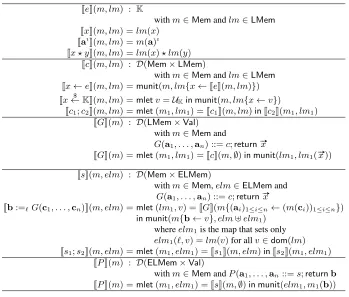
JeK(m, lm) : K
withm∈Memandlm∈LMem
JxK(m, lm) =lm(x) Ja
ı
K(m, lm) =m(a) ı
Jx ? yK(m, lm) =lm(x)? lm(y) JcK(m, lm) : D(Mem×LMem)
withm∈Memandlm∈LMem
Jx←eK(m, lm) =munit(m, lm{x←JeK(m, lm)})
Jx
$
←KK(m, lm) =mletv=UKin munit(m, lm{x←v})
Jc1;c2K(m, lm) =mlet(m1, lm1) =Jc1K(m, lm)inJc2K(m1, lm1) JGK(m) : D(LMem×Val)
withm∈Memand
G(a1, . . . ,an) ::=c;return#»x
JGK(m) =mlet(m1, lm1) =JcK(m,∅)in munit(lm1, lm1(#»x))
JsK(m, elm) : D(Mem×ELMem)
withm∈Mem,elm∈ELMemand
G(a1, . . . ,an) ::=c;return#»x
Jb:=`G(c1, . . . ,cn)K(m, elm) =mlet(lm1, v) =JGK(m{(ai)1≤i≤n←(m(ci))1≤i≤n}) in munit(m{b←v}, elm]elm1)
whereelm1is the map that sets only elm1(`, v) =lm(v)for allv∈dom(lm)
Js1;s2K(m, elm) =mlet(m1, elm1) =Js1K(m, elm)inJs2K(m1, elm1) JPK(m) : D(ELMem×Val)
withm∈MemandP(a1, . . . ,an::=s;returnb
JPK(m) =mlet(m1, elm1) =JsK(m,∅)in munit(elm1, m1(b))
wherem{x1, . . . , xn←v1, . . . , vn}denotes the mapmwherexiis updated withvifor eachi
in increasing order, and]denotes the disjoint union of partial maps.
Fig. 2: Semantics of gadgets and algorithms
11In order to justify that the marginals have the required type, observe that one can refine the type
ofJGKgiven in Figure 2 toMem→ D(Val×(OG→K)). Similarly, one can refine the type
4
Baseline probing security
We first review the basic notion of probabilistic non-interference and state some of its key properties. As usual, we start by introducing a notion of equivalence on memories. Definition 1 LetGbe a gadget, and letI ⊆ IG. Two memoriesm, m0 ∈ Memare
I-equivalent, writtenm∼Im0, wheneverm(a)ı=m0(a)ıfor everyaı∈ I.
Next, we define probabilistic non-interference.
Definition 2 Let G be a gadget, and letI ⊆ IG and O ⊆ OG.G is (I,O) -non-interfering (or(I,O)-NI), iffJGKO(m) = JGKO(m
0)for every m, m0 ∈ Mem s.t. m∼Im0.
For every gadgetGand every position setO, we define the dependency set ofOas
depsetG(O) =T{ I |G
is(I,O)-NI}; thus,depsetG(O)is the smallest setI ⊆IG such thatGis(I,O)-NI.
Lemma 1 LetGbe a gadget andO ⊆OGbe a set of positions inG.Gis(depsetG(O),O) -NI.
Proof (sketch).It suffices to show that there existsIsuch thatGis(I,O)-NIand that for everyIandI0, ifGis(I,O)-NIand(I0,O)-NI, then it is also(I ∩ I0,O)-NI. ut We conclude this section by providing an alternative definition of non-interference, in the style of simulation-based security.
Lemma 2 A gadgetGis(I,O)-NIiff there exists a simulatorSim ∈(I → K) →
D(O →K)such that for everym∈Mem,
JGKO(m) =Sim(m|I)
wherem|Iis the restriction ofmto elements inI.
Proof. For the direct implication, defineSas follows: given a functionm∈ I →K, we letSbeJGKO(m
0), wherem0is any memory that extendsm. It is immediate to check thatSsatisfies the expected property. The reverse direction is immediate.
This observation is useful to connect the information-flow based formulation of probing security introduced below with the simulation-based formulations of probing security often used by cryptographers. Indeed, the dependency setdepsetG(O)can be interpreted as a set ofG’s input shares that is sufficient to perfectly simulate the joint distribution of positions inOto an adversary.
Next we define our baseline notion of probing security, which we call t-non-interference, and state some of its basic properties. The notion oft-non-interference is based on the notion of degree of an input set, which we define first. Given an input setI
and an encoding variablea, we define the setI|a 4
Definition 3 (Probing security) A gadgetGist-non-interfering(ort-NI) whenever kdepsetG(O)k ≤ |O|for everyO ⊆OGsuch that|O| ≤t.
The next lemma establishes thatt-NIis already achieved under a weaker cardinality constraint on the dependency set. Variants of Lemma 3 in simulation-based settings appear in [10,8].
Lemma 3 A gadgetGist-NIiffkdepsetG(O)k ≤tfor everyO ⊆OGs.t. |O| ≤t.
Proof. The direct implication follows from transitivity of≤. The reverse implication proceeds by induction onk=t− |O|. The casek= 0is immediate by definition of t-NI. For the inductive case, letObe such thatt− |O|=k+ 1. Letabe an encoding variable such that|depset(O)|a|=kdepset(O)k. Sincekdepset(O)k ≤ |O| ≤t, there necessarily exists an input positionaısuch thataı∈/depset(O). LetO0=O ∪ {aı}. We havekdepsetG(O0)k ≤ |O0|= 1 +|O|by induction hypothesis andkdepsetG(O0)k=
1 +kdepsetG(O)kby construction, therefore we can conclude. ut The notion oft-non-interference extends readily to algorithms. In addition, one can prove that an algorithm is secure iff the gadget obtained by fully inlining the algorithm is secure.
Lemma 4 A programPist-NIiff the gadgetinline(P)obtained by full inlining ist-NI.
The lemma sheds some intuition on the definition oft-NIfor algorithms. However, we emphasize that verifying fully inlined algorithms is a bad strategy; in fact, previous work indicates that this approach does not scale, and that composition results are needed.
5
Strong Non-Interference
We introduce strong non-interference, a reinforcement of probing security based on a finer analysis of cardinality constraints for dependency sets. Informally, strong non-interference distinguishes between internal and output positions, and requires that the dependency set of a position setOhas degree≤k, i.e. contains at mostkshares of each encoding input, wherekis the number ofinternalpositions inO. Formally, a local variable is anoutput positionforGif it appears in the return tuple ofG, and an internal position otherwise. LetOint (resp.Oext) denote the subset of internal (resp. output) positions of a setO. Strongt-non-interference requires that the degree ofdepset(O)is smaller than|Oint|, rather than|O|. Intuitively, at-SNIgadget information-theoretically hides dependencies between each of its inputs and its outputs, even in the presence of internal probes. This essential property is what supports compositional reasoning. Definition 4 (Strong probing security) A gadgetGist-strongly non-interfering(or
t-SNI) ifkdepsetG(O)k ≤ |Oint|for every position setOsuch that|O| ≤t.
Gadget 4Mask Refreshing Gadgets 0: functionRefreshA(a)
1: c0←a0 2: fori= 1totdo 3: r←$ K
4: c0←c0⊕r 5: ci←ai r
6: returnc
(4a)Addition-Based Mask Refreshing
0: functionRefreshM(a) 1: fori= 0totdo 2: ci←ai
3: fori= 0totdo 4: forj=i+ 1totdo 5: r←$ K
6: ci←ci⊕r
7: cj←cj r 8: returnc
(4b)Multiplication-Based Mask Refreshing
Proposition 1 RefreshM(Gadget 4b) ist-SNI.
On the contrary, the additive refreshing gadgetRefreshA(Gadget 4a) achievesNI but fails to achieveSNI. Interestingly, Coron’s linear-space variant of Ishai, Sahai and Wagner’s multiplication [12, Alg. 6] (Gadget 7) and theMultLingadget for securely multiplying linearly dependent inputs [15, Alg. 5] (Gadget 8) are both strongly non-interfering. The proof ofSNIfor Gadget 7 is easy to adapt to the more standard quadratic-space multiplication gadget, since they compute the same intermediate values in different orders.
Proposition 2 TheSecMultgadget (Gadget 7) ist-SNI.
Proposition 3 TheMultLingadget (Gadget 8) ist-SNI.
The proofs of Propositions 1, 2 and 3 have been machine-checked using Easy-Crypt[5]. We also provide more detailed game-based proof sketches in the full version of this paper.
Strong Non-Interference for Mask Refreshing We now show how choosing at-SNI refreshing gadget over at-NI refreshing gadget critically influences the security of algorithms. Concretely, we provide a separating example, which captures the essence of the flaw in the inversion algorithm of Rivain and Prouff [31]. The example considers two algorithms (Algorithm 5) which compute a cube inGF(28)by squaring and multiplying (using, for illustration purposes, somet-NIgadgetsSquareandMultfor squaring and multiplication). Both algorithms use a refreshing gadget between the two operations, but they differ in which gadget they use:BadCube(Gadget 5a) uses the additive refreshing gagdetRefreshA, which ist-NIbut nott-SNI, andCube(Gadget 5b) uses theRefreshM
Alg. 5Cubing procedures (withK=GF(28)) functionBadCube(x)
y1:=Square(x)
y2:=RefreshA(y1)
z:=Mult(x,y2) returnz
(5a)Insecure Cubing
functionCube(x)
y1 :=Square(x)
y2 :=RefreshM(y1)
z:=Mult(x,y2) returnz
(5b)Secure Cubing
Lemma 5 ([15]) BadCubeis nott-NIfor anyt≥2.Cubeist-NIfor allt.
Coron et al. [15] exhibit proofs for both statements. In Appendix C, we give a compact proof oft-NIforCubethat does not exhaustively consider all(t+ 1)-tuples of positions inCube. The key argument is thatRefreshMbeingt-SNIessentially renders useless any information ony2the adversary may have learned from observing positions inMult: those do not add any shares ofy1to the dependency set we compute forRefreshM, and therefore do not influence the shares ofxthat appear in the final dependency set for
Cube. On the other hand, using a simplet-NImask refreshing gadget (such asRefreshA) in its place breaks the proof by allowing us to deduce only that each position in the multiplication may depend on 2 shares ofx.
In Section 6, we show how the proof of Lemma 5 can be improved and extended into a compositional proof for the (repaired) inversion algorithm of Rivain and Prouff [31], and, in fact, outlines a general mehodology for proving algorithmst-NIort-SNI.
A Generic Composition Result Before formalizing and automating this proof process to obtain precise probing security proofs for large circuits, we now give a coarse but simple composition result that illustrates the generality ofSNI. Informally, an algorithm ist-NIif all its gadgets verifyt-NIand every non-linear usage of an encoding variable is guarded byt-SNIrefreshing gadgets. In addition, it shows that processing all inputs, or the output of at-NIalgorithm with at-SNIgadget (hereRefreshM) suffices to make the algorithmt-SNI.
Proposition 4 An algorithmPist-NIprovided all its gadgets aret-NI, and all encoding variables are used at most once as argument of a gadget call other than RefreshM. MoreoverP ist-SNIif it ist-NIand one of the following holds:
– its return expression isband its last instruction is of the formb:=RefreshM(a);
– its sequence of encoding parameters is(a1, . . . ,an), itsith instruction isb :=i
RefreshM(ai)for1≤i≤n, andaiis not used anywhere else in the algorithm.
6
Enforcing probing policies
Definition 5 (Probing policy)
1. Aprobing assertionis a pair(Γ, φ), whereΓ is a map from encoding variables to expressions in the theory of finite sets, andφis a cardinality constraint. Each probing assertion(Γ, φ)defines a set of subsets of positions for a fixed algorithmP, denoted byJ(Γ, φ)K. (The syntax and semantics of set expressions and cardinality constraints is explained below.)
2. Aprobing policyis a pair of assertions
(Γin, φin)⇐= (Γout, φout)
where(Γout, φout)is thepost-assertionand(Γin, φin)is thepre-assertion.
3. AlgorithmPsatisfies the policy(Γin, φin)⇐= (Γout, φout), writtenP |= (Γin, φin)⇐=
(Γout, φout), if for every position setO ∈J(Γout, φout)K,P is(I,O)-NIfor some
input position setI ∈J(Γin, φin)K.
The syntax of set expressions and cardinality constraints is given by the following grammar:
(set expr.) S:=X | ∅ |S∪S (arith. expr.) l:=|S| | |O`| |t|l+l (cardinality constr.) φ:=l≤l|φ∧φ
The syntax distinguishes between variablesXthat are drawn from a setX of names–that we will use to represent sets of shares of an encoding variable, and variablesO, annotated with a label`, that are drawn from a disjoint setΩof names–that we will use to represent sets of internal positions probed in the gadget used at instruction`.
Remark 1 Our syntax for set expressions and constraints is a fragment of the (decidable) theory of finite sets with cardinality constraints. It would be possible to include other set-theoretical operations, as in [32,3]. However, we have found our core fragment sufficient for our purposes.
The semantics of assertions is defined using the notion of valuation. A valuationµis a mapping from names inXandΩto finite sets, such that∀X∈ X. µ(X)⊆ {0, . . . , t}
and∀O` ∈ Ω. µ(O`) ⊆
OG`, whereG`is the gadget called at instruction`. Every valuationµdefines, for every set expressionS, a set of share indicesµ(S)⊆ {0, . . . , t}
and for every arithmetic expressionl an interpretationµ(l) ∈ N, using the intended interpetation of symbols (i.e. ∪is interpreted as set union,+is interpreted as addition, . . . ).
Definition 6 (Interpretation of assertions)
1. µsatisfies a cardinality constraintφ, writtenµ |=φ, ifµ(l1) ≤µ(l2)for every conjunctl1≤l2ofφ.
2. The interpretation ofΓ underµis the set
µ(Γ) =[
a
{aı|ı∈µ(Γ(a))} ∪[
O µ(O)
3. The interpretation of(Γ, φ)is the set
We now turn to the definition of the type system.
Definition 7 AlgorithmP(a1, . . . ,an) ::=s;returnrhas type(Γin, φin)⇐= (Γout, φout)
if the judgment`s: (Γin, φin)⇐= (Γout, φout)is derivable using the typing rules from
Figure 3. We denote this fact`P : (Γin, φin)⇐= (Γout, φout).
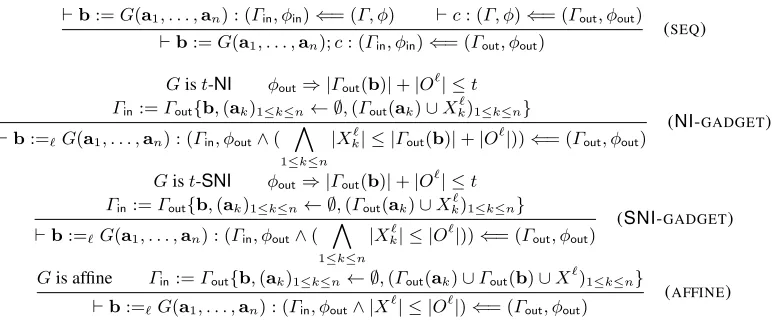
We briefly comment on the rules. Rule (SEQ) is used for typing the sequential composition of gadget calls and is as expected. The remaining rules are used for interpreting the non-interference properties of gadgets. We now detail them.
`b:=G(a1, . . . ,an) : (Γin, φin)⇐= (Γ, φ) `c: (Γ, φ)⇐= (Γout, φout) `b:=G(a1, . . . ,an);c: (Γin, φin)⇐= (Γout, φout)
(SEQ)
Gist-NI φout⇒ |Γout(b)|+|O`| ≤t
Γin:=Γout{b,(ak)1≤k≤n← ∅,(Γout(ak)∪Xk`)1≤k≤n}
`b:=`G(a1, . . . ,an) : (Γin, φout∧( ^
1≤k≤n
|Xk`| ≤ |Γout(b)|+|O`|))⇐= (Γout, φout)
(NI-GADGET)
Gist-SNI φout⇒ |Γout(b)|+|O`| ≤t
Γin:=Γout{b,(ak)1≤k≤n← ∅,(Γout(ak)∪Xk`)1≤k≤n}
`b:=`G(a1, . . . ,an) : (Γin, φout∧( ^
1≤k≤n
|Xk`| ≤ |O `
|))⇐= (Γout, φout)
(SNI-GADGET)
Gis affine Γin:=Γout{b,(ak)1≤k≤n← ∅,(Γout(ak)∪Γout(b)∪X`)1≤k≤n}
`b:=`G(a1, . . . ,an) : (Γin, φout∧ |X`| ≤ |O`|)⇐= (Γout, φout)
(AFFINE)
whereΓ{∀k. vk← ∀k. ek}stands for the mapΓ where eachvkis updated to map toekand all
other indices are left untouched.
Fig. 3: Typing rules
Rule (SNI-GADGET) is used for typing calls to aSNI-gadget with an arbitrary post-assertion and a pre-assertion in which the mappingΓout is updated to reflect the dependencies created by the call, and the constraint is strenghtened with the cardinality constraint imposed by strong non-interference. The rule has a side condition|O`|+
|Γout(b)| ≤tensuring that the total number of positions whose dependency set byG we are considering is bounded byt, whereO`is the name of the subset of positions that are observed in the current gadget (called at line`), andΓout(b)is the set of shares ofbthe adversary has information about from positions probed in gadgets that use blater on in the algorithm. This side condition is verified under the conditionφout. Note that the variablesX`
k are fresh, and annotated with the label`that identifies the current instruction, and an indicekthat identifies the argument. Rule (NI-GADGET) is similar but deals withNI-gadgets, and therefore extendsΓin with correspondingly weaker constraints on theX`
k.
example, multiplication by a constant–or public–scalar, or shifts in the representation when addition is bitwise). Formally, we say that a gadgetGwith parameters(a1, . . . ,an) is affine iff there exists a family of proceduresf0, . . . , ftsuch thatGis an inlining of
x0←f0(a0
1, . . . ,a0n);. . .;xt←ft(at1, . . . ,atn); returnhx0, . . . , xti;
Thus, one can define a mappingη : OG → {0, . . . , t}such that for every position π∈ OG,η(π) =ıifπoccurs in the computation of theıthshare (i.e. in the computation offı(aı1, . . . , aın)). The fine-grained information about dependencies given by this notion of affinity is often critical to proving the probing security of algorithms. Therefore, it is important to capture affinity in our type system. LetO=Oint] Oextbe a position set, split between internal and output positions. The affine property ensures that the joint distribution ofOdepends only on input positions inη(Oint∪ Oext), and furthermore that|η(Oint∪ Oext)| = |η(Oint)|+|η(Oext)| = |η(Oint)|+|Oext|. Rule(AFFINE) interprets this affine property into our type system, usingΓout(b)and a freshO`for
OextandOint, respectively, and encodingη(O`)into an abstract existential setX`. The condition|X`| ≤ |O`|precisely captures the fact that|η(O)| ≤ |O|for allO.
Definition 8 (Typing of an algorithm) LetPbe an algorithm with a definition of the formP(a1, . . . ,an) ::=s;returnr.
P is well-typed forNI, written`NI P, whenever there exist Γin,φin such that
` P : (Γin, φin) ⇐= (∅,P1≤`≤|P||O`| ≤ t)and, for eachi ∈ {1, . . . , n},φin ⇒
|Γin(ai)| ≤t.
P is well-typed forSNI, written`SNI P, whenever there existΓin,φinsuch that
`P : (Γin, φin)⇐= ([r←O],|O|+P1≤`≤|P||O`| ≤t)and, for eachi∈ {1, . . . , n},
we haveφin⇒ |Γin(ai)| ≤P1≤`≤|P||O`|(where[v←x]is the map that associatesx
tovand is everywhere else undefined).
When typing forNI, we start from the empty map forΓoutand simply consider any output position observed as if they were internal. However, the same cannot be done when typing forSNIsince we need to distinguish clearly between internal positions in one of theO`, used to type the gadget at instruction`, and output positions inO, initially used as the set of position of the algorithm’s return encoding.
Proposition 5 (Soundness of the Type System)
If `s: (Γin, φin)⇐= (Γout, φout)then also|=P : (Γin, φin)⇐= (Γout, φout)
If `NIP thenPist-NI If `SNIP thenPist-SNI
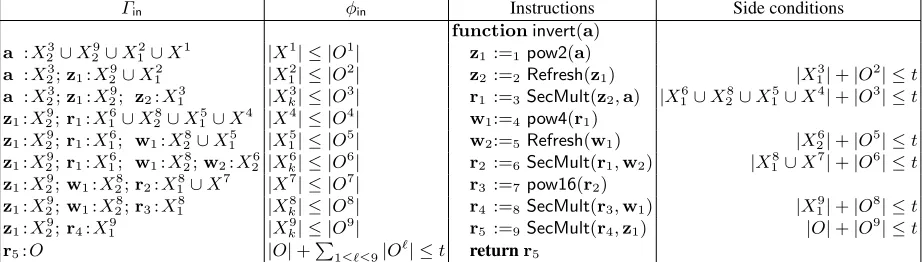
An Example: Rivain and Prouff ’s inversion algorithm We now illustrate the type system by describing a typing derivation on Rivain and Prouff’s algorithm for computing inversion in GF(28)[31,15]. An algorithm implementing this operation securely is shown in Figure 4, with some information relevant to its typing derivation. We recall that the functionx7→x2nis linear (for anyn) in binary fields and rely on affine gadgets
We present the typing derivation in the slightly unusual form of a table, in Figure 4, which shows the code of the inversion algorithm along with the values ofΓinandφin(φin shows only the part of the constraint that isaddedat that program point, not the entire constraint) at each program point. By the sequence rule, these serve asΓout andφout for the immediately preceding program point. The table also shows the side conditions checked during the application of gadget rules where relevant. It is easier to understand the type-checking process by reading the table from the bottom up.
As per the definition of well-typedness forSNI, we start from a state where the output position setOis associated to the algorithm’s return encodingr5, and where the constraint contains only the global constraint that the whole position setO∪S
`O `is of cardinality bounded byt. When treating line 9, we know thatSecMultist-SNIand try to apply rule (SNI-GADGET). We check that the number of positions observed in this instance ofSecMultis bounded byt(which trivially follows from the global constraint), and construct the new value of(Γin, φin)following the rule: since neither of the call’s input encodings are used below, new setsX9
1andX29are associated to the call’s inputs and theSNIconstraints are added toφin. Applying the rules further until the top of the program is reached, and performing the appropriate set unions inΓ when an encoding variable is used more than once, we observe that the resulting pre-assertion is such that
|Γin(a)| ≤ |O1|+|O2|+|O3|+|O9| ≤P`O`, and therefore proves that this inversion algorithm ist-SNI.
Γin φin Instructions Side conditions
functioninvert(a)
a :X3
2∪X29∪X12∪X1 |X1| ≤ |O1| z1:=1pow2(a)
a :X23;z1:X29∪X12 |X12| ≤ |O2| z2:=2Refresh(z1) |X13|+|O2| ≤t
a :X3
2;z1:X29; z2:X13 |Xk3| ≤ |O3| r1 :=3SecMult(z2,a) |X16∪X28∪X15∪X4|+|O3| ≤t
z1:X29;r1:X16∪X28∪X15∪X4 |X4| ≤ |O4| w1:=4pow4(r1)
z1:X29;r1:X16; w1:X28∪X 5 1 |X
5 1| ≤ |O
5|
w2:=5Refresh(w1) |X26|+|O
5| ≤ t
z1:X29;r1:X16; w1:X28;w2:X26 |Xk6| ≤ |O6| r2 :=6SecMult(r1,w2) |X18∪X7|+|O6| ≤t
z1:X29;w1:X28;r2:X18∪X7 |X7| ≤ |O7| r3 :=7pow16(r2)
z1:X29;w1:X28;r3:X18 |Xk8| ≤ |O8| r4 :=8SecMult(r3,w1) |X19|+|O8| ≤t
z1:X29;r4:X19 |Xk9| ≤ |O
9|
r5 :=9SecMult(r4,z1) |O|+|O9| ≤t
r5:O |O|+P1≤`≤9|O
`| ≤
t returnr5
Fig. 4:a−1inGF(28)
Finally, one can remark that the instances ofSecMultat line 6 and 8 do not in fact need to bet-SNI. As pointed out by Bela¨ıd et al. [8], using at-NImultiplication gadget at these program points is sufficient to construct a type derivation forSNI.
7
SNI Checker for Gadgets
Verification algorithm We adapt tot-SNIthe algorithmic contributions of Barthe et al. [4] that support the automated verification, on small to medium gadgets and for small orders, of Ishai, Sahai and Wagner’s circuit privacy property [24], which is similar to our t-NI. Their work builds on two observations: first, every probabilistic programPtaking inputxand performing a (statically) bounded number (sayq) of uniform samplings over Kis equivalent, in the sense below, to composing a deterministic programP† taking inputsxandrwith random sampling overKq. Formally, for everyx,
JPK(x) =mletr=UKq inJP †
KO(x, r)
Second,Psatisfies(I,O)-NIiff there exists a functionf such that for everyx1,x2and r, such thatx1∼Ix2
JP †
KO(x1, r) =JP †
KO(x2, f(x2, r))
and moreoverf(x,·)is a bijection for everyx. The latter equality can be easily verified for allxandrusing standard tools, therefore the key to proving non-interference is to exhibit a suitable functionf. Their algorithm proceeds by incrementally defining bijec-tionsf1, . . . , fnsatisfying the two conditions above until evenutallyJP†KO(x, fn(x, r)) can be rewritten into an expression that does not depend syntactically on secrets.
However, even with efficient algorithms to prove that a programPis(I,O)-NIfor some position setO, proving thatPist-NIremains a complex task: indeed this involves proving(I,O)-NIfor allOwith|O| ≤ t. Simply enumerating all possible position sets quickly becomes untractable asP andtgrow. Therefore, [4] uses the following fact: ifPis(I,O0)-NIthen it is also(I,O)-NIfor allO ⊆ O0. Hence, checking thatP is(I,O0)-NIfor some large setO0is sufficient to prove thatPis(I,O)-NIfor every
O ⊆ O0, and this using only one proof of non-interference. In particular, they exhibit algorithms that rely on the explicit construction of the bijectionfnto efficiently extend the setOfrom which it was constructed into a potentially much larger setO0for which that bijection still proves(I,O0)-NI. Further, they also exhibit algorithms that rely on such extensions to prove the existence ofIsuch that(I,O)-NIfor all position setsO
much more efficiently than by considering all position sets individually.
We adapt their algorithms by changing the core bijection-finding algorithm in two ways: i. rather than being applied to a modified program that includes the initial uniform sampling of secret encodings, our core algorithm works directly on the gadget description (this is necessary to ensure that we provet-SNIinstead of alternative security notions); and ii. our search for a bijection stops whenJP†KO(x, fn(x, r))can be simplified into an expression that syntactically depends on at mostdshares of the secret (for the desired bounddonkIk, that isd=|Oint|forSNI), rather than stopping when all syntactic dependencies on the secret input have been removed. We note that replacing the boundd from the second point withd=tyields a verification algorithm fort-NI(by Lemma 3). Our full algorithm is given in App. B.
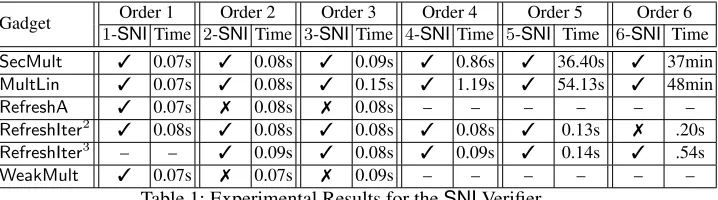
Evaluation We evaluate the performance of ourSNIverifier on some medium and small gadgets:SecMult,Coron’s linear-memory ring multiplication algorithm [12, Alg. 6];
Gadget Order 1 Order 2 Order 3 Order 4 Order 5 Order 6 1-SNI Time 2-SNI Time 3-SNITime 4-SNITime 5-SNI Time 6-SNI Time
SecMult 3 0.07s 3 0.08s 3 0.09s 3 0.86s 3 36.40s 3 37min
MultLin 3 0.07s 3 0.08s 3 0.15s 3 1.19s 3 54.13s 3 48min
RefreshA 3 0.07s 7 0.08s 7 0.08s – – – – – –
RefreshIter2 3 0.08s 3 0.08s 3 0.08s 3 0.08s 3 0.13s 7 .20s
RefreshIter3 – – 3 0.09s 3 0.08s 3 0.09s 3 0.14s 3 .54s
WeakMult 3 0.07s 7 0.07s 7 0.09s – – – – – –
Table 1: Experimental Results for theSNIVerifier
of two encodings;RefreshA,the weakly secure mask refreshing algorithm from Rivain and Prouff [31];RefreshIterk,the iterated additive refresh proposed by Coron [12, Alg. 4] for supporting more efficient composition in his full model (we make explicit the number of iterationsk);WeakMult,the generic reduced-randomness multiplication algorithm proposed by Bela¨ıd et al. [8]. Table 1 sums up our findings and some verification statistics.
8
Masking Transformation
As a proof of concept, we implement our type system for a comfortable subset of C that includes basic operators, static for loops, table lookups at public indices, and mutable secret state, and extended with libraries that implement core gadgets for some choices of K. Moreover, we define a source-to-sourcecertifying masking transformation, which takes an unprotected program and returns a masked algorithm accepted by our type system, selectively inserting refreshing gadgets as required for typing to succeed. We note that the transformation itself need not be trusted, since its result is the final program on which typing is performed.
Furthermore, the choice of C as a supporting language is for convenience, since many of the algorithms we consider have reference implementations written in C. In particular, we do not claim that compiling and executing the C programs produced by our masking transformation will automatically yield secure executables: our verification results are onalgorithmsdescribed in the C language rather than on C programs in general. Making use of these verification results in practice still requires to take into account details not taken into account in the probing model. Although an important problem, this is out of the scope of this paper and a research area on its own: for example Balasch et al. [2] consider some of the issues involved in securely implementing probing secure algorithms.
8.1 Implementation
that must be encoded. We call public type any type outside of those used for denoting variables that must be encoded.
Parsing and Pre-Typing This pass parses C code into our internal representation, checks that the program is within the supported subset of C, performs C type-checking and checks that variables marked as sensitive (variables given typeK) are never implicitly cast to public types. Implicit casts from public types toK(when compatible, for example, when casting a publicuint8 tto a protected variable inGF(28)) are replaced with public encoding gadgets (that set one share to the public value and all other shares to 0).
Gadget Selection and Generic Optimizations This pass heuristically selects optimal gadgets depending on their usage. For example, multiplication of a secret by a public value can be computed by an affine gadget that multiplies each share of the secret, whereas the multiplication of two secrets must be performed using theSecMultgadget. Further efforts in formally proving precise types for specialized core gadgets may also improve this optimization step. Since the encoding replaces scalar-typed variables (passed by value) with array-typed variables (passed by reference), it is also necessary to slightly transform the program to ensure the correctness of the resulting program. In addition, we also transform the input program into a form that more closely follows the abstract language from Figure 1, which makes it easier to type-check.
Type Inference and Refresh Insertion This is the core of our transformation. We imple-ment a type inference algorithm for the type system of Section 6. The algorithm simplifies policies on the fly, supports inferred types on sub-algorithms as gadget-invocation types, and fails when the simplified policy is inconsistent. Failure arises exactly when a refresh-ing operation is needed. At the cost of trackrefresh-ing some more information and reinforcrefresh-ing the typing constraint on sub-algorithms, we use this observation to automatically insert
Refreshgadgets where required. When type inference fails, the variable whose masks need to be refreshed is duplicated and one of its uses is replaced with the refreshed duplicate. To avoid having to re-type the entire program after insertion of a refresh gadget, our transformation keeps track of typing information for each program point already traversed and simply rewinds the typing to the program point immediately after the modification.
8.2 Practical Evaluation
To test the effectiveness of our transformation, we apply it to different algorithms, generating equivalent masked algorithms at various orders. We apply our transformation to the following programs: AES (),a full computation (10 rounds including key schedule) of AES-128 masked using the multiplication gadget, and implemented in
GF(28); AES (xg(x)),a full computation (10 rounds including key schedule) of AES-128 masked using Coron et al.’s gadget for computingxg(x), and implemented inGF(28);Keccak,a full computation (24 rounds) of Keccak-f[1600], implemented inGF(264); Simon,a block of Simon(128,128), implemented inGF(264);Speck,a block of Speck(128,128), implemented in GF(2)64, and using one of the following modular addition algorithms;AddLin,Coron, Großsch¨adl and Vadnala’s algorithm [14] for the computation of modular addition on boolean-masked variables (inGF(2)64); AddLog,Coron et al.’s improved algorithm [13] for the computation of modular addition on boolean-masked variables (inGF(2)64). We first discuss the performance of our verifier and the verification results before discussing the practical significance, in terms of time, memory and randomness complexity of our masking transformation. Finally, we discuss examples on which our tool implementation could be improved.
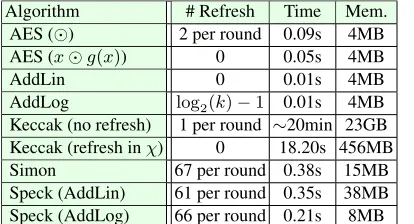
Verification Performance and Results Table 2 shows resource usage statistics for gener-ating the masked algorithms (at any order) from unprotected implementations of each algorithm. The table shows the number of mask refreshing operations inserted in the program12, the compilation time, and the memory consumption. For Keccak, we show two separate sets of figures: the first, marked “no refresh”, is produced by running our algorithm transformer on a bare implementation of the algorithm; the second, marked “refresh inχ”, is produced by running our tool on an annotated implementation, where a mask refreshing operation is manually inserted in theχfunction and the tool used for verification only. We discuss discrepancies between the numbers on these two lines in Section 9, and consider the “refresh inχ” set of statistics in all discussions until then. We first note the significant improvements these results represent over the state of the art in formal verification for probing security. Indeed, our closest competitor [4] report the verification of all 10 rounds of AES (including key schedule) at order 1 in 10 minutes, and could not verify all 10 rounds for higher orders. In contrast, our tool verifies the probing security of Rivain and Prouff’s algorithm [31] as fixed by Coron et al. [15]at all ordersin less than a second.13Further, we note that the masked algorithms our transformation produce for modular addition are the first such algorithms known to bet-probing secure using onlyt+ 1shares. Indeed, the original proofs [14,13] rely on the ISW framework and make use of2t+ 1shares to obtaint-probing security. We further note that Coron, Großsch¨adl and Vadnala’s algorithm [14] does not require the insertion of mask refreshing operations, and is thust-probing secure witht+ 1shares as it was originally described. Finally, we note that, to the best of our knowledge, the
12
Note that the number of mask refreshing operations executed during an execution of the algorithm may be much greater, since the sub-procedure in which the insertion occurs may be called multiple times.
results obtained on Keccak, Simon and Speck constitute the first generic higher-order masking schemes for these algorithms.
Algorithm # Refresh Time Mem.
AES () 2 per round 0.09s 4MB
AES (xg(x)) 0 0.05s 4MB
AddLin 0 0.01s 4MB
AddLog log2(k)−1 0.01s 4MB Keccak (no refresh) 1 per round ∼20min 23GB Keccak (refresh inχ) 0 18.20s 456MB
Simon 67 per round 0.38s 15MB
Speck (AddLin) 61 per round 0.35s 38MB Speck (AddLog) 66 per round 0.21s 8MB Table 2: Resource usage during masking and verification
Performance of Masked Algorithms Table 3 reports the time taken to execute the resulting programs 10,000 times at various orders on an Intel(R) Xeon(R) CPU E5-2667 0 @ 2.90GHz with 64GB of memory running Linux (Fedora). As an additional test to assess the performance of the generated algorithms at very high orders, we masked an AES computation at order 100: computation took∼0.11 seconds per block. For AES and Speck, the figures shown in the “unmasked” column are execution times for the input to our transformation: a table-based implementation of AES or an implementation of Speck that uses machine arithmetic, rather than Coron, Großsch¨adl and Vadnala’s algorithm would be much faster, but cannot be masked directly using our transformation. Although these observations do highlight the cost of security, we note that usingRefreshAwhen masking the AES SBox does not incur a significant timing gain for any of the masking orders we tested (t≤20). However, the randomness cost is greatly reduced, which may be significant in hardware or embedded software settings. Further research in reducing the randomness cost ofSNImask refreshing, or of other gadgets, serves to make security less costly [8,1,6]. We also confirm the 15% timing improvements reported by Coron et al. [15] when implementing the AES SBox using their gadget for computingxg(x).
Algorithm unmasked Order 1 Order 2 Order 3 Order 5 Order 10 Order 15 Order 20 AES () 0.078s 2.697s 3.326s 4.516s 8.161s 21.318s 38.007s 59.567s AES (xg(x)) 0.078s 2.278s 3.209s 4.368s 7.707s 17.875s 32.552s 50.588s Keccak 0.238s 1.572s 3.057s 5.801s 13.505s 42.764s 92.476s 156.050s
We now look more closely at statistics for the modular addition algorithms AddLin and AddLog and their effects on the performance of masked algorithms for Speck. We first note that proving AddLogt-NIrequires the addition of a mask refreshing gadget, whereas AddLin does not. Despite this additional cost, however, AddLog is better than AddLin when word sizekgrows, since it savesk−log(k)multiplications and replaces them with a single mask refreshing operation. These performance gains on modular addition become overwhelming when seen in the context of a masked algorithm for Speck, which computes one 64-bit modular addition per round. It would be interesting to consider using our transformer to produce masked algorithms for other efficient circuits for modular addition [26] and measure their performance impact in terms of randomness, time and memory when masked.
9
Discussions and Related Work
Here, we further discuss the relation between the definitions and results reported here and existing and future work in theoretical and practical cryptography. Our discussions focus mainly on: i. adversary and leakage models; ii. compositional security notions; iii. theoretical and practical masking transformations; and iv. limitations of our definitions and tools.
Adversary and Leakage Models for Masking We have considered security in the probing model of Ishai, Sahai and Wagner [24], which is particularly well-suited to automated analysis due to its tight relation to probabilistic non-interference. In particular, our notion oft-NIis equivalent to the notions oft-probing securityandperfectt-probing security
used by Carlet et al. [10] and others [31,15].
Despite its broad usage in the literature, the practical relevance of the probing model is not immediately obvious: in practice, side-channel adversaries observeleakage traces, which contain noisy information about all intermediate computations, rather than precise information about some. This threat model is much more closely captured by the
noisy leakage model, first introduced by Chari et al. [11] and extended by Prouff and Rivain [30]. The noisy leakage model is much more complex and makes security proofs on masked algorithms significantly more involved, and much harder to verify.
Duc, Dziembowski and Faust [17] show that proving probing security allows one to estimate the practical (noisy leakage) security of a masked algorithm. While Duc, Faust and Standaert [18] empirically show that some of the factors of Ducet al.’s bound [17] are likely proof artefacts, the remainder of the bound, and in particular a factor that includes the size of the circuit, seems to be tight. Intuitively, Ducet al.[18] essentially show that the probing security order gives an indication of the smallest order moment of the distribution over leakage traces that contains information about the secret, whereas the size of the circuit the adversary can probe is an indicator of how easy it is to evaluate higher-order moments.
For example, each core gadget (field operations and mask refreshing operation) could be marked off as a separate region (as in [17]). More recently, and in work contempo-rary with that presented here, Andrychowicz, Dziembowski and Faust [1] consider a more general notion of region whose size must be linear in the security parameter (and masking order), and exhibit a mask refreshing gadget that is linear in size and fulfills, in the probing model, thereconstructibilityandre-randomizationproperties from Faust et al. [21]. We now discuss the implications of reconstructibility and re-randomization, and their relation to our notion ofSNI, based on the similarity of Prop. 4 with Ishaiet al.’s remark on “Re-randomized outputs” [24], before discussing the applicability ofSNIto security in the region and stateful probing models [24].
Intuitively, a gadget is t-reconstructible whenever anyt of its positions can be simulated using only its (shared) inputs and outputs, and a gadget is re-randomizing whenever its output encoding is uniform andt-wise independent even if its input encoding is completely known. OurSNInotions combines both considerations. Formulating it in similar terms, a gadget ist-SNIwhenever anytof its positions can be simulated using only its (shared) inputs, and if its output encoding is uniform and(t−d)-wise independent even ifdshares of each of its inputs are known (for alldsuch that0≤d < t). Expressed in this way, it is clear thatSNIis slightly weaker than “reconstructible and re-randomizable” in the probing model. This allows us to automatically verify that a gadget isSNIfor some fixedt, whereas reconstructibility and re-randomization are more complex. In addition, the ability to combine the use ofSNIand weaker (NIor affine) gadgets in a fine-grained way allows us to more precisely verify the security of large algorithms in models where the adversary can placetprobes in the entire algorithm. We leave a formal investigation of the relation betweenSNIand “reconstructibility and re-randomization” as future work.
Based on reconstructibility and re-randomization, Faust et al. [21,1] prove elegant and powerful composition results that in fact apply in the more powerful region probing and stateful probing models [24], where the adversary may (adaptively) placetprobes in each region (or in each subsequent iteration) of the algorithm. It is worth noting that ourSNInotion also enables composition in these two models: indeed, it is easy to see that any two2t-SNIalgorithms (our regions) can be composed securely when the adversary can placetprobes in each of them. Further, our composition techniques also support elegant constructions that support compositional security proofs in the region and stateful probing models without doubling the number of shares computations are carried out on (instead, simply doubling the number of shares at region boundaries). We give details of theserobust compositionresults in Appendix D. Depending on the size of regions that are considered, these robust composition results may bring significant performance gains in terms of randomness and time complexity.
Finally, our notion ofSNIand the automated verification techniques presented allow the efficient, precise and automated verification oft-SNIinside each region, an issue which is not addressed by the works of Faust et al. [21,1].
computations occur–with a quadratic impact on performance and randomness complexity. Faust et al. [17,1] rely on making sure that all gadgets used in the masked algorithm are reconstructible and re-randomizing. This guarantees security in a stronger probing model, but incurs an even greater loss of performance. By contrast, our transformation attempts to decide whether a mask refreshing operation is required to ensure security in the probing model, and our core contributions (the notion ofSNIand the type-checker) do support composition in stronger probing models, whilst still allowing the proofs of security within regions to be handled precisely.
Coron [12] proposes schemes for masking lookups at secret or sensitive indices in public tables. We have not investigated whether or not the proposed algorithms are SNI or simplyNI, and whether or not establishing these properties can be done by adapting our type-system or if it should be done in a different way (either as a direct proof or using the checker from Section 7). We note in passing that part of the result by Coron [12], namely that usingRefreshIter2t+12t between each query to the masked S-box supports security in the stateful probing model is subsumed and improved by the robust composition results described in the full version.
The security analysis of masking schemes in thet-probing model is connected to techniques from multi-party computation, exploited in parallel lines of research by threshold implementations [28,9]. In particular, higher-order threshold implementations are exposed to similar security issues due to composition, although they offer additional protection against practical considerations not captured in standard probing models, namelyglitches. We believe that the results discussed here are in fact applicable to the compositional security analysis of threshold implementations but leave a formal investigation of these links as future work.
RefiningSNI We now discuss some limitations of our current implementation, and leads for future theoretical work that may yield significant practical improvements.
Alg. 6Semi Public Modular Addition inGF(2)k functionAddPub(x, y)
w:=xy
a:=x⊕y
u:=w1 fori= 2tok−1do
a0:=RefreshM(a)
ua:=ua0 u:=ua⊕w u:=u1
z:=a⊕u
returnz
(6a)Masked algorithm produced by our tool
functionAddPub(x, y)
w:=xy
a:=x⊕y
w:=RefreshM(w)
u:=w1 fori= 2tok−1do
ua:=ua u:=ua⊕w u:=u1
z:=a⊕u
returnz
(6b)Masked algorithm produced by hand
indeed, our tool unrolls them to perform type-checking and rolls them back up afterwards if possible (otherwise leaving them unrolled in the final algorithm). For smaller algo-rithms, this is not a problem, but unrolling all 24 rounds of Keccak-f, along with all the loops internal to each iteration, yields a very large program that is then backtracked over each time a mask refreshing operation is inserted. Refining our non-interference notions to multi-output gadgets and algorithms would allow us to significantly improve our tool’s handling of loops and high-level composition, whilst gaining a better understanding of probing security in such scenarios. This improved understanding may in turn help inform the design of primitives that are easier to protect against higher-order probing.
Second, we discuss our greedy policy for the insertion of mask refreshing algorithms. In our experiments, we consider a version of the linear-time modular addition algo-rithm [14] whose second argument is a public (non-shared) value (for example, a round counter, as in Speck). We show its code, as produced by our masking transformer, in Gadget 6a, and display a hand-masked variant in Gadget 6b, slightly abusing notations by denoting simple gadgets with the symbol typically used for their unprotected versions. Notice that the variablewis used once per loop iteration, and that our tool refreshes each of them, while it is sufficient to mask only the first one. Improving our gadget selection algorithm to detect and implement this optimization—and others—would be an interesting avenue for future work, that could help improve our understanding of the effect on security of compiler optimizations.
Acknowledgements The work presented here was supported by projects S2013/ICE-2731 N-GREENS Software-CM, ANR-10-SEGI-015 PRINCE and ANR-14-CE28-0015 BRUTUS, and ONR Grants N000141210914 and N000141512750, as well as FP7 Marie Curie Actions-COFUND 291803.
References
1. Marcin Andrychowicz, Stefan Dziembowski, and Sebastian Faust. Circuit compilers with O(1/log(n))leakage rate. InEUROCRYPT 2016, LNCS, pages 586–615. Springer, Heidel-berg, 2016.
2. Josep Balasch, Benedikt Gierlichs, Vincent Grosso, Oscar Reparaz, and Franc¸ois-Xavier Stan-daert. On the cost of lazy engineering for masked software implementations. InProceedings of the Smart Card Research and Advanced Application Conference (CARDIS), volume 8968 ofLNCS, pages 64–81. Springer, Heidelberg, November 2014.
3. Kshitij Bansal, Andrew Reynolds, Clark Barrett, and Cesare Tinelli. A new decision procedure for finite sets and cardinality constraints in SMT. InProceedings of the 8th International Joint Conference on Automated Reasoning (IJCAR), volume 9706 ofLNCS, pages 82–98, June 2016.
4. Gilles Barthe, Sonia Bela¨ıd, Franc¸ois Dupressoir, Pierre-Alain Fouque, Benjamin Gr´egoire, and Pierre-Yves Strub. Verified proofs of higher-order masking. In Elisabeth Oswald and Marc Fischlin, editors,EUROCRYPT 2015, Part I, volume 9056 ofLNCS, pages 457–485. Springer, Heidelberg, April 2015.