A Novel Approach for Digital Image Encryption
based on Pixel Explosion Techniques
Shusama Tripathi1, Prof. Rishi Sharma2
MTech Scholar, Department of Electronics & Communication Engineering, OIST, Bhopal, M.P, India 1
Assistant Professor, Department of Electronics & Communication Engineering, OIST, Bhopal, M.P, India 2
ABSTRACT: Presently a day's advanced India ubiquity, associations are proposing various structures concentrating on computerized encryption systems. Because of the simplicity of duplicating, altering, and altering of computerized reports and pictures has prompted scrambling the data obligatory for transmission and capacity. It apparent that the relationship between's the picture pixels to its neighborhood area is high, decreasing connection between's the pixels esteem makes it hard to figure for the first picture and along these lines enhance the security. In this paper, we present a novel picture encryption strategy which at first revamps the picture based on exchanging dim codes and pixel blast. The pixel blast utilizes all around characterized key that switches between the dim codes of the picture pixels. Exploratory outcomes would demonstrate that the proposed pixel blast is sufficient for halfway encryption and upgrades security of the information. Further, it could likewise bolster as a combat hardware for any current calculation.
KEYWORDS: Encryption, Gray-Code, Pixel Displacement, Authentication
I. INTRODUCTION
In current time, as the computerized India is picking up the force, the security related with advanced record and pictures is turning into a dynamic research zone. Moreover, quick improvements in the cutting edge correspondence framework have permitted the exponential ascent in information exchange over the system effortlessly. Presently a-days, it clear and recorded that there is a noteworthy ascent in the secrecy break of certain touchy information because of increment in the quantity of aggressors. As a rule, the vast majority of the aggressors concentrate on misusing mystery data as the exchange of information and data occur through web is of high volume. As it is open-free channel constraining the entrance would hamper the execution and unwavering quality of the channel. Thus to neutralize this defenselessness, numerous scientists have thought of proficient calculations to encode the computerized data before transmission and capacity in open-community channels.
Encryption is a science that arrangements with the change of information into a shape that is muddled to any watcher without the proper learning (a key or code) [1]; truly it changes plain content into figures. Encryption is the exploration of utilizing arithmetic based change to scramble or decode the information. Encryption is utilized to keep information from the unapproved get to which decreases the likelihood of unapproved get to a few times and just the approved faculty's having the key is permitted to get to it. The fundamental consideration has now moved towards improved and secure correspondence. From these the data security is most driving territory of research. The framework in any condition ought to be sufficiently secure to confine any sort of unapproved get to and just the approved faculty should just be permitted to get to the data.
additional time in view of mass picture information (pixel esteems) in all the three layers. It ought to be noticed that these encryption and unscrambling operations are guided by some particular keys, where the keys might be same or can be effortlessly gotten from the information. Such cryptographic procedures are gathered under private key cryptography [5], [6]. On the other hand, encryption and unscrambling keys might be extraordinary or it may not be plausible to determine one key despite the fact that the learning of other key is accessible, and such cryptographic techniques are known as open key cryptography [4].
A very much characterized encryption ought to limit the connection between's the pixels as well as sufficiently quick to execute rapidly while scrambling information. Moreover, the great encryption plan ought to give both protection and security and is lossless in nature. It ought to be sufficiently intense to have insusceptibility against cryptanalysis and has a multi target issue limiting the relationship affected among the pixels. So it is essential to lessen the relationship between's the encompassing pixels and increment the level of irregularity of the picture. Be that as it may, it can't stop an insider (representative, doctor, seller, business accomplice, and so on.) to get to the private data.
II. LITERATURE SURVEY
In this segment, a detail study on existing advanced picture control calculations that are promptly accessible for computerized encryption is introduced. It is extremely easy to mess with any picture and make it accessible to others by showing proprietorship, confirmation evidence. In this way fore, protecting computerized media uprightness has in this manner turn into a noteworthy worry among the analysts in the current advanced period. Encryption is a standout amongst the most well-known strategies for consolidated by associations as apparatus for respectability authorization, secured correspondence, altered confirmation channel and verification. In this paper, we exhibit a novel picture encryption strategy which at first revamps the picture based on exchanging dim codes and pixel blast at that point completes existing encryption calculations. Contrasted with the strategies and conventions for security generally utilized to play out this undertaking, a specific accentuation on connection between's the neighbor-hood pixels.
Some effective ways are proposed by Disorder based cryptographic calculations to create secure picture encryption methods. A picture encryption in view of hyper-disorderly guide meets the prerequisites of the protected picture exchange. The ergodic grid of one hyper-turbulent grouping is utilized to permute picture, the type of which is chosen by a tumultuous calculated guide, the other hyper-clamorous arrangement is utilized to diffuse permuted picture. To make the figure more hearty against any assault, we need to process a few rounds of change and dispersion. The underlying states of the hyper-turbulent guide are changed after each round. The consequences of different exploratory, measurable examination and key affectability tests demonstrates that the proposed picture encryption plot gives a productive, compelling and secure route for picture encryption and transmission [7].
M-Succession in view of Picture scrambling parameter can be delivered by a progression of move registers is presented as pseudo encryption calculation. Likewise, the parametric M-grouping is abused wherein; the client can change the security keys, r, which demonstrates the quantity of actualized move operations , or the separation parameter p, to create a wide range of M-successions. Subsequently guaranteeing the mixed pictures are hard to interpret while offering an abnormal state of security assurance for the pictures. The calculation exhibited here can scramble the 2-D or 3-D pictures in a single step. It likewise calculations safe against the picture assaults, for example, information misfortune and clamor assaults [8]. The calculation can be connected in the constant applications as it is a direct procedure and can be effortlessly executed.
system. Reenactment investigation and examinations demonstrate that the calculation's execution against existing picture encryption is extensive compelling while invulnerable against a few basic assaults [9].
Further, another parametric n-exhibit Dim code, the (n, k, p)- Dark code, which incorporates a few usually utilized codes, for example, the twofold reflected, ternary, and (n, k) - Dim codes. The new (n, k, p) - Dim code has potential applications in computerized correspondences and flag/picture preparing frameworks with concentrate on three illustrative uses of the (n, k, p)- Dim code, in particular, picture bit-plane decay, picture de-noising, and encryption are illustrated. The PC reenactments demonstrate that the (n, k, p)- Dim code offer preferred execution over other customary Dark codes for these applications in picture frameworks [10].
III.PROPOSED ALGORITHM
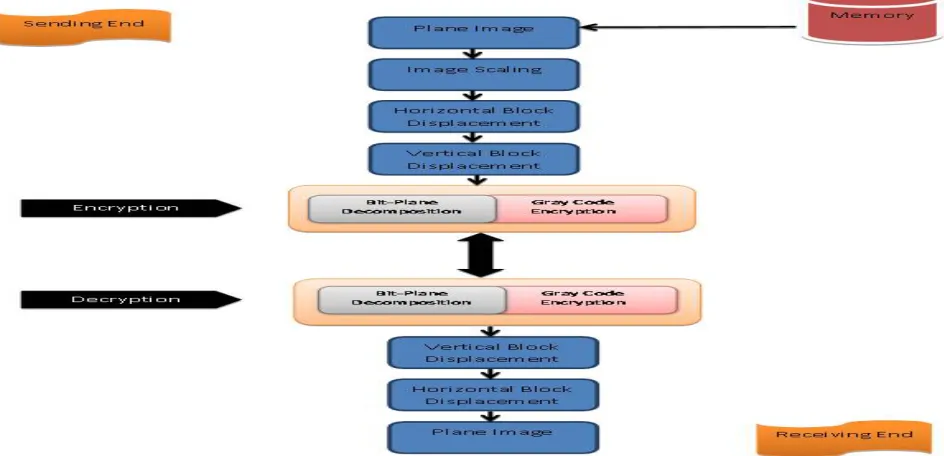
To design a secured encryption scheme, it is not only vital to know how to manipulate/alter data within a cover image but also we need to know how to reconstruct the original information from manipulated/altered data of the cover image. In this section, we present in detail the features of the proposed encryption algorithm for digital images based on pixel explosion and switching gray-code encoding. In addition, we also explain about correlation based relationship between the image sub-blocks and manipulate data bit for successful reconstruction of encoded data. The proposed algorithm could effectively reconstruct the encrypted information lossless with authorized knowledge of the keys associated during the encryption of original cover media. The Fig.3 presents a detail block diagram of encoding and decoding process of the proposed algorithm.
Fig 2. Block Diagram of Encoding and Decoding Process of the proposed algorithm
encrypted using the proposed scheme maintains the visible artifacts while maximizes the distortion and limit the changes to highly correlated areas.
A. Encoding Process
Input: The secured data which is to be encrypted
Step1: Choose the key-code for pixel explosion
Step2: Decompose the cover image into various rows. And differentiate rows into unchanged and gray-code based switching and key-code.
Step3: Decompose the cover image into various columns. And differentiate columns into unchanged and gray-code based switching and key-code. Step4: Convert the encrypted data into a binary stream of the bits Convert the each bit into gray-code, and append to encrypt stream
Step5: Recombine the encrypted stream into image blocks based on the key
Step6: Determine the encryption that could be incorporated over the uncorrelated bits encryption algorithm
Output: Crypto image with secured digital keys
The main focus of any encryption system is to attain a high un-correlation among the neighborhood
pixels while maximizing the visible or statistical distortions in the cover image. Hence, we could
shuffle data randomly before manipulating the data based on key that could transferred with the
image or externally.
B. Decoding Algorithm
The decoding system is quite simple and the exact reserve procedure of the encoding process. The
general steps in reconstruction the cover data from encrypted information are:
Input: Input the Crypto image and digital key.
Step1: Decompose the crypto image into various binary stream based on the key.
Step2: Convert gray-code of bit to corresponding binary code Convert the bit into digital image,
Step3: Recompose the cover image through various columns after differentiates columns into unchanged and gray-code based switching and key-code.
Step4: Recompose the cover image through various rows after differentiates rows into unchanged and gray-code based switching and key-gray-code.
Step5: Recombine the reconstructed binary information
Output: Output the reconstructed cover image.
IV.COMPUTERSIMULATIONSANDRESULTS
In this section, the simulations results of proposed switching gray-code and pixel explosion based encryption system for digital images are presented in detail. Computer simulations were simulated using MATLAB software package. Analysis was done using various color and gray-scale bitmap images varying in size, type, and classes of image features. These images were stored as uncompressed TIFF some of which are later converted into bitmap images by threshold.
Visual Analysis Test: In this test, we check the feasibility of the proposed system and visual distortion of the proposed system at each stage of the operation. The figure 4 , presents the original “Airbus” cover image and every output image after each stage i.e. .Horizontally Shifted using 1:2:3 rule + gray code encryption, Vertically Shifted using 1:2:3 rule + gray code encryption, Gray Code encryption of global image, Fibonacci Bit place decomposition algorithm.
Fig.4 a) cover image “Airbus”, b) partially encrypted image “Horizontal + gray-code encrypted”, c) partially encrypted image “Vertical + gray-code encrypted”, d) encrypted image
Fig.5 a) cover image “Airplane”, b) partially encrypted image “Horizontal+ gray-code encrypted”, c) partially encrypted image “Vertical + gray-code encrypted”, d) encrypted image
The figure 5, presents the original “Airplane” cover image and every output image after each stage i.e. Horizontally Shifted using 1:2:3 rule + gray code encryption, Vertically Shifted using 1:2:3 rule + gray code encryption, Gray Code encryption of global image, Fibonacci Bit place decomposition algorithm. The figure 6 , presents the original “Flower” cover image and every output image after each stage i.e. Horizontally Shifted using 1:2:3 rule + gray code encryption, Vertically Shifted using 1:2:3 rule + gray code encryption, Gray Code encryption of global image, Fibonacci Bit place decomposition algorithm.
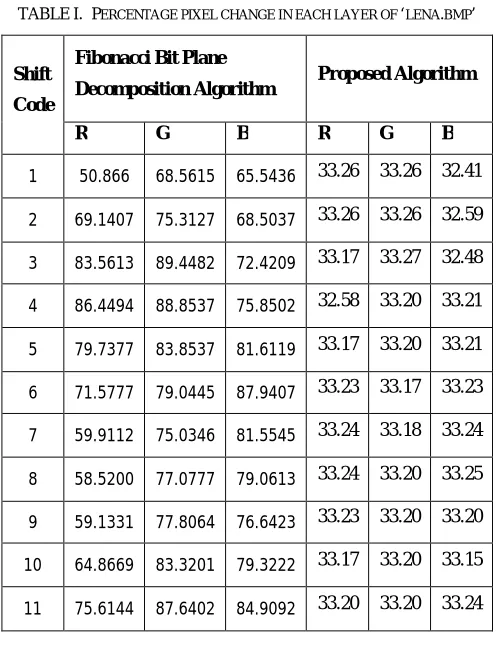
TABLE I. PERCENTAGE PIXEL CHANGE IN EACH LAYER OF ‘LENA.BMP’
Shift
Code
Fibonacci Bit Plane
Decomposition Algorithm Proposed Algorithm
R G B R G B
1 50.866 68.5615 65.5436 33.26 33.26 32.41
2 69.1407 75.3127 68.5037 33.26 33.26 32.59
3 83.5613 89.4482 72.4209 33.17 33.27 32.48
4 86.4494 88.8537 75.8502 32.58 33.20 33.21
5 79.7377 83.8537 81.6119 33.17 33.20 33.21
6 71.5777 79.0445 87.9407 33.23 33.17 33.23
7 59.9112 75.0346 81.5545 33.24 33.18 33.24
8 58.5200 77.0777 79.0613 33.24 33.20 33.25
9 59.1331 77.8064 76.6423 33.23 33.20 33.20
10 64.8669 83.3201 79.3222 33.17 33.20 33.15
11 75.6144 87.6402 84.9092 33.20 33.20 33.24
V. CONCLUSION
In this paper, we presented a novel picture encryption technique which at first improves the picture based on exchanging dim codes and pixel blast. The re-enactment comes about demonstrate that exchanging dim code and pixel blast altogether diminishes the connection affect inside the area while scrambling the cover picture. It is clear that this system could be utilized for incomplete encryption progressively applications and recordings. The pixel blast utilizes all around characterized key that switches between the dark code of the picture pixels. Along these lines, the proposed calculation improves security of the cover data. Further, test comes about demonstrates that the proposed pixel blast is sufficient for incomplete encryption and upgrades security of the information. Likewise, it could likewise bolster as a deadly implement for any current calculation.
REFERENCES
[1] Xinyi Zhou, 2Wei Gong, 3WenLong Fu,LianJing Jin Enhanced Technique for LSB Based Shading Picture steganography Joined with Cryptography. IEEE 2016
[2] C. C. Ravindranath, Bhatt A K and Bhatt A; "Versatile Cryptosystem for Computerized Pictures utilizing Fibonacci Bit-Plane Deterioration" Worldwide Diary of PC Applications (0975 – 8887)Volume 65– No.14, Walk 2013
[3] RSA Security. http://www.rsasecurity.com/rsalabs/faq/3-2-6.html
[4] DES. http://csrc.nist.gov/productions/fips/fips46-3/fips46-3.pdf. The urlexplains the idea of the Information Encryption Standard. [5] S. S. Maniccam and N. G. Bourbakis,"Image and video encryption utilizing examine designs," Example Acknowledgment 37, pp.
725-737, 2004. NJ: Prentice Corridor, 2003.
[6] B. Furht, D. Socek, and A.M. Eskicioglu, "Essentials of Interactive media Encryption Procedures," Section in Sight and sound Security Handbook, pp. 94 – 144, CRC Press, 2005
[8] Y. Zhou, K. Panetta, and S. Agaian, "A picture scrambling calculation utilizing parameter based M-successions," in Procedures of the seventh Universal Gathering on Machine Learning and Computer science, ICMLC, 2008, vol. 7, pp. 3695– 3698.
[9] Y. Zhou, K. Panetta, S. Agaian, and C. L. P. Chen, "Picture encryption utilizing P-Fibonacci change and disintegration," Pick. Commun., vol. 285, pp. 594– 608, 2012.
[10] Y. Zhou, K. Panetta, S. Agaian, and C. L. P. Chen, "(n, k, p)- Dark code for picture frameworks," IEEE Trans. Cybern., vol. 43, pp. 515– 529, 2013.
[11] J. Z. J. Zou, R. K. Ward, and D. Q. D. Qi, "The summed up Fibonacci changes and application to picture scrambling," 2004 IEEE Int. Conf. Acoust. Discourse, Flag Process., vol. 3, 2004.
[12] W. Zou, J. Huang, and C. Zhou, "Advanced picture scrambling innovation in view of two measurement fibonacci change and its periodicity," in Procedures - third Universal Symposium on Data Science and Designing, ISISE 2010, 2011, pp. 415– 418.
[13] J. Z. J. Zou, R. K. Ward, and D. Q. D. Qi, "another computerized picture scrambling strategy in view of Fibonacci numbers," 2004 IEEE Int. Symp. Circuits Syst. (IEEE Feline. No.04CH37512), vol. 3, 2004.