THE DESIGN AND DEVELOPMENT OF A SYSTEM FOR
CONTROLLING AUTOMOTIVE FUNCTIONS USING
SPEECH RECOGNITION
(REKABENTUK DAN PEMBANGUNAN SEBUAH SISTEM UNTUK
PENGENDALIAN FUNGSI AUTOMOTIF MENGGUNAKAN
PENGECAMAN SUARA)
ABD MANAN BIN AHMAD
RESEARCH VOT NO:
74066
Jabatan Kejuruteraan Perisian
Fakulti Sains Komputer dan Sistem Maklumat Universiti Teknologi Malaysia
ABSTRACT
ABSTRAK
teknologi Very Large Scale Integration (VLSI). Pengaktifan suara bagi kelengkapan rumah juga boleh mendapat faedah daripada perintegrasian tersebut.
CONTENTS
NO TITLE PAGE
ABSTRACT i
ABSTRAK ii
CONTENTS iii
LIST OF FIGURES vii
LIST OF TABLES ix
LIST OF ABBREVIATIONS x
LIST OF APPENDICES xii
CHAPTER I PROJECT OVERVIEW
1.1 Introduction 1.2 Background 1.3 Problem Statement 1.4 Aim
1.5 Project Objective 1.6 Scope Project 1.7 Thesis Arrangement
1 2 2 4 4 4 6
CHAPTER II LITERITURE REVIEW
2.2 Automotive Function and Devices
2.3 The Windows Xp Embedded Operating System 2.4 Speech Recognition
2.4.1 General Architecture for Controlling Devices
2.4.2 Controlling Automotive Function using Speech Recognition General Approach 2.5 Statistical Learning Framework
2.6 Support Vector Machine (SVM)
2.6.1 SVM Introductory Overview 2.6.2 SVM Classifier
2.7 GGobi 2D Function
9 10 13 16 17 18 20 21 23 25
CHAPTER III METHODOLOGY
3.1 Introduction
3.2 Research Approach
3.3 Research Methodology 3.4 General Workflow of SVM-DSW 3.5 Analyze Requirement
3.5.1 Software Requirement 3.5.2 Hardware Requirement 3.6 Summary 26 26 28 34 35 35 35 36 CHAPTER IV DATA & DISCUSSION
4.1 Introduction
4.2 Data Source
4.2.1 Training and Testing Data 4.3 Result
4.4 Demo 4.5 Summary
CHAPTER V CONCLUSION
5.1 Introduction
5.2 Advantages
5.2.1 Commercialization 5.2.2 Potential Beneficiaries 5.3 Summary
58 59 60 61 61
REFERENCES APPENDICES
LIST OF FIGURES
NO FIGURES PAGES
2.1 Human speech recognition process 14
2.2 General Speech Recognition Architecture 15
2.3 Illustrates the proposed system 17
2.4 Example object, RED and GREEN plots 22 2.5 Classic example of a linear classifier 22
2.6 Basic idea behind SVM 23
3.1 Research approach for SVM-DSW prototype development 27 3.2 MFCC Feature Extraction Procedure 28
3.3 Partial recognition simulation. 30
3.4 Embedded grammar rule. 31
3.5
DSW pseudo-code segment (prob = probability, curr = current, prev = previous, inc = increase, dec = decrease, recog =
recognized/recognition, cnt = count).
32
3.6 Process workflow overview. 34
4.1 Performance comparison of the data augmentation technique. 41 4.2 Data visualization using GGobi for
a) letter b and b) word sorot 48
4.3 Controlling Automotive Functions using Speech Recognition GUI 49 4.4 Recording voice using Matlab interface for “lampu luar buka”. 50
4.6 Device info for “lampu luar buka” 52
4.7 Simulation for “lampu luar buka” 53
4.8 Recording voice using Matlab interface for “lampu luar tutup”. 54
4.9 Wav file for “lampu luar tutup” 55
LIST OF TABLES
NO TABLE PAGE
1.1 Word for control and devices 5
1.2 Example lists of commands 6
2.1 List of devices in a car for voice control 9 4.1 HTK workflow process for whole-word unit. 39 4.2 Confusion matrix and result analysis for
a) baseline and b) proposed techniques. 44
LIST OF ABBREVIATIONS
A2D - Analog to Digital
ASR - Automatic Speech Recognition ANN - Artificial Neural Network
CAN - Controller Area Network
DBP - Dewan Bahasa Pustaka
DCT - Discrete Cosine Transform
DSW - Dynamic Shifting Window
FIR - Finite Impulse Response GUI - Graphical user interface
HMM - Hidden Markov Model
HTK - Hidden Markov Toolkit
MDI - multiple document interface
MFCC - Mel-Frequency Cepstral Coefficients
OS - Operating System
PDA - Personal Digital Assistant
PROTON - Perusahaan Otomobil Nasional
QP - Quadratic Programming
SFS - Speech Filing System
SRM - Structural Risk Minimization
SVA SDK - Sensory's VoiceActivation™ SDK
SVM-DSW - Support Vector Machine-Dynamic
Shifting Windows
UTM - Universiti Teknologi Malaysia VLSI - Very Large Scale Integration
LIST OF APPENDICE
APPENDIX TITLE PAGE
A List of commands 71
B General Architecture for Speech Recognition in Microcontroller
74
C Flow diagram chart for traditional speech recognition system
75
E GUI for SVM-DSW 76
F Recognition result for each iteration 78
CHAPTER I
PROJECT OVERVIEW
1.1 Introduction
Speech recognition research has lead to many commercial products this day. It is now very common to see devices being controlled by speech recognition. Smart home, voice dial and speech recognition computer software are many example of its
applications. Even with a lot of successful applications to this technology, sadly it is speech recognition with only English input. Although there are speech engine that recognized Malay words, there is almost no commercial products that is making the highlight of using speech recognition in Malay.
just try to turn on the internal cabin light. The idea is that is it impossible to give a full concentration when the driver has to accomplish two things in the same time.
By combining two different backgrounds, a new challenge of resolving this situation can be done by developed a prototype of speech recognition system that can controlled car devices such as door windows, audio player or bonnet.
1.2 Background
The purposed of the design and development of a system for controlling automotive function using speech recognition research development is to allow
consumer’s car to control such device in their car by using their voice either to turn off or turn on devices and etc. To recognize consumer voice, SVM-DSW has been developed to achieve that purposed. SVM-DSW speech recognition engine will be embedded in a device which has a microcontroller to execute the processes. This device will be
embedded in a car. So that, the consumer car will interfacing with this device to control such windows, horn, radio, lamp and etc in the car.
SVM-DSW speech recognition engine will be developed based on SVM method, developed using Matlab tools. In the end of the research development, the result will be compare between result from SVM-DSW and conventional method HMM.
1.3 Problem Statement
SVW-DSW speech recognition engine has been developed to give another ways to car’s consumer to control their own device in a car by using a voice. So that, they can use a voice to turn off the radio, turn on the radio, enabled the horn and etc. However, to develop SVM-DSW speech recognition engine functional in a car, there are some
i. The tedious work of handpicking candidate speakers: filtering abnormal samples, data pre-processing: manual segmentation and feature extraction, and post-processing runs: classification and recognition; for all 16 speakers (four males and four females for each training and testing modules) had consume the entire semester.
ii. Considering the times spend, we feel that the scope had to be cut-down. Instead of using a 69 sentences vocabulary, we opt to derive only 16 utterances from the same corpus. The focus is on how to exploit the Dynamic Shifting Window (DSW) potentials for speaker-independent continuous speech recognition task.
iii. As it was stated in our objectives, the algorithm (DSW) will be tested against conventional approach (HMM) for benchmarking purposes and so have we successfully achieved the results needed using HTK. The expected outcome for DSW will come through shortly before the semester ends.
iv. Despite the availability of segmentation residues from the recognition process, we do not wish to make an extensive comparison with the ones gained from DSW. Only a few examples between the two will be cross-examined for the sake of discussion, as the technique is never meant for segmentation.
v. In order to conjure unbiased hypotheses from the experiment, the same recognition unit was used for both methods, namely the whole-word unit. However, we have also applied phone model for HMM to observe the differences. We argue that this model is quite ambiguous largely because it depends on trivial phonetic transcription, as there is no existing standard Malay phonetics for our vocabulary.
contras for each system sub-components with hope in finding a better conclusion to which our scheme can be improved.
1.4 Aim
The aim of this research is to design and develop a system for controlling
automotive function by using consumer’s car voice to control a device in the car such as windows, radio, horn and etc which input by voice in Malay language.
1.5 Project Objectives
The purpose of this research is to design and develop a system for controlling automotive function using speech recognition. Consumer appliance will use their voice to control a device such as radio, windows, horn and etc. There are several objectives for this research. There are:
i. To design and develop the proposed speech recognition system (for Malay) and the speech database based on an automotive control corpus ii. To implement, test and verify the proposed system using a prototype
system capable of providing control for the functions of radio tuning, cruise control assistance, wind-screen wipers and air-conditioning control
1.6 Scope Project
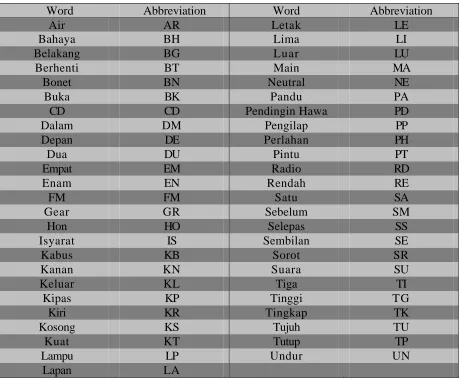
Speech engine would be recognized word form the table 1.1. There are 49 words combining 9 words for devices and 36 words for control and lead to 69 types of
a word after going a segmentation process. Total words for database are 450 words. The speech engine then recognizes the commands sentences word by word.
The whole system will be running in an embedded environment. After much considering, the Microsoft Windows XP Embedded is chose as the operating system for this project. The operating system has a very small image build up that can cater
minimum requirement to run the speech recognition system. Prototype for this system can be described as a speech to text system.
Table 1.1: Word for control and devices
Word Abbreviation Word Abbreviation
Air AR Letak LE
Bahaya BH Lima LI
Belakang BG Luar LU
Berhenti BT Main MA
Bonet BN Neutral NE
Buka BK Pandu PA
CD CD Pendingin Hawa PD
Dalam DM Pengilap PP
Depan DE Perlahan PH
Dua DU Pintu PT
Empat EM Radio RD
Enam EN Rendah RE
FM FM Satu SA
Gear GR Sebelum SM
Hon HO Selepas SS
Isyarat IS Sembilan SE
Kabus KB Sorot SR
Kanan KN Suara SU
Keluar KL Tiga TI
Kipas KP Tinggi TG
Kiri KR Tingkap TK
Kosong KS Tujuh TU
Kuat KT Tutup TP
Lampu LP Undur UN
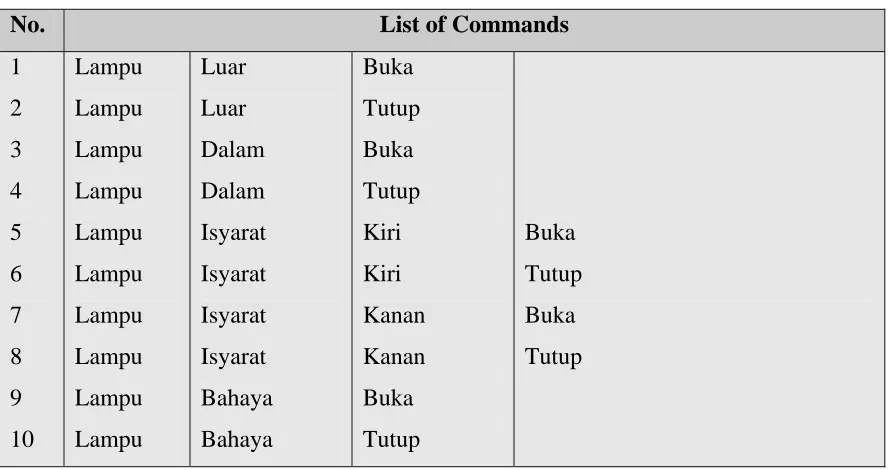
Table 1.2: Example lists of commands
No. List of Commands
1 2 3 4 5 6 7 8 9 10 Lampu Lampu Lampu Lampu Lampu Lampu Lampu Lampu Lampu Lampu Luar Luar Dalam Dalam Isyarat Isyarat Isyarat Isyarat Bahaya Bahaya Buka Tutup Buka Tutup Kiri Kiri Kanan Kanan Buka Tutup Buka Tutup Buka Tutup
1.7 Thesis Arrangement
i. Project Overview.
First chapter that should be done is Project Overview. This chapter describes project overview: A Design and Development of a system for Controlling Automotive Functions using Speech Recognition. It contains of general overview research project: Speech Recognition, Automotive Control and our research target and also project objectives.
ii. Literature Review
iii. Methodology
In this chapter, it will describe about the methodology, method and techniques that will be use in this system development life cycle. This chapter will be divided into two parts: project development methodology and system prototype development methodology.
iv. Project Design and Implementation
In this chapter, it consists of two main process developments: automotive controlling system development and speech recognition engine development. This chapter will describe a model to develop the system and the methodology based on SVM-DSW development process.
v. Result and Conclusion
CHAPTER II
LITERATURE REVIEW
2.1 Introduction
Controlling a devices or communicate with the computer by using a voice is one of the most effort that speech researcher want to achieve since a decades ago. One of the purposed of this Design and development of a system for controlling automotive function using speech recognition or SVM-DSW research is to contribute with that controlling device instead of improving speech recognition technique in controlling devices applications. Speech recognition for automotive control or better known as voice activated control is gaining acceptance in commercial automotive industry. Voice
activated control for climate control, audio systems and telephone is already an important feature in automobiles such as Jaguars and Fords. The need to incorporate speech
recognition into an automotive environment is already a common criterion because it promotes safe driving, improves automotive controls and also provides for more marketable automobiles.
Sensory's VoiceActivation™ SDK (SVA SDK) is a comprehensive set of software
components, tools, and methods that can be embedded Sensory's versatile, small footprint voice recognition technologies into a product. It provides a powerful API offering
tremendous flexibility to accommodate the designed system architecture and product objectives and it is operating system independent.
2.2 Automotive Function and Devices
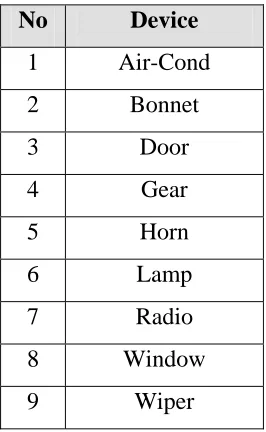
The purposed of SVM-DSW development was to control such devices in a car like horn, radio, window and etc by using consumer’s car voice. In speech recognition terms, SVM-DSW used continuous vocabulary and small database. The input of this prototype is voice in spoken Malay. There are 69 command sentences consists of 9 control devices. Appendix A shows the full list of the devices and commands.
Table 2.1: List of devices in a car for voice control
No Device
1 Air-Cond 2 Bonnet 3 Door 4 Gear 5 Horn 6 Lamp 7 Radio 8 Window 9 Wiper
2.3 The Windows Xp Embedded Operating System
Windows XP Embedded is the embedded operating system that delivers the power of Windows in componentized form to allow developers to rapidly build reliable and advanced embedded devices. Based on the same binaries as Windows XP
Professional, Windows XP Embedded contains over 10,000 individual feature components so developers can choose and achieve optimum functionality while
managing or reducing footprint in a customized device image. Popular device categories for building operating systems using Windows XP Embedded include retail point-of-sale terminals, thin clients and advanced set-top boxes.
Windows XP Embedded delivers industry-leading reliability, security, and
performance features and enhancements. The operating system software also provides the latest multimedia and Web browsing capabilities and contains extensive device support. In addition, Windows XP Embedded incorporates the latest embedded-enabling
capabilities, such as support for multiple boot, storage, deployment and management technologies.
Based on the Win32 programming model, Windows XP Embedded reduce time-to-market by using familiar development tools such as Visual Studio .NET, working with commodity PC hardware and seamlessly integrating desktop applications
Microsoft XP Embedded image is created by Microsoft Windows Embedded Studio Target Designer. Target Designer is used to assemble a configuration to build into a run-time image for the target device. It accesses a component database that can be selected the components that can be add to a configuration. The component database contains the entire set of components included in the Windows XP Embedded operating system (OS).
Three methods can be chosen to create initial configuration:
• Use Target Analyzer to create a .pmq file that records the specific hardware, and then import the .pmq file into Component Designer as a macro component. Macro component then can be add to the database and bring it into a configuration in Target Designer.
• Use one of the design templates provided with Windows Embedded Studio, and then add or remove components as necessary to suit specific application.
After building a run-time image for the target device, the deployment tools is used to prepare the target media, deploy the run-time image, and boot the target device.
The development process for creating and deploying run-time images consists of four major steps. Each major step must be completed in order:
i. Create a new configuration or work with an existing configuration.
With a new configuration, components must be added. An existing configuration may already contain some components that can be edited Components also can be add to the existing configuration.
The Windows Embedded Studio tools include Target Analyzer, which can be use to collect information about the hardware in the target device, and then generate a
configuration based on that information.
ii. Add components to the configuration if necessary.
If no configuration is currently open, these options are unavailable. Also, if the component cannot be added to a configuration for any other reason, the Add option is unavailable and the components cannot be dragged into the configuration editor.
The component database can have multiple versions of the same component. If more than one version exists in the database, you specify the version to add by choosing the Add Version menu item. The most recent version is marked with (current) and appears at the top of the menu.
When a component is added to a configuration, the configuration editor scrolls down to display the component that was just added. However, the current tree node selection does not change in the configuration editor.
iii. Dependencies checking for all the components in the configuration.
A dependency is a functional relationship between two or more components. Before building the configuration into a run-time image, a dependency check should be run on the configuration to ensure that all the component dependencies have been resolved.
Target Designer can be set to automatically resolve certain component dependencies. If the dependency check encounters components with unresolved dependencies, a task describing the requirement is added to the task list for each unresolved dependency.
2.4 Speech Recognition
Speech recognition is an alternative to traditional methods of interacting with a computer, such as textual input through a keyboard. An effective system can replace, or reduce the reliability on, standard keyboard and mouse input. This can especially assist the following:
• People who have little keyboard skills or experience, who are slow typist, or do not have the time to resources to develop keyboard skills.
• Dyslexic people, or others who have problems with character or word use and manipulation in a textual form.
• People with physical disabilities that affect either their data entry, or ability to read (and therefore check) what they have entered.
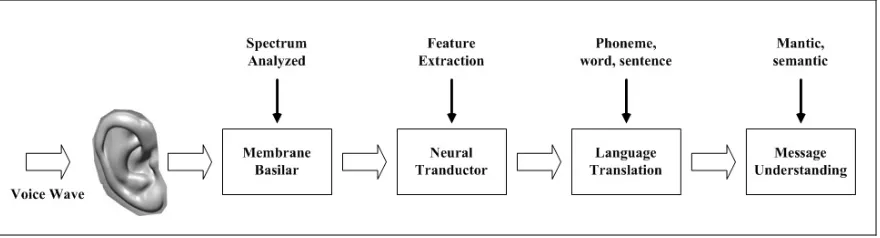
Speech and understanding voice message by human is a complex process. Factors like height, weight, sex, teeth and lips can give an impact to their speech. Voice processing by human can be simplified as below.
Processing sequence in the human auditory system.
- Fixed filter which represents the transfer from free field to eardrum and through the middle ear.
- A bank of logarithmically spread bandpass filters in cochlea.
- Dynamic compression, when mechanical energy is transformed to neural signals by the hair cells.
- Periodicity estimation at each band.
- Integration of the band-wise processed signals and further calculations. This takes place in the central nervous system (brains).
on the auditory nerve and the brain will translate and understood the speech. Figure 2.1 show the scenario of human speech recognition process.
Figure 2.1: Human speech recognition process
A speech recognition system consists of the following: • A microphone, for the person to speak into. • Speech recognition software.
• A computer to take and interpret the speech. • A good quality soundcard for input and/or output.
At the heart of the software is the translation part. Most speech recognition software breaks down the spoken words into phonemes, the basic sounds from which syllables and words are built up. These are analyzed to see which string of these unit best “fits” an acceptable phoneme string or structure that the software can derive from its dictionary.
Most speech recognition software is configured or designed to be used on a stand-alone computer. However, it is possible to configure some software in order to be used over a network. We can classify speech recognition tasks and systems along a set of dimensions that produce various tradeoffs in applicability and robustness. A speech recognition system can be used in many different modes (speaker dependent or independent, isolated / continuous speech, for small or large vocabulary). Figure 2.2 show the general speech recognition architecture which it contains two main components, Features Extraction and Speech Recognizer. This architecture received speech voice as an input and text as an output.
Figure 2.2: General Speech Recognition Architecture
Isolated word versus continuous speech: Some speech systems only need identify single words at a time (e.g., speaking a number to route a phone call to a company to the appropriate person), while others must recognize sequences of words at a time. The isolated word systems are, not surprisingly, easier to construct and can be quite robust as they have a complete set of patterns for the possible inputs. Continuous word systems cannot have complete representations of all possible inputs, but must assemble patterns of smaller speech events (e.g., words) into larger sequences (e.g., sentences).
Speaker independent systems must handle a wide range of speakers. Speaker dependent systems are more accurate, but the training is not feasible in many applications. For instance, an automated telephone operator system must handle any person that calls in, and cannot ask the person to go through a training phase before using the system. With a dictation system on your personal computer, on the other hand, it is feasible to ask the user to perform a hour or so of training in order to build a recognition model.
Small versus vocabulary systems: Small vocabulary systems are typically less than 100 words (e.g., a speech interface for long distance dialing), and it is possible to get quite accurate recognition for a wide range of users. Large vocabulary systems (e.g., say 20,000 words or greater), typically need to be speaker dependent to get good accuracy (at least for systems that recognize in real time). Finally, there are mid-size systems, on the order to 1000-3000 words, which are typical sizes for current research-based spoken dialogue systems.
Some applications can make every restrictive assumption possible. For instance, voice dialing on cell phones has a small vocabulary (less than 100 names), is speaker dependent (the user says every word that needs to be recognized a couple of times to train it), and isolated word. On the other extreme, there are research systems that attempt to transcribe recordings of meetings among several people. These must handle speaker independent, continuous speech, with large vocabularies. At present, the best research systems cannot achieve much better than a 50% recognition rate, even with fairly high quality recordings.
2.4.1 General Architecture for Controlling Devices
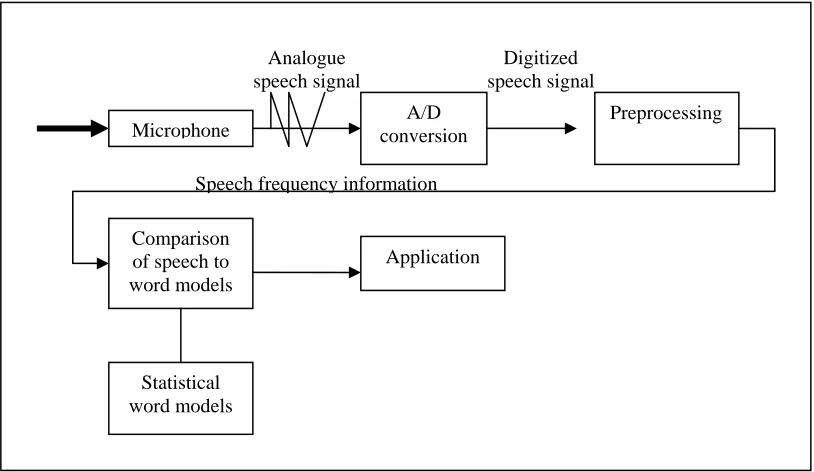
usable features for the acoustic modeling phase. In this phase the input speech will be matched word for word through a statistical model for the need of recognizing the correct voice command.
Speech frequency information
Digitized speech signal Analogue
speech signal
Microphone conversionA/D Preprocessing
Comparison of speech to word models
Application
Statistical word models
Figure 2.3: Illustrates the proposed system
2.4.2 Controlling Automotive Function using Speech Recognition General Approach
There are several stage continuously perform stage by stage in purposed to
achieved automotive controlling device using speech recognition. All stages lists a below:
i. Raw speech input is converted from analog to digital (A2D) waveform via a uni-directional microphone and consequently stored in WAVE sound file format.
iii. Further characteristic of the WAVE file such as sampling rate (8000, 11025, 22050), channel type (mono/stereo) and bits per sample (8/16 bits) are also being extracted from the WAVE file header. This information is much needed both in the early and later stages.
iv. Based on the plotted waveform, a typical start-endpoint detection algorithm (short-time energy and zero-crossing rate) is applied to locate the actual speech activities from the entire region. Dismissing the beginning and trailing silence part of speech will reduce the processing load. The result, a connected string of words, however, is still lengthy and inappropriately oversized. Thus an additional or modified endpoint algorithm is used to spot the word boundaries and isolates each word.
v. Speaking in graphical user interface (GUI) context, the program will be able to open an array of displays comprises a plotted waveform before and after affects of the endpoint detection, a frequency response graph before and after applying the Finite Impulse Response (FIR) filters, LPC or cepstral coefficients and the resulting feature vector values. By using multiple document interface (MDI) feature in Windows programming, more than one speech sample can be open simultaneously. This supports the need for comparison.
2.5 Statistical Learning Framework
embedded in a HMM framework. The performance of these hybrid systems have been competitive with many HMM-based systems and typically require a significantly reduced parameter count. The hybrid connectionist systems also provide a way to mitigate some of the assumptions made in HMM systems that we know are incorrect for the human speech process. One such significant assumption is that of independence of observations across frames. Hybrid systems mitigate this problem by allowing the neural network classifiers to classify based on several frames of acoustic data at a time. A similar approach will be pursued in this dissertation by processing multi-frame data.
Although the final system configurations for connectionist systems are simpler than HMM based systems, their use has been limited because of various limitations listed below:
• Generalization: Neural networks have been known to overfit data unless specific measures are taken to avoid that. These measures typically include some form of cross-validation which can be restrictive when the amount of training data is limited to start with.
• Optimization Process: Neural network learning is based on the principle of empirical risk minimization via the back-propagation algorithm. Though this guarantees good performance on the training data, obtaining a bound on the performance on the test data is not easy.
• Model Topology: In most connectionist hybrid systems the topology of the neural network classifiers needs to be fixed prior to the estimation process. This is not always easy without expert knowledge of the data. Techniques do however exist to learn connections automatically but are expensive.
The need for discrimination and classifiers with good generalization and convergence properties that can be used for speech recognition has led us to look at a new machine learning paradigm called the support vector machines (SVM) which forms the basis of this dissertation.
2.6 Support Vector Machine (SVM)
Recognition process is a challenges task. It required a lot of effort and
computational process to recognize a single word from human voice. There are many techniques and method that provided to recognize human speech and also depend on what kind of purpose the recognition process must be done.
empirical risk, they also try to minimize the “structural risk”, being the solution a compromise between empirical error and generalization capability.
These characteristics have made SVMs very popular and successful in many fields of application. Nevertheless, in order to use them in a problem of speech
recognition, some limitations must be overcome. One of them is the number of training samples they can deal with that, in spite of the apparition of techniques as Sparse SVM, is still limited to a few thousands. Another problem of SVMs is that, in their original
formulation, they are restricted to work with input vectors of fixed dimension (although nowadays there are some solutions to cope with this problem, as we will see). Finally, another limitation is that SVMs only classify, but they don’t give us a reliable measure of the probability of the correctness of the classification. This can cause problems in
recognition, where without a concrete value of probability we can’t carry out some algorithms as Viterbi, to look for the most probable sequence of recognition units.
2.6.1 SVM Introductory Overview
Figure 2.4: Example object, RED and GREEN plots
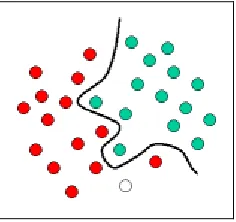
The figure above is a classic example of a linear classifier, i.e., a classifier that separates a set of objects into their respective groups (GREEN and RED in this case) with a line. Most classification tasks, however are not that simple, and often more complex structures are needed in order to make an optimal separation, i.e. , correctly classify new objects (test cases) on the basis of the examples that are available (train cases). This situation is depicted in the illustration below. Compared to the previous schematic, it is clear that a full separation of the GREEN and RED objects would require a curve (which is more complex than a line). Classification tasks based on drawing separating lines to distinguish between objects of different class memberships are known as hyperplane classifiers. SVM are particularly suited to handle such tasks.
Figure 2.5: Classic example of a linear classifier
schematic) is linearly separable and, thus, instead of constructing the complex curve (left semantic), all we have to do is to find an optimal line that can separate the GREEN and the RED objects.
Figure 2.6: Basic idea behind SVM
2.6.2 SVM Classifier
Some of the generalization properties of neural networks have been mentioned in the previous section. Why is generalization important? HMM-based speech recognition systems perform very well on closed-loop tests but performance degrades significantly on open-loop tests. The performance of systems on speaker-dependent tasks is significantly better than on speaker-independent tasks. This can be attributed to the fact that most systems do not generalize well. There is a definite need for systems with good generalization properties where the worst-case performance on a given test set can be bounded as part of the training process without having to actually test the system. With many real-world applications where open-loop testing is required, the significance of generalization is further amplified.
several configurations of the classifier that can achieve minimum risk on the training set. This is one of the reasons why neural networks can get stuck in local saddle points. The problem then is to decide on the configuration that has the least upper bound on the expected test set error. This is the principle of structural risk minimization (SRM). Support vector machines are founded on this principle and the result of SRM is a classifier with the least expected risk on the test set and hence good generalization.
SVMs in their simplest form are hyperplane classifiers. The power of SVMs lies in their ability to implicitly transform data to a high dimensional space and to construct a linear binary classifier in this high dimensional space. Since this is done implicitly, without having to perform any computations in the high dimensional space, neither the dimensionality of the data nor the sparsity of data in the high-dimensional space is a problem with SVMs.
SVMs have been applied successfully on several kinds of classification problems and have consistently performed better than other non-linear classifiers like neural networks and mixtures of Gaussians. The dataset that propelled SVMs to prominence in the early 90’s was the US Postal Service digit data on which the SVMs achieved the best numbers reported. The development of efficient optimization schemes led to the use of SVMs for classification of larger tasks like text-categorization.
discriminatively classify frames of speech. The end result is a first successful application of SVMs to continuous speech recognition.
2.7 GGobi 2D Function
Based on the result from those experiments that been done, some software has been used in purposed to describe more detailed and easy understanding. One of the software that been used is GGobi. GGobi 2D is an interactive graphical software for exploratory data analysis. By using GGobi, it is easy to perform a simple task with virtually no instruction. What is needed just some cursory knowledge of the
developments in interactive statistical graphics. In another word, GGobi is an open source visualization program for exploring high-dimensional data. It provides highly dynamic and interactive graphics such as tours, as well as familiar graphics such as the scatterplot, barchart and parallel coordinates plots. Plots are interactive and linked with brushing and identification.
By using GGobi, the results from the experiment that been done can be display in graphical view. It is one way to explain about the result compare to real situation in a car with real radio, window and etc. From the graphical views, it also can show the output from the recognition process. As been describes before in chapter I, this research
CHAPTER III
METHODOLOGY
3.2 Introduction
Defining the project’s methodology is an important task, as it can give guidelines about activities that need to be performed in order to successfully develop a system. Moreover it helps to achieve the project’s objectives and vision, as well as solving the background problems. This chapter discusses the methodology of the research project: A Design and Development of system for Controlling Automotive Functions using Speech Recognition. This chapter will give a clear view on the methodology used by describing the framework of SVM-DSW. This chapter attempts to provide clear guidelines on how the project goal and objectives are accomplished.
3.2 Research Approach
objectives. Generally, there are three steps in research approach for this research development (figure 3.1) and will be describes in the next section.
Preprocessing (Data Acquisition)
Front-end (spectral analysis/feature extraction)
Back-end (recognition) Input (wav files)
Output (text)
Figure 3.1: Research approach for SVM-DSW prototype development
i. Preprocessing (data acquisition)
ii. Front-end (spectral analysis/feature extraction)
Mel-Frequency Cepstral Coefficients (MFCC) – conventional approach for robust speech feature extraction technique. MFCC is a signal processing techniques to extract acoustic features from the speech waveform. A diagram of the MFCC feature extraction procedure is shown in figure 3.2. First, the input waveform signal goes through a Mel-scaled filter bank. Then it is followed by low pass filtering and downsampling. Finally, discrete cosine transform (DCT) is performed on the log-energy of the filter outputs.
Figure 3.2: MFCC Feature Extraction Procedure
iii. Back-end (recognition)
Support Vector Machines-Dynamic Shifting Window (SVM-DSW) – a combination of the most recent and discriminate type of classifiers (SVM) with enhanced level building algorithm (DSW).
3.3 Research Methodology
number of features for the current segment accordingly. Apart from the probability score cues, DSW also governed by an embedded grammar rule; this limits the possibility of recognizing out-of-vocabulary utterances. In other words, it tries to maximize the probability of a known string of words belonging to an anonymous array of features. With respect to conventional grammar induced algorithm which calculates the probability of words being recognized beforehand, DSW embeds this grammar rule in real-time. Owing to SVM’s confidence in recognition and translating it into probability estimation, we felt that there is no need for extra computation on the language counterpart itself. Instead of producing misleading conclusion when use in isolation (acoustic and grammar attributes), ours would drive the recognition process faster and more accurate (refer Figure 3.3, 3.4 and 3.5).
vii. The recognition scheme, denote as Dynamic Shifting Window (DSW), is now robust against silence and noise factors that maybe existed along the path of speech signal as well as it can handles variability in the rate of speaking. Hence, we have omitted endpoint detection and frame normalization processes in the current methodology.
viii. Despite the gains, it does have a few shortcomings. The size of window may vary from one speaker to another; thus, a speaker-dependent training mode could bare better results. In addition, segmentation error could occur in case of insufficient training sample.
ix. Only two control variables play major role in the whole algorithm, namely the initial window size and the shifting increment. The first parameter determines the initial guess where each word in the utterance is located. The latter one positions (moves and resizes) the window to fit the entire word.
Vector Machines (SVM) classifier has excels in both segmentation and recognition accuracy.
< 0.8
0.875 0.95 0.925
0.975 0.85
0.925 0.875 0.95
LAMPU
BUKA Scores
initial start/end 1 frame of acoustic features
hold start/end
increase segment forward/backward
word boundary
Legend:
< 0.8 < 0.8 0.9 0.85 0.8
: Scores:
1: 1: 1: 1: 1: isyarat dalam luar bahya sorot kabus kanan kiri rendah tinggi buka tutup lampu hon gilap tingkap hawa gear radio pintu bonet Legend: word node 1: recognized node node without association node group node link recognized link association rule
If (curr_prob >= Probability Threshold)
If (curr_recog_word = null) prev_prob = curr_prob;
prev_recog_word = curr_recog_word;
Else If (prev_recog_word = curr_recog_word) unstable_recog_cnt = 0;
If (prev_prob < curr_prob) prev_prob = curr_prob;
prev_recog_word = curr_recog_word; prob_dec_cnt++;
prob_inc_cnt = 0;
Else If (prev_prob >= curr_prob) prev_prob = curr_prob;
prev_recog_word = curr_recog_word; prob_inc_cnt++;
If (prob_dec_cnt > 1) && (prob_inc_cnt > 3) switch train model;
set new Backtrack Size; set new Segment Size;
prev_prob = prev_recog_word = null;
prob_dec_cnt = prob_inc_cnt = unstable_recog_cnt = 0;
If (prob_increase_count > 2) switch train model; set new Backtrack Size; set new Segment Size;
prev_prob = prev_recog_word = null;
prob_dec_cnt = prob_inc_cnt = unstable_recog_cnt = 0;
Else If (prob_dec_cnt > 3) switch train model; set new Backtrack Size; set new Segment Size;
prev_prob = prev_recog_word = null;
prob_dec_cnt = prob_inc_cnt = unstable_recog_cnt = 0;
Else If (unstable_recog_cnt > 1)
prev_prob = prev_recog_word = null;
prob_dec_cnt = prob_inc_cnt = unstable_recog_cnt = 0; prob_threshold_cnt = 0;
Else If (curr_prob < Probability Threshold) prob_threshold_cnt++;
If (prob_threshold_cnt > 1)
prev_prob = prev_recog_word = null;
prob_dec_cnt = prob_inc_cnt = unstable_recog_cnt = 0;
3.5 General Workflow of SVM-DSW
i. The recognition scheme, denote as Dynamic Shifting Window (DSW), is now robust against silence and noise factors that maybe existed along the path of speech signal as well as it can handles variability in the rate of speaking. Hence, we have omitted endpoint detection and frame normalization processes in the current methodology.
ii. Despite the gains, it does have a few shortcomings. The size of window may vary from one speaker to another; thus, a speaker-independent training mode could bare better results. In addition, segmentation error could occur in case of insufficient training sample.
iii. Only two control variables play major role in the whole algorithm, namely the initial window size and the shifting increment. The first parameter determines the initial guess where each word in the utterance is located. The latter one positions (moves and resizes) the window to fit the entire word.
Overall Recognition Accuracy
Classification (Training) Spectral Analysis
Recognition (Testing)
Words String “Lampu Luar Buka” Speech Signal
Segmented Feature Trained Models
1 2 n
Dynamic Shifting Window Recognized
Word w/
Probability Estimate
3.5 Analyze Requirement
To develop a prototype of Intelligent Agent for Speech Recognition and
Translation, this prototype needs two requirements, software and hardware to achieve the process development.
3.5.1 Software Requirement
There are several types of software involved in this research prototype.
i. Matlab
Matlab handles numerical calculations and high-quality graphics, provides a
convenient interface to built-in state-of-the-art subroutine libraries, and incorporates a high-level programming language. For training process in speech recognition system, matlab has been used for training modules. Data that been collected will be process and it called a training data.
ii. C Programming Language
C programming language has been used to implement SVM technique for recognition process.
3.5.2 Hardware Requirement
Hardware also is a main component parts in prototype development. Generally, there is a computer applied in prototype development especially for speech recognition processes development (computational) and one personal computer for collecting data training and preprocessing (data acquisition) process. This hardware specification is as below:
b. 40 GB Hard Disk c. 512 Mb RAM
d. Keyboard and Mouse e. Monitor 17”
f. Sound Card
ii. Personal Computer (preprocessing – data acquisition) a. Pentium IV 1.6 GHz processor
b. 35 GB Hard Disk c. 512 Mb RAM
d. Keyboard and Mouse e. Monitor 17”
f. Sound Card and Microphone
3.6 Summary
CHAPTER IV
DATA AND DISCUSSION
4.1 Introduction
This chapter describes about two topics, the data and discussion about the result that been achieved from the experiments based on SVM-DSR method. In this chapter also, the data for this research will be explain in detailed such as data format, how the data collected and processed and etc. The result form the experiments will be describe to show the performance and contribution that SVM-DSR offer to improve the performance of controlling automotive functions using voice.
4.2 Data Source
Speech Filing System (SFS) 4.6 was used for automatically extracts the continuous speech into discrete speech signals for training purposes. Do note that the word-segment hand-labeling process was done beforehand.
Corrections of mislabeled speech segments were then follows. Other errors constituted of voice clippings, cut-offs and mispronunciations. These types of errors usually were rectified by removing the whole sequence and reproducing new substitute.
4.2.1 Training and Testing Data
As opposed to HMM and other techniques, SVM utilizes only minimal feature (8th order Mel-Frequency Cepstral Coefficients instead of 12th order per frame) to classify discriminately. By using whole word as the recognition unit, much of the contextual information are retained, therefore we do not have to represent each frame deliberately. Frame normalization or time alignment, which implies a theoretical issue for static classifier such as SVM; appear to be practically unnecessary in this research. A simple zero padding at the end of each word’s frame is sufficient to produce good output.
A new criterion for SVM’s model selection has been formulated to suit the purpose of the project. Conventional model selection relies solely on classification accuracy. Our algorithm requires the use of probability estimate to perform classification. This is vital owing to the fact that the highest probability determines the recognized word. Thus, the model selection in SVM must be based upon classification accuracy that undertakes probability estimates. Subsequently, selected models will be used as ‘matching templates’ in the recognition paradigm.
window itself. This alleviates confusion of co-articulation effects among inter-words that have high dependency.
In order to conjure unbiased hypotheses from the experiment, the same recognition unit was used for both methods, namely the whole-word unit. However, we have also applied phone model for HMM to observe the differences. We argue that this model is quite ambiguous largely because it depends on trivial phonetic transcription, as there is no existing standard Malay phonetics for our vocabulary.
We managed to obtain two outcomes from HTK (apart from segmentation attributes): recognition based on whole-word unit and phone unit. The complexity of the recognition task can be calculated as 16 (sentences) x 10 (repetitions) x 8 (speakers) = 1280 sentences = 56 (words) x 10 (repetitions) x 8 (speakers) = 4480 words (on a 13 words vocabulary). HTK scores 76.72% and 95.23% sentence accuracies for the first (whole-word) and second (phone) procedures respectively. This justified the effectiveness of HMM in dealing with sub-word units. Our target however is to approach or exceed HTK’s whole-word performance milestone and consequently extend the DSW capabilities into a phone-like unit based recognizer (refer Table 4.1).
Table 4.1: HTK workflow process for whole-word unit. 1) Building the task grammar (a "language model") $model1 = KIRI | KANAN;
$model2 = RENDAH | TINGGI;
$model3 = LUAR | DALAM | BAHAYA | SOROT | ISYARAT $model1 | KABUS $model2;
$model4 = BUKA | TUTUP;
(SILENCE LAMPU $model3 $model4 SILENCE)
2) Constructing a dictionary for the models
BAHAYA bahaya sp
BUKA buka
ISYARAT isyarat sp
KABUS kabus sp
KANAN kanan sp
KIRI kiri sp
LAMPU lampu sp
LUAR luar sp
RENDAH rendah sp
SILENCE [] sil
SOROT sorot sp
TINGGI tinggi sp
TUTUP tutup
3) Creating transcription files for training data #!MLF!#
"*/M1SET01.lab" Lampu
Luar Buka .
"*/ M1SET02.lab" Lampu
Luar Buka . (etc.)
4) Encoding the data (feature processing) # Coding parameters
WINDOWSIZE = 250000.0 USEHAMMING = T PREEMCOEF = 0.97 NUMCHANS = 26 CEPLIFTER = 22 NUMCEPS = 12
5) (Re-)training the acoustic models ~o <VecSize> 39 <MFCC_0_D_A>
6) Evaluating the recognizer against the test data [Whole]
====================== HTK Results Analysis ====================== Date: Wed Apr 05 18:06:48 2006
Ref : testref.mlf Rec : recout.mlf
--- Overall Results --- SENT: %Correct=76.72 [H=982, S=298, N=1280]
WORD: %Corr=90.54, Acc=89.91 [H=4056, D=62, S=362, I=28, N=4480]
[Phone]
====================== HTK Results Analysis ====================== Date: Fri Apr 07 05:56:25 2006
Ref : testref.mlf Rec : recout.mlf
--- Overall Results --- SENT: %Correct=95.23 [H=1219, S=61, N=1280]
WORD: %Corr=98.62, Acc=98.62 [H=4418, D=0, S=62, I=0, N=4480]
============================================================
4.3 Result
The main probably reason behind the performance gap is due to the way HMM traditionally handles its acoustic modeling process, indiscriminate classification. This type of learning scheme suffers the most when the training data is insufficient to model each own classes precisely, hence the classifier often ‘confuses’ to generalize over new set of instances (the testing data).
with fixed time duration. The idea was applied in two areas: re-sampling and spectral analysis.
Apart from data reduction, the purpose for re-sampling the data into three smaller sub-samples is to provide the test sample with a virtual space in SVM’s separating hyperplane. The same reason applies in spectral analysis counterpart for using three different time frames instead of just one. We re-sampled our own data from 16 kHz to: a) ½ of 16 kHz (1st-tier), b) ½ of ½ of 16 kHz (2nd-tier), and c) ½ of ½ of ½ of 16 kHz (3rd -tier). This will split the sample into three. For spectral analysis, we used MFCC with three sets of frame size: a) 180 samples window by 60 step-sizes (1st-tier), b) 240 samples window by 80 step-sizes (2nd-tier), and c) 300 samples window by 100 step-sizes (3rd -tier). Consecutively, each of the re-sampled speech is tripled once more.
Through trial and error, recognition accuracy on the Ti46 dataset only benefited from spectral analysis augmentation alone, unlike both augmentations (re-sampling and spectral analysis) for our own data. A straightforward explanation for this is Ti46’s unusual 12.5 kHz sampling rate (w.r.t. ours’ 16 kHz), which does not fit the re-sampling methodology of down-sampling the data in halves.
We ran two sets of experiment for each dataset: a) training: one, using 2nd-tier configuration while the other, using all-tiers setup (in re-sampling and spectral analysis), b) testing: only a single-tier parameter (in re-sampling and spectral analysis) for both datasets).
We substituted the standard gauge for performance measure (accuracy) with probability estimates accuracy. It is not the case of hard-margin classification; this adjusted score depicts the confidence of SVM’s separating margin (from test example’s origin to the decision boundary) in hyperspace.
the corresponding support vectors before plotting, which can be obtained from the SVM model itself.
Table 4.2: Confusion matrix and result analysis for a) baseline and b) proposed techniques.
a) --- | b c d e g p t v z | Correct | Error | --- | b | 211 0 21 10 0 0 0 14 0 | 211 | 45 | | c | 0 249 0 0 0 1 1 4 1 | 249 | 7 | | d | 29 1 207 5 0 2 5 7 0 | 207 | 49 | | e | 6 0 5 241 0 0 1 3 0 | 241 | 15 | | g | 0 1 6 0 246 0 3 0 0 | 246 | 10 | | p | 3 1 1 0 2 236 8 5 0 | 236 | 20 | | t | 0 1 0 0 3 1 250 1 0 | 250 | 6 | | v | 20 1 22 3 1 6 5 195 3 | 195 | 61 | | z | 1 5 0 0 0 0 2 7 241 | 241 | 15 | --- --- | Class | Sample | Correct | Error | Accuracy | Prob | ProbError | ProbAccy | --- | b | 256 | 211 | 45 | 82.42% | 157.48 | 98.52 | 61.52% | | c | 256 | 249 | 7 | 97.27% | 230.76 | 25.24 | 90.14% | | d | 256 | 207 | 49 | 80.86% | 158.34 | 97.66 | 61.85% | | e | 256 | 241 | 15 | 94.14% | 219.90 | 36.10 | 85.90% | | g | 256 | 246 | 10 | 96.09% | 225.34 | 30.66 | 88.02% | | p | 256 | 236 | 20 | 92.19% | 209.99 | 46.01 | 82.03% | | t | 256 | 250 | 6 | 97.66% | 222.79 | 33.21 | 87.03% | | v | 256 | 195 | 61 | 76.17% | 163.29 | 92.71 | 63.79% | | z | 256 | 241 | 15 | 94.14% | 222.99 | 33.01 | 87.10% | --- | Total | 2304 | 2076 | 228 | 90.10% |1810.88 | 493.12 | 78.60% | =============================================================================
Probability estimation score = 90.06%
b) --- | b c d e g p t v z | Correct | Error | --- | b | 210 0 16 10 0 0 0 20 0 | 210 | 46 | | c | 0 251 0 0 0 0 1 2 2 | 251 | 5 | | d | 25 0 209 4 1 2 4 11 0 | 209 | 47 | | e | 5 0 5 242 0 0 2 1 1 | 242 | 14 | | g | 0 0 2 0 248 0 5 1 0 | 248 | 8 | | p | 4 0 1 0 3 240 4 4 0 | 240 | 16 | | t | 0 0 1 0 1 0 253 1 0 | 253 | 3 | | v | 17 1 14 3 0 3 6 209 3 | 209 | 47 | | z | 0 3 0 0 0 0 1 6 246 | 246 | 10 | --- --- | Class | Sample | Correct | Error | Accuracy | Prob | ProbError | ProbAccy | --- | b | 256 | 210 | 46 | 82.03% | 176.33 | 79.67 | 68.88% | | c | 256 | 251 | 5 | 98.05% | 239.93 | 16.07 | 93.72% | | d | 256 | 209 | 47 | 81.64% | 179.62 | 76.38 | 70.16% | | e | 256 | 242 | 14 | 94.53% | 230.06 | 25.94 | 89.87% | | g | 256 | 248 | 8 | 96.88% | 237.08 | 18.92 | 92.61% | | p | 256 | 240 | 16 | 93.75% | 226.96 | 29.04 | 88.66% | | t | 256 | 253 | 3 | 98.83% | 241.53 | 14.47 | 94.35% | | v | 256 | 209 | 47 | 81.64% | 187.93 | 68.07 | 73.41% | | z | 256 | 246 | 10 | 96.09% | 239.36 | 16.64 | 93.50% | --- | Total | 2304 | 2108 | 196 | 91.49% |1958.79 | 345.21 | 85.02% | =============================================================================
N.B.: Prob = Correct’s probability estimation, ProbError = Error’s probability estimation, ProbAccy = Prob over Sample. Probability estimation score is obtained via proper class distribution weighting.
a)
Class
1 2 3 4 5 6
A c cur a cy (% ) 65 70 75 80 85 90 95 100 Hb Habc HTQ Class
1 2 3 4 5 6
A c cur a cy (% ) 65 70 75 80 85 90 95 100 Ha Habc HTQ Class
1 2 3 4 5 6
A c cur a cy (% ) 75 80 85 90 95 100 HTQ-a HTQ-b HTQ-c Class
1 2 3 4 5 6
b)
Class
1 2 3 4 5 6
A c cur a cy (% ) 65 70 75 80 85 90 95 Tb Tabc HTQ Class
1 2 3 4 5 6
A c cur a cy (% ) 70 80 90 Ta Tabc HTQ Class
1 2 3 4 5 6
A c cur a cy (% ) 94 95 96 97 98 99 HTQ-a HTQ-b HTQ-c Class
1 2 3 4 5 6
A c cur a cy (% ) 65 70 75 80 85 90 95 100 Tc Col 8 Col 9 c) Class
1 2 3 4 5 6
A c cur a cy (% ) 70 80 90 100 Qb Col 5 Col 6 Class
1 2 3 4 5 6
A c cur a cy (% ) 65 70 75 80 85 90 95 100 Qa Qabc HTQ Class
1 2 3 4 5 6
A c cur a cy (% ) 90 92 94 96 98 100 HTQ Col 6 Col 9 Class
1 2 3 4 5 6
d)
C lass
1 2 3 4 5 6
Ac
c
u
ra
c
y
(
%
)
95.5 96.0 96.5 97.0 97.5 98.0 98.5
H TQ -H b H TQ -Tb H TQ -Q b
Figure 4.1: Performance comparison of the data augmentation technique.
N.B.: The graphs are generated from Table 4.2’s ProbAccy column but they are based on the results of our own dataset. Re-sampling codes: H = 1st-tier, T = 2nd-tier, Q = 3rd-tier; Spectral analysis codes: a = 1st-tier, b = 2nd-tier, c = 3rd-tier. Experiment setups: a) (i) Ha on Ha, Habc, HTQ; (ii) Hb on Hb, Habc, HTQ; (iii) Hc on Hc, Habc, HTQ; (iv) the best of (i), (ii), (iii); with HTQ = all-tiers setup. Same settings are applied to b) and c) w.r.t. T and Q. In conclusion, from d) the best of (a), (b), (c), testing Tb on HTQ train configuration outperforms the rest.
a) (i) a) (ii)
b) (i) b) (ii)
Figure 4.2: Data visualization using GGobi for a) letter b and b) word sorot
N.B.: The plots depicted the following: support vectors (hallow circles) of the train data, and test examples (dots), while the rest of the train data are omitted. Left side represents partial result of Table 4.2 (a) while the other denotes Table 4.2 (b). It can be seen that the test examples in the right view are more centralized towards the core of the support vectors, resulting in a much larger margin separation. This explains why ProbAccy of Table 4.2(b) is higher than Table 1(a); it proves that the separating hyperplane is more confidence.
Table 4.3: Recognition performance benchmark
98.75 (79/80) -
1 -
Sent
99.64 (279/280) 0 1 0 Word SVM-DSW
100 (80/80) -
- -
Sent
4.4 Demo
Figure 4.3: Controlling Automotive Functions using Speech Recognition GUI
Figure 4.4: Recording voice using Matlab interface for “lampu luar buka”.
Figure 4.5: Wav file for “lampu luar buka”
After the human voice has been recorded and save in wav file format, the file will be segmented. As been show above, the “lampu luar buka” has been segmented into three continuous words.
Figure 4.11: Simulation after “lampu luar tutup” recognition process
4.6 Summary
CHAPTER V
CONCLUSION AND SUGGESTION
5.1 Introduction
A design and development of a system for controlling automotive function using speech recognition already has been developed. A system that received a voice in
Malay’s spoken as an input to control such devices in a car (radio, air-conditioner, wiper and etc). There are 9 devices that can be control and 69 commands for those devices. The speech recognition engine namely SVM-DSW is responsible for speech processing while the output can be shows as visualization using GGobi tools.
The project began with understanding the basic requirements for developing a speech recognition-based application. The system consists of a speech recognizer engine and a speech database in Malay, which corresponds to a complete set of automotive controls. Both components were built concurrently. In summary, there are 69 commands (sentences) for controlling 9 automotive devices with a total of 48 words involving 8 speakers from each gender. Speech acquisition task was done under considerable controlled condition (approximately 30dB of signal-to-noise ratio) with
the microphone with 10 repetitions per utterance. We then allocated the whole dataset evenly for experimentation; 5 repetitions for training and testing respectively. Manual segmentation (word annotation of the speech sample) was applied only for the training set in order to generate corresponding acoustic models.
The recognition engine incorporates the Support Vector Machines (modified from LibSVM, a library for SVM) classifier scheme with Dynamic Shifting Window (DSW) as a complement for SVM’s inability to handle time-varying data such in speech utterance. Justification for using SVM is largely due to its powerful discriminative trait which surpasses that of Artificial Neural Network’s (ANN). Inspiringly,through experiments, SVM-DSW even outperforms the predominant technique in speech recognition, namely the Hidden Markov Models (applying Cambridge University’s Hidden Markov Toolkit - HTK). The gist of our work is the development of DSW method which enables the SVM to be robust against silence and noise factors that may exist along the path of speech signal as well as handling the variability of speaking rate.
In the final leg of project, we simulate the whole process of controlling automotive functions via voice. Matlab is used as the main platform for real-time testing (recognition) and output analysis (segmentation). The car simulation is produced by Matlab’s Virtual Reality Toolbox.
5.2 Advantages
Several advantages can be gained from SVM-DSW for controlling automotive devices using speech recognition development research. The advantages that can be gained from the research such as:
ii. Provide leverage to the local automotive industry by introducing competitive technology to the sector.
iii. Encouraging safer driving methods through promoting hands-free tuning of controls.
iv. Domestic industry linkages – this project will establish a collaboration between the researchers of UTM and Proton as well as DBP.
5.2.1 Commercialization
As car manufacturer installed more electronic control interface like wifi, bluetooth or infrared using CAN Bus system, the control of certain device in the car can be transfer form the car to another device such as Personal Digital Assistant (PDA) provide the cars manufactures giving the support to the development. As PDA is a complete computer but much smaller scale, it can be mount on the car’s dashboard. The PDA is then installed with speech recognition system, making the car devices can be control by speech. For best performance and security issues the user need to use a Bluetooth headset as interface to the PDA. Speech engine in the PDA is giving many advantages such as the easy of upgradeability of the speech engine, easier testing and verifying and mobility as the user may has two cars, the system easily can be installed to the other car without much hassle.
5.2.2 Potential Beneficiaries
The project produces a device for car control and speech database (bahasa Melayu) first in the country. The speech database can be used as a standard so that any speech engine develop for Malay can be tested for accuracy and comparison can be make with other speech engine. So, two areas that can involve using this SVM-DSW engine are:
i. Perushaan Otomobil Nasional (PROTON) – Automative Control System ii. Dewan Bahasa dan Pustaka – Automative Control Carpus (Speech
Database)
However, these two areas just potential beneficiaries that related with this engine. The engine also can be applied to another area and purpose based on the domain.
5.3Summary
This research project ‘The Design and Development of a System for Controlling Automotive Function using Speech Recognition” began with understanding the basic requirements for developing a speech recognition-based application. The system consists of a speech recognizer engine and a speech database in Malay, which corresponds to a complete set of automotive controls. Both components were built concurrently.
Hidden Markov Toolkit - HTK). The gist of our work is the development of DSW method which enables the SVM to be robust against silence and noise factors that may exist along the path of speech signal as well as handling the variability of speaking rate.
REFERENCES
Abd Manan Ahmad, Ag. Noorajis Ag. Nordin, Emrul Hamide Md. Saaim, Den Fairol bin Samaon and Mohd Danial bin Ibrahim, An Architecture Design of the Intelligent Agent for Speech Recognition and Translation, 14th International Conference on Computer Theory and Applications (ICCTA’ 2004), Sheraton Hotel, Alexandria, Egypt. 28 – 30 September 2004.
BENGIO, Y. 1993. A Connectionist Approach to Speech Recognition. International Journal on Pattern Recognition and Artificial Intelligence, 7, 647-668.
BURGES, C. 1998. A Tutorial on Support Vector Machines for Pattern Recognition.
Data Mining and Knowledge Discovery, 2, 121-167.
CHANG, C.C., AND LIN, C.J. 2001. LIBSVM: A Library for Support Vector Machines (Version 2.6). http://www.csie.ntu.edu.tw/~cjlin/libsvm.
CHIN, K.K. 1999. Support Vector Machines Applied to Speech Pattern Classification. Master thesis, Cambridge University.
CORTES, C., AND VAPNIK, V. 1995. Support-Vector Networks. Machine Learning, 20, 273-297.
COSI, P., HOSOM, J.P., SCHALKWYK, J., SUTTON, S., COLE, R.A. 1998. Connected Digit Recognition Experiments with the OGI Toolkit's Neural Network and HMM-Based Recognizers. In Proceedings of 4th IEEE Workshop on Interactive Voice Technology for Telecommunications Applications, Turin Italy, 135-140.
DELIGNE, S., DHARANIPRAGADA, S., GOPINATH, R., MAISON, B., OLSEN, P., AND PRINTZ, H. 2002. A Robust High Accuracy Speech Recognition System for Mobile Applications. In Proceedings of IEEE Trans. on Speech and Audio Processing, 10, 8, 551-561.
Den Fairol Samaon, Abdul Manan Ahmad, Md Sah Salam, Continiuos Voice Activated Automotive Control via Sequential Feature Segmentation, 2nd National Conference on Computer Graphics and Multimedia, ESSET, Selangor, Malaysia. 8 -10 December 2004.
DUAN, K., KEERTHI, S.S., AND POO, A.N. 2003. Evaluation of Simple Performance Measures for Tuning SVM Hyperparameters. Neurocomputing, 51, 41-59.
ECK, D., GRAVES, A., AND SCHMIDHUBER, J. 2003. A New Approach to
Continuous Speech Recognition Using LSTM Recurrent Neural Networks.
Technical Report IDSIA-14-03, IDSIA. http://www.idsia.ch/techrep.html.