Analysis of Performance Measures for the
Development of Devanagari Character
Recognition System
Shrutika C. Wankhade1, Prashant M. Kakde2
ME Student, Department of Electronics and Tele Communication, HVPM’s College of Engineering & Technology,
Amravati, Maharashtra, India1
Assistant Professor, Department of Electronics and Tele Communication, HVPM’s College of Engineering &
Technology, Maharashtra, Amravati, India2
ABSTRACT: Development of real time recognition systems for character recognition for Indian scripts is a challenging task. This paper presents a novel real time character reading system for Hindi script. The system is developed using Raspberry Pi and Open CV Python. Raspberry Pi operates and controls the video camera for capturing the printed character. The haar-like features is used and HOG +SVM algorithm is used for character recognition. As the recognition process is done using OCR the character code in text files are processed using Raspberry Pi device on which it recognizes character using algorithm and python programming and audio output is listened after translating Hindi to English language. In order to achieve a higher accuracy and effectiveness we use Open CV libraries and python computer language. Training and identification is done in embedded device known as Raspberry Pi.
KEYWORDS: Devanagari character recognition, Raspberry Pi, Python, Performance Analysis.
I. INTRODUCTION
Optical Character Recognition has been an active subject of research since a decade. The rapid growth of digital libraries worldwide poses new challenges for document image analysis research and development. Digital libraries offer access to larger document collection, and at a faster speed. A number of OCR software available in market claims 99% recognition accuracy, but in practice these accuracy rates are rarely achieved. Most systems breakdown when input document images are highly degraded. OCR is a process which associates a symbolic meaning with objects (letters, symbols an number) with the image of a character. It is defined as the process of converting scanned images of machine printed into a computer process able format.
A methodology is implemented to recognition sequence of characters and the line of reading. As part of the software development the Open CV (Open source Computer Vision) libraries is utilized to do image capture of Hindi text, to do the character recognition. Optical character recognition (OCR) is the translation of captured images of printed Hindi text into machine-encoded text. It is widely used to convert books and documents into electronic files for use in storage and document analysis. OCR makes it possible to apply techniques such as machine translation, text-to-speech and text mining to the capture / scanned page.
mainly used in the field of research in Character recognition, Artificial intelligence and computer vision .In this research , as the recognition process is done using OCR the character code in text files are processed using Raspberry Pi device on which it recognizes character using algorithm and python programming and audio output is listened. To use OCR for pattern recognition to perform Document image analysis (DIA) we use information in grid format in virtual digital library’s design and construction. This research mainly focuses on the analysis of character recognition using Raspberry PI. Raspberry PI features a Broadcom system on a chip (SOC) which includes ARM compatible CPU and an on chip graphics processing unit GPU. It promotes Python programming as main programming language.
II. LITERATURE REVIEW
Divakar Yadav, Sonia Sánchez-Cuadrado and Jorge Morato[13] [5] proposed an OCR for printed Hindi text in Devanagari script, by used techniques of Artificial Neural Network (ANN), and then improved recognition efficiency. He performed conversion of gray scaled images to binary images and a back-propagation neural network having two hidden layers is used. The classifier is trained and tested for printed Hindi texts.
Sushama Shelke and P.B.Khanale [8][6] in their paper presents a novel approach for recognition of unconstrained handwritten Marathi characters. The recognition is carried out using multistage feature extraction and classification scheme. The hybrid classifier at the final stage takes the input from two neural network classifiers and template matching classifier and decides the final output based on maximum voting rule. This multistage feature extraction and classification scheme improves there cognition accuracy over individual classifiers considerably. The recognition rate achieved from the proposed method is 95.40%.
Sandhya Arora and Vikas Dongre [2][1] in their paper presents a two stage classification approach for handwritten Devnagari characters the first stage is using structural properties like shirolekha, spine in character and second stage exploits some intersection features of characters which are fed to a feed forward neural network. Simple histogram based method does not work for finding shirolekha, vertical bar (Spine) in handwritten devnagari characters. So they designed a differential distance based technique to find a near straight line for shirolekha and spine. This approach has been tested for 50000 samples and they got 89.12% success.
R. Bajaj, L. Dey, S. Chaudhari [4], employed three different kinds of features, namely, the density features, Moment features and descriptive component features for classification of Devanagari Numerals. They proposed multi Classifier connectionist architecture for increasing the recognition reliability and they obtained 89.6% accuracy for hand written Devanagari numerals.
M. M. Farhad, Jacob George [15] [18], some problems in designing OCRs for Indian scripts are discussed. The authors presented a data collection tool, a segmentation analysis tool, and a feature selection tool capable of tuning the features used for the classification of a particular font or script of another set. With increasing popularity of digital cameras attached with various handheld electronic devices, some new computational challenges have gained significance recently. One such problem is the extraction of textual information from natural scene images captured by such devices. The extracted text information can be sent to an OCR or to a text-to-speech engine for further processing. Because of the recent surge in digital library projects globally and large scale intensification of digitization efforts, it is expected that almost all of man’s knowledge will be available in digital form on the Web in the coming year.
Anusha Bhargava, Karthik V. Nath , Pritish Sachdevaand Monil Samel[14][17]aims to study the image recognition technology with speech synthesis and to develop a cost effective, user friendly image to speech conversion system with help of Raspberry Pi. A Majority of the visually impaired use Braille for reading documents and books which are difficult to make and less readily available. This gives rise to the need for the development of devices that could bring relief to the agonizing tasks that the visually impaired has to go through it
V. Ajantha Devi and Dr. S Santhosh Baboo [12] [9] in their paper recognize the Tamil character by using raspberry pi and python and convert it into speech. To use OCR for pattern recognition to perform Document image analysis (DIA) we use information in grid format in virtual digital library’s design and construction. This research mainly focuses on the analysis of character recognition using Raspberry PI. Raspberry PI features a Broadcom system on a chip (SOC) which includes ARM compatible CPU and an on chip graphics processing unit GPU. It promotes Python programming as main programming language.
III.PROPOSED WORK
System Hardware Design:
To implement such a project, the main and most important step was finding the hardware to use for the device. We have chosen a Raspberry Pi model B3 to use in our device. We have done a lot of research, and compared elements in different microcontrollers, like, cost, processing, and user friendliness. The main reasons why we have chosen this specific element are the high processing capacity, relatively low price, and its ability to adapt in different programming modes. The device uses Linux as an operating system, which has access to a large number of libraries and applications compatible with it. The Hardware system is composed by following parts: an image capturing camera, Raspberry Pi board to run image recognition programs on it and a Headphone to deliver the output speech. The system block diagram is shown in Fig 1.
Fig.1Main Block Diagram
1. Raspberry pi
the signal for the face identification. Raspberry Pi does not have an operating system previously installed, but that can be downloaded from the Raspberry website, and transferred to an SD card, Figure 1 shows the Raspberry pi model B 3 along with its components The foundation provides Debian and Arch Linux ARM distributions and also Python as the main programming language, with the support for BBC BASIC, C and Perl. The system is programmed using Python programming language.
Fig.2 Raspberry Pi
Raspberry Pi is also termed as a mini computer. It is a credit card size computer. It has 900 MHz quad-core ARM processor with integrated OpenCV (Open Source Computer Vision) library on Raspberry Pi. The OpenCV library supports real time image processing. The programming language used in this system to program the Raspberry Pi is Python. It is a high level programming language used to write programs for Raspberry Pi. It has 1GB RAM, quad core ARM cortex A7 CPU, 4 USB ports, Ethernet, HDMI and Audio-Video port. The camera is interfaced to Raspberry Pi using Camera Serial Interface (CSI). The cost of Raspberry Pi is less and is affordable for standalone system development.
2. Camera
The camera module used in this project is Raspberry PI NOIR (No IR) CAMERA BOARD [2] as shown in the Fig 3. The camera plugs directly into the Camera Serial Interface (CSI) connector on the Raspberry Pi. It’s able to deliver clear 8MP resolution image, or 1080p HD video recording at 30fps.
3. Storage (Memory)
System Software Design
Fig.3 Image processing and translator modules
The device consists of two main modules, the image processing module and translator module (Figure.6). Image processing module captures image using camera, converting the image into text. Translate module translates the text into any desired language and processes it with specific physical characteristics so that the sound can be understood. Fig.3 shows the block diagram of the device, 1st block is image processing module, where OCR converts .jpg to .txt form. 2nd is voice processing module which translates and gives .txt to speech output.
I. Image processing module using optical character recognition
The Pi camera module is connected to the Raspberry Pi via camera serial interface. Pi camera captures the image of the page with characters. It is 8 megapixel fixed focus camera and can be controlled with the help of the software. The camera has a 15 pin cable which can be easily inserted into the CSI port. The next section discusses the character recognition module and the steps involved in it in detail.
A. Character recognition
Optical character recognition, usually abbreviated to OCR, is the mechanical or electronic conversion of scanned images of handwritten, typewritten or printed text into machine encoded text. It is widely used as a form of data entry from some sort of original paper data source, whether documents, sales receipts, mail, or any number of printed records. It is crucial to the computerization of printed texts so that they can be electronically searched, stored more compactly, displayed on-line and used in machine processes such as machine translation, text-to-speech and text mining. OCR is a field of research in pattern recognition, artificial intelligence and computer vision.
Optical character recognition (OCR) systems allow desired manipulation of the scanned text as the output is coded with ASCII or some other character code from the paper based input text. For a specific language based on some alphabet, OCR techniques are either aimed at printed text or handwritten text.
An image with the text is given as input. Then it is processed and command takes two arguments: First argument is image file name that contains text and second argument is output text file in which, extracted text is stored. The output file extension is given as .txt, so no need to specify the file extension while specifying the output file name as a second argument. After processing is completed, the content of the output is present in .txt file. In simple images with or without colour (gray scale), It provides results with 100% accuracy...
II. The Translate Module
IV.RESULT
In this system, a Hindi character reading system is developed with the help of Raspberry Pi.The first step in which the device is moved over the printed page and the camera captures the images of the Hindi text. The quality of the image captured will be high so as to have fast and clear recognition due to the high resolution camera otherwise as shown in figureinput image is taken in the form of .JPGA format as shown in fig.4(a)
Fig.4(a)
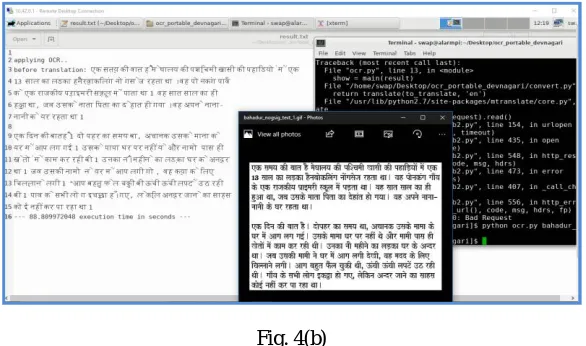
After the pre-processing and feature extraction, the of character recognition is obtain as shown in fig.(b).The image which has been processed is displayed in the form window. From this OCR output we can calculate the accuracy of character recognition, Time and analyse the performance.
Fig. 4(b)
The displayed image output is translated into the English language by using Google translator and save it as a .txt file. This file is read out by the text to speech engine.The Final process of the above methodology is complete as the above text is synthesized and converted in to audio format and played using microphone or mini speaker connecting to on-board audio jack of Raspberry Pi.
TABLE 1
Parameters MATLAB Raspberry
Accuracy 89% 95%
Time Required 00.00.03123 sec. 00.00.00088 sec.
Error rate 37% 10%
Performance 0.000179 0.000153
V. CONCLUSION
The device with the methodology detailed in this paper help toanalysis of performance measures like recognition rate, Error rate, accuracy, time etc. will be helpful in optimization of these parameters. This post processing will result into an efficient Devnagari character recognition system and its application help to the visually challenged to read books and to the international travellerfor translation purpose.
ACKNOWLEDGMENT
Thank to Prof MrP. M. Kakde, Assistant Professor, Electronics and Telecommunication Department, HVPM’s College of Engineering and Technology, Amravati, India.
REFERENCES
1. Vikas J Dongre andVijay H Mankar, ―A Review of Research on Devnagari Character‖, International Journal of Computer Applications (0975 – 8887) Volume 12– No.2, November 2010.
2. SandhyaArora,DebotoshBhattacharjee,MitaNasipur and D. K. Basu ―Recognition of Non- Compound Handwritten Devnagari Characters using a Combination of MLP and Minimum Edit Distance ‖,International Journal of Computer Science and Security (IJCSS),Volume (4)-November 2012
3. C. V. Jawahar, Pavan Kumar, S. S. Ravi Kiran, “A Bilingual OCR for Hindi-Telugu Documents and its Applications”, seventh Intl. Conf. on Document Analysis and Recognition (ICDAR 2003), volume 3 pp 1-7, 2003.
4. R. Bajaj, L. Dey, S. Chaudhary. “Devanagari numeral recognition by combining decision of multiple connectionist classifiers”, Sadhana, volume 27, pp. 59-72, (2002).
5. U. Pal, N. Sharma, T. Wakabayashi, F. Kimura. “Offline handwritten character recognition of Devanagariscript”, 9th International Conference on Document Analysis and Recognition, pp. 496-500, (2007).
6. P.B.Khanale and S.D. Chitnis ―Handwritten Devnagri Character Recognition using Artificial Neural Network‖, Journal of Artificial Intelligence 4(1): 55-62, ISSN1994-5450,, 2011
7. S. Shelke, S. Apte. “Handwritten Marathi Character Recognition using Neural Networks - Single-stage,Multi-stage and Hybrid Classification Techniques”,Lambert Academic Publishing, Germany, 2012.
8. S. Arora, D. Bhattacharjee, M. Nasipuri, D. Basu, M. Kunda. “Combining multiple feature extraction techniques for handwritten Devanagari character recognition”, IEEE Region Colloquium and the ThirdICIIS, pp. 1-6, (2008).
9. S. Shelke, S. Apte and Dr. S Santhosh Baboo. “A novel multi-feature multiclassifier scheme for unconstrained handwrittenDevanagari character recognition,” 12th International Conference on Frontiers in Handwriting Recognition, pp. 215-219, (2010).
10. W. Ahmad, S. A. Hassan, M. A. Irfan, A. Bais, G. M.Hassan, S. A. Ali Shah, M. Khawaja. “Design andimplementation of real time LPR system on a fixed point DSP”, 6th International Conference on EmergingTechnologies, pp. 159-163, (2010).
11. M. M. Farhad. “Real time numeric character recognition system based on finger movements,” InternationalConference on Electrical Information and Communication Technology, pp. 1–5, (2013).
12. V. Ajantha Devi. “Efficient algorithm for realtime handwritten character recognition in mobiledevices”, 8th International Conference on Electrical Engineering Computing Science and Automatic Control, pp. 1–6, (2011).
13. Divakar Yadav, Sonia Sánchez-Cuadrado and Jorge Morato2nd ed., McGraw Hill: NewC. V. Jawahar, Pavan Kumar, S. S. Ravi Kiran, “A Bilingual OCR for Hindi-Telugu Documents and its Applications”, Seventh Intl. Conf. on Document Analysis and Recognition (ICDAR 2013), pp 1-7, 2013.
14. Anusha Bhargava, Karthik V. Nath,study the image recognition technology with speech synthesis and to develop a cost effective, user friendly image to speech conversion system with help of Raspberry Pi.vol 2-2015
15. M. M. Farhad. “Real time numeric character recognition system based on finger movements,” International Conference on Electrical Information and Communication Technology, pp. 1–5, (2013).
16. A. Beltran, S. Mendoza. “Efficient algorithm for real time handwritten character recognition in mobile Devices”, 8thInternational Conference on Electrical Engineering Computing Science and Automatic Control, pp. 1–6, (2011).
17. Pritish Kumar, C.Purnima, “Assistive System for Product Label Detection with Voice Output For Blind Users “, IJREAT International Journal of Research in Engineering & Advanced Technology, Volume 1, Issue 6, Dec-Jan, 2014, pp 1- 4.