
Dispersive analysis of the
κ/K
0∗(700)
meson and other light
strange resonances.
José R.Peláez1,∗,ArkaitzRodas1,∗∗, andJacoboRuiz de Elvira2,∗∗∗
1Departamento de Física Teórica and IPARCOS. Universidad Complutense, 28040, Madrid, Spain
2Albert Einstein Center for Fundamental Physics, Institute for Theoretical Physics, University of Bern,
Sidlerstrasse 5, 3012 Bern, Switzerland
Abstract.We briefly review our recent works where we use dispersion rela-tions to constrain fits to data onπK → πKand ππ → KK¯ providing a sim-ple but consistent description of these processes. Then, simsim-ple analytic meth-ods allow to extract parameters of poles associated to light strange resonances without assuming a particular model. We also present preliminary results on a model-independent determination of the controversialκorK∗
0(700) resonance parameters, by using those constrained parameterizations as input for partial-wave hyperbolic dispersion relations that allow to perform a rigorous analytic continuation to determine its associated pole.
1 Introduction
πK → πK scattering provides most of the information on strange resonances below 2 GeV. Unfortunately this process cannot be observed directly but has to be extracted as a sub-process withinπN →πKN0. This leads to large systematic uncertainties and to conflicting data sets. Moreover, the determination of the parameters of these resonances is very often affected by large model dependencies, due to the use of too simple models. The most extreme case is the
κmeson, nowadays calledK∗
0(700), which is the lightest strange resonance, and whose very
existence has been controversial over almost four decades. As a matter of fact, according to the last Review of Particle Physics [1], theκ/K∗
0(700) still “Needs Confirmation”. It should
nevertheless be noted that, for several decades now, as soon as models describe the low-energy data, respect unitarity and have some basic analyticity properties, aκpole is found around 600 to 900 MeV [2].
Mathematically, resonances are defined rigorously through their associated pole lying in the second Riemann sheet of the complex plane of any amplitude in which that resonance appears. The mass and width of the resonance is then related to the pole position by √spole'
MR−iΓR/2 and its residue is related to the coupling to the elastic channel. Thus, in case the resonance is narrow its pole lies close to the physical axis (i.e. the real axis above the energy threshold). In cases where the resonance is also isolated from other analytic structures (other poles, thresholds, cuts etc...), it appears in experiment as a characteristic peak. In such cases even simple models describing the data in the vicinity of the peak, like the usual Breit-Wigner
∗e-mail: [email protected] ∗∗e-mail: [email protected] ∗∗∗e-mail: [email protected]
parameterization, may provide fair approximations to the pole position and residue. However, when resonances are wide, or overlap with other resonances, or have threshold cuts and other analytic or dynamical structures nearby, simple models are inadequate to determine the pole parameters or even the very existence of the resonant state.
Nevertheless by taking rigorously into account the analytic structure of the singulari-ties that appear in amplitudes one can overcome all the above caveats. In particular, using Cauchy’s Integral Formula, these singularities translate into integral relations known as dis-persion relations. In this workshop we reviewed our recent analyses using such disdis-persion relations to constrain the ofπK →πKandππ→ KK¯ data fits. The resulting parameteriza-tions can later be used as input to determine in a model-independent way the pole parameters of strange resonances.
2 Poles determined from Dispersive and Analytic methods
Thus, over a series of works, we have followed our goal of determining the existence of strange resonances as well as extracting their parameters from the existing data avoiding or minimizing model dependencies. Hence, in [3] we provided first simple unconstrained fits toπK → πKdata onS,P,D,F partial waves up to 1.8 GeV, taking particular care on the estimation of systematic uncertainties. We then showed that such simple parameterizations lead to inconsistencies with Forward Dispersion Relations (FDR). Our main result was then to provide a set of partial-wave parameterizations, called Constrained Fits to Data (CFD), which is consistent with a complete set of FDRs up to 1.6 GeV, i.e., one FDR for thes↔u
symmetricF+amplitude and another one for the antisymmetricF−, wheres,t,uare the usual Mandelstamm variables.
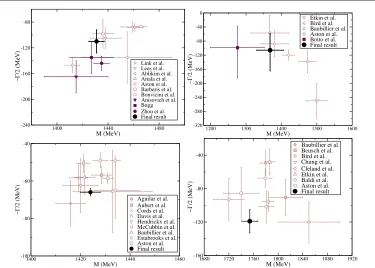
Unfortunately, an analytic continuation to the complex plane for partial waves cannot be obtained from FDRs. Nonetheless, we can use of a powerful method [4] based on the conver-gence on the complex plane of series of Padé approximants constructed from information on the physical axis. Remarkably, this method does not require a choice of parameterization for the resonance pole, hence avoiding such a model dependence. In particular, the residue is not necessarily related to the pole position in a Breit-Wigner-like form, as it has been assumed in most analyses of strange resonances below 2 GeV. Obviously, the main caveat is that we are not able to calculate an infinite sequence of Padés, but it has to be truncated. In practice, the pole can only be determined with a few Padés, not an infinite number of them, and that effect yields a sizable contribution to the systematic uncertainty. Another relevant feature of this technique is that it can be applied not only in the elastic region but, more importantly, also in the inelastic region. Hence, our “Final result”+poles in [5] obtained by applying this Padé method to ourπK CFD fits in the inelastic region are shown in Fig.1. Hollow sym-bols stand for Breit-Wigner-like parameterizations whereas solid symsym-bols representT-matrix poles (references can be found in [1]). The large dispersion in older values is mostly due to model-dependence, which we have avoided with the Padé sequence technique.
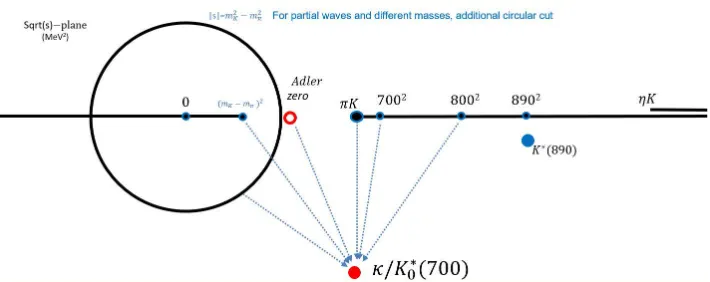
Concerning theκ/K0∗(700), we illustrate in Fig.2, that its pole lies very deep in the com-plex plane in comparison with theK∗(892) pole, for which a Breit-Wigner parameterization
1400 1440 1480 M (MeV) -240 -200 -160 -120 -80 −Γ/2
(MeV) Link et al.Lees et al. Ablikim et al. Aitala et al. Aston et al. Barberis et al. Bonvicini et al. Anisovich et al. Bugg Zhou et al. Final result
1200 1300 1400 1500 1600
M (MeV) -320 -280 -240 -200 -160 -120 -80 -40 0 −Γ/2 (MeV)
Etkin et al. Bird et al. Baubillier et al. Aston et al. Boito et al. Final result
1400 1420 1440 1460
M (MeV) -100 -80 -60 -40 −Γ/2
(MeV) Aguilar et al.
Aubert et al. Cords et al. Davis et al. Hendrickx et al. McCubbin et al. Baubillier et al. Estabrooks et al. Aston et al. Final result
1680 1720 1760 1800 1840 1880 1920
M (MeV) -160 -120 -80 -40 −Γ/2 (MeV)
Baubillier et al. Beusch et al. Bird et al. Chung et al. Cleland et al. Etkin et al. Baldi et al. Aston et al. Final result
Figure 1. Pole positions of the K∗
0(1430) (top-left), K
∗
1(1410) (top-right), K
∗
2(1430) (bottom-left),
K∗
3(1780) (bottom-right) extracted from data fits constrained with Forward Dispersion Relations and using sequences of Padé approximants for the analytic continuation to the complex plane. Also shown are the poles listed in the RPP (see [1] for references). The figures and our “final result" come from [5].
that makes use of partial-wave hyperbolic dispersion relations for the analytic continuation to the complex plane of a numerical solution (without fitting elastic data) of Roy-Steiner equations. In spite of this rigorous result, theκ, still calledK0∗(800) in 2016, still “Needs confirmation” in the RPP.
It is worth noting that in the elastic regime, just by naively extrapolating to the complex plane our CFD description, which has been constructed matching simple parameterizations in different energy regions, we find a pole roughly consistent with the RPP estimate. In Fig.3 we have denoted this result by ‘Conformal CF”. However, such a simple determination relies on a specific parameterization and is therefore model dependent.
Remarkably, applying the Padé method explained above to our constrained fits to data in [3] we have also shown in [5] that there is a pole for the controversialκ/K∗
0(700). It is shown
as the “Padé resul” in Fig.3. Note that this result, with its very reduced model dependence, is in very good agreement with the dispersive prediction in [6] triggered the κ change of denomination at the 2018 RPP revision: from K∗
0(800) to its present name K ∗
0(700). Still,
even with this additional piece of evidence, the 2018 RPP [1] considers that this state "Needs Confirmation”.
Figure 2.The analytic structure ofπKpartial waves has physical cuts on the real axis extending from each new threshold to infinity, a circular cut and a left cut due to crossed channels. The presence of an Adler zero in the subthreshold region is a requirement of chiral symmetry breaking. For typical Breit-Wigner-like resonances like theK∗
(892), their associated pole in the lower half of the complex plane (in blue) lies close to the real axis very near its nominal mass. In contrast, theκ/K∗
0(700) pole (in red) lies very deep in the complex plane. Moreover, its pole is as close to its nominal mass region in the real axis as it is to theπKthreshold, the Adler zero, the circular and left cuts. For a precise determination of theκ/K∗
0(700) pole a careful calculation of such contributions is thus required.
quark model sense. This is not just a matter of being a wide resonance, but of the pole residue (i.e. its coupling toπK) being related to the mass and width in a different way than for ordinary resonances (those generically described with simple Breit-Wigner equations or slightly modified variants).
Therefore, with the aim of providing the confirmation requiered for theκ/K0∗(700), two of us are presently completing [9] a data analysis using partial-wave hyperbolic and fixed-t
dispersion relations up to'1 GeV as constraints. In this way we take into account correctly all analytic structures inπKpartial waves, as shown in Fig.2. This kind of dispersion relations, with crossing built in, are called Roy-Steiner equations.
Let us remark that in our ongoing analysis we are using data in the elastic region of the
S,P,D,F waves. This is in contrast to what was done by the authors of [6], who found solutions forS andP waves only, but without input from data on those very same waves in the elastic region. In addition, note that we use the dispersion relations as constraints on fits, not to obtain solutions, as did in [6]. On top of that, we are constraining partial waves with both hyperbolic and fixed-t dispersion relations, contrary to [6], where the hyperbolic dispersion relations used as input a solution of the fixed-t ones.
Since they are needed for theπK → πK analysis, we obtained first constrained fits to data forππ→KK¯ scattering [8]. Actually, we showed that some of the existingππ→ KK¯
data, as well as simple unconstrained fits to those data, fail to satisfy hyperbolic dispersion relations. Nevertheless we were able to provide Constrained Fits toππ→KK¯ Data (CFD), describing data while being consistent with the dispersion relations up to 1.47 GeV. Note that our CFD parameterizations can describe data up to 2 GeV, but, as shown in [8], 1.47 GeV is the maximum applicability region of hyperbolic dispersion relations.
Figure 3.Preliminary results for theκ/K∗
0(700) pole from a Roy-Steiner analysis. For comparison, we show theT-matrix poles listed in the RPP [1] (see references therein) and the grey rectangle stands for the uncertainty presently estimated there [1]. In the top panel we show how, even with the same UFD input, the red and blue poles, respectively obtained using one or no subtractions forF−
yield incompati-ble values. In contrast, we show in the lower panel that, when using our simple CFD parameterizations, the two red and blue poles come out consistently, determining precisely theκ/K∗
0(700) pole position at the red and blue numerical values quoted in the inset rectangle, which are also preliminary.
the obtained pole is accurate. This is illustrated in the top panel of Fig.3, where we have used as input for the dispersion relations our unconstrained fits toπKdata, which describe data but do not satisfy well the Roy-Steiner representation in the real axis. In such case, the pole obtained from the once-subtracted relations forF−(in red) is incompatible with the pole obtained with the unsubtracted dispersion relation forF−(in blue). And both come from the
same data! If on top of that one were to use a simple model for a naive analytic continuation, the result would be even less reliable!! To determine theκ/K∗
0(700)pole it is therefore im-portant to have both an input that satisfies the dispersive representation on the real axis and
a dispersive integral to perform the analytic continuation to the complex plane.
wave dispersion relations obtained from fixed-t dispersion relations. Moreover, we have constrained the fits and determine the pole existence and parameters with both one or no subtractions for the antisymmetric amplitude (only the subtracted one was used before). Fur-thermore, we have included other improvements in our calculation. In particular, our isospin 1/2P-wave describes the existing data, ourππ→KK¯ input has associated uncertainties and satisfies the Roy-Steiner representation and we have improved the Pomeron determination to be consistent with factorization of kaon-nucleon data.
With all those improvements, our preliminary results for theκ/K0∗(700) pole are shown in the lower panel of Fig.3. Remarkably, the poles obtained either with one or no-subtractions (red and blue, respectively) lie on top of each other. Not only they are very compatible among themselves but also with our Padé result and with the previous Roy-Steiner prediction. There-fore, we think our preliminary results are on the way of providing the confirmation demanded by the RPP to finally settle the existence and parameters of theκ/K∗
0(700) resonance and
com-plete the members of the controversial light scalar nonet.
Acknowledgements
Talk presented by JRP at the International Workshop on e+e− collisions from Phi to Psi, Budker Institute, Novosibirsk, February 25th-March 1st, 2019. JRP thanks the PhiPsi19 organizers for the invitation to give a talk and for the very nice workshop organization. JRP and AR are supported by the Spanish Project FPA2016-75654-C2-2-P. The work of JRE is supported by the Swiss National Science Foundation. AR acknowledges the financial support of the Universidad Complutense de Madrid through a predoctoral scholarship.
References
[1] M. Tanabashi et al. (Particle Data Group), Phys. Rev. D 98, 030001 (2018).
[2] R. L. Jaffe, Phys. Rev. D15, 267 (1977). M. D. Scadron, Phys. Rev. D26, 239 (1982). E. van Beveren,et al.Z. Phys. C30, 615 (1986). S. Ishida, M. Ishida, T. Ishida, K. Taka-matsu and T. Tsuru, Prog. Theor. Phys. 98 (1997) 621. R. Kaminski, L. Lesniak and B. Loiseau, Phys. Lett. B413, 130 (1997). J. A. Oller and E. Oset, Nucl. Phys. A620, 438 (1997) [Erratum-ibid. A652, 407 (1999)]. Phys. Rev. D60(1999) 074023. J. A. Oller, E. Oset and J. R. Pelaez, Phys. Rev. Lett.80(1998) 3452, Phys. Rev. D59, 074001 (1999) [Erratum-ibid. D 60, 099906 (1999)] [Erratum-ibid. D 75, 099903 (2007)]. D. Black, A. H. Fariborz, F. Sannino and J. Schechter, Phys. Rev. D59, 074026 (1999). F. E. Close and N. A. Tornqvist, J. Phys. G28, R249 (2002). J. R. Pelaez, Mod. Phys. Lett. A19, 2879 (2004). Z. Y. Zhou and H. Q. Zheng, Nucl. Phys. A 775(2006) 212. D. V. Bugg, Phys. Rev. D81(2010) 014002. T. Wolkanowski, M. Sołtysiak and F. Giacosa, Nucl. Phys. B
909, 418 (2016)
[3] J. R. Pelaez and A. Rodas, Phys. Rev. D93(2016), 074025
[4] P. Masjuan and J. J. Sanz-Cillero, Eur. Phys. J. C73, 2594 (2013). P. Masjuan, J. Ruiz de Elvira and J. J. Sanz-Cillero, Phys. Rev. D90, 097901 (2014). I. Caprini, P. Masjuan, J. Ruiz de Elvira and J. J. Sanz-Cillero, Phys. Rev. D93, 076004 (2016)
[5] J. R. Pelaez, A. Rodas and J. Ruiz de Elvira, Eur. Phys. J. C77(2017), 91 [6] S. Descotes-Genon and B. Moussallam, Eur. Phys. J. C48(2006) 553 [7] J. R. Pelaez and A. Rodas, Eur. Phys. J. C77(2017), 431
![Figure 3. Preliminary results for the κ/K∗0(700) pole from a Roy-Steiner analysis. For comparison, weshow the T-matrix poles listed in the RPP [1] (see references therein) and the grey rectangle stands forthe uncertainty presently estimated there [1]](https://thumb-us.123doks.com/thumbv2/123dok_us/8005218.1330094/5.482.129.340.74.397/preliminary-steiner-comparison-references-rectangle-uncertainty-presently-estimated.webp)
