A Survey on Lightweight Entity Authentication with Strong PUFs
Jeroen Delvaux1,2, Roel Peeters1, Dawu Gu2 and Ingrid Verbauwhede1 1 ESAT/COSIC and iMinds, KU Leuven,
Kasteelpark Arenberg 10, B-3001 Leuven-Heverlee, Belgium
{jeroen.delvaux, roel.peeters, ingrid.verbauwhede}@esat.kuleuven.be 2
CSE/LoCCS, Shanghai Jiao Tong University, 800 Dongchuan Road, Shanghai 200240, China
Abstract. Physically unclonable functions (PUFs) exploit the unavoidable manufacturing variations of an integrated circuit (IC). Their input-output behavior serves as a unique IC ‘fingerprint’. Therefore, they have been envisioned as an IC authentication mechanism, in particular the subclass of so-called strong PUFs. The protocol proposals are typically accompanied with two PUF promises: lightweight and an increased resistance against physical attacks. In this work, we review nineteen proposals in chronological order: from the original strong PUF proposal (2001) to the more complicated noise bi-furcation and system of PUF proposals (2014). The assessment is aided by a unified notation and a transparent framework of PUF protocol requirements.
Keywords: physically unclonable function, entity authentication, lightweight
1
Introduction
In this work12, we consider a common authentication scenario between two parties: a low-cost resource-constrained tokenand a resource-rich server. Practical instantiations of a token include the following: radio-frequency identification (RFID) tags, smart cards and nodes of a wireless sensor network. One-way or possibly mutual entity authentication is the main objective, occasionally extended with token privacy. Although the server has secure computing and storage at its disposal, providing security is a major challenge given the requirements at the token side. Tokens typically store a secret key in non-volatile memory (NVM), using a mature technology such aselectrically erasable programmable read-only memory (EEPROM) and its successor Flash, battery-backed static random-access memory (SRAM) or fuses. Cryptographic primitives import the key and perform an authentication protocol.
Today’s issues are as follows. First, implementing cryptographic primitives in a resource-constrained manner is rather challenging. A lightweight hash function (Spongent, Quark, Photon, etc.) still requires 1500 gate equivalents, typically. Second, an attacker can gain physical access to the integrated circuit (IC) of a token. NVM has proven to be vulnerable to physical attacks [55] as the secret is stored permanently in a robust electrical manner. Third, most NVM technologies oppose the low-cost objective. EEPROM/Flash requires floating gate transistors, resulting in additional manufacturing steps with respect to a regularcomplementary metal-oxide-semiconductor (CMOS) design. Battery-backed SRAM requires a battery. Circuitry to protect the NVM contents, e.g., a mesh of sensing wires, tends to be expensive.
Physically unclonable functions (PUFs) offer a promising alternative. Essentially, they are binary functions, with their input-output behavior determined by IC manufacturing variations. Therefore, they can be understood as a unique IC ‘fingerprint’, analogous to human biometrics. They might alleviate the aforementioned issues. Many PUFs allow for an implementation which is both resource-constrained and CMOS compatible. Furthermore, the secret is hidden in the physical structure of an IC, which is a much less readable format. Invasive attacks might easily destroy this secret, as an additional advantage.
1
This work extends our prior CHES 2014 manuscript “Secure Lightweight Entity Authentication with Strong PUFs: Mission Impossible?” as follows. Most notably, eleven additional strong PUF protocols are included in the overview-analysis. Also, we improved the transparency of our analysis by explicitly listing protocol requirements. Finally, token privacy has been included in the analysis.
2
Numerous PUF-based authentication protocols have been proposed. Two categories of protocols naturally emerge, linked to functional discrepancies between so-called weak and strong PUFs. The weak PUF approach comprehends the use of PUFs as key generator, which is perfectly compatible with conventional authentication protocols. We focus on the strong PUF approach instead. The input-output behavior of the PUF is then an essential component of the protocol itself. This requires a special flavor of protocol design. We are the first to construct an extensive list of protocol requirements and apply it as an analysis tool to a rather complete list of strong PUF protocols. Numerous security and practicality issues appear. To such an extent, that we cannot support the use of most proposals in their current form. Our framework of protocol requirements is also intended as a checklist to improve the quality of future PUF-based protocols.
We consider the followinglist of strong PUF protocols, all described with a unified notation for ease of understanding: basic strong PUF authentication [45], controlled PUFs [15], Bolotnyy et al. [4], ¨Ozt¨urk et al. [44], Hammouri et al. [18], Kulseng et al. [33], Sadeghi et al. [53], logically reconfigurable PUFs [29], reverse fuzzy extractors [59], the converse protocol [30], Lee et al. I [35], Jin et al. [23], slender PUFs [40], Xu et al. [60], He et al. [19], Jung et al. [24], Lee et al. II [36], noise bifurcation [61] and system of PUFs [31]. All protocols in this work employ two phases. The first phase is a one-time enrollment in a secure environment, following IC manufacturing. The server then initializes variables in NVM and/or obtains some information about the PUF to establish a shared secret. The destruction of one-time interfaces might per-manently restrict direct NVM/PUF access afterwards. The second phase is in-the-field deployment, where tokens are vulnerable to physical attacks. Token and server then authenticate over an insecure communication channel.
The remainder of this manuscript is organized as follows. Section 2 introduces notation and preliminaries. Section 3 lists the requirements of a PUF-based authentication protocol. Section 4 introduces authentication via PUF-based key generation, to be considered as a reference. Section 5 describes and analyzes all strong PUF protocols. Our analysis is performed at protocol level, considering PUFs as a black box. Section 6 provides an overview of the protocol assessment. Section 7 concludes the work.
2
Preliminaries
2.1 Notation
Binary vectors are denoted with a bold lowercase character, e.g.,c∈ {0,1}1×m. All vectors are row vectors. Their elements are selected with an indexi≥1 between round brackets, e.g.,c(1),c(2), etc. The null vector is denoted as0. Binary matrices are denoted with a bold uppercase character, e.g.,H. Operations are the following: addition modulo 2 (XOR), e.g.,x⊕c, multiplication modulo 2, e.g., e·HT, concatenation, e.g., x||c, and bit inversion, e.g.,r. Variable assignment is denoted with an arrow, e.g.,d←d−1. Variables may occasionally be denoted with an additional protocol run counter, e.g.,c(1), c(2), etc. Functions are printed in italic, with their input arguments between round brackets, e.g., Hamming weightHW(r) and Hamming distanceHD(r1,r2).
2.2 Embedded Non-Volatile Memory
in additional masks and processing steps. Battery-backed SRAM relies on CMOS-compatible SRAM, but batteries are considered to be very expensive. There are MTP NVM cell structures which do not further complicate the manufacturing process, as provided by, e.g., eMemory. However, these initiatives should not be considered as a commodity yet. Furthermore, the storage density is typically lower than EEPROM/Flash.
2.3 Physically Unclonable Functions: Black Box Description
Them-bit input andn-bit output of a PUF are referred to as challengecand responserrespectively. Unfor-tunately for cryptographic purposes, the behavior of challenge-response pairs (CRPs) does not correspond with a random oracle. First, the response bits are not perfectly reproducible. Noise in transistors and wires as well as various environmental perturbations (supply voltage, temperature, etc.) result in non-determinism. Second, the response bits arenon-uniformly distributed: bias and correlations are present. Without proper compensation, this might enable a variety of attacks.
PUFs are often subdivided in two classes, according to their number of CRPs. Weak PUFs offer few CRPs, scaling roughly linear with the required IC area. Architectures typically consist of an array of identi-cally laid-out cells, each producing one or more response bits. E.g., the SRAM PUF [22] and the ring oscillator PUF3 [56] are both very popular. Spatial correlations among cells are to be expected. Addressing the array provides a challenge-response mechanism. However, the total array size is of primary importance: mostly, all 2m·nbits are used collectively to generate a secret key. This key is stored in volatile memory whenever cryptographic operations have to be performed, opposing the permanent nature of NVM. Post-processing logic, typically a fuzzy extractor [11], is required to ensure a reproducible and uniformly distributed key.
Strong PUFs offer an enormous number of CRPs, often scaling exponentially with the required IC area. Despite their small response space, mostly n= 1, architectures are typically able to provide a large challenge space, e.g.,m= 128. Therefore, they might greatly exceed the need for secret key generation and have been promoted primarily as lightweight authentication primitives. The most famous example is the arbiter PUF [34]. However, correlations among CRPs are severe, as these are not only spatial in nature but also induced by the functional behavior. Therefore, unprotected exposure to the PUF might enable so-called modeling attacks. One tries to construct a predictive model of the PUF, given a limited set of training CRPs. Machine learning algorithms have proven to be successful [51].
Former subdivision comprehends a popular adaption of more restrictive notions in [17]. Originally, weak and strong PUFs were required to be tamper evident. Furthermore, correlations between CRPs were required to be negligible. For strong PUFs, this would implicate resistance against modeling attacks. Although highly relevant as an ideal case specification, we stick to the more recent practical notions.
PUFs were initially praised for their resistance against physical attacks. Hereby often relying on the intuitive insight that invasion of the IC might damage the PUF and hence destroy the secret. This is in addition to the volatile nature of PUFs, posing limits on the attack time. However, a recent string of physical attacks [3, 20, 41, 52, 57] reduces the optimism. Side-channel analysis is non-invasive and cannot destroy the secret. Even invasive techniques were demonstrated to be successful. The primary focus of these attacks is collecting CRPs. For weak PUFs, this directly corresponds with a characterization of the secret. For strong PUFs, an additional machine learning step might be required for the attack to be successful. Despite all the former, it needs to be said that there is hardly work on countermeasures. Just like NVM and algorithms without countermeasures are an easy target, the same might be true for PUFs.
2.4 Secure Sketches and Fuzzy Extractors
The noisiness of a PUF causes the regenerated instance of a responserto be slightly different:er=r⊕e, with HW(e) relatively small. Although a wide variety of reconstruction methods has been proposed [8], secure sketches [11, 12] are a particularly useful tool, as defined by a two-step procedure. First, public helper data is generated:p=Gen(r). Second, reproduction is performed:r=Rep(er,p). Helper datapunavoidably leaks some information about r, although this entropy loss is supposed to be limited. Despite the rather generic definition, two constructions dominate the implementation landscape, as specified in Figure 1. Both the code-offset and syndrome construction employ a binary [n, k, t] block codeC, withtthe error-correcting capability.
3
The latter construction requires a linear block code, as it employs the parity check matrixH∈ {0,1}(n−k)×n. Successful reconstruction is guaranteed for both constructions, given HW(e) ≤ t. Information leakage is limited to n−k bits. The hardware footprint is asymmetric: Gen is better suited for resource-constrained devices thanRep [59].
Gen
Randomw∈ C p←r⊕w
Rep
e
w←er⊕p=w⊕e Error-correctwe tow
r←p⊕w
(a)
Gen
p←r·HT
Rep
s←er·H
T⊕p=e·HT
Determinee r←er⊕e
(b)
Fig. 1.Secure sketch constructions: (a) code-offset, (b) syndrome.
A fuzzy extractor (FE) can be constructed out of a secure sketch. An additional hash function then produces a nearly uniform output:k←Hash(r). By having more input than output bits, it compensates for the non-uniformity ofr as well as the helper data leakage. It is advisable to extend all of the former with a helper data integrity check [5]. E.g., a token could check whether Hash(r,p) matches a reference value stored in NVM. This disables the exploitation of token failure rate probabilities, which has been identified as a threat for a variety of helper data methods [8]. However, this does not stop the enhancement of side channel analysis via helper data manipulation, as in [25] and [42].
3
Protocol Requirements
PUFs require a special flavor of protocol design. We are the first to explicitly list an extensive set of protocol requirements. Sections 3.1 to 3.10 describe a mixture of PUF-induced requirements and more conventional concerns. The list is tailored to the vast majority of PUF protocols, aiming to obtain token-server entity authentication, but can be mapped quite easily to other settings. The interpretation of individual items ranges from strictly required to highly desired, as nuanced hereafter.
3.1 Complete Specification (#1)
A protocol should be specified in a complete unambiguous manner. Although this seems obvious, we observe that many proposals do not comply. Furthermore, the use of a particular PUF should be suggested, at least for protocols of which the security and/or functional behavior is PUF-dependent. As a side note, there is considerable advantage in having a graphical representation of a protocol, clearly detailing all computations and exchanged messages. This facilitates the analysis considerably. We observe that many proposals focus on a text-based description, with only a minimal graphical representation as support. In this work, we represent all protocols in a detailed graphical manner, hereby using a unified notation. For ease of understanding, we make abstraction of non-essential refinements regarding the two-party setting. E.g., multiple servers, a trusted issuer to aid the enrollment, a distinction between RFID readers and the back-end server, etc.
3.2 Leakage Resilience (#2)
3.3 Able to Handle Noisiness (#3)
Noisiness of the PUF responses should be taken into account. One can employ either one of two approaches: error correction and error tolerance. Responsesertypically have a 1−15% error rate, considering their enrolled versionsras a reference, although it largely depends on the IC’s environment. The lowest noise levels apply to laboratory settings where the environment is ultra-stable. Higher noise levels apply to practical in-the-field settings. Market products are typically supposed to function in a range of temperatures, among other specifications. For completeness, we mention the noisiness to be bit-specific: some bits are noisy, others are stable. Or more precisely, there is a continuous spectrum of bit error rates [38].
3.4 Counteracting Strong PUF Modeling Attacks (#4)
Strong PUFs are too fragile for unprotected exposure, as demonstrated by a history of machine learning attacks [34,39,50,51]. So far, no PUF architecture can claim to be practical, well-validated and robust against modeling. Or stated otherwise: no architecture satisfies the original strong PUF definition given in [17], as has been observed by others, e.g., [37]. With strong cryptographic primitives such as a hash function, one can fully mitigate this threat. Several proposals opt for more lightweight logic, such as XORing, a pseudorandom number generator (PRNG), a true random number generator (TRNG), etc. Although this might offer partial protection only, as becomes clear later-on.
An unprotected strong PUF able to resist modeling would be a real breakthrough. Unfortunately, two fundamental issues undermine the optimism. First, strong PUFs extract their enormous amount of bits from a limited IC area only, hereby using a limited number of circuit elements. The delay model of the arbiter PUF [50] provides an example. A highly correlated structure is the unavoidable consequence. Machine learning algorithms exploit these correlations in a ‘blind’ implicit manner. The modeling resistance is usually quantified by the minimum size of the training set as well as the algorithm runtime. More insightful explicit quantification has been initiated in [39]. Via simulations, one characterized the probability P(ru = rv) =
f(cu,cv) for the ‘averaged’ arbiter PUF. CRPs with|f−1/2|>0 are correlated.
As a second issue, the more entangled and diffusing the structure of a PUF, the more robust against modeling, but the less reproducible the responses as they accumulate more contributions from local noise sources. A popular countermeasure against modeling is the replication of a strong PUF circuit, hereby XORing the output bits. As has been analyzed for arbiter PUFs, correlations are considerably reduced then. Unfortunately, XORing amplifies the noisiness, posing a practical limit on the modeling resistance.
3.5 Strong PUF Response Space Expansion (#5)
To counteract brute-force attacks and random guessing, all strong PUF protocols in this work require the challengecand responserto be of sufficient length, e.g.,m=n= 128. Unfortunately, strong PUFs provide a small response space only, often n = 1. Replicating the PUF circuit is a simple but unfortunately very expensive solution [29, 30]. The lightweight approach is to evaluate a list of n challenges, hereby concate-nating the response bits. Several proposals suggest the use of a particular method to generate such a list. The server could send a list of true random numbers, requiring no additional IC logic, but resulting in a large communication overhead [18]. A small PRNG, such as a linear feedback shift register (LFSR), is often employed [10, 18, 31, 40, 46, 59, 61]. Challenge c is then used as seed value:er← SPUF(PRNG(c)). In [44], a repeated permutation is employed for the same purpose. One might also be able to reuse cryptographic primitives, e.g., in [29], a challenge with an additional counter input is repeatedly hashed. We make abstrac-tion of the response expansion method in the remainder of this work, except when there is a related security issue.
3.6 Low-Cost and Resource-Constrained (#6)
3.7 Easy-to-instantiate (#7)
Ideally, one should not make exacting assumptions about the PUF, so that the protocol can be instantiated easily. There is considerable advantage in the design of generic PUF-independent protocols. First, efficiency and performance characteristics differ for every PUF, in terms of speed, area, power, noisiness, etc. Flexibility of choice allows for better optimization with respect to a given set of constraints. Second, the recent string of physical attacks on PUFs promotes to envision them as easy-to-replace building blocks. We note that all protocols in this work require physical attacks on the PUF to be infeasible. PUF-based key generation is compatible with quasi every weak or strong PUF. The proposals under review are more specific: they all require a strong PUF. Furthermore, additional constraints are imposed, most frequently with respect to the modeling robustness.
3.8 Resistance against Protocol Attacks (#8)
Resistance against conventional protocol attacks should be provided. We hereby assume the PUF to be an ideal random oracle, in order to distinguish from previous requirements. The primary threat is token and/or server impersonation. Furthermore, denial-of-service (DoS) attacks should be considered. We limit the scope to protocol-based DoS attacks, as they can be executed remotely. This because mechanical DoS attacks are trivial to perform, given that one might acquire physical access to a token. Specific protocol claims such as token privacy should be validated as well. For protocols which claim NVM leakage resilience, all of the former should be reevaluated. It even makes sense to reevaluate DoS, as it could have a benefit to perform such an attack with delay, in a non-mechanical manner.
The assumed attacker capabilities should be realistic with respect to the intended application, as it is an occasional practice to mitigate realistic threats with unrealistic assumptions. Luckily, most proposals stick to a fully insecure channel between token and server as well as physical attacks on the token state. We stress the importance of assuming that a token and its PUF are still functional after performing the NVM leakage attack. If an attacker cannot interfere with a genuine protocol run anymore, the security claim would be very marginal. Note that server impersonation, token privacy and DoS are irrelevant for a broken token.
3.9 Scalability: Identification Prior to Authentication (#9)
We distinguish between authentication and identification. The former comprehends the secure verification of an identity while the latter is limited to an unverified claim. Most protocols in this work provide token authentication and therefore also token identification. Unfortunately, identification prior to authentication is more practical. Otherwise, the server would have to iterate over all enrolled tokens to establish a match. There is a simple solution if token privacy is of no concern. Each token can store an identifier in insecure OTP NVM [59]. Alternatively, one could opt for a PUF-generated identifier as well. Matching noisy identifiers is a straightforward operation and more complicated algorithms might even obtain sublinear complexity. We will not further comment on the absence of an identification step, except for the proposals which claim token privacy.
3.10 On the Mutual Authentication Order (#10)
An attacker’s potential to freely query tokens is a major concern. Therefore, it is a good practice to establish server authenticity first, in the case of mutual authentication [21]. The corresponding reduction in attack surface inherently benefits the security and privacy objectives. This might even be the reason to provide mutual authentication in the first place, rather than token authenticity only. Although several protocols employ the opposite order, we do not further discuss, as it comprehends a guideline rather that a stringent requirement.
4
Authentication via PUF-Based Key Generation
NVM k Enc
IC n
a ×
(a) Reference I-A: key in NVM. NVM Dec
TRNG
=?
k
IC
n
b ×
(b) Reference I-B: key in NVM.
WPUF
Rep Hash e
r r
×
Gen p
a
n
(c) Reference II-A: PUF-based key IC
WPUF Hash
Rep TRNG
=? er
r ×
Gen p
n
b
(d) Reference II-B: PUF-based key. IC
SPUF
Rep PRF
e
r r
×
Gen p
a
n
(e) Gassend [13] IC
NVM
NVM
SPUF
Rep PRF
TRNG
y
p k
Gen p
nS
a
nT
× × ×
IC
(f) Sadeghi et al. [53].
NVM
Hash
Hash =?
WPUF
Gen TRNG
er
i
a
nS
b
nT
e
p ×
×
IC
(g) Modified reverse FE [37].
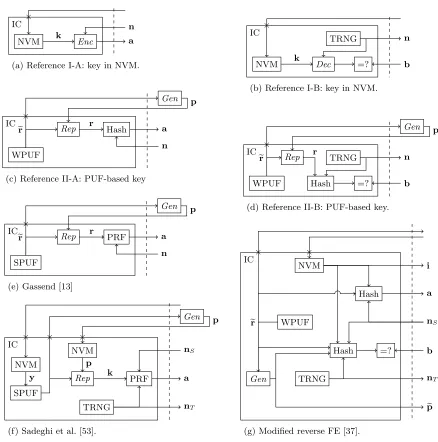
such concatenations are not the primary interest of this work, they establish a baseline in terms of security, efficiency and extensibility. A well-validated protocol combined with a secure mechanism for PUF-based key generation might provide excellent security guarantees. Efficiency might be a major concern though as strong cryptographic primitives are expected to be involved. Extensibility to other requirements is excellent and one might benefit from a wide body of literature. Guided by Figure 2, we now refine foregoing sketch on concatenated protocols.
4.1 Reference Protocols
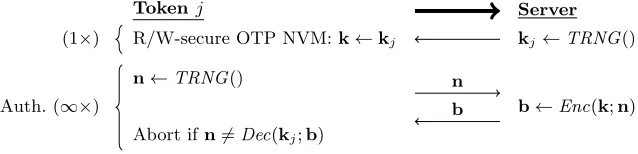
Reference I-A in Figure 2(a) relies on physically secure NVM, an assumption which might not always hold in practice. Figure 3 represent the corresponding protocol, which offers token authenticity only. Each token stores a unique secret keykin OTP NVM. A cryptographic primitive performs the authentication. We opt for a block cipher with encryption and decryption algorithms Enc and Dec respectively. E.g., the 128-bit version of the Advanced Encryption Standard (AES) might be used. Reference I-B, represented by Figure 2(b) and 4, provides server authenticity. Both mechanisms could be combined in order to provide mutual authentication.
(1×)
Auth. (∞×)
Tokenj
R/W-secure OTP NVM:k←kj
a←Enc(k;n)
n
a
Server
kj←TRNG()
n←TRNG()
Abort ifn6=Dec(kj;a)
Fig. 3.Authentication with Reference I-A. The thick arrow points from verifier to prover.
(1×)
Auth. (∞×)
Tokenj
R/W-secure OTP NVM:k←kj
n←TRNG()
Abort ifn6=Dec(kj;b)
n
b
Server
kj←TRNG()
b←Enc(k;n)
Fig. 4.Authentication with Reference I-B.
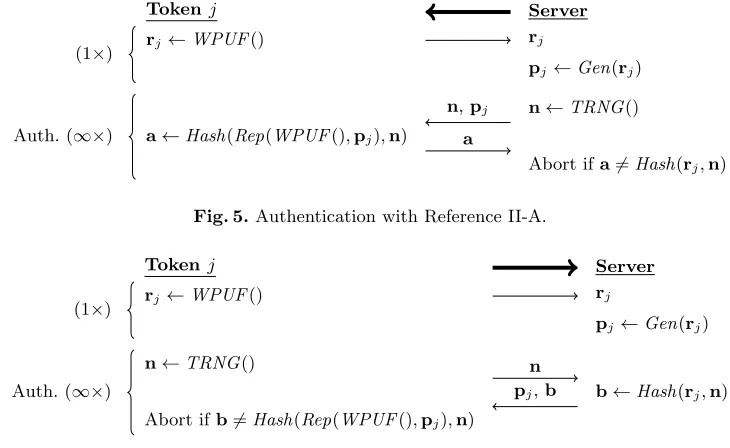
Reference II-A, represented by Figures 2(c) and 5, provides token authenticity. A weak PUF (WPUF) is sufficient and logic for generating challenges might be as simple as reading out the whole cell array. One could opt for a strong PUF (SPUF) with challenge generator as well. Strong PUFs typically require less area to provide a given number of response bits. The other side of the coin is that these bits are more correlated, requiring more bits to provide identical entropy and hence increasing the post-processing burden as well. The response noisiness and non-uniformity issues are resolved with a fuzzy extractor.Gen is executed only once during enrollment. Public helper datapis stored by the server, or alternatively at the token side in insecure OTP NVM. For simplicity, we did omit a helper data integrity check, although we highly recommend to include one. One could generate a key ask←Hash(r). We perform an optimization by merging this step with the authentication. Reference II-B, represented by Figure 2(d) and 6, provides server authenticity. Again, both mechanisms could be combined in order to provide mutual authentication.
4.2 Existing Literature
(1×)
Auth. (∞×)
Tokenj
rj←WPUF()
a←Hash(Rep(WPUF(),pj),n)
n,pj a
Server rj
pj←Gen(rj)
n←TRNG()
Abort ifa6=Hash(rj,n)
Fig. 5.Authentication with Reference II-A.
(1×)
Auth. (∞×)
Tokenj
rj←WPUF()
n←TRNG()
Abort ifb6=Hash(Rep(WPUF(),pj),n)
n pj,b
Server rj
pj←Gen(rj)
b←Hash(rj,n)
Fig. 6.Authentication with Reference II-B.
termphysically obfuscated key. We represent the corresponding protocol by its block diagram in Figure 2(e) only, due to its incomplete specification and given the striking similarities with Reference II-A. Their strong PUF is evaluated with hardwired challenges, which would be equivalent with the later notion of weak PUFs. A pseudorandom function (PRF) is suggested as cryptographic primitive. Tuyls et al. [58] use public key cryptography, mitigating the need for a shared secret between token and server, although it might not be so very lightweight. The proposal of Sadeghi et al. [53] is formulated as a strong PUF protocol and hence analyzed later-on, although it can be reduced quite trivially to a weak PUF protocol. The modified reverse fuzzy extractor proposal [37] comprehends a special case of secret key generation, as the key is adapted to the noise. We analyze this protocol later-on, together with the original strong PUF version. There is the protocol of Bassil et al. [1], which has been badly broken in [54]. The proposal of Karda¸s et al. [27] is formulated as a strong PUF protocol, although it can again be reduced quite trivially to a weak PUF protocol. However, it does not fully fit our scope, as it aims to defend against RFID reader compromise.
5
Strong PUF Protocol Analysis
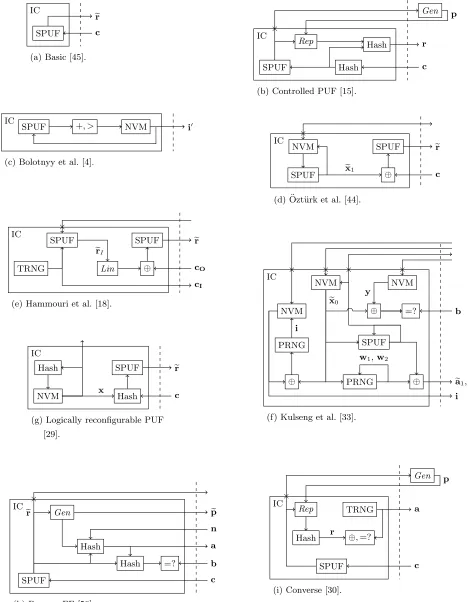
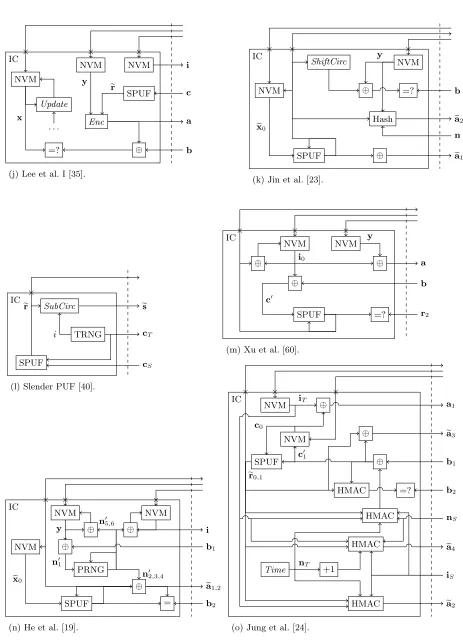
We describe and analyze all strong PUF protocols in chronological order, guided by Figure 7. As some protocols contain similar design concepts, we also considered categorizing them. However, it does not fly all the way, so we opt for the history of development as main theme instead. Sections 5.1 to 5.19 can be read in arbitrary order, although we recommend to get acquainted with the basic protocol first.
5.1 Basic Authentication (2001)
SPUF IC
c
e
r
(a) Basic [45].
Hash SPUF
Rep Hash
Gen p
×
r
c
IC
(b) Controlled PUF [15].
SPUF +, > NVM i0
IC
(c) Bolotnyy et al. [4].
NVM
SPUF
SPUF
⊕
e
x1
er
c ×
IC
(d) ¨Ozt¨urk et al. [44].
TRNG SPUF
Lin ⊕
SPUF erI
e
r
cO
cI
×
IC
(e) Hammouri et al. [18].
NVM
NVM NVM
PRNG
⊕
SPUF
PRNG
=?
⊕
⊕ i
w1,w2
y
e
x0
× × × ×
e
a1,ea2
i b
(f) Kulseng et al. [33]. IC
NVM Hash
Hash SPUF
x
e
r
c
(g) Logically reconfigurable PUF [29].
IC
SPUF Gen
Hash
Hash =?
er ep
n
a
b
c ×
IC
(h) Reverse FE [59].
SPUF Rep
Hash ⊕,=? TRNG
r
Gen p
a
c ×
IC
(i) Converse [30].
NVM NVM NVM SPUF Enc Update =? ⊕ er y x . . . i c a b × × × IC
(j) Lee et al. I [35].
NVM NVM Hash ShiftCirc SPUF =? ⊕ ⊕ e x0 y × × × e a2 e a1 n b
(k) Jin et al. [23]. IC SPUF TRNG SubCirc e r i es cT cS × IC
(l) Slender PUF [40].
SPUF NVM NVM ⊕ ⊕ =? ⊕ y i0 c0
IC× × ×
r2
a
b
(m) Xu et al. [60].
NVM NVM NVM SPUF PRNG = ⊕ ⊕ ⊕ ⊕ e
x0 n
0
2,3,4
n05,6
y
n01
IC × × ×
i
b1
e
a1,2
b2
(n) He et al. [19].
NVM NVM SPUF HMAC HMAC HMAC ⊕ ⊕ =? HMAC ⊕ Time +1 iT e
r0,1
nT c01
c0 × × × a1 e a3 b1 b2 nS e a4 iS e a2 IC
(o) Jung et al. [24].
NVM NVM
NVM
⊕ ⊕
=?
Hash
SPUF
MAC =?
Hash MAC
⊕
⊕
c1 er1
e
r0
c0
i
y
n0
b1
b2
b3
e
a3
e
a2
e
a1
× × ×
IC
(p) Lee et al. II [36].
SPUF
TRNG
↓d
e
r
ui
es
cT
cS ×
IC
(q) Noise bifurcation [61].
SPUF WPUF
SPUF
e
rH
e
rS
cS
e
rG
cH
IC
(r) System of PUFs [31].
Fig. 7.Token representation for all strong PUF protocols (continued).
(1
×
)
Auth.
(
d
×
)
Tokenj
rij←SPUF(cij)
e
r←SPUF(c)
c
e
r
Server
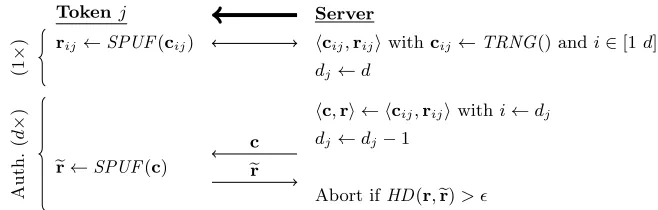
hcij,rijiwithcij←TRNG() andi∈[1d]
dj←d
hc,ri ← hcij,rijiwithi←dj dj←dj−1
Abort ifHD(r,er)>
Modeling Attacks (#4) The proposal does not prevent PUF modeling attacks. A predictive model would enable token impersonation. Therefore, the practical value of the protocol is rather limited: there is no secure instantiation due to the lack of an appropriate strong PUF. We stress that the former applies to silicon PUFs. Optical PUFs [45], which initiated PUF history, are generally believed to be much more robust against modeling. Unfortunately, these are not so very compatible with low-cost integrated applications.
5.2 Controlled PUFs (November 2002)
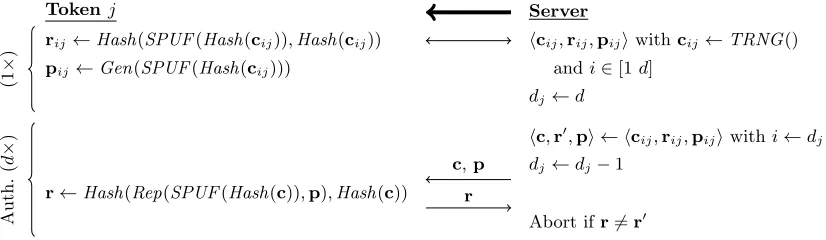
Controlled PUFs [13–16] provide reinforcement against modeling via a cryptographic hash function (one-way). Two instances, preceding and succeeding the PUF respectively, are shown in Figure 7(b). Figure 9 represents the corresponding protocol. The preceding instance eliminates the chosen-challenge advantage of an attacker. The succeeding instance hides exploitable correlations due to the PUF structure. The latter hash seems to provide full protection by itself, but requires preceding error-correction: its avalanche effect would trigger on a single bit flip. As an optional reinforcement, the authors suggest to use the PUF in feedback mode. The error-corrected PUF output is then fed back as a PUF input, and this for multiple rounds. CRPs stored by the server are accompanied by helper data. The authors introduced the first silicon PUF, a predecessor of the arbiter PUF, the latter which makes history as the most popular strong PUF architecture.
(1
×
)
Auth.
(
d
×
)
Tokenj
rij←Hash(SPUF(Hash(cij)),Hash(cij))
pij←Gen(SPUF(Hash(cij)))
r←Hash(Rep(SPUF(Hash(c)),p),Hash(c))
c,p r
Server
hcij,rij,pijiwithcij←TRNG() andi∈[1d]
dj←d
hc,r0,pi ← hcij,rij,pijiwithi←dj dj←dj−1
Abort ifr6=r0
Fig. 9.Authentication with controlled PUFs. We note that they were proposed in a wider context than CRP-based token authentication only.
Incomplete Specification (#1) The authors do not suggest a method to expand the response space of the strong PUF. If the PUF is used in feedback mode, the expansion should be performed multiple times.
Suboptimal (#6) The proposal seems to be inferior to reference II-A in terms of efficiency. Or stated otherwise: inferior to their own concept of physically obfuscated keys. First, server storage requirements scale linearly with the number of authentications, in contrast to constant-size. Second, there seems to be overprotection against PUF modeling attacks: the preceding hash as well as the feedback mechanism could be omitted. Nevertheless, the proposal might be superior in terms of physical security. As the authors point out, PUF-based key generation relies on the secrecy of a relatively limited number of bits, i.e., the key and/or the associated PUF response. With controlled PUFs, there is no condensed secret anymore. For impersonation purposes, one would have to physically extract sufficient CRPs so as to enable a subsequent modeling attack. As for reference II-A, this includes physical attacks on the PUF as well as Rep and the hash front-end. Depending on the modeling resistance of the strong PUF, this corresponds to an increased number of executions of a certain physical attack, not to be confused with stopping physical attacks though. In [3], controlled arbiter PUFs were defeated with such a hybrid physical-modeling attack.
5.3 Bolotnyy et al. (March 2008)
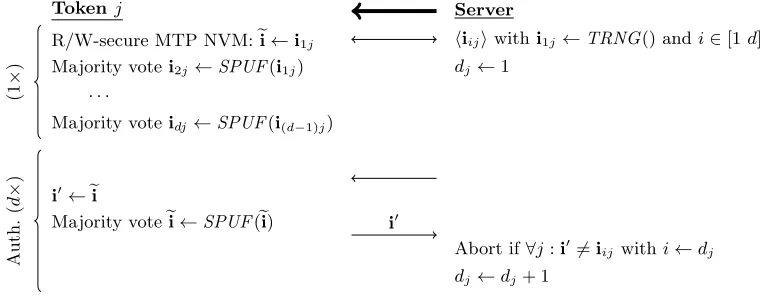
PUF multiple times to approach the most likely response value. The authors claim token privacy under the assumption of an eavesdropping attacker.
(1
×
)
Auth.
(
d
×
)
Tokenj
R/W-secure MTP NVM:ei←i1j
Majority votei2j←SPUF(i1j) . . .
Majority voteidj←SPUF(i(d−1)j)
i0←ei
Majority voteei←SPUF(ei) i0
Server
hiijiwithi1j←TRNG() andi∈[1d] dj←1
Abort if∀j:i06=iij withi←dj dj←dj+ 1
Fig. 10.Authentication protocol of Bolotnyy et al.
Incomplete Specification (#1) The authors do not acknowledge the need to expand the response space of the strong PUF.
NVM Undermines PUF Benefit (#2) The need for secure NVM undermines the main benefit of PUF
technology: improved physical security. Leakage of the state allows for one-time token impersonation as well as a one-time privacy breach. This issue could be resolved by storing the preceding identifier rather than the currently valid identifier. With write-access, an attacker could reconstruct the server database.
Non-Functional due to PUF Noisiness (#3) PUF noisiness has not been taken into account properly, making the protocol non-functional. Under the assumption of a uniform bit error rate, one could make the failure rate arbitrarily small. However, in practice, bit error rates are highly non-uniform, so a majority vote by itself is ineffective. Bits with error rates close to 50% remain problematic.
Modeling Attacks (#4) It is unrealistic to assume that PUFs are robust against modeling, which further limits the practical value of the protocol. There is no secure instantiation due to the lack of an appropriate strong PUF.
Overly Restricted Attacker Capabilities, Denial-of-Service (#8) As acknowledged in the article, the assumption of an eavesdropping attacker mitigates a denial-of-service threat. However, we argue that realistic threats should not be mitigated with unrealistic assumptions. Sending an authentication request to a token is sufficient to cause desynchronization. Either blocking or modifying a token response has a similar effect.
5.4 Ozt¨¨ urk et al. (March 2008) ¨
(1
×
)
Auth.
(
∞×
)
Tokenj
R/W-secure MTP NVM:ex0←x0j
e
x1←SPUFI(ex0) er←SPUFO(ex1⊕c) e
x0←ex1
c
er
Server
Train modelsSPUF^Ij andSPUF^Oj x0j←TRNG()
c←TRNG()
x1←SPUF^Ij(x0j) r←SPUF^Oj(x1⊕c) Abort ifHD(er,r)>
x0j←x1
Fig. 11.Authentication protocol of ¨Ozt¨urk et al.
Incomplete Specification (#1) The authors use a repeated permutation to expand the response space of the inner PUF:∀i:ex1(i)←SPUFI(πi(ex0)). The permutation is not further specified but should be chosen carefully. Repetition is bound to occur, as determined by the orderk: πi(
e
x0) =πi+k( e
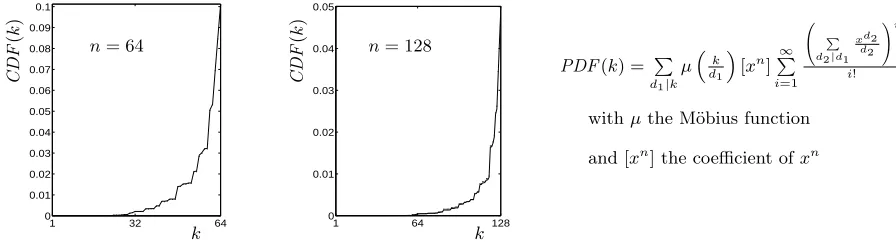
x0). This could result in x1e having identical bits, opposing its presumed uniformity. Figure 12 demonstrates that a significant fraction of randomly chosen permutations hask < n. Furthermore, the authors do not acknowledge the need to expand the response space of the outer PUF.
1 32 64
0 0.01 0.02 0.03 0.04 0.05 0.06 0.07 0.08 0.09 0.1
n= 64
CDF
(
k
)
k 1 64 128
0 0.01 0.02 0.03 0.04 0.05
n= 128
CDF
(
k
)
k
PDF(k) = P
d1|k
µk
d1
[xn]P∞
i=1
P
d2|d1
xd2
d2
i
i! withµthe M¨obius function
and [xn] the coefficient ofxn
Fig. 12. Probability distribution of the order k of a randomly chosen permutation, given a set with n elements. Dots represent simulation results originating from 100000 randomly chosen permutations. An exact mathematical formula [48], drawn continuously although of discrete nature, is hereby verified.
Secure NVM Reduces PUF Benefit (#2) One requires secure NVM, hereby undermining the main
benefit of PUF technology. Either read or write access would enable an attacker to model the system, as during the enrollment. Furthermore, the motivation for the inner PUF is rather questionable. One might equally well opt for a PRNG. First, the outer PUF and the initialization of x0e already induce IC-specific behavior. Second, its noisiness poses a limit on the complexity of the feedback loop, and hence the modeling resistance of the overall system.
log
2
(
w
)
t/n n= 128
n= 64
0 0.05 0.1 0.15
0 20 40 60 80
w=Pt
i=0
n i
=Pt
i=0
n!
i!(n−i)!
Fig. 13.The worst-case search effortw in order to correct a maximum ofta priori unknown errors in a vector of lengthn.
Denial-of-Service (#8) There is a simple denial-of-service attack. An attacker only needs to send a single c in order to desynchronize token and server. Either blocking or modifying a returned responseer has the same effect.
5.5 Hammouri et al. (December 2008)
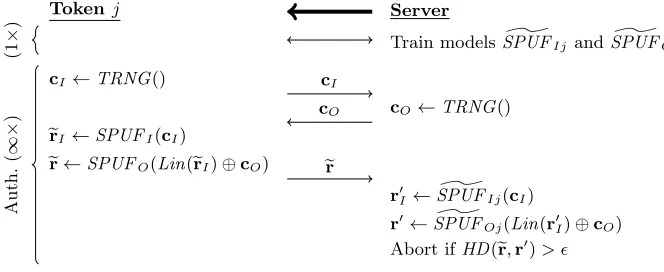
Similar to ¨Ozt¨urk et al., Hammouri et al. [18] employ again two strong PUFs, as shown in Figure 7(e). As before, both PUFs are modeled during enrollment via an auxiliary one-time interface. The outer PUF is an arbiter PUF. An XOR networkLinlargely compensates its non-linearity. The systemer←SPUFO(Lin(erI)) is therefore not bothered by error amplification. The inner PUF is a custom architecture based on the arbiter PUF. We refer to Appendices A and B of our CHES 2014 manuscript, which extends former high-level description with PUF internals. Figure 14 represents the authentication protocol.
(1
×
)
Auth.
(
∞×
)
Tokenj
cI ←TRNG()
e
rI←SPUFI(cI)
e
r←SPUFO(Lin(erI)⊕cO)
cI
cO
er
Server
Train modelsSPUF^Ij andSPUF^Oj
cO←TRNG()
r0I←SPUF^Ij(cI)
r0←SPUF^Oj(Lin(r0I)⊕cO)
Abort ifHD(er,r
0
)>
Fig. 14.Authentication protocol of Hammouri et al.
Non-Functional due to PUF Noisiness (#3,#7) PUF noisiness has not been taken into account
properly, making the protocol non-functional. Minimization of error amplification does not hold for the systemer ← SPUFO(Lin(erI)⊕cO), in the general case that cO 6= 0. Persistent token rejection is to be
expected. This could have been avoided by implementing the system er ←SPUFO(Lin(erI ⊕cO)) instead.
Nevertheless, two fundamental issues would remain, associated to the need for Lin. First, it degrades the modeling resistance of the overall system. Second, it makes the proposal non-generic.
Enrollment Overcomplicated (#7) Reading outerI via a one-time interface would have made the en-rollment easy. This would allow to model both PUFs separately. However, one designed a rather complicated procedure to model the inner PUF via the response of the outer PUF. FixingcO=0, one obtains a system
er←SPUFO(Lin(erI)), which is not bothered by error amplification. Via a one-time interface, one modifies the response expansion method of the inner PUF: bits corresponding to the same challengecI are
the outer arbiter PUF is extremely likely to produce different outputs for these vectors. Unfortunately, this is not the case for the chosen expansion method of the latter: the server sends a list of challenges cO. For
a significant fraction of the fabricated tokens, the output bit er might be in a noisy state, leading to yield issues.
5.6 Kulseng et al. (March 2010)
The proposal of Kulseng et al. [33] provides mutual authentication. Figures 7(f) and 15 represent the protocol. Token identifier i is updated after every authentication, for improved privacy: tracking is only possible in between protocol executions. An attacker can desynchronize token and server by blocking the last message: only the former updates its state then. Therefore, recovery logic is foreseen to prevent denial-of-service from occurring. The authors suggest the use of an arbiter PUF.
(1
×
)
Auth.
(
∞×
)
Tokenj
Insecure MTP NVM:i←ij
R/W-secure MTP NVM:ex−1,xe0←x0j R/W-secure OTP NVM:y←yj x1j←SPUF(ex0j)
Ifb=y⊕ex0 e
x1←SPUF(ex0) e
w1←PRNG(ex0)
i←PRNG(i⊕ex0) e
x−1←ex0 e
x0←ex1
Else ifb=y⊕ex−1 e
x1←SPUF(ex−1) e
w1←PRNG(ex−1) Else Abort
e
a1←ex1⊕we1 e
x2 ←SPUF(ex1) e
w2←PRNG(w1) e
a2←ex2⊕we2
i
b
e
a1,ea2
Server
ij←TRNG()
x0j←TRNG() yj←TRNG()
x1j
Abort ifi6=ijori=6 PRNG(ij⊕x0j) b←yj⊕x0j
w1←PRNG(x0j)
Abort ifx1j6=ae1⊕w1
ij←PRNG(ij⊕x0j) x0j←x1j
w2←PRNG(w1)
x1j←ea2⊕w2
Fig. 15.Authentication protocol of Kulseng et al. We assume that x0 is used to update i, given the contradictive
Incomplete Specification (#1) There is contradictive information regarding the update ofi: eitherx0
or x1 may be used. Although it leads to an equally insecure system, we align our interpretation with the
cryptanalysis in [26] and opt forx0. Also, the authors do not acknowledge the need to expand the response
space of the strong PUF.
Secure NVM Undermines PUF Benefit (#2) The need for secure NVM undermines the main benefit
of PUF technology. Either read or write access would enable an attacker to break the system.
Non-Functional due to PUF Noisiness (#3) PUF responses are not acknowledged to be noisy, making the protocol non-functional. There will be a mismatch ex1 =x01⊕e, with HW(e) small, leading to token rejection. The use ofx2is even more problematic: the feedback loop over the PUF leads to error amplification. We make abstraction of the noisiness issue in the remainder of our analysis.
Server Impersonation (#8) The desynchronization recovery logic allows for a simple replay attack. One can impersonate the server by resending the lastb.
Denial-of-Service (#8) As observed in [26], there is a simple denial-of-service attack. Interfering with a genuine protocol run and modifyingea2to an arbitrarily chosen value is sufficient to desynchronize token and server.
Token/Server Impersonation and Privacy Breach (#8) The PRNG is instantiated with a LFSR.
In [26], one describes an attack which leads to full system disclosure. Given ann-bit output sequence of an
n-bit LFSR, one can easily retrieve the initial state. This principle is applied to two consecutive identifiers: i(1) and i(2). This allows for the recovery ofxe(1)0 and subsequently all other secret variables. Our analysis revealed an alternative PRNG exploitation attack, leading to full system disclosure as well. One can recover w1(1)=i(2)⊕LFSR(i(1)) and subsequently also other secret variables.
5.7 Sadeghi et al. (October 2010)
The protocol of Sadeghi et al. [53] is represented by Figures 2(f) and 16. Essentially, one uses a strong PUF to generate a cryptographic key. The authors claim token privacy, in particular for an attacker which obtains the NVM contents.
(1×)
Auth. (∞×)
Tokenj
Insecure OTP NVM:y←TRNG() Insecure OTP NVM:p←Gen(rj)
rj←SPUF(yj)
nT←TRNG()
k←Hash(Rep(SPUF(y),p))
a←PRF(k;nT,nS)
nS
nT,a
Server
kj←Hash(rj)
nS←TRNG()
Abort if∀j:a6=PRF(kj;nT,nS)
Fig. 16.Authentication protocol of Sadeghi et al. Unlike the proposing manuscript, we represent the fuzzy extractor as an explicit part of the protocol. We argue that implicit usage does not properly reflect the security and efficiency concerns.
Suboptimal (#6) Two inefficiencies have not been addressed. First, there is no need for the PUF to have an enormous input-output space. Even a weak PUF could be used and the NVM storingycould be omitted as well. Second, joint optimization of the fuzzy extractor and the authentication logic has not been explored, unlike Reference II-A which reuses cryptographic functions.
Privacy without Identification (#9) The proposal does not scale in the number of tags. One cannot introduce a public identifier as this would oppose the privacy claim.
5.8 Logically Reconfigurable PUF (September 2011)
Logically reconfigurable PUFs [28, 29] were proposed to make tokens recyclable in a privacy-preserving manner. This in order to reduce the amount of electronic waste and its associated disposal costs. Figure 17 represents the authentication protocol. The server collects CRPs which are valid for the current statex only. Read access tox is allowed, as shown in Figure 7(g), although not required. There is no direct write access, although one can perform an update:x←Hash(x). The server then needs to collect new CRPs. An attacker can only track tokens in between state updates. We note that this corresponds to a rather limited form of privacy only: other proposals claim to prohibit tracking across authentications.
(1
×
)
Auth.
(
d
×
)
Tokenj
W-secure MTP NVM:x rij←SPUF(Hash(x,cij))
er←SPUF(Hash(x,c))
c
e
r
Server
hcij,rijiwithcij←TRNG() andi∈[1d]
dj←d
hc,ri ← hcij,rijiwithi←dj dj←dj−1
Abort ifHD(r,er)>
Fig. 17.Authentication protocol for logically reconfigurable PUFs.
NVM Undermines PUF Benefit (#2) The proposal requires write-secure NVM. This partly undermines the main benefit of PUF technology: improved physical security. Together with the hash, the need for MTP NVM also degrades the economical gain with respect to basic authentication. Disposable but low-cost tokens are transformed to recyclable but expensive tokens.
Modeling Attacks (#4) The proposal does not aim to prevent PUF modeling attacks. Therefore, the practical value of the proposal is rather limited: the protocol cannot be instantiated due to lack of an appropriate strong PUF. An attacker cannot fully control the PUF input, but this is insufficient as defense: most modeling attacks do not rely on a chosen-challenge advantage.
Denial-of-Service (#8) There is a simple denial-of-service attack. An attacker can updatex and hence invalidate the CRP database of the server. The proposal does not describe a user authentication mechanism for the reconfiguration, which is required to stop this attack.
5.9 Reverse Fuzzy Extractors: Predecessor (February 2012) and Successor (August 2012)
traditionaln−kentropy loss. The proof-of-concept implementation makes use of an arbiter PUF. One author later proposed a modified protocol [37], as represented by Figures 2(g) and 19. A reversal of authentication checks is stated to be the main difference, although there seem to be other fundamental changes as clarified hereafter.
(1
×
)
Auth.
(
∞×
)
Tokenj
Insecure OTP NVM:i←ij rij←SPUF(cij)
er←SPUF(c) e
p←Gen(er)
a←Hash(i,n,er,ep)
Abort ifb6=Hash(a,er)
i
c,n
e
p,a
b
Server
ij←TRNG()
hcij,rijiwithcij←TRNG() andi∈[1d]
Abort ifi6=ij
hc,ri ← hcij,rijiwithi∈[1d]←TRNG()
n←TRNG()
er←Rep(r,pe)
Abort ifa6=Hash(i,n,er,ep)
b←Hash(a,er)
Fig. 18.Original reverse FE protocol.
(1
×
)
Auth.
(
∞×
)
Tokenj
Insecure OTP NVM:i←ij rj←WPUF()
e
r←WPUF()
e
p←Gen(er)
nT ←TRNG()
Abort ifb6=Hash(i,pe,er,nT,nS)
a←Hash(i,er,nS)
i,ep,nT
b,nS
a
Server
ij←TRNG()
rj
Abort if∀j:i6=ij r0←Rep(rj,ep)
nS←TRNG()
b←Hash(i,ep,r
0
,nT,nS)
Abort ifa6=Hash(i,r0,nS)
Fig. 19.Modified reverse FE protocol.
would have to physically extract sufficient CRPs so as to enable a subsequent modeling attack. This includes physical attacks on the PUF as well as the front-ends of Gen and the hash. Depending on the modeling resistance of the strong PUF, this corresponds to an increased number of executions of a certain physical attack, not to be confused with stopping physical attacks though. Against arbiter PUFs, as used in the proof-of-concept implementation, former hybrid physical-modeling attack might perform well [3]. Therefore, the suggested countermeasure might not outweigh the missed advantages and there might be numerous more rewarding countermeasures. The modified protocol proposal [37] does not discuss the foregoing matter, although it usesd= 1, hereby suggesting the use of a weak SRAM PUF.
PUF Noisiness Lower Bound (#7) Non-determinism is essential to avoid replay attacks. For tokens, one does exploit the PUF noisiness for this purpose, hereby avoiding the need for a TRNG. A lower bound for the PUF noisiness is imposed, in order to avoid server impersonation. However, this seems to be a very delicate balancing exercise in practice, opposing more conventional design efforts to stabilize PUFs. The need for environmental robustness magnifies this opposition. An attacker might immerse the IC in an extremely stable environment, hereby minimizing the PUF error rate. For genuine use however, one might have to provide correctness despite large perturbations, corresponding to the maximum error rate. The modified protocol proposal [37] does not discuss the foregoing contradiction, although its use of a token TRNG provides a solution.
PRNG Exploitation (#8,#5) The proof-of-concept implementation uses a PRNG to expand the 1-bit response of an arbiter PUF:er←SPUF(LFSR(c)). Due to code size limitations,eris subdivided in x non-overlapping sections:er= er1er2. . .erx, with each section having lengthn. A corresponding helper data list e
p= pe1ep2. . .epx
, with each section having lengthn−k, is transferred to the server. The authors usex= 7 and k= 21, aiming at a security level of 128< x·k bit. As a side note, the proposal does not provide an explicit warning to refuse fixed points of the LFSR, e.g.,c=0. This would have been appropriate in order to avoid a trivial server impersonation attack. Fixed points will result in eitherer =0or er =0, assuming stability for one particular response bit. An attacker could hence guess bwith success probability 1/2. A PRNG-related token impersonation threat, which is far less obvious, is described next.
For simplicity, consider the unrealistic but usually desired case of a perfectly deterministic PUF, at least for now. Also consider an arbitrary response section, e.g., r1. Helper data leakage can be understood via an underdetermined system of linear equations: H·r1T =p1T, having n−k equations for n unknowns. Consider a challengec(1) leading to an responser(1)1 = r1r2. . . rn
. One could easily construct a challenge c(2)leading to a responser(2)
1 = r2r3. . . rn+1, given the use of an LFSR. Repeating the former mechanism, we can construct challengesc(3),c(4),. . .,c(q), withr(q)= r
q rq+1. . . rq+n−1. An attacker collects all data in a single system of equations:
A· r1r2. . . rq+n−1 T
=
p(1)1 T
p(2)1
T
.. .
p(1q) T
withA=
H 0T . . .0T 0T H · · ·0T
..
. ... . .. ... 0T 0T · · · H
.
Even for smallq, an attacker easily obtains more equations than unknowns. Equation dependencies still have to be considered though. We performed experiments where A is transformed to reduced row echelon form (rref). A distinction between cyclic and non-cyclic codes seems to be crucial, as illustrated in Figure 20. In the latter case, an attacker is able to solve the system. The persistence of few unknowns is only a minor inconvenience. In the former case, the number of unknowns remainsk, independent ofq. However, for large
2 4 6 8 10 2
4 6 8 10 12 14
Hamming:A
2 4 6 8 10 2
4 6 8 10 12 14
Hamming:rref(A)
2 4 6 8 10 2
4 6 8 10 12 14
BCH:A
2 4 6 8 10 2
4 6 8 10 12 14
BCH:rref(A)
Fig. 20. PRNG exploitation for the reverse fuzzy extractor: illustration for non-cyclic Hamming and cyclic BCH codes, with [n= 7,k= 4,t= 1] andq= 5. Black and white represent 0 and 1 respectively.
We now consider a PUF which is bothered by noise. To minimize this inconvenience, an attacker could ensure the IC’s environment to be very stable. Code parameters, which are normally chosen in order to maintain robustness against a variety of environmental perturbations (supply voltage, outside temperature, etc.), become relatively relaxed then. Subsequently, we consider a transformationH?=T·H, which selects linear combinations of the rows of H. The transformation is chosen so that the rows ofH? do have a low Hamming weight, making it feasible to incorporate a limited set of stable bits only. One could develop a variety of algorithms in order to find a suitable transformation. Recent follow-up work in [2] experimentally confirms the validity of the PRNG issue, i.e., in the presence of noise. We also stress that former attacks do not apply to the modified protocol proposal [37], as there is no PRNG.
5.10 Converse Authentication: Predecessor (March 2012) and Successor (June 2012)
Figures 7(i) and 21 represent the latest version of the converse authentication protocol [30]. The authenti-cation is one-way, in a less conventional setting where tokens verify the server. The difference vector (XOR) between two responses is denoted asa. The restrictiona6=0prevents an attacker from impersonating the server, choosingcu=cv andpu=pv. Optionally, one can extend the protocol with the establishment of a session keyk←Hash(ru,rv). The attacker capabilities are restricted: invasive analysis of the prover IC is assumed to be impossible. Furthermore, one assumes an eavesdropping attacker, trying to impersonate the server given a log of genuine authentication transcripts. The authors suggest the use of arbiter PUFs.
(1
×
)
Auth.
(
∞×
)
Tokenj
rij←Hash(SPUF(cij))
pij←Gen(SPUF(cij))
a6=0←TRNG()
ru←Hash(Rep(SPUF(cu),pu))
rv←Hash(Rep(SPUF(cv),pv)) Abort ifru⊕rv6=a
a
cu,pu,
cv,pv
Server
hcij,pij,rijiwithcij←TRNG() andi∈[1d]
Findu,vsuch thatruj⊕rvj=a
If none, choose randomu,v
cu←cuj,pu←puj,cv←cvjandpv←pvj
Fig. 21.Converse authentication protocol.
capabilities are reduced. Fifth, the protocol is initiated by a token instead of the server. Sixth, PUF responses are reinforced by a cryptographic hash function. In its absence, we see a direct opportunity for prover im-personation in the occasional case that HW(a)< t. Consider an arbitrary responser=Rep(SPUF(c),p). For both secure sketch constructions, an attacker might be able to produce a givena:
Code-offset construction:r⊕a=Rep(SPUF(c),p⊕a). Syndrome construction: r⊕a=Rep(SPUF(c),p⊕a·HT).
Unclear and Overly Restricted Attacker Capabilities (#1) The attacker capabilities are unclear and overly restricted to be practical. First, restricting invasion would automatically extend to physical attacks in general, including side channel analysis. A real-life attacker is not inclined to obey artificial constraints. Furthermore, this restriction would greatly reduce the need for PUFs, with respect to the traditional approach of storing a key in NVM. It is also not clear whether an attacker is allowed to freely query the server, as exploited hereafter. We argue that this should be possible as well, as the protocol is initiated by a token.
Suboptimal (#6) The proposal seems to be inferior to reference II-B in terms of efficiency. First, the PUF is required to have an enormous instead of modest input-output space, which is inherently more demanding. Second, the PUF and its fuzzy extractor both need to be evaluated twice, instead of only once, in addition to extra XORing logic. Third, server storage requirements and its associated computational effort are both enormous instead of modest.
Brute-force (#8) The proposal does not scale to a comfortable security level. The server can be imperson-ated via brute-force, independent of who would initiate the protocol. Successful authentication relies on the availability of a givenawithin the server database. As is clear from Figure 22, token-specific CRP databases should be roughly of sized= 2n2+1. Although the memory requirements are enormous with respect to other
proposals, the computational effort is even worse. An efficient method to (construct and) search within a database was not discussed and seems far from obvious. We assume an exhaustive trial and error procedure: each of the d(d2−1) pairwise selections has a probability of 1
2n−1 to produce the given a. A database of size
d= 225 is mentioned to be realistic. This would correspond to circa 249 pairs and a security level n= 48. As tokens initiate the protocol, an attacker might exhaustively query the server and construct a personal database: hai,ci1,pi1,ci2,pi2i. Authentication will succeed, although a session key cannot be retrieved if present. If the server would initiate the protocol, there is a similar threat. Random guessing has a probabil-ity of 1
2n to be successful. In summary, attacker and server face a similar computational effort. Even worse:
the server faces this effort for every authentication, while an attacker only needs to do it once.
P
log2(d)
n= 16 n= 32 n= 48
0 5 10 15 20 25 30
0 0.5 1
P= 1−1− 1
2n−1 d(d2−1)
withranda6=0uniformly distributed
Fig. 22.Scalability of the converse authentication protocol. We represent the probabilityP that a randomly chosen
5.11 Lee et al. I (March 2012)
The first protocol of Lee et al. [35] is represented by Figures 7(j) and 23. The authors instantiateEnc with the affiliated stream cipher NLM-128, wither and y as key and initialization vector respectively. We note thatEnccorresponds to key stream generation only rather than encryption, as there is no message involved. NVM physical security is not explicitly addressed, although we note that one can obtain iand x=a⊕b via a direct query and eavesdropping respectively.
(1
×
)
Auth.
(
d
×
)
Tokenj
Insecure OTP NVM:i←ij
Insecure MTP NVM:x←xj
R/W-Secure OTP NVM:y←yj rij←SPUF(cij)
er←SPUF(c)
a←Enc(er;y)
Abort ifb6=a⊕x
Updatex
i
c
a
b
Server
ij←TRNG()
xj←TRNG()
yj←TRNG()
hcij,rijiwithcij←TRNG() andi∈[1d]
dj←d
Abort ifi6=ij
hc,ri ← hcij,rijiwithi←dj dj←dj−1
Abort ifa6=Enc(r;yj)
b←a⊕xj
Updatexj
Fig. 23.Authentication protocol of Lee et al.
Incomplete Specification (#1) The update mechanism for x is not further specified, but should be chosen carefully. We argue that secret variableyshould be involved in the update:x←f(x,y), rather than x←f(x). If not, one could mount a simple server impersonation attack. Consider eavesdropping on a genuine protocol run (1). An attacker could get authenticated with an arbitraryc(2)andb(2)←a(2)⊕f(a(1)⊕b(1)). Also, the authors do not suggest the use of particular strong PUF. They do not acknowledge the need to expand its response space either.
Secure NVM Undermines PUF Benefit (#2) The use of secure NVM undermines the main benefit of
PUF technology: improved physical security.
Non-Functional due to PUF Noisiness (#3) The authors mention the existence of fuzzy extractors as an error-correction mechanism. However,Gen/Repprocedures are not part of the proposed protocol and the need for helper data is not acknowledged either. We assume the complete absence of error-correction rather than an implicit usage, as security and efficiency concerns would not be reflected properly in the latter case. In practice, there will then be a mismatcher=r⊕e, withHW(e) relatively small, leading to token rejection. We make abstraction of the noisiness issue in the remainder of our analysis.
Cryptanalysis of NLM-128 (#8) A cryptanalytic attack on the stream cipher NLM-128 has recently been reported [43], so one might have to consider other ciphers.
5.12 Jin et al. (April 2012)
The proposal of Jin et al. [23] seems to be inspired by [33]. The protocol is represented by Figures 7(k) and 24. The function ShiftCirc rotates its input over half the length. The authors claim resistance against physical attacks recovering the secret state x0: future authentications are not threatened. The protocol ise also claimed to be resistant against tracking. An attacker can desynchronize token and server by blocking the last message: only the latter updates its state then. Therefore, recovery logic is foreseen to prevent denial-of-service from occurring.
(1
×
)
Auth.
(
∞×
)
Tokenj
Insecure MTP NVM:ex0←x0j
R/W-secure OTP NVM:y←yj x1j←SPUF(x0j)
e
x1←SPUF(xe0) e
x2←SPUF(xe1) e
a1←xe1⊕ex2 e
a2←Hash(y,ex2,n)
Abort ifb6=y⊕ShiftCirc(ex2) e
x0←ex1
n
e
a1,ea2
b
Server
x0j←TRNG() yj←TRNG()
x1j
n←TRNG()
Ifea2=Hash(yj,x2,n) withx2←ea1⊕x1j
b←yj⊕ShiftCirc(x2j) x0j←x1j
x1j←x2
Else ifea2=Hash(yj,x2,n) withx2←ea1⊕x0j
b←yj⊕ShiftCirc(x2j)
Else Abort
Fig. 24.Authentication protocol of Jin et al.
Incomplete Specification (#1) The authors instantiate the protocol with a custom variant of the feed-forward arbiter PUF. However, the description is too vague to allow for the interpretation of a workable PUF. Also, the need to expand its response space is not acknowledged.
Secure NVM Undermines PUF Benefit (#2) The use of secure NVM undermines the main benefit
of PUF technology: improved physical security. The authors claim to be robust against key leakage via x0, although they do not stress that this protection does not apply to y0. The latter which is prone to physical attacks as well.
Server Impersonation (#8) Eavesdropping on the last protocol execution allows for server impersonation. First one sends an arbitrary noncen(2) and subsequently one responds withb(2)←b(1)⊕ShiftCirc(
e a(2)1 ).
Denial-of-Service (#8) The proposal instantiates the hash computation as follows:ea2←Hash(y,x2e ,n) = Hash(y⊕x2e ⊕n). This allows for desynchronization attacks: we describe two variations. With the first variant, one injects the following messages during a genuine protocol run:n←n⊕eandea1←ea1⊕e, with an arbitrary e6=0. The server accepts and corrupts its state. With the second variant, one eavesdrops on a genuine protocol run and obtainsn(1) and ea(1)2 . Subsequently, one replies with the following messages in the next protocol run: ea(2)2 ←ea(1)2 andea(2)1 ←n(1)⊕n(2). Again, the server accepts and corrupts its state. Furthermore, these attacks are in conflict with generally accepted privacy definitions. A single token which is persistently refused can easily be distinguished from its neighbors.
Token Impersonation via Leakage of ex0 (#8,#2) We argue the leakage claim to be incorrect. It
allows for unlimited token impersonation, meanwhile also incapacitating the genuine token. An attacker eavesdrops on a genuine protocol run and obtainsea(1)1 . Subsequently,xe(2)0 is obtained via leakage. Thereafter, e
x(2)1 ←ea(1)1 ⊕ex(2)0 can be computed. One can choose an arbitrary value forxe(2)2 . The attacker can now reply to the server nonce n(2) and construct messages
e
a(2)1 and ea(2)2 . The impersonation extends to an unlimited number of authentications: the PUF operation can be replaced with an arbitrary function.
Privacy without Identification (#9) The proposal does not scale in the number of tags. One cannot introduce a public identifier as this would oppose the privacy claim.
5.13 Slender PUFs: Predecessor (May 2012) and Successor (January 2014)
The original slender PUF proposal [40] includes three countermeasures against modeling, while avoiding the need for cryptographic primitives, as is clear from Figure 7(l). First, the protocol requires a strong PUF with a high resistance. A machine learning model is constructed during enrollment via auxiliary one-time interfaces. The authors opt for an XOR arbiter PUF with swapped inputs. Second, the exposure of er is limited to random substrings es, hereby obfuscating the CRP link. The corresponding procedure SubCirc treats the bits in a circular manner. Third, server and token both contribute to the challenge via their respective noncescS andcT, counteracting chosen-challenge attacks. Figure 25 represents the protocol. For completeness, we note the design to be inspired by the pattern matching key generator [46], which serves as an alternative for a fuzzy extractor.
(1
×
)
Auth.
(
∞×
)
Tokenj
er←SPUF(cS,cT)
cT←TRNG()
er←SPUF(cS,cT)
i∈[1n]←TRNG()
es←SubCirc(er, i)
cS
cT,es
Server
Train modelSPUF^j
cS←TRNG()
r0←SPUF^j(cS,cT)
Abort if∀i:HD(SubCirc(r0, i),es)>
Fig. 25.Slender PUF protocol.
A protocol extension has been proposed in [49]. One presents a fourth countermeasure against modeling. Substringesis padded with random bits before transmission, again in a circular manner:SubCirc(esP, k)←es withesP ∈ {0,1}1×
nP ←TRNG() andk∈[1n