Quantum Computing
JamesAmundson1,∗and ElizabethSexton-Kennedy1,∗∗ 1Fermilab, P.O. Box 500, Batavia, Illinois 60563, USA
Abstract. In recent years Quantum Computing has attracted a great deal of attention in the scientific and technical communities. Interest in the field has expanded to include the popular press and various funding agencies. We discuss the origins of the idea of using quantum systems for computing. We then give an overview in recent developments in quantum hardware and software, as well as some potential applications for high energy physics.
1 Introduction
Interest in quantum computing has exploded into the public sphere in the past year or so. One finds articles extolling the transformative potential of quantum computers in newspapers such as the New York Times[1]. the Wall Street Journal[2], and Die Zeit[3]. The scientific origin of interest in using quantum mechanical systems goes back more than three decades. In a seminal talk on the subject, Richard Feynman said[4]
Trying to find a computer simulation of physics seems to me to be an excel-lent program to follow out . . . the real use of it would be with quantum mechan-ics . . . Nature isn’t classical . . . and if you want to make a simulation of Nature, you’d better make it quantum mechanical, and by golly it’s a wonderful problem, because it doesn’t look so easy.
The quantum mechanical simulations Feynman had in mind are what we now think of as analog simulators. In the meantime, schemes have been developed to create digital quan-tum computers, which we will discuss in the section on quanquan-tum information and Shor’s Algorithm2. Both analog and digital approaches to quantum computing are of interest today. Although the interest in quantum computing is already very strong, there have yet to be any fundamentally new results due to quantum computing. Many new technologies follow a similar pattern, known as theHype Cycle[6]. Quantum computing is clearly in the early stages of the cycle, which is illustrated in Fig. 1. The goal of this work is to describe the origin of the optimism for the technology, as well as some of the potential applications relevant for high energy physics without getting distracted by the grandiose claims that inevitably surround a new and potentially transformative technology.
Figure 1.The generic features of the Hype Cycle[5]. Quantum computing is still in the early stages.
2 Quantum Information and Shor’s Algorithm
Consider a system ofnclassical two-state systems, i.e.,bits. It can be described by
b1,b2, . . .bn, (1)
wherebi=0 or 1. Obviously,nclassical bits of information can be stored in a single integer
in the range (0,2n).
Next, consider a system ofnquantum two-state systems, which we will callqubits. The wave function of the combined system is
|ψ=a1|0. . .00+a2|0. . .01+a3|0. . .10+. . .+ak|1. . .11. (2)
This system requires 2ncomplex numbers (minus two real numbers for the normalization and
overall phase, respectively) to describe an arbitrary state. This is the essence of the difference
between the classical and quantum systems. As we increase the sizenof the two systems, the quantum systems hold exponentially more information than the classical one. Putting this statement into practical terms requires some hand-waving – extracting information from the quantum system is both probabilistic and imprecise. However, roughly speaking, a 50-qubit quantum computer could potentially hold as much information as the largest current supercomputers. A similar 70-qubit quantum computer would hold over amilliontimes as much information.
While the scaling properties of quantum information long seemed tantalizing, it was not until Peter Shor described an algorithm to use a finite set of gates on a digital quantum com-puter to factor numbers[8] that the promise of general-purpose quantum comcom-puters had its first (theoretical) realization. The best known algorithm for factorization on classical com-puters is the general number field sieve (GNFS). It scales as
O exp 3
64
9 b logb2
Figure 1.The generic features of the Hype Cycle[5]. Quantum computing is still in the early stages.
2 Quantum Information and Shor’s Algorithm
Consider a system ofnclassical two-state systems, i.e.,bits. It can be described by
b1,b2, . . .bn, (1)
wherebi=0 or 1. Obviously,nclassical bits of information can be stored in a single integer
in the range (0,2n).
Next, consider a system ofnquantum two-state systems, which we will callqubits. The wave function of the combined system is
|ψ=a1|0. . .00+a2|0. . .01+a3|0. . .10+. . .+ak|1. . .11. (2)
This system requires 2ncomplex numbers (minus two real numbers for the normalization and
overall phase, respectively) to describe an arbitrary state. This is the essence of the difference
between the classical and quantum systems. As we increase the sizenof the two systems, the quantum systems hold exponentially more information than the classical one. Putting this statement into practical terms requires some hand-waving – extracting information from the quantum system is both probabilistic and imprecise. However, roughly speaking, a 50-qubit quantum computer could potentially hold as much information as the largest current supercomputers. A similar 70-qubit quantum computer would hold over amilliontimes as much information.
While the scaling properties of quantum information long seemed tantalizing, it was not until Peter Shor described an algorithm to use a finite set of gates on a digital quantum com-puter to factor numbers[8] that the promise of general-purpose quantum comcom-puters had its first (theoretical) realization. The best known algorithm for factorization on classical com-puters is the general number field sieve (GNFS). It scales as
O exp 3
64
9 b logb2
(3)
Figure 2. Time to factor a number of size 2bitsusing classical and quantum algorithms. Taken from
Ref. [7].
Table 1.Resource requirements for Shor’s algorithm. Taken from Ref. [7].
number 1024 2048 4096
size bits bits bits
qubits 5,124 10,244 20,484
gates 3×10¹⁰ 2×10¹¹ 2×10¹²
for factoring numbers ofbbits. Shor’s algorithm, on the other hand, scales as
Ob2logblog logb, (4)
which represents asuperpolynomialspeedup compared to GNFS.
time it would take to factor a number of interest using classical and quantum computers. The results of the calculations in Ref. [7] are shown in Fig. 2. The quantum resource requirements are shown in Table 1. Fig. 2 is the source of much of the excitement about the potential of quantum computing. The ability to solve a problem in less than a day that would otherwise take longer than the lifetime of the universe would be transformative.
The next question to ask is whether there are other quantum algorithms with similar speedups with regards to their classical counterparts. The answer is that many have, in fact, already been identified. Discovering new quantum algorithms is an active area of research. There is a web site entitled the “Quantum Algorithm Zoo”[9] which collects the current state-of-the art in quantum algorithms.
3 Current and Near-term Hardware
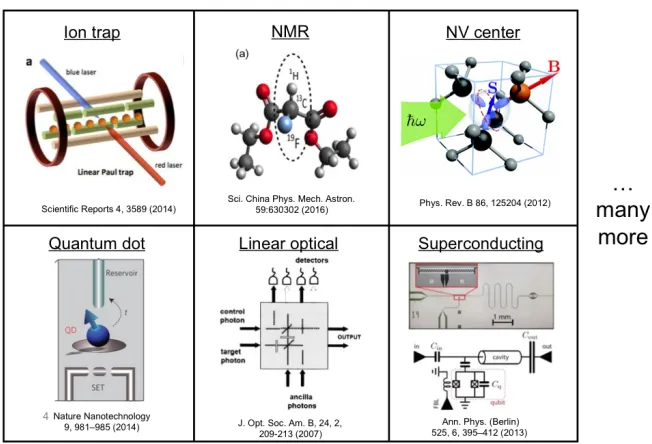
Figure 3. Qubit technologies under current investigation. Superconducting qubits are currently the most popular technology choice, but other approaches may still prevail.
The first serious realizations of multi-qubit systems are just now starting to appear. In Fig. 3 we show some technologies being studied for quantum computing. As of this writing, Google, IBM, Intel and Rigetti have produced many-qubit machines using superconducting technologies. IonQ is currently pursuing ion-trap technologies, but has not yet produced a device. Google, IBM and Rigetti have made available machines in the eight to twenty-two qubit range. Google, IBM, and Intel have announced machines in the 50-qubit, or in Google’s case, 70-qubit range. None of these machines has yet been made available to the public.
While the race to produce more qubits is proceeding apace, that is only part of the story. Referring again to the resource requirements for Shor’s algorithm in Table 1, we see that current efforts are a factor of 100 to 1000 away from the number of qubits required to factor
time it would take to factor a number of interest using classical and quantum computers. The results of the calculations in Ref. [7] are shown in Fig. 2. The quantum resource requirements are shown in Table 1. Fig. 2 is the source of much of the excitement about the potential of quantum computing. The ability to solve a problem in less than a day that would otherwise take longer than the lifetime of the universe would be transformative.
The next question to ask is whether there are other quantum algorithms with similar speedups with regards to their classical counterparts. The answer is that many have, in fact, already been identified. Discovering new quantum algorithms is an active area of research. There is a web site entitled the “Quantum Algorithm Zoo”[9] which collects the current state-of-the art in quantum algorithms.
3 Current and Near-term Hardware
Figure 3. Qubit technologies under current investigation. Superconducting qubits are currently the most popular technology choice, but other approaches may still prevail.
The first serious realizations of multi-qubit systems are just now starting to appear. In Fig. 3 we show some technologies being studied for quantum computing. As of this writing, Google, IBM, Intel and Rigetti have produced many-qubit machines using superconducting technologies. IonQ is currently pursuing ion-trap technologies, but has not yet produced a device. Google, IBM and Rigetti have made available machines in the eight to twenty-two qubit range. Google, IBM, and Intel have announced machines in the 50-qubit, or in Google’s case, 70-qubit range. None of these machines has yet been made available to the public.
While the race to produce more qubits is proceeding apace, that is only part of the story. Referring again to the resource requirements for Shor’s algorithm in Table 1, we see that current efforts are a factor of 100 to 1000 away from the number of qubits required to factor
large integers. The current limiting factor however, is the number of operations (gate count) that can be performed on the qubits before various sources of noise cause the system to lose
coherence, and hence computational power. Pinning down the usable gate count for current devices is somewhat difficult, but in practice it ranges from a few to, at the very most, a
hundred. This is many orders of magnitude away from the requirements of Shor’s algorithm. To make progress on the gate-count front will require quantum error correction, which is not yet available and will require many more qubits than are available in systems today.
4 Quantum Efforts at Fermilab
Fermilab is engaged in four areas of quantum science: quantum computing for high energy physics, HEP technology for quantum computing, quantum technology for HEP experiments and quantum networking. The latter three topics are all important, but mostly outside the scope of this article. Briefly, Fermilab is involved in applying superconducting RF technology to create better qubits and using novel cold instrumentation electronics for data acquisition in quantum information systems. On the experimental HEP front, we are using highly-sensitive quantum technology developed for quantum computers to create a Matter-wave Atomic Gra-diometer Interferometric Sensor (MAGIS-100) and a detector for Axion Dark Matter. In the quantum networking area, we are working to transmit a quantum state over distances on the scale of the Chicago area.
The Fermilab quantum efforts we focus on here are all designed to be and/or enable
quantum computing applications for high energy physics. In order to enable HEP quantum computing efforts, we have partnered with Google to use Fermilab’s HEPCloud project to
provide access to Google’s existing quantum computing test devices. This project will allow HEP physicists to run quantum computing jobs using an interface similar to that they are already using for classical computing workflows. Our remaining quantum efforts are all in
the area of developing quantum algorithms useful in high energy physics. The three main areas we have identified to date are optimization, machine learning and quantum simulation. Using quantum computers to solve optimization problems is already an active area in quantum computing. Applications to HEP include both reconstruction and data analysis problems. Some of the most advanced work in the field to date is the Quantum Approxi-mate Optimization Algorithm (QAOA)[10], which was developed by researchers from high energy physics. We are currently investigating the use of quantum optimization algorithms using currently available quantum hardware.
Quantum machine learning is another area of active research in the quantum community that is directly applicable to HEP. Applications include reconstruction in a variety of detectors as well as astrophysical image analysis. Fermilab is working with Lockheed Martin and Google on these applications.
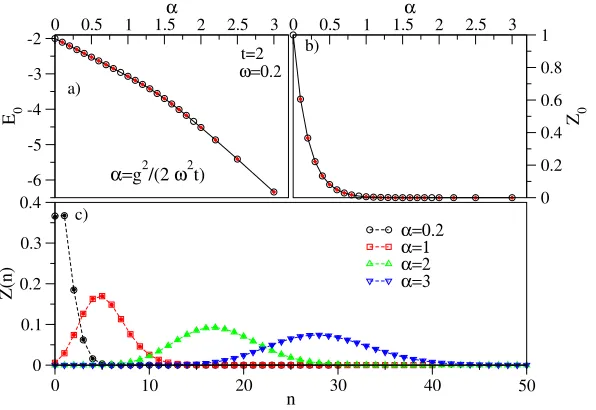
Quantum simulation is the application closest to the roots of quantum computing. It was the subject of the quote from Feynman at the beginning of this paper. The general applicabil-ity of quantum computing to the simulation of quantum systems is straightforward. Indeed, it is in this area that some of the biggest successes of quantum computing have occurred to date. Quantum algorithms for quantum chemistry[12] have been created to simulate general Hamiltonian problems involving fermion-fermion interactions. Since fermion-boson inter-actions are very important for a wide variety of HEP problems, we have written a pair of papers[11, 13] extending the existing fermion algorithms to also include fermion-boson interactions. Fig. 4 shows a first application of our fermion-fermion-boson algorithm.
References
0 0.5 1 1.5 2 2.5 3 α
-6 -5 -4 -3 -2
E0
0 10 20 30 40 50
n 0
0.1 0.2 0.3 0.4
Z(n)
α=0.2 α=1 α=2 α=3
0 0.5 1 1.5 2 2.5 3
α
0 0.2 0.4 0.6 0.8 1
Z0 t=2
ω=0.2
α=g2/(2 ω2t)
a)
b)
c)
Figure 4. An example calculation demonstrating the ability to simulate fermion-boson (in this case, phonon-electron) problems. The energy (a) and quasiparticle weight (b) for the 2-site Holstein polaron versus coupling strength. (c) The phonon number distribution for different couplings. The open symbols
are computed using exact diagonalization on a classical computer; the full symbols are calculated using quantum phase estimation on a quantum simulator. Taken from Ref. [11].
[2] How Google’s Quantum Computer Could Change the World,The Wall Street Journal, October 16, 2017
[3] Wie funktioniert ein Quantencomputer?,Zeit Online, January 30, 2018 [4] R.P. Feynman, International Journal of Theoretical Physics21, 467 (1982)
[5] J. Kemp, English Wikipedia, CC-BY-SA 3.0, https://commons.wikimedia.org/w/index.
php?curid=10547051
[6] https://en.wikipedia.org/wiki/Hype_cycle
[7] R.J. Hughes, Philosophical Transactions of the Royal Society of London A: Math-ematical, Physical and Engineering Sciences 356, 1853 (1998), http://rsta. royalsocietypublishing.org/content/356/1743/1853.full.pdf
[8] P.W. Shor, SIAM J. Comput.26, 1484 (1997) [9] http://quantumalgorithmzoo.org/
[10] E. Farhi, J. Goldstone, S. Gutmann, A quantum approximate optimization algorithm (2014),arXiv:1411.4028
[11] A. Macridin, P. Spentzouris, J. Amundson, R. Harnik, Phys. Rev. Lett.121, 110504 (2018),1802.07347
[12] A. Kandala, A. Mezzacapo, K. Temme, M. Takita, M. Brink, J.M. Chow, J.M. Gam-betta, Nature549, 242 EP (2017)
![Figure 1. The generic features of the Hype Cycle[5]. Quantum computing is still in the early stages.](https://thumb-us.123doks.com/thumbv2/123dok_us/8002609.1329437/2.482.90.415.68.270/figure-generic-features-hype-cycle-quantum-computing-stages.webp)
![Figure 1. The generic features of the Hype Cycle[5]. Quantum computing is still in the early stages.](https://thumb-us.123doks.com/thumbv2/123dok_us/8002609.1329437/3.482.87.387.64.297/figure-generic-features-hype-cycle-quantum-computing-stages.webp)