IJEDR1601071
International Journal of Engineering Development and Research (www.ijedr.org)441
Real time Localization System based on iBeacon
Technology in Indoor Environment
1Ms. Shivangi V. Jain, 2Dr. KiritKumar Bhatt,3Mr. Brijesh Kamani
1M.E. Scholar SVIT-Vasad, 2Professor SVIT-Vasad, 3CEO Teksun Microsys pvt ltd 1Electronics and Communication Engineering,
1Sardar Vallabhbhai Patel Institute of Technology, Vasad, India
________________________________________________________________________________________________________
Abstract - Indoor asset tracking is a unique specialty of many types of RTLS, as Global Positioning Systems (GPS) have difficulty providing asset locations within buildings. RTLS deployments generally address the problems of determining the location of equipment and products in a warehouse or even tracking employees and files in an office. The most common RTLS uses a WiFi infrastructure to determine the location of tagged assets. These systems employ Received Signal Strength Indication (RSSI) techniques to wirelessly determine asset location. This presents a new method for providing an accurate, low cost estimate of sub-room indoor Asset location. Recently proposed indoor localization solutions have required anywhere from zero additional infrastructure to customized RF hardware and have provided room-level to centimeter-level accuracy, typically in that respective order. An iBeacon based Bluetooth Low Energy (BLE) technology used to track and manage assets. Each asset to be tracked is tagged with an iBeacon tag, and tracked using BLE enabled device located throughout a facility. Based on the tracking information, the system allows users to manage assets and generate reports regarding the various tagged assets.
Index Terms - iBeacon, Indoor, BLE, RTLS, RSSI.
________________________________________________________________________________________________________
I.INTRODUCTION
Nowadays, Location Based Services (LBS) have been broadly applied in different areas and their location awareness has become an important part of our lives [15]. Recently, the Indoor LBS have gained more attention in market, as people spend more time in indoor places. Although outdoor positioning has been extensively studied and applied, indoor positioning is still facing big challenges and some of its techniques and methods have deficiencies [16]. Indoor positioning based on traditional Bluetooth has been both carefully evaluated and improved. According to the best of my knowledge, no academic work can be found which characterizes and evaluates Bluetooth low energy in a positioning setting. Meanwhile, commercial systems using the technology are rapidly emerging on the market promising different performance and properties. The technology and algorithms behind the commercial systems are often vaguely described and kept secret due to competition. This project thoroughly evaluates and investigates the properties of Bluetooth smart or iBeacon and describes its suitability and applicability for providing inexpensive widely available indoor positioning.
Since the introduction of GPS technology, services that rely on positioning and localization data have emerged in a rapid pace. Today positioning technologies are used in a variety of areas such as providing driving directions, recording running routes during training and tracking valuable goods in real-time to name a few. While GPS has become a de facto standard for outdoor positioning applications, no similar widespread technique is present for indoor positioning or in areas where GPS is not available. The topic of indoor positioning does not lack research: Several approaches and suggestions based on different technologies have been developed and introduced over the last two decades. What is common for all of them is that no approach has made any big impact within the area. A number of systems have been commercialized, produced and installed in different quantities but none of these have yet made a big penetration into society. The systems are usually proprietary and used in very small scale installations based on requirements of the specific use case, resulting in that no common universal standard such as GPS exists in the area of indoor positioning.
One proposed iBeacon based technique for indoor positioning is to use Bluetooth technology and provide positioning based on signal strength parameters that can be easily obtained. A major advantage of using Bluetooth is that it is a technology with high penetration in society. Devices such as cell phones, tablets and computers normally come equipped with the technology as standard. The large penetration rate also means that the required hardware is produced in large quantities, resulting in a very low unit cost. A Bluetooth chip combined with a microcontroller is typically available for less than 5$. Research on positioning based on Bluetooth has also made some progress in the past years, possibly making it a viable candidate for large scale deployment in several scenarios and applications.
IJEDR1601071
International Journal of Engineering Development and Research (www.ijedr.org)442
Table 1 Classic Bluetooth vs. Bluetooth Low Energy [17]II.LITERATURE SURVEY
IJEDR1601071
International Journal of Engineering Development and Research (www.ijedr.org)443
to address the needs for a low-power and low-cost wireless networking solution for both residential and industrial applications. [12] Illustrates another approach based on infrared technology. This system tried to know the approximate position and orientation of the user’s head by using infrared transmitters and Head-Mounted Displays. However, several drawbacks of this system, such as heavy weight of the head unit, restriction of head rotation range, and the large number of beacons in the ceiling, still exists. [5] Utilize the new iBeacon technology for quick deployment and positioning. Since iBeacon is based on Bluetooth LE, it is significantly more energy-efficient. A coin-sized beacon can function for months on a battery. Even with a small amount of training data and a very light-weight distance-based matching module, the positioning accuracy is shown to be fairly high. This allows indoor position service to be deployed quickly even if there is no RF infrastructure such as Wi-Fi. One important thing that should be noticed that for most cases, more training data yields a higher accuracy, but this is not always the case. The reason is that the distance-based match algorithm is not robust against noisy data. [6] Demonstrate that how iBeacon can track your luggage at the airport. Tracking a suitcase with iBeacon has three use cases: First is to know when the suitcase is nearby. So when the device that is searching for the suitcase detects the specific one, it pushes a notification, so that the user knows that the suitcase is in a region of about 30 meters. The second case is when the suitcase is within reach and we need to calculate the distance between the suitcase and user. The last case applies if the suitcase leaves the tracking region. In this case the user needs a notification that the luggage is more than 30 meters away. When we check in and hand over the luggage it is clear that we get a notification that the luggage has left the region. From [6] paper it is clears that iBeacon are proximity devices and to detect regions they are working really well The notifications for entering and leaving a region work well, but the accuracy could be improved with better iBeacon. To calculate distances it requires better technology to improve their accuracy.III.PROPOSED WORK
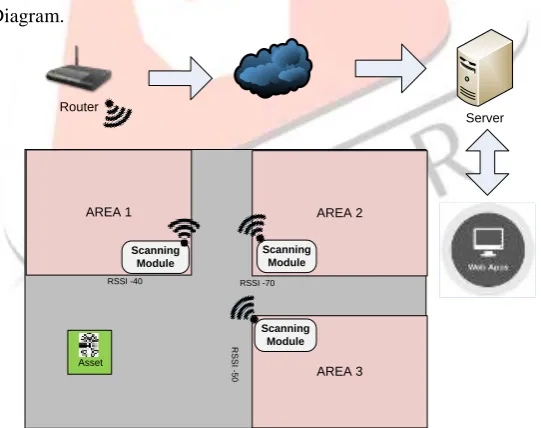
The aim is to make Real Time Location Systems (RTLS) capable of remotely determining the location of tagged assets in an environment within a relatively short time frame (real time). Signals from tags are received wirelessly by readers, which use information about the signal, to continuously determine the location of the tag relative to each reader. Using readers positioned at several locations around a tag offers multiple location readings, which can be compiled together at a central host to estimate the location of a tag in a two dimensional space.
Real time Localization System consists of mainly three parts:
A. iBeacon: it is a one type of Beacon tag. Tag is attached on a particular asset which we want to track. B. Scanning Module: this module is used to scan the iBeacon tag and send the related information to the router.
C. Web application: This is specially design for the specific project. Web application shows the location of tagged asset.
Figure 1 shows the system block Diagram.
AREA 1 AREA 2
AREA 3 Asset
Scanning Module
Scanning Module
Scanning Module
RSSI -40
Server Router
RSSI -70
R
S
S
I
-5
0
Figure 1proposed System Block Diagram System Overview
The function of various Components shown in figure 1 are described below.
A. iBeacon: it is used to track valuable asset. Any asset which we want to track, we have to just attach an iBeacon tag on it. iBeacon is working in advertising mode so that it sends the relevant data continuously in predefined time. B. Scanning Module: it is used to scan the iBeacon tag. Scanning module consist of two main components which are
BLE enable module and Wi-Fi module.BLE chipset is used to scan the iBeacon tag and send the information to the Wi-Fi module. Wi-Fi Module send the information to router
C. Router: It provides Wi-Fi connectivity to the Scanning Module. Once WiFi sends data to router, It sends the data to server Database and the beacon tag data store in database.
IJEDR1601071
International Journal of Engineering Development and Research (www.ijedr.org)444
Project ImplementationAs per the proposed work, the complete Project is divided in four parts: 1. Programming of Scanning Module
2. Store Asset Related information on Server Database
3. Design an accurate Algorithm for Tracking Asset in Real time
4. Show tracked asset information in 2 dimensional view using Web Application.
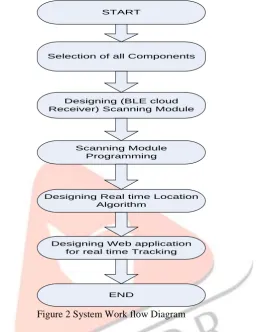
Work flow of the complete Project is as shown in figure 2:
START
Selection of all Components
Designing (BLE cloud Receiver) Scanning Module
Scanning Module Programming
Designing Real time Location Algorithm
Designing Web application for real time Tracking
END
Figure 2 System Work flow Diagram Future Work
Scanning Modules which scans the different assets and make entry in server Database with different RSSI value; Based on this RSSI values stored in server database that is used in tracking algorithm; which shows the distance between tag attached on asset and reference node (scanning Module). We can use this distance information for tracking a valuable asset. The GUI architecture of Tracking is shown on Web Page. Figure 3 shows the sample example of tracking that how the location of asset shown on web page in 2 dimensional view.
Figure 3Sample GUI view Shown on Web App.
IV.CONCLUSION
IJEDR1601071
International Journal of Engineering Development and Research (www.ijedr.org)445
can be used by any industry to track any single valuable inventory to be aware of the activity that where the inventory actually placed, and from which place it is moved and when it is move from one place to another.V.REFERENCES
[1] Zhang Dian ; Lu Kezhong ; Mao Rui; "A precise RFID indoor localization system with sensor network assistance" Communications, IEEE Journals & Magazines, Volume: 12, Issue: 4 Pages: 13 - 22, 2015.
[2] Hasani, M.; Talvitie, J.; Sydanheimo, L.; Lohan, E.-S.; Ukkonen, L. “Hybrid WLAN-RFID Indoor Localization Solution Utilizing Textile Tag”, Antennas and Wireless Propagation Letters, IEEE Journals & Magazines, Volume: 14, Pages: 1358 - 1361, 2015.
[3] Zhang, D.; Yang, L.T.; Chen, M.; Zhao, S.; Guo, M.; Zhang, Y., “Real-Time Locating Systems Using Active RFID for Internet of Things”, IEEE Systems Journal, Volume: PP, Issue: 99, Pages: 1 - 10, 2014.
[4] Krukar, Grzegorz; Wenzel, Marco; karbowwnik, Piotr; Franke, Norbert; von der Grun, Thomas “Proof-of-concept real time localization system based on the UWB and the WSN technologies”, International Conference on Indoor Positioning and Indoor Navigation (IPIN), IEEE , Pages: 756 - 757,2014.
[5] Fard, Hadis Kakanejadi; Chen, Yuanzhu; Son, Kyung Kook “Indoor positioning of mobile devices with agile iBeacon deployment” 28th Canadian Conference on Electrical and Computer Engineering (CCECE), IEEE, Pages: 275 - 279, 2015.
[6] Kohne, M.; Sieck, J. “Location-Based Services with iBeacon Technology” 2nd International Conference on Artificial Intelligence, Modelling and Simulation (AIMS), Pages: 315 – 321, 2014
[7] P. Bahl and V. N. Padmanabhan, “RADAR: An In-Building RF-based User Location and Tracking System,” in Proc. IEEE Nineteenth Annual Joint Conference of the IEEE Computer and Communications Societies (INFOCOM 2000), Pages: 775-784, 2000.
[8] V. Hayes, S. J. Kerry, and A. Petrick, Wireless LAN Medium Access Control (MAC) and Physical Layer (PHY) Specification, New York: IEEE Standards, 1999.
[9] P. Bahl, V. N. Padmanabhan, and A. Balachandran, “Enhancements to the RADAR User Location and Tracking System,” Tech. Rep., Microsoft Corporation, Redmond, WA, Feb. 2000.
[10] J. Hightower and G. Borriello, “A Survey and Taxonomy of Location Systems for Ubiquiitous Computing,” Tech. Rep., University of Washington, Seattle, WA, Aug. 2001.
[11] Sun-Jin Kim, Jung Hae Seo, Jonnalagadda Krishna, Sun-Joong Kim; “Wireless Sensor Network based Asset Tracking Service” PICMET 2008 Proceedings, 27-31 July, Cape Town, South Africa (c),pages: 2643-2647,2008.
[12] R. Azuma, “Tracking requirements for augmented reality,” Communications of the ACM, vol. 36, Pages: 50-51, 1993. [13] Specification of the Bluetooth system, Tech. rep., Bluetooth special interest group, version 4.0 (may 2010).
[14] http://www.bluetooth.com/Pages/Basics.aspx
[15] http://apsima.com/blog/ibeacon-for-logistics-facilities-asset-inventory-management/ [16] http://apsima.com/beacons/bluetooth-proximity-beacons
![Table 1 Classic Bluetooth vs. Bluetooth Low Energy [17]](https://thumb-us.123doks.com/thumbv2/123dok_us/8251407.1374823/2.595.94.495.65.419/table-classic-bluetooth-vs-bluetooth-low-energy.webp)