DEVELOPING AND TESTING AN INTEGRATED MODEL OF CHOKING IN SPORT
By Jin Wang
A dissertation submitted to the faculty of Human Development in fulfillment of the requirement for the degree of
DOCTOR OF PHILOSOPHY
VICTORIA UNIVERSITY
FACULTY OF HUMAN DEVELOPMENT
ABSTRACT
In general, choking has been defined as the occurrence of sub-optimal performance under pressure (Baumeister and Showers, 1986). The most widely accepted theory of choking is what I have labeled the “automatic execution model” (Baumeister, 1984), the basic premise being that choking occurs due to the inhibition of well-learned or automatic skills. The present dissertation was designed to test the automatic execution model in a sport context. Beyond this, I was interested in
broadening the research paradigm by concentrating on choking as a process. The five inter-related studies contained in this dissertation tested predictors of choking, perceptions of pressure, coping processes, the automatic execution model, and gender differences. The general aim of this dissertation was to produce an integrated model of choking in sport.
The five studies used to examine choking had a total of 89 competitive basketball players as participants (M = 20.01 years old, SD = 2.12). Sixty-four participants took part in studies, 1, 2, 3 and 5. The remaining 25 participants took part in study 4 only. All participants completed a series of basketball free throws in a low-pressure (LP) condition and a high-low-pressure (HP) condition. Pressure was manipulated by videotaping performance, using an audience, and offering financial incentives.
In Study 2, the effects of manipulated pressure were examined for possible changes in perceived state anxiety (A-state) and subsequently performance.
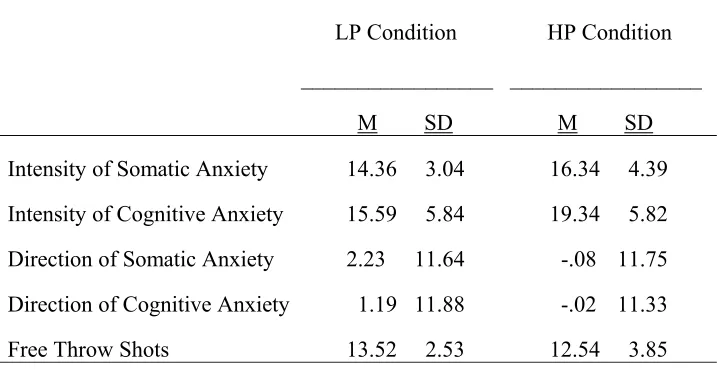
Participants (N = 64) completed the modified Competitive State Anxiety Inventory-2 (CSAI-2; Jones & Swain, 1992) prior to performing in the LP condition and the HP condition. A multivariate analysis of variance (MANOVA) and a correlational analysis showed that participants experienced increased intensity of somatic and cognitive A-state in the HP condition, but the direction (facilitative/debilitative) of somatic A-state and cognitive A-state did not change significantly. Correlation analysis between A-state and performance under pressure was also not significant. In addition, a one-way analysis of covariance (ANCOVA) showed an absence of significant differences in performance between participants who had a negative A-state and participants who had a positive A-A-state.
Study 3 was designed to examine the relationship between coping styles and choking susceptibility. Participants (N = 64) completed the Coping Style Inventory for Athletes (CSIA; Anshel & Kaissidis, 1997). As stated above participants also
completed the CSAI-2 prior to performing in the LP and HP conditions. Correlation and hierarchical regression analyses supported the hypothesis that approach coping strategies would result in heightened A-state and performance decrements under pressure.
In Study 4, the automatic execution model was tested by investigating possible differences in the occurrence of choking as a function of task characteristics.
Participants (N = 25) completed a running task (effort-dominant task) and a free throw shooting task (skill-dominant task) in a LP condition and a HP condition. As
performance for the running task but decrements in performance for the free-throw shooting task.
Study 5 was used to investigate potential gender differences in choking susceptibility. Participants (male = 46; female = 18) had already completed the SCS, SAS, CSIA, and CSAI-2. A one-way MANCOVA showed there were no gender differences in somatic and cognitive A-state changes from the LP condition to the HP condition. Furthermore, a one-way ANCOVA showed no gender differences in performance from the LP condition to the HP condition. In addition, a correlational analysis showed that S-C was more likely to affect performance for females and A-trait was more likely to affect performance for males.
DEDICATION
ACKNOWLEDGMENTS
I am grateful to my two supervisors, Dr. Daryl Marchant and Professor Tony Morris. You have both provided me with your invaluable guidance and support over several years in the preparation of this manuscript and encouragement throughout what has been most enjoyable years of study. Daryl, thank you especially for your
enthusiasm, constant support, and expert advice. Writing this dissertation has been a long-standing goal, which without your help I would still be struggling with. Having the opportunity to work with you I hold you in the highest esteem, not only for your knowledge but your humor, a necessity in being a sport psychologist. Tony, thank you for your help and expert advice that were invaluable for the completion of this
dissertation. I was impressed by not only your knowledge but also your perseverance. Having the opportunity to work with you has been a special privilege.
I take this opportunity also to thank Associate Professor Mark Andersen for help with the preparation for this dissertation. Time spent at the Victoria University
allowed me to meet a number of scholars in sport psychology and physical education. In addition, I would like to thank Professor Terry Roberts, Dr. Harriet Speed, Dr. Rob Hess, and Dr. Anne Binkley.
To my parents Xianfeng and Chuanxiou in Chongqin, China: Thanks for always providing me with your support when I have needed you.
Finally, I would also like to acknowledge Mark Stoove, Georgina Sutherland, and all postgraduate students at the School of Human Movement, Recreation, and Performance in the Victoria University.
CONTENTS
ABSTRACT...I
DEDICATION... V
ACKNOWLEDGMENTS ...VI
CONTENTS...VIII
TABLE OF FIGURES...XVIII
LIST OF APPENDICES ... XIX
CHAPTER 1
INTRODUCTION... 1
AIMS OF THE DISSERTATION... 2
General Aims... 2
Specific Aims ... 2
CHAPTER ORGANIZATION... 3
CHAPTER 2 LITERATURE REVIEW... 5
OVERVIEW... 5
DEFINITIONS... 5
Descriptions of Choking... 5
Definitions of Choking ... 6
SELF-AWARENESS, ANXIETY, AND PERFORMANCE... 8
Stable Causes of Choking... 14
Self-consciousness ... 14
Trait anxiety ... 18
Unstable Causes of Choking ... 20
Possible reward or punishment ... 20
Audience ... 22
Competition... 27
Expectation... 30
Task Characteristics... 31
COPING WITH CHOKING... 33
Coping Processes... 34
Coping and Choking... 35
HYPOTHETICAL EXPLANATIONS OF CHOKING... 37
Arousal-Performance Theories... 37
Drive theory ... 37
Inverted-U hypothesis. ... 39
Catastrophe model... 42
Attention Theories... 43
Nideffer’s distraction model ... 45
Automatic execution model ... 47
Limitations of the Existing Models ... 52
PREVENTION AND TREATMENT OF CHOKING IN SPORT... 55
INVESTIGATIONS IN THIS DISSERTATION... 57
INTRODUCTION... 58
Self-Consciousness and Choking ... 58
Trait Anxiety and Choking... 59
Present Research... 59
METHOD... 60
Participants ... 60
Task ... 60
Pressure Manipulation ... 61
Measures... 62
Self-Consciousness Scale... 62
Sport Anxiety Scale ... 63
Procedure... 63
RESULTS... 66
Manipulation Check ... 66
Performance Analysis... 66
Reliability of Self-consciousness and Trait Anxiety Scores ... 67
Regression Analyses... 68
DISCUSSION... 71
Choking under Pressure... 71
Self-Consciousness as a Predictor of Choking... 73
A-trait as a Predictor of Choking... 77
Conclusion... 78
INTRODUCTION... 80
METHOD... 83
Participants ... 83
Task ... 83
Measures... 83
Pressure Manipulation ... 83
Procedure... 84
RESULTS... 84
Perception of Pressure ... 84
Performance... 85
Relationship between A-state and Performance under Pressure ... 86
DISCUSSION... 88
CHAPTER 5 STUDY THREE: CHOKING AND COPING STYLE ... 94
INTRODUCTION... 94
METHOD... 96
Participants ... 96
Task ... 97
Measures... 97
Coping Style Inventory for Athletes ... 97
Competitive State Anxiety Inventory-2 ... 97
Pressure Manipulation ... 97
Procedure... 98
Manipulation Check ... 98
Performance Analysis... 99
Coping Styles and A-state ... 99
Coping Styles and Performance ... 101
DISCUSSION... 102
CHAPTER 6 STUDY FOUR: WHEN EFFORT GETS YOU NOWHERE... 107
INTRODUCTION... 107
METHOD... 110
Participants ... 110
Tasks... 110
Skill-dominant task. ... 110
Effort-dominant task ... 110
Experimental Conditions ... 111
Low-Pressure condition ... 111
High-Pressure condition... 111
Measures... 112
Competitive State Anxiety Inventory-2 ... 112
Procedure... 112
RESULTS... 114
Manipulation Check ... 114
Performance on The Running and Free Throw Shooting Tasks ... 115
CHAPTER 7
STUDY FIVE: CHOKING AND GENDER DIFFERENCES ... 123
INTRODUCTION... 123
METHOD... 126
Participants ... 126
Task ... 126
Measures... 127
Self-Consciousness Scale... 127
Sport Anxiety Scale ... 127
Coping Style Inventory for Athletes ... 127
Competitive State Anxiety Inventory-2 ... 127
Pressure Manipulation ... 127
Procedure... 127
RESULTS... 127
Gender and Perceived Pressure ... 127
Gender Differences and Performance Outcome... 129
Relationship between Self-Consciousness, A-trait and Performance Outcome.... 130
Gender, Coping Styles, and Performance... 132
DISCUSSION... 134
Gender Differences in Perceived Pressure ... 134
Gender Differences in Performance ... 135
CHAPTER 8
GENERAL DISCUSSION ... 139
FEATURES OF CHOKING AND AN ALTERNATIVE DEFINITION... 140
Two Features of Choking ... 140
Existing Definitions of Choking... 141
Alternative Definition... 142
AN INTEGRATED MODEL OF CHOKING IN SPORT... 142
SUSCEPTIBILITY FACTORS... 145
Stable Causal Factors ... 145
Self-consciousness ... 145
Trait anxiety ... 147
Unstable Causal Factors ... 148
Imminent failure and success. ... 149
Ego threat/fear of evaluation... 150
Performance expectancy ... 151
Perceived uncertainty of outcome... 151
Social debilitation (audience effects) ... 152
Position goal (i.e., task difficulty)... 152
PERCEPTION OF PRESSURE... 153
Negative Appraisal and Positive Appraisal Under Pressure ... 153
Perceived Importance of Performing Well... 155
COPING WITH CHOKING... 157
Approach Coping and Avoidance Coping... 157
TASK CHARACTERISTICS... 159
Tasks Requiring Perceptual Skills and Tasks Requiring Motor Skills... 159
CHOKING AMONG ELITE ATHLETES... 163
SUMMARY... 163
CHAPTER 9 CONCLUSIONS AND RECOMMENDATIONS... 165
SUMMARY AND CONCLUSIONS... 165
General Findings ... 165
Integrated Model of Choking in Sport... 167
IMPLICATIONS FOR SPORT PRACTICE... 169
FUTURE RESEARCH INTO CHOKING UNDER PRESSURE IN SPORT... 170
CONTRIBUTION OF THIS DISSERTATION TO SPORT... 172
REFERENCES... 174
TABLE OF TABLES
Table 1. Means, Standard Deviation, F Rations for One-Way Analyses of
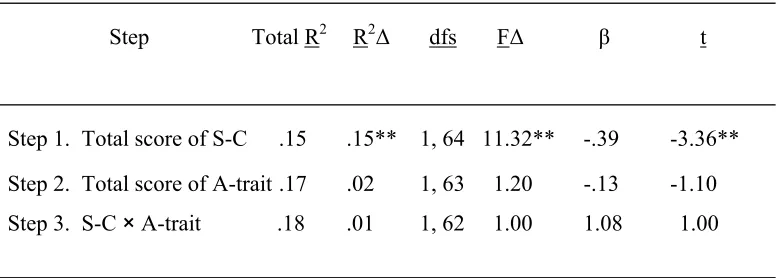
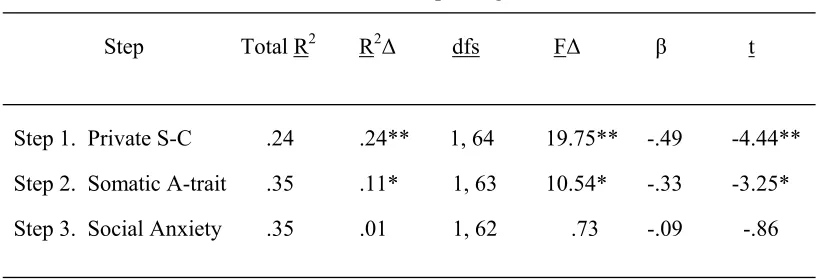
Variance on Manipulated Pressure (N = 66) ...67 Table 2. Total Self-Consciousness and Trait Anxiety as Predictors of Poor
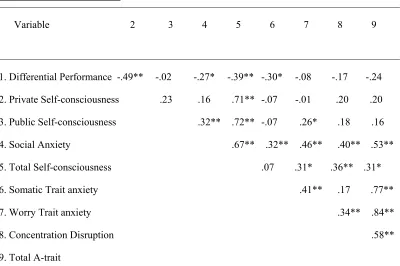
Performance under Pressure: Hierarchical Multiple Regression...68 Table 3. Correlation Matrix for Self-consciousness Subscales, Trait
Anxiety Subscales, and Performance under Pressure...69 Table 4. Self-Consciousness Subscale and Trait Anxiety Subscale as
Predictors of Poor Performance under Pressure: Hierarchical
Multiple Regression...70 Table 5. Mean (SD) Anxiety Scores for the CSAI-2 in the LP and HP
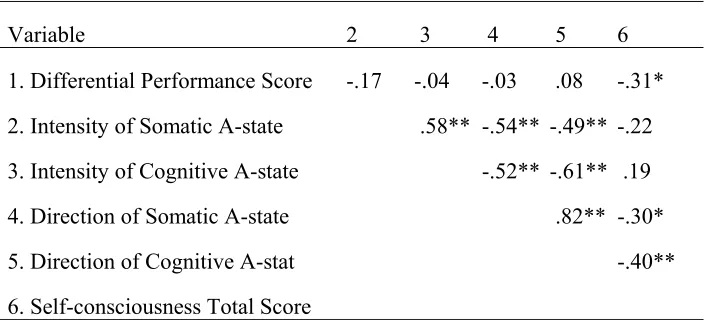
conditions (N = 64)...85 Table 6. Correlation Matrix for A-state Sub-scale Scores,
Self-consciousness and Performance ...87 Table 7. A-state and Performance Scores for the Low-pressure Condition
and the High-pressure Condition (N = 64) ...99 Table 8. Correlation Matrix for Coping Styles and A-state (Intensity and
Direction) in the LP and HP Conditions...100 Table 9. Prediction of Choking under Pressure Using Hierarchical
Multiple Regressions ...101 Table 10. Mean Anxiety Scores of the CSAI-2 in the Low Pressure and
High Pressure Conditions for the Running Task and Free Throw
Shooting Task (N = 25) ...114 Table 11. Mean and Standard Deviation for Running and Free Throw
Table 12. Means and Standard Deviation for the Sub-scores of the CSAI-2 Between the Low-pressure and High-pressure Conditions by
Gender Difference ...129 Table 13. Correlation Matrix for S-C, A-trait, and differential scores of
performance for the male participants (n = 46) ...131 Table 14. Correlation Matrix for S-C, A-trait, and differential scores of
TABLE OF FIGURES
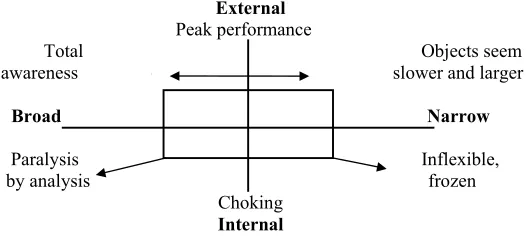
Figure 1. Dimensions of consciousness, from Nideffer (1992) Psyched
to Win (p. 34)... 46 Figure 2. From Nideffer and Sagal (1998) Concentration and attention
control training. In J. M. Williams (Ed.) Applied sport
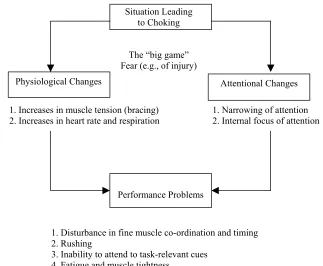
psychology (3rd ed., pp. 296-315)... 47 Figure 3. Proposed Choking Process Model in Sport ... 144 Figure 4. A suggested classification of skilled tasks by Holding (1989).
LIST OF APPENDICES
Appendix A: Informed Consent 1 ... 203
Appendix B: Informed Consent 2 ... 204
Appendix C: Experimental Time Table ... 205
Appendix D: Participants Instruction 1... 206
Appendix E: Participant Instruction 2... 207
Appendix F: Participant Instruction 3 ... 208
Appendix G: Participant Instruction 4 ... 209
Appendix H: Baseline Score Table 1 ... 210
Appendix I: Baseline Score Table 2 ... 211
Appendix J: Experimental Testing Score Table 1... 212
Appendix K: Experimental Testing Score Table 2 ... 213
Appendix L: Self-Consciousness Questionnaire... 214
Appendix M: Trait Anxiety Questionnaire ... 215
Appendix N: Coping Style Questionnaire... 217
CHAPTER 1 INTRODUCTION
Choking may be the most miserable and humiliating experience in sport. Choking can affect athletes at all levels of competition, including the most gifted. As Patmore (1986) has noted, “there are very few champions around today on the tennis circuit who have not choked.” (p. 91) Champion tennis player Pete Sampras, the record holder for the most singles Grand Slam Championships, confessed after winning his seventh Wimbledon title, “We all choke …. No matter who you are, you just feel pressure in the heat of the moment.” (Sampras, 2000, p. 68)Sport media reports frequently describe situations in which high profile performers are accused of choking under pressure. In such reports, journalists speculate that athletes, such as golfer Greg Norman, marksman Frank Gorman, and tennis player Jana Novotna, after being in seemingly unassailable positions, have choked and subsequently lost in dramatic fashion. The media frequently report such incidents, and typically base their accusations of choking on speculation and conjecture, rather than a clear notion of what actually constitutes a choke.
Any confusion from the media about what choking is could possibly be attributed to the difficulty in clearly establishing a definition of choking. Baumeister (1984), a social psychologist, has defined choking as “performance decrements under pressure circumstances” (p. 610) and pressure as “any factor or combination of factors that increases the importance of performing well on a particular occasion.” (p. 610) To understand the choking phenomenon better, researchers need to conduct further research to make explicit aspects of choking, such as definitions, causes, and explanatory
Courneya & Carron, 1990; Gayton, Matthews, & Nickless, 1987; Hardy, Mullen, & Jones, 1996; Heaton & Sigall, 1989, 1991; Leith, 1988; Lewis & Lindner, 1997; Masters, 1992; Schlenker, Phillips, Boniecki, & Schlenker, 1995a, 1995b; Tanner & Sands, 1997). Although this research has led to a number of conceptual developments, much remains to be learned about choking in sport. Baumeister and Showers (1986) noted some problems with the research that remain unresolved after 16 years. Specifically, there are three substantial problems in the choking related research that need resolving. First, few researchers have directly investigated the specific factors that predispose athletes to choking in sport. Second, research into the role of dispositional self-consciousness (S-C) as a cause of choking has resulted in somewhat contradictory findings. Third, although there have been a number of models developed to explain aspects of choking, no one model appears capable of describing and explaining the complexities and contradictions evident in the choking research.
Aims of the Dissertation General Aims
The present dissertation was designed to clear up some of the inconsistent findings from previous choking research and also to examine some previously ignored aspects of choking. Further, on the basis of the findings in this dissertation and past theoretical frameworks, an integrated model of choking in sport is presented. In addition, a comprehensive definition and description of choking in sport have been proposed.
Specific Aims
2. To examine intensity and direction of A-state in both low-pressure and high-pressure conditions and possible connections to choking.
3. To test coping styles (i.e., approach coping and avoidance coping) to determine whether coping strategies are related to choking under pressure.
4. To examine task characteristics to determine whether the occurrence of choking is associated with the type of task being performed.
5. To test for possible gender differences in choking susceptibility. 6. To draw together research into a theoretical model of choking in sport.
Chapter Organization
Each chapter begins with an identified objective and a brief overview. In Chapter 1, choking, as both a research theme and topic in the popular press, is introduced. In addition, general aims, specific aims and the organization of chapters are established. Chapter 2 provides a review of literature, including the definitions of choking used by researchers and the limitations of those definitions. Other issues that relate to choking, including causes of choking, coping with choking, choking theories, and the prevention and treatment of choking, are also reviewed. Chapters 3 – 7 are presented as self-contained, but interrelated studies with a focus on testing specific research
hypotheses. In this dissertation, because I have attempted to present the 5 studies as self-contained, there is a necessary element of repetition. Chapter 3 focuses on the
contribution of S-C and A-trait as predictors of choking under pressure in a sport context. In Chapter 4, the focus turns to the perception of pressure and the relationship between A-state, self-focus, and performance under pressure. Chapter 5 examines the role of coping processes in choking under pressure and presents a study of the
task characteristics as a fundamental determinant in choking susceptibility by testing the automatic execution model. Chapter 7 is an analysis of the results of the previous four studies from a gender perspective. Based on the experimental findings, Chapter 8 is used to present a preliminary model of choking in sport, and linking findings are
CHAPTER 2 LITERATURE REVIEW
Overview
Although past studies have advanced our understanding of choking, a number of unresolved issues remain. Specifically, a number of definitions of choking have been proposed, but none of these appear adequate. Similarly, theoretical explanations have been advanced and tested with no one theory gaining universal support from choking researchers. There does, however, appear to be almost universal agreement that choking is fundamentally a problem of attention. Yet, researchers view the specifics of how attention affects performance under pressure from different perspectives. For example, the role of self-consciousness (S-C) in choking is frequently discussed, yet some researchers agree that high self-conscious individuals are more susceptible to choking, whereas other researchers believe that low self-conscious people are more likely to choke under pressure. It seems that some issues in choking have had not been examined. For example, although some researchers have suggested that choking may be related to an inability to cope with pressure, no studies to date have examined possible links between coping processes and choking in detail. Similarly, although anxiety has been linked to choking under pressure by some researchers, the large majority of research studies into choking have not actually measured perceived anxiety.
Definitions Descriptions of Choking
On the next, she was slow to react to a high shot by Graf, and missed badly on a forehand volley (“When It Comes to the Crunch,” 2000, p. 44).
The sport media normally apply the choking label to athletes who have been performing well for all but the last part of a competition. For example, when Novotna lost at Wimbledon, she had dominated most of the match, and was only a few points from victory. When Greg Norman eventually lost at Augusta in the 1997 Masters, he had easily outperformed the world’s top golfers for the first three rounds (i.e., 54 holes) before his form deteriorated over the final 18 holes and losing easily.
Choking has been described in a variety of ways. Daniel (1981) observed that choking typically occurs to the athlete who practices very hard, but has difficulty replicating their practice form in competition. Similarly, Singer (1986) has suggested that athletes susceptible to choking often perform well in regular season competition, but perform poorly in major competitions. Masters (1992) proposed that choking involves the failure of normally expert skill under pressure. According to Nideffer (1992), choking occurs “when attention becomes so focused on internal cues (thoughts and feelings) that you cannot attend to external task-relevant cues.” (p.128)
Definitions of Choking
essentially an attentional problem. Despite covering choking in some detail, Weinberg and Gould appeared to be sensitive to the difficulty in defining choking.
In general, choking in sport is defined as the inability to perform up to previously exhibited standards (Anshel, 1997; Daniel, 1981; Leith, 1988). This definition is problematic because there are numerous reasons why athletes may not perform up to previous standards, such as injury, poor preparation, or lack of motivation. Baumeister (1984) defined choking as performance decrements in pressure circumstances. This definition is more specific, adding pressure as a necessary condition for choking to occur. Similarly, Baumeister and Showers (1986) defined choking as the occurrence of sub-optimal performance under pressure conditions. Baumeister and Showers also discussed a number of conditions that must be present before the choking label can be applied. First, there must be reasonable certainty that the performer could have done better. Second, the performer must be motivated to perform well. If for example, the performer is not motivated, the choking label cannot be applied because they are not under pressure. Third, Baumeister and Showers used the term “performance” to denote situations where the task calls for optimal outcome and effort, whereas, in practice situations, for example, the goal is usually long-term improvement in skill. Based on the Baumeister and Showers’ explanation, choking under pressure could occur among performers at any level of skill. Nevertheless, Baumeister’s brief definition that focuses on performance outcome appears inadequate, because no mechanism is suggested to explain why performance decrements occur under pressure.
in one’s normal state of consciousness. Nideffer explained a normal state of
consciousness as a performance focus where an athlete is aware of the task at hand. This normal state of consciousness under the right conditions can result in peak performance. When athletes become anxious in pressure situations, they are likely to immerse in their own thoughts, thus alterations in consciousness result. Consequently, the athlete is unable to concentrate on the task at the hand. Based on Nideffer’s definition, choking is essentially a process that leads to a decline in performance, and this process involves task-irrelevant thinking. An advantage of Nideffer’s definition is that the focus is not solely on performance outcome, but rather on choking as a process. Nideffer’s
definition may be more useful than previous definitions in an applied sense, because it helps to explain why choking occurs. A weakness has been that Nidiffer’s definition may not fit some performances under pressure. For example, Lewis and Linder (1997) examined whether choking on a golf-putting task was due to distraction (i.e., attending to task irrelevant stimuli) or inhibition of automatic skills. Lewis and Linder found, contrary to Nideffer’s explanation, that choking was caused by concentration on task relevant cues, not task irrelevant cues.
In summary, both Baumeister’s (1984) and Nideffer’s (1992) definitions appear to be inadequate, but for different reasons, one has focused exclusively on choking as an outcome, the other has focused exclusively on choking as a process.
Self-awareness, Anxiety, and Performance
is referred to as the state in which individuals direct their attentional focus inwardly (Fenigstein, Scheier, & Buss, 1975). Early research into choking (Baumeister, 1984) has identified that self-awareness is harmful to performance. Furthermore, Heaton and Sigall (1991), and Kurosawa and Harackiewicz (1995) found that manipulating self-awareness (e.g., presence of audience, video camera, mirror, financial inducement) caused performance decrements in their experiments. Other choking research (e.g., Baumeister, Hutton, & Cairns, 1990; Lewis & Linder, 1997) has also revealed poor performances in conditions involving manipulation of self-awareness (e.g., the presence of audiences or a video camera).
Further investigations by Hardy et al. (1996) and Masters (1992) have shown that choking under pressure was associated with not only heightened self-awareness but also increased A-state. Hardy et al. have proposed that anxious participants may exert extra efforts to ensure the success of their performance, and paradoxically the conscious control in the performing process results in the inhibition of automatic skills. In
addition, Nideffer and Sagal (1998) claimed that self-awareness could increase somatic anxiety. Conceivably, alternations in self-awareness have the effect of changing task focus and attention. It appears choking research is also directly related to attention and anxiety under pressure. Thus in essence choking may be a combined attention-anxiety issue.
The concept of anxiety has been explored extensively in sport psychology. Multidimensional anxiety theory separates A-state into somatic and cognitive
individuals may have a predisposition to report anxiety symptoms as being either facilitative or debilitative. Thus, the concept of A-state has been explained as including intensity and direction dimensions, with the intensity dimension relating to the amount, or level of A-state, and the direction dimension considering whether anxiety influences performance negatively or positively (Jones, 1995).
In competitive anxiety studies, A-state has been frequently tested using the Competitive State Anxiety Inventory-2 (CSAI-2). Early anxiety research focused on examining the relationship between anxiety and performance based on task
characteristics. For example, Jones and Cale (1989) reported that intensity of somatic A-state accounted for 23% of the performance variance on a digit span task, but only 7% of the performance variance on a perceptual-motor speed task. Parfitt and Hardy (1993) reported that somatic A-state explained 36% of the performance variance on a letter span task, and 26% of the performance variance on a rebound task. Some concerns about these studies are that manipulated pressure did not relate to the experimental tasks directly, and performance was measured 1 hour prior to the presence of pressure. In addition, these studies used too many variables relative to the sample size for the regression analysis. Hair, Anderson, Tatham, and Black (1998) argued that
In recent years, Jones and Swain (1992) and Jones, Swain, and Hardy (1993) have found that elite athletes frequently interpreted their A-state as positive, but novice athletes often reported their A-state as negative. Furthermore, Swain and Jones (1996) reported that direction of cognitive A-state was a better predictor of performance than intensity of cognitive state (23% vs. 18.4% of accounted variance). For somatic A-state, direction explained 17% of performance variance, whereas intensity explained only 2% of performance variance. In contrast, Edwards and Hardy (1996) found that both somatic and cognitive direction did not predict performance outcome in netball, whereas somatic intensity explained 10% of the performance variance. The differences in the findings may reflect methodological limitations pertaining specifically to these studies. First, self-report was used for performance measures. Jerome and Williams (2000) claimed that the type of performance measure employed by researchers might cause equivocal results. Second, in Edwards and Hardy’s study, because 45
observations were involved in repeated measures, the assumption that each observation is independent in regression analysis was violated. Although Edwards and Hardy adjusted the degrees of freedom by calculating it as 202, this still violated the
A-state: d = .00 and cognitive A-state: d = .14). Landers and Arent argued that additional limitations such as conceptual distinctions or inappropriate methodological analysis have also been problematic. Although Jerome and Williams were aware of some methodological limitations of previous studies, their study design was not particularly strong. For example, participants completed the CSAI-2 questionnaire 45 minutes prior to performance; Jerome and Williams claimed that 45 minutes was close enough to the commencement of competition. Clearly, for a state measure to be used for predictive purposes the timing of administration of the measure needs to be as close as possible to the commencement of the performance. Emotions change very quickly in sport, and previous research has consistently shown that dramatic changes in A-state can occur in the final hours and minutes before competition (Gould, Petlichkoff, & Weinberg, 1984). For instance, Jones and Cale (1989) have found significant
differences in A-state among athletes at various time to event points such as 20 minutes, 2 hours, and 2 days prior to a competition. The highest levels of A-state were found to be at 20 minutes before competition.
In a recent choking study, Hardy et al. (1996) used the CSAI-2 and heart rate as dependent variables to measure A-state in a high-pressure condition. Participants (N = 32) performed a golf-putting task in two distinct phases. The first phase was a skill acquisition phase consisting of four sessions of 100 putts. The second phase was the test phase consisting of a session of 100 putts. Pressure was manipulated by social
evaluation and financial incentives. Participants completed the CSAI-2 during the break between trials in the third and fifth sessions. Hardy et al. reported a significant increase in intensity of somatic and cognitive A-state. Unfortunately, Hardy et al. did not provide evidence that increased A-state related to the performance decrements directly. In addition, Hardy et al. did not report direction of somatic and cognitive A-state. Thus, it was unclear whether these participants interpreted their A-state as helpful or harmful to their performance. Although the common understanding is that negative appraisal of A-state may lead to performance decrements, Butler and Baumeister (1998) showed that positive appraisal caused by pressure was also negatively related to performance under pressure. Specifically, Butler and Baumeister investigated the effect of a supportive audience on performance. Although presence of a supportive audience also causes pressure, this type of pressure is usually rated as positive. Butler and Baumeister have claimed that a supportive audience creates “friendly faces” to performers. They found that, although participants appraised the pressure as being helpful, performance decrements tended to occur when participants performed in front of supportive audiences. Butler and Baumeister explained that supportive audiences might engender “the imagination of outcome” for performers, consequently increasing the importance of performing well. It seems situations that promote pressure may result in positive
self-awareness, A-state, and performance in situations that promote the importance of performing well.
Hypothesised Causes of Choking
There have been relatively few studies specifically exploring the causes of choking. Hanrahan (1996) noted that occurrences of choking are sometimes hard to predict. The common assumption (Baumeister & Showers, 1986), however, has been that situations where athletes becomes aware of the importance of performing well can induce choking. The importance of performing well may be heightened by the presence of family, friends, or a home crowd. Athletes may also be aware of the importance of performing well when involved in critical events, or when in a commanding position during a competition. These situations may increase perceived pressure, resulting in choking. In general, situational perceptions of pressure may be associated with both stable factors and unstable factors.
Stable Causes of Choking
Some inferred causes of choking are relatively stable. Based on previous choking research dispositional self-consciousness and trait anxiety have received considerable investigation as a potential stable cause of choking.
Self-consciousness. Self-consciousness (S-C) is predicted to mediate choking because it is associated with self-awareness (Baumeister, 1984; Heaton & Sigall, 1991). According to Fenigstein, Scheier, and Buss (1975), and Scheier and Carver (1985), persons habitually direct their attention either inwardly or outwardly. Some individuals seem to become inwardly focused more easily than others, and these people are likely to become concerned about the relationship between themselves and others in most
the self and other objects. To explain the sensitivity to interpersonal relationships, Hull et al. (1991) have proposed that people high in S-C are likely to show concern about the impressions they make on others. Furthermore, Carver and Scheier (1978) have
suggested that individuals high in S-C are generally more aroused than less conscious individuals. According to Fenigstein (1979) and Woody (1996), self-conscious individuals believe themselves to be the target of others’ observations, and this over-sensitivity leads to further self-focus. Based on these claims on the negative effects of self-focus, people high in S-C should be more strongly affected by situations that induce self-awareness.
Young, 1983) demonstrates that persons high in both private S-C and public S-C are likely to be adversely affected by situations where pressure promotes self-awareness.
Existing research into the effects of S-C on performance has yielded inconsistent results. Baumeister (1984) conducted a series of six experiments, which included three experiments that related to testing the effects of S-C on performance in a “roll-up” task. Specifically, in Experiment 3, half of participants were told to attend to the performance process in the experimental condition, while performing the roll-up task. Experiment 4 involved a competition as manipulated pressure, and Experiment 5 involved a reward as manipulated pressure. Results from these three experiments showed that participants low in S-C performed more poorly than those high in S-C. Baumeister claimed that high self-conscious people find it easier to cope with situations that promote self-awareness, because they are accustomed to performing while focusing on themselves. Conversely, people low in dispositional S-C are more susceptible to choking under pressure, because they are less experienced in dealing with situations that promote inward attention.
An alternative perspective on the relationship between S-C and performance outcomes can be drawn from other research. For example, Brockner (1979) unlike Baumeister (1984), found a significant positive correlation between high S-C and poor performance under pressure. In discussing his findings, Brockner claimed specifically that negative outcomes, such as anxiety and poor attentional focus, were underpinned by high S-C and low self-esteem. O’Donnell, Dansereau, Hall, and Rocklin (1987) found that participants high in public S-C recalled significantly less information and expressed more anxiety on a reading or recall task than low S-C participants.
relationship between S-C and performance. According to Heaton and Sigall, both high and low self-conscious persons could choke depending on the sources of pressure. Specifically, Heaton and Sigall have proposed that people high in S-C may choke following failure feedback, due to their tendency to direct their attention inwardly, whereas people low in S-C are likely to choke when an audience is watching, because of their tendency to direct their attention outward. Heaton and Sigall tested complex relationships between performance, S-C, audience, and feedback on performance. Participants (N = 78) were randomly assigned to one of six conditions that consisted of the supportive audience with success feedback and failure feedback, non-supportive audience with success feedback and failure feedback, and control conditions with success feedback and failure feedback. In their study, participants took part in a three-round “perfection” competition against another team of participants. The “perfection” game comprised of 25 differently shaped pegs and holes, each peg fitting only one hole on a game-board. Participants were required to match the hole as quickly as possible. Heaton and Sigall demonstrated that individuals low in S-C choked when they believed that audiences were disappointed in their performance, and persons high in S-C were more likely to choke when they believed they had performing poorly.
skilled participants (e.g., Baumeister, 1984; Brocker, 1979; Heaton & Sigall, 1991; Masters, Polman, & Hammond, 1993).
In addition, the most popular data-manipulation technique in choking research has been a median-split technique to dichotomize total S-C scores of the SCS scale
(Fenigstin et al., 1975) into high S-C group and low S-C group (e.g., Baumeister, 1984; Brocker, 1979; Heaton & Sigall, 1991; Kurosawa & Harackiewicz, 1995). According to Cohen (1994), using median splits on continuous variables for analyses of variance may result in a high correlation between independent variables, which is outmoded and an unacceptable treatment of data. As a result, a reexamination of dispositional S-C on a skilled task using skilled participants under pressure is needed.
Trait anxiety. Baumeister and Showers (1986), in a choking review article claimed that trait anxiety (A-trait) could influence performance under pressure. They suggested that A-trait negatviely influneces performance under pressure. Spielberger (1966) referred to A-trait as a behavioural pre-disposition to perceive a wide range of circumstances as threatening, and to respond to these with A-state reactions. People high in A-trait tend to respond to pressure situations with A-state, or transitory feelings of tension, more frequently or more intensely than people low in A-trait (Spielberger, Anton, & Bedell, 1976). It has been well documented in the sport anxiety literature that A-trait is a strong predictor of A-state (e.g., Gill & Martens, 1977; Marchant, Morris, & Andersen, 1998; Martens, Vealey, & Burton, 1990; Willams & Krane, 1992).
A-trait people frequently focus on self-evaluative, or self-depreciative thinking in pressure situations (Wine, 1971), resulting in an increase in self-awareness and negative effects on performance. Byrne and Eysenck (1995) suggested that high A-trait
individuals tended to detect threat in a variety of situations, and this selective attentional bias is likely to distract performance on the task at hand. Halvari and Gjesme (1995) tested the relationship between A-trait, A-state, and performance on a competition task (i.e., “Kasten Bumerang Task”). Using Spielberger, Gorsuch, and Lushene’s (1970) State-trait Anxiety Inventory and Martens’ (1977) Sport Competition Anxiety Scale, Halvari and Gjesme found that A-trait was significantly related to both A-state and performance. Kurosawa and Harackiewicz (1995) examined the effects of A-trait on performance in situations where pressure promoted self-awareness. Participants were randomly assigned to one of four experimental conditions: mirror, video camera, evaluation, and control. Kurosawa and Harackiewicz found that participants high in A-trait performed more poorly on a puzzle task than those low in A-A-trait, when they were in a heightened self-awareness condition. Kurosawa and Harackiewicz claimed that high A-trait participants also exhibited more social concerns and performance concerns than low A-trait participants. These concerns reflected performance specific cognitive activity processes relating to performance impairments under pressure.
research, because they are more sensitive to individual difference (e.g., Jerome & Williams, 2000). Thus, further testing of the A-trait effect on performance is needed in choking research.
Unstable Causes of Choking
Unstable causes of choking are factors that do not always appear in pressure situations or are changeable depending on the situation. There is very little research directly investigating unstable causes of choking. A number of unstable internal and external factors may, however, cause choking under pressure. For example, expectations of others, self-expectations, importance of competition, thoughts focused on poor past performances, and situational variables may represent potential unstable causes of choking (Singer, 1986). Tanner and Sands (1997) investigated choking with tennis players, and reported that distraction due to the pressure of an audience and perceived inability to cope with anxiety-induced circumstances were also associated with choking.
and a condition where financial inducements were made available depending on the performance level achieved. To create a reward contingency, the participants were told the money would increase if they performed better in the testing condition compared to the baseline condition. The results of both studies clearly indicated that choking occurred in the reward condition.
There appears to be two primary explanations why contingent rewards mediate performance. First, contingent rewards may lead performers to be aware of the importance of performing well. If athletes believe there is a chance of winning, then they will try harder to perform well. Second, contingent rewards may induce anxiety that is associated with choking. For instance, Hardy et al. (1996) indicated that A-state significantly increased in the reward condition. On the basis of the processing efficiency theory (Eysenck & Calvo, 1992), Hardy et al. proposed that anxious performers might expend extra efforts in an attempt to improve their performance when they believed they could perform well. Consequently, they may paradoxically choke due to the inhibition of automatic skills. Baumeister and Showers (1986) have proposed that contingent punishment also creates performance pressure. When a mistake occurs while performing, performers may become acutely aware of the importance of performing well. According to Heaton and Sigall (1989), contingent punishment induces heightened self-awareness. In pressure situations, performers may attempt to eliminate possible punishment by consciously performing well. Choking may occur because conscious control interferes with automatic execution of skills. Furthermore, contingent
the greatest contribution in predicting the perception of pressure among middle school-aged athletes.
Audience. Audience effects may mediate the perception of pressure while performing, because individuals often worry over evaluations about their capabilities when others are watching. Baumeister and Showers (1986) have claimed that the presence of an audience relates to choking, because the audience adds to the importance of performing well, resulting in increased pressure. Furthermore, Wicklund (1975) proposed that the presence of an audience may induce diversion of attention from the task, resulting in performance decrements. Choking studies (e.g., Baumeister, 1984; Butler & Baumeister, 1998; Heaton & Sigall, 1991) have shown that the presence of an audience caused performance decrements. For example, Baumeister in Experiment 6 reported choking caused by the presence of an audience.
Choking research relating to audiences has centered on examining the effects of a supportive audience on performance (e.g., Baumeister & Steinhilber, 1984; Butler & Baumeister, 1998; Heaton & Sigall, 1991). Heaton and Sigall tested audience effects on performance as a function of S-C and feedback. Heaton and Sigall reported that
Butler and Baumeister in Experiment 3 included additional audience categories, such as an adversarial audience who made negative comments about the participant’s chances of being successful. Participants (N = 93) were randomly assigned to four conditions (i.e., supportive, adversarial, neutral, and control), and performed a video game with two trials (baseline and experiment). The results indicated that the presence of the supportive and adversarial audiences caused larger performance decrements than the presence of a neutral audience. Based on the research design, some methodological concerns are again evident. Researchers in these studies used either simple tasks or unskilled participants, violating the assumption that skill execution should be involved in the performance process. In addition, researchers in these studies used a between-subject design when a within-between-subjects design would have been more suitable.
features, Bond and Titus reported that the presence of experts was helpful to performance on simple tasks but there were no significant performance effects for experts on complex tasks. In addition, Bond and Titus reported that the presence of an unfamiliar audience was likely to harm performance on complex tasks, and the presence of a coactor did not affect performance on complex tasks.
The theoretical explanations for audience effects on performance have mainly centered on self-awareness (Duval & Wicklund, 1972), self-presentation (Bond, 1982), and social monitoring and comparison (Guerin & Innes, 1982). Except for the self-awareness explanation, these approaches have been based on arousal theories to explain performance effects. Bond and Titus (1983) noticed that researchers reported an
inconsistency with the fluctuation of arousal in the audience conditions, resulting in difficulties in applying these theories to practice. From the current perspective, Baumeister and Showers (1986) argued that appropriate descriptions for audience effects should focus on process based explanations of behavior. They pointed out that arousal theories are vague and incomplete in respect to explaining the process of behavior.
have proposed that being in a position to win a championship creates enormous pressure on players from devoted home fans. Furthermore, Baumeister and Steinhilber suggested that high expectations from home fans leads athletes to becoming overly conscious of winning. Thus, the presence of a home audience may actually be harmful rather than helpful in some situations.
for the later games, especially the all-important game seven. Schlenker et al. (1995a) examined data from the same baseball Games, but this time from 1924 to 1942 and 1946 to 1993. They also examined data from the same basketball Games, but this time from 1967 to 1993. In addition, they added new data from the League Championships of Baseball period from 1985 to 1993. Schlenker et al. (1995a) reported the results from 194 baseball games of the World Series, which showed home teams won 60.0 % of games in Games 1 and 2, and 48.0 % of games in Game 7. Results from 54 baseball games of the League Championships showed home teams won 63.0 % of games in Games 1 and 2, and 67.0 % of games in Game 7. For basketball, Schlenker et al. (1995a) examined 163 games, and found that home team won 72.0 % of games in Games 1 and 4, and 58.0 % of games in Game 7. Schlenker et al. (1995a) claimed that, although there was a significant difference in winning between early games and Game 7 for basketball, 58.0 % winning in Game 7 did not represent a disadvantage.
Furthermore, Schlenker et al. (1995a) claimed a ‘home-field disadvantage’ appeared in Game 6, because home teams only won 41.0 % of games. Schlenker et al. (1995a), thus, argued that focusing on success does not really cause home choking. Baumeister (1995), however, argued that the main findings by Schlenker et al. (1995a) did not differ
significantly from what Baumeister and Steinhilber found. Further, Baumeister provided a rebuttal by referring to research findings (e.g., Wright, Jackson, Christie, McGuire, & Wright, 1991) that showed the performance of home golfers deteriorated more than visiting golfers from the first to the final round. Schlenker et al. (1995b) pointed out that ‘home choking’ did not occur for all World Series data before 1950, which Baumeister and Steinhilber had ignored.
as home team ranking, the state of home team (e.g., injury), opponents’ skills, or audience features (e.g., are the all audiences supportive?). Second, the authors did not provide a clear definition about ‘home choking’. Thus, interpretations for the
occurrence of ‘home choking’ were not clarified. Finally, archival data were purposively selected, with the authors choosing sample based on the needs of their argument.
The controversy over whether ‘home choking’ exists may reflect a flaw with choking theories. Although these home choking studies were based on different
hypotheses of audience effects on performance, there was little or no underlying theory to explain ‘home choking’. According to Baumeister and Steinhilber’s (1984), presence of a supportive audience induces performers to control the performing process
consciously. Gayton et al. (1987) argued that the equivocal findings on ‘home choking’ might result from the effect of task characteristics. They pointed out that different attentional demands might result in different forms of choking. Thus, it has appeared that Baumeister and Steinhilber’s hypothesis does not cover the range of situations.
Based on the discussion in this section, developing a more comprehensive choking model is needed. The presence of an audience can, however, result in athletes feeling substantial pressure. Whether the presence of an audience induces choking needs further testing.
with their previous performances. In choking research, competition has been used to manipulate pressure. For instance, Heaton and Sigall (1991) used an explicit
competition as manipulated pressure to test the interaction between performance, S-C, audience, and feedback for performance. Participants inserted all the pegs into their correct holes as quickly as possible, with the team using the least total time being the winner. The experiment consisted of three trials. After the second trial participant were told who was the winner. Although Heaton and Sigall reported the manipulation of pressure caused choking successfully they did not report whether the manipulated competition caused an increase in perceived pressure.
participants performed poorly in the high-pressure condition, but performed better in the low-pressure condition, compared to the non-competition condition. To strengthen the design, Baumeister should probably have measured perceptions of manipulated pressure as a manipulation check.
self-presentational processes. In addition, to explain why competitions cause performance decrements, Orlick (1986) has claimed, “the winning focus is likely to heighten anxiety and interfere with proper skill execution in virtually all sports.” (p.12) Regarding the outcome focus in competitions, Bond (1986) has suggested that competitions may cause athletes to think about their competitive performance. The chokers seem to be
preoccupied with the outcome focus. Such an outcome focus leads the athletes to become controlled by thoughts about the consequence of wining and losing.
Subsequently, competitive anxiety may increase due to feedbacks from the negative consequence of performance, such as making a small mistake in competitions.
Because competition may create pressure further research is needed to investigate the effects of competition on performance. For example, the level of competition may have an influence on the perception of pressure and subsequently choking. The higher the level of competition, the more pressure athletes may feel. In addition, an athlete may perceive more pressure in a formal competition than an informal competition, or an international level competition than a national level competition.
Expectation. Although no choking research has tested how expectation affects performance under pressure, Baumeister and Showers (1986) have claimed that a performer’s response to pressure may be mediated by his expectancy of success,
tested performance by comparing a condition that presented an expectation for success with a control condition, and found that performance declined when participants expected success.
Dutman (1988) has noted that high expectations of winning may result in an outcome focus by the performer during competitions. This focus on winning increases perceived pressure and self-doubts and can result subsequently in performance
decrements. For instance, Singer (1986) has suggested that choking occurs when athletes begin to doubt their ability to perform. An athlete might be unable to forget a poor past-performance and fear a repetition in similar circumstances. When the critical situation occurs again, a feeling of dread may manifest itself if they doubt their capacity to achieve the performance goal. Baumeister et al. (1985) have suggested that audience expectations do not always facilitate performance. In addition, performance decrements can also be caused by low expectations of performance, but this cannot be attributed to choking because these performance decrements are likely associated with low
motivation or effort withdrawal. Task Characteristics
Task difficulty refers to the likelihood of executing the correct performance. Task complexity refers to characteristics of the skills or processes needed to perform the task. Baumeister et al. pointed out that task complexity has often been confounded with task difficulty in social facilitation research. Furthermore, researchers have not always made a clear distinction between what constitutes complex and simple tasks. Some
researchers (e.g., Landers, 1994; Wrisberg, 1994) suggested that performance on complex tasks requires more coordination, precision, and information processing.
Some researchers (e.g., Nideffer, 1993) have suggested that attention demands also reflect task characteristics. Nideffer has claimed that distraction may significantly influence performance under pressure, especially on tasks that demand the undivided attention to the performance process for successful completion. Eaterbrook (1959) used cue-utilization theory to explain performance under pressure. According to Eaterbrook, pressure first cause increased arousal that may repress useful visual, perceptual, and attentional qualities needed to perform tasks effectively. Similarly, Landers (1980, 1981) has also proposed that a narrowed focus may inhibit information analysis on tasks resulting in blocked or inappropriate responses to task demands.
task, but improvements in performance on the effort task. Baumeister et al. reported that audience pressure explained 10.7% of the performance variance for the effort task, and 4.9% of the performance variance for the skill task. Baumeister et al. concluded that effort might paradoxically harm performance on skill tasks, because the effort causes performers to refocus on performance execution, resulting in the inhibition of automatic skills. Similarly, Kimble and Rezabek (1992) reported deterioration in performance occurred when participants performed a skill task. This has implications for sport, because sport psychologists often advocate a greater focus on the performance process under pressure (e.g., Nideffer, 1992).
Coping with Choking
A quote from tennis great John McEnroe illustrates the practical importance of coping for elite athletes, “choking is a big part of every sport, and a part of being a champion is being able to cope with it better than everyone else.” (Goffi, 1984, pp. 61-62) Singer (1986) has proposed that athletes can learn to master coping skills. When coping techniques are learned well, as with other high-level athletic skills, they can be employed automatically. To cope with a difficult situation, athletes may attempt to exert control over their performance by ‘trying hard’ (Hockey, 1986). As discussed above, researchers (e.g., Baumeister, 1984; Masters, 1992; Moran, 1996) have observed that although some athletes tried hard in their performance, they performed poorly under pressure.
researchers have investigated the role of coping as a contributing factor to choking, and as such, additional research is warranted in this area.
Coping Processes
Coping is commonly defined as a process of adaptation to perceived threat. Endler and Parker (1990) described coping as “a response to environmental and psychological demands in particularly stressful situations.” (p. 845) According to Stone and Neale (1984), coping could be any conscious effort to deal with stressful demands. Folkman and Lazarus (1988) have suggested that coping is related to emotional experience. Initial appraisal and its attendant emotions induce coping, and individuals try to regulate the person-environment relationship. Consequently, the re-appraisal leads to a change in emotional quality and intensity. From this perspective, negative emotions such as anxiety may result from the inability to cope with existing stressful events. Some researchers (e.g., Anshel & Kaissidis, 1997; McCrae & Costa, 1986; Terry, 1991) have referred to coping as a set of interactions between personal dispositions and situational appraisals, which includes cognitive processes and problem-solving behaviors.
Anshel and Kaissidis (1997) have suggested that individuals’ appraisals may influence the involvement of the coping process. Perceived pressure may cause individuals to manage cognition so as to avoid negative affective consequences.The more stress an individual perceives, the more they want and need to cope with it. Folkman and Lazarus (1985) have claimed that coping under pressure indicates an attempt by an individual to control the situation. Unsatisfactory coping, however, shows how individuals are not always able to control situations, resulting in a possible increase in perceived pressure.
with pressure by regulating their emotion, typically avoid approaching problems, whereas some individuals attempt to cope with pressure by focusing specifically on problems. Whether coping reduces perceived pressure seems dependent on whether an individual selects the appropriate coping strategies.
Coping and Choking
Folkman (1984) has suggested that an individual’s effort output may be associated with personal control; furthermore, Folkman has proposed that personal control is related to primary appraisal. The more pressure or stress-related emotion there is, the more coping efforts are directed to emotion regulation or diverted to solving problems. According to Baumeister (1984) and Masters (1992), however, effort may not always be helpful to subsequent performance. If a performer under pressure exerts additional effort in trying to perform well, it may paradoxically impair performance due to the conscious control of automatic skills (Simon, 1967).
Research into coping in sport has primarily focused on whether athletes are consistent in their coping responses across various situations (e.g., Anshel, 1996; Anshel & Kaissidis, 1997; Anshel, Porter, & Quek, 1998; Crocker, 1992). Individuals normally deal with problems in their habitual style (Folkman & Lazarus, 1988). Numerous researchers (e.g., Felton, Revenson, & Hinrichsen, 1984; Folkman, Lazarus, Dunkel-Schetter, DeLongis, & Gruen, 1986; Folkman, Lazarus, Pimley, & Novacek, 1987; McCrae, 1982,1984; Vitaliano, Russo, Carr, Maiuro, & Becker, 1985) have suggested that coping efforts can be treated as either approach or avoidance behavior. Crocker found that athletes usually prefer to use active coping and problem-focused coping strategies (i.e., analogous to approach coping).
Cohen, 1986). An approach coping style refers to the typical use of coping strategies that direct cognitive and behavioral efforts toward reducing the intensity of stress. Conversely, avoidance coping style refers to the typical use of coping strategies that direct activity away from the threat-related stimulus (Anshel & Weinberg, 1999). Research in non-sport settings (e.g., Mullen & Suls, 1982; Roth & Cohen, 1986) has found that an avoidance coping style is effective in reducing stress in uncontrollable situations. Madden, Summers, and Brown (1990) found an approach coping style was correlated with high-perceived stress in pressure situations. Recent research (e.g., Anshel, 1996; Anshel, & Kaissidis, 1997; Anshel, Porter, & Quek, 1998; Anshel & Weinberg, 1999) has shown that the appropriate coping style is largely a function of situational demands. For instance, Anshel, and Kaissidis investigated coping responses of basketball players following stressful events. They found that situational appraisals have an influence on the selection of coping strategies more so than personal factors. These basketball players were likely to use avoidance strategies when receiving a bad call from a referee, whereas they might use approach strategies after missing an easy jump shot. Thus, the ability to be able to respond to stress appropriately is somewhat dependent on an individual’s ‘coping flexibility’.
Although coping studies have indicated that athletes may have different coping strategies in competitions, little evidence exists in the sport psychology literature examining coping strategies in relation to choking. Furthermore, there is a dearth of research comparing the effects of coping strategies on performance under pressure. Anshel, Porter, and Quek (1998) found that attempts to try harder (i.e., approach strategy) usually followed an error. In addition, athletes rated the situation as
Hypothetical Explanations of Choking
The literature on choking research reveals the most accepted theoretical
explanations for choking have been the distraction model and the automatic execution model. The distraction model (Nideffer, 1992; Weinberg & Gould, 1999) is based on the belief that the performer is unable to concentrate on the task relevant cues because of either internal or external distractors. The automatic execution model (Baumeister, 1984; Masters, 1992) is based on the belief that choking occurs because automatic execution processing becomes inhibited. Although the two models have appeared to explain choking most appropriately, there have been some other theories or models that explain phenomena similar or relevant to choking. Because these additional theories or models have been used to explain choking, I include them in the hypothetical
explanations of choking. Arousal-Performance Theories
A number of arousal-performance theories have been postulated and tested in the sport psychology literature. Arousal has been more often defined physiologically as the intensity of behavior, the state of varying on a continuum from deep sleep to extreme excitement (Malmo, 1959). Arousal in this context reflects varying degrees of readiness to perform physically, intellectually, perceptually, and emotionally. Both internal thoughts and external situations may trigger changes in arousal levels. Athletes may under some circumstances improve their performance on a task when they become more aroused. An over-aroused athlete, however, may experience a decline in performance, or an inability to perform well.
1943; Spence, 1956). Drive, in this context, is considered as arousal. Hull and Spence have defined behaviour as a multiplicative function of habit strength and generalized drive: in mathematical notation, E = f (H × D), where E, H, and D represent excitatory potential toward a behaviour, habit strength, and generalized drive respectively. According to Drive theory, performance is believed to improve in a linear relationship with arousal, because increased arousal is likely to elicit the dominant response, which for skilled performers normally equates to the correct response.
To explain performance decrements under audience pressure, Zajonc (1965) used Drive theory. Specifically, Zajonc suggested that the presence of others increases an individual’s level of generalized arousal that may either enhance or impair performance. For simple or well-learned tasks, correct responses are assumed to be dominant,
whereas on complex or unlearned tasks, incorrect responses are assumed to be
dominant. Based on Zajonc’s hypothesis, an unskilled individual or an individual who is performing a complex task in the presence of others is more likely to choke, compared to expert performers or when performing simple tasks.
Research has indicated that Drive theory is limited and is inadequate to explain performance decrements among expert performers. For example, Singer (1965)
examined performance on a stabilometer balancing in front of an audience. Participants were 16 university athletes and 16 non-athletes selected from required physical
venue. These results are difficult to reconcile by applying Drive theory. Overall, research related to Drive theory has indicated an inconsistent predication of arousal between theory and findings. For example, Bond and Titus (1983) reviewed 241 social facilitation studies by examining effect sizes, and reported that the presence of others did not induce a reliable effect on the physiology of persons performing a simple task (d = .04). In addition, according to Zaichkowsky and Baltzell (2001), a difficulty with Drive theory is how to determine dominance of correct or incorrect responses for complex motor skills.
Inverted-U hypothesis. The inverted-U hypothesis has been used to describe a progressive changes in performance as arousal level increases from drowsiness to alertness. According to the inverted-U hypothesis, once arousal increases beyond alertness to a state of excitement, a progressive decrease in task performance will occur. Yerkes and Dodson (1908) were the first researchers to show experimental support for the inverted-U hypothesis using mice in a laboratory study. Early experimental evidence (e.g., Broadhurst, 1957; Fiske & Maddi, 1961; Klavora, 1979;Wood & Hokanson, 1965) supported the inverted-U hypothesis. This research involved a wide range of tasks such as, reaction time (Lansing, Schwaartz, & Lindsley, 1965), hand steadiness
(Martens & Landers, 1970), auditory reaction (Stennett, 1957), and attention (Bacon, 1974; Easterbrook, 1959).
performed best at high levels of arousal. Arguably, given the differences in optimal arousal based on task characteristics, athletes may be more likely to choke if they are unable to regulate the optimal level of arousal that a task requires.
Second, the inverted-U hypothesis in its most basic form is unable to
accommodate individual differences in optimal arousal or anxiety, hence the line of research into zones of optimal functioning (Hanin, 1978). Athletes usually differ in perceptual characteristics, cognitive strategies, and approaching tasks, as well as their habitual level of muscular tension. These individual differences dictate that optimal levels of arousal or anxiety are achieved at a range of arousal or anxiety levels. Personality traits, such as A-trait or introversion-extroversion, may also influence an individual’s optimal arousal or anxiety level. For instance, findings have shown that introverts prefer less arousing situations for optimal performance, whereas extroverts generally prefer more arousing situations to perform at their best (Anshel, 1997). In addition, individuals’ skill level may influence optimal arousal. Terelak (1990), for example, testing the effects of individual differences on performance, found that, in learning tasks of moderate difficulty, people who were anxious were hampered in the initial stages of learning. Such people, however, exhibited substantially better
performances in the late stages of learning, compared to less anxious people.