Volume 3, No. 1, Jan-Feb 2012
International Journal of Advanced Research in Computer Science
RESEARCH PAPER
Available Online at www.ijarcs.info
ISSN No. 0976-5697
PAPR Reduction Methods in OFDM Systems
Subhashita Shrivastava* and Rekha Gupta
Madhav Insitute of Technology & Science Gwalior, India [email protected]
Abstract: For the wireless communication, orthogonal frequency division multiplexing is an attractive technique, due to its several attributes. However, the potentially large peak-to-average power ratio (PAPR) of the transmitting signals has limited its application. This high PAPR causes interference when the OFDM signals are passed through an amplifier which does not have enough linear range. In this paper, methods for PAPR reduction are investigated. There are different methods to reduce the high PAPR like coding, clipping, phase rotation et c. In the paper, four methods: Clipping & Filtering, Selected Mapping, Clipping based Active Constellation Extension and Adaptive Active Constellation are studied. In Clipping & filtering method, as the clipping level is increasing, while in SLM method on increasing the number of OFDM signal frames U, PAPR decreases. In the CB ACE method, PAPR decreases as iteration increases but it results in degradation of BER. While in Adaptive ACE method, PAPR decreases and it causes less error in bits, but complexity increases.
Keywords: PAPR, Clipping & Filtering, SLM, ACE, OFDM.
I. INTRODUCTION
The IEEE 802.11a WLAN standard uses the orthogonal frequency division multiplexing (OFDM) to support data rates from 6 to 54 Mbps and operates in the 5-GHz band. OFDM is a special form of multi carrier modulation technique which is used to generate waveforms that are mutually orthogonal. With OFDM, it is possible to have overlapping sub channels in the frequency domain, thus increasing the transmission rate. In order to avoid a large number of modulators and filters at the transmitter and complementary filters and demodulators at the receiver, it is desirable to be able to use modern digital signal processing techniques, such as fast Fourier transform (FFT) [1].
In the MIMO-OFDM, the output is the superposition of multiple subcarriers. Some instantaneous power outputs might increase very much and become higher than the mean power of the system when the phases of these carriers are same. This defines as the large Peak-to-Average Power Ratio (PAPR) [2].
High PAPR is one of the serious problems in MIMO-OFDM system. To transmit signals with high PAPR, it requires power amplifiers with very high power scope. But these kinds of amplifiers are very expensive and have low efficiency-cost. For the linear amplifiers to transmit such power is out of the scope. This results in non linear distortions, which changes the superposition of the signal spectrum and degrade the performance [3].
To reduce the high PAPR, one solution is to use such amplifiers which have large trade-off range [4]. But these amplifiers are generally expensive and have low efficiency-cost. On the other side there are certain algorithms which have good performance of high PAPR reduction. In this paper, some of the methods, namely Clipping & Filtering, SLM, Clipping based ACE and Adaptive ACE are studied and compared on the basis of their PAPR performances and error performances.
II. SYSTEMDESCRIPTION
In an OFDM system, the input bit stream is multiplexed into N symbol streams, each with symbol period Ts, and each symbol stream is used to modulate parallel, synchronous sub-carriers. The OFDM symbol can be expressed as:
where are the baseband symbols on each sub-carrier. At the receiver, the signal is converted back to a discrete N point sequence , corresponding to each sub-carrier. The demodulated symbol stream is given by:
where W (m) corresponds to the FFT of the samples of w (n), which is the Additive White Gaussian Noise (AWGN) introduced in the channel [5].
III. PEAK-TO-AVERAGEPOWERRATIO
OFDM is one of the many multicarrier modulation techniques, which provides high spectral efficiency, low implementation complexity, less vulnerability to echoes and non-linear distortion. Due to these advantages of the OFDM system, it is vastly used in various communication systems. But the major problem one faces while implementing this system is the high peak-to-average power ratio of this system.
Theoretically, large peaks in OFDM system can be expressed as Peak-to-Average Power Ratio, or referred to as PAPR, in some literatures, also written as PAR. It is usually defined as
received signals is N times the average power when same QPSK/QAM symbols are transmitted on each sub-carrier [6].
A. Probability Distribution Function of PAPR:
According to central limit theorem, for a large number of sub-carriers in multi-carrier signal, the real and imaginary part of sample values in time-domain will obey Gaussian distribution with mean value of 0 and variance of 0.5. Therefore, the amplitude of multicarrier signals follows Rayleigh distribution with zero mean and a variance of N
times the variance of one complex sinusoid. Its power value obeys a distribution with zero mean and 2 degrees of freedom. Cumulative Distribution Function (CDF) is expressed as follows
(4) The probability distribution function for PAPR less than a certain threshold value, is therefore expressed as
(5) It is preferred to take the probability of PAPR exceeding a threshold as measurement index to represent the distribution of PAPR. This can be described as “Complementary Cumulative Distribution Function” (CCDF).
A.
(6) Fig.1 shows CCDF distribution of PAPR with different number of sub-carriers (i.e. N=32, N=128, N=1024). The x-axis represents the PAPR thresholds while the y-x-axis represents the probability of CCDF.
Figure 1. PAPR’s curve of OFDM signal
IV. METHODSFORPAPRREDUCTION
There are many different algorithms that have been proposed to reduce the high PAPR in OFDM system. The PAPR reduction techniques which have discussed in this paper are as follows:
A. Clipping and Filtering:
Amplitude clipping is considered as the simplest technique which may be under taken for PAPR reduction in an OFDM system. A threshold value of the amplitude is set in this case to limit the peak envelope of the input signal.
Signal having values higher than this pre-determined value are clipped and the rest are allowed to pass through un-disturbed.
Where, = the amplitude value after clipping, = the initial signal value, A=the threshold set by the user for clipping the signal. Amplitude clipping causes distortion which falls in both in-band and out-of-band. A repeated filtering and clipping operation can be implemented to solve the problem of out-of-band distortion. The desired amplitude level is only achieved after several iteration of this process [7].
[image:2.595.324.551.317.502.2]For the simulation, OFDM signal with N=128 sub-carriers modulated by QPSK has been used. The signal is four times clipped and filtered to get the better performance as shown in fig 2. The probability of high PAPR is significantly decreased. Increasing the level of clipping, leads to the improvement of PAPR reduction performance. In this method significantly improves the PAPR distribution of OFDM system but BER performance degrades due to in-band distortion.
Figure 2. Comparison of PAPR using clipping and filtering method
B. Selected Mapping:
The main objective of this technique is to generate a set of data blocks at the transmitter end which represent the original information and then to choose the most favorable block among them for transmission. Let us consider an OFDM system with N orthogonal sub–carriers. A data block
vector representing modulation
symbol transmitted over N sub–carriers. X is multiplied
element by element with U vector
, where and
for and is defined so
that , where |.| denotes the modulus operator. This
results in vector , after IDFT, a
corresponding OFDM signal given by
[image:2.595.40.279.423.615.2]number of phase sequences U and the design of the phase sequences. To the receiver, the information about the selected phase sequence has to be transmitted as side information. To recover the original signal, reverse operation is performed at the receiving end.
Figure 3. Block diagram of SLM method
[image:3.595.368.523.138.285.2]OFDM system with =128 carriers and oversampling factor =8, modulated by QPSK with phase set of [1 -1 j -j] has been used for simulation as shown in figure 4. Comparison of PAPR reduction performance with different values of has done. The probability of high PAPR is significantly decreased. As we increasing the value of , leads to the improvement of PAPR reduction performance. Increasing the number of OFDM signal frames will raise the complexity, but with benefit of improvement of PAPR reduction performance.
Figure 4. Comparison of PAPR using SLM method
C. Active Constellation Extension:
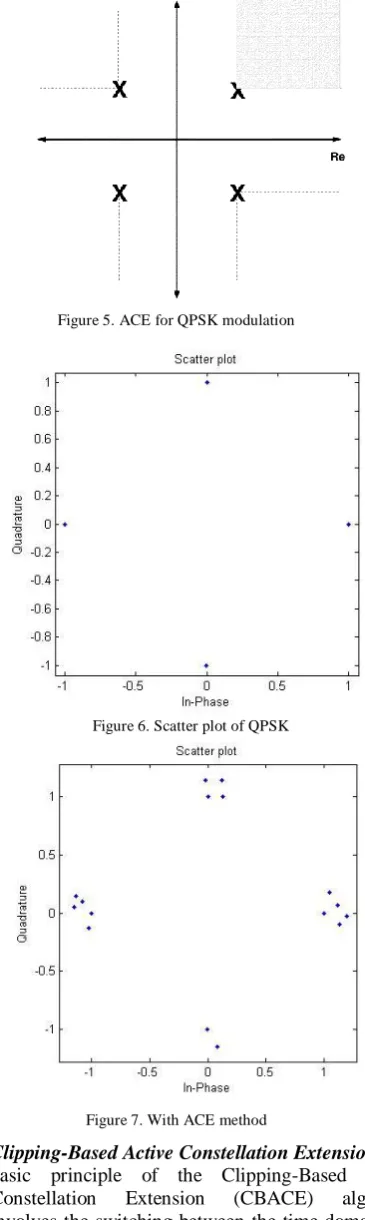
In the active constellation extension method, in the data signal block some points in the outer signal constellation are dynamically extended toward the outside of the original constellation so that the value of PAPR is reduced. For the OFDM signal with QPSK modulation, there are four possible constellation points, which lie in each quadrant in the complex plane and are equidistant from the real and imaginary axes. Assuming white Gaussian noise, the maximum-likelihood decision regions are the four quadrants bounded by the axes, and thus a received data symbol is assigned according to the quadrant in which the symbol is observed [9].
Those points which are, farther from the decision boundaries than the nominal constellation point which offers increased margin which guarantee lower error rate. Thus modification in constellation can be allowed with better
[image:3.595.349.532.140.751.2]performance. This can be illustrated in figure 5, where the shaded part represents the region of increase margin in first quadrant. Figure 6 shows the scatter plot of ACE method for QPSK modulation. Figure 7 shows the scatter plot of QPSK, without using algorithm. It is clear from figures that, after applying ACE method, some of the points are shifted towards outside.
Figure 5. ACE for QPSK modulation
Figure 6. Scatter plot of QPSK
Figure 7. With ACE method
a) Clipping-Based Active Constellation Extension: The
[image:3.595.41.263.375.555.2]clipping in the time domain, both require iterative processing to suppress the subsequent re-growth of the peak power [10].
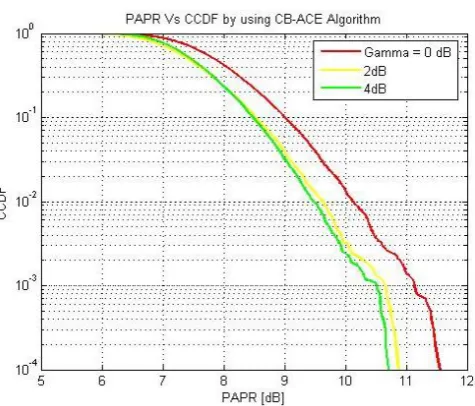
The CB-ACE algorithm is first used to clip the peak amplitude of the original OFDM signal. The clipping sample obtained after clipping the peak signals, denoted by .
where, = Clipping Sample of the ith iteration, = Oversampled OFDM signal, A = Predetermined Clipping Level, = arg (-). The predetermined clipping level, denoted by A, is related to the target clipping ratio, γ and is given.
[image:4.595.39.279.100.446.2]where, γ = Target Clipping Ratio, A = Predetermined Clipping Level, Xn = Oversampled OFDM signal
[image:4.595.321.557.408.607.2]Figure 8. CB ACE method with 4 iterations
Figure 9. CB ACE method with different values of Gamma
The in-band distortion results in the system performance degradation and cannot be reduced, while, the out-of-band distortion can be minimized by filtering the clipped signals. The signal obtained after filtering the clipped signal is given by
Where are the feasible points which can be extended in active region, we can get these points by done following comparison. If
Then, Otherwise, &
b) Adaptive Active Constellation Extension: For
reducing the Peak-to-Average Power Ratio (PAPR) adaptive ACE control both the clipping level and the convergence factor at each step and thereby minimize the peak power signal whichever is greater than the initial target clipping level. The Convergence Factor (CF) [11], denoted by μ can be estimated by
where, = Real Part, = Peak Signal above the Pre-Determined Level, = Anti-Peak Signal at the ith iteration
The clipping level, denoted by A, for the next iteration is given by
The gradient with respect to the target clipping ratio, denoted by , is given by
where, = Next Iteration Level, = Present Iteration Level, = Step size with, = Gradient with respect to A, = Number of peak samples larger than A.
Figure 10. PAPR performance by using Adaptive ACE method
[image:4.595.42.280.472.675.2]Figure 11. SNR v/s BER comparison
V. CONCLUSION
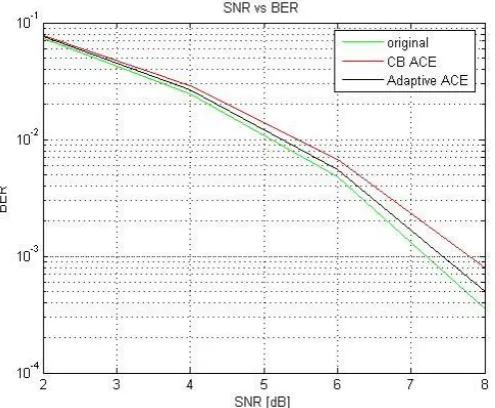
This dissertation discusses four methods Clipping & Filtering, SLM, CB ACE and Adaptive ACE. All four have the potential to reduce PAPR at the cost of loss in data rate, transmit signal power increase, BER increase, computational complexity increase, etc. In clipping & filtering, time domain high amplitude peaks are removed but in-band distortion & out-band distortion results. Out-band distortion can be removed by filtering the clipped signal and iterative Clipping & Filtering can reduce in-band distortion. In ACE method, transmitted power of signal has increased. When this power is normalized to unity, result in degradation of BER. In Adaptive ACE method, the BER degradation is less as compared to CB ACE method. In SLM method, to recover the information side information of phase sequences are required. If this side information gets errors then the whole symbol will get corrupted. No specific PAPR reduction technique is the best solution for all multicarrier transmission systems. Rather, the PAPR reduction technique should be carefully chosen according to various system requirements. In practice, the effect of the transmit filter, D/A converter, and transmit power amplifier must be taken into consideration to choose an appropriate PAPR reduction technique.
VI. REFERENCES
[1] Wang, Yang, Ku and Liu, “A Low-Complexity Peak-to-Average Power Ratio Estimation Method for OFDM Signals”, pp.1-5, IEEE, 2006.
[2] Luqing Wang and Chintha Tellamburan, “A Simplified Clipping and Filtering Technique for PAR Reduction in OFDM Systems”, IEEE Signal Processing Letters, Vol. 12, No. 6, pp.453-456, June 2005.
[3] Heo, Noh, Seon and Shine, “A Modifed SLM Scheme with Low Complexity for PAPR Reduction of OFDM Systems”, IEEE Trans. Broadcast., Vol. 53, No. 4, pp.804-808, Dec 2007.
[4] Li and Chimini, “Effects of Clipping and Filtering on the Performance of OFDM, IEEE Comm. Letters, vol. 2, no. 5, pp.131-133, May 1998.
[5] Ye (Geoffrey)Li and Gordon Stuber, “Orthogonal Frequency Multiplexing for Wireless Communication”, pp.08-25.
[6] Cho, Kim, Yang and Kang, “MIMO-OFDM Wireless Communications with MATLAB”, pp.209-250.
[7] Rana, “Clipping Based PAPR reduction method for LTE OFDMA Systems”, IJECS-IJENS Vol.10, No.05,pp.01-05, 2009.
[8] Rathore and Neelam, “Analysis of Selected Mapping and Patial Transmit sequence for PAPR Reduction”, Jour. Of Telecomm., Vol. 5, Issue 1, pp.8-11, Oct 2010
[9] Han and Lee, “An Overview of Peak-To-Average Power Ratio Reduction Techniques for Multicarrier Transmission”, IEEE Wireless Communications,pp.56-65, April 2005.
[10] Brian Scott Krongold and Douglas L. Jones, “PAR Reduction in OFDM via Active Constellation Extension”, IEEE Trans. Broadcast., Vol.49, No.3, pp.258-268, Sep. 2003.
[11] Kitaek Bae and Jeffrey G. Andrews, “Adaptive Active
Constellation Extension Algorithm for Peak-to-Average Ratio Reduction in OFDM”, IEEE Comm. Letter, Vol.14, NO.1, pp.1-3, Jan 2010.
[12] Guel and Palicot, “Analysis and Comparison of Clipping Techniques for OFDM Peak-To-Average Power Ratio Reduction”, IEEE, pp.1-6, july 2009.
[13] Ermolova, “Nonlinear amplifier effects on clipped-filtered multicarrier signals”, IEEE Proc.-Comm., Vol. 153, No. 2, pp.213-218, April 2006.
[14] Yang and Chen, “Reducing the Peak-to-average Power Ratio of OFDM Signal by a Modified Selected Mapping Technique”, ICSP Proc.,Vol. 3, pp.1-3, 2006.
[15] Jayalath and Tellambura, “SLM and PTS Peak-Power Reduction of OFDM Signals without Side Information”, IEEE Trans. on Wireless Comm., Vol. 4, No. 5, pp.2006-2013, Sep 2005.
[16] Yajun Kou, Wu-Sheng Lu and Andreas Antoniou, “New Peak-to-Average Power-Ratio Reduction Algorithms for Multicarrier Communications”, IEEE Trans. Circuits and syst., Vol.51, No.5, pp.1790-1800, Sep. 2004.