International Journal of Advanced Research in Computer Science
RESEARCH PAPER
Available Online at www.ijarcs.info
Odia Handwritten Vowel Recognition System using Slantlet Transform and
Differential Evolution based Functional Link Artificial Neural Network Classifier
Puspalata Pujari and Babita Majhi
Department of Computer Science and Information Technology, Guru Ghasidas Vishwavidyalaya, Central University, Bilaspur (CG), India
Abstract: One of the challenging problems in optical character recognition (OCR) is the identification of handwritten characters. It has several complexities like missing part, size variation, added noise, media devices used, slant variation etc. The goal of this paper is to develop an effective system for recognition of Odia handwritten vowels using functional link artificial neural network (FLANN) classifier and differential evolution (DE) optimization technique. In this paper the emphasis is on preprocessing, feature extraction, feature reduction and classification with optimization technique. Various preprocessing operations like size normalization mean filtering and canny edge detection methods are carried out on the vowel images to enhance the quality. Slantlet transform (SLT) is applied for feature extraction and the extracted features are further reduced by principal component analysis (PCA) method. FLANN classifier is applied on the reduced feature vector and the weights of the FLANN are optimized with DE evolutionary technique. The system has achieved a good classification accuracy of 91.32% on the dataset.
Keywords: Evolutionary techniques, Character recognition, Feature extraction, Classification, Slantlet transform (SLT), Functional Link Neural Network (FLANN), Differential Evolution (DE), Differential Evolution based Functional Link Artificial Neural Network (DE-FLANN).
I. INTRODUCTION
Hybrid models are widely used integrated techniques which provide efficient solutions to a wide range of complex problems belonging to different domain. Hybrid systems are specially used to overcome the weakness of one technique with the strength of other technique. Neural networks can model non linear relationships from given input patterns. But, due to the gradient search techniques artificial neural network (ANN) suffers from the problem of local minima. On the other hand DE provides potential candidate solutions for the neural network parameters. This paper presents a hybrid model of integrating FLANN and DE algorithm. In this model FLANN is used as a classifier and DE evolutionary algorithm is used to optimize the weight of FLANN.
Nibaran Das et.al [1] have proposed a soft computing paradigm embedded within the frame work of a two pass approach for recognition of basic, compound and allographs of Bangla character. An algorithmic approach has been developed for formation of pattern groups. To improve recognition accuracy, GA (Genetics Algorithm) based local region selection method has been used. The authors have achieved significant improvement over one pass approach. A handwriting recognition system has been developed in [2] based on genetics algorithm and visual coding. The system has been applied on Arabic script and obtained promising results. The authors have implemented a character recognition system for Devnagari script using SVM (Support Vector Machine) and particle swarm optimization in [3]. A comparative analysis has been carried out between the two techniques. An accuracy of 90 % has been achieved with particle swarm optimization (PSO). Laheeb M. AI-zoubaidy [4] has proposed a multiobjective genetic algorithm to minimize the number of features and a validity index method to measure the quality of cluster. The strategy has been applied on Arabic handwritten characters. Genetics algorithm has been used to improve
recognition speed and accuracy. A multistage recognition system based on GA and SVM has been developed by Nibarana Das et.al in [5] for recognition of handwritten Bangla compound characters. The pattern classes are identified in the first pass and optimal local discriminating regions are identified in the second pass. The system has achieved an accuracy of 78.93%. In [6] the authors have proposed a neural network approach for identification of skilled and unskilled forgeries. PSO algorithm has been used for training the neural network. In [7], the authors have developed an optimization technique to optimize input and output weights of a single layer feed forward network (SLFN). The model is applied on MNIST and United States postal service (USPS) database. In [8], to train FLANN Particle swarm based optimization (PSO) technique has been proposed. L. M. Al-zoubaidy [9] has proposed a method for feature selection in unsupervised learning for recognition of Arabic handwritten character. Multiobjective genetic algorithm has been proposed to improve the recognition speed and accuracy of the system. Differential evolution has been successfully applied for solving many optimization techniques for many applications such as parametric identification of seismic isolation [10], functionally graded beam [11], noisy multi objective optimization[12], complementary metal oxide-conductor (CMOS) inverter design [13], time series forecasting [14], neural network stagnation problem [15] etc. From literature it is noticed that the DE optimization technique has not been applied to Odia vowel recognition. Hence in this paper this problem is addressed and suitable solution is proposed for recognition of the handwritten Odia vowels.
modeling of intelligent pressure sensor [17], stock market prediction [18][19], detection of impulsive noise in images [20], data classification [21] and channel equalization [22] etc. The FLANN model has been successfully applied to many classification problems with low computational complexity with better solution. Thus in this paper the FLANN model is chosen for the recognition of handwritten Odia vowels.
Feature extraction is an important phase of character recognition which significantly affects the recognition phase. In literature several authors have employed successfully various feature extraction techniques to extract important features from the input pattern. From the literature it is observed that the SLT has been successfully applied to many fields like electric power quality detection [23], exchange rate prediction [24], and classification of current in power system [25], brain image classification [26], reversible water marking scheme [27], and nonlinear dynamic systems [28]. Being motivated by these applications SLT has been employed in this paper to extract important features from handwritten Odia vowels.
The chapter is organized as follows. Section II outlines the proposed system, section III describes preprocessing phase, section IV describes feature extraction technique using Slantlet transform and feature extraction using PCA. Section V presents the structure of FLANN model followed by the basics of general DE algorithm. The proposed DE-FLANN model is discussed in Section VII. Experimental study is carried out in Section VIII followed by conclusion.
II.PROPOSED SYSTEM
For the proposed system 1440 handwritten Odia Vowels are collected from NIT Rourkela, 120 for each vowel in .jpg format. Each sample is categorized into one out of twelve classes ranging from 1-12. The images are preprocessed before feature extraction and recognition phase. After preprocessing SLT transform is applied on the images to extract the feature vector. The features extracted are further reduced using PCA. The reduced features are applied to FLANN classifier for recognition of vowels. The weights of FLANN are optimized with DE optimization technique. Figure 2 shows a block diagram of proposed system.
Fig.2. Block diagram of proposed system
III.PREPROCESSING
Pre-processing is the initial step of character recognition. In this step all type of irregularities present in the vowel images are removed. It includes the operations like background noise reduction, filtering, slant correction, normalization, original image restoration etc.
A. Dataset used for the propose study
The development and performance evaluation of the proposed model is done using standard Odia handwritten vowels data set collected from NIT, Rourkela. This database contains 1440 samples of Odia handwritten vowels. All samples of the dataset are categorized into twelve classes from ranging from (1-12). Each vowel appears 120 times in the database. Figure 1 shows one sample of Odia handwritten vowels (1-12).
Fig.1. Handwritten Odia vowels from the database
The images are also normalized to a standard pixel size of 64x64 to get uniform images of each vowel. Then the gray scale images of the data are generated by using mean filtering method.
B. Edge detection
Edge detection is the process of finding sharp contrasts in the intensities of an image. It preserves most important structural features and reduces the amount of data in an image. In this paper Canny edge detection method is proposed for detecting edges from the images [30][31][32]. For smoothing, removing noise and unwanted details Gaussian filter 𝐺𝐺𝐺𝐺(𝑥𝑥,𝑦𝑦) is applied to the image 𝑓𝑓(𝑥𝑥,𝑦𝑦) by using equation 1.
𝑔𝑔(𝑥𝑥,𝑦𝑦) = 𝐺𝐺𝐺𝐺(𝑥𝑥,𝑦𝑦)∗ 𝑓𝑓(𝑥𝑥,𝑦𝑦) 𝑤𝑤ℎ𝑒𝑒𝑒𝑒𝑒𝑒𝐺𝐺𝐺𝐺(𝑥𝑥,𝑦𝑦)𝑖𝑖𝑖𝑖𝑔𝑔𝑖𝑖𝑔𝑔𝑒𝑒𝑔𝑔𝑎𝑎𝑖𝑖 𝐺𝐺𝐺𝐺(𝑥𝑥,𝑦𝑦) =�21𝜋𝜋𝐺𝐺2 exp[−𝑥𝑥22+𝐺𝐺𝑦𝑦22]
� (1)
The first derivative in horizontal (𝑔𝑔𝑥𝑥) and vertical direction �𝑔𝑔𝑦𝑦� is calculated by filtering the image with Sobel Kernel. From this the magnitude 𝑀𝑀(𝑥𝑥,𝑦𝑦) and direction
𝜃𝜃(𝑥𝑥,𝑦𝑦) for each pixel by is calculated b using equation 2.
𝑀𝑀(𝑥𝑥,𝑦𝑦) = � 𝑔𝑔𝑥𝑥2(𝑥𝑥,𝑦𝑦) + 𝑔𝑔𝑦𝑦2(𝑥𝑥,𝑦𝑦)
𝑎𝑎𝑔𝑔𝑎𝑎
𝜃𝜃(𝑥𝑥,𝑦𝑦)=𝑡𝑡𝑎𝑎𝑔𝑔−1�𝑔𝑔𝑦𝑦(𝑥𝑥,𝑦𝑦)⁄𝑔𝑔𝑥𝑥(𝑥𝑥,𝑦𝑦)� �
(2)
Non-maxima suppression is calculated by using equation 3
MT(x, y) =�𝑀𝑀(𝑥𝑥,𝑦𝑦) 𝑖𝑖𝑓𝑓 𝑀𝑀(𝑥𝑥,𝑦𝑦) > 𝑇𝑇
0 𝑜𝑜𝑡𝑡ℎ𝑒𝑒𝑒𝑒𝑤𝑤𝑖𝑖𝑖𝑖𝑒𝑒 (3)
set of vowels with detected edge using Canny edge detection method.
Fig. 3. Edge of the vowels using Canny edge detection method.
IV.FEATURE EXTRACTION USING SLANTLET TRANSFORM
This step is carried out to extract important features from the vowels. In this paper Slantlet transform (SLT) based approach is used for feature extraction. The Slantlet transform [25],[26] is an orthogonal discrete wavelet transform with two zero moments and with improved time localization. The construction of the Slantlet is based on a filter bank approach than the traditional tree based approach, with filters of different lengths at different scales. It is an orthonormal transform that defines a continuous function over L2 space with shorter support. The filters used for construction of Slantlet filter bank are𝑔𝑔𝑖𝑖(𝑔𝑔)𝑓𝑓𝑖𝑖(𝑔𝑔)𝑎𝑎𝑔𝑔𝑎𝑎ℎ𝑖𝑖(𝑔𝑔). For 𝑙𝑙 scales, let 𝑔𝑔𝑖𝑖(𝑔𝑔)𝑓𝑓𝑖𝑖(𝑔𝑔)𝑎𝑎𝑔𝑔𝑎𝑎ℎ𝑖𝑖(𝑔𝑔) be the filters employed in scale 𝑖𝑖 to analyze the signal, where each of these filters has an exact support of 2𝑖𝑖+1 . The l scale Slantlet has 2𝑙𝑙 number of channels. The low pass filter bank (LPF) which is the first filter has transfer functionℎ𝑖𝑖(𝑔𝑔). The low pass filter is paired with its adjacent filter with transform function𝑓𝑓𝑖𝑖(𝑔𝑔), where each filter is followed by a downsampling by 2𝑙𝑙. Each of the other (𝑙𝑙 −1) channel pairs constitutes of a 𝑔𝑔𝑖𝑖(𝑔𝑔) filter and its shifted time-reversed version (𝑖𝑖= 1,2, … ,𝑙𝑙 −1), followed by a down sampling by 2𝑖𝑖+1. The filter banks in the Slantlet analysis is determined by solving variables (parameters) in equation 4.
𝑔𝑔𝑖𝑖(𝑔𝑔) =�𝑎𝑎0,0+𝑎𝑎0,1𝑔𝑔 𝑓𝑓𝑜𝑜𝑒𝑒 𝑔𝑔= 0, … , 2 𝑖𝑖−1
𝑎𝑎1,0+𝑎𝑎1,1𝑔𝑔 𝑓𝑓𝑜𝑜𝑒𝑒 𝑔𝑔= 2𝑖𝑖, … , 2𝑖𝑖+1−1
ℎ𝑖𝑖(𝑔𝑔) =�𝑏𝑏0,0+𝑏𝑏0,1𝑔𝑔 𝑓𝑓𝑜𝑜𝑒𝑒 𝑔𝑔= 0, … , 2 𝑖𝑖−1
𝑏𝑏1,0+𝑏𝑏1,1𝑔𝑔 𝑓𝑓𝑜𝑜𝑒𝑒 𝑔𝑔= 2𝑖𝑖, … , 2𝑖𝑖+1−1
𝑓𝑓𝑖𝑖(𝑔𝑔) =�𝑐𝑐0,0+𝑐𝑐0,1𝑔𝑔 𝑓𝑓𝑜𝑜𝑒𝑒 𝑔𝑔= 0, … , 2 𝑖𝑖−1
𝑐𝑐1,0+𝑐𝑐1,1𝑔𝑔 𝑓𝑓𝑜𝑜𝑒𝑒 𝑔𝑔= 2𝑖𝑖, … , 2𝑖𝑖+1−1
(4)
The objective is to determine the parameters as, bs and cs, to design 𝑔𝑔𝑖𝑖(𝑔𝑔),𝑓𝑓𝑖𝑖(𝑔𝑔)𝑎𝑎𝑔𝑔𝑎𝑎ℎ𝑖𝑖(𝑔𝑔) filters for each ith
scale, which is based on formulation of constraints which satisfy orthogonality and two vanishing moments [29].
C. Feature reduction using PCA
The principal component analysis (PCA) is a mathematical procedure that uses an orthogonal transformation to convert a set of observations of possibly correlated variables into a set of values of linearly uncorrelated variables called principal components. By using the SLT 2519 numbers of features are generated for each vowel. The number of features generated is large. To reduce the computational complexity of the classifier
the number of features is further reduced from 2519 to 32 by using the principal component analysis (PCA) method. These features are then fed to the FLANN model for training purpose and the weights of the FLANN is optimized with DE algorithm.
V.FUNCTIONAL LINK ARTIFICIAL NEURAL NETWORK MODEL FOR CLASSIFICATION
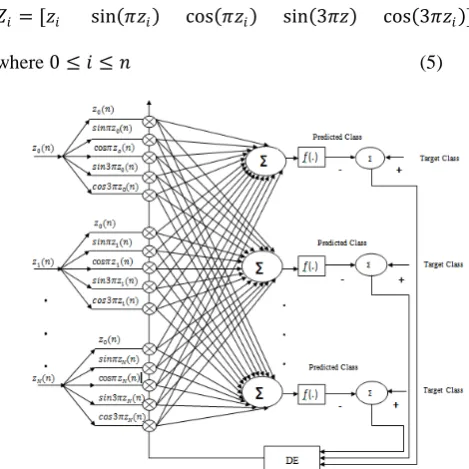
ANN can solve highly non linear problems. But, the complexity of ANN increases with the increase in number of layers. It needs more time to adjust the weight vector. Hence a FLANN model is suggested in this paper for the recognition of handwritten vowels. The FLANN [17][18][19] is a single layer neural network with no hidden layer. It has the capability to solve non linear classification problems with low complexity and provides better convergence rate. FLANN uses gradient descent algorithm iteratively to obtain a solution based on the training samples. In FLANN, the dimension of input pattern is expanded by a set of linearly independent function. The extended inputs are fed to the classifier for recognition purpose. Various mathematical functions such as sine, cosine, and log are used to functionally expand the input vector. Figure 4 shows the architecture of FLANN model. In this paper the reduced features are fed to the FLANN model for generating the enhanced intermediate pattern. The input 𝑧𝑧𝑖𝑖 is trigonometrically expanded into five terms as
𝑍𝑍𝑖𝑖= [𝑧𝑧𝑖𝑖 sin(𝜋𝜋𝑧𝑧𝑖𝑖) cos(𝜋𝜋𝑧𝑧𝑖𝑖) sin(3𝜋𝜋𝑧𝑧) cos(3𝜋𝜋𝑧𝑧𝑖𝑖)]
[image:3.595.309.544.379.614.2]where 0≤ 𝑖𝑖 ≤ 𝑔𝑔 (5)
Fig. 4 A five input trigonometric expansion based DE-FLANN adaptive model
VI.DIFFERENTIAL EVOLUTION (DE)
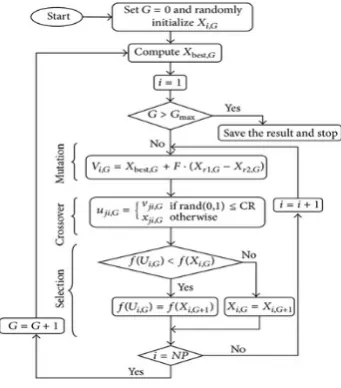
is used to generate a third individual called target vector, obtaining a new trial solution. A standard DE goes through four main operations: initialization, mutation, crossover, and selection.
Basic steps of DE algorithm
Step1: Select 𝑁𝑁𝑁𝑁 number of individuals 𝑋𝑋⃗𝑖𝑖,𝐺𝐺randomly, where
𝑋𝑋⃗𝑖𝑖,𝐺𝐺 is the 𝑖𝑖𝑡𝑡ℎ individual of 𝐺𝐺𝑡𝑡ℎ generation.
Step 2: Let 𝑓𝑓𝑖𝑖 =𝑓𝑓�𝑋𝑋⃗𝑖𝑖,𝐺𝐺� represents the fitness value of 𝑖𝑖𝑡𝑡ℎ individual solution at Gth generation, for 𝑖𝑖= 1 to 𝑁𝑁𝑁𝑁 .
Step 3: Repeat steps 4 to 10 while stopping criteria is not reached
Step 4: For i=1 to 𝑁𝑁𝑁𝑁 repeat steps 5 to 10
Step 5: Select three random indices 𝑒𝑒0=𝑏𝑏𝑒𝑒𝑖𝑖𝑡𝑡, 𝑒𝑒1, 𝑒𝑒2 between 1 to 𝑁𝑁𝑁𝑁(𝑖𝑖 ≠ 𝑒𝑒0≠ 𝑒𝑒1≠ 𝑒𝑒2)
Step 6: Compute the mutant vector as
𝑉𝑉�⃗𝑖𝑖,𝐺𝐺 =𝑋𝑋⃗𝑏𝑏𝑒𝑒𝑖𝑖𝑡𝑡,𝐺𝐺+𝐹𝐹(𝑋𝑋⃗𝑒𝑒1,𝐺𝐺− 𝑋𝑋⃗𝑒𝑒2,𝐺𝐺) (6)
where F is a real value within the range [0.0, 1.0]
Step 7: For 𝑗𝑗= 1 𝑡𝑡𝑜𝑜𝑔𝑔 repeat steps 8 to 9
Step 8: Select a random number 𝑒𝑒𝑗𝑗 where �0≤ 𝑒𝑒𝑗𝑗 < 1� and
𝑗𝑗𝑒𝑒𝑎𝑎𝑔𝑔𝑎𝑎 index (1≤ 𝑒𝑒𝑒𝑒𝑎𝑎𝑔𝑔𝑎𝑎 <𝑔𝑔)
Step 9: If 𝑒𝑒𝑗𝑗 ≤ 𝐶𝐶𝑒𝑒 or 𝑗𝑗=𝑗𝑗𝑒𝑒𝑎𝑎𝑔𝑔𝑎𝑎 then 𝑢𝑢𝑗𝑗,𝑖𝑖,𝐺𝐺=𝑔𝑔𝑗𝑗,𝑖𝑖,𝐺𝐺 else 𝑢𝑢𝑗𝑗,𝑖𝑖,𝐺𝐺=
[image:4.595.77.248.559.753.2]𝑥𝑥𝑗𝑗,𝑖𝑖,𝐺𝐺 where 𝐶𝐶𝑒𝑒 is a real valued crossover factor in the range
[0.0, 1.0]. Construct the trial vector 𝑈𝑈��⃗𝑖𝑖,𝐺𝐺 using 𝑢𝑢𝑗𝑗,𝑖𝑖,𝐺𝐺
Step 10: Selection process is carried out as, if 𝑓𝑓(𝑈𝑈��⃗𝑖𝑖,𝐺𝐺)≤ 𝑓𝑓𝑖𝑖 then 𝑋𝑋⃗𝑖𝑖,𝐺𝐺+1=𝑈𝑈��⃗𝑖𝑖,𝐺𝐺 and 𝑓𝑓𝑖𝑖 =𝑓𝑓(𝑈𝑈��⃗𝑖𝑖,𝐺𝐺) else 𝑋𝑋⃗𝑖𝑖,𝐺𝐺 =𝑋𝑋⃗𝑖𝑖,𝐺𝐺
Figure 5 shows the flowchart of basic DE algorithm.
Fig.5. Flow Chart of Differential Evolution Algorithm
VII.DEVELOPMENT OF DE-FLANN HYBRID MODEL FOR RECOGNITION OF ODIA HANDWRITTEN VOWELS
FLANN is a derivative based algorithm which, sometimes suffer from local minima problem. The choice of initial parameter such as weight significantly affects the learning quality in recognition phase. So to improve the learning quality, the weights of the FLANN model is optimized with DE evolutionary algorithm. In this paper the DE based learning scheme is proposed to overcome the limitation FLANN model. The steps involved in DE based weight optimization model are
(a) Initialise the population
M
of FLANN-DE model. Eachm
th individual of the population represents the coefficientsor weights of the FLANN model. N number of weights of the FLANN model corresponds to each individual of the population.
(b) Generate 𝐾𝐾 numbers of input patterns, each containing 32 features extracted from handwritten vowels. Expand each input trigonometrically to five non linear values.
(c) Multiply each element of the expanded input feature vector with each element of the member of population and then add together the partial sums to determine the estimated outputs 𝑦𝑦𝑖𝑖 as
𝑦𝑦𝑖𝑖 =∑𝑁𝑁𝑔𝑔=1𝑤𝑤𝑔𝑔𝑥𝑥𝑔𝑔 (7)
(d) Generate 𝐾𝐾 errors by comparing the
i
th predicted outputof the DE-FLANN model with the corresponding actual outputs. The
i
therror is represented as
𝑒𝑒𝑖𝑖(𝑔𝑔) =𝑎𝑎𝑖𝑖(𝑔𝑔)− 𝑦𝑦𝑖𝑖(𝑔𝑔) (8)
(e) Calculate the MSE (Mean Square Error) for finding fitness value of each member. Determine the MSE for a set of parameters corresponding to 𝑖𝑖𝑡𝑡ℎ member using equation 9. Repeat it for 𝑀𝑀 times.
𝑀𝑀𝑀𝑀𝑀𝑀(𝑖𝑖) =∑𝐾𝐾𝑘𝑘=1𝑒𝑒𝑖𝑖2
𝐾𝐾 (9)
(f) Minimize the MSE using the DE.
(g) Using equation (6) obtain the mutant vector.
(h) Using step 9 of section IV perform crossover operation and generate trial vectors.
(i) Based on minimum MSE criterion select the members for the next generation. Repeat the whole process for desired number of generations.
VIII. SIMULATION STUDY
To measure the performance of the DE-FLANN model simulation is carried out using Matlab software. The handwritten Odia vowels from NIT Rourkela comprising of 1440 handwritten vowels belonging to twelve target classes (1-12) are used for recognition purpose. Each class contains 120 samples. The images are normalized to a standard size of 64x64 pixels. Then the mean filtering technique is applied to convert the images into gray scale images. Canny edge detection method is applied on the images to detect the edge of the vowels. Slantlet transform is employed to each image to extract feature vectors. Further the features are reduced by using PCA from 2519 to 32 numbers to reduce computational complexity. Trigonometric FLANN is chosen as classifier and its weights are updated with DE based optimization algorithm. Out 1440 number of samples 1152 samples each with 32 attributes is used for training the weights of the FLANN and the remains are used for testing purpose. Each feature of the sample is trigonometrically expanded to five terms. Log sigmoid function is used as activation function. The estimated output for each input sample is compared with the desired output to calculate error term. Mean square error (MSE) is computed from the set of error terms. In the present simulation study the MSE is considered as the fitness function which is progressively minimized by varying the weight vector of the population using DE based optimization technique. The parameters of DE used in the simulation study are: population size = 750, F=0.1, 𝐶𝐶𝑒𝑒=0.9, number of generations = 1000 and number of independent run =10. The experimental results are also obtained for GA-FLANN and PSO-FLANN models under similar condition for comparison. The comparison of convergence characteristics of all three adaptive models is shown in Figure 6. From the figure it is observed that the DE-FLANN model gives minimum MMSE level as compared to other two models. The confusion matrix obtained during
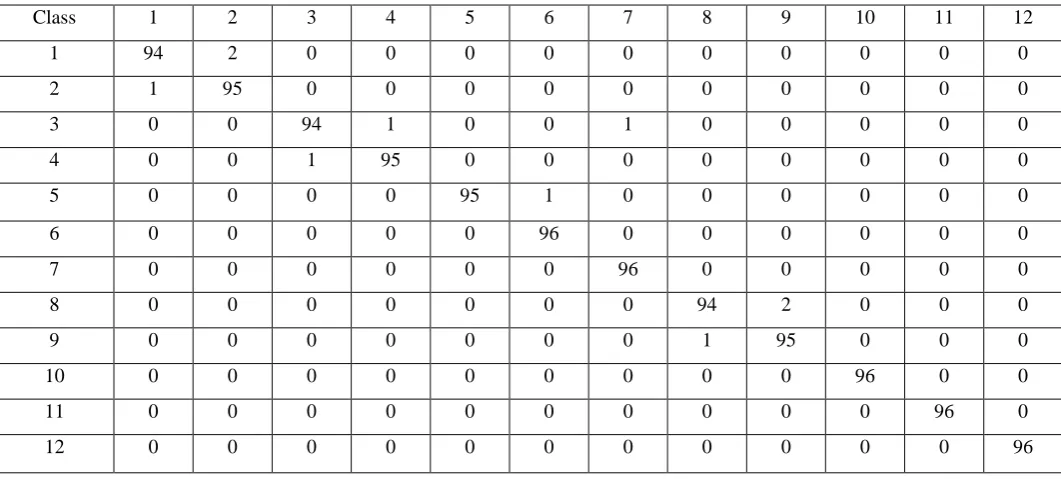
training and testing of DE-FLANN model is given in Table 1 and Table 2 respectively. Table 3 shows the accuracy
[image:5.595.33.564.528.767.2]of individual class for DE-FLANN model during training and testing phase. Table 4 shows the comparison of recognition accuracy of the three models during validation. The recognition accuracy obtained is 91.31%, 84.72% and 82.29% for DE-FLANN, PSO-FLANN and GA-FLANN model respectively. From the simulation results it is noticed that the proposed DE-FLANN model is a better model in comparison to the other two models for recognition of handwritten Odia vowels.
Fig. 6 Comparison of convergence characteristics of three adaptive models during training period
Table1.Confusion matrix of training dataset using DE-FLANN model
Class 1 2 3 4 5 6 7 8 9 10 11 12
1 94 2 0 0 0 0 0 0 0 0 0 0
2 1 95 0 0 0 0 0 0 0 0 0 0
3 0 0 94 1 0 0 1 0 0 0 0 0
4 0 0 1 95 0 0 0 0 0 0 0 0
5 0 0 0 0 95 1 0 0 0 0 0 0
6 0 0 0 0 0 96 0 0 0 0 0 0
7 0 0 0 0 0 0 96 0 0 0 0 0
8 0 0 0 0 0 0 0 94 2 0 0 0
9 0 0 0 0 0 0 0 1 95 0 0 0
10 0 0 0 0 0 0 0 0 0 96 0 0
11 0 0 0 0 0 0 0 0 0 0 96 0
Table2.Confusion matrix of testing dataset using DE-FLANN model
Class 1 2 3 4 5 6 7 8 9 10 11 12
1 21 1 0 0 1 0 0 0 0 0 1 0
2 1 23 0 0 0 0 0 0 0 0 0 0
3 0 0 22 1 0 0 1 0 0 0 0 0
4 0 0 1 21 0 0 1 1 0 0 0 0
5 0 0 0 1 22 0 1 0 0 0 0 0
6 0 0 0 0 0 23 1 0 0 0 0 0
7 0 0 0 0 1 1 21 1 0 0 0 0
8 0 0 0 1 0 0 1 22 0 0 0 0
9 0 0 0 0 0 0 0 1 23 0 0 0
10 0 0 0 0 0 0 0 0 1 22 0 1
11 0 0 0 0 1 0 0 0 0 0 22 1
12 0 0 0 0 0 0 0 0 0 1 2 21
Table3. Accuracy of each class using DE-FLANN model for training and testing dataset
Class
Training Testing
Total Sample
Correct Class
Accuracy in %
Total Sample Correct Class
Accuracy in %
1 96 94 97.92 24 21 87.5
2 96 95 98.96 24 23 95.83
3 96 94 97.92 24 22 91.67
4 96 95 98.96 24 21 87.5
5 96 95 98.96 24 22 91.67
6 96 96 100 24 23 95.83
7 96 96 100 24 21 87.5
8 96 94 97.92 24 22 91.67
9 96 95 98.96 24 23 95.83
10 96 96 100 24 22 91.67
11 96 96 100 24 22 91.67
12 96 96 100 24 21 87.5
Total Accuracy 95.17 % Total Accuracy 91.32 %
Table4. Comparison of recognition accuracy during validation of three adaptive models
DE-FLANN PSO-FLANN GA-FLANN
Class No of samples in all cases
No. of Correct Prediction
Accuracy in %
No. of Correct Prediction
Accuracy in %
No. of Correct Prediction
Accuracy in %
1 24 21 87.5 20 83.33 21 87.5
2 24 23 95.83 21 87.5 18 75
3 24 22 91.67 20 83.33 19 79.17
4 24 21 87.5 21 87.5 20 83.33
5 24 22 91.67 21 87.5 20 83.33
6 24 23 95.83 20 83.33 19 79.17
7 24 21 87.5 21 87.5 20 83.33
8 24 22 91.67 19 79.17 20 83.33
9 24 23 95.83 20 83.33 21 87.5
10 24 22 91.67 22 91.67 20 83.33
11 24 22 91.67 20 83.33 19 79.17
12 24 21 87.5 19 79.17 20 83.33
IX.CONCLUSION
This paper has proposed a hybrid soft computing approach DE-FLANN model using FLANN as classifier and DE as optimization technique for recognition of handwritten Odia vowels. All generic phases of character recognition are carried out. The feature vector is generated using Slantlet transform and further reduced using PCA. The system is also compared with PSO-FLANN and GA-FLANN model. From the experimental result DE-FLANN model has achieved a recognition accuracy of 91.32% on test dataset which is highest than the other models. The present work is an attempt to use evolutionary based approach for recognition of handwritten vowels. Different feature extraction and classification techniques can be applied to the system to increase the recognition accuracy.
REFERENCES
[1] Nibaran Das, Ram Sarkar, Subhadip Basu, Punam K. Saha, Mahantpas Kundu , Mita Nasipuri, “ Handwritten bangal character recognition using a soft computing paradigm embedded in two pass approach”, Pattern Recognition, Volume 48. Issue 6, June 2015, pp: 2054-2071
[2] M.Kherallah, F. Bouri, A.M. Alimi, “ On-line Arabic handwritten recognition system based on visual encoding and genetic algorithm”, Engineerng Applications of Artificial Intelligence, Volume 22, Issue 1, Febbruary 2009, Pages 153-170
[3] Prashant M. Kakde, S. M. Gulhane, “ A comparative analysis pf particle swarm optimization and support vector machines for Devnagri character recognition: An android application”, Procedia Computer Science, Proceedings of International conference on communication, computing and virtualization (ICCCV) 2016, volume 79, 2016, Pages 337-343.
[4] Laheeb M. AI-zoubaidy, “ Efficient genetic algorithms for Arabic Handwritten Characters Recognition”, Applications of Soft Computing, Volume 36 of the series Advance in intelligent and soft computing, pp: 3-14
[5] Nibaran Das, Kallol Acharya, Ram Sarkar, Suhadip Basu, Mahantapas Kundu, Mita Naspuri, “A Novel GA-SVM Based Multistage Approach for Recognition of Handwritten Bangla compound characters”, Proceedings of the International Conference on Information Systems Design and Intelligent Applications 2012 (INDIA 2012) held in Visakhapatnam, India, January 2012, ISBN: 27442-8 (Print) 978-3-642-27443-5 (Online).
[6] M. T. Das and L. C. Dulger, Signature verification (SV) toolbox: Application of PSO-NN, Engineering Applications of Artificial ntelligence, Elsevier, vol.22, pp.688–694, 2009.
[7] Z. Man, K. Lee, D. Wang, Z. Cao and S. Khoo, An optimal weight learning machine for handwritten digit image recognition, Signal Processing, Elsevier, vol.93, issue 6, p.1624-1638, June 2013.
[8] S. Dehuri, R. Roy, S-B Cho and A. Ghosh, An improved swarm optimized functional link artificial neural network (ISO-FLANN) for classification, Journal of Systems and Software, Elsevier, vol.85, issue 6, , pp.1333-1345, June 2012.
[9] L. M. Al-zoubaidy, Efficient genetics algorithms for Arabic handwritten characters recognition , Advances in Intelligent and Soft Computing, Springer, vol.36, pp.3-14, 2006.
[10] G. Quaranta, G. Carlo Marano, R. Greco and G. Monti, Parametric identification of seismic isolators using differential evolution and particle swarm optimization, Applied Soft Computing, Elsevier, vol. 22, pp.458-464, September 2014. [11] C.M.C Roque and P.A.L.S. Martins, Differential evolution for
optimization of functionally graded beams, Composite Structures, Elsevier, vol.133, pp.1191-1197, December 2015.
[12] P. Rakshit and A. Konar, Differential evolution for noisy multiobjective optimization, Artificial Intelligence, Elsevier, vol.227, pp.165-189, October 2015.
[13] B. P. De, R. Kar, D. Mandal and S. P. Ghosal, Optimal CMOS inverter design using differential evolution algorithm, Journal of Electrical systems and information technology, Elsevier, vol.2, issue 2, pp.219-241, September 2015.
[14] L. Wang, Y. Zeng and T. Chen, Back propagation neural network with adaptive differential evolution algorithm for time series forecasting, Expert systems with applications, Elsevier, vol. 42, pp.855-863, 2015.
[15] A. P. Piotrowski, Differential Evolution algorithms applied to neural network training suffer from stagnation, Applied soft computing, Elsevier, vol.21, pp.382-406, August 2014
[16] S. K. Behera, D. P. Das and B. Subudhi, Functional link artificial neural network applied to active noise control of a mixture of tonal and chaotic noise, Applied soft computing, Elsevier, vol. 23, pp. 51-60, October 2014.
[17] J. C. Patra and A. Bos, Modelling of an intelligent pressure sensor using functional link artificial neural networks, ISA transactions, Elsevier, vol.39, issue 1, pp.15-17, February 2000. [18] R. Majhi, G. Panda and G. Sahoo, Development and
performance evaluation of FLANN based model for forecasting of stock markets, Expert Systems with Applications, Elsevier, vol.36, pp.6800-6808, June 2012.
[19] C.M.Anish and B. Majhi, Hybrid nonlinear adaptive scheme for stock market prediction using feedback FLANN and factor analysis, Journal of the Korean Statistical Society, July 2015. [20] B. Majhi and P. K. Sa, FLANN-based adaptive threshold
selection for detection of impulsive noise in images, AEU- International Journal of Electronics and Communications, Elsevier, vol. 61, issue 7, pp.478-484, July 2007.
[21] B. Naik, J. Nayak and H. S. Behera, A global-best harmony search based gradient descent learning FLANN (GbHS-GDL-FLANN) for data classification, Egyptian Informatics Journal, Elsevier,21 October 2015(In press).
[22] W-D Weng, C-S Yang and R-C Lin, A channel equalizer using reduced decision feedback Chebyshev functional link artificial neural networks, Information Sciences, Elsevier, vol.177, issue 13, pp.2642-2654, July 2007.
[23] Cheng-Tao Hsieh , Jeu-Min Lin , Shyh-Jier Huang, “Slant transform applied to electric power quality detection with field programmable gate array design enhanced”, Electrical Power and Energy Systems 32 (2010) 428–432.
[24] Kaijian He, Kin Keung Lai, Jerome Yen, “A hybrid slantlet denoising least squares support vector regression model for exchange rate prediction”, International Conference on Computational Science, ICCS 2010, Procedia Computer Science 1 (2012) 2397–2405
[25] Amitava Chatterjee , Madhubanti Maitra, Swapan Kumar Goswami, “Classification of overcurrent and inrush current for power system reliability using Slantlet transform and artificial neural network”, Expert Systems with Applications 36 (2009) 2391–2399
[26] Madhubanti Maitra, Amitava Chatterjee, “A Slantlet transform based intelligent system for magnetic resonance brain image classification” Biomedical Signal Processing and Control 1 (2006) 299–306
[27] Rasha Thabit, Bee Ee Khoo “Robust reversible watermarking scheme using Slantlet transform matrix”, The Journal of Systems and Software 88 (2014) 74– 86
[28] H Pal Thethi, S.S. Roy, S. Mondal, B. Majhi and G. Panda, Improved Identification Model for Nonlinear Dynamic Systems Using FLANN and Various Types of DE, In proc. of International Symposium on Devices, MEMS, intelligent Systems, Communications, Sikkim, 12-14 April 2011, pp. 1-6. [29] I.W. Selesnick, The Slantlet transform, IEEE Trans. Signal
Process. 47 (5) (1999) 1304–1313.
[31] Lijun Ding, Ardeshir Goshtasby,” On the Canny edge detector”, Pattern Recognition 34 (2001) ,721-725