by Bill Chiaravalle and Barbara Findlay Schenck
Branding
FOR
About the Authors
Bill Chiaravalleknows brands and how to build them. His experience includes a decade-long stint as Design and Creative Director at the world-renowned brand strategy and design firm Landor Associates, where he worked on the branding programs for American Express, AT&T, Bacardi, Bell Atlantic, Danone, Delta Airlines, FedEx, Gatorade, Hyatt, IBM, Microsoft, NEC, P&G, Smucker’s, Sunkist, Sutter Home, and many others.
Since founding his own firm, Brand Navigation, in 1999, Bill’s role as Principal and Creative Director has been to assist clients large and small in the devel-opment of strategic positions and creative visions and expressions for their brands. A short list of clients Brand Navigation has worked with include Microsoft, Intel, The Miami Herald,Thomas Nelson Publishers, Krusteaz, Canterbury Cuisine, John C. Maxwell, and Bubbies of San Francisco.
Bill was born in San Francisco and received his training at the Academy of Art University in San Francisco. He has been honored with numerous branding, design, and industry awards. Away from brands, he enjoys spending time with his wife and four children, biking, swimming, fine dining, and jazz music. He lives in Sisters, Oregon. To visit his company online, go to www.brand navigation.com.
Barbara Findlay Schenckknows marketing and why brands are so important. She’s a business strategist with more than 20 years of experience helping com-panies and organizations shape their brands, messages, and marketing plans. She’s worked internationally in community development, served as a college admissions director and writing instructor in Hawaii, and cofounded an adver-tising agency in Oregon that ranked as one of the Northwest’s Top 15 at the time of its sale in 1995. Since then, she’s written Small Business Marketing For Dummies, Business Plans Kit For Dummies,2nd Edition, and numerous branding and marketing courses, presentations, and plans.
Authors’ Acknowledgments
Where to begin?
We start by giving heartfelt thanks to the long list of businesses and organiza-tions that have entrusted their brands and business hopes to each of us over the years. Here’s to your continued success!
We also give huge thanks to Wiley Publishing, Inc. for allowing us this once-in-a-lifetime opportunity to explain branding in the famous format of the world’s most famous book brand. Acquisitions Director Joyce Pepple, Acquisitions Editor Mike Lewis, Senior Project Editor Chrissy Guthrie, and Senior Copy Editor Elizabeth Rea made the making of this book a pure pleasure and won our highest regard and appreciation.
Special thanks also go to Bill Berenson, owner of Brand Architects, who applied his widely regarded expertise and wisdom during the technical review of this book. We’re fortunate for his talent.
Additionally, we each have personal lists of thanks.
From Bill: In addition to developing brands for over 20 years, I’ve been involved in the design of more than a thousand book covers in my lifetime. But I’d never considered writing one — until Barbara Schenck approached me. Thank you Barbara and Peter, you have been kind advocates for almost a decade. Thanks also to my staff at Brand Navigation: Ben, DeAnna, Russ, Steve, Terra, Mark, and Brittany. Without you, designing brands wouldn’t be near as much fun.
Special thanks to my children, Heidi, Wil, Michael, and Laura, who love me regardless of my obsession with brands.
And, most of all, to my beautiful wife, who is not only my business partner but my friend and the love of my life. You complete me.
From Barbara: Deep thanks to Bill for agreeing to coauthor this book and for adding so significantly to its value. And immeasurable gratitude to those who make all the joys and successes in my life possible: My husband, Peter, my son, Matthew, my three sisters, and my parents.
Publisher’s Acknowledgments
We’re proud of this book; please send us your comments through our Dummies online registration form located at www.dummies.com/register/.
Some of the people who helped bring this book to market include the following:
Acquisitions, Editorial, and Media Development
Senior Project Editor: Christina Guthrie
Acquisitions Editor: Michael Lewis
Senior Copy Editor: Elizabeth Rea
Technical Editor: William Berenson
Editorial Manager: Christine Meloy Beck
Media Development Manager:
Laura VanWinkle
Editorial Assistants:Erin Calligan, David Lutton
Cartoons: Rich Tennant (www.the5thwave.com)
Composition Services
Project Coordinator:Erin Smith
Layout and Graphics: Lavonne Cook, Brooke Graczyk, Denny Hager, Joyce Haughey, Stephanie D. Jumper, Barbara Moore, Heather Ryan
Anniversary Logo Design:Richard Pacifico
Proofreaders:Melanie Hoffman, Jessica Kramer, Nancy L. Reinhardt
Indexer:Galen Schroeder
Special Help
Marc Mikulich, Rev Mengle, Kirk Bateman
Publishing and Editorial for Consumer Dummies
Diane Graves Steele, Vice President and Publisher, Consumer Dummies
Joyce Pepple, Acquisitions Director, Consumer Dummies
Kristin A. Cocks, Product Development Director, Consumer Dummies
Michael Spring, Vice President and Publisher, Travel
Kelly Regan,Editorial Director, Travel
Publishing for Technology Dummies
Andy Cummings,Vice President and Publisher, Dummies Technology/General User
Composition Services
Gerry Fahey,Vice President of Production Services
Contents at a Glance
Introduction ...1
Part I: Everything You Ever Wanted
to Know About Branding ...7
Chapter 1: Branding ABCs...9
Chapter 2: When and How to Brand ...21
Chapter 3: Heating Up Your Branding Iron...43
Part II: Building a Brand, Step-by-Step...59
Chapter 4: Finding a Niche You Can Fill: Researching Your Market...61
Chapter 5: Filling Your Niche: Positioning Your Brand...77
Chapter 6: Putting Your Brand into Words...91
Chapter 7: Naming Your Brand ...103
Chapter 8: Designing Your Logo and Tagline ...123
Part III: Launching Your New Brand ...143
Chapter 9: Countdown to Takeoff: Planning Your Brand Launch...145
Chapter 10: Getting the Word Out with Public Relations ...165
Chapter 11: Advertising and Promoting Your Brand ...185
Chapter 12: Sending Your Brand into Cyberspace...205
Part IV: The Care and Feeding of Your Brand ...223
Chapter 13: Suiting Up a Team of Brand Champions...225
Chapter 14: Getting Customers to Pledge Allegiance to Your Brand...239
Chapter 15: Valuing Your Brand ...253
Chapter 16: Leveraging Brand Value with Brand Extensions and Licensing ...265
Chapter 17: Revitalizing Your Brand ...281
Part V: Protecting Your Brand ...297
Chapter 18: Defending Your Brand...299
Part VI: The Part of Tens ...325
Chapter 20: Ten Truths about Branding...327
Chapter 21: Ten Branding Mistakes and How to Avoid Them ...333
Chapter 22: Ten Traits of the World’s Most Valuable Brands ...341
Appendix: Resources for Brand Managers...345
Table of Contents
Introduction...1
About This Book...1
Conventions Used in This Book ...2
What You’re Not to Read ...3
Foolish Assumptions ...3
How This Book Is Organized...4
Part I: Everything You Ever Wanted to Know About Branding...4
Part II: Building a Brand, Step-by-Step...4
Part III: Launching Your New Brand ...5
Part IV: The Care and Feeding of Your Brand ...5
Part V: Protecting Your Brand ...5
Part VI: The Part of Tens ...6
Icons Used in This Book...6
Where to Go from Here...6
Part I: Everything You Ever Wanted
to Know About Branding...7
Chapter 1: Branding ABCs . . . .9
What Are Brands, Anyway?...9
What brands do ...10
Why brands are a big deal...13
Seeing the Big Branding Picture ...14
What’s involved? ...15
Who’s involved?...16
Gulp! How much does it cost? ...18
Pop Quiz: Are You Ready to Rev Up Your Branding Engine? ...19
Chapter 2: When and How to Brand . . . .21
Branding Demystified ...21
Translating branding lingo ...22
Branding’s essential ingredient ...23
To Brand or Not to Brand ...23
Products ...24
Service businesses ...26
Business brands ...26
Individuals (namely, yourself) ...28
A Bird’s-eye View of the Branding Process ...30
Step 1: Decide what you’re going to brand ...30
Step 3: Position your product or service ...33
Step 4: Write your brand definition...34
Step 5: Develop your name, logo, and tagline...35
Step 6: Launch your brand ...36
Step 7: Manage, leverage, and protect your brand ...36
Step 8: Realign your brand to keep it current...37
When to Brand...38
Opening a new business ...38
Introducing a new product...39
Fundraising for a nonprofit ...40
Taking your business public ...40
Going global ...40
Raising venture capital ...41
Merging with another business ...42
Chapter 3: Heating Up Your Branding Iron . . . .43
Gearing Up to Brand, Rebrand, or Refine Your Brand...43
Getting real about your current brand identity...44
Taking stock of your brand assets and using them to your advantage ...45
In your dreams! Defining your desired brand identity ...46
What’s Your Goal? Prioritizing Your Brand’s To-Do List ...49
Build awareness...49
Create an emotional connection ...50
Differentiate your product ...51
Create credibility and trust ...52
Motivate purchasing ...52
Crunching the Numbers: Budgeting for Your Brand Building Program ...54
Making Brand Development Part of Your Business Plan ...56
Knowing the relationship between your mission, vision, and brand identity ...56
Committing to the branding process ...57
Who’s on First? Recruiting Your Branding Team ...57
Getting buy-in from the top down ...58
Engaging all employees in the process...58
Part II: Building a Brand, Step-by-Step ...59
Chapter 4: Finding a Niche You Can Fill:
Researching Your Market . . . .61
Defining Who Buys What You’re Selling — and Why...62
Your customer profile ...62
What your customers want and value ...64
What sets your most ideal customers apart...65
Digging Up the Info You Need ...67
Know thyself: Conducting a self-assessment of your offering...67
Tuning in to customer insights...68
Conducting customer research ...69
When to do it yourself and when to get research help ...73
Where else to turn for facts and figures ...74
Putting It All in Perspective ...75
Seizing Marketplace Opportunities ...75
Chapter 5: Filling Your Niche: Positioning Your Brand . . . .77
The Marketing Muscle of Positioning ...78
Finding a Position of Your Own: The Birthplace of Your Brand...78
Fulfill an unfilled need...78
Specialize to create a new market niche ...79
Transform an established solution ...79
Discover an all-new solution ...80
Figuring Out What You Do Better Than Anyone Else ...80
Deciding Which Customers You Serve the Best...82
Finding Your Place in the Competitive Landscape ...84
Putting your brand on the positioning map ...84
Determining your point of difference ...85
No copycats! Avoiding the fate of a me-too brand ...87
Testing and Protecting Your Position ...87
Chapter 6: Putting Your Brand into Words . . . .91
Dusting Off Your Business Vision, Mission, and Values ...91
Refocusing your vision ...92
Building your brand on the strong back of your business mission ...94
Polishing your business promise ...96
Defining your brand character ...98
Mission Possible: Defining Your Brand ...100
What to incorporate...100
The anatomy of a brand identity statement ...101
Grading your statement...101
Putting your brand identity statement to the test ...101
Chapter 7: Naming Your Brand . . . .103
What’s In a Name? ...103
What the right name does ...104
When naming happens ...108
Types of names ...109
Naming advice to follow ...110
Picking (or Inventing) Your Brand Name ...111
Rounding up good ideas ...112
The hard part: Narrowing your list to the best options ...114
Putting your top contenders through a preliminary test...115
Building consensus around your top-choice name ...116
xi
Grabbing a Domain Name, If You Can...117
Fitting Your Name into Your Brand Architecture...118
Catch It If You Can: Protecting Your Name ...119
Screening to see if the name you want is already taken...119
Treading the trademark ropes ...121
Chapter 8: Designing Your Logo and Tagline . . . .123
Planning Your Logo: The Face of Your Brand ...124
Matching your logo to your brand and business ...125
Choosing your logo approach ...126
Developing Your Logo Design...129
Design ingredients...131
Preparing your logo artwork...134
Putting Your Logo to Work...135
Saving Face: Giving an Existing Logo a Makeover...137
Managing Your Logo ...138
Creating logo tools, standards, and usage rules ...138
Naming a brand cop ...140
Creating a Tagline...140
Discovering what makes a great tagline ...140
Deciding whether you need a tagline (and you probably do) ...141
Tag(line), you’re it! Coming up with your slogan ...142
Part III: Launching Your New Brand ...143
Chapter 9: Countdown to Takeoff: Planning Your Brand Launch . . .145
Committing to Internal and External Brand Launches — In That Order...146
Preparing for Your Brand Launch ...146
Knowing your story, chapter and verse ...146
Putting your brand launch into context ...147
Producing prototypes to introduce your brand...150
Checking your internal readiness ...151
Previewing your brand story with priority audiences ...152
Ten, Nine, Eight . . . Writing Your Brand Launch Marketing Plan...154
Benchmarking your pre-launch situation...155
Setting your goal and objectives ...155
Defining your target market ...157
Setting your strategies...157
Selecting your brand introduction tactics ...158
Establishing your budget ...160
Takeoff! Launching Your Brand ...161
Launching internally ...161
Chapter 10: Getting the Word Out with Public Relations . . . .165
Creating Your Brand Launch PR Plan ...166
Covering all the bases...166
Writing your public relations game plan ...169
Introducing Your Brand with Publicity...171
Matching publicity efforts to your brand launch objectives...172
Targeting media outlets ...173
Prioritizing editorial contacts...174
Pitching your story ...175
Preparing and distributing news releases...176
Creating a media kit ...180
Building an online pressroom...181
Extra! Extra! Making News...182
Staging news conferences ...183
You’re on! Shining in media interviews ...183
There’s No Such Thing as Bad Publicity, Right? Wrong! ...184
Chapter 11: Advertising and Promoting Your Brand . . . .185
Getting Singular with One Brand Message and Tone ...186
The power of consistency for you and your brand ...186
How to present a consistent brand image ...186
A Clear Purpose: Don’t Get Creative without One! ...187
Gaining Awareness and Getting Some Action...189
Making an Ad Schedule ...190
Matching media vehicles to your communication needs ...190
Scheduling your ads...193
Creating Ads That Work ...194
Print ads ...195
Broadcast ads ...199
Hiring professional creative help ...199
Measuring Your Ad’s Effectiveness...201
Packaging Your Product to Convey Your Brand...202
Staging Promotions to Build Business and Brand Awareness...203
Chapter 12: Sending Your Brand into Cyberspace . . . .205
Creating Your Online ID ...206
Naming your site ...206
Registering your name...208
Building a Site That Reinforces Your Brand ...209
Settling on the right type of site ...210
Considering content...210
Mapping out easy navigation ...211
Integrating your brand image online and offline...212
xiii
Getting People to Your Site ...214
Register with search engines ...215
Help search engines find your site...215
Build incoming links to your site...216
Promote, promote, promote ...217
Using Blast E-Mail to Reach Your Market...218
Building permission marketing networks ...218
Getting your e-mail opened and read ...219
Blogging and Podcasting ...220
Blogging basics ...220
Podcasts ...221
Part IV: The Care and Feeding of Your Brand...223
Chapter 13: Suiting Up a Team of Brand Champions . . . .225
Branding from the Top Down ...226
Writing your branding playbook ...226
Becoming your brand’s MVP ...227
Training Your Team...229
Developing brand champions...230
Gaining team buy-in ...231
Prepping Your Sales Force ...234
Arming your sales force with testimonials and product endorsements ...234
Intercepting objections...237
Chapter 14: Getting Customers to Pledge
Allegiance to Your Brand . . . .239
Kindling Customer Loyalty ...239
Turning sales transactions into customer relationships ...240
Why customer relationships matter ...241
Delivering a Great Brand Experience...242
Putting your brand experience to a personal test ...242
Auditing your brand experience ...243
Making Sure You’re Exceeding Customer Expectations...246
Igniting Customer Passion ...248
Generating buzz...249
Recipe for a cult brand ...252
Chapter 15: Valuing Your Brand . . . .253
The Brand Value–Brand Equity Connection ...254
Revving up the economic engine ...254
Estimating Your Brand’s Equity...256
Brand equity measuring sticks ...256
Calculating your brand equity ...260
When you need a pro: Identifying evaluation experts...262
Protecting Your Brand Equity...264
Chapter 16: Leveraging Brand Value with
Brand Extensions and Licensing . . . .265
Planning for Product Innovations ...266
Tiptoeing into the Brand Extension Arena ...267
Avoiding line extension traps ...268
Look before leaping into brand extensions ...270
Cobranding: Brand Value ×2 ...276
Uniting brands with like visions, values, and budgets ...276
Cobranding checklist ...277
Brand Licensing...278
Understanding licensing lingo ...278
Benefits of licensing ...279
Licensing steps to follow ...279
Chapter 17: Revitalizing Your Brand . . . .281
Brands Grow Old, Too ...282
Spotting brand aging signs...282
Brand change-of-life warning signals ...283
Examining Your Brand’s Health...288
Conducting a brand review ...289
Making the diagnosis: Retool or retire?...292
Fixing a Broken Brand ...293
Protecting your valuables ...294
Making the change ...295
Part V: Protecting Your Brand ...297
Chapter 18: Defending Your Brand . . . .299
Immunizing Your Brand with Government Filings and Trademarks ...300
Filing your name with local government offices ...300
Obtaining a trademark...302
Maintaining your trademark registration...304
Shielding Your Brand from Misuse ...307
Laying down the law with brand usage guidelines ...307
Enforcing the rules ...308
Naming and empowering a brand cop...309
xv
Chapter 19: Taking Action When Bad Things
Happen to Good Brands . . . .311
Handle with Care: Avoiding Brand Equity Landmines ...311
Identifying potential threats ...313
Taking preemptive strikes against brand threats ...315
Be Prepared: Reacting to Brand Threats...316
Compiling a list of who’s who ...317
Knowing who to call...318
Working out what to do and say...319
Following crisis communications dos and don’ts...322
Part VI: The Part of Tens ...325
Chapter 20: Ten Truths about Branding . . . .327
Branding Starts with Positioning ...327
A Brand Is a Promise Well Kept ...328
Branding Happens from the Inside Out...328
Consistency Builds Brands ...329
People Power Brands ...329
Brands Live in Consumers’ Minds ...330
Brand Names Unlock Brand Images ...330
Brand Experiences Trump Brand Messages...331
Brands Need to Start and Stay Relevant ...331
Brands Are Valuable Assets ...332
Chapter 21: Ten Branding Mistakes and How to Avoid Them . . . .333
Thinking of Branding as a Quick Fix ...333
Starting with a Weak Identity...334
Forgetting the Rule of One ...335
Failing to Differentiate ...335
Failing to Launch ...336
Failing to Protect and Defend ...336
Believing That What You Say Is More Important Than What You Do....337
Underestimating the Value of Consistency ...338
Asking Your Brand to Stretch Too Far ...338
Ignoring Brand Aging Signs...339
Chapter 22: Ten Traits of the World’s Most Valuable Brands . . . .341
Simple, Powerful Differentiation ...342
A Clear and Compelling Vision ...342
A Promise Consumers Want and Believe ...342
Distinctive, Reliable, Superior Products and Services ...343
A Single, Consistently Presented Brand Message ...343
An Amazing Brand Experience ...343
Brand Allegiance from the Top Down...344
Adaptability to Changing Times...344
Focus, Passion, and Persistence ...344
Appendix: Resources for Brand Managers . . . .345
Browsing Great Branding Web Sites ...345
Allaboutbranding.com ...345
Brandchannel.com ...345
MarketingProfs.com ...346
Rebrand.com...346
Adding to Your Branding Library...346
Flipping through Branding Magazines...347
Brandweek...347
BusinessWeek/Interbrand Annual Global Brand Report ...347
Checking Out a Trademark Information Center ...348
Index...349
xvii
Introduction
C
ongratulations! You’re about to take control of your brand.If you’re thinking, “I don’t even have a brand,” then this book is definitely for you. It’s also for anyone who wants to build a better brand, repair a broken brand, extend the power of a brand, or start from scratch and create a brand-new brand.
Branding has always been a red-hot topic (pardon the pun, pardner), but that’s even more the case in today’s competitive business world. When con-sumers hear your organization’s name, memories pop up that influence what they think and how they buy. Those memories are the basis of your brand. If you have a name people know, then you have the basis of a brand. This book is all about making sure that the brand you have is the brand you want.
Branding is the single biggest buzzword in marketing today for good reason: Brands pave the way for marketing success. Count on this book to demystify the topic and lead you to a better, stronger brand so that you can compete successfully in the big, branded world around you.
About This Book
When the publisher of one of the world’s most recognized book brands asked us to write a yellow-and-black book on branding, we knew we were looking at a tall order and some pretty sky-high standards to live up to. We gulped. And then we jumped at the chance.
Here’s our pledge: You don’t need an MBA or even a marketing or business background to make sense of this book. All you need is an interest in the topic of branding — a curiosity about what it is and how to do it. We take care of the rest.
You probably already know that branding works. This book shows you how to make it work for you.
Conventions Used in This Book
This book includes a few style conventions aimed at keeping the information easy to read and understand. First, a few words on the language we use:
When we say brand,we aren’t talking about side-of-the-steer ranch brands. We’re talking about brands for businesses, organizations, con-cepts, campaigns, and even individuals.
Throughout this book we talk about brandsand branding programs.To synchronize our thinking with yours from the get-go, brandrefers to the set of characteristics that arise in a customer’s mind when that person hears your name or sees your logo; branding programrefers to the process you follow to develop a clear brand image in your customer’s mind. In other words, the brand is the destination you aim to arrive at; the branding program is how you get there.
To describe those who comprise your target market, we use the words “customer” and “consumer.” They’re the people you’re seeking to influ-ence with your branding program. For some readers, the audiinflu-ence is comprised of retail clients. Others target online visitors, business clients, wholesalers, or a combination of buyers. Those working to brand nonprofit organizations or fundraising or political campaigns may target voters, donors, subscribers, or members. Entrepreneurs gearing up to start new businesses are probably seeking to build brands in the minds of cutting-edge employees, venture capitalists, and early-adopter customers. In this book, we use the words “customer” and “consumer” to cover all bases.
To keep this book easy to scan and read (and to meet For Dummiesbranding standards!), we incorporate the following style conventions:
Anytime we introduce a new term you need to know, we italicizeit.
We boldkey words and phrases in bulleted lists as well as the action parts of numbered lists.
What You’re Not to Read
If you have the time and inclination, by all means, read every precious word in this book. We’d love nothing more!
However, if you’re a “Just the facts, ma’am” kind of person, you can skip the gray-shaded sidebars, which contain information that complements but isn’t essential to your understanding of the surrounding chapter content. The sidebars are full of interesting approaches and examples that can help round out your branding knowledge, but you can get by just fine without them.
Foolish Assumptions
First things first: Anyone smart enough to want to know more about branding is no fool. Thanks for entrusting us with your interest. We’ve done back flips to make sure that this book includes everything you need to know about branding, all presented in plain English with easy-to-understand translations for every technical term.
In writing this book, we made a few assumptions about you and the many others we hope will use this book.
You’re not a marketing professional — or if you are, you’re looking for a branding refresher course that starts at ground level and builds topic knowledge from there. To make this book useful to every reader, we gear our explanations and advice to those who are charting new territory by entering the branding arena.
You’re interested in building or strengthening a brand — for your com-pany, for a nonprofit organization, for your new business, for a campaign (fundraising, political, social, you name it . . .), or for yourself by making your name into a local personality or a small-scale celebrity. Regardless of your branding objective, we’re guessing that you’re not expecting to become the next Nike or Apple, but we think it’s a safe bet that you’d like to acquire some of their branding strength. Who wouldn’t!
You’re willing to invest effort to achieve the returns that result from a good branding program. To help, we include worksheets, charts, and sets of how-to instructions to guide the research, planning, positioning, design, implementation, and management involved in fueling your suc-cess with the power of a great brand.
3
How This Book Is Organized
Each of the six parts of this book deals with a different phase of the branding process: Getting familiar with the language and lay of the land, building your brand from the ground up, launching your brand, putting your brand to work, protecting your brand, and managing your brand with a little advice.
Part I: Everything You Ever Wanted
to Know About Branding
Building a brand is a lot like building a house. You need to begin with a strong foundation, and that’s what Part I delivers. Chapter 1 provides an overview of how brands work and what it takes to build one. With Chapter 2, you move into branding action, figuring out what kind of brand you want to build, how your brand fits within your organization, when to start branding (the short answer is, right now!), and what steps to follow. Chapter 3 helps you launch your branding program by setting your branding goals, defining your brand identity, earmarking the necessary funds, and assembling the team that will turn your brand idea into reality.
Part II: Building a Brand, Step-by-Step
This part is your brand construction guide. It starts with Chapter 4, which walks with you through the essential research phase of finding out who buys your product and why, what competition you’re up against, how your offering is different and better, and what distinguishing characteristics you should be branding. Chapter 5 capitalizes on your research by helping you fill a unique position in the marketplace — and in your consumers’ minds. In Chapter 6, you get the formula for creating your brand definition and business promise, and Chapter 7 helps you brainstorm, choose, adopt, and protect the name for your brand. Finally, we wind this part up with an all-important chapter (Chapter 8) that features Bill’s proven advice on developing your logo and tagline — the face and slogan for your brand.
Part III: Launching Your New Brand
program with ads that work, packaging that competes, and promotions that drive results. Finally, Chapter 12 helps you move your brand online, with tips on everything from building your Web site, integrating your image online and offline, driving traffic to your site, and creating online relationships through permission mailings and the marketing muscle of blogs and podcasts.
Part IV: The Care and Feeding
of Your Brand
This part helps you reap the value of your brand. Chapter 13 tells you how to build brand support from the inside-out, first by becoming your brand’s key evangelist and then by creating a team of brand champions who take your brand story on the road to business partners and customers. Chapter 14 offers the formula for keeping your brand true to its purpose and promise. Chapter 15 helps you put a price on your brand and then leverage that value through brand equity protection and development. Chapter 16 is a must-read for anyone considering the opportunities (and seeking to avoid the land mines) of subbranding, brand extensions, and brand partnerships. Chapter 17 winds this part up with advice on how to monitor the strength of your brand, how to fix a broken brand, and how to manage the brand revitalization or rebrand-ing process.
Part V: Protecting Your Brand
This part contains only two chapters, but you can’t afford to skip either one. Chapter 18 is all about protecting the legal right to your brand. Chapter 19 is all about defending your brand from attacks, whether from innocent, zealous designers who want to put their own marks on your image, from managers with lofty but misguided ideas about brand-tainting “opportunities,” or from natural or other disasters that shake the foundation of your brand and your business.
Part VI: The Part of Tens
This final part sends you off with three ten-part lists of advice. Chapter 20 features ten laws of branding, Chapter 21 helps you avoid ten big branding mistakes, and Chapter 22 presents snapshots of ten of the world’s most valu-able brands.
And don’t miss the Appendix, which lists great branding resources to turn to for additional information.
5
Icons Used in This Book
This book wouldn’t live up to the For Dummiespromise without the symbols that sit in the outer margin alerting you to valuable information and advice. Watch for these icons:
The bull’s-eye marks tried-and-true approaches that will save you time, money, and trouble as build your branding program.
It’s one thing to read advice and steps to follow. It’s a whole other thing to read a true story of how an actual business tackled an issue topic success-fully. This icon flags great branding examples and lessons we’ve learned from firsthand experience.
When there’s a danger to avoid or just a bad idea to steer clear of, this icon sits in the margin like a flashing yellow light.
This icon points out branding’s golden rules. Watch for them throughout the book.
Where to Go from Here
True to the For Dummiesformat, you can start this book on any page. Every portion of the book is a self-standing component, which means that you don’t have to read sequentially from cover-to-cover to make sense of the content.
If you’re new to the field of branding, Chapter 1 is a great place to start; you get a good overview of the contents of the entire book as well as a crash-course on the whole topic, language, and process of branding. If you’re in a hurry because you’re facing a crucial branding issue or wrestling with a branding problem, turn to the table of contents or index to guide you straight to the advice you need. If you already have a branding program but want to polish the luster of your brand or even do some rapid brand repair, skip to Part IV.
Part I
Everything You Ever
Wanted to Know
In this part . . .
I
f all the talk in the business world about branding leaves you feeling like you’re tuned in to some very foreign language, the chapters in this part will serve as a welcome translation guide. They present clear-cut definitions for all the terms that arise in branding conversations, and they take a look at why brands are so powerful, when and how to create a brand, what it takes to manage and protect a brand, and how to incorporate branding into your busi-ness strategy.Chapter 1
Branding ABCs
In This Chapter
Orienting yourself to what branding’s all about Understanding the power of branding
Committing the necessary people, resources, and time to build a brand
M
aybe you’re launching a new company or a new product, and you want to establish a strong brand from the get-go. Or maybe you’ve been in business for a while, and you’re getting ready to do some brand repair, brand extensions, or rebranding.Perhaps you’ve just joined the marketing team for an established business, and you want to come up to speed — in a hurry — on the whole topic of branding and how to do it best. Or, you may be among the many marketers who aren’t quite sure whether or not you even havea brand, but you’re pretty sure you need one, and you want to know which steps to take in order to end up with the brand you set out to build.
No matter your starting point, if branding action is on your agenda, this chapter gets you going in the right direction. It provides an overview of the reasons that brands matter, why you need one, and how building a brand delivers value that far exceeds the time and effort you invest.
What Are Brands, Anyway?
As you venture into the world of branding, keep these truths in mind:
You establish your brand by building trust in a one-of-a-kind promise about who you are, what you stand for, and what unique and mean-ingful benefits you deliver.
You build your brand by living up to your promise every single time people come into contact with your name, your message, or your busi-ness.It makes no difference whether that contact comes through adver-tising, publicity, word of mouth, the buying experience, customer service, billings, returns, or ongoing communication.
You strengthen your brand by constantly reinforcing your brand promise.If encounters with your brand are inconsistent or not in line with what people expected they could count on, you essentially break your promise, breaking your brand and risking your reputation and business as a result.
Building brands takes focus, passion, persistence, and diligence. Plus brand building requires effort and money. The payoff, and it’s a big one, is that strong brands build business and equity for their owners. The following sec-tions shed light on what brands do and why they’re such a big deal.
What brands do
Brands create consumer trust and emotional attachments. As a result, they foster relationships between consumers and products that withstand pricing wars, transcend offers from new competitors, and even overcome rare lapses in product or service excellence.
Great brands aren’t just known and trusted. They’re loved.
For examples of brands that enjoy strong bonds with customers, the next time you’re stuck in traffic, look at the logos posted in the windows of the cars around you. Each time you see a logo decal, try to think of that brand’s chief competitor. Then ask yourself “What’s the chance that a buyer of the competing brand would ‘wear’ the brand’s logo with such pride?” Only brands that strike deep emotional chords with customers make their way into hearts, minds, and car windows! Chapters 13 and 14 provide a playbook on how to develop a contingent of brand enthusiasts inside and outside your organization.
Brands make selling easier
Brands are a big business today because they make selling easier in person and online. People prefer to buy from companies they feel they know and can trust, and brands put forth that assurance.
Whether you’re selling products to consumers, investment opportunities to stockholders, job opportunities to applicants, or ideas to constituents, a brand paves the way for success by establishing awareness of your unique and meaningful promise before you ever present your sales proposition.
When people are aware of your brand, they’re aware of the positive character-istics you stand for. Long before they get ready to make a purchase, they feel they know who you are and what unique value they can count on you to deliver. As a result, when it comes time to make a sale, brand owners can con-centrate on the wants and needs of the consumer rather than take up valuable consumer time trying to explain themselves and their unique attributes.
Without a brand, you have to build a case for why you deserve the con-sumer’s business every single time you get ready to make a sale. While brand owners are closing the deal, those without strong brands are still introducing themselves.
Imagine you’re setting out to buy a new laptop computer and you see one emblazoned with a known logo — the face of a known brand. It’s likely that your next step is to dive into a discussion with the salesperson of how much memory the particular model you’re viewing contains, how the machine can be customized to your needs, what software is included, and other details that will move you to the purchase decision. On the other hand, if you see a
11
Chapter 1: Branding ABCs
Perception is everything
Many people think that the logo is the brand, but,in fact, the logo is just one representation of the brand. Your brand isn’t how you look or what you say or even what you sell. Your brand is what people believe you stand for. For example:
Starbucks sells coffee. It stands for daily inspiration.
Apple sells computers. It stands for thinking differently.
Disney sells animated and amusement park family entertainment. It stands for making dreams come true.
no-name model — even at a dramatically lower price — you’re likely to first try to assess the quality of the manufacturer. You may ask the salesperson where the computer was made, how long the manufacturer’s been in busi-ness, whether the manufacturer is reliable, whether other customers have been satisfied, and many other mind-calming questions about consumer sat-isfaction levels, warranties, and return programs that you wouldn’t raise when dealing with the known entity of an established brand.
Selling a no-name item takes time and patience. It’s a costly route to a sale in a retail setting, and it’s nearly impossible online, where there’s no one stand-ing by to offer explanations, inspire confidence, counter resistance, or break down barriers for your consumers.
Brands trump commodities
In the marketplace, you have either a one-of-a-kind brand or a one-is-as-good-as-any-other commodity. When it comes to creating a marketing success story, there’s no question that brands fare better because
Brands are products defined by and chosen for their unique distin-guishing attributes.People buy brands because they relate to and trust their distinctions and promises. Consumers are willing to spend extra time and money in order to obtain the brands they believe in.
Commodities are products that are easy to substitute and hard to dif-ferentiate.Commodities are purchased simply because they serve a purpose. Oil, coffee beans, wheat flour, and milk are all commodities. Consumers buy commodities because they meet minimum standards and are available when and where they’re needed and at the lowest price.
Brands build equity
Brands that are preferred and valued by consumers deliver a long list of busi-ness benefits that translate to higher sales, higher profit margins, and higher owner value. Consider these brand advantages as proof:
Consumers are willing to pay more to buy brands because they believe that the brands deliver outstanding and desirable benefits.
Consumers stay loyal to brands, buying them more often, in greater volume, and without the need for promotional incentives.
Retailers provide brands greater store visibility because they know that brands drive sales and result in higher store revenues.
Brand owners find it easier to attract and retain good employees because applicants believe in the quality of the workplace based on advance knowledge of the caliber of the brand.
Brand owners run more efficient operations because they align all deci-sions with the mission, vision, and values that underpin the brand promise.
Brand owners benefit from increased market share, increased investor support, and increased company value.
Why brands are a big deal
The list of reasons the word “branding” arises so often in today’s business conversations is long and growing. With more new businesses and products than ever before, and with a competitive arena that — thanks to the Internet — now stretches all the way around the world, brands are more necessary than they’ve ever been before. Here are a few of the reasons why:
Brands unlock profitability.Today’s marketplace is full of more prod-ucts than ever before, and, overwhelmed by the selection, people choose and pay premium prices only for products they’ve heard of, trust, and believe deliver higher value than the others. If consumers think all products in a category are virtually the same and no offering is better or distinctly different from the others, they simply grab whichever one is available at the lowest price. That’s a profit-squeezing reality that brand marketers gratefully avoid.
Brands prompt consumer selection.For the first time in shopping his-tory, consumers can shop and buy without any geographic limitation. The Internet and other at-home shopping options allow far-reaching access to any product, anywhere. With a few clicks or keystrokes, con-sumers find and select products with names they know and promises they trust. In this boundless marketplace, brands rule and no-name products barely survive.
Brands build name awareness.For good reason, new businesses and products increasingly go by invented names instead of by known words. For one thing, more than three million U.S. trademarks are already regis-tered, so any marketer who wants to protect a new name practically needs to create a never-before seen word in order to succeed. For another, 99 percent of all words in the English dictionary are already reserved as Internet addresses and are therefore unavailable to new marketers. As a result, most new offerings are launched under invented names, and invented names require strong and diligent branding in order to achieve consumer awareness, recall, and meaning. (Chapter 7 is full of advice for naming your brand.)
13
What’s involved?
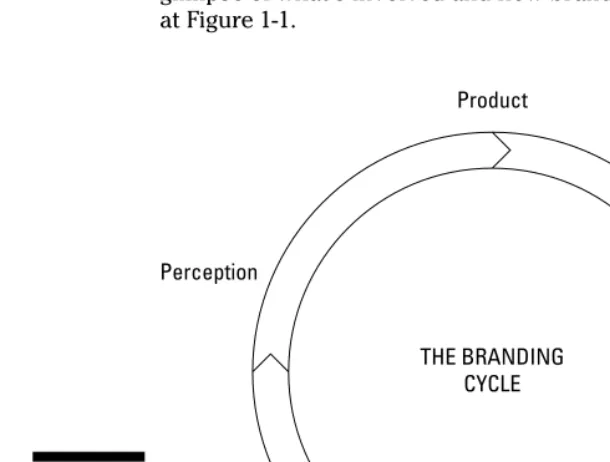
Chapter 2 walks you through the steps involved to build a brand from the essence of an idea to the esteem of a known and trusted offering. For a glimpse of what’s involved and how branding is a never-ending cycle, look at Figure 1-1.
Branding is a circular process that involves these actions:
1. Product definition:You can brand products, services, businesses, even people or personalities. But you can’t start the branding process with-out first knowing what it is you’re trying to brand and whether your brand will be a one-and-only or one of several in your organization. Chapters 2 and 16 provide assistance with this beginning step.
2. Positioning:Each brand needs to fill a unique, meaningful, and available spot in the marketplace and in the consumer’s mind. To determine your product’s point of difference and the unique position it (and only it) fills in the market, see Chapters 4 and 5.
3. Promise:The promise you make and keep is the backbone of your brand and the basis of your reputation. Chapter 6 helps you put your promise into words.
Product
Presentation
Position
Promise Persistence
Perception
THE BRANDING CYCLE
Figure 1-1:
An at-a-glance view of the branding cycle.
15
4. Presentation:How you present your brand can make or break your abil-ity to develop consumer interest and credibilabil-ity in your offering. Start with a great name and logo (see Chapters 7 and 8), and then launch your marketplace communications with professionally produced and com-pelling packaging and communications. The chapters in Part III tell when, where, and how to proceed as you send your brand message into the marketplace.
5. Persistence:This is the point in the branding cycle where too many brands lose steam. After brands are launched, brand owners often get tired of their own looks and messages and begin to improvise with new looks, new messages, and even new brand personalities and promises. Just when consistency is most necessary in order to gain clarity and confidence in the marketplace, brands that lack persistence go off track. To save your brand from this pitfall, turn to Chapters 8 and 19 for help writing and enforcing brand presentation and management rules.
6. Perception analysis:In a consumer’s mind — which is where brands live and thrive — a brand is a set of beliefs about what a company offers, promises, and stands for. Great brands continually monitor brand per-ceptions to see that they’re in alignment with the brand owner’s aspira-tions and in synch with consumer wants and needs. (Chapter 17 provides questionnaires and advice for conducting this assessment.)
Based on the results of perception analysis, brand owners begin their loop around the branding cycle again, this time adjusting their products, fine-tuning their positioning statements, strengthening their promises, updating their presentations, rewriting their brand management rules, and once again monitoring perceptions in order to guide ongoing brand realignments and revitalizations.
Who’s involved?
Brands grow from the top down and from the inside out. What that means is that your brand needs commitment from the highest levels of leadership and support from employees in every department and at every point on the orga-nizational chart.
Assembling your branding team
Whether you have a 1-person team or a 1,000-person team, every single person in your organization has to be involved in building and maintaining your brand. In order of who you bring on board first, here’s who to involve:
2. Marketing and brand management team:This group takes on the day-to-day responsibility for advancing, maintaining, protecting, and fine-tuning the brand. As you name your team, name one person to serve as your brand manager and chief brand protector. Be sure that this person is a senior-level executive who has the authority and commands the respect necessary to oversee what, in time, will become your organiza-tion’s most valuable asset — your brand.
3. An organization-wide team of brand champions:Every person in your organization serves as an expression and an ambassador of your brand. If one person fails to uphold your brand promise — at any point from an initial inquiry to a post-purchase product or service concern — the strength of your brand is weakened. That’s why great brands begin with internal launches that achieve team understanding and support (see Chapter 9). They also include ongoing brand orientations and training sessions to ensure flawless brand experiences (see Chapters 13 and 14).
Enlisting professional help
Brand development requires professional expertise and effort from those within and outside your organization. One person — or even one outside firm — can’t do it all. Pick and choose from the following professional resources:
Brand consultants:These are firms that specialize in the soup-to-nuts creation, building, and management of brands. They’re experienced in everything from positioning to naming and trademarking to logo devel-opment to launching brands internally and externally. If your organiza-tion is seeking to build a brand that reaches into large markets or competitive fields, the expertise of a brand consultant can be worth the expense many times over.
Public relations specialists:New brands are newsworthy if they’re pre-sented with the right news hooks and angles. An experienced public relations professional can help you get your story into circulation. Depending on the size and ongoing nature of your needs, a public rela-tions freelancer may be able to handle your task as a one-time assign-ment. But if brand publicity is an ongoing objective, a public relations firm with greater staff and media resources may be the way to go. (Flip to Chapter 10 for more on public relations.)
Logo designers:If you need help only with logo development or refinement, hire a graphic designer with a great logo portfolio. Ask to see samples to be sure that the caliber of design matches up with your expectations. Then use the advice in Chapter 8 as you manage the logo-development process.
Advertising agencies:Some ad agencies specialize in brand develop-ment. Others focus on creation of print, broadcast, or interactive adver-tising. Yet others are known for outstanding packaging development, and even for their public relations departments. Whatever your needs, be aware that professionally produced communications can make a big difference in the strength of the brand image you transmit.
17
Chapter 11 offers guidance as you determine your needs, locate the right resources, conduct interviews, manage the selection process, and work with the professionals you hire.
When interviewing professionals, ask to see case studies to determine whether those you’re considering have the experience you seek. Many companies pre-sent themselves as brand developers when, in fact, they handle only one aspect of the branding process, such as logo development or brand advertising.
Gulp! How much does it cost?
Brand development budgets run the gamut depending on whether you’re building a brand that will face only moderate competition in a small geo-graphic region or a brand that aims to elbow out major competitors in the global marketplace.
A glance at branding budgets
Table 1-1 shows a lineup of the major tasks involved in brand development along with the range of price tags involved. Brace yourself: The high-end fig-ures are apt to cause heart palpitations.
Table 1-1
Professional Brand Development Fees
Task Low-End Fee High-End Fee
Name development $10,000 $75,000
Brandmark (logo) creation $3,500 $150,000
Core brand presentations (Web site $10,000 $250,000+ and collateral materials)
Advertising $10,000 Millions annually
Signage, vehicles, packaging $20,000 $250,000+ annually
As you reach for your calculator to start tallying up the costs to your busi-ness, avoid the temptation to strike out certain line items that you think you can handle on your own without incurring outside costs. Businesses that start with do-it-yourself logos and presentation materials achieve false sav-ings. They economize on the front end, for sure, but they also cost them-selves the benefit of a strong, competitive, professional first impression.
If your goal is to build a brand that you can grow, leverage, and even sell in the future, invest the money required to get off to a good start. By the time you amortize your start-up expenses, the cost will be minimal in comparison to the value received.
In lieu of big bucks . . .
In case you’re clinging to your billfold or balance sheet, shaking your head, and wondering how you can build a brand on your kind of budget, remember this truth: A well-defined and consistently delivered brand strategy can level the playing field.
If you don’t have the budget to develop the most powerful brand identity, triple or quadruple your efforts to design and deliver the most consistent brand experience. Follow these suggestions:
Spend extra time and effort to define your brand and what it stands for so that you and all in your organization know exactly the promise you’re making and keeping.Defining your brand involves creating your mission and vision statements, defining your brand promise, developing your brand definition and core brand message, and deciding on the brand character or personality that you’ll put forth with every brand communication. Chapter 6 covers these tasks.
Develop a brand experience that never fails or fluctuates.If you can’t have the most dazzling brand identity and presentation materials, aim instead to have the most amazing and amazingly consistent brand encounters. Chapter 14 helps you ensure brand contacts that never let consumers down and never let them wonder what you stand for.
Pop Quiz: Are You Ready to Rev
Up Your Branding Engine?
Is branding the right next step for your organization? If you answer “yes” to a good many of the following questions, you have good reason to turn the page and get started!
19
Are you launching a company or product that will benefit from a clear identity and high awareness?
Have you been in business for a while but feel you lack consumer aware-ness and understanding about who you are and what you stand for?
Do you sell your offerings online or over distances but feel that prospects don’t know your name or the distinct benefits you offer?
Do you feel that people in your own organization are unclear about how to explain your offerings, your distinctions, your target market, and how you excel over competitors?
When you look at how your organization communicates through adver-tising, marketing materials, personal presentations, and at each cus-tomer contact point, do you see inconsistencies in the look, message, and company personality being presented?
Is the leader of your organization prepared to devote time, staff, energy, and dollars to develop, launch, and grow a brand?
Chapter 2
When and How to Brand
In This Chapter
Branding products, businesses, services, and even yourself Following the branding process, step-by-step
Seizing the best moment to brand or rebrand
T
he short answer to the question of when and how to brand is this: Brand when you’re ready to make a promise to customers, and brand by making a promise that you’re absolutely, positively certain you can keep.A brand,in essence, is a promise about who you are and what benefits you deliver that gets reinforced every single time people come in contact with any facet of you or your business.
Branding isn’t a veneer that you slap on (usually in the form of a new logo) to mask or transform a product offering. Treating branding like some skin-deep solution to your business’s problems is like putting lipstick on a pig: People see through the makeup, no matter how thick the application. Branding has to go all the way to the core of who you are and what you stand for.
Count on this chapter to lead you into the branding process, starting with a good overview of branding definitions and terminology. Then we move into a look at all the things you can brand and a lineup of the moments when brand-ing is most essential and beneficial to your business and marketbrand-ing success.
Branding Demystified
When people encounter your business’s name, they automatically conjure up impressions and memories that determine what they believe about you. Their notions may be the result of communications you’ve had with cus-tomers, or they may be the result of good or bad publicity or word-of-mouth. Your customers may have a deep well of perceptions about you, or your slate may be nearly clear of any impressions whatsoever.
Regardless of whether the beliefs a customer holds about you are many or few, good or bad, or accurate or inaccurate, they comprise the image of your brand in your customer’s mind — and they influence how your customer thinks and buys.
Your brand image lives in your customers’ minds whether you intentionally put it there or not. Branding is the route to making sure that the brand image you have is the brand image you want.
Translating branding lingo
Branding terminology is a language unto itself. To get a feel for the complexi-ties, just type “branding terms” into your favorite Internet search engine. We did that recently and got a whopping 12 million results! Assuming that you’d rather focus on key phrases instead of the full foreign language of branding, check out this need-to-know list of terms:
Brand:A promise about who you are and what benefits you deliver that gets reinforced every time people come in contact with any facet of you or your business
Brand identity:The marks that visually present your brand, usually in the form of a logo, symbol, or a unique typestyle
Brand image:The set of beliefs about what your brand is and what it stands for that exists in the customer’s mind as a result of associations with you and your name
Branding:The process of building a positive collection of perceptions in your customer’s mind
Brand position:How your brand fits in with and relates to various other brands within your competitive market
Brand management:Controlling the presentation of your brand identity and brand message across your entire organization and through all media and communication outlets
Don’t get overwhelmed when you hear people talk about brand message, brand promise, brand mission, brand strategy, brand extension, brand revi-talization, rebranding, and a mind-boggling array of other brand terms. Armed with an understanding of the terms in this section, you can navigate branding conversations just fine. Throughout this book, we introduce other terms as you need to know them for specific branding situations.
Branding’s essential ingredient
Originally we titled this section “Branding’s Essential Ingredients.” Lucky for you, we changed the plural to a singular. Brands are built around four funda-mentals: product differentiation, relevance, esteem, and knowledge. But the magic ingredient that converts those fundamentals into a branding success story is consistency.If you bring consistency to your branding program, you end up with a brand that stands head and shoulders (no branding pun intended) above the others.
If you know what you stand for and project messages to your target market that constantly reinforce how your offering is different and relevant, you build knowledge and, eventually, esteem. As a result of your consistency, you win out over businesses that shift with the wind, regardless of how beauti-fully they’ve polished their identities or their marketing materials. In brand-ing, consistency is more important than level of execution.
We’ve seen too many companies develop award-winning logos and impressive brand launch materials only to have their brand images go sideways when the customer has an actual brand experience. Remember the lipstick-on-a-pig anal-ogy from this chapter’s introduction: False promises don’t work. Your brand must honestly express who you are and who you aspire to be every time the customer encounters you, your staff, your offices, your Web site, your customer service, your product, your marketing communications, your news coverage, and every other impression that you or others make on behalf of your brand.
Turn to Chapter 6 for assistance as you define your brand and put your desired brand identity into words you can live up to. Then turn to Chapter 14 for help pledging allegiance to your brand through a brand management pro-gram that ensures consistent presentation of your brand through every single customer encounter.
To Brand or Not to Brand
That is the question. Well, that’s the question that hangs in the air until people hear this truth: If you can think of even one reason why customers should choose your offering over all the others, then you have at least one reason to brand it.
23
Whether you’re marketing a product, service business, large company or cor-poration, or even yourself, the same branding process applies and the same branding benefits accrue.
Products
Productsare tangible, physical items that you can hold in your hands or see with your own eyes before you make the purchase. Products fall into two categories:
Commoditiesare products that customers can’t differentiate from one another because they all seem to serve the same need, solve the same problem, and deliver the same value.
If people can’t see a clear reason to buy one product over another — if they think that all available products deliver the same value and quality — they buy whatever’s available at the lowest price, which is hardly a formula for business success.
Branded productsare the opposite of commodities. Commodity products become branded products, usually known as consumer brands,when a manufacturer wins awareness in the marketplace that its product has compelling characteristics that make it different and better than others in the product category. Branding is a powerful tool that differentiates your offering in ways that create consumer preference and allow you to command premium pricing.
Airline tickets, desktop computers, and strawberry jam are all commodities. Until you read the name on the boarding pass, hard drive, or jelly jar, all com-petitors serve basically the same need in the same way. Yet customers make a conscious decision to choose one company’s offerings over the others because of what they believe and trust to be true about their product of choice. Maybe they’re won over by the frequent flyer club options, service or warranty program, promise of organic ingredients, or any of a zillion other distinguishing attributes.
The minute a marketer gets customers to believe “our product is different and better, and here’s why,” the marketer turns a commodity into a brand — and a better chance for sales success.
When you turn your product into a consumer brand you build perceived value, consumer trust, buyer preference, and the potential for higher profit margins. See the sidebar “Product marketing success hangs on a brand” for a great commodity-to-brand case study.
Service businesses
Servicesare products that people buy sight-unseen. Unlike tangible, three-dimensional products that shoppers can see and feel and try out before buying, people buy services purely based on their trust that the person or business they’re buying from will deliver as promised.
When service is your offering, customers buy your brand. They buy into and trust your promise of superb service.
If you sell a service or run a service business, you absolutely, positively need to develop and manage a strong, positive brand image for the following reasons:
People buy your service based entirely on their belief in your brand promise.People need to have faith in you, your ability, and your reputa-tion before they decide to commit their business.
Before signing on the dotted line to purchase a service, customers need to believe that their expectations will be met.If they know noth-ing about you or lack confidence in the quality of your service, they take their business elsewhere.
Examples of globally recognized service brands include Google, eBay, H&R Block, Charles Schwab, Merrill Lynch, and FedEx. For examples of local-level service brands, think of your region’s leading law firm, best hair salon, most innovative homebuilder, or most trusted medical clinic. Each earned its repu-tation by building a clear identity and consistently conveying a believable promise that consumers trust in while they wait for the purchased service to be performed and their high expectations to be met.
Business brands
Many larger companies and corporations brand their businesses in addition to or instead of branding their products.
Table 2-1 summarizes how product and company brands differ from and complement each other.
Table 2-1
Comparison of Business Brands and Product Brands
Business Brand Product or Consumer Brand
Builds trust with business stakeholders, Builds emotional attachment with the including investors, associates, and customer
employees
Helps prospective stakeholders decide: Helps prospective customers decide: Is this company organized to deliver How is this product relevant to my life? upon its promises? How strong and What does this product mean to me? trustworthy is this company’s leadership?
Is this company innovative?
Projected through marketing tools and Projected through product packaging, especially through personal contacts labeling, and advertising
Results in lasting investor, employee, Results in product choice, purchase, customer, and stakeholder relationships and loyalty
27
Chapter 2: When and How to Brand
Amazon.com: Branding service with a smile
Amazon.com has trained e-shoppers to believethat when they hit “proceed to checkout,” they can count on consistently friendly and reliable delivery, service, and customer support. Amazon has built one of the world’s leading ser-vice brands, identified by a visual symbol — the Amazon logo, which we show here — that was updated in 2000 to more fully reflect the com-pany’s A-to-Z service commitment.
Founder and CEO Jeff Bezos explained the new logo in a company news release: “To reflect Amazon’s brand and its relationship with its more
than 16 million customers better; the familiar logo was changed to communicate the company’s mission of being the most customer-centric com-pany in the world, most notably by depicting the ultimate expression of customer satisfaction: a smile.”
Some of the millions of Amazon.com devotees add yet more symbolism to the logo: They say it reflects the genial expression of the company’s most visible personality, the always-smiling company founder.
If you can only build one brand — and that’s the advice we give to any busi-ness that’s short on marketing expertise or dollars — make it a busibusi-ness brand because business brands
Lead to corporate or company awareness, credibility, and good reputations
Pave a smooth road for new product introductions
Inspire employees
Attract the interest of job applicants, investors, and business reporters
Contribute to customer preference,which means that people not only want to buy from your business but also often are willing to pay more for the association with a leading company held in high esteem
Individuals (namely, yourself)
Individual brands come in two types: personal brands and personality brands.
Personal brands
Personal brandsreflect personal reputations. They differentiate individuals by creating awareness of who they are, what they stand for, what they do best, and how they contribute to the world around them.
Whether you know it or not, you have a personal brand. If people know your name or recognize your face, they hold your brand image in their minds. As proof, say the name of someone you know and pay attention to the thoughts that pop into your mind. The set of memories that arise comprise your brand image of that person. The person you’re thinking of may have some lofty title, but if the first thing that comes to mind is “She’s always late,” then being late is an important part of her brand. On the more positive side, if you think “Everything she touches turns to gold,” then success is a major part of the person’s brand.
By developing a personal brand, you can
Establish yourself as an expert in your field
Enhance your visibility and reputation within your community or industry
Differentiate yourself from competitors based upon your unique style and talents
Personality brands
Personality brandsare personal brands gone big-time. They’re individual brands that are so large and strong that they not only deliver wide-reaching personal celebrity but also create significant value when associated with products or services.
Oprah is a personality brand. So are Martha Stewart, Tiger Woods, Michael Jordan, George Foreman, Paul Newman, Jennifer Lopez, and Donald Trump, to name a few.
People who develop personality brands often use their visibility to present or endorse products, quickly increasing product visibility, sales, and brand equity as a result of association with the celebrity’s name. The connections between personality brands and product brands break down as follows:
Some personality brands grow out of product brands.For example, the late Dave Thomas became a personality brand as a result of the Wendy’s brand marketing campaign. He then leveraged his personality brand to create attention for his Foundation for Adoption.
Some product brands grow out of personality brands.For example, Newman’s Own grew out of the personality brand of Paul Newman, the George Foreman Grill gained product notoriety as a result of