Enhancing the Energy Efficiency of Virtual Network Embedding in Cloud
Devagudi Siva Sankar1, P. Chandra Prakash2
1Student, Department of CSE, Seshachala Institute of Technology, Puttur, Andhra Pradesh, India 2Assisstant Professor, Department of CSE, Seshachala Institute of Technology, Puttur, Andhra Pradesh, India
ABSTRACT
System Virtualization is perceived as a key innovation for the long term internet. Vitality productivity is one a few of the most challenges in future networking environments. Network virtualization has caught the attention of the many researchers in recent years. It facilitates the method of making many virtual networks over one physical network. In the existing system, if any one of the machines will get broken means then we are able to simply transfer all the information corresponding to that machine to a different machine. here we tend to concentrate on only data we don’t take into account network efficiency, cost, and power consumption.to overcome this problem we move to the proposed model. The aim of this paper, we will be inclined to endorse a power sparing digital system putting in (EEVNE) method for distributed computing structures, wherever manage investment budget are provided by using solidifying property inside the device and server farms. We show our method in an ip over WDM plan the utilization of joined whole collection facilitate programming (MILP). The execution of the EEVNE strategy is separated and some comes closer to the composed works of artwork: the measurements change capacity cost system (CostVNE) what is more the vitality mindful method (VNE-EA). The CostVNE method pushes the use of open realities transmission, regardless of the fact that the VNE-EA method compels the potential use with the guide of reducing the extent of commenced middle points and institutions at the same time as no longer mulling over the granular energy usage of the facts focuses and furthermore the definitely particular device devices. The consequences show that the EEVNE show accomplishes the most strength sparing of 60% (ordinary 20%) contrasted with the CostVNE display underneath an energy wasteful server farm manage profile. We have a propensity to accumulate a heuristic, non-stop vitality streamlined VNE (REOViNE), with manipulate reserve funds drawing nearer those of the EEVNE display. We have a tendency to furthermore take a look at the one of a kind methodologies receiving a power effective server farm control profile.
Keywords : Cloud networks, energy efficient networks, IP over WDM networks, MILP, network virtualization, optical OFDM, virtual network embedding.
I.
INTRODUCTIONDistributed computing might be a technique worldview that conveys on request, pay as you utilize administrations. These administrations typify programming Gadget as a Service (SaaS) with the manual of permitting clients to apply application over the net, Platform as a Service (PaaS) because the package association, databases and internet servers,
number of the foremost critical issue of dispensed computing is virtualization. It is techniques way of coherently section physical belongings verily that one physical asset will oblige diverse clients' requests at an identical time. Thus, sharing assets can inspire to lower cost and energy utilization along increasing belongings usage. Network virtualization has been said as a reaction to the obvious solidification of this internet. Severa variations of machine virtualization are examined and it's now widely utilized in present-day Future internet testbeds. It gives a deliberation from substrate property, making a virtual property that is required to be a tremendous deal of adaptable and less worrying to oversee for clients. One many of the maximum motivators for sending virtualization innovation inside the center device is that the potential to merge property. Rising power costs cause an expanded goal energy effectiveness of ICT equipment. Without a doubt, power skill ability is one many of the maximum problems in destiny structures management situations. System virtualization is frequently acclimated to deal with this issue by sharing system, in place of requiring a devoted device for every instance. In this way, in order to spare vitality, unused tools may be placed into a power proficient relaxation mode, or maybe killed definitely. To make use of these power sparing measures it is critical to determine besides the virtual device belongings ought to be mapped onto the gadget. As a piece of virtualization, arrange virtualization were given consideration of the several analysts at some point in a previous couple of years. It encourages the strategy for making numerous digital systems more than one physical system referred to as Substrate Network SN. It offers assets sharing hobby over allotted computing framework. System Virtualization assumes an important element as the connection between virtual and bodily framework. In this manner, the approach for virtual belongings allotment over the comparing bodily ones turned into a critical trouble. This disadvantage is known as Virtual Network Embedding VNE. The VNE
focuses; a vitality wasteful electricity profile and a vitality sparing pressure profile. Our paintings additionally examine the impact of region and delay requirements in an exceedingly realistic undertaking reply of VNE in mists. Besides we appear anyway VNE will affect the planning problem of ideally finding records locations for insignificant strength utilization in cloud systems.
II.
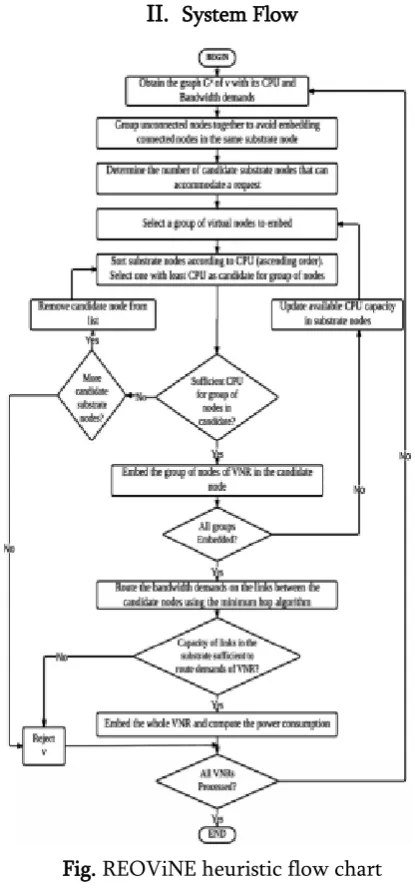
System FlowFig. REOViNE heuristic flow chart
Fig.2. Virtual Network Embedding problem
ALGORITHM
Virtual Networks in IP Over WDM Networks
the digital servers and automated exchange and has of motion of substrate center factors and L is that the sports plan of substrate joins. Every hub or connection within the substrate organize is recognized with its personal unique asset trends. The VNR v is spoken to via the chart G^V = (R^v, L^v)anyplace R^v is that the arrangement of digital hubs and L^v is that the arrangement of digital connections. We have a propensity to delineate anyway requests in a very VNR are mapped onto the substrate set up over unique layers. We plainly indicate anyplace a number of the elements and parameters applied are situated over the layers.
IV.
CONCLUSIONThis paper has inquired about the essentialness energy of advanced framework introducing in IP over WDM frameworks. We developed up a MILP appear (EEVNE) and a heuristic (REOViNE) to enhance using wavelengths within the machine additionally to becoming a member of the utilization of assets in server ranches. The effects show that the EEVNE display achieves the greatest energy saving of 60 mins (standard 20%) regarded differently on the subject of the CostVNE reveal that restrains the transfer speed favorable role of installing a VNR. The EEVNE display has likewise higher power reserve funds contrasted with the digital device installing power conscious (VNE-EA) display from the writing.
We've got shown that after it involves power finances within the machine, it is insufficient to create models that just kill connections and hubs within the system anyway it is crucial to don't forget all the strength devouring devices within the system at that point restriction their power usage all in all. The REOViNE heuristic's electricity funding funds and the number of recounted solicitations approaches the ones of the MILP show.
V.
REFERENCES1. M A. Sharkh, M. Jammal, A. Shami, and A. Ouda, Resource allocation in a network-based cloud computing environment: Design challenges, IEEE Commun. Mag., vol. 51, no. 11, pp. 46–52, 2013. 2. United States Environmental Protection Agency.
Report to Congress on Server and Data Center Elmirghani, Distributed energy efficient clouds over core networks,IEEE J. Lightw. Technol., vol. 32, no. 7, pp. 1261–1281, Jan. 2014.
4. R. Jain and S. Paul, Network virtualization and software defined networking for cloud computing: A survey,IEEE Commun. Mag., vol. 51, no. 11, pp. 24–31, Nov. 2013.
5. A Belbekkouche, M. M. Hasan, and A. Karmouch, discovery and allocation in network virtualization, IEEE Commun. Surveys Tuts., vol. 14, no. 4, pp. 1114–1128, Oct.–Dec. 2012.
6. N. M. M. K. Chowdhury and R. Boutaba, Network virtualization: State of the art and research challenges, IEEE Commun. Mag., vol. 47, no. 7, pp. 20–26, Jul. 2009.
survey, IEEE Commun. Surveys Tuts., vol. 15, no. 4, pp. 1888–1906, Oct.–Dec. 2013.
8. B. Wang, X. Chang, J. Liu, and J. K. Muppala, Reducing power consumption in embedding virtual infrastructures, in Proc. IEEE Globecom Workshops, Dec. 3–7, 2012, pp. 714–718.
9. M Yu, Y. Yi, J. Rexford, and M. Chiang, Rethinking virtual network embedding: Substrate support for path splitting and migration, SIGCOMM Comput. Commun. Rev., vol. 38, no. 2. pp. 17–29, 2008.
10. C. Yang, J. Li, T. Wo, C. Hu, and W. Liu, Resilient virtual network service provision in network virtualization environments, in Proc. 16th Int Conf.Parallel Distrib. Syst., 2010.
11. D. G. Anderson, (2002). Theoretical Approaches to Node Assignment. [Online]. Available: http://repository.cmu.edu/cgi/viewcontent.cgi?art icle = 1079&context = compsci.
12. J.F. Botero, X. Hesselbach, M. Duelli, D. Schlosser, A. Fischer, and H. De Meer, Energy efficient virtual network embedding, IEEE Commun., vol. 16, no. 5, pp. 756–759, May 2012. 13. S. Sen, Z. Zhongbao, C. Xiang, W. Yiwen, L. Yan,
and W. Jie, Energyaware virtual network embedding through consolidation, in Proc. IEEE Comput. Commun. Workshops, 2012, pp. 127– 132.
14. J. F. Botero and X. Hesselbach, Greener networking in a network virtualization environment, Comput. Netw., vol. 57, no. 9, pp. 2021–2039, 2013.