A Study on Expert Sourcing Enterprise Question Collection and Classification
Yuan Luo
1, Thomas Boucher
2, Tolga Oral
3, David Osofsky
3, Sara Weber
3 1MIT CSAIL, 32 Vassar St, Cambridge, MA, 021392UMass CS, 140 Governors Drive, University of Massachusetts, Amherst, MA, 01003 3IBM CIOLab, 1 Rogers St, Cambridge, MA, 02139
E-mail: [email protected], [email protected], {tolga_oral,david_osofsky,sara_weber}@us.ibm.com
Abstract
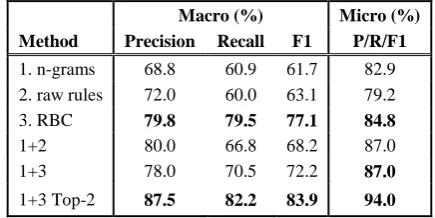
Large enterprises, such as IBM, accumulate petabytes of free-text data within their organizations. To mine this big data, a critical abil-ity is to enable meaningful question answering beyond keywords search. In this paper, we present a study on the characteristics and classification of IBM sales questions. The characteristics are analyzed both semantically and syntactically, from where a question clas-sification guideline evolves. We adopted an enterprise level expert sourcing approach to gather questions, annotate questions based on the guideline and manage the quality of annotations via enhanced inter-annotator agreement analysis. We developed a question feature extraction system and experimented with rule-based, statistical and hybrid question classifiers. We share our annotated corpus of ques-tions and report our experimental results. Statistical classifiers separately based on n-grams and hand-crafted rule features give reasoable macro-f1 scores at 61.7% and 63.1% respectively. Rule based classifier gives a macro-f1 at 77.1%. The hybrid classifier with n-gram and rule features using a second guess model further improves the macro-f1 to 83.9%.
Keywords: question classification, expert sourcing, machine learning
1.
Introduction
Watson Sales Assistant (WSA) is an internal pilot of adapting IBM Watson to help IBM salespeople get an-swers to their questions. In order to leverage its rich ana-lytic components and parallel processing ability to digest petabytes of web repository content, we adapted the Wat-son platform to IBM enterprise content. Among others, adaptation of the question classification model is the first crucial step. Watson was trained on questions that look for named entities given declarative sentences as clues. On the other hand, WSA needs to answer sales questions of great variety, for which we had few existing archives, much less those with answers. We took an expert sourcing approach by inviting IBM Subject Matter Experts (SMEs) within the IBM sales division, whose jobs involve an-swering IBM salespeople's questions, to contribute to the set of questions and answers. The SMEs were asked to provide questions for which they have answers, as the first step in a boot strapping process that would allow us to train a question answering model with the collected cor-pus. To our best knowledge, there are few if any question classification corpora available for enterprise content question answering. To be broadly useful as a shared da-taset, our question classification scheme is designed to be general and does not contain organization specific classes. The sales questions can be interrogative questions with wh-words, or yes/no questions, or even imperative sen-tences. They may ask for a named entity, a description of a product, or reasoning on a fact. Such variety and com-plexity brings several challenges to the collection and classification task of sales questions. This paper describes the approach used to collect, annotate and automatically classify those sales questions.
2.
Related Work
General domain question classification is an area of active research, since the ability to accurately answer a question depends on correct question classification (Hovy et al., 2001). In early TREC question answering tracks, rule-based approaches were typically applied with hand crafted heuristic rules (Voorhees, 1999; Voorhees and Tice, 2000; Voorhees, 2002). In (Hermjakob, 2001), the author aug-mented the rules with both semantic enrichment and an additional Penn Treebank questions. In (X. Li and Roth, 2002), the authors released the UIUC question classifica-tion dataset annotated using a two level taxonomy and classified questions with classes from each level, using the Sparse Network of Winnows (SNoW) algorithm. Many works have since focused on statistical models in-cluding SVM (Hacioglu and Ward, 2003; Solorio et al., 2004), log-linear models (Blunsom et al., 2006), Maxi-mum Entropy models (M. L. Nguyen et al., 2007), kernel methods (Moschitti et al., 2007; Moschitti et al., 2011), among others (Pinto et al., 2002; Zhang and Lee, 2003). Only a few have continued rule-based approach, e.g., (Ray et al., 2010). Besides widely used n-grams, advanced semantic-syntactic features such as parse subtrees have been tested in statistical approaches with both positive results (M. L. Nguyen et al., 2007) and negative results (Moschitti et al., 2011). Most works used the UIUC cor-pus (X. Li and Roth, 2002) with minor variations. We also observed that a straightforward hybrid rule-based and statistical model could be beneficial, but has not yet been extensively investigated in previous studies.
3.
Methods
analyzing the first 600 questions collected. We then start-ed the expert sourcing question collection and classifica-tion approach. With the feedback from annotators, our understanding of the characteristics of sales questions evolved, so did the classification guideline.
3.1
Expert Sourcing Approach for Question
Col-lection
We invited a group of 630 SMEs to participate in the vol-untary effort. Gifts were awarded to drive participation, at the levels of 25 submitted questions and answers (award-ed a cap), 50 (a tumbler), and 100 (a backpack). A total of 165 SMEs contributed questions and answers.
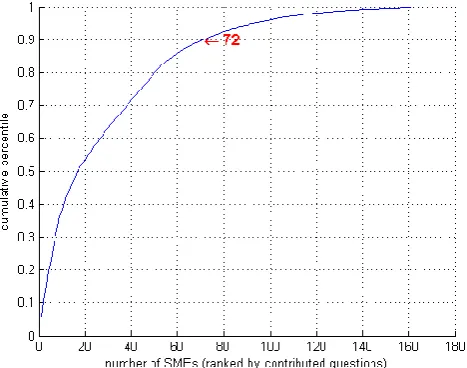
Figure 1 shows that 72 SMEs (44%) contributed 90% of the initial set of questions and answers (the most produc-tive participant contributing 5%). We tracked and pub-lished participation record to improve the quality of the questions and answers, as users' reputations were at stake.
Figure 1: Cumulative Contribution by SMEs. The SMEs are ranked in descending order on number of questions contributed.
Figure 2 shows the question collection UI, integrated with the answering system. SMEs are asked to enter questions that might be asked by other salespeople and give the an-swers in the “Provide your own answer” textbox. In the textbox below, SMEs could optionally provide evidence URLs that are sources of their answers. During question analysis, the optionally provided evidence URLs were used to verify the correctness of the answers and also al-lowed discovery of new content sources to be included in the system. The phase 1 expert sourcing effort ran over a three month period and collected 3602 questions in total.
3.2
Question Classification along Semantic and
Syntactic Axes
Following (Hovy et al., 2002; Garcia-Fernandez et al., 2010), we also take into account questions’ syntactic
characteristics in addition to what the questions are asking for (semantic). As enterprise repository is a different con-tent from general web concon-tent, we built our classification scheme in a bottom-up and data-driven fashion, keeping in mind the implication on answer generation and ranking. Our semantic component shares some classes with the UIUC dataset, but also has noticeable differences. For example, we have no classes of “food”, “animal” etc. On the other hand, our “approach” and “info” classes are heavily populated.
Currently 3602 questions have been manually classified with the following semantic categories: {named entity, degree, location, info, time, fact, definition, approach, reason, relation, difference}. Most categories are self-explanatory. The “info” questions ask for a URL or a ref-erence. The “degree” questions ask for a numeric answer, or abstract degrees. The “named entity” questions ask for named entities other than “degree”, “location”, “info” and “time”. If a question cannot be otherwise labeled, it is labeled as asking about a “fact”.
Figure 2: Question and answer collection tool UI, inte-grated with the WSA answering system.
Questions of the same semantic categories may be found in different syntactic constructs, which we identified as: {who, what, which, when, where, how, polar, declarative, imperative}.
We define a question class as the combination of its se-mantic category and its syntactic construct1. Examples:
a. [named entity/what] What is IBM’s Smarter Cities offering?
b. [definition/what] What is an application server? c. [fact/what] What are the benefits of IBM Cognos
64-bit?
d. [time/when] When will IBM deliver CloudBurst 2.1? e. [time/what] What is the target delivery date for IBM
WebSphere 9.0?
f. [approach/how] How do I install IBM Smarter Ana-lytics on Red Hat?
1
g. [approach/what] What is the easiest way to install PureApplication System on Red Hat?
h. [approach/polar] Can I install InfoSphere Replication Server on Red Hat?
i. [approach/declarative] My client wants instructions for installing ISDM on Red Hat.
j. [approach/imperative] Tell me how to install Lotus Notes on Red Hat.
Semantic classes directly affect downstream steps in the question answering workflow. On the other hand, the syn-tactic class can also be useful for answer generation and scoring. For example, “time/what” questions may prefer a time format (e.g., what year, what month, or what date) while “time/when” questions generally do not have such restrictions. Another more involved example concerns an existing Watson answer evidence scorer that replaces the focus2 of the question with candidate answers and then computes a matching score between the modified question text and relevant sentence returned from search. This scorer is directly applicable to “degree/what” while not directly applicable to “degree/how” as the latter often do not have a nominal focus. The recognition of the syntactic construct is nontrivial for computers, especially for sen-tences with complex clauses. Thus human annotations for training the classifier are necessary.
We also found that it is easier for human annotators to first look for a question’s syntactic class then determine semantic classes, since making annotators first classify syntactic construct (easier step) prunes the options for semantic goals (harder step). We point out that our classi-fication has the flexibility to be folded to the semantic-only classification by dropping the syntactic component, if that is determined to be more appropriate.
3.3
Expert Sourcing Classification and
Enhanc-ed Inter-Annotator Agreement
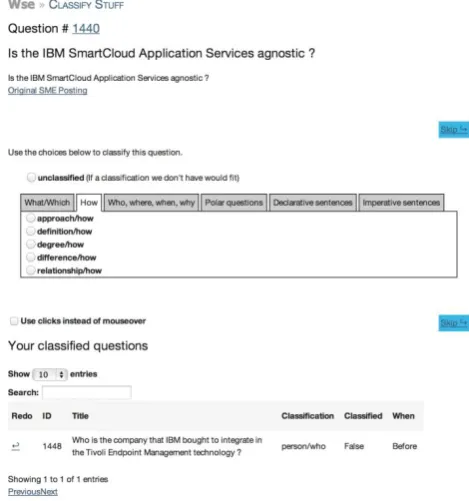
The collected questions were classified by twelve annota-tors who were members of the WSA adaptation team. We developed a classification annotation tool, which presents each question along with candidate question classes orga-nized by their syntactic constructs. In Figure 3, each tab includes a list of possible question classes associated with certain syntactic construct. We supplied a classification guideline3 with a description and examples of each ques-tion class.
A key feature of the annotation tool is the randomization of questions. By default, questions exported from the question answering tool tend to be grouped by the SME who often generates a series of questions. Randomization prevents a single annotator who might have difficulty
2 In Watson terminology, focus is the part of a question that is a reference to a named entity answer. For example, “what” is the focus in “What is the maximum memory capacity for a single node x3850 X5 server?” Note that focus is by definition nomi-nal.
3
An updated question classification guideline is submitted as supplemental material.
derstanding a particular SME’s questions from operating on a complete series of those questions.
We had group training and practice sessions for question classification, but classification of the 3602 questions us-ing the annotation tool was performed individually. The tool enforces independent classification by preventing annotators from viewing classifications from others. If the first two classifications of a question match, the tool deems classification of that question complete and re-moves it from the queue of unclassified questions. Be-cause questions are assigned to two of twelve annotators
randomly, there are ( ) combinations of
annota-tors that are involved in initial inter-annotator agreement run.
If the first two annotators’ classifications of a question do not agree, the question remains in the unclassified queue. The tool only removes a question from the queue when at least 70% of the classifications for that question agree. This enhanced inter-annotator agreement guarantees a high level of annotation confidence. For example, if two annotators disagree on a classification, a third annotator alone cannot break the tie.
Figure 3: Classification Tool UI. Syntactic classes are grouped into tabs to balance the list length of the associat-ed semantic classes.
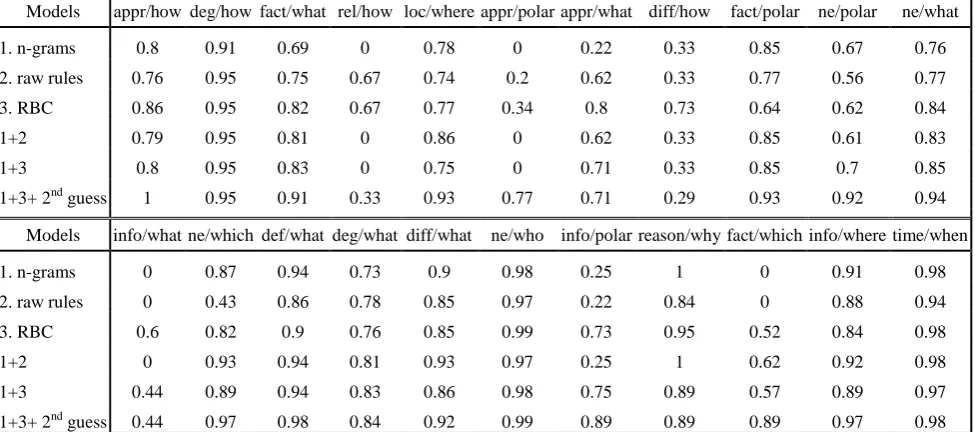
Models appr/how deg/how fact/what rel/how loc/where appr/polar appr/what diff/how fact/polar ne/polar ne/what
1. n-grams 0.8 0.91 0.69 0 0.78 0 0.22 0.33 0.85 0.67 0.76
2. raw rules 0.76 0.95 0.75 0.67 0.74 0.2 0.62 0.33 0.77 0.56 0.77
3. RBC 0.86 0.95 0.82 0.67 0.77 0.34 0.8 0.73 0.64 0.62 0.84
1+2 0.79 0.95 0.81 0 0.86 0 0.62 0.33 0.85 0.61 0.83
1+3 0.8 0.95 0.83 0 0.75 0 0.71 0.33 0.85 0.7 0.85
1+3+ 2nd guess 1 0.95 0.91 0.33 0.93 0.77 0.71 0.29 0.93 0.92 0.94 Models info/what ne/which def/what deg/what diff/what ne/who info/polar reason/why fact/which info/where time/when
1. n-grams 0 0.87 0.94 0.73 0.9 0.98 0.25 1 0 0.91 0.98
2. raw rules 0 0.43 0.86 0.78 0.85 0.97 0.22 0.84 0 0.88 0.94
3. RBC 0.6 0.82 0.9 0.76 0.85 0.99 0.73 0.95 0.52 0.84 0.98
1+2 0 0.93 0.94 0.81 0.93 0.97 0.25 1 0.62 0.92 0.98
1+3 0.44 0.89 0.94 0.83 0.86 0.98 0.75 0.89 0.57 0.89 0.97
1+3+ 2nd guess 0.44 0.97 0.98 0.84 0.92 0.99 0.89 0.89 0.89 0.97 0.98
Table 3: The per-class f-measures of different models on test set. Classes are in the form of semantic/syntactic classifica-tion, as defined in section 3.2. Abbreviations used in the table: approach (appr), relation (rel), location (loc), difference (diff), named entity (ne), definition (def), degree (deg).
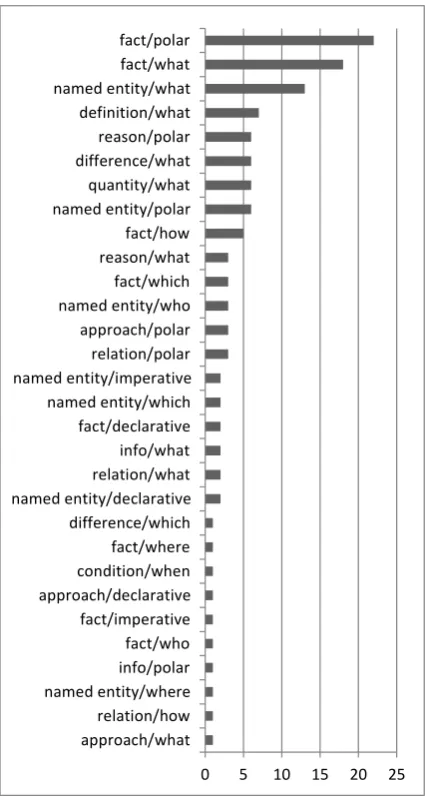
The fact that questions are collected from SMEs may bias the corpus toward questions that already have answers and may not reflect the questions from all salespeople. We are expanding the question collection by opening the question collection UI to the rest of salespeople even if they do not have an answer. We are continuing to collect and annotate more questions and expect to release a larg-er data set with more populated question classes. We also monitored the ratio of under-populated classes to guide possible merging (current frequency threshold 10, adjust-able).
Evaluation with multiple rule-based and statistical classi-fiers showed that automated approach for classifying enterprise questions can achieve promising results and that hand crafted rules integrating syntactic, semantic and morphologic features do help. Including second guess improved the performance of the system significantly. When the top five predicted classes were included in the model, the performance increased to near perfection. This indicates that a feed-forward neural network or a deep learning architecture may perform well without a second guess model. We intend to evaluate these types of models in the future.
6.
Acknowledgments
We would like to acknowledge the team of research sci-entists, engineers, and designers at IBM for their work to influence and develop extensions of Watson and the DeepQA architecture for enterprise use. It is this team who has made it possible for the work described in this paper. From IBM, Daniel Rucci, Alexander Rock, Meg-gan Todd, Desmond Wang, Dave Newbold, Edward Geraghty, Marita Beck, Beth Shiffman, Rob Johnson, Francoise Legoues.
7.
References
Blunsom, P., Kocik, K. and Curran, J.R., (2006). Question classification with log-linear models. In
Proceedings of the 29th annual international ACM SIGIR conference on Research and development in information retrieval. ACM, pp. 615–616.
Fellbaum, C., (1998). WordNet: An Electronic Lexical Database, Mit Press.
Fleiss, J.L., (1981). Statistical Methods for Rates and Proportions, Wiley.
Garcia-Fernandez, A., Rosset, S. and Vilnat, A., (2010). MACAQ: A Multi Annotated Corpus to Study how we Adapt Answers to Various Questions. In LREC. pp. 3559–3565.
Hacioglu, K. and Ward, W., (2003). Question classification with support vector machines and error correcting codes. In Proceedings of the 2003 Conference of the North American Chapter of the Association for Computational Linguistics on Human Language Technology: companion volume of the Proceedings of HLT-NAACL 2003–short papers-Volume 2. Association for Computational Linguistics, pp. 28–30.
Hermjakob, U., (2001). Parsing and question classification for question answering. In Proceedings of the workshop on Open-domain question answering-Volume 12. Association for Computational Linguistics, pp. 1–6.
technology research. Association for Computational Linguistics, pp. 1–7.
Hovy, E., Hermjakob, U. and Ravichandran, D., (2002). A question/answer typology with surface text patterns. In Proceedings of the second international conference on Human Language Technology Research. Morgan Kaufmann Publishers Inc., pp. 247–251.
Li, X. and Roth, D., (2002). Learning question classifiers. In Proceedings of the 19th international conference on Computational linguistics-Volume 1. Association for Computational Linguistics, pp. 1–7.
McCord, M.C., (2010). Using Slot Grammar. IBM Technical Report.
Moschitti, A., Chu-Carroll, J., Patwardhan, S., Fan, J. and Riccardi, G., (2011). Using syntactic and semantic structural kernels for classifying definition questions in Jeopardy! In Proceedings of the Conference on Empirical Methods in Natural Language Processing. Association for Computational Linguistics, pp. 712– 724.
Moschitti, A., Quarteroni, S., Basili, R. and Manandhar, S., (2007). Exploiting syntactic and shallow semantic kernels for question answer classification. In
ANNUAL MEETING-ASSOCIATION FOR
COMPUTATIONAL LINGUISTICS. pp. 776–783. Murdock, J. and Welty, C., (2006). Obtaining Formal
Knowledge from Informal Text Analysis. IBM Technical Report.
Ng, A.Y., (2004). Feature selection, L 1 vs. L 2 regularization, and rotational invariance. In
Proceedings of the twenty-first international conference on Machine learning. ACM, pp. 78–85. Nguyen, M.L., Nguyen, T.T. and Shimazu, A., (2007).
Subtree mining for question classification problem. In Proceedings of the 20th international joint
conference on Artifical intelligence. Morgan Kaufmann Publishers Inc., pp. 1695–1700.
Noreen, E.W., (1989). Computer-intensive methods for testing hypotheses: an introduction, Wiley.
Pinto, D. et al., (2002). QuASM: a system for question answering using semi-structured data. In
Proceedings of the 2nd ACM/IEEE-CS joint conference on Digital libraries. ACM, pp. 46–55. Ray, S.K., Singh, S. and Joshi, B., (2010). A semantic
approach for question classification using WordNet and Wikipedia. Pattern Recognition Letters, 31, pp.1935–1943.
Solorio, T., Pérez-Coutino, M., Montes-y-Gémez, M., Villasenor-Pineda, L. and López-López, A., (2004). A language independent method for question classification. In Proceedings of the 20th international conference on Computational Linguistics. Association for Computational Linguistics, pp. 1374–1380.
Suchanek, F.M., Kasneci, G. and Weikum, G., (2007). Yago: a core of semantic knowledge. In Proceedings of the 16th international conference on World Wide Web. ACM, pp. 697–706.
Voorhees, E.M., (2002). Overview of the TREC 2001 question answering track. NIST special publication, pp.42–51.
Voorhees, E.M., (1999). The TREC-8 question answering track report. In Proceedings of TREC. pp. 77–82.
Voorhees, E.M. and Tice, D., (2000). Overview of the TREC-9 question answering track. In Proceedings of TREC. pp. 71–80.