Discourse Structures
to Reduce Discourse Incoherence
in Blog Summarization
Shamima Mithun Concordia University
Computer Science & Software Eng. Montreal, Canada
Leila Kosseim Concordia University
Computer Science & Software Eng. Montreal, Canada
Abstract
Discourse incoherence is an important and typical problem with multi-document ex-tractive summaries. To address this issue, we have developed a schema-based sum-marization approach for query-based blog summaries that utilizes discourse struc-tures. In our schema design, we tried to model discourse structures which are typ-ically used by humans in their summary writing in response to a particular question type. In our approach, a sentence instan-tiates a specific slot of the schema based on its discourse structures. To validate our approach, we have built a system named BlogSum and have evaluated its perfor-mance through 4 human participants using a likert scale of 1 to 5. The evaluation re-sults show that our approach has signifi-cantly improved summary coherence com-pared to the summaries with no discourse structuring without compromising on con-tent evaluation.
1 Introduction
Research on text summarization dates back since the 1950s and with the growth of the Internet it has become a popular research topic in last decade. Text summarization reduces text search time by providing the most relevant information from the documents which enables users to comprehend more quickly the main ideas of a set of docu-ments. Over time, different summarization tech-niques have been developed and evaluated. Al-though significant improvement continues to be made, the summaries generated automatically are by no means of the same quality as their human created counter parts. The area in which auto-matic summaries differ most from human gener-ated summaries is text coherence (Otterbacher et
al., 2002; Conroy and Dang, 2008; Genest et al., 2009).
Coherence problems can be the result of dif-ferent phenomena: discourse incoherence, redun-dancy, temporal incoherence, grammatical mis-takes or many other linguistic problems. In a man-ual analysis of 15 summaries, (Otterbacher et al., 2002) showed that coherence problems are caused mostly by discourse incoherence (34%) where the main concern is the lack of relations between sen-tences as well as in the overall summary.
Recently, (Genest et al., 2009) demonstrated that the performance of automatic summarizers in term of linguistic quality is significantly weaker compared to that of a baseline consisting of sen-tences extracted from the source documents by 5 human extractors and added to the summary with-out any modification. This result indicates that there is still much space to improve coherence of summaries even for pure extractive summaries.
1.1 Discourse Incoherence
Computational theories on discourse coherence were introduced by (Hobbs, 1985; Mann, 1988). According to (Mann, 1988), a discourse is coher-ent if the hearer knows the communicative role of each of its portion; that is, if the hearer knows how the speaker intends each clause to relate to each other. As a result, a summary will exhibit dis-course incoherence if the reader cannot identify the communicative intentions of the writer from the clauses or if the clauses do not seem to be in-terrelated.
Consider the following summary (ID:T1001.81) which contains discourse incoherence problems (shown in Figure 1). The summary for the ques-tion is incoherent. Even though all the sentences are relevant to the query, improper sentence order-ing degrades the coherence of this summary. In
ad-1The summary is taken from the TAC 2008 opinion sum-marization track.
dition, sentence 3 contains a pronoun(it)without having an antecedent. One possible better order-ing for this summary would be 4-3-1-2 or 4-3-2-1.
Figure 1: A Sample Summary
Topic:Carmax
Question:What motivated positive opinions of Carmax from car buyers?
Summary:
(1) It’s like going to disney world for car buyers. (2) have to say that Carmax rocks.
(3) We bought it at Carmax, and I continue to have nothing bad to say about that company. (4) After our last big car milestone, we’ve had an odyssey with cars.
A summary with poor coherence confuses the readers and degrades the quality and readability of the summary. The proper sentence order sig-nificantly improves the readability of summaries. (Lapata, 2003) experimentally showed that the time to read a summary strongly correlates with the arrangement of sentences.
1.2 State of the Art
Currently, most of the automatic summarization systems for news articles use an extractive ap-proach. In general, this approach works in two steps: in the first step, the most salient sentences are extracted from the source documents and in the second step, these sentences are ordered to create a summary. Since in the first step, sen-tences may be selected from multiple documents or without consideration to their interdependency with other sentences this may cause text incoher-ence. Moreover, in multi-document summariza-tion, documents may be written by different writ-ers who have different pwrit-erspectives and writing styles thus exasperating coherence problems. To improve coherence, the second step tries to reorder the selected sentences appropriately.
As part of the sentence ordering, two major types of approaches are used to address coherence: making use of chronological information (McKe-own et al., 2002), and learning the natural order of sentences from large corpora (Barzilay and Lee, 2004; Lapata, 2003). However, in the first case, if the source documents are not event-based, the quality of the summaries will be degraded because temporal cues are missing. In the later case, prob-abilistic models of text structures are trained on a large corpus. If the genre of the corpus and the
source documents mismatch then they will per-form poorly.
Summarization for opinionated text is a recent endeavor. Query-based blog summarization ap-proaches have been first developed in the TAC 2008 opinion summarization track. Most of these summarization approaches (e.g. (Murray et al., 2008)) use sentence scores for summary gener-ation. Some of these approaches (e.g. (Kumar and Chatterjee, 2008)) use the sentence order of the original documents to specify the sentence or-der of the summary. Recent work (e.g. (Paul et al., 2010)) on blog summarization also mostly use sentence scores for summary generation. How-ever, these approaches hardly can be effective in coherence improvement. To the best of our knowl-edge, text schemata and discourse relations, found effective in news summarization and question an-swering (Blair-Goldensohn and McKeown, 2006; Sauper and Barzilay, 2009), were never used in blog summarization.
In our research, we try to reduce discourse inco-herence of extractive summaries; and in particular in query-based blog summaries. In this work, we propose a domain independent query-based blog summarization approach to address discourse in-coherence using discourse structures in the frame-work of schemata. To verify our approach we have developed a system called BlogSum and evalu-ated its performance using the Text Analysis Con-ference (TAC 2008) opinion summarization track data2.
2 Discourse Structures to Reduce Discourse Incoherence
In our research, we are interested in query-based blog summarization. Nowadays, because of the rapid growth of the Social Web, a large amount of informal opinionated texts are available on any topic. Query-based opinion summarizers present what people think or feel on a given topic in a condensed manner to analyze others’ opinions re-garding a specific question (e.g.Why do people like Starbucks better than Dunkin Donuts?). This re-search interest motivated us to develop an effective query-based multi-document opinion summariza-tion approach for blogs and we utilize discourse structures in the framework of schema to improve discourse coherence.
2.1 Previous Work on Schemas
(McKeown, 1985) introduced a schema-based ap-proach for text planning based on the observation that certain standard patterns of discourse orga-nization (schema) are more effective to achieve a particular discourse goal. (McKeown, 1985) demonstrated the usability of this schema-based approach for a domain-dependent question an-swering application. In this application, she designed various schemata that incorporate dis-course structures which are typically used in hu-man writing for a specific question type (e.g. iden-tification). In most recent summarization work, (Sauper and Barzilay, 2009) also tried to utilize discourse structures learned from domain rele-vant articles to design schemata (or templates) for structured domains (e.g. Wikipedia pages).
We also believe that for any domain, for a par-ticular type of query, certain types of sentences if organized in a certain order can meet the commu-nicative goal more effectively and create a more coherent text. For example, to take (McKeown, 1985)’s example, to define an entity or event (e.g. what is a ship?) it is natural to first include the identification of the item as a member of a generic class, then to describe the object’s constituency or attributes followed by a specific example and so on. On the other hand, a comparison of two ob-jects should use another combination to be effec-tive and coherent.
2.2 Our Schema-based Approach
In our schema-based approach, the basic units of a schema arerhetorical predicateswhich character-ize the structural purposes of a text and delineate the discourse relations between propositions.
2.2.1 Our Set of Rhetorical Predicates
Six main types of rhetorical predicates which have been found most useful for our blog summariza-tion applicasummariza-tion were considered:
1. Attributive: Provides details about an entity or event. It can be used to illustrate a particu-lar feature about a concept - e.g. Mary has a pink coat.
2. Comparison: Gives a comparison and con-trast among different situations - e.g.Perhaps that’s why for my European taste Starbucks makes great espresso while Dunkin’s stinks.
3. Contingency: Provides cause, condition, rea-son, evidence for a situation, result or claim
- e.g. The meat is good because they slice it right in front of you.
4. Illustration: Is used to provide additional in-formation or detail about a situation - e.g. Al-lied Capital is a closed-end management in-vestment company that will operate as a busi-ness development concern.
5. Attribution: Provides instances of reported speech both direct and indirect which may express feelings, thoughts, or hopes - e.g. I said actually I think Zillow is great.
6. Topic-opinion: Can be used to express an opinion; an agent can express internal feeling or belief towards an object or an event - e.g. The thing that I love about their sandwiches is the bread.
Rhetorical relations characterized by compari-son, illustration, and contingency predicates are also considered by other research groups (e.g. (Carlson, 2001)). We consider three addi-tional classes of predicates attributive, attribu-tion, and topic-opinion. The attributive predi-cate and theattributionpredicate are also listed in Grimes’ predicates (McKeown, 1985) and (Carl-son, 2001)’s relations list, respectively. We intro-ducedTopic-opinionpredicates to represent opin-ions which are not expressed by reported speech.
2.2.2 Schemata Design
In our schema-based approach, sentences need to be classified and organized based on what rhetor-ical predicates they contain. We designed and as-sociated appropriate schemata (e.g. compare and contrast) to generate a summary that answers spe-cific types of questions (e.g. comparison, sugges-tion) by defining constraints on the types of pred-icates (e.g.comparison,attribution) and the order in which they should appear in the output sum-mary for a particular question type. In our ap-proach, schemata help to ensure the global coher-ence of the summary.
Topic-opinion or Attribution predicates followed by zero or many Illustration predicates can be used3.
Figure 2: A Sample Schema
Predicates & Constraints
Predicate:{Comparison/Contingency}+ Constraint: Compared objects,
Sentence focus
Predicate:{Topic-opinion/Attribution}∗ Constraint: Sentence polarity
Predicate:Illustration∗
From Figure 2, we can see that constraints are also defined on predicates based on their seman-tic content. In the example, theComparison and Contingencypredicates must contain all objects or events which are being compared and the topic4of the sentence needs to be the focus of the sentence; andTopic-opinionandAttributionpredicates must have the same polarity as the question. In order to answer a different type of questions, a differ-ent schema would be more appropriate. In this ap-proach, schemata will help to improve coherence by specifying a higher level text organization by constraining the order of the predicates.
3 BlogSum
In order to test our approach, we have built a sys-tem called BlogSum. Given an initial question on a particular topic and a set of related blogs, Blog-Sum performs sentence selection then content or-ganization.
3.1 Content Organization
The content organization requires as input a ranked list of sentences from the document set. In our test, we have developed our own sentence extractor based on question similarity, topic simi-larity, and subjectivity scores. However, any other sentence ranker could have been used. The role of content organization is to select a few sentences from the candidate sentences and order them so as to produce a coherent and query relevant sum-mary. For content organization, BlogSum per-forms the following tasks: A) Question Catego-rization, B) Schema Selection, C) Predicate Iden-tification, and D) Sentence Selection and Order-ing.
3
Following (McKeown, 1985)’s notations, the symbol / indicates an alternative,*indicates that the item may appear 0 to n times,+indicates that the item may appear 1 to n times. 4Text specified in the Target in the TAC 2008 task data.
3.1.1 Question Categorization
Our content organization approach first catego-rizes questions to determine which schema will better convey the expected communicative goal of the answer for a particular question type and should be used for text planning.
By analyzing the TAC 2008 opinion summa-rization track questions manually, we have identi-fied 3 categories of questions based on their com-municative goals, namely: comparison, sugges-tion, andreason.
1.Comparisonquestions ask about the differences between objects - e.g. Why do people like Star-bucks better than Dunkin Donuts?
2. Suggestion questions ask for suggestions to solve some problems - e.g.What do Canadian po-litical parties want to happen regarding NAFTA? 3. Reason questions ask for reasons for some claim - e.g.Why do people like Mythbusters?
To automatically identify a unseen question into one of these 3 categories, we have designed lexi-cal patterns by analyzing the same set of questions which we used to identify question categories.
3.1.2 Schema Selection
Based on the observation that for a particular ques-tion type, sentences need to be organized in a spe-cific order to be coherent, we have designed three schemata, one for each question type, 1) compari-son, 2)suggestion, and 3)reason. To design these schemata, we have analyzed 50 summaries gen-erated by participating systems at the TAC 2008 opinion summarization track. From our analysis, we have derived which question types should con-tain which type of predicates. Each schema is de-signed based on giving priority to its associated question type and subjective sentences as we are generating summaries for opinionated texts. For each type of schema, we have also defined con-straints on the predicates based on their semantic content to improve the question relevance. As part of the schema selection, BlogSum selects the as-sociated schema for a specific question category to select and order sentences for the final summary.
3.1.3 Predicate Identification
In our approach, candidate sentences need to be classified into a predefined set of rhetorical pred-icates to fill the various slots of the matched schema - we called this process predicate identi-fication.
In (Mithun and Kosseim, 2011), we have in-troduced a domain independent approach to iden-tify which rhetorical predicates are conveyed by a sentence. As specified in (Mithun and Kosseim, 2011), predicates can describe a single proposi-tion or the relaproposi-tion between proposiproposi-tions. To iden-tify the predicates between propositions - e.g. ev-idence, we have used the SPADE discourse parser (Soricut and Marcu, 2003). On the other hand, in order to identify predicates within a single propo-sition - e.g. attributive, we have used three other taggers: comparison (Jindal and Liu, 2006), topic-opinion (Fei et al., 2008), and our attributive tag-ger (Mithun and Kosseim, 2011). By combining these approaches, a sentence is tagged with all possible predicates that it may contain and ready to be used in a schema.
3.1.4 Sentence Selection and Ordering
In BlogSum, sentence selection and ordering is ac-complished in the following manner:
First, candidate sentences fill particular slots in the selected schema based on which rhetorical predicate they convey and whether they fulfil the semantic constraints. This process is performed for each candidate sentence based on their extrac-tion score until the maximum summary length is reached. Since the use of schemata alone is not sufficient to achieve a total order; for example there may be several sentences that can fill a par-ticular slot of a selected schema, we have used post-schemata heuristics to improve this partial or-der and coherence. These heuristics include: topi-cal similarity, explicit discourse markers, and con-text. At the end of the sentence ordering process, to create a total order, we finally use the rank of the sentences in the original list of candidates. Let us now describe the post-schemata heuristics.
1. Topical Similarity: In the schema for a par-ticular predicate type (e.g. contingency), we tried to use topical similarity in order to group sentences that describe the same topic together. To find topically similar sentences we used the cosine similarity usingtf.idf.
2. Explicit Discourse Markers: To further im-prove discourse coherence, we add conjunc-tive markers based on the sentences’ topical similarity and polarity value. For example, if two sentences are topically similar, our ap-proach will place them next to each other and make a single sentence out of them using a conjunctive marker (e.g. and) even though these sentences may not adjacent in the can-didate list. If BlogSum finds another sentence on this topic, it will position that sentence to-gether using another conjunctive marker.
3. Context: To improve discourse coherence further, if a potential sentence starts with a pronoun without having a potential an-tecedent, we include its previous sentence from the source document as a context from the original document.
3.1.5 An Example to Describe Content Organization
To illustrate the content organization process, let us take the following example:
Question: What motivated positive opinions of Carmax from car buyers?
Figure 3: Partial Candidate List
(1) With Carmax you will generally always pay more than from going to a good used car dealer.
(2) We bought it at Carmax, and I continue to have nothing bad to say about that company.
(3) Carmax did split the bill which made me happy.
(4) Not sure if you have a Carmax near you, but I’ve had 2 good buying experiences from them.
(5) have to say that Carmax rocks. (6) At Carmax, the price is the price and when you want a car you go get one. (7) Sometimes I wonder why all businesses can’t be like Carmax.
(8) Arthur Smith, 36, has been living in a van outside the CarMax lot, 24 hours a day, for more than a month.
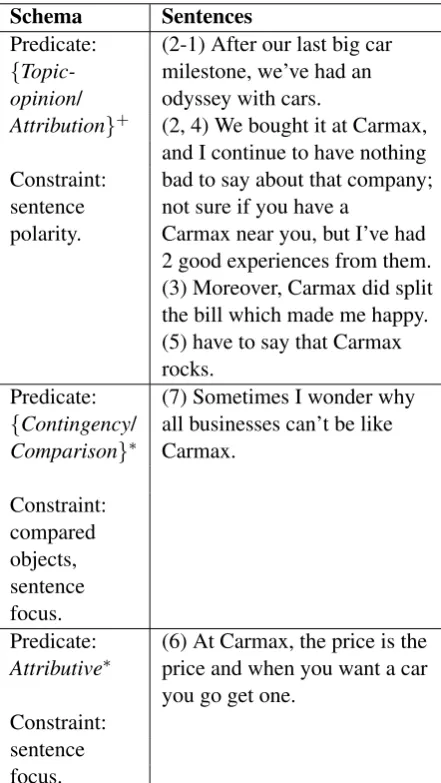
is used to order the sentences. TheReasonschema and the final order of the sentences are shown in Figure 4. In Figure 4, the constraints “sentence polarity”, “compared objects”, and “sentence fo-cus” indicate that the sentence needs to have the same polarity as the question, the sentence needs to contain all objects which are being compared, and the topic of the sentence needs to be the focus of the sentence, respectively.
Figure 4: Summary Generated using the Reason Schema
Schema Sentences
Predicate: (2-1) After our last big car {Topic- milestone, we’ve had an opinion/ odyssey with cars.
Attribution}+ (2, 4) We bought it at Carmax, and I continue to have nothing Constraint: bad to say about that company; sentence not sure if you have a
polarity. Carmax near you, but I’ve had 2 good experiences from them. (3) Moreover, Carmax did split the bill which made me happy. (5) have to say that Carmax rocks.
Predicate: (7) Sometimes I wonder why {Contingency/ all businesses can’t be like Comparison}∗ Carmax.
Constraint: compared objects, sentence focus.
Predicate: (6) At Carmax, the price is the Attributive∗ price and when you want a car
you go get one. Constraint:
sentence focus.
In this sample, we can see that the schema did not include sentences 1 and 8 in the final summary even though the summary is within the length limit. This is because these sentences did not fit within theReasonschema. Though sentence 1 was classified as containing a comparison predicate, it did not fulfil the semantic constraint (shown in Figure 4) that the topic of the sentence (Carmax) be the focus of the sentence5. On the other hand,
5To identify this, we test if the subject or object of the
sentence 8 was not included, because it did not contain any of the rhetorical predicate which can fill the slots of this schema.
We can see that since for the sentence 2, the an-tecedent of the pronounit is missing, our context heuristic added the preceding sentence 2-1 of sen-tence 2 from the source document. Our approach placed sentences 2 and 4 next to each other be-cause of their topical similarity and also merged them using the conjunctive marker ‘;’. We can also see that the system added the discourse marker “Moreover” in sentence 3. In the summary, sen-tences 6 and 7 are also reordered compared to the candidate list based on the rhetorical predicate cat-egory they contained.
4 Evaluation
In order to test our approach, we have evaluated BlogSum-generated summaries for coherence and overall readability.
4.1 Corpus and Experimental Design
In this evaluation, we have used the TAC 2008 opinion summarization track data. The data set consists of 50 questions on 28 topics; on each topic one or two questions are asked and 10 to 50 relevant documents are given. For each question, one summary was generated by OList and one by BlogSum and the maximum summary length was restricted to 250 words. To evaluate coherence, we did not use the ROUGE metric because from a manual analysis (Blair-Goldensohn and McK-eown, 2006) found that the ordering of content within the summaries is an aspect which is not evaluated by ROUGE. Instead, 4 participants man-ually rated 50 summaries from OList and 50 sum-maries from BlogSum for coherence with respect to the question for which the summary is gener-ated using a blind evaluation. These summaries were rated on a likert scale of 1 to 5 where 1 refers to “very poor” and 5 refers to “very good”. As a baseline, we used the original ranked list of candi-date sentences (OList), and we compared it to the final summaries which are generated by BlogSum after applying the discourse structuring.
4.2 Results
In the evaluation, to calculate the score of Blog-Sum and OList for a particular question, we cal-culated the average scores of all annotators’ rat-ings to that question. Table 1 shows the perfor-mance comparison between BlogSum and OList.
We can see that 52% of the time BlogSum sum-maries were rated better than OList sumsum-maries; 30% of the time both performed equally; and 18% of the time BlogSum was weaker than OList. This means that 52% of the time, our approach has im-proved the coherence compared to that of the orig-inal candidate list (OList).
Table 1: Summary of the Comparison
Comparison %
BlogSum Score>OList Score 52% BlogSum Score = OList Score 30% BlogSum Score<OList Score 18%
Table 2 shows the performance of BlogSum ver-sus OList on each likert scale; where∆shows the performance difference. From Table 2, we can see that BlogSum outperformed OList in the scale of “very good” and “good” by 16% and 8%, respec-tively; and improved the performance in “barely acceptable” and “poor” categories by 12% and 14%, respectively.
Table 2: Performance of BlogSum vs. OList
Category OList BlogSum ∆
Very Good 8% 24% 16%
Good 22% 30% 8%
Barely Acceptable 36% 24% -12%
Poor 22% 8% -14%
Very Poor 12% 14% 2%
We have also evaluated if the difference in per-formance between BlogSum and OList was statis-tically significant using thet-test. Thet-test results show that in a two-tailed test, BlogSum performed significantly better than OList with a p-value of 0.0223.
In this experiment, we also calculated the inter-annotator agreement using Cohen’s kappa coeffi-cient to verify the annotation subjectivity. We have found that the average pair-wise inter-annotator agreement is substantial with the kappa-value of 0.76.
4.3 Error Analysis
From the evaluation results of Table 2, we can see that about 54% of the time the coherence of BlogSum is categorized as “very good” or “good”; about 24% of the time “barely acceptable”; but still, about 22% of the time the summaries were considered “poor” or “very poor”. From an er-ror analysis, we have found that many of the sum-maries are ranked in the lower categories because
of their question irrelevance, an incorrect polar-ity identification or a predicate tagging error. Al-though the annotators were asked to evaluate co-herence only, they found it difficult to abstract all other factors and assign a high score to a coherent text that did not answer the question properly.
The evaluation results of Table 1 show that 52% of the time our approach has improved the coherence over the original candidate list (OList). However, in 18% of the time (9 summaries), our approach was weaker than OList. We have analyzed these 9 summaries and found that in 4 cases, some sentences were tagged with the wrong polarity; as a result when the post-schemata heuristics were applied (e.g. conjunctive marker) they made the summaries weaker. In 3 cases, sentences were tagged with the wrong predicates thus they were included in the final summaries yet they should not have and in 2 other cases, BlogSum excluded sentences which were actually potential sentences again because of a wrong polarity identification and predicate tagging.
In order to determine if the improvement in coherence was done at the expense of content, we evaluated this aspect by using the TAC 2008 opinion summarization track data and the ROUGE metric using answer nuggets (provided by TAC), which had been created to evaluate participants’ summaries at TAC, as gold standard summaries. In this evaluation, we compared original candi-date list (OList) to BlogSum-generated final sum-maries. The ROUGE scores are also calculated for all 36 submissions in the TAC 2008 opinion sum-marization track. In this experiment, BlogSum achieved a better F-Measure for ROUGE-2 and ROUGE-SU4 compared to OList. Results show that BlogSum gained 18% and 16% in F-Measure over OList using ROUGE-2 and ROUGE-SU4, re-spectively. Compared to the other systems, Blog-Sum ranked third and its F-Measure score differ-ence from the best system is very small. Both BlogSum and OList performed better than the av-erage systems.
5 Conclusion and Future Work
query-based blog summarization system called BlogSum to validate our approach. The performance of BlogSum was evaluated manually using the TAC 2008 question answering track data by 4 human participants in a likert scale of 1 to 5. The results indicate that about 54% of the summaries are rated as “very good” or “good” as opposed to 30% for the summaries with no discourse structuring. The evaluation results also show that our approach has significantly improved summary coherence com-pared to that of the original candidate list without compromising on content.
An error analysis following the human evalua-tion has shown that an important source of error in low ranking summaries is question irrelevance. As a result, we plan to test our content organiza-tion strategies with a better initial candidate list. In the future, we also plan to evaluate the individual contribution of the post-schemata heuristics to the overall coherence of the summaries.
Acknowledgement
The authors would like to thank the anonymous referees for their comments on a previous version of the paper.
This work was financially supported by NSERC.
References
Barzilay, R., Lee, L.: Catching the Drift: Probabilis-tic Content Models, with Applications to Generation and Summarization.In Proceedings of HLT-NAACL, 113–120 (2004), Boston, USA.
Blair-Goldensohn, S., McKeown, K.R.: Integrating Rhetorical-Semantic Relation Models for Query-Focused Summarization.In Proceedings of the Doc-ument Understanding Conference (DUC) Workshop at NAACL-HLT, (2006), New York, USA.
Carlson, L., Marcu, D.: Discourse Tagging Reference Manual. University of Southern California Informa-tion Sciences Institute, ISI-TR-545, 2001.
Conroy, J. M., Dang, H. J.: Mind the Gap: Dangers of Divorcing Evaluations of Summary Content from Linguistic Quality.In Proceedings of the 22nd Inter-national Conference on Computational Linguistics (Coling), 145–152 (2008), Manchester, UK.
Fei, Z., Huang, X., Wu, L.: Mining the Relation be-tween Sentiment Expression and Target Using De-pendency of Words.PACLIC20: Coling 2008: Pro-ceedings of the 20th Pacific Asia Conference on Language, Information and Computation, 257–264 (2008), Wuhan, China.
Genest, P., Lapalme, G., Yousfi-Monod, M: HEX-TAC: the Creation of a Manual Extractive Run.
In Proceedings Text Analysis Conference, (2010), Gaithersburg, USA.
Hobbs, J. R.: On the Coherence and Structure of Dis-course. Center for the Study of Language and Infor-mation, Stanford University, Report No. CSLI-85-37, 1985.
Jaidka, K., Khoo, C. S. G., Na, J.: Imitating Human Literature Review Writing: An Approach to Multi-document Summarization. In Proceedings of the 12th International Conference on Asia-Pacific Dig-ital Libraries, 116–119 (2010), Gold Coast, Aus-tralia.
Jindal, N., Liu, B.: Identifying Comparative Sentences in Text Documents.In Proceedings of ACM SIGIR, 244–251 (2006), Seattle, USA.
Kumar, S., Chatterjee, D.: IIIT Kharagpur at TAC 2008: Statistical Model for Opinion Summarization.
In Proceedings Text Analysis Conference, (2008), Gaithersburg, USA.
Lapata, M.: Probabilistic Text Structuring: Experi-ments with Sentence Ordering.In Proceedings of the Annual Meeting of ACL, 545–552 (2003), Sapporo, Japan.
Mann, W., Thompson S.: Rhetorical Structure Theory : Toward a Functional Theory of Text Organisation.
J. Text, 3(8):234-281, 1988.
Marcu, D.: From Discourse Structures to Text Sum-maries.Proceedings of the ACL’97/EACL’97 Work-shop on Intelligent Scalable Text Summarization, 82–88 (1997), Madrid, Spain.
McKeown, K.R.: Discourse Strategies for Generat-ing Natural-Language Text.J. Artificial Intelligence, 27(1):1–41, 1985.
McKeown, K., Klavans, J., Hatzivassiloglou, V., Barzi-lay, R., Eskin, E.: Towards Multidocument Summa-rization by Reformulation: Progress and prospects.
AAAI/IAAI, 27–36 (2002), Edmonton, Canada. Mithun, S., Kosseim, L.: Comparing Approaches to
Tag Discourse Relations.In Proceedings (1) of CI-CLing, 328–339 (2011), Tokyo, Japan.
Murray, G., Joty, S., Carenini, G., Ng, R.: The Univer-sity of British Columbia at TAC 2008.In Proceed-ings Text Analysis Conference, (2008), Gaithersburg, USA.
Otterbacher, J. C., Radev, D. R., Luo, A.: Revisions that Improve Cohesion in Multi-document Sum-maries: A Preliminary Study.In Proceedings of the Workshop on Automatic Summarization (including DUC 2002), 27–36 (2002), Philadelphia, USA. Paul, M. J., Zhai. C., Girju, R.: Summarizing
con-trastive viewpoints in opinionated text.In Proceed-ings of the 2010 Conference on Empirical Methods in Natural Language Processing, 65–75 (2010). Sauper, C., Barzilay, R.: Automatically Generating
Wikipedia Articles: A Structure-Aware Approach.
In Proceedings of the Joint Conference of ACL and AFNLP, 208–216 (2009), Suntec, Singapore. Soricut, R., Marcu, D.: Sentence Level Discourse