Lexical Semantics-Syntactic Model for Defining and Subcategorizing
Attribute Noun Class
Xiaopeng Bai, Hui Wang
Department of Chinese Studies, National University of Singapore
The Shaw Foundation Building, Block AS7, Level 3, 5 Arts Link, Singapore 117570, Singapore {baixiaopeng, chswh}@nus.edu.sg
Abstract. Either word sense classification or word sense clustering can not avoid this problem: what features people can get from word meaning that can be used as the tools employed for producing word sense ontology. In this paper, we present a lexical
semantic-syntactic model to define and subcategorize a noun class—attribute noun class, by acquiring syntactic behavior and semantic restrictions from corpus. First we introduce
the idea of attribute noun class. Then we describe the model, which is a specific tool providing a practical method to decide whether a word should be located in a specific word sense class or not. Then we apply the model to 15 nouns to show how the model
works, and create a sample taxonomy for the 15 nouns.
Keywords: attribute nouns, word sense classification, syntagmatic features
1.
Attribute Noun and Attribute Noun Class
Concept (refers to either entity or abstract thing) has several characteristics viewed from different aspects. All things have properties: physical, social, etc. see the expressions below: a1 The color of the hat is red.
a2 这人脾气暴躁。(The guy’s temper is irritable.)
“color” in a1 is a physical property of hat. “脾气(temper)” in a2 is a psychological property of people.
Attribute noun class (as ANC below) refers to such characteristics/properties of things (like “color” of hat and “脾气(temper)” of “人(man)”above). The noun is called attribute noun if it can be classified into ANC. The “attribute” presents the incomplete information—it is supposed to combine with other words to make an integrated expression, in other words, the attribute noun “looks forward to” collocating with words which can specify its meaning. In a1, “red” specify the meaning of attribute noun “color”; in a2, “暴躁(irritable)” specify the meaning of attribute noun “脾气(temper)”
2.
The syntactic and semantic features of attribute noun
Therefore, we have the syntactic behavior of ANC by studying its lexical meaning. F1. The attribute noun can not be the isolate subject in SP.
F2. The attribute noun can not be the attributive in AH.
We will use F1 and F2 to determine whether a noun is an attribute noun or not in the section below. Worth to mention that: 1) the rules of F1 and F2 is not black or white rule, the syntactic features
occur with very big probability; 2) when we test whether a noun is an attribute one, the F1 and F2 should be applied in sentence level, i.e. if a noun is an isolate subject or attributive, the SP or AH must
be semantically understandable as a sentence.
2.2 Semantic features of ANC
The ANC is a big word sense class and its meaning is general concept, thus we need to divide ANC
into small sense classes in terms of more specific meaning. We use the semantic features to subcategorize ANC which are the semantic constrains between attribute noun and the collocate words
in SP, VO and AH.
The selectional restrictions can be learned by studying the meaning of attribute noun and it’s collocate words in AH, SP and VO.
2.2.1 Attribute Noun Used as Subject in SP
Predicate tells something about the subject. In SP, predicate is the value of attribute noun. Attribute
nouns with different meanings calls for predicates that with different concept. Thus, we can assign an attribute noun to more specific ANC class in terms of the meanings of predicate collocated with.
2.2.2 Attribute noun as object in VO
Attribute noun is object in VO, which is one of the arguments of verb. Object semantically matches with verb as other types of arguments. For example, for the attribute noun “外貌”, it can collocate with
verb with the meaning of “watch” like “看” in VO (看/v 他 的 外貌/o, watch his appearance); while for the attribute noun “性格”, the verb should be with the meaning of “mental action” like “了解” (了
解/v 他 性格/o, know his temperament). Different attribute nouns “tend to” collocate with different
verbs.
2.2.2 Attribute noun as head in AH
The function of attributive in AH is specifying the head. There are two meanings of attribute: 1) the value of attribute (昂贵/a 的 价格/h, high price) which semantically resembles the predicate in 2.2.1; 2) the host which semantically possess the attribute (书/a 的 价格/h, price of the book). Thus the meanings of host of attribute and attribute, as well as attribute value and attribute should match each other.
The attribute nouns can be assigned to more specific ANC classes in terms of the meanings of words with which the attribute nouns collocate in SP, VO and AH. Thus the selectional restrictions in three grammatical relations can be used as subcategorization criterion for ANC.
3.
The lexical semantic-syntactic model for defining and subcategorizing
attribute noun
Define AN
{
syn_behvior;
sr_SP;
sr_VO;
sr_AH;
}
AttrDef(AN noun)
{
if(Be_Attr(noun, AH)==false||Be_IsoSub(noun, SP)==false)
Subcat_AN(noun);
else
printf(“the noun is not an attribute noun”);
}
Subcat_AN(noun)
{
while(sentence[i])
features=get_syn_features(noun, sentence[i]);
noun=SR(noun, features, AH)
store the result in AN;
noun=SR(noun, features, VO);
store the result in AN;
noun=SR(noun, features, SP);
store the result in AN;
}
end.
The attribute noun is presented in a structure AN, in which the syntactic behavior and selectional restrictions are stored. The function AttrDef decides whether a word is an attribute noun or not, using the syntactic features F1 and F2. Then the word is input in Subcat_AN which assigns the word to a more specific sense class. In Subcat_AN, a noun is semantically analyzed in SR function with 3 syntactic relations: AH, VO and SP. The result of syntactic and semantic analysis will be presented in structure for each input.
4.
Experiment
In this section, we make an experiment to evaluate the applicability of LSS model.
4.1 Methods
First we choose 15 nouns from Singapore Chinese Textbook Corpus. Then we abstract sentences from the first page result that CCL online corpus generated for each noun and acquire the data of syntactic features. The syntactic features are used to determine whether a noun is attribute noun or not.
semantic selectional restrictions. Such semantic features help us to divide 15 attribute nouns into several subcategories.
The features, either of syntactic or semantic, are manually abstracted from sample sentences. We do not employ machine learning software (like Stanford Parser, SRL software) to do the job, because the purpose of this paper is to create a model for attribute noun and evaluate rather than evaluate machine learning algorithm. We want the data to verify the model. In additional, the data set is quite small (15 words).
4.2 Syntactic behavior to determine whether a noun is attribute noun
The 15 nouns are: 老 百 姓(people), 华 裔(foreign citizen of Chinese origin), 茶 客 (customer), 矿长(mine manager), 珍珠(pearl), 甘泉(spring), 气浪(airsurge), 声音(sound), 乾坤(the universe), 前臂(forearm), 长度(length), 指标(indicator), 外貌(appearance), 性能 (performance), 直径(diameter). The last five nouns are already tagged as attribute noun. We use 4 indicators to show the grammatical distribution: isolate subject in SP, head in AH, Attributive in AH, object in VO. A word is called isolate subject when it is the subject of a sentence all alone, rather than in a noun phrase.
Table 1
Word Isolate sub in
SP
Head in AH Attributive in AH Object in VO
老百姓/45 13 9 10 13
华裔/50 0 0 50 0
茶客/50 22 18 4 6
矿长/50 2 23 23 2
珍珠/40 4 14 11 11
甘泉/43 6 18 2 17
气浪/ 4 37 1 4
声音/49 5 33 1 10
乾坤/42 9 1 2 32
前臂/51 14 14 13 10
长度/39 0 34 3 2
指标/47 0 45 0 2
外貌/40 0 34 2 4
性能/42 0 41 0 1
直径/32 0 32 0 0
Table 1 shows the grammatical distribution of the 15 nouns. Five attribute nouns show quiet distinguish grammatical distribution from other nouns: they can not be isolate subject in SP and rarely be attributive in AH. This distinguishable grammatical distribution verifies that F1 and F2 rules are valid.
4.3 The 15 attribute nouns for abstracting semantic features
The nouns are randomly chosen from the corpus.
4.4 Selectional restrictions in AH
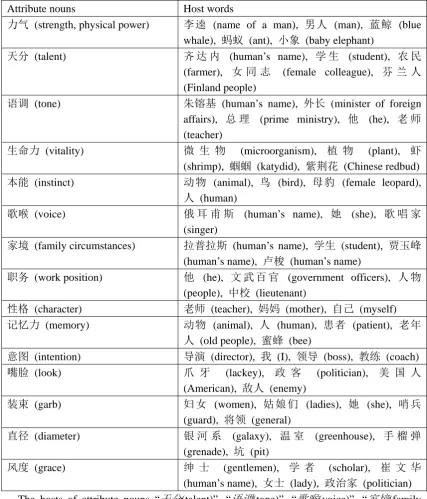
Table 2 shows the host word (noun) and attributes nouns (head) in AH.
Table 2
Attribute nouns Host words
力气 (strength, physical power) 李逵 (name of a man), 男人 (man), 蓝鲸 (blue
whale), 蚂蚁 (ant), 小象 (baby elephant)
天分 (talent) 齐 达 内 (human’s name), 学 生 (student), 农 民
(farmer), 女 同 志 (female colleague), 芬 兰 人 (Finland people)
语调 (tone) 朱镕基 (human’s name), 外长 (minister of foreign
affairs), 总 理 (prime ministry), 他 (he), 老 师 (teacher)
生命力 (vitality) 微 生 物 (microorganism), 植 物 (plant), 虾
(shrimp), 蝈蝈 (katydid), 紫荆花 (Chinese redbud)
本能 (instinct) 动物 (animal), 鸟 (bird), 母豹 (female leopard),
人 (human)
歌喉 (voice) 俄 耳 甫 斯 (human’s name), 她 (she), 歌 唱 家
(singer)
家境 (family circumstances) 拉普拉斯 (human’s name), 学生 (student), 贾玉峰
(human’s name), 卢梭 (human’s name)
职务 (work position) 他 (he), 文 武 百 官 (government officers), 人 物 (people), 中校 (lieutenant)
性格 (character) 老师 (teacher), 妈妈 (mother), 自己 (myself)
记忆力 (memory) 动物 (animal), 人 (human), 患者 (patient), 老年
人 (old people), 蜜蜂 (bee)
意图 (intention) 导演 (director), 我 (I), 领导 (boss), 教练 (coach)
嘴脸 (look) 爪 牙 (lackey), 政 客 (politician), 美 国 人
(American), 敌人 (enemy)
装束 (garb) 妇 女 (women), 姑 娘 们 (ladies), 她 (she), 哨 兵
(guard), 将领 (general)
直径 (diameter) 银 河 系 (galaxy), 温 室 (greenhouse), 手 榴 弹
(grenade), 坑 (pit)
风度 (grace) 绅 士 (gentlemen), 学 者 (scholar), 崔 文 华
(human’s name), 女士 (lady), 政治家 (politician) The hosts of attribute nouns “天分(talent)”, “语调(tone)”, “歌喉(voice)”, “家境(family circumstances)”, “职务(position)”, “性格(character)”, “意图(intention)”, “嘴脸(look)”, “装 束(garb)” and “风度(grace)” are all of meaning of “human”. The structure presentation of these nouns is:
家境(family circumstances)= {syn_behavior[]; sr_AH[human]; sr_VO[]; sr_SP[]}; 职务(position)={syn_behavior[]; sr_AH[human]; sr_VO[]; sr_SP[]};
性格(character)={syn_behavior[]; sr_AH[human]; sr_VO[]; sr_SP[]}; 意图(intention)={syn_behavior[]; sr_AH[human]; sr_VO[]; sr_SP[]}; 嘴脸(look)={syn_behavior[]; sr_AH[human]; sr_VO[]; sr_SP[]}; 装束(garb)={syn_behavior[]; sr_AH[human]; sr_VO[]; sr_SP[]}; 风度(grace)={syn_behavior[]; sr_AH[human]; sr_VO[]; sr_SP[]}; ÆThese nouns can be classified as “attribute of human”.
The nouns “力气(strength)”, “生命力(vitality)”, “本能(instinct)” have hosts of not only the meaning of “human” also of “animal”. Both meanings can be presented as “living creatures, thus the structure presentation of these nouns is:
力气(strength)={syn_behavior[]; sr_AH[living creatures]; sr_VO[]; sr_SP[]}; 生命力(vitality)={syn_behavior[]; sr_AH[living creatures]; sr_VO[]; sr_SP[]}; 本能(instinct)={syn_behavior[]; sr_AH[living creatures]; sr_VO[]; sr_SP[]}; ÆThese nouns can be classified as “attribute of living creatures”.
While the nouns above can be subcategorized by the meaning of the host words, while the noun “直径(diameter)” can not, because there is no semantic agreement of its hosts. The hosts are of various meanings, like “space” (银 河 系/galaxy), “architecture” (温 室 /greenhouse), and “artificial production” (手榴弹/grenade).
4.5 Selectional restrictions in VO
The ANC can be further classified by the verb with which the attribute noun matches. The attribute nouns and verbs are showed in table 3.
Table 3
Attribute noun Verb
力气 (strength, physical power) 有 (have), 没有 (do not have), 下,费 (spend)
天分 (talent) 有 (have), 没有 (do not have),
语调 (tone) 运用 (handle), 用 (use)
生命力 (vitality) 显示 (show), 具有 (have), 保持 (maintain)
本能 (instinct) 有 (have), 成为 (become)
歌喉 (voice) 展示 (show), 听 (listen to)
家境 (family circumstances) NULL
职务 (work position) 担任 (occupy), 开除 (dismiss), 辞去 (retire from) 性格 (character) 突出 (highlight), 表现 (present)
记忆力 (memory) 丧失 (lost), 保持 (maintain)
意图 (intention) 领会 (understand), 贯彻 (carry out), 知 (know), 揣摩
(conjecture)
嘴脸 (look) 描写 (describe), 揭露 (explosure), 看清 (realize), 露
出 (reveal)
装束 (garb) 穿 着 (wear), 看 (look), 瞅 着 (stare at), 看 清 (see
clearly),
直径 (diameter) NULL
The verbs governing “力气(strength)”, “天分(talent)”, “语调(tone)”, “生命力(vitality)”, “性 格(character)”, “本 能(instinct)”, 记 忆 力 (memory) and “风 度(grace)” are not specialized, the verb governing “力气(strength)” can also collocate with “性格(character)”. Thus, we can not produce subcategories for these attribute nouns by the meaning of verbs.
The nouns “嘴脸(look)”, “装束(garb)” and have verbs with meanings that only can collocate with them: “看(look)”, “瞅着(stare at)”. We can also find out some other verbs with same meaning for them: “观察(observe)”, “看见(see)”. If anything can be saw by human’s eyes, watched or observed, it must has outward appearance. The structure presentation of these nouns is:
嘴脸(look)={syn_behavior[]; sr_AH[human]; sr_VO[watch]; sr_SP[]};
装束(garb)={syn_behavior[]; sr_AH[human]; sr_VO[watch]; sr_SP[]};
ÆThus we create a new ANC subcategory for the two nouns: “appearance attribute of human”.
The verbs of noun “意图(intention)” are of meaning of “mental processing”, so it can be presented as:
意图(intention)={syn_behavior[]; sr_AH[human]; sr_VO[mental processing]; sr_SP[]}; ÆThus we generate a subcategory for it: “mental attribute of human”.
The meaning of verbs of “职务(position)” is “social acting”, so it can be presented as :
职务(position)={syn_behavior[]; sr_AH[human]; sr_VO[social acting]; sr_SP[]}; ÆWe create a new subcategory for it—“social attribute of human”.
4.6 Selectional restrictions in SP
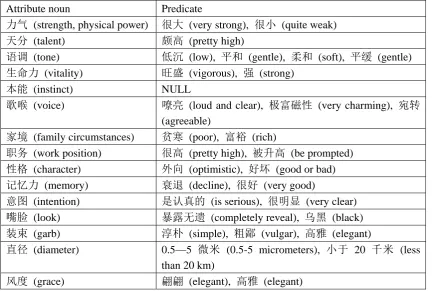
The nouns are needed to be analyzed in SP, for the AH and VO are not work on some nouns. Table 4 below is the attribute noun and predicates.
Table 4
Attribute noun Predicate
力气 (strength, physical power) 很大 (very strong), 很小 (quite weak)
天分 (talent) 颇高 (pretty high)
语调 (tone) 低沉 (low), 平和 (gentle), 柔和 (soft), 平缓 (gentle)
生命力 (vitality) 旺盛 (vigorous), 强 (strong)
本能 (instinct) NULL
歌喉 (voice) 嘹亮 (loud and clear), 极富磁性 (very charming), 宛转
(agreeable)
家境 (family circumstances) 贫寒 (poor), 富裕 (rich)
职务 (work position) 很高 (pretty high), 被升高 (be prompted) 性格 (character) 外向 (optimistic), 好坏 (good or bad)
记忆力 (memory) 衰退 (decline), 很好 (very good)
意图 (intention) 是认真的 (is serious), 很明显 (very clear)
嘴脸 (look) 暴露无遗 (completely reveal), 乌黑 (black)
装束 (garb) 淳朴 (simple), 粗鄙 (vulgar), 高雅 (elegant)
直径 (diameter) 0.5—5 微米 (0.5-5 micrometers), 小于 20 千米 (less
than 20 km)
The meanings of predicates of attribute nouns “力气(strength)”, “天分(talent)”, “语调 (tone)”, “生命力(vitality)”, “本能(instinct)” and “记忆力 (memory)” are not distinguishable. The predicates like “很大 (very strong)”, “很小(quite weak)”, “旺盛(vigorous)”, “强 (strong)” have general meanings in semantic, which can collocate with many different attribute nouns.
The meaning of predicates of “歌喉(voice)” are “tone of sound” which can not collocate with other 14 nouns, thus “歌喉(voice)” can be presented as:
歌喉(voice)={syn_behavior[]; sr_AH[human]; sr_VO[]; sr_SP[tone of sound]}; ÆWe get a new subcategory: “audible attribute of human”.
The meaning of predicates of “家境(family circumstances)” mean “social status” which can only collocate with the noun. “家境(family circumstances)”:
家境(family circumstances)={syn_behavior[];sr_AH[human]; sr_VO[]; sr_SP[social status]}; ÆThe noun can be assigned with a new subcategory: “social attribute of human”.
Meaning of predicates of “风度(grace)” mean “appearance status” which can only collocate with the noun:
风度(grace)={syn_behavior[]; sr_AH[human]; sr_VO[]; sr_SP[appearance status]};
ÆThe predicate of “风度(grace)” and the verb of “嘴脸(look)” and “装束(garb)” have similar in meaning, thus “风度(grace)” can be assigned in “appearance attribute of human”. “直径(diameter)” takes quantifier phrase as its predicate in SP. It can be presented as: 直径(diameter)={syn_behavior[QP as predicate]; sr_AH[human]; sr_VO[]; sr_SP[quantity status]};
ÆSo we get a subcategory: “quantity attribute”.
4.7 Sample taxonomy
To summary, we create a sample taxonomy for these 15 attribute nouns:
Attribute noun
Living creature
Quality attribute
Human
Appearance
Social
Mental
Audible
In this paper, we present a practical method to define and subcategorize the attribute noun class, and produce sample word sense taxonomy for 15 Chinese attribute nouns. Syntactic and semantic features are employed to do the job, from which we derive a syntactic-lexical semantic model for defining and subcategorizing the word sense class. First learn the grammatical distributions of each word from corpus to determine a noun is whether attribute noun or not. Then we study the selectional restrictions between the noun and its collocate words in each grammatical relation and assign the noun to more specific sense class. Finally produce a small word sense taxonomy. We found that:
1. we get the syntactic behavior of word by studying the meaning of the word, thus sense classes (meanings with same concept) could be distinguished by syntactic behavior;
2. creating word sense class requires both syntactic and semantic features which we call “syntagmatic features” of word;
3. general meaning of collocate words is essential for acquiring the semantic features of word sense class, which means some coarse and solid concepts of noun, verb and adjective are needed. Such coarse and solid concepts are the precondition for studying the selectional restrictions between collocate words.
References:
Adrienne Lehrer, Semantic fields and lexical structure, North-Holland Press, 1974
Beth Levin, English verb classes and alternations: a preliminary investigation, University of Chicago Press, 1993
Thomas R. Gruber, Toward Principles for the Design of Ontologies Used for Knowledge Sharing, Formal Ontology in Conceptual Analysis and Knowledge Representation, Kluwer Academic Publishers, 1993
Scott McDonald, Michael Ramscar, Testing the Distributional Hypothesis: The Influence of Context on Judgements of Semantic Similarity, Proceedings of the 23rd Annual Conference of the Cognitive Science Society, 2001
Wang Hui, A Syntagmatic Study on Noun Senses in Contemporary Chinese, Peking University Press, 2004