Text Readability Classification of Textbooks of a Low-Resource Language
Zahurul Islam, Alexander Mehler and Rashedur Rahman AG Texttechnology
Institut f¨ur Informatik Goethe-Universit¨at Frankfurt
zahurul,[email protected], [email protected]
Abstract
There are many languages considered to be low-density languages, either because the population speaking the language is not very large, or because insufficient digitized text material is available in the language even though millions of people speak the language. Bangla is one of the latter ones. Readabil-ity classification is an important Natural Lan-guage Processing (NLP) application that can be used to judge the quality of documents and assist writers to locate possible prob-lems. This paper presents a readability clas-sifier of Bangla textbook documents based on information-theoretic and lexical features. The features proposed in this paper result in anF-scorethat is50%higher than that for tra-ditional readability formulas.
1 Introduction
The readability of a text relates to how easily hu-man readers can process and understand a text as the writer of the text intended. There are many text re-lated factors that influence the readability of a text. These factors include very simple features such as type face, font size, text vocabulary as well as com-plex features like grammatical conciseness, clarity, underlying semantics and lack of ambiguity.
Nowadays, teachers, journalists, editors and other professionals who create text for a specific audience routinely check the readability of their text. Read-ability classification, then, is the task of mapping text onto a scale of readability levels. We explore the task of automatically classifying documents based
on their different readability levels. As input, this function operates on various statistics relating to lex-ical and other text features.
Automatic readability classification can be useful for many Natural Language Processing (NLP) appli-cations. Automatic essay grading can benefit from readability classification as a guide to how good an essay actually is. Similarly, search engines can use a readability classifier to rank its generated search results. Automatically generated documents, for ex-ample documents generated by text summarization systems or machine translation systems, tend to be error-prone and less readable. In this case, a read-ability classification system can be used to filter out documents that are less readable. The system can also be used to evaluate machine translation output. A document of higher readability tends to be better than a document that belongs to a lower readability class.
With nearly 230 million speakers, Bangla is one of the largest spoken languages in the world, but only a very small number of linguistic tools and resources are available for it. For instance, there is no morpho-logical analyzer, POS tagger or syntax parser avail-able for Bangla.
To create a supervised readability classification, it is important to use a corpus that is already classi-fied for the different levels of readers. In this work, the corpus is collected from textbooks that are used in primary and middle school in Bangladesh. The collected documents are classified according to their readability. So the extracted corpus is ideal for a readability classification task.
In this paper, we present a readability classifica-tion based on informaclassifica-tion-theoretic and lexical fea-tures. We evaluate this classifier in comparison with traditional readability formulas that, even though they were proposed in the early stages of readabil-ity classification research, are still widely used.
The paper is organized as follows: Section 2 dis-cusses related work followed by an introduction of the corpus in Section 3. The features used for clas-sification are described in Section 4, and our exper-iments in Section 5 are followed by a discussion in Section 6. Finally, we present our conclusions in Section 7.
2 Related Work
There is no standard approach to measuring text quality. According to Mullan (2008), a good read-able English sentence should contain14to22words. He also stated that if the average sentence length is more than22words then the content is not clear. If the average sentence length is shorter than14then it is probable that the presentation of ideas is discon-tinuous.
Much work was done previously in this field and many different types of features were used. We sum-marize the related research grouped by type:
Lexical Features: In the early stage of read-ability research fairly simple features were used due to the lack of linguistic resources and computational power. Average Sentence length (ASL) is one of them. The ASL can be used as a measure of grammatical complexity assum-ing that a longer sentence has a more complex
grammatical structure than a shorter one. Dale and Chall (1948; 1995) showed that reading difficulty is a linear function of the ASL of the percentage of rare words. They listed3,000 commonly known words for the4thgrade.
Gunning (1952) also considered the numbers of sentences and complex words to measure text readability. The formula uses similar lex-ical features as (Dale and Chall, 1948; Dale and Chall, 1995) with different constants. The Flesch-Kincaid readability index (Kincaid et al., 1975) considers the average number of words per sentence and the average number of syllables per words. They proposed two dif-ferent formulas, one for measuring how easy a text is to read and the other one for measuring grading level. Senter and Smith (1967) also de-signed a readability index for theUS Air force that uses the average number of characters in a word and the average number of words in a sentence. Many of the other readability formu-las are summarized in (Dubay, 2004).
English has a long history of readability re-search, but there is very little previous research in Bangla text readability. Das and Roychud-hury (2004; 2006) show that readability for-mulas proposed by (Kincaid et al., 1975) and (Gunning, 1952) work well for Bangla text. The readability formulas were tested semi-automatically on seven documents, mostly nov-els. Obviously this data set is small.
Petersen & Ostendorf (2009) and Feng et al. (2009) show that these traditional methods have significant drawbacks. Longer sentences are not always syntactically complex and the syllable number of a single word does not cor-relate with its difficulty. With recent advance-ments of NLP tools, a new class of text features is now available.
mod-els. Combining information from statistical language models with other features using Sup-port Vector Machines (SVM) outperform tradi-tional readability measures. Pitler and Nenkova (2008) also used a unigram language model and found that this feature is a strong predictor of readability.
POS-based Features: Parts of Speech (POS)-based grammatical features were shown to be useful in readability classification (Pitler and Nenkova, 2008; Feng et al., 2009; Aluisio et al., 2010; Feng et al., 2010). In the experiment of (Feng et al., 2010), these features outperform language-model-based features.
Syntax-based Features: Text readability is af-fected by syntactic constructions (Pitler and Nenkova, 2008; Barzilay and Lapata, 2008; Heilman et al., 2007; Heilman et al., 2008). In this line of research, Barzilay and Lapata (2008) show, for example, that multiple noun phrases in a single sentence require the reader to remember more items.
Semantic-based Features: On the semantic level, a paragraph that refers to many entities burdens the reader since he has to keep track of these entities, their semantic representations and how these entities are related. Texts that refer to many entities are extremely difficult to understand for people with intellectual disabil-ities (Feng et al., 2009). Noemie and Huener-fauth (2009) show how working memory limits the semantic encoding of new information by readers.
Researchers also experimented with semantic features likelexical chains,discourse relations andentity grids(Feng et al., 2010; Barzilay and Lapata, 2008). It has been shown that these fea-tures are useful for readability classification.
In this paper, we do not compare our work with any previous work that explores linguistic features. Due to the unavailability of a Bangla syllable identifica-tion system, we could not compare our work with readability formulas that use syllable information. We will only compare our proposed features with a
baseline system that uses three traditional readabil-ity formulas proposed by Gunning (1952) , Dale and Chall (1948; 1995) and Senter and Smith (1967). These traditional formulas are widely used in many readability classification tools.
3 Corpus Extraction
The government agency National Curriculum and Textbook Board, Bangladesh1makes available text-books that are used in public schools in Bangladesh. The textbooks cover many different subjects, includ-ing Bangla Literature, Social Science, General Sci-ence and Religious Studies. These textbooks are for students from grade one to grade ten. All of the textbooks are in Portable Document Format (PDF). Some of them are made by scanning textbooks and some of them are converted from typed text. There is a Bangla OCR (Hasnat et al., 2007) available but it is unable to extract text from the scanned PDF books. Therefore, we only considered textbooks that were converted to PDF from typed text. TheApache PDFBox2 is used to extract text from PDFs. Note that24 textbooks were extracted from class twoto class eight. After text extraction, it was observed that the text was not written in Unicode Bangla. A non-standard Bangla input method called Bijoy is used to type the textbooks. This is an ASCII based Bangla input method that was widely used in the 1990s. The next challenge was to convert non-standard text to Bangla Unicode.
The selected text books were written using a font calledSutonnyMJ that has many different versions, all of which differ slightly in terms of the code point of someconsonant conjuncts. The freely available open source CRBLPConverter3 is used to convert these non-standard Bangla texts to Unicode. To cope with the font of the text, the CRBLPConverter re-quired some slight modifications. Text books not only contain descriptive texts but also contain ques-tions, poems, religious hymns, texts from other lan-guages (e.g., Arabic, Pali) and transcription of Ara-bic texts (e.g., Surah). Manual work was involved to clean these non-descriptive texts and extract each chapter as a document. Classtwocontains only one
1http://nctb.gov.bd/book.php 2http://pdfbox.apache.org/
Classes Documents Avg. Doc-ument Length
Avg. Sentence Length
Avg. Word Length
three 123 65.21 8.07 4.31
four 88 126.25 8.63 4.37
five 43 196.72 9.34 4.41
six 62 130.13 11.53 4.85
Table 1: The Bangla Readability Corpus
textbook and classsix,sevenandeightcontain two textbooks each. To avoid a data sparseness prob-lem, classtwois merged with classthreeand class sevenandeightare merged with classsix. Each doc-ument is tokenized using a slightly modified version of the tokenizer which is freely available in4. Table 1 shows the details of the corpus. TheAverage Docu-ment Lengthshows the average number of sentences per document. TheAverage Sentence Length repre-sents the average number of words in a sentence and Average Word Lengthdisplays the average number of characters in a word.
It should be noted that80%of the corpus is used for training and the remaining20%is used as a test set.
4 Features
4.1 Lexical Features
In this paper, we compare a lexical and information-theoretic classifier of text readability with a classifier based on traditional readability formulas. The liter-ature explores some of the linguistic indicators of readability. This includes the avg. sentence length, avg. word length and the avg. number of diffi-cult words (of more than 9 letters). We develop a classifier of text readability based on lexical and information-theoretic features. We first describe lex-ical features used by this classifier.
The Average Sentence Length is a quantitative measure of syntactic complexity. In most cases, the syntax of a longer sentence is more difficult than the syntax of a shorter sentence. However, children of lower grade levels are not aware of syntax. In any event, a longer sentence contains more entities and children have to remember all of these entities
4http://statmt.org/wmt09/scripts.tgz
in order to understand the sentence, which makes a longer sentence more difficult for them. As an example, Table 1 shows that theAverage Sentence Lengthrises in the text of higher readability classes. TheAverage Word Lengthis another lexical feature that is useful for readability classification. A longer word carries some difficulties for children at a lower grade level. For example: the wordbiodegradable will be harder to pronounce, spell and understand for children at a lower grade level. This characteris-tic is reflected in our readability corpus that is shown in Table 1. TheAverage Word Lengthwill be more useful for agglutinative languages such as German, which allows concatenation of morphemes to build longer words.
The Average Number of Complex Wordsfeature is related to the Average Word Length. The aver-age length of English written words is 5.5(N´adas, 1984). Table 1 shows that the average word length in our corpus is below5. Dash (2005) showed that the average word length in the CIIL5corpus is5.12. Majumder et al. (2006) claimed that the average word length in a Bangla news corpus is8.62. They have mentioned that the average length is higher due to the presence of many hyphenated words in the news corpus. In this work, any word that contains 10or more characters is considered a complex word. A complex word will be harder to read for children at a lower grade level. The type token ratio (TTR), which indicates the lexical density of text, has been considered as a readability feature too. Low lexical densities involve a great deal of repetition.
The termHapax Legomenais widely used in lin-guistics referring to words which occur only once within a context or document. These are mostly con-tent words. Kornai (2008) showed that 40% to 60% of the words in larger corpora areHapax Legomena. Documents with more Hapax Legomena generally will contain more information. In terms of text read-ability, the difficulty level will be higher.
4.2 Entropy Based Features
Recently, researchers have independently made the suggestion that the entropy rate plays a role in hu-man communication in general (Genzel and Char-niak, 2002; Levy and Jaeger, 2007). The rate of
Features Accuracy F-Score Gunning fog readability index 48.3% 36.5% Dale–Chall readability formula 48.3% 45.0% Automated readability index 51.6% 46.2%
All together 53.3% 49.6%
Table 2: Evaluation of baseline system with3traditional readability formulas.
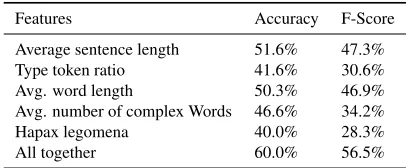
Features Accuracy F-Score
Average sentence length 51.6% 47.3%
Type token ratio 41.6% 30.6%
Avg. word length 50.3% 46.9%
Avg. number of complex Words 46.6% 34.2%
Hapax legomena 40.0% 28.3%
All together 60.0% 56.5%
Table 3: Evaluation of lexical features.
these formulas, Automated readability indexis the highest performing formula. Das and Roychudhury (2004; 2006) showed that these traditional features nonetheless work well for Bangla novels. Note that we have used the SMO (Platt, 1998; Keerthi et al., 2001) classifier model in WEKA (Hall et al., 2009) together with the Pearson VII function-based univer-sal kernel PUK ( ¨Ust¨un et al., 2006).
5.2 System with Lexical Features
Lexical features use the same kind of surface fea-tures as the traditional readability formulas used in the baseline system (see: Section 5.1). Table 1 shows that the average sentence length and diffi-culty levels are proportional. That means that sen-tence length increases for higher readability classes. Average word lengthexhibits the same characteris-tics. These characteristics are reflected in the exper-iment. These two are the best performing features among all of the lexical features. Table 3 shows the evaluation of the system that uses only lexical fea-tures. Although the individual accuracy of some of these features is similar to the traditional formulas, the combination of all lexical features outperforms the baseline system.
5.3 System with Entropy Based Features
As noted earlier, entropy measures the amount of in-formation in a document. The entropy rate is con-stant in human communication (see Section: 4.2).
Features Accuracy F-Score
Word probability 53.3% 49.3%
Character probability 48.3% 35.4% Word length probability 50.0% 36.9% Word frequency probability 43.3% 32.4% Character frequency probability 53.3% 47.7%
Entropy features 61.6% 59.8%
Lexical + entropy features 73.3% 72.1%
Table 4: Evaluation of entropy based features.
The documents in this work are assumed to be a medium of communication between writers and readers. Conversely, information flow of a very readable document will differ from that of a less readable document. So, the constants for the cor-responding entropy rates of the different readability classes will differ. As a single feature, these entropy based features perform similarly to lexical features. But, collectively this is the best performing feature set. Among all similar features the random variable withWord Probabilityworks better than others. Ta-ble 4 shows the results of these features. Adding lex-ical features withentropy based features improves accuracyandF-scoresubstantially.
5.4 System with Kullback-Leibler Divergence-based Features
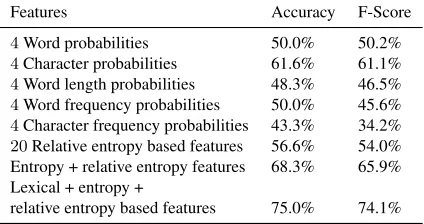
Relative entropy-based features represent the dis-tance between the test document and target classes. The target class with the lowest distance will be the class of the test document. Five different types of random variables are used in this work (see Sec-tion 4.3). The random variable based oncharacter probabilitiesis the best performing individual fea-ture among all feafea-tures used in this work. However, this feature set performs worse than thelexicaland entropybased features set. The evaluation is shown in Table 5. The combination of all, i.e.,lexical, en-tropyandrelative entropybased features, gives the best result, namelyaccuracyof75%andF-scoreof 74.1%.
6 Discussion
Features Accuracy F-Score
4Word probabilities 50.0% 50.2% 4Character probabilities 61.6% 61.1% 4Word length probabilities 48.3% 46.5% 4Word frequency probabilities 50.0% 45.6% 4Character frequency probabilities 43.3% 34.2% 20Relative entropy based features 56.6% 54.0% Entropy + relative entropy features 68.3% 65.9% Lexical + entropy +
relative entropy based features 75.0% 74.1%
Table 5: Evaluation of Kullback-Leibler Divergence-based Features.
not useful for studies like the one presented here. This is probably due to the fact that these formulas were specially designed for English. One reason for the poor performance is that Bangla script is a syl-labic script that has glyphs representing clusters and ligatures.
It also has to be noted that Bangla is an inflec-tional language, so that the average word length can be longer than that of many other languages.
The lexical features that are assumed to be good indicators of text difficulty did indeed perform well in classification. The respective feature set performs better than the baseline system. Average sentence lengthandAverage word lengthdo not perform well, as reflected in Table 1. That shows that the average word and sentence lengths are longer in higher read-ability classes than in lower readread-ability classes.
As an individual feature, eachentropybased fea-ture performs similarly to other feafea-tures. However, the combination of theentropybased features are the best performing features among all. The classifica-tion performance even increases whenentropybased features are combined withlexicalfeatures.
Among all relative entropy based features, the random variable based on character probabilities performs best. This feature performs better than the baseline system. But the performance drops when this feature is added to otherrelative entropybased features. Although therelative entropy based fea-ture set performs better than the baseline system, the lexicalandentropybased feature set performs even better. The performance surpasses the baseline sys-tem by50%whenlexical,entropybased andrelative entropybased features are combined.
7 Conclusion
In this paper, we have presented features for text readability classification of a low resource language. Altogether we have proposed 30 quantitative fea-tures. Twenty-five of them are information-theoretic based features. These features do not require any kind of linguistic processing. Recent advances in NLP tools argue that linguistic features are useful for readability classification. However, our exper-imental results show that lexical and information-theoretic features perform very well. There are many languages in theAsia Pacific region that are still considered as low resource languages. These features can be used for readability classification of these languages. As a future work, we plan to ex-plore many other information-theoretic features like mutual information,point wise mutual information andmotifs.
8 Acknowledgements
We would like to thank Mr. Munir Hasan from the Bangladesh Open Source Network (BdOSN) and Mr. Murshid Aktar from the National Curriculum & Textbook Board Authority, Bangladesh for their help on corpus collection. We would also like to thank Andy L¨ucking, Paul Warner and Armin Hoe-nen for their fruitful suggestions and comments. Fi-nally, we thank three anonymous reviewers. This work is funded by the LOEWE Digital-Humanities project in the Goethe-Universit¨at Frankfurt.
References
Ra Aluisio, Lucia Specia, Caroline Gasperin, and Car-olina Scarton. 2010. Readability assessment for text simplification. InNAACL-HLT 2010: The 5th Work-shop on Innovative Use of NLP for Building Educa-tional Applications.
Regina Barzilay and Mirella Lapata. 2008. Modeling local coherence: An entity-based approach. Computa-tional Linguistics, 21(3):285–301.
Kevyn Collins-Thompson and James P Callan. 2004. A language modeling approach to predicting reading dif-ficulty. InHLT-NAACL.
R.J. Senter and E. A. Smith. 1967. Automated read-ability index. Technical report, Wright-Patterson Air Force Base.
Claude Elwood Shannon. 1948. A mathematical theory of communication. The Bell System Technical Jour-nal, 27(1):379–423.