Multiple Emotions Detection in Conversation Transcripts
Duc-Anh Phan, Hiroyuki Shindo, Yuji Matsumoto
Graduate School of Information and Science
Nara Institute of Science and Technology
8916-5, Takayama, Ikoma, Nara, 630-0192, Japan
{
phan.duc anh.oq3,shindo,matsu
}
@is.naist.jp
Abstract
In this paper, we present a method of pre-dicting emotions from multi-label conversa-tion transcripts. The transcripts are from a movie dialog corpus and annotated partly by 3 annotators. The method includes building an emotion lexicon bootstrapped from Wordnet following the notion of Plutchik’s basic emo-tions and dyads. The lexicon is then adapted to the training data by using a simple Neural Network to fine-tune the weights toward each basic emotion. We then use the adapted lexi-con to extract the features and use them for an-other Deep Network which does the detection of emotions in conversation transcripts. The experiments were conducted to confirm the ef-fectiveness of the method, which turned out to be nearly as good as a human annotator.
1
Introduction
Along with the trend of ”Affective Computing”, the task of Emotion Detection in text has received much attention in the recent years. However, very little research has been working on the detection of mul-tiple emotion simultaneously. Instead, most of them make simple assumption that emotions are mutually exclusive and focus on multi-class classification. In fact, the nature of human emotion is complicated: emotions have connections, some are opposite of each other, while some occur together at the same time, resonate and create another emotional state -dyads (Plutchik, 1980)
The survey by Dave and Diwanji (2015) predicted the need for Emotion Detection in streaming data
and the study of emotion flow during chatting. In this paper, we tackle the simplified version of this task by detecting the emotions inconversation. The corpus we used is made of conversations among movie characters, who take turns in the conversa-tion. Those turns are called utterances, which are then manually annotated in a multi-label manner.
Emotion detection in conversation is essentially different from identifying emotions in news head-lines (Strapparava and Mihalcea, 2007) or Tweets (Bollen et al., 2011) where each instance is inde-pendent of each other. Generally, the expression of Emotion in general depends on the words being used. However, it also quite depends on the gram-mar structure and syntactic variables such as: negations, embedded sentence, and the type of sentence -question, exclamation, command or statement (Col-lier, 2014). Therefore, similar to the detection of emotions of sentences in a paragraph, the context in-formation of the whole conversation and what is said in the previous utterance should be taken into con-sideration. The extraction of context features will be further explained in sub-section 4.3.1
Unlike other works (Li et al., 2015; Wang et al., 2015) where small sets of basic emotions are used, we annotated the dataset using the notion of Plutchik’s basic emotion and dyads (1980). This eases the annotators’ task since it offers annotators with wider range of emotion labels (8 basic and 23 combinations) to choose from.
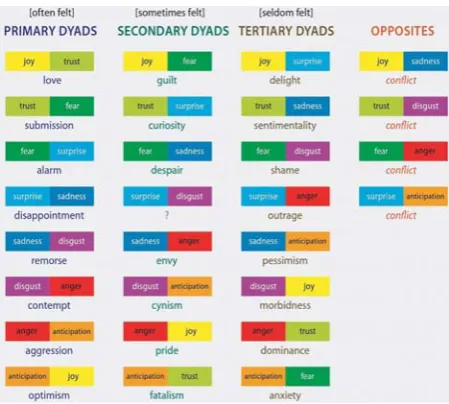
Figure 1: Plutchik’s basic emotion and dyads - image taken fromhttp://twinklet8.blogspot.jp
feel happiness and sadness from the same incident altogether. Furthermore, Ekman’s basic emotions are the result of observation made on human facial expressions so applying such notion in text classi-fication task seems irrelevant. Newer works relies on dimensional representation using valence-arousal space (Calvo and Mac Kim, 2013; Yu et al., 2015)
Plutchik (1980) suggested 4 axes of bipolar ba-sic emotions: Joy Sadness, Fear Anger, Trust -Disgust, Surprise - Anticipatation. These primary emotions may blend to form the full spectrum of hu-man emotional experience. The new complex emo-tions formed by them are called dyads(Figure 1). Plutchik’s notion reasonably explains the connection between emotions. Some emotions will not occur at the same time since they are on the opposite side of the axis. Complex emotions can also be viewed as combinations of primary ones. The idea enables us to approach emotion detection in a more compre-hensive manner. In the future, we may address not only complicating mixture of emotions but also the intensity of each of them.
In this paper, we propose a three steps method for the detection of emotions in conversation: 1)Build-ing Emotion Lexicon from Wordnet (Miller, 1995). 2) Using simple Neural Network to adapt the lexicon to the training data. 3) Using Deep Network with features extracted from adapted lexicon and classify the multi-label corpus.
4 proposes our approach which includes the 3 steps mentioned above. Section 5 evaluates the lexicon, the effectiveness of the adapted lexicon and the pro-posed method in general. Section 6 gives the con-clusion and discusses future work.
2
Related Work
Most of the work in the field tried to define a small set of emotions (D’Mello et al., 2006; Yang et al., 2007) which involved only 3 and 4 emotional states respectively. Another work by Hasegawa et al. (2013) performed amulti-classclassification on dialog data from Twitter in Japanese. They auto-matically labeled the obtained dialogs by using emo-tional expression clues, which is similar to our col-location list explained in sub-section 3.3. We pro-pose a more comprehensive approach by exploiting Plutchik’s notion which covers the full spectrum of human emotions to work on challenging multi-label conversation corpus.
Having the same notion, Buitinck et al. (2015) proposed a simple Bag of Words approach and tuned RAKEL for multi-label classification for movie re-views. We go further and work on conversation data where the exchange between characters and the con-text of the whole dialog are of great importance. The closest to our work is Li et al. (2015) on paragraphs and documents which tried to improve the sentence-level prediction of some special emotions which, due to data sparseness and inherent multi-label clas-sification, were very hard to predict. They incorpo-rated label dependency among labels and context de-pendency into the graph model to achieve such goal. However, their work is for paragraphs in Chinese. In our case, we take advantages of Deep Neural Net-work to capture the abstract representation of con-text information.
Our system is different from previous methods in four main ways:
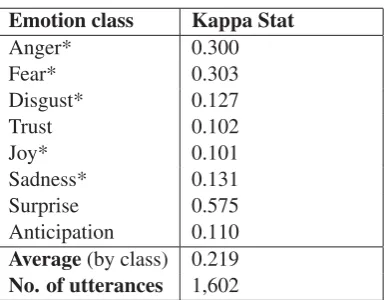
Trust 0.102
Joy* 0.101
Sadness* 0.131 Surprise 0.575 Anticipation 0.110
Average(by class) 0.219
No. of utterances 1,602
* indicates that these emotions are also in ISEAR dataset
Table 1: Kappa Agreement score.
this dataset for words which frequently appear to-gether with one emotion. If a word also appears in other emotions situation, it loses its place as the in-dicator toward one specific emotion and we discard it from the collocation list. The use of this colloca-tion list in our work is closely similar to emocolloca-tional expression clues in (Hasegawa et al., 2013).
4
The Proposed Method
4.1 Bulding Lexicon
Using Lexicon is proven to provide significant im-provement in identifying the emotion conveyed by a word (Mohammad, 2012). Therefore, in our case, we built a new lexicon, each lexical item of which displays not only its association with Plutchik’s ba-sic emotions but also how strong the association is.
We define the primary emotions and dyads in Plutchik’s theories as the seeds of our lexicon. Throughout Wordnet, we search for synonyms, hy-pernyms, hyponyms of the seeds. A reverse lem-matisation is necessary to retrieve related verbs, ad-jectives and adverbs and their derived forms (verb forms and comparative, superlative adjectives) of the seeds. We keep tracks of the original nouns and the seeds where the new words were derived from (Ta-ble 2). Note that sometimes a word was derived from different nouns and seeds, which suggests mixed emotional states.
Each lexical item in the lexicon has a vector of values on each axis of the basic emotions: Joy Sadness, Fear Anger, Trust Disgust, Surprise
-love (dyad)-love
benevolent benevolence-love
worship worship-fear, worship-love
Table 2: Wordnet expansion.
Anticipatation . We manually assign the primary emotions with a value vector of 1, 0 or -1 and the dyads with 0.5, 0 or -0.5, depending on the axes they belong. For example, ”joy” came from the axis of Joy-Sadness, thus, its vector is [1,0,0,0] while the vector for ”sadness” is [-1,0,0,0] (Table 3). The dyad ”love” came from primary emotions ”joy” and ”trust”, hence its vector is [0.5,0.5,0,0]. It is to be noted that the minus sign only indicates that the emotion is on the other side of the axis. It is not a suggestion of negative emotion in any case.
In addition, we calculate thewupsimilarity (Wu and Palmer, 1994) between a new word and the seed it came from, based on the depth of the two senses in the Wordnet taxonomy and that of their Least Com-mon Subsumer.
wup(word, seed) = 2∗dep(lcs)
dep(word) +dep(seed)
(1) We assumed that the higher the similarity, the closer emotional state of the word to the seed. Thus, the value vector of a word is the sum of the products of each seed vector and the similarity between the word and such seed.
vector(word) =nk=1vector(seedk)
×wup(word, seedk). (2)
For example, in the case of the word ”worship”, we first calculate thewupscores between the word and its two seeds: fear and love (Table 2). Next, they are multiplied by the vectors of the seeds fear-[0,0,1,0] and love-[0.5,0.5,0,0], and then summed up to get the result (Table 3).
4.2 Adapting Lexicon to Training data
Words J-S T-D F-A S-An
joy 1 0 0 0
sadness -1 0 0 0
fear 0 0 1 0
love 0.5 0.5 0 0
benevolent 0.47 0.47 0 0 worship 0.14 0.14 0.29 0
Table 3: Value vector of some words. (J-S: Joy-Sadness, T-D: Trust-Disgust, F-A: Fear-Anger, S-A: Surprise-Anticipation)
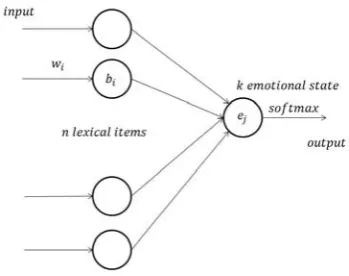
domain. In order to partly solve this problem, we built a simple neural network with one input layer and one output softmax layer.
Figure 2: Adapting lexicon for emotional stateej
The input to the network is the Bag-of-Words fea-tures of the training data. We then steps by steps, try to do binary classification on the basic emotionej.
Let each node of the network be corresponding to each lexical item in the Lexicon. The biases a node biare initialized according to the value of each
lexi-cal items in the lexicon while the weightswiare
ran-domly initialized. After each step, we update the bi-ases and weights and then repeat the process for the whole 8 basic emotions. Figure 2 shows the struc-ture of the network. We use the log-likelihood as the cost function for the network input: C = −ln(aLy)
whereaL is the output of the final layer andyis the desired output. In the end, we updated the lexicon with new values from the network. We will discuss about the improvements made by the network later in section 5.
4.3 Deep Network for Multi-label Classification
4.3.1 Features Extraction
The process of feature selection for the network is an heuristic one. We initially used a lot of fea-tures and then through logistic regression, unimpor-tant features such as the genre of the movie or n-grams features were filtered out.
The core part of the extraction process is to take advantages of the lexicon to transform an utterance to a vector of values expressing the tendency to-wards each emotion state. This task is done in a rule-based manner (Algorithm 1 and Figure 3). Each word in the utterance is mapped to the lexicon to re-trieve the value vector. The representation vector of an utterance is the sum vector of all the word in-side it. The negation and word dependency are also taken into account when we calculate the sum with the help of NLTK (Bird et al., 2009) dependency parsing.
Data: Movie Dialogs
Result: Tendency Features utterance value←0
foreachword in utterancedo
value←retrieve from lexicon(word)
dependencies←
check dependency(word, utterance)
ifvalue & check negation(dependencies) then
value← −value
end
utterance value+ =value
end
Algorithm 1: Tendency Features extracting algo-rithm
Figure 3: Extracting tendency features
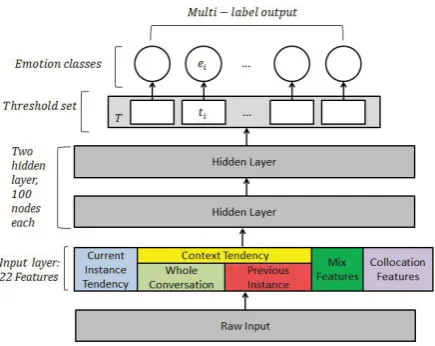
Each utterance in the dataset is presented by the following compact set of 22 features:
icon that appear in the conversation which pro-vides thecontext of the conversation.
3. The sum vector of the previous utterance in the conversation which also provides thecontext of previous exchange(of what triggered the cur-rent emotion).
4. The polarity (negative/ positive) score of the sentence.
5. Features such as: length, is it a question, is it an exclamatory sentence.
6. Collocation features which indicate the num-ber of appearances of words inside the ISEAR collocations list.
The reason for us to use extracted features is that it is very hard to capture the context of both the con-versation and previous exchange using direct word-embedding. While using a recurrent neural network can solve the latter, it is a challenge to address the first. Each conversation has different number of ut-terances, it may hurt the performance of the system and result in network architecture complexity if we use a non-fixed size window to monitor all the utter-ances in a same conversation.
4.3.2 Building the Deep Network
The structureof the network is built as shown in Figure 4. The raw input is generalized to produce a small set of features. These features are fed to the network as input layer. We have 2 fully connected hidden layers and an output layer. Since the task is a multi-label classification problem where softmax cannot be used,the output layer is change into sig-moid we add a set of threshold values (one for each basic emotions). Only the labels, whose output val-ues greater than the threshold are considered valid. The thresholds are randomly initialized and then up-dated after each epochs the same way we upup-dated the biases and weights. In our implementation of the network, Theano (Bastien et al., 2012) was used to take advantages of GPU computing power.
Figure 4: Structure of the Deep Network
The global cost function, similar to Zhang and Zhou (2006), is defined to reward the system for right predictions and severely punish for wrong ones in equation 3.
E=
m
i
= 1
|Yi||Y¯i|
(k,l)∈Yi×Y¯i
exp (−(cik−cil))
(3) Let X be the set of all m instances. Let Y =
{1,2, .., Q} be the set of all possible labels, Yi is the set of true labels for ith instance xi and Y¯i is
the set of the labels not belong to xi. Obviously,
Yi∪Y¯i=Y . We defineEas the global cost function
of the network. ciis the set of actual outputs of the model for input xi, each label has its own output.
ci
k is the output of labelkbelongs to the set of true
labels,k∈Yi. Meanwhile,cilis the output of labell
forl∈Y¯i. The differencecik−cilmeasure the output
of the system between the labels, which an instance belong to and which it doesn’t. Naturally, we want this difference to be as big as possible.
5
Experiments
5.1 Experiment Setting
Corpus
Anger 18.48% 0.615 0.265
Fear 16.52% 0.70 0.285
Disgust 16.52% 0.65 0.275
Trust 13.35% 0.69 0.313
Joy 5.56% 0.92 0.01
Sadness 5.18% 0.92 0.01
Surprise 17.01% 0.605 0.34 Anticipation 38.72% 0.395 0.27
Table 4: Accuracy and F1 for each emotion class.
achieves the highest F1 among other classes. While ”Anticipation” class is a dominant class in the cor-pus, it suffers from low Agreement score. As a con-sequence, the classification result for this class is also not high. From this result, we can hope that in the future when movie footage are included, not only the agreement score but the system performance will also go up as well.
6
Conclusion & Future Work
In this paper, we propose our method of detecting and classifying emotions from a conversation cor-pus. The corpus is a set of movie dialogs annotated with multi-label emotions following Plutchik’s no-tion of basic emono-tions and dyads. Our method in-volves building a lexicon from Wordnet using some
pus, extracting a feature set from the input and clas-sifying the emotions accordingly with the help of a deep neural network. The experiments show that our method’s power to detecting emotion is comparable to that of a human annotator. However, one may argue that the disagreement among annotators may have affected the result. As discussed above, we hope to solve this problem by including the movies’ footage in our annotating scheme.
At the time of the submission, we are adding the footages as well as improving annotating scheme to have higher Kappa statistics and evaluate again our method. Once finished, the corpus will be published for other researchers to use. In the future, we also want to further exploit the method by incorporating emotion detection on voices and images and moni-toring complex emotions other than the basic ones and their intensity.